Crystallography and Mineralogy
Dr.B.GURUGNANAM
Professor and Head
Centre for Applied Geology
GRI-DU
Mr.K.KALAIVANAN
Research Scholar
Centre for Applied Geology
GRI-DU.
Introduction to Crystallography
What is crystallography?
CRYSTALLOGRAPHY is simply a fancy word
meaning "the study of crystals“
•The study of crystalline solids and the principles
that govern their growth, external shape, and
internal structure
•Crystallography is easily divided into 3 sections -
geometrical, physical, and chemical.
Definition of crystal
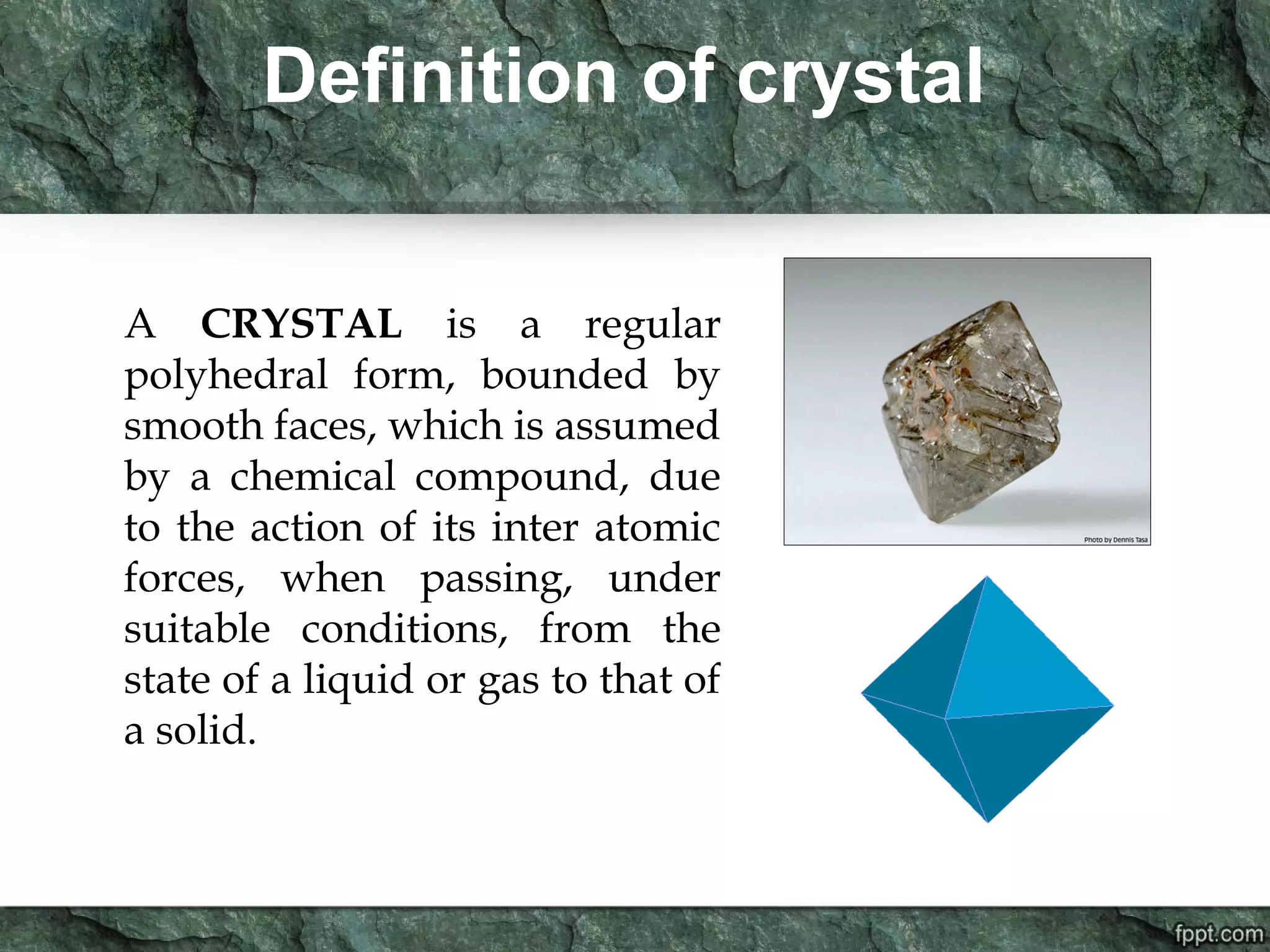
A CRYSTAL is a regular
polyhedral form, bounded by
smooth faces, which is assumed
by a chemical compound, due
to the action of its inter atomic
forces, when passing, under
suitable conditions, from the
state of a liquid or gas to that of
a solid.
Crystalline and Amorphous
• (In Greek amorphous means “formless”) do not have
overall regular internal structure; their constituent
particles are arranged randomly; hence, they are
isotropic, have no symmetry, and cannot be bounded by
faces.
• Particles are arranged in them in the same way as in
liquids; hence, they are sometimes referred to as super
cooled liquids.
• Examples of amorphous substances are glass, plastics.
• In distinction to crystalline substances, amorphous ones
have no clearly defined melting point.
Cont…
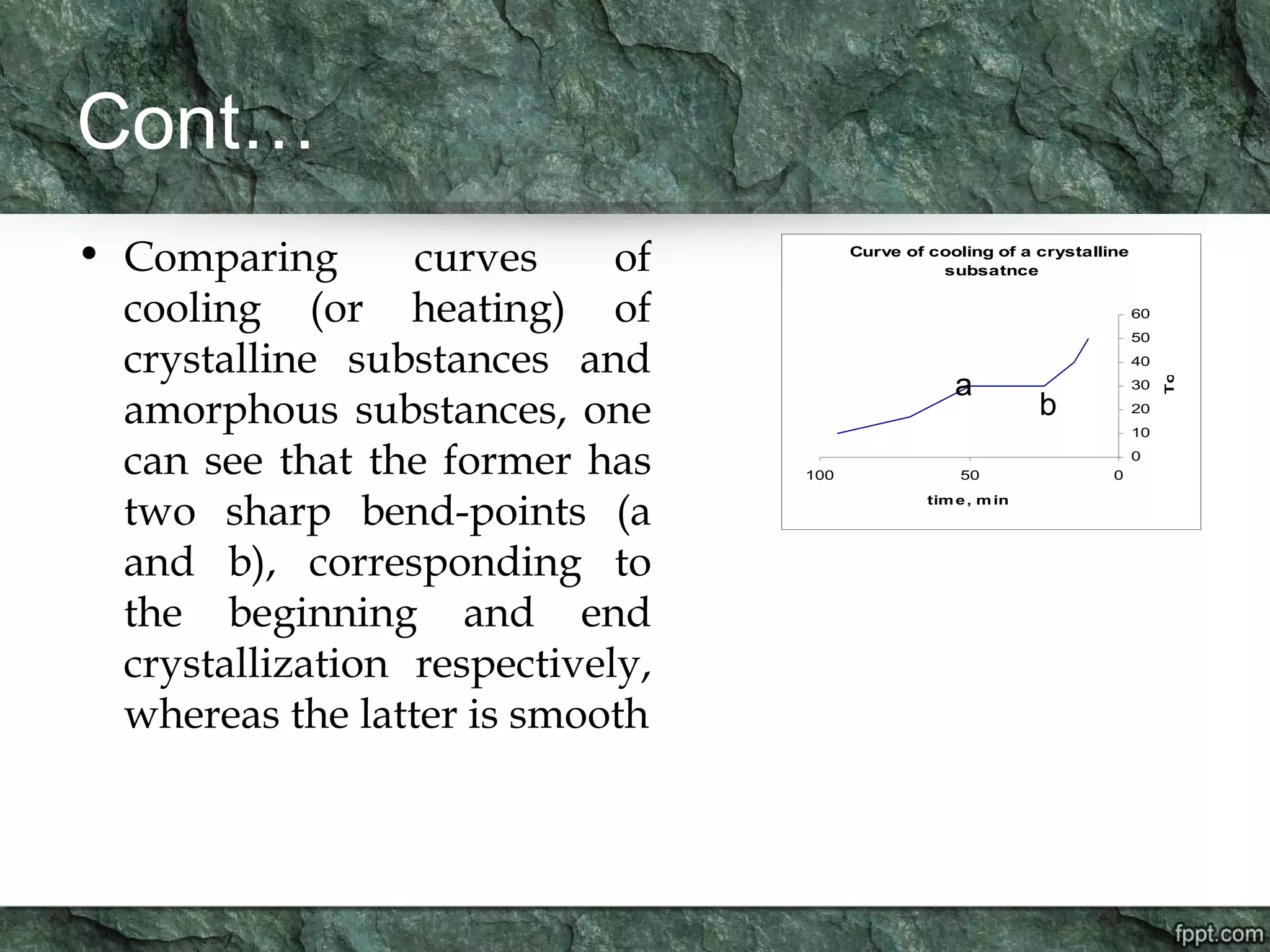
• Comparing curves of
cooling (or heating) of
crystalline substances and
amorphous substances, one
can see that the former has
two sharp bend-points (a
and b), corresponding to
the beginning and end
crystallization respectively,
whereas the latter is smooth
Curve of cooling of a crystalline
subsatnce
0
10
20
30
40
50
60
050100
time, min
To
a
b
Symmetry
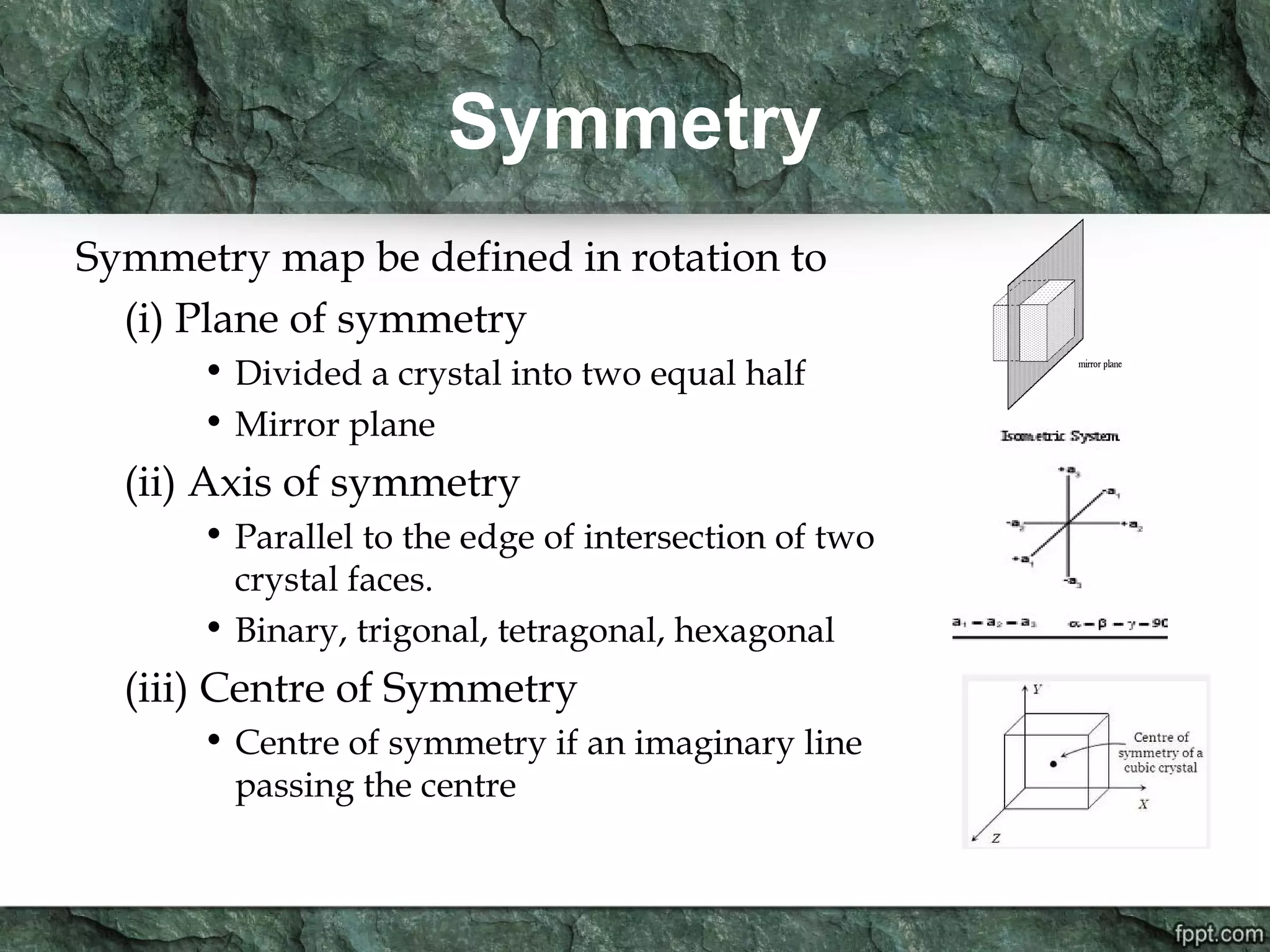
Symmetry map be defined in rotation to
(i) Plane of symmetry
• Divided a crystal into two equal half
• Mirror plane
(ii) Axis of symmetry
• Parallel to the edge of intersection of two
crystal faces.
• Binary, trigonal, tetragonal, hexagonal
(iii) Centre of Symmetry
• Centre of symmetry if an imaginary line
passing the centre
Classification of crystals
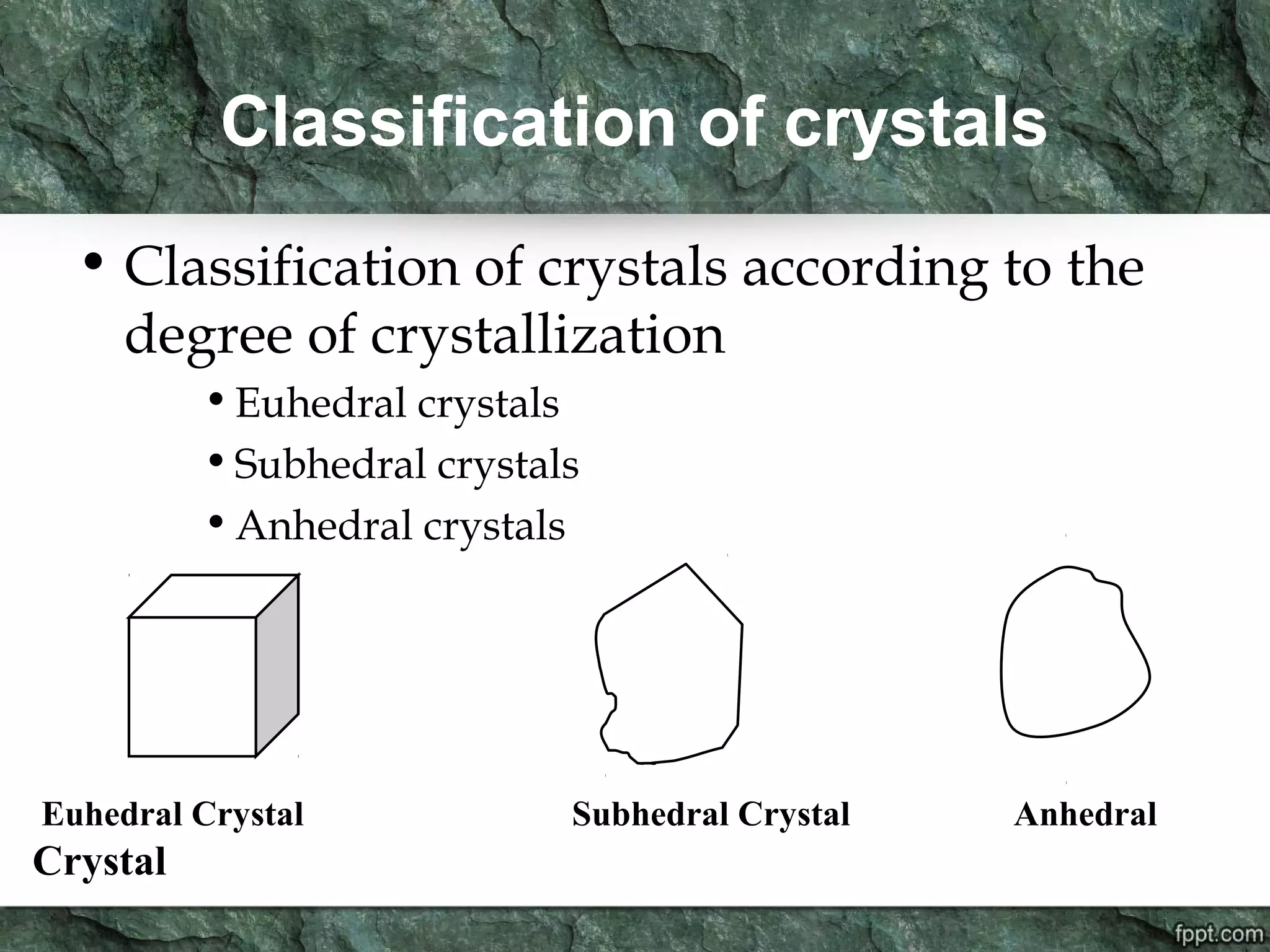
• Classification of crystals according to the
degree of crystallization
•Euhedral crystals
•Subhedral crystals
•Anhedral crystals
Euhedral Crystal Subhedral Crystal Anhedral
Crystal
Crystallographic forms
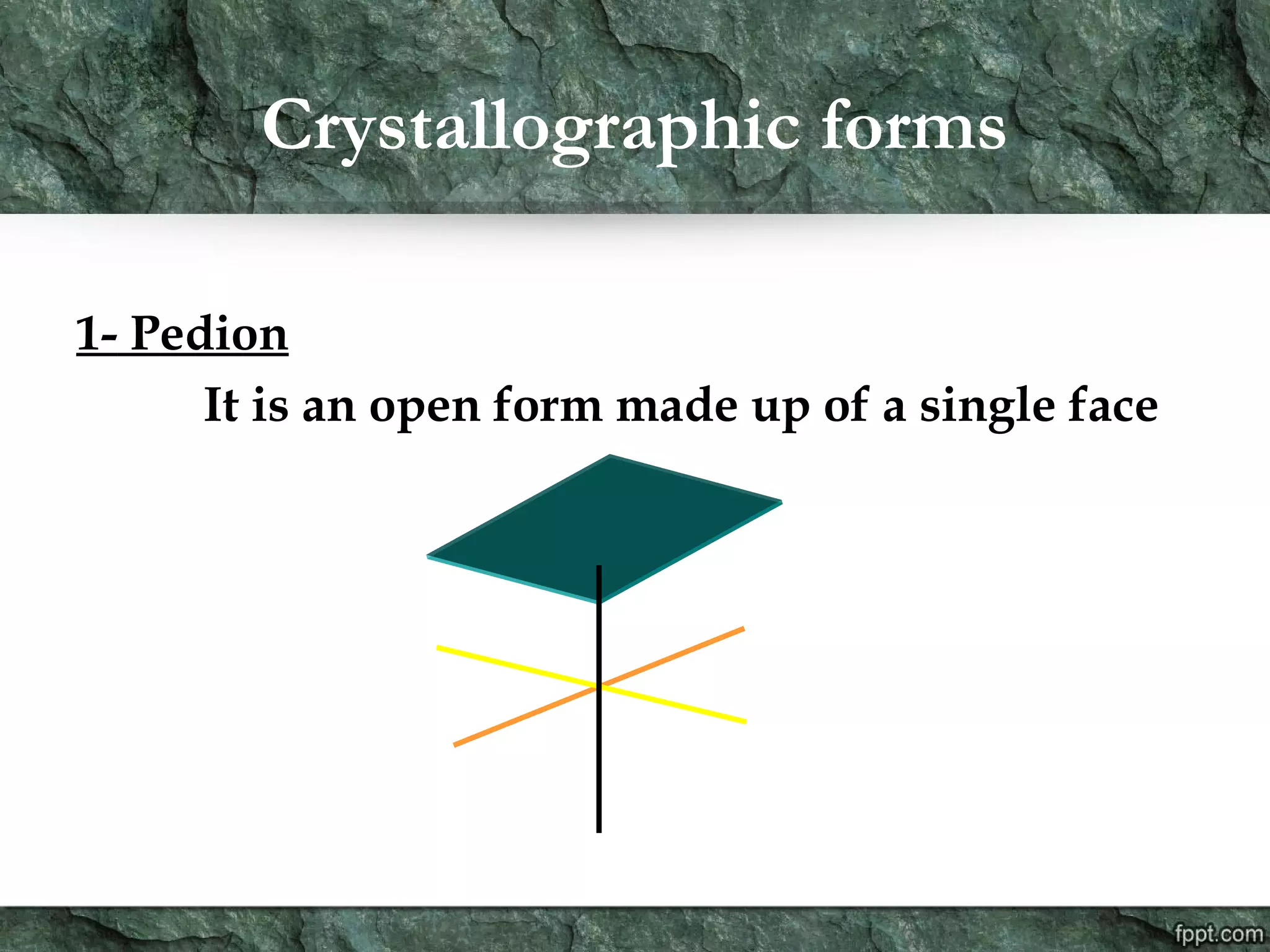
1- Pedion
It is an open form made up of a single face
Cont…
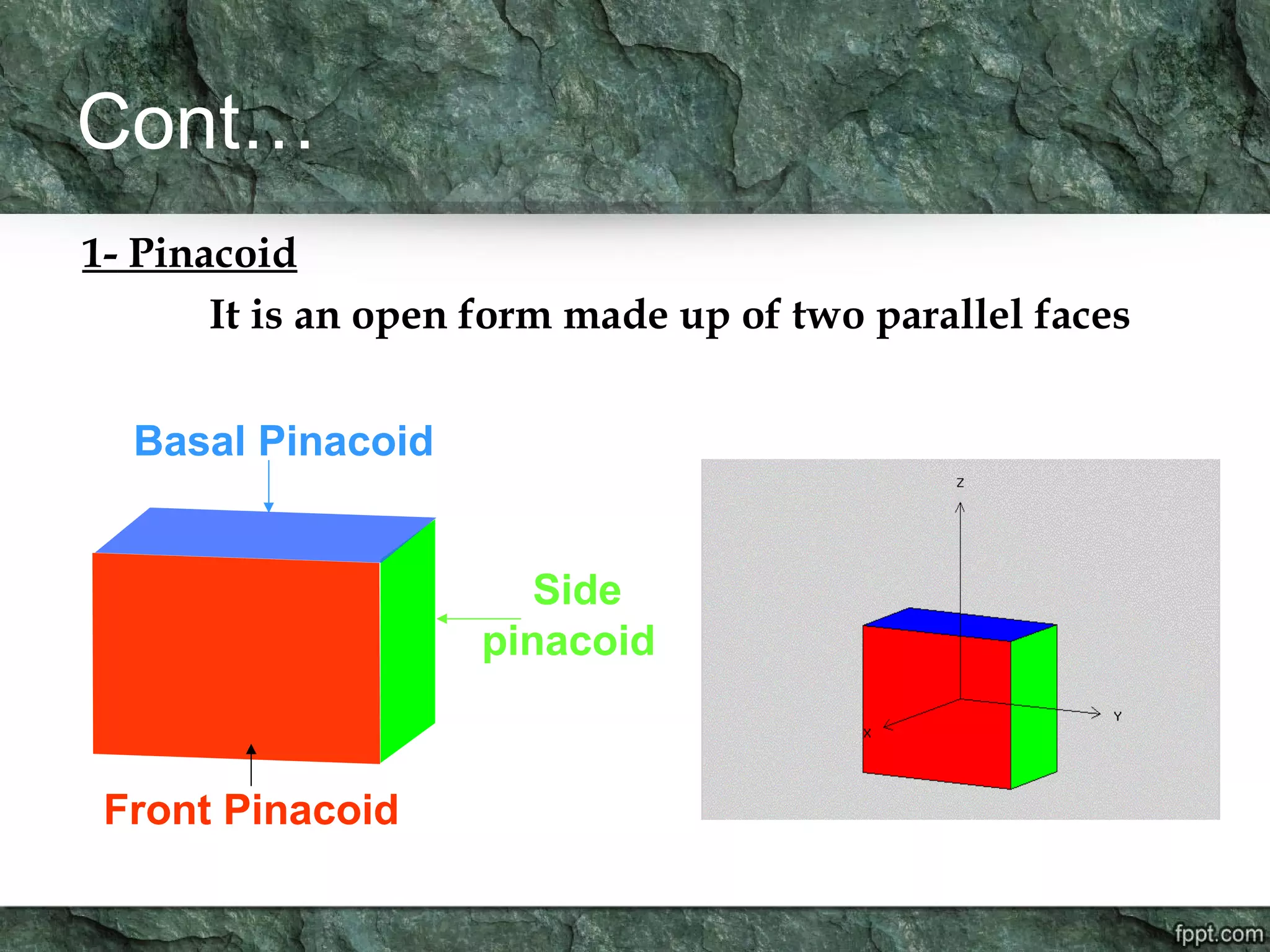
1- Pinacoid
It is an open form made up of two parallel faces
Basal Pinacoid
Side
pinacoid
Front Pinacoid
Cont…
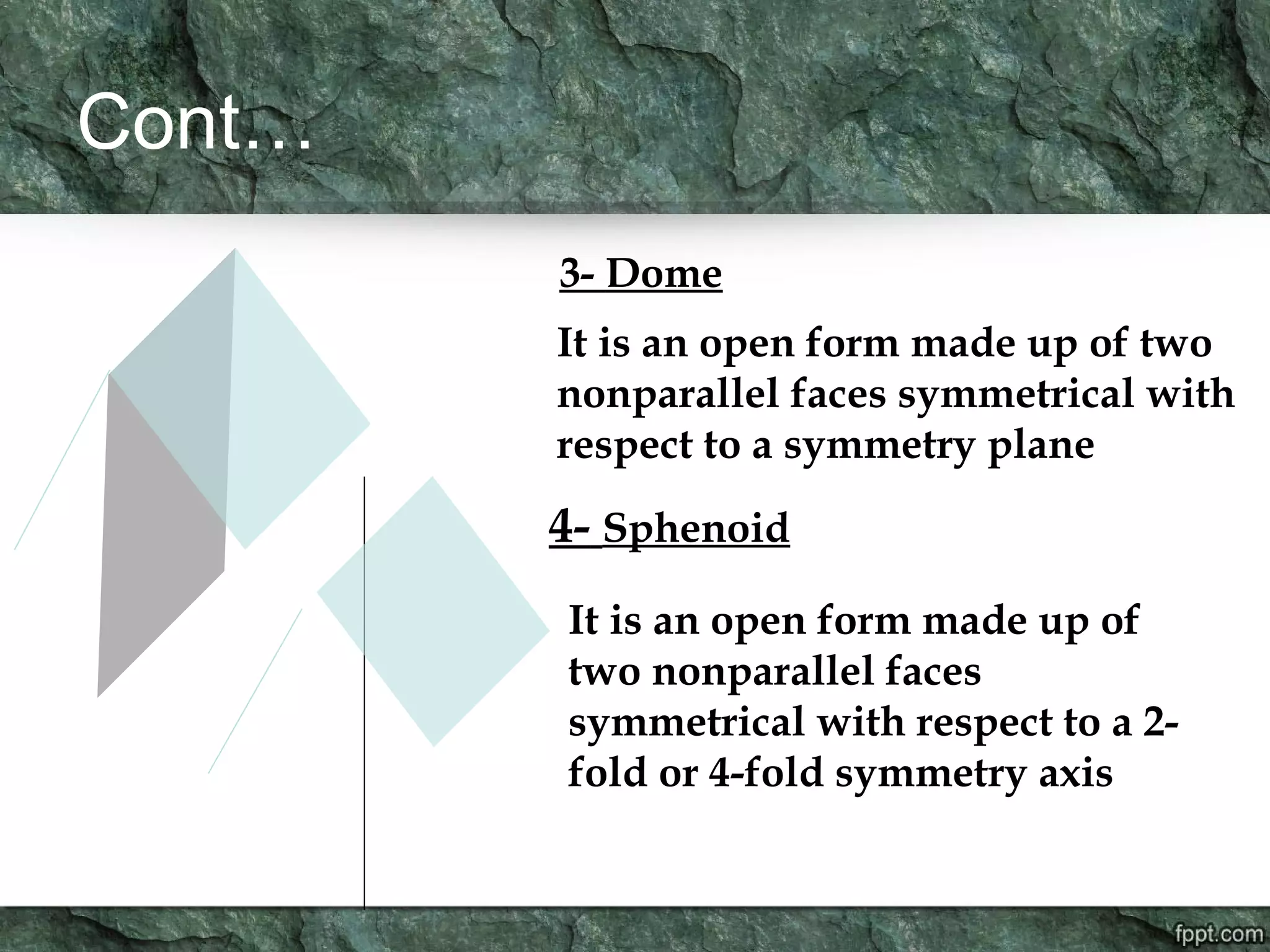
3- Dome
It is an open form made up of two
nonparallel faces symmetrical with
respect to a symmetry plane
4- Sphenoid
It is an open form made up of
two nonparallel faces
symmetrical with respect to a 2-
fold or 4-fold symmetry axis
Cont…
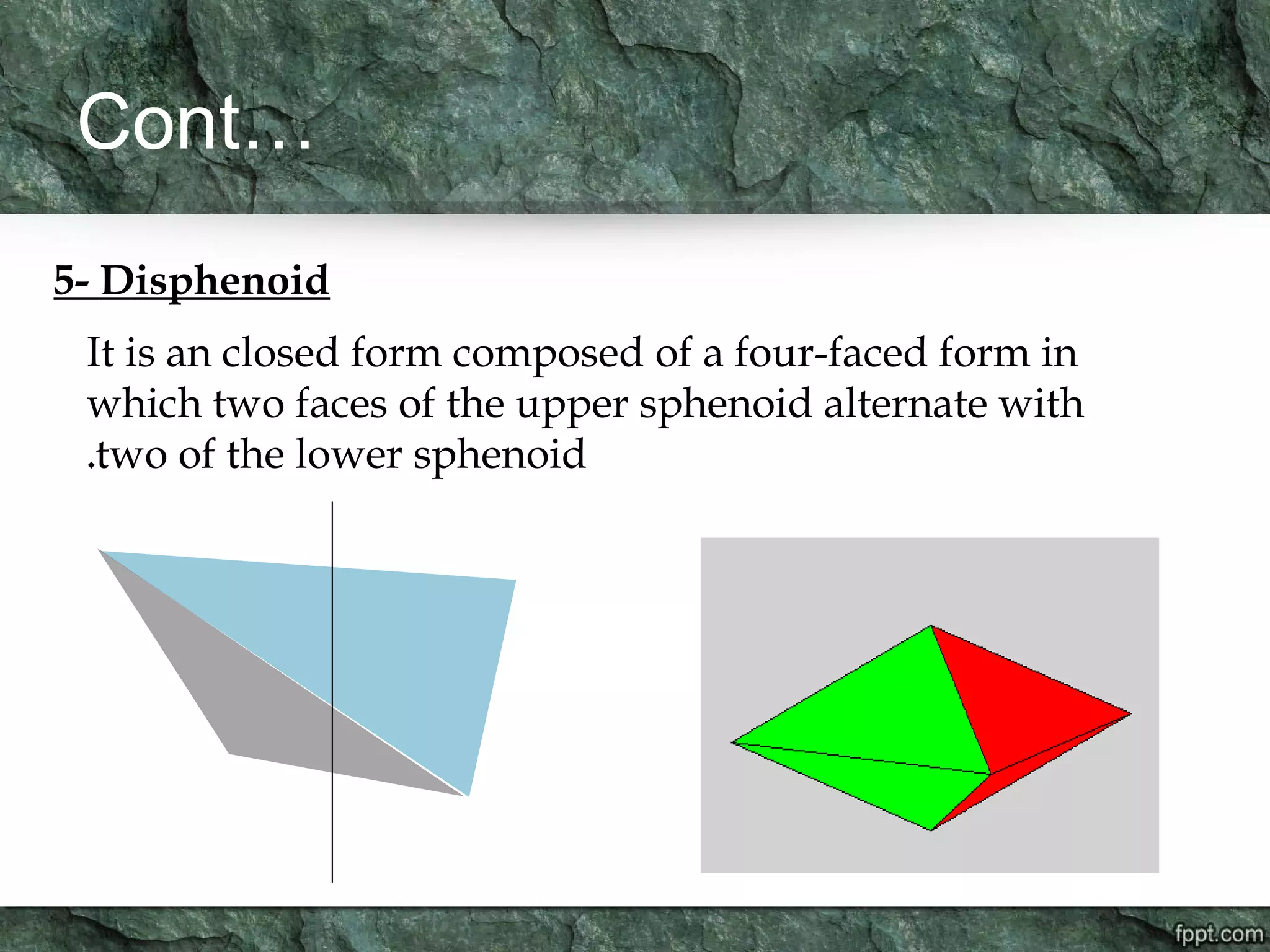
5- Disphenoid
It is an closed form composed of a four-faced form in
which two faces of the upper sphenoid alternate with
two of the lower sphenoid.
Cont…
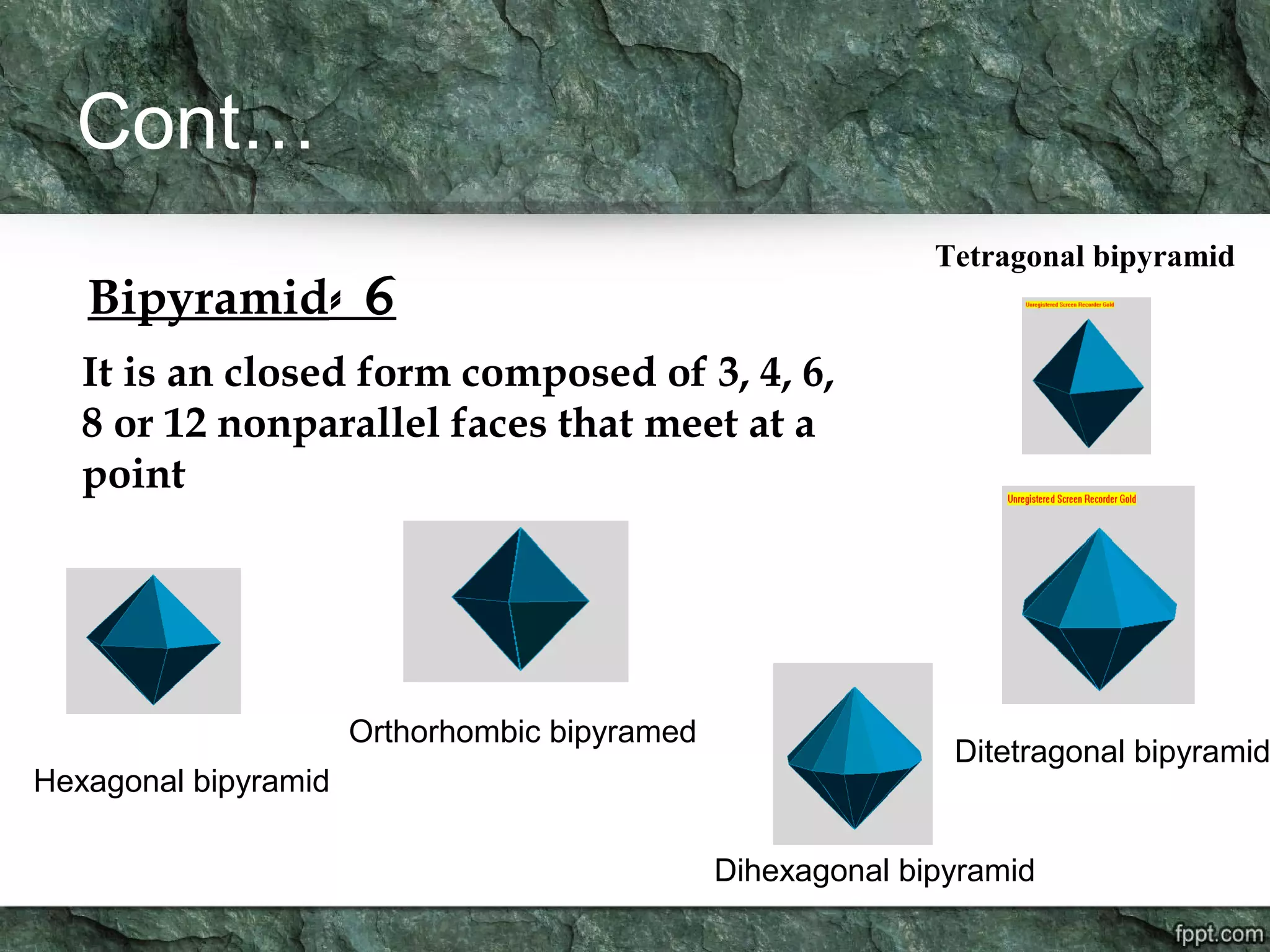
6-Bipyramid
It is an closed form composed of 3, 4, 6,
8 or 12 nonparallel faces that meet at a
point
Orthorhombic bipyramed
Ditetragonal bipyramid
Tetragonal bipyramid
Dihexagonal bipyramid
Hexagonal bipyramid
Cont…
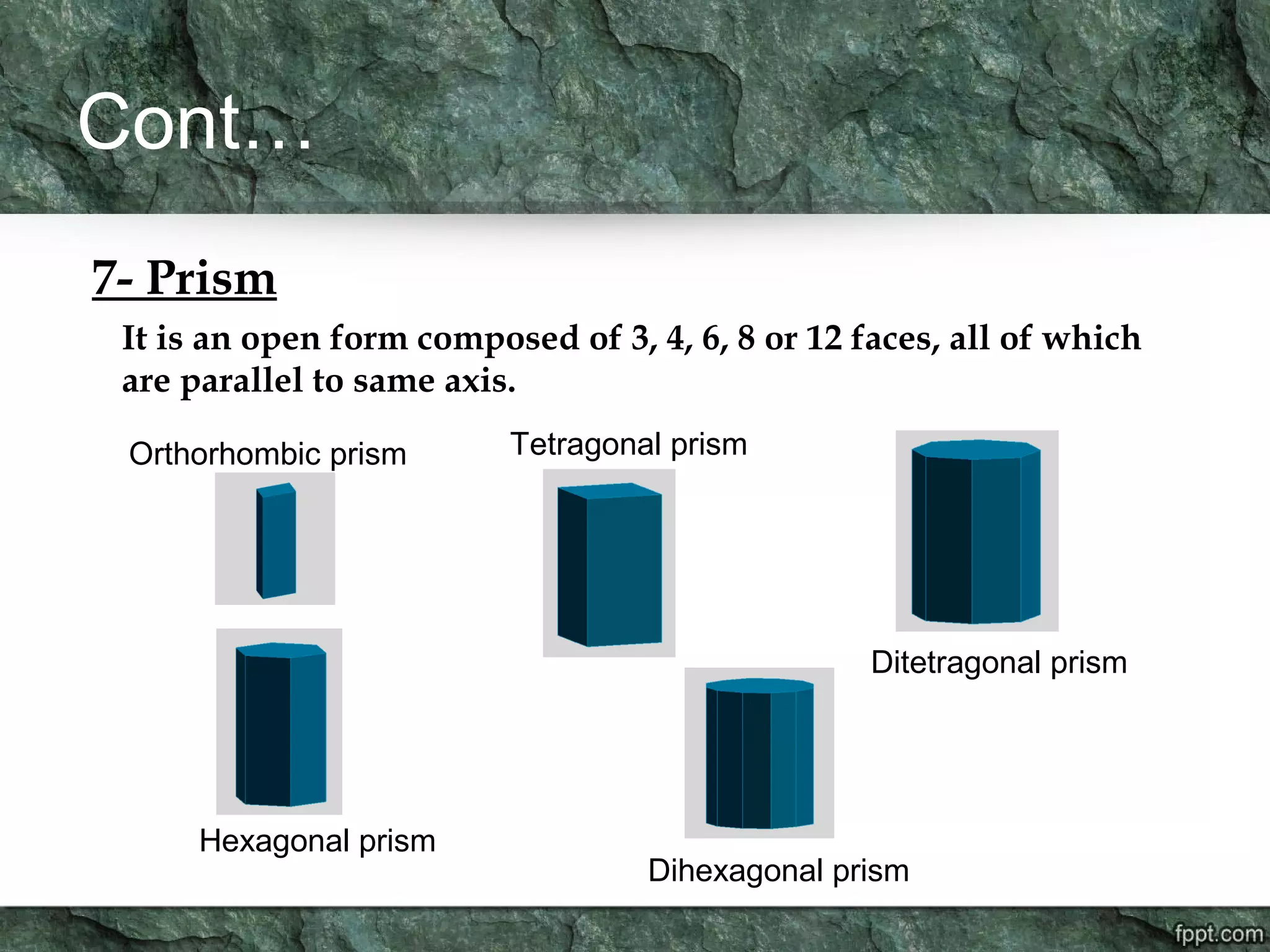
7- Prism
It is an open form composed of 3, 4, 6, 8 or 12 faces, all of which
are parallel to same axis.
Orthorhombic prism Tetragonal prism
Ditetragonal prism
Hexagonal prism
Dihexagonal prism
Cont…
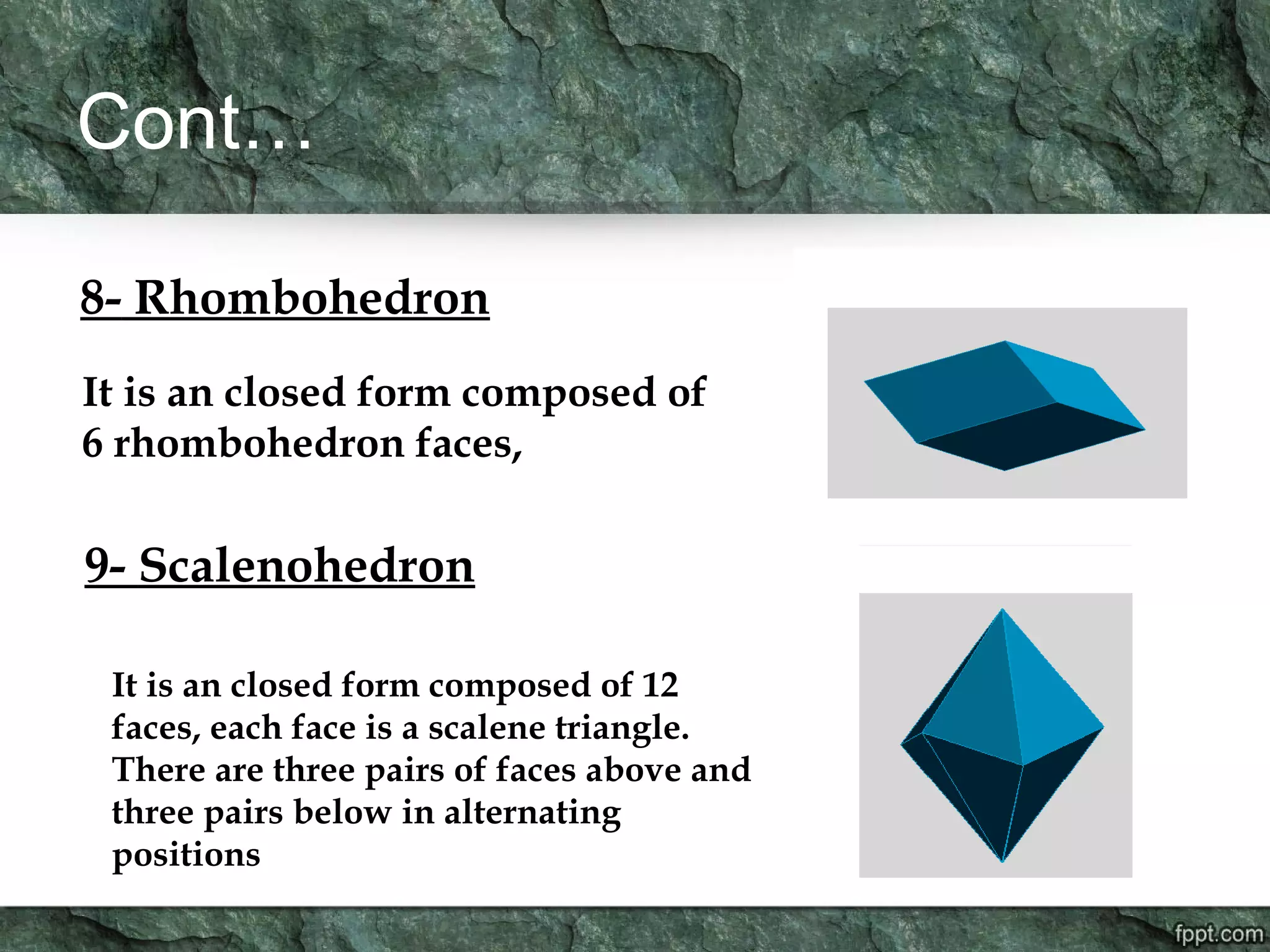
8- Rhombohedron
It is an closed form composed of
6 rhombohedron faces,
9- Scalenohedron
It is an closed form composed of 12
faces, each face is a scalene triangle.
There are three pairs of faces above and
three pairs below in alternating
positions
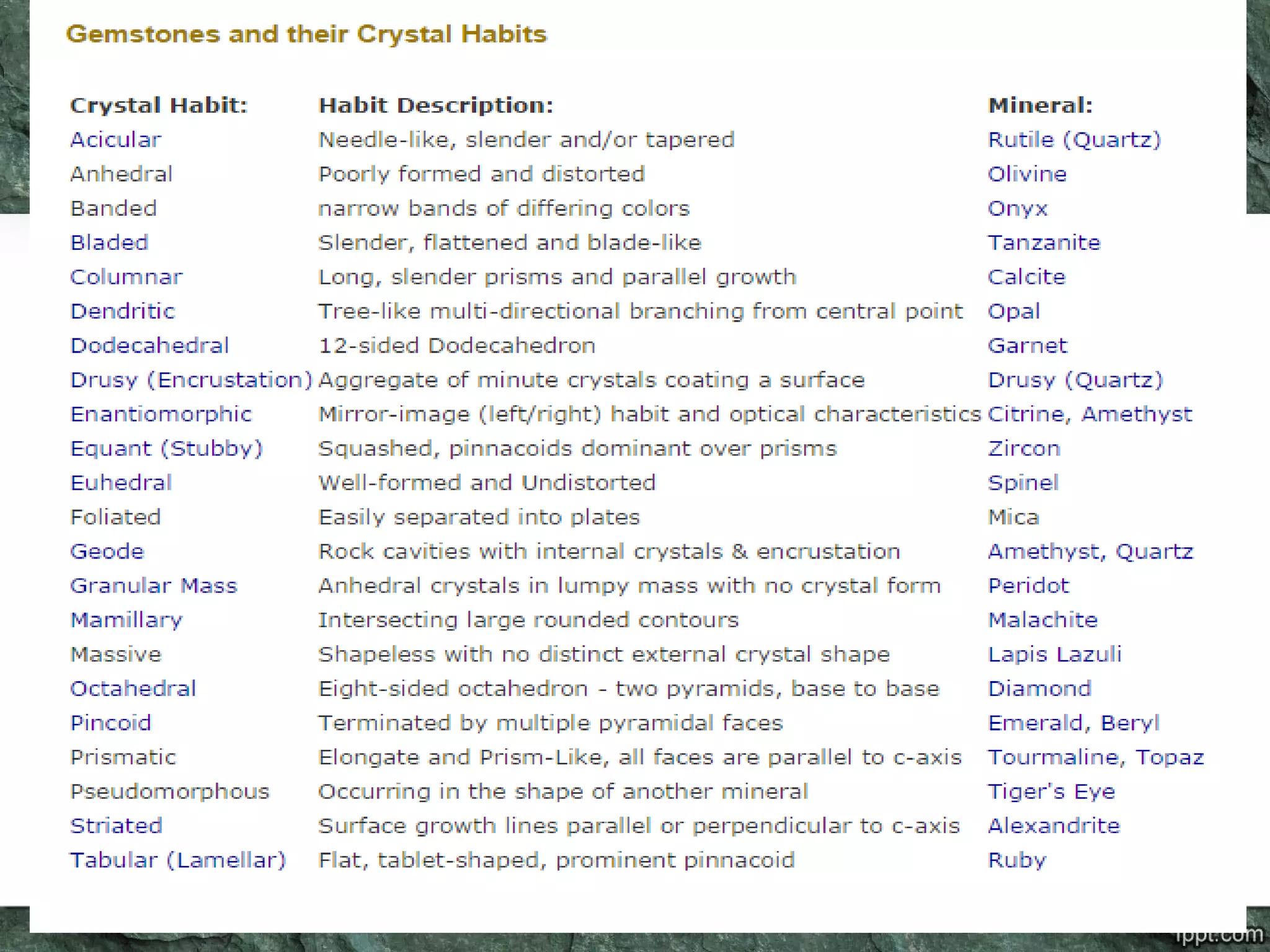
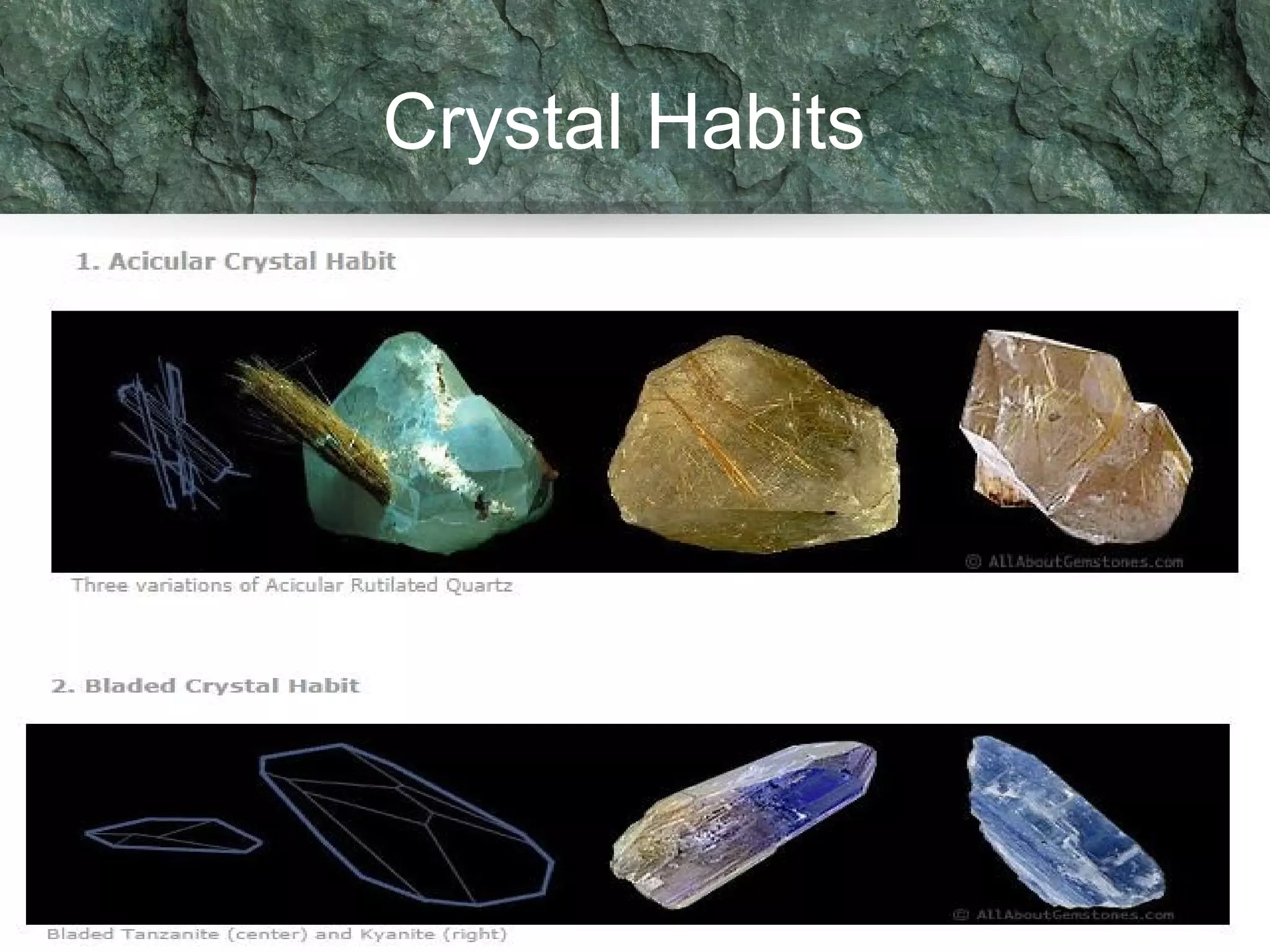
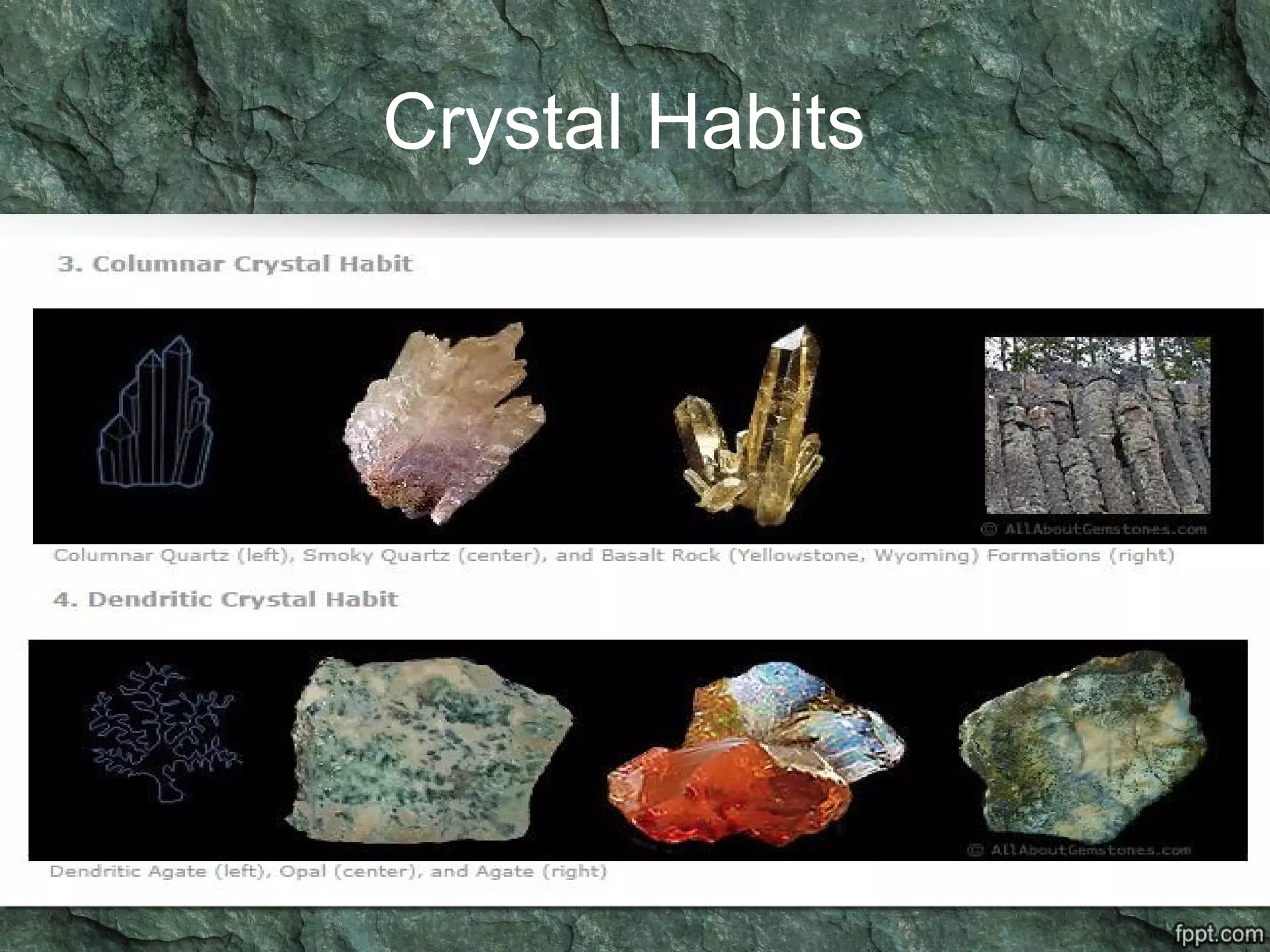
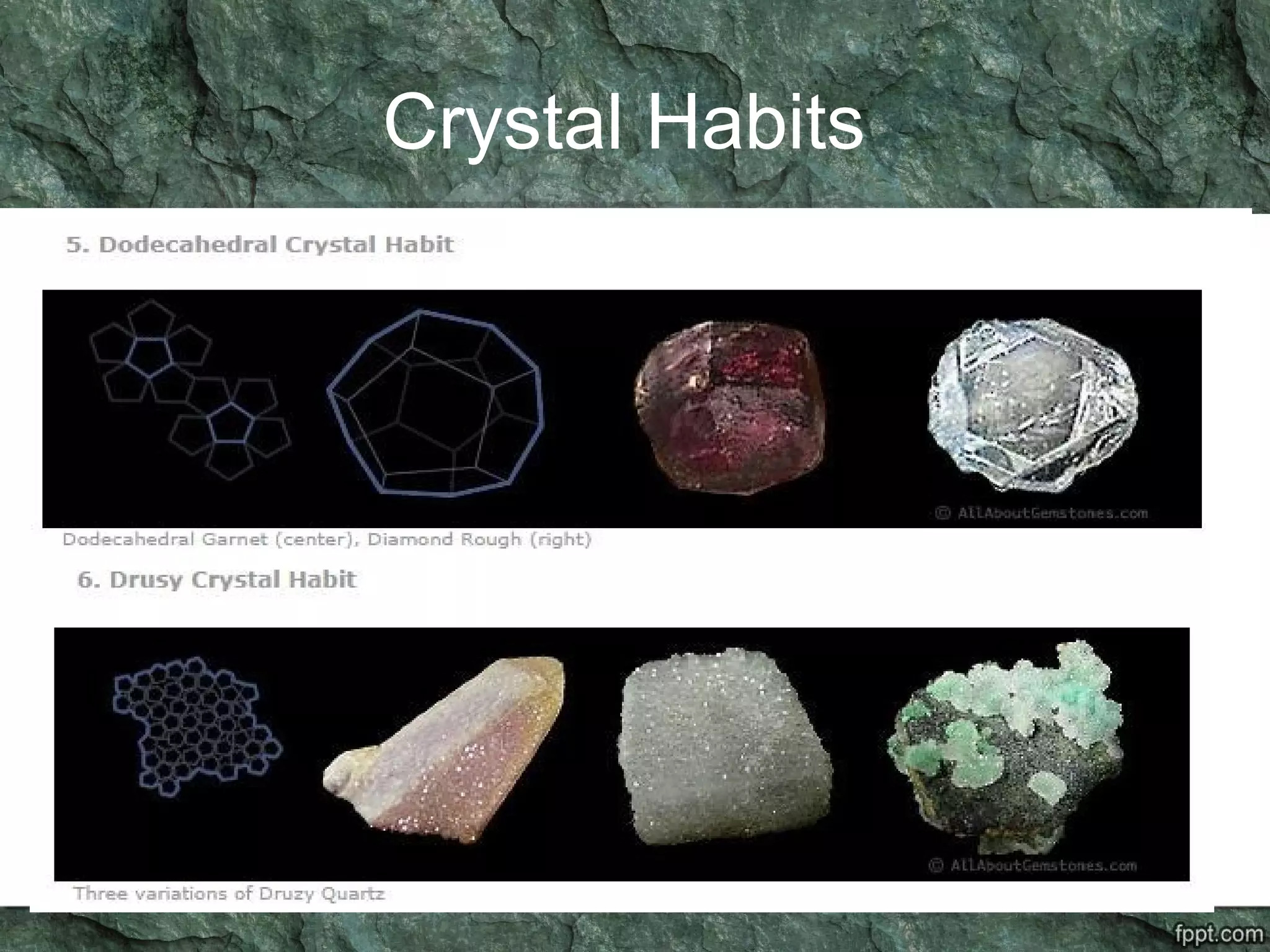
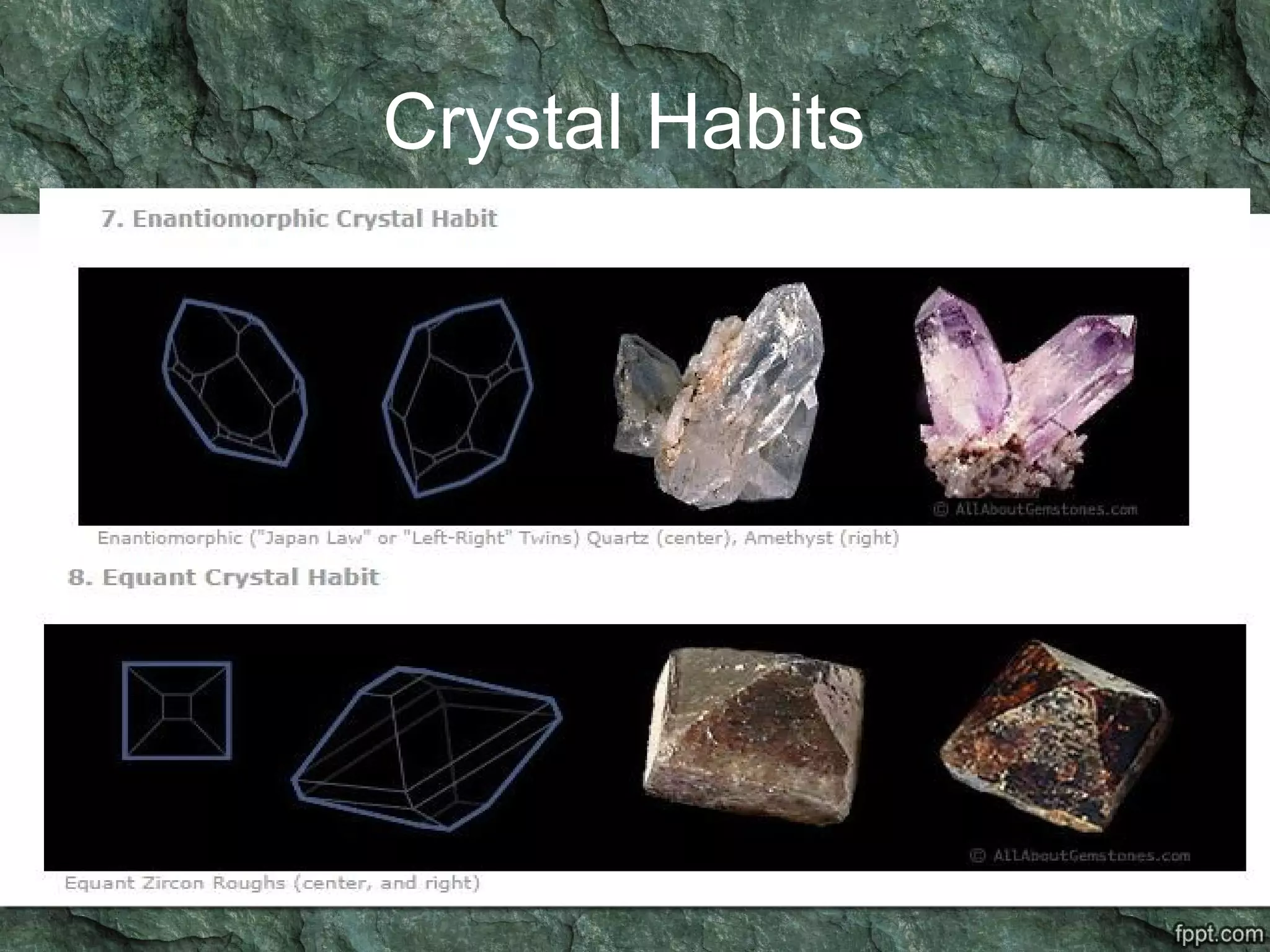
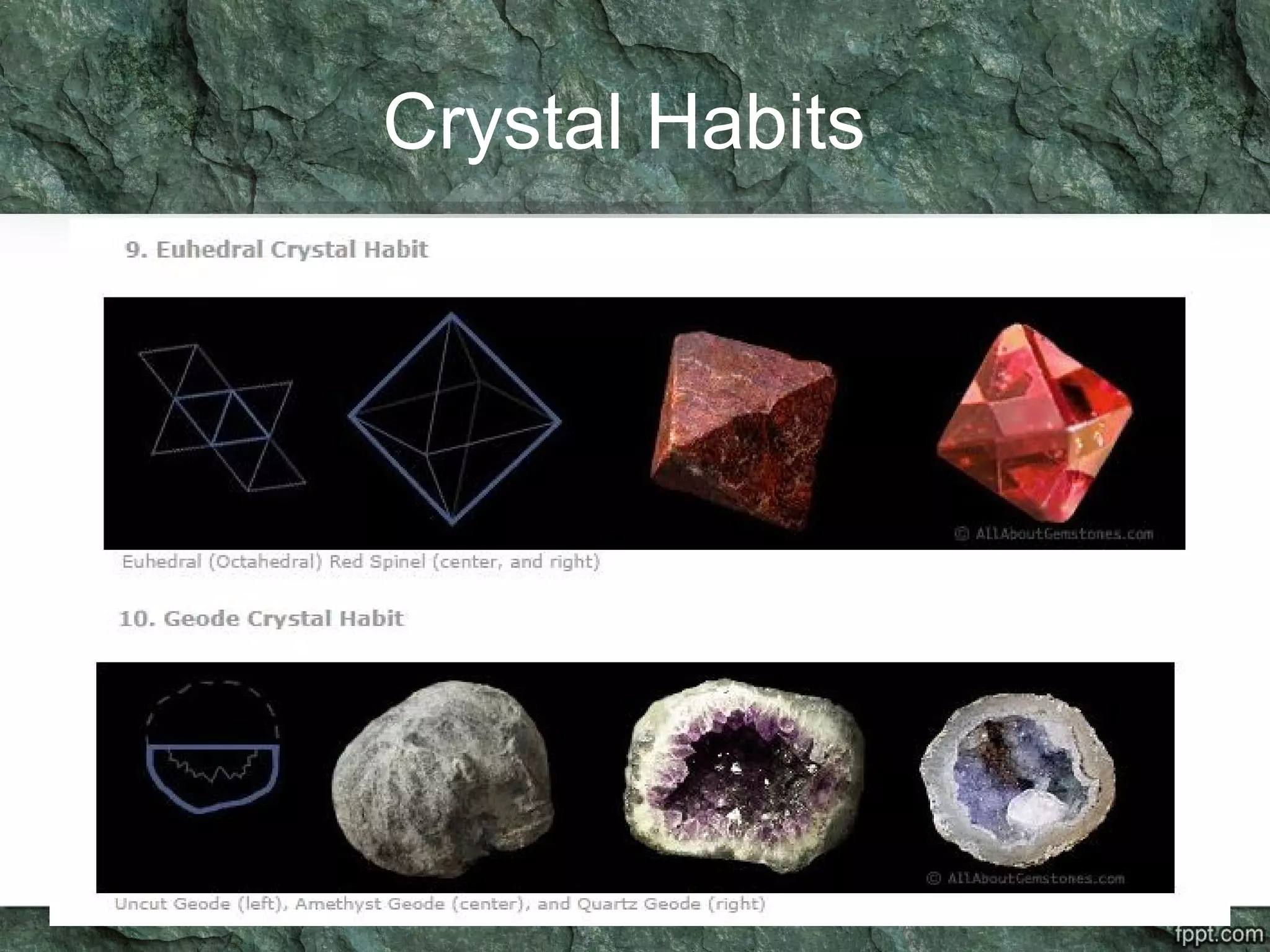
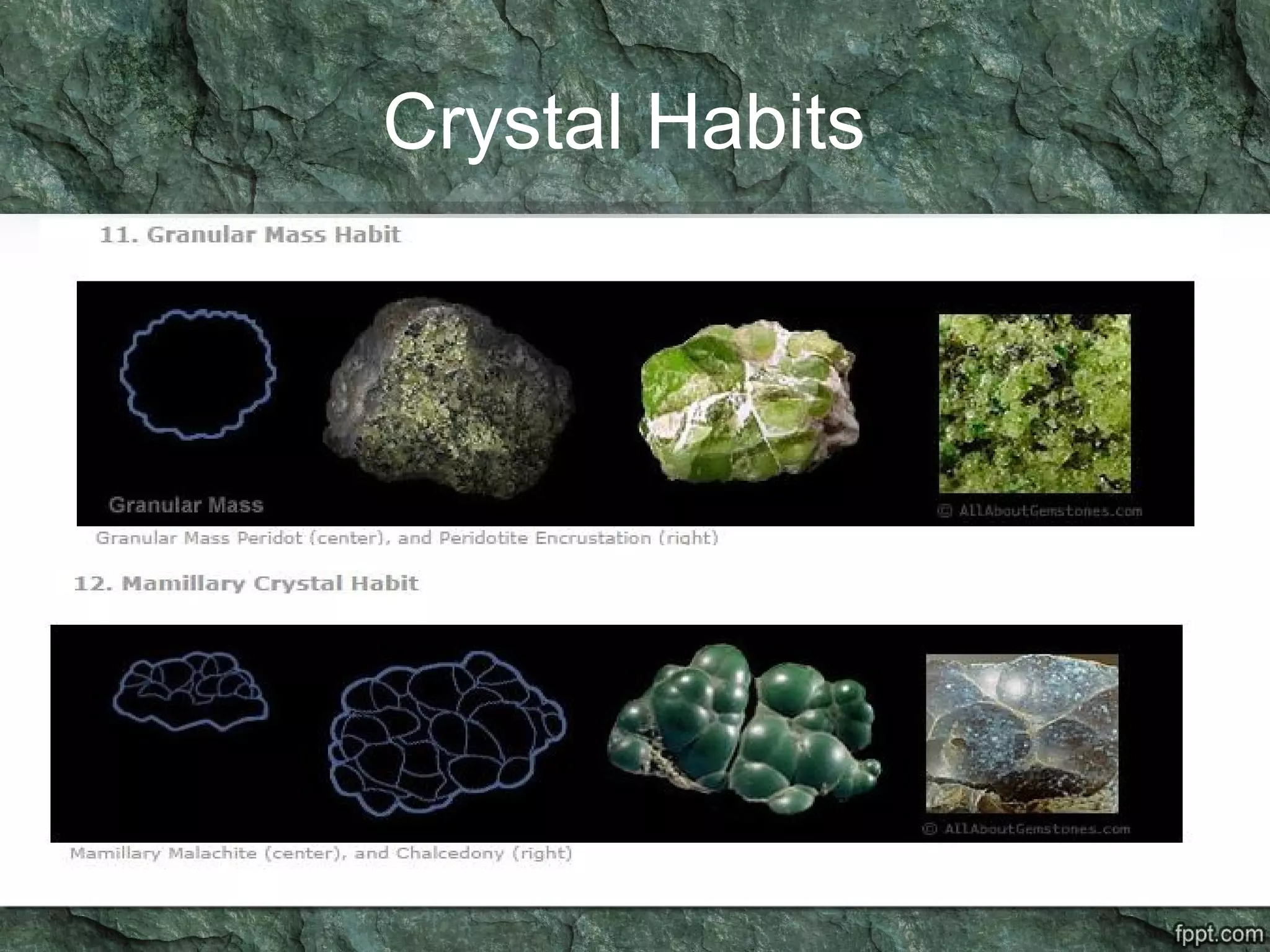
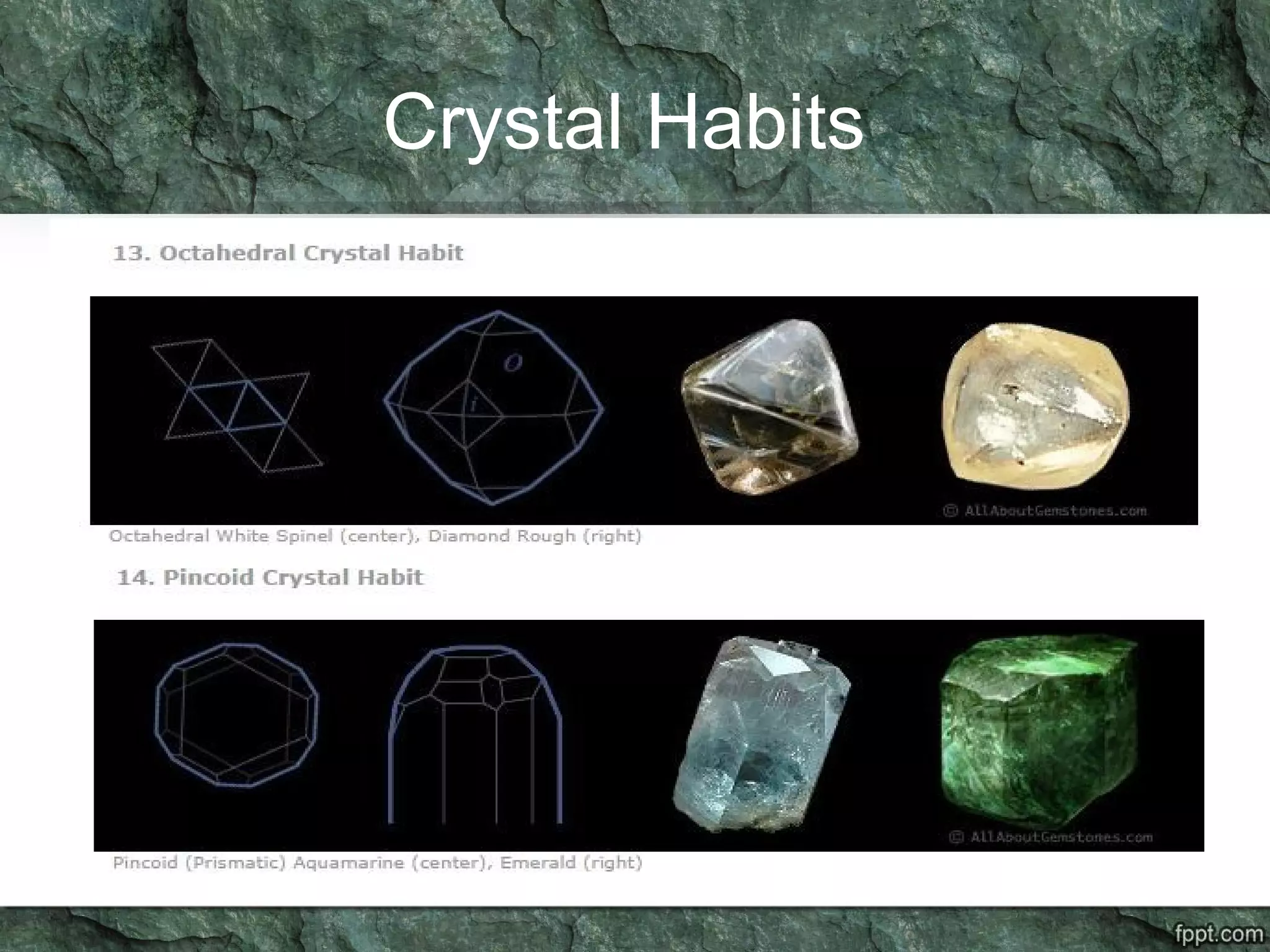
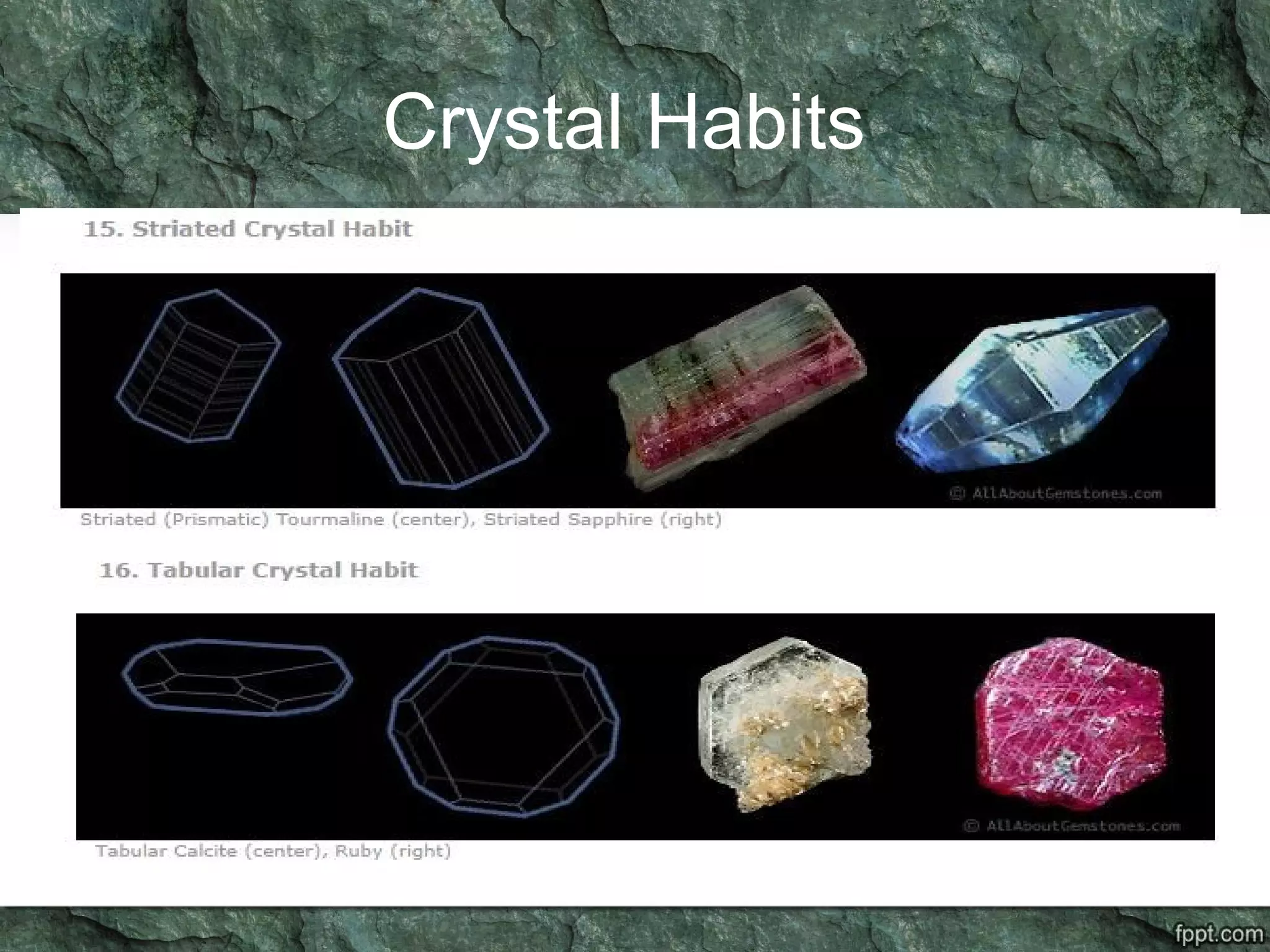
Crystal Habits
The term "crystal habit" is used to categorize
the appearance, shape, and size of a crystal, and
identify its unique growth characteristics that
result from its crystalline structure and growth
environment.
1. Crystal Twinning ( two individual crystals share some of
the same crystal lattice points)
2. Growth Conditions (heat, pressure, and space)
3. Trace Impurities (present during crystal formation)
 
Crystal Habits
Crystal Habits
Crystal Habits
Crystal Habits
Crystal Habits
Crystal Habits
Crystal Habits
Crystal Habits

Introduction to Crystallography

  • 1.
    Crystallography and Mineralogy Dr.B.GURUGNANAM Professorand Head Centre for Applied Geology GRI-DU Mr.K.KALAIVANAN Research Scholar Centre for Applied Geology GRI-DU.
  • 2.
    Introduction to Crystallography Whatis crystallography? CRYSTALLOGRAPHY is simply a fancy word meaning "the study of crystals“ •The study of crystalline solids and the principles that govern their growth, external shape, and internal structure •Crystallography is easily divided into 3 sections - geometrical, physical, and chemical.
  • 3.
    Definition of crystal ACRYSTAL is a regular polyhedral form, bounded by smooth faces, which is assumed by a chemical compound, due to the action of its inter atomic forces, when passing, under suitable conditions, from the state of a liquid or gas to that of a solid.
  • 4.
    Crystalline and Amorphous •(In Greek amorphous means “formless”) do not have overall regular internal structure; their constituent particles are arranged randomly; hence, they are isotropic, have no symmetry, and cannot be bounded by faces. • Particles are arranged in them in the same way as in liquids; hence, they are sometimes referred to as super cooled liquids. • Examples of amorphous substances are glass, plastics. • In distinction to crystalline substances, amorphous ones have no clearly defined melting point.
  • 5.
    Cont… • Comparing curvesof cooling (or heating) of crystalline substances and amorphous substances, one can see that the former has two sharp bend-points (a and b), corresponding to the beginning and end crystallization respectively, whereas the latter is smooth Curve of cooling of a crystalline subsatnce 0 10 20 30 40 50 60 050100 time, min To a b
  • 6.
    Symmetry Symmetry map bedefined in rotation to (i) Plane of symmetry • Divided a crystal into two equal half • Mirror plane (ii) Axis of symmetry • Parallel to the edge of intersection of two crystal faces. • Binary, trigonal, tetragonal, hexagonal (iii) Centre of Symmetry • Centre of symmetry if an imaginary line passing the centre
  • 7.
    Classification of crystals •Classification of crystals according to the degree of crystallization •Euhedral crystals •Subhedral crystals •Anhedral crystals Euhedral Crystal Subhedral Crystal Anhedral Crystal
  • 8.
    Crystallographic forms 1- Pedion Itis an open form made up of a single face
  • 9.
    Cont… 1- Pinacoid It isan open form made up of two parallel faces Basal Pinacoid Side pinacoid Front Pinacoid
  • 10.
    Cont… 3- Dome It isan open form made up of two nonparallel faces symmetrical with respect to a symmetry plane 4- Sphenoid It is an open form made up of two nonparallel faces symmetrical with respect to a 2- fold or 4-fold symmetry axis
  • 11.
    Cont… 5- Disphenoid It isan closed form composed of a four-faced form in which two faces of the upper sphenoid alternate with two of the lower sphenoid.
  • 12.
    Cont… 6-Bipyramid It is anclosed form composed of 3, 4, 6, 8 or 12 nonparallel faces that meet at a point Orthorhombic bipyramed Ditetragonal bipyramid Tetragonal bipyramid Dihexagonal bipyramid Hexagonal bipyramid
  • 13.
    Cont… 7- Prism It isan open form composed of 3, 4, 6, 8 or 12 faces, all of which are parallel to same axis. Orthorhombic prism Tetragonal prism Ditetragonal prism Hexagonal prism Dihexagonal prism
  • 14.
    Cont… 8- Rhombohedron It isan closed form composed of 6 rhombohedron faces, 9- Scalenohedron It is an closed form composed of 12 faces, each face is a scalene triangle. There are three pairs of faces above and three pairs below in alternating positions
  • 15.
    Crystal Habits The term"crystal habit" is used to categorize the appearance, shape, and size of a crystal, and identify its unique growth characteristics that result from its crystalline structure and growth environment. 1. Crystal Twinning ( two individual crystals share some of the same crystal lattice points) 2. Growth Conditions (heat, pressure, and space) 3. Trace Impurities (present during crystal formation)  
  • 17.
  • 18.
  • 19.
  • 20.
  • 21.
  • 22.
  • 23.
  • 24.