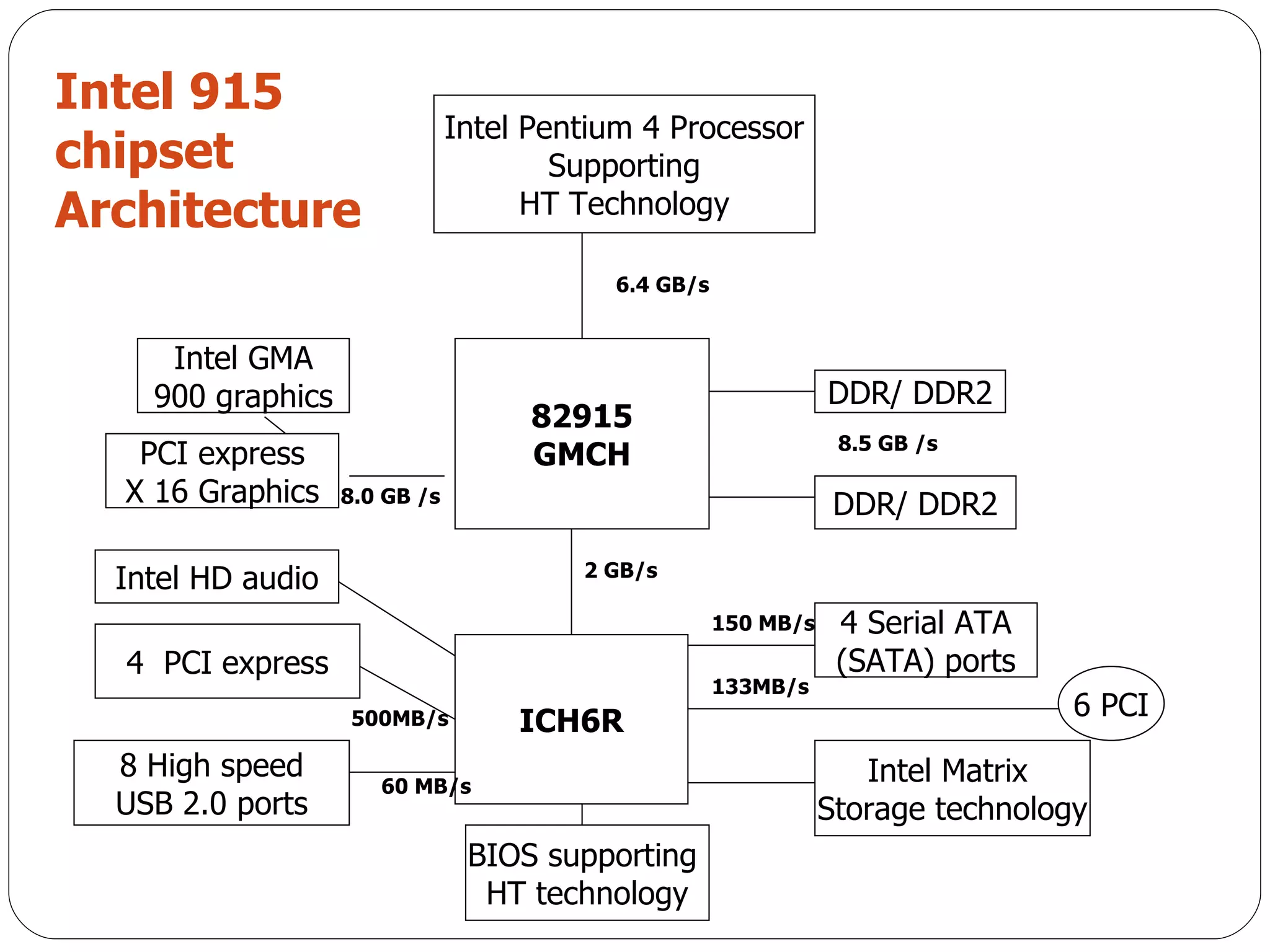
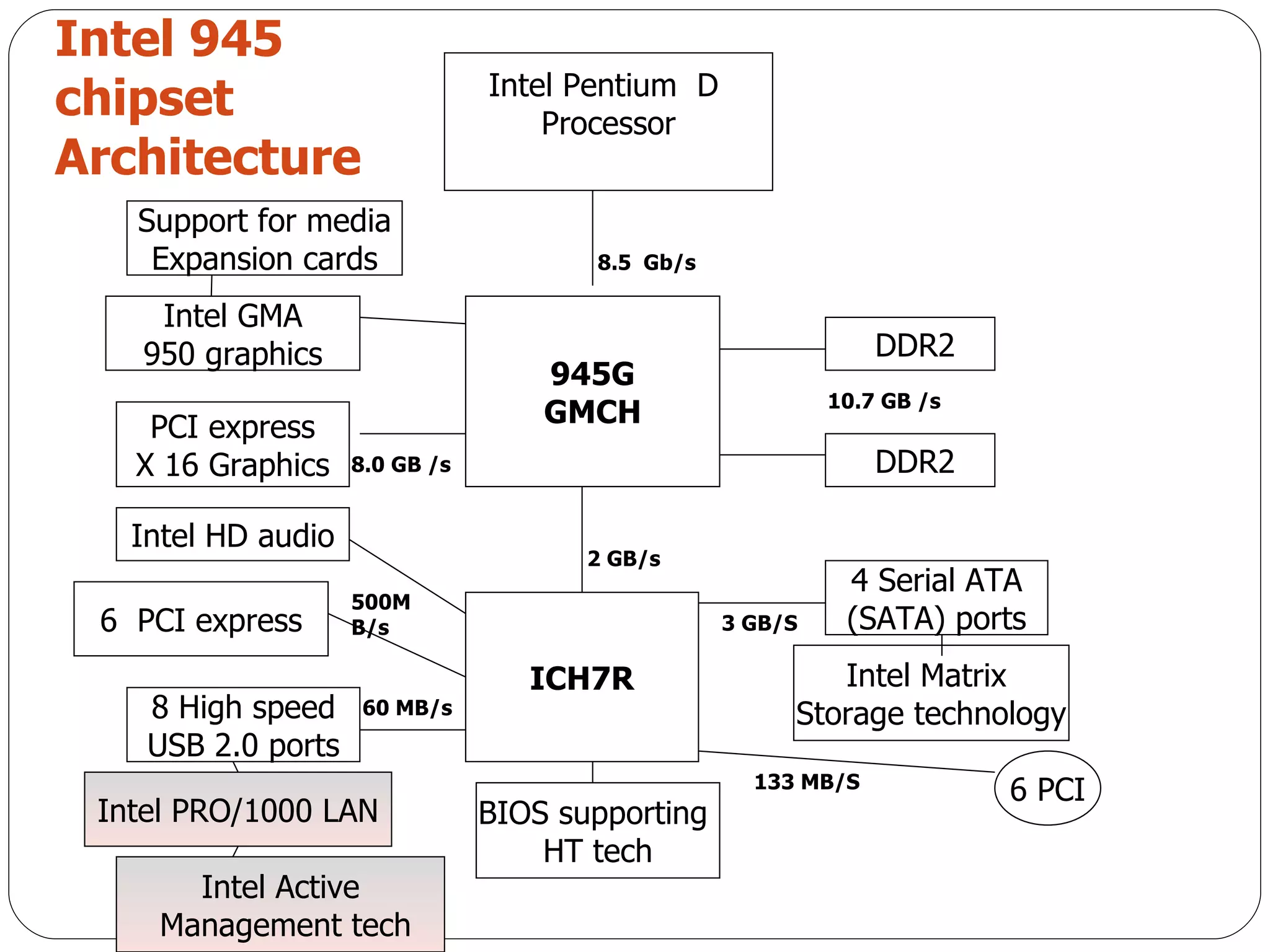
The document discusses chipsets and their components. A chipset consists of controller chips that work together, like interrupt, DMA, timer and clock chips. It specifically refers to the northbridge and southbridge chips. The northbridge links the CPU to fast devices like memory and graphics. It handles communication between these components. The southbridge connects to slower peripheral buses and contains integrated peripherals like Ethernet and audio. It provides functionality like PCI bus support and power management. The document provides examples of chipsets from Intel that pair specific processors with memory and expansion card support.
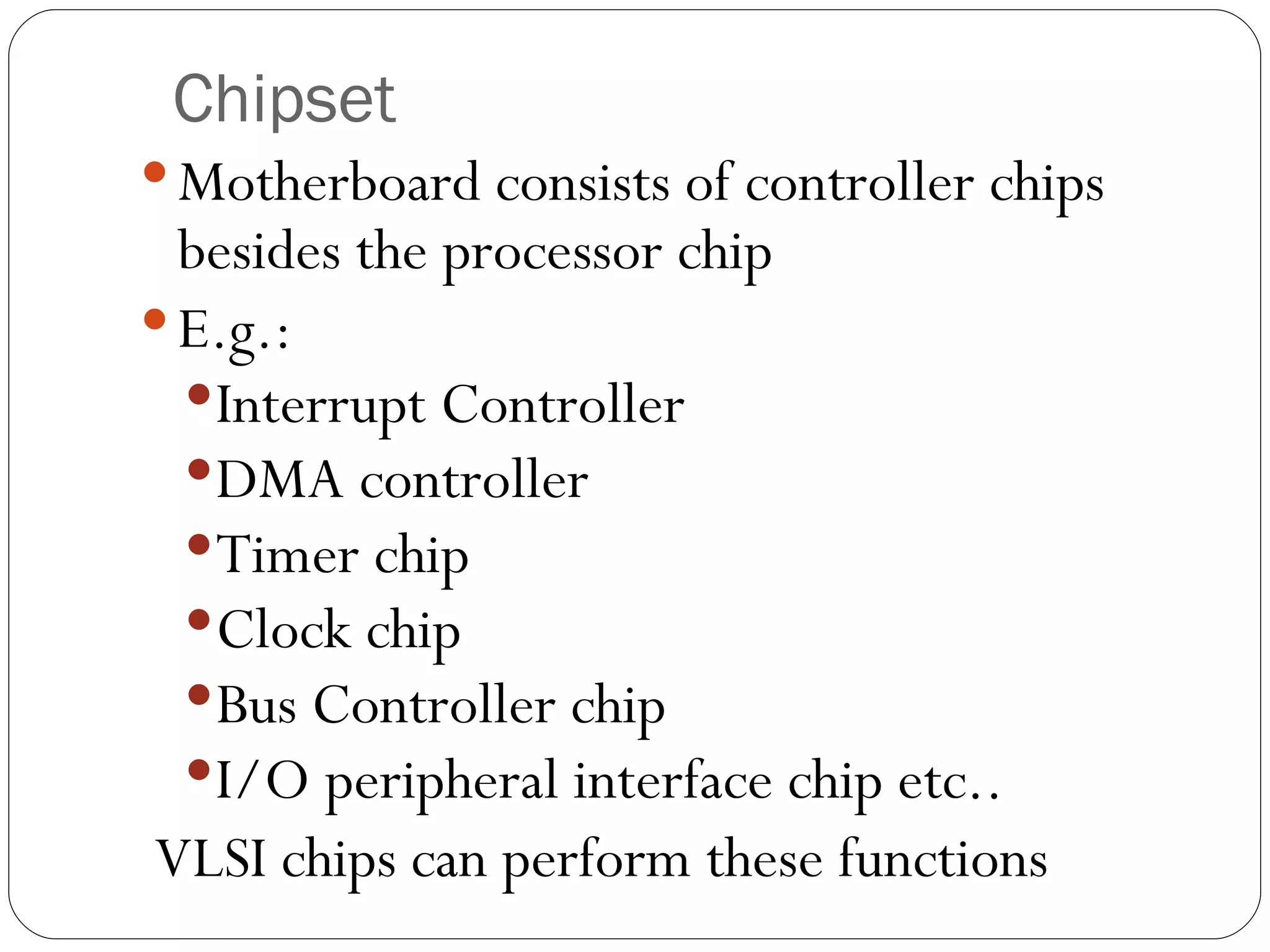
Chipset Motherboard consistsof controller chips besides the processor chip E.g.: Interrupt Controller DMA controller Timer chip Clock chip Bus Controller chip I/O peripheral interface chip etc.. VLSI chips can perform these functions
3.
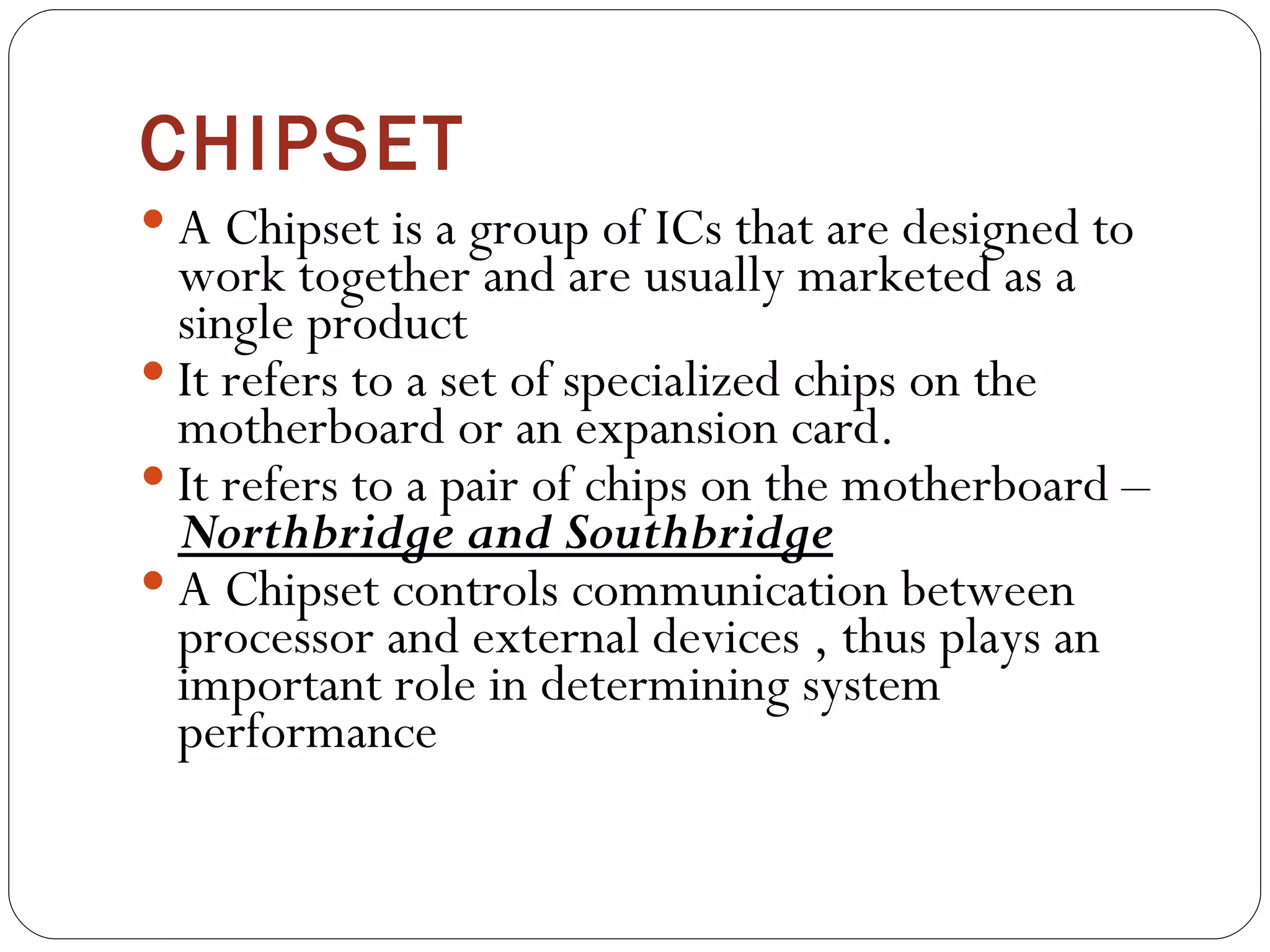
CHIPSET A Chipsetis a group of ICs that are designed to work together and are usually marketed as a single product It refers to a set of specialized chips on the motherboard or an expansion card. It refers to a pair of chips on the motherboard – Northbridge and Southbridge A Chipset controls communication between processor and external devices , thus plays an important role in determining system performance
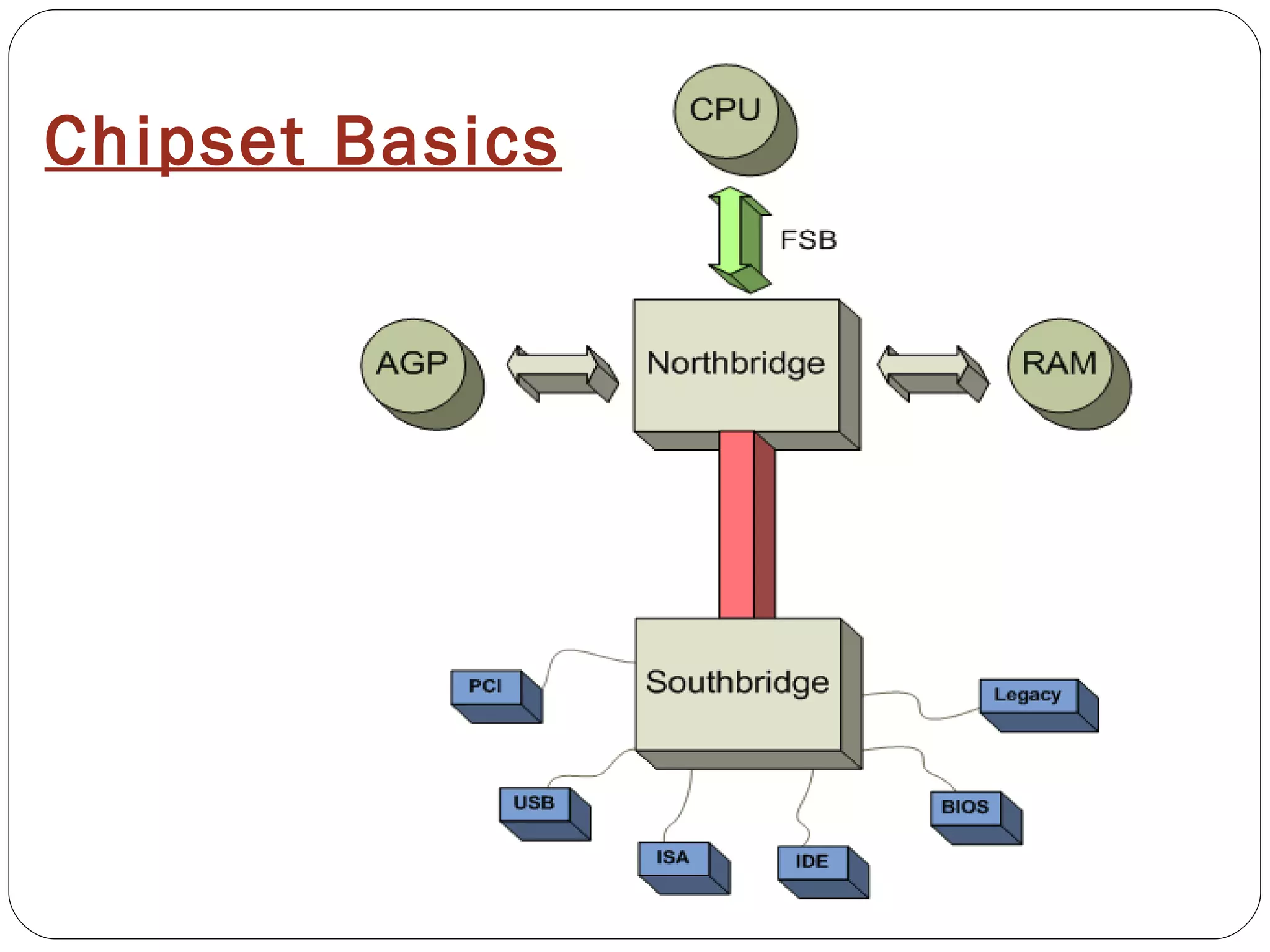
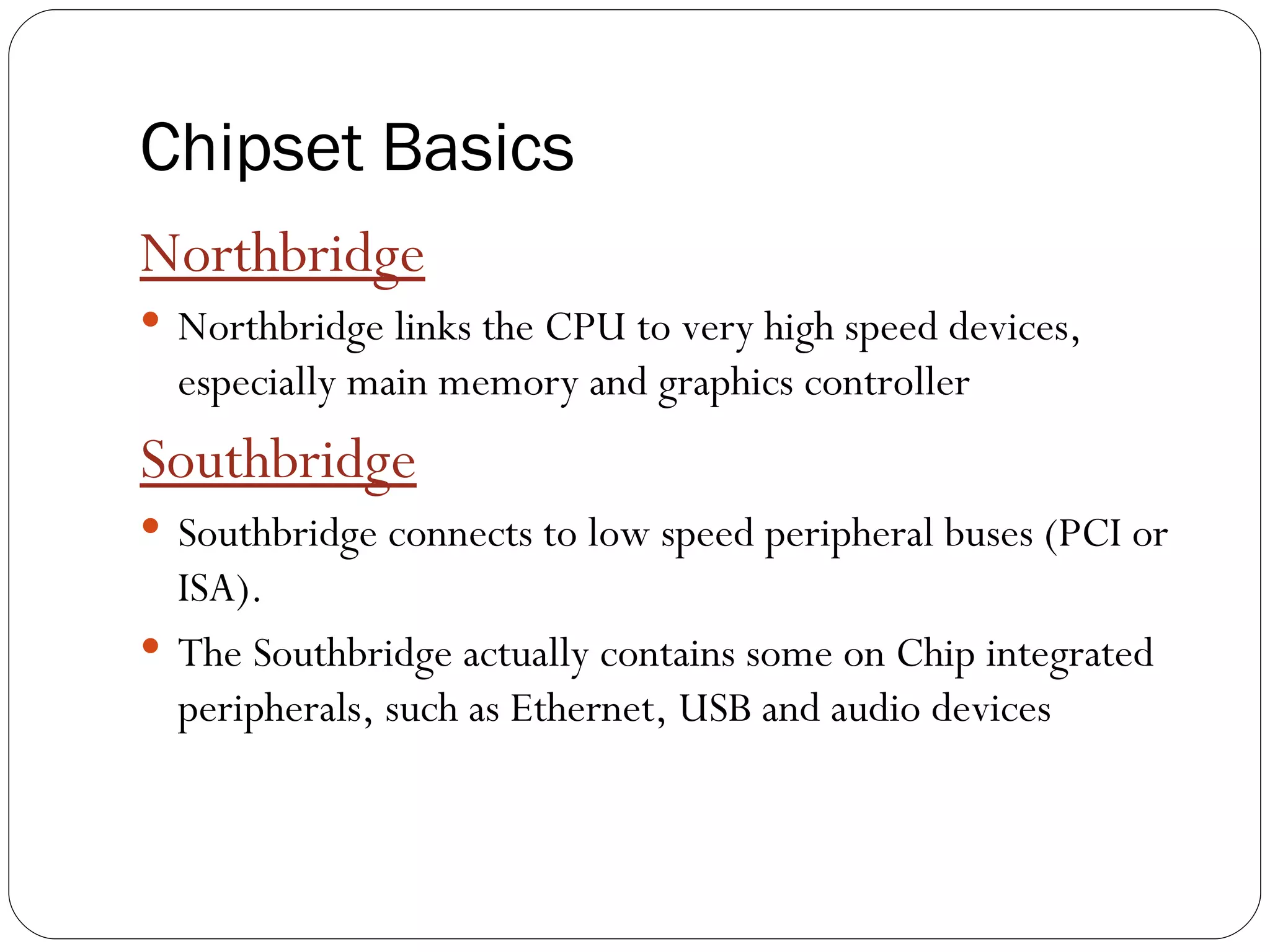
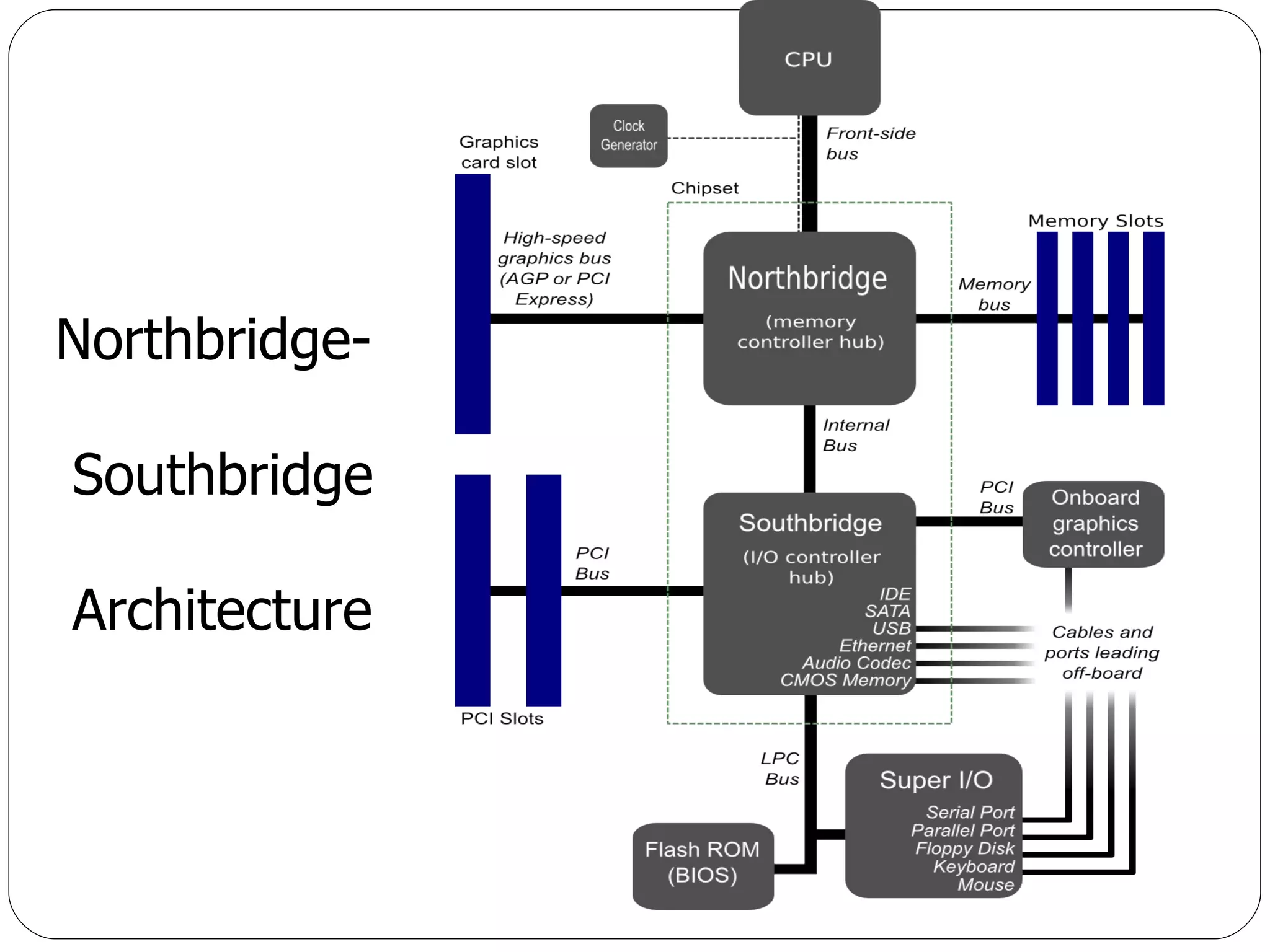
Chipset Basics NorthbridgeNorthbridge links the CPU to very high speed devices, especially main memory and graphics controller Southbridge Southbridge connects to low speed peripheral buses (PCI or ISA). The Southbridge actually contains some on Chip integrated peripherals, such as Ethernet, USB and audio devices
6.
Manufacturers Some ofthe manufacturers of the chipset are NVIDIA AMD VIA technologies SiS Intel Broadcom
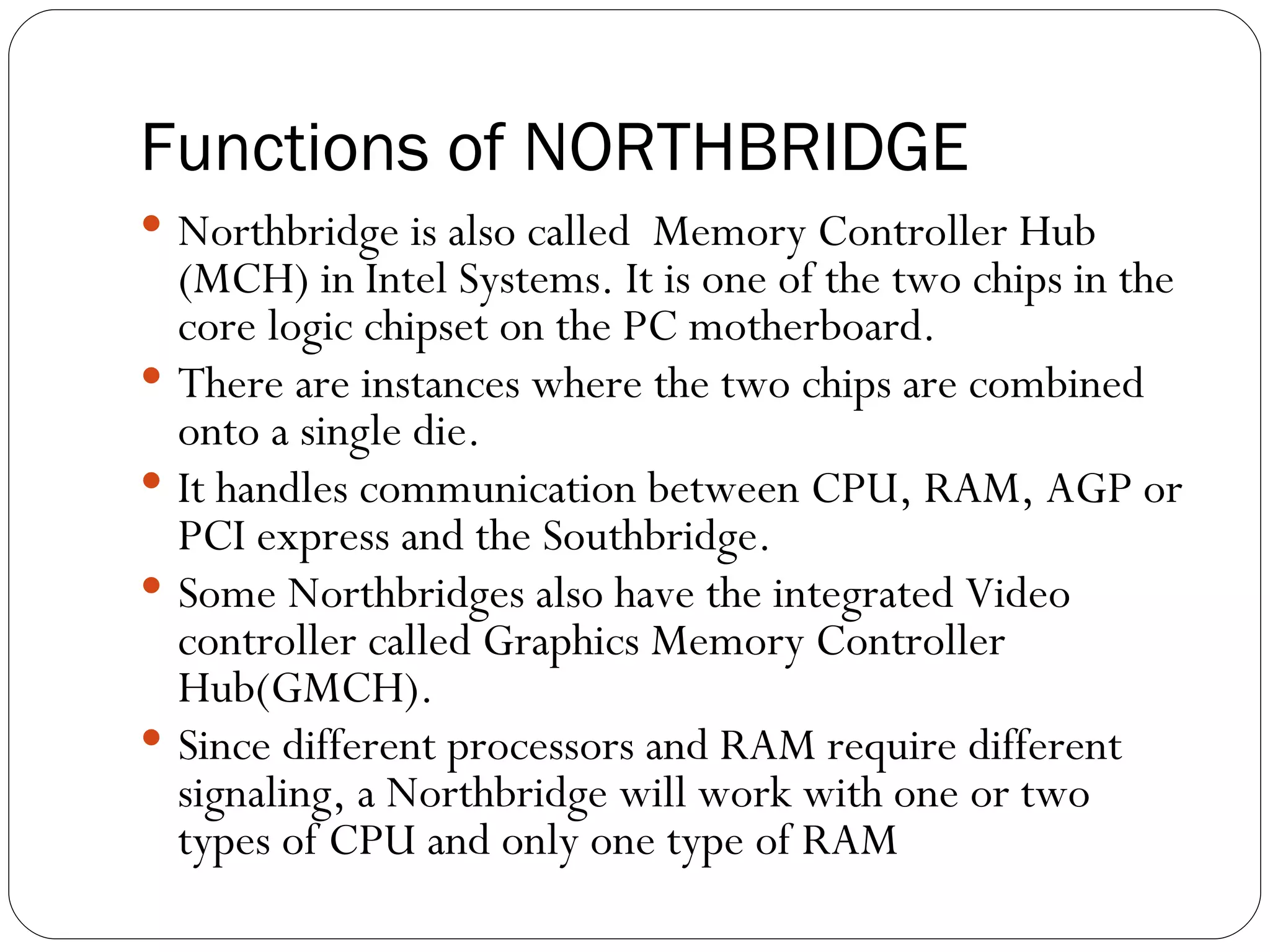
Functions of NORTHBRIDGENorthbridge is also called Memory Controller Hub (MCH) in Intel Systems. It is one of the two chips in the core logic chipset on the PC motherboard. There are instances where the two chips are combined onto a single die. It handles communication between CPU, RAM, AGP or PCI express and the Southbridge. Some Northbridges also have the integrated Video controller called Graphics Memory Controller Hub(GMCH). Since different processors and RAM require different signaling, a Northbridge will work with one or two types of CPU and only one type of RAM
9.
Functions of NORTHBRIDGEIt provides the number, Speed, type of CPU, Size, type of RAM that can be used. The Northbridge plays an important role in deciding how far a computer can be over clocked. It uses a heat sink and some kind of cooling.( Fan)
10.
South bridge The Southbridge , also known as the I/O Controller Hub (ICH) It is a chip that implements the "slower" capabilities of the motherboard in a Northbridge/Southbridge chipset computer architecture It is not directly connected to the CPU . Rather, the Northbridge ties the Southbridge to the CPU. A particular type of Southbridge may work with different Northbridge chipsets The interface between the Northbridge and the Southbridge is the PCI bus
11.
Southbridge Functionality Thefunctionality found on a contemporary southbridge includes: PCI bus: The PCI bus support includes the traditional PCI specification, but may also include support for PCI-X and PCI Express. ISA bus or PLC Bridge: The LPC Bridge provides a data and control path to the Super I/O (the normal attachment for the keyboard, mouse, parallel port, serial port, IR port, and floppy controller) and FWH (firmware hub which provides access to BIOS flash storage). SPI bus: The SPI bus is a simple serial bus mostly used for firmware (e.g., BIOS) flash storage access. SMBus: The SMBus is used to communicate with other devices on the motherboard (e.g. system fans).
12.
Southbridge Functionality DMAcontroller: The DMA controller allows ISA or LPC devices direct access to main memory without needing help from the CPU. Interrupt controller: The interrupt controller provides a mechanism for attached devices to get attention from the CPU IDE (SATA or PATA) controller: The IDE interface allows direct attachment of system hard drives .
13.
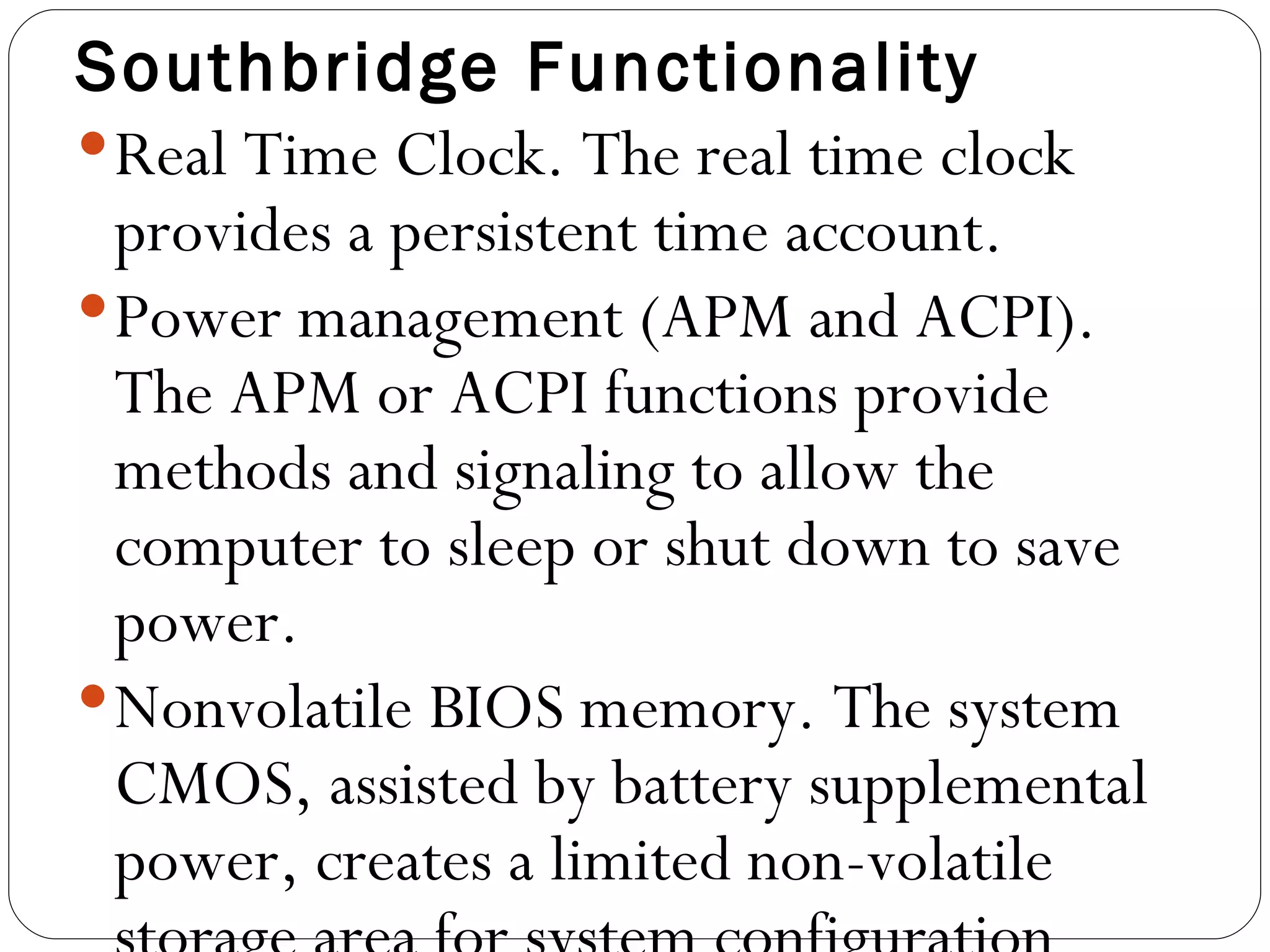
Southbridge Functionality RealTime Clock. The real time clock provides a persistent time account. Power management (APM and ACPI). The APM or ACPI functions provide methods and signaling to allow the computer to sleep or shut down to save power. Nonvolatile BIOS memory. The system CMOS, assisted by battery supplemental power, creates a limited non-volatile storage area for system configuration data.