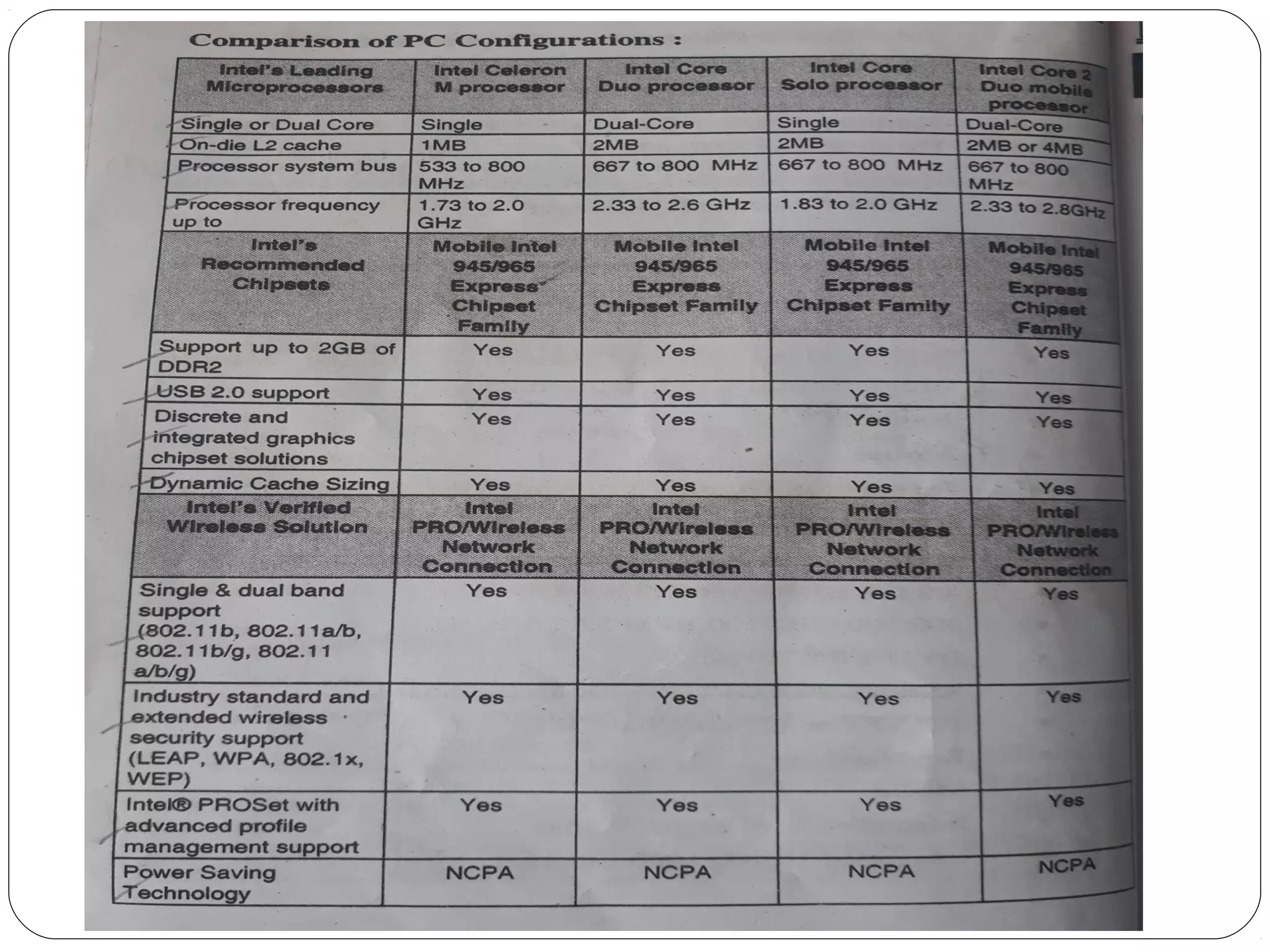
PC CONFIGURATION AND
COMPARISION
PC Configuration:
The PC configuration means the description of the
components of the computer. It means details of CPU
system box internally and externally physically
connected all components are called as PC
configuration. It includes the following components :
System board or Motherboard type.
CPU or Processor
Primary Memory
Cache Memory
Secondary Memory
Keyboard
Mouse
Display (Monitor) CRT/TFT
Switch Mode Power Supply
USB Port]
DVD etc.
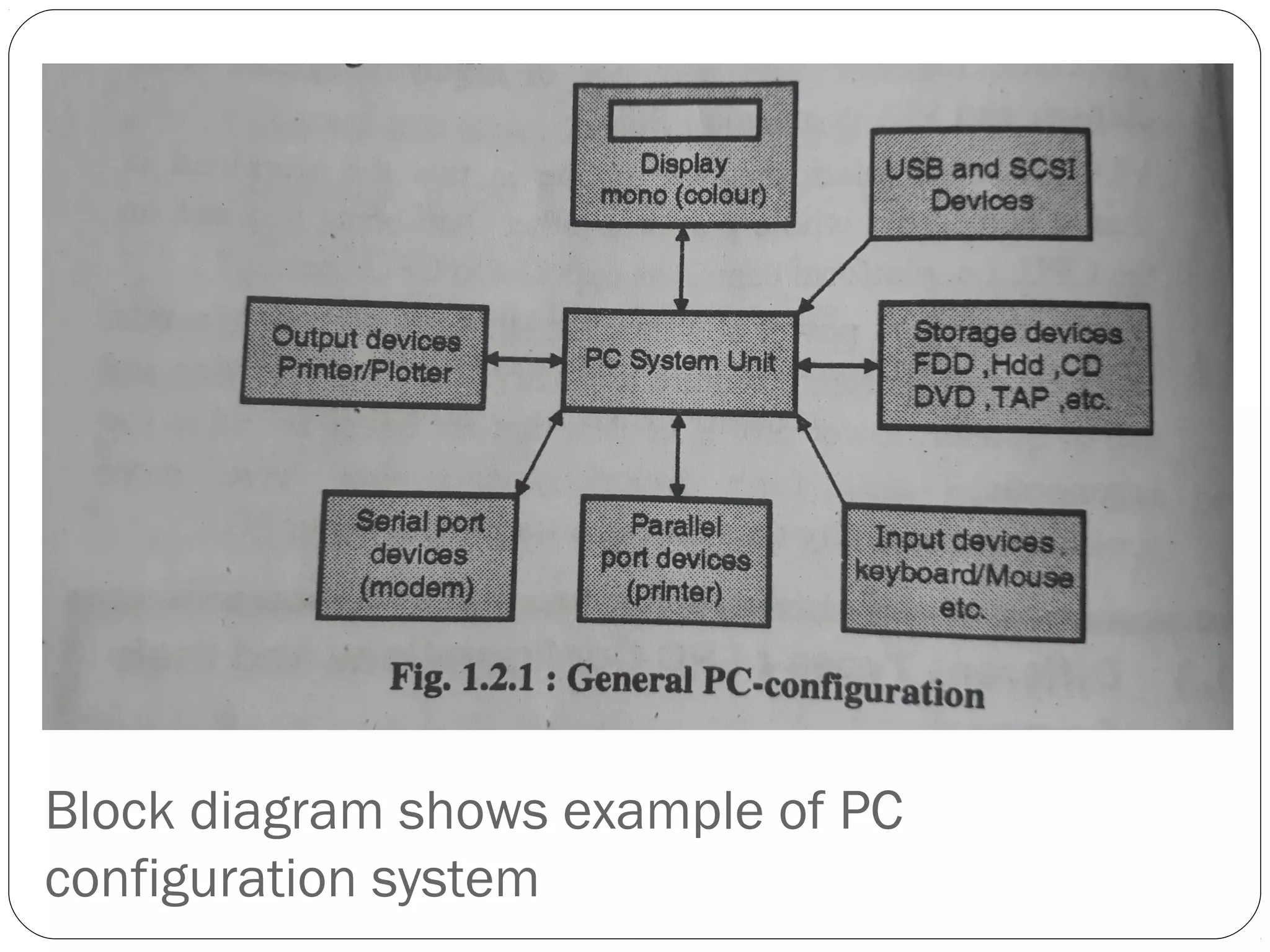
Block diagram shows example of PC
configuration system
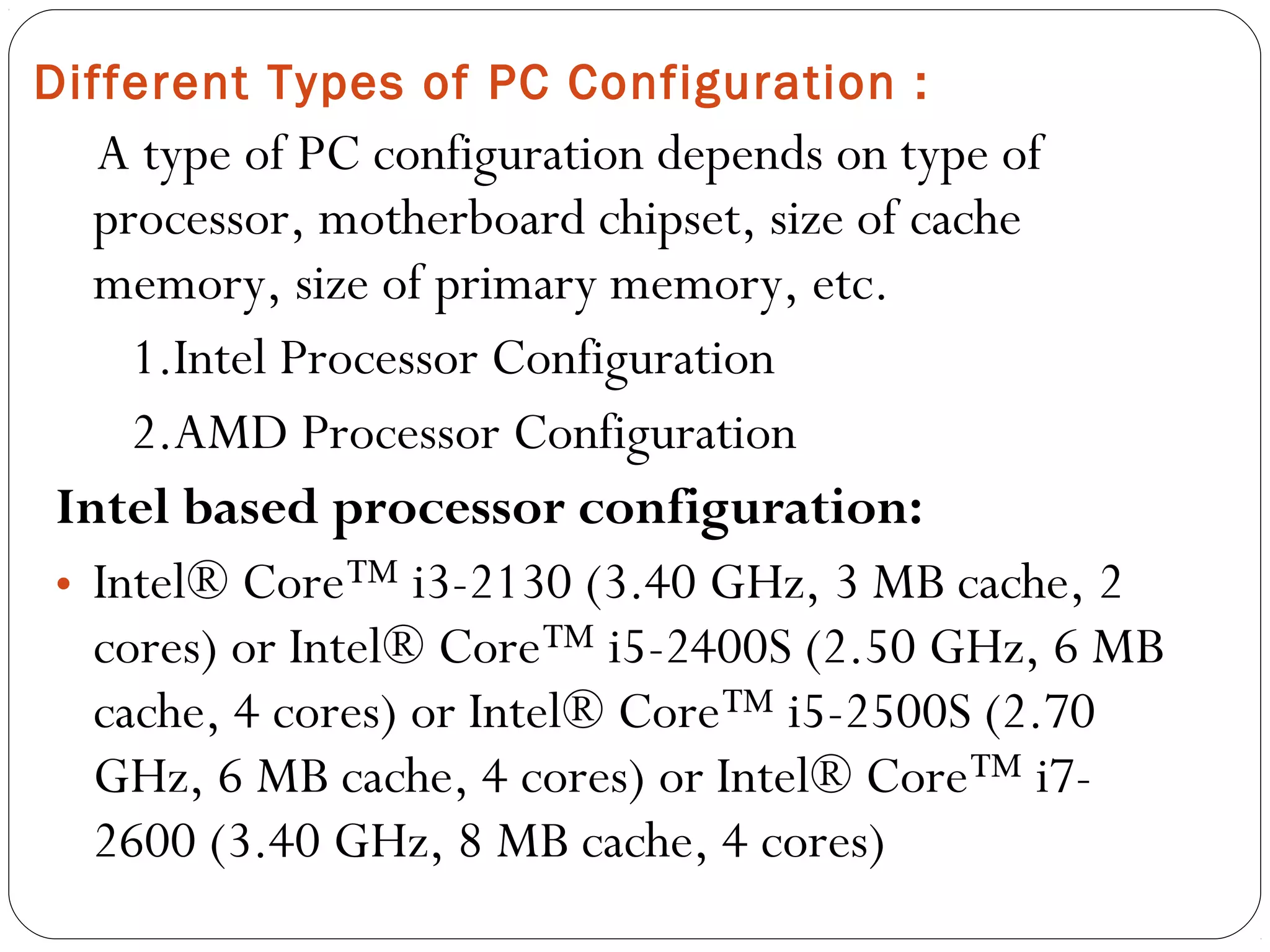
A type of PC configuration depends on type of
processor, motherboard chipset, size of cache
memory, size of primary memory, etc.
1.Intel Processor Configuration
2.AMD Processor Configuration
Intel based processor configuration:
• Intel® Core™ i3-2130 (3.40 GHz, 3 MB cache, 2
cores) or Intel® Core™ i5-2400S (2.50 GHz, 6 MB
cache, 4 cores) or Intel® Core™ i5-2500S (2.70
GHz, 6 MB cache, 4 cores) or Intel® Core™ i7-
2600 (3.40 GHz, 8 MB cache, 4 cores)
Different Types of PC Configuration :
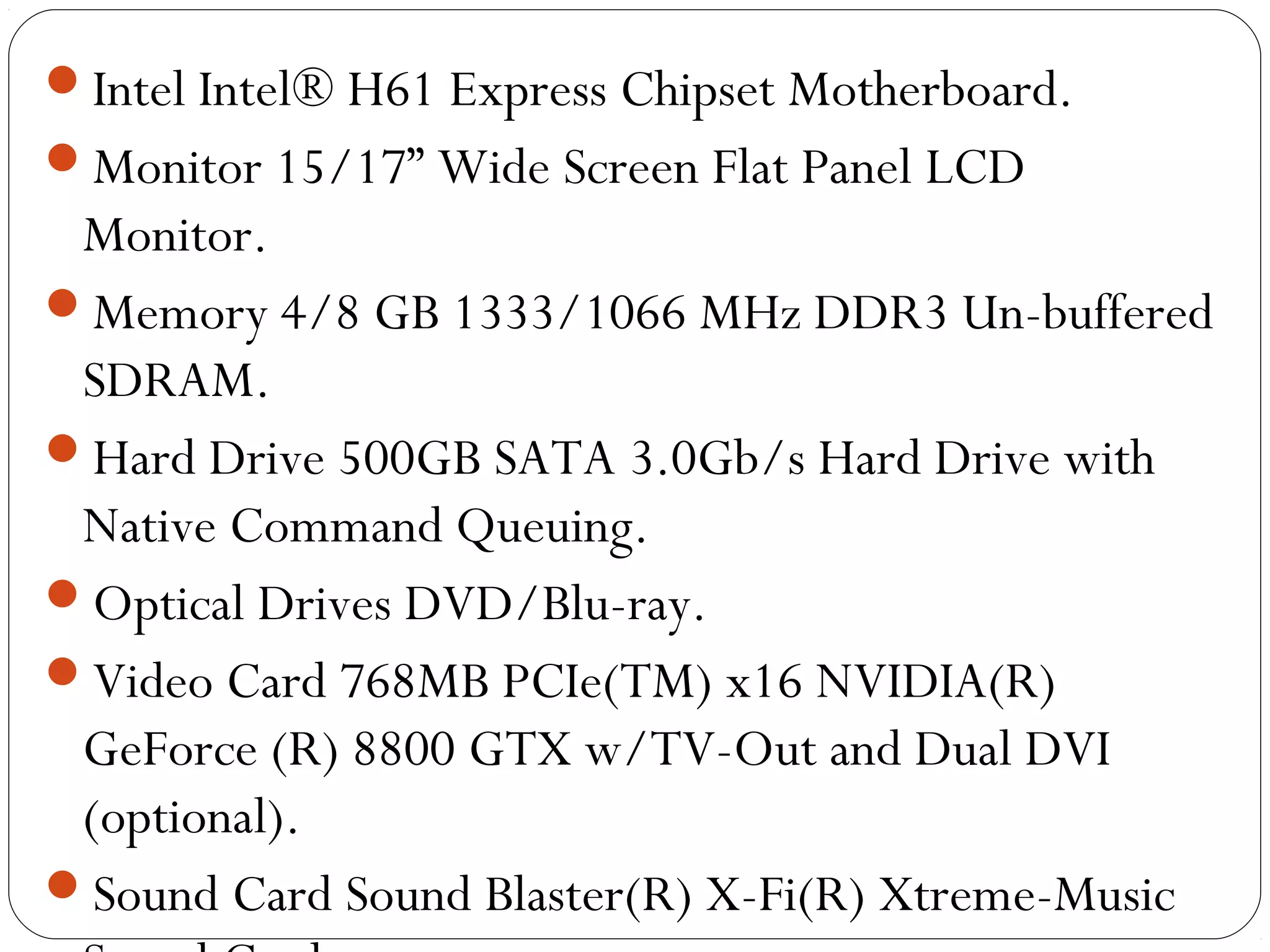
Intel Intel® H61 Express Chipset Motherboard.
Monitor 15/17” Wide Screen Flat Panel LCD
Monitor.
Memory 4/8 GB 1333/1066 MHz DDR3 Un-buffered
SDRAM.
Hard Drive 500GB SATA 3.0Gb/s Hard Drive with
Native Command Queuing.
Optical Drives DVD/Blu-ray.
Video Card 768MB PCIe(TM) x16 NVIDIA(R)
GeForce (R) 8800 GTX w/TV-Out and Dual DVI
(optional).
Sound Card Sound Blaster(R) X-Fi(R) Xtreme-Music
• Keyboard
• Mouse
• Integrated Gigabit Ethernet 10/100/1000.
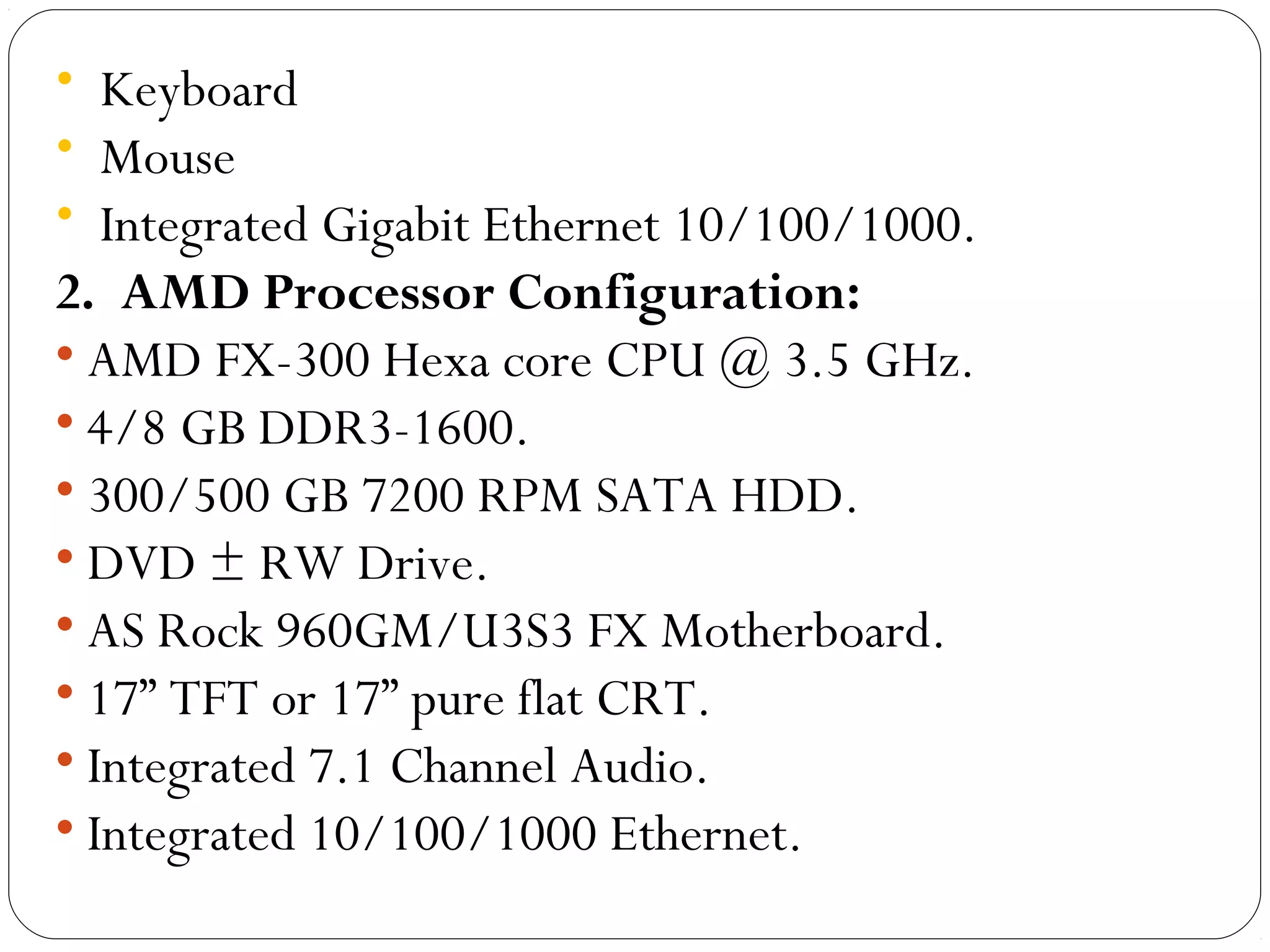
2. AMD Processor Configuration:
• AMD FX-300 Hexa core CPU @ 3.5 GHz.
• 4/8 GB DDR3-1600.
• 300/500 GB 7200 RPM SATA HDD.
• DVD ± RW Drive.
• AS Rock 960GM/U3S3 FX Motherboard.
• 17” TFT or 17” pure flat CRT.
• Integrated 7.1 Channel Audio.
• Integrated 10/100/1000 Ethernet.
CHIPSETS BASIC
Chipset
Motherboard consists of controller chips
besides the processor chip
E.g.:
Interrupt Controller
DMA controller
Timer chip
Clock chip
Bus Controller chip
I/O peripheral interface chip etc..
VLSI chips can perform these functions
Chipset
A Chipset is a group of ICs that are designed
to work together and are usually marketed as a
single product
It refers to a set of specialized chips on the
motherboard or an expansion card.
It refers to a pair of chips on the motherboard
– Northbridge and Southbridge
A Chipset controls communication between
processor and external devices , thus plays an
important role in determining system
performance
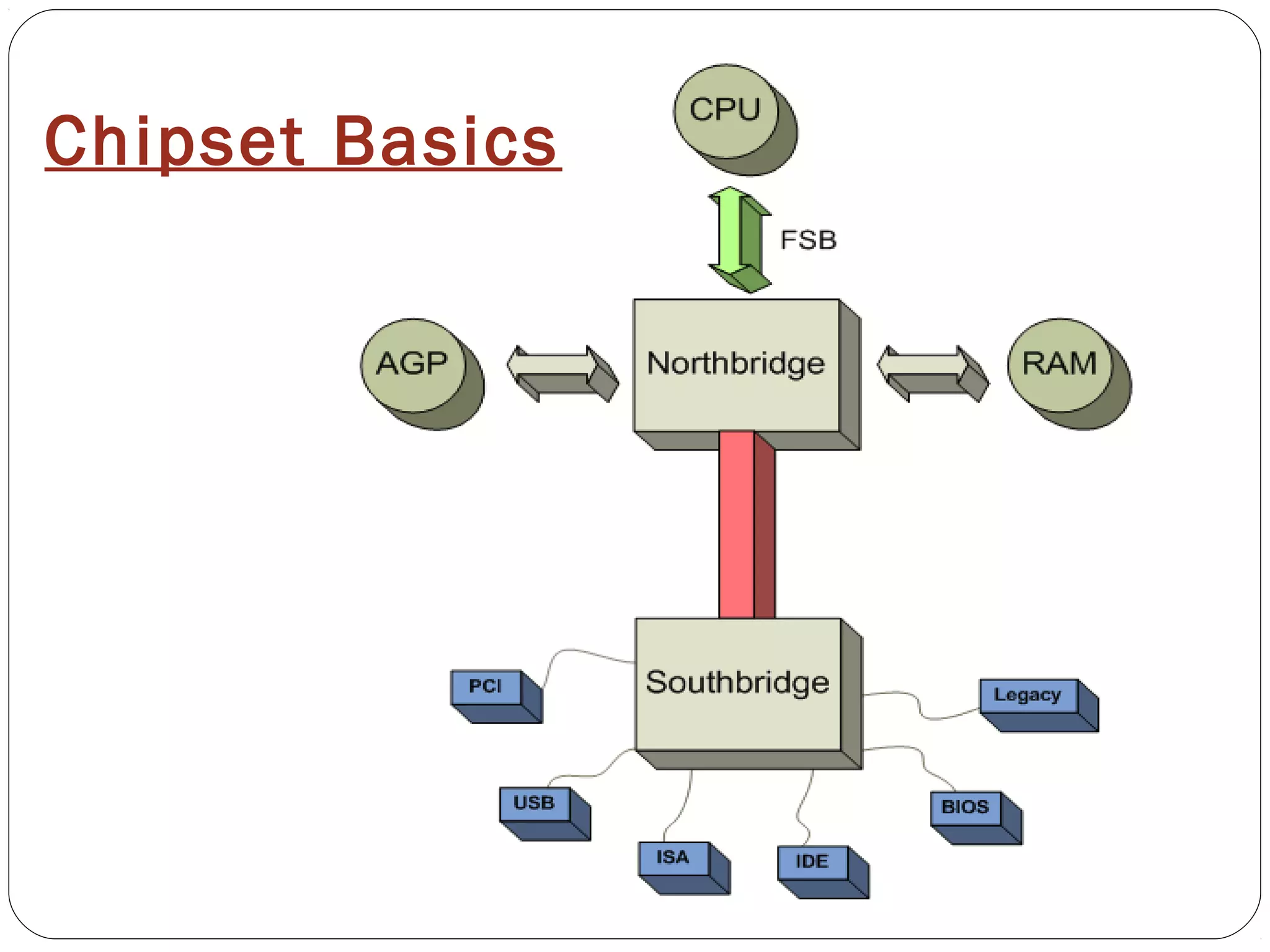
Chipset Basics
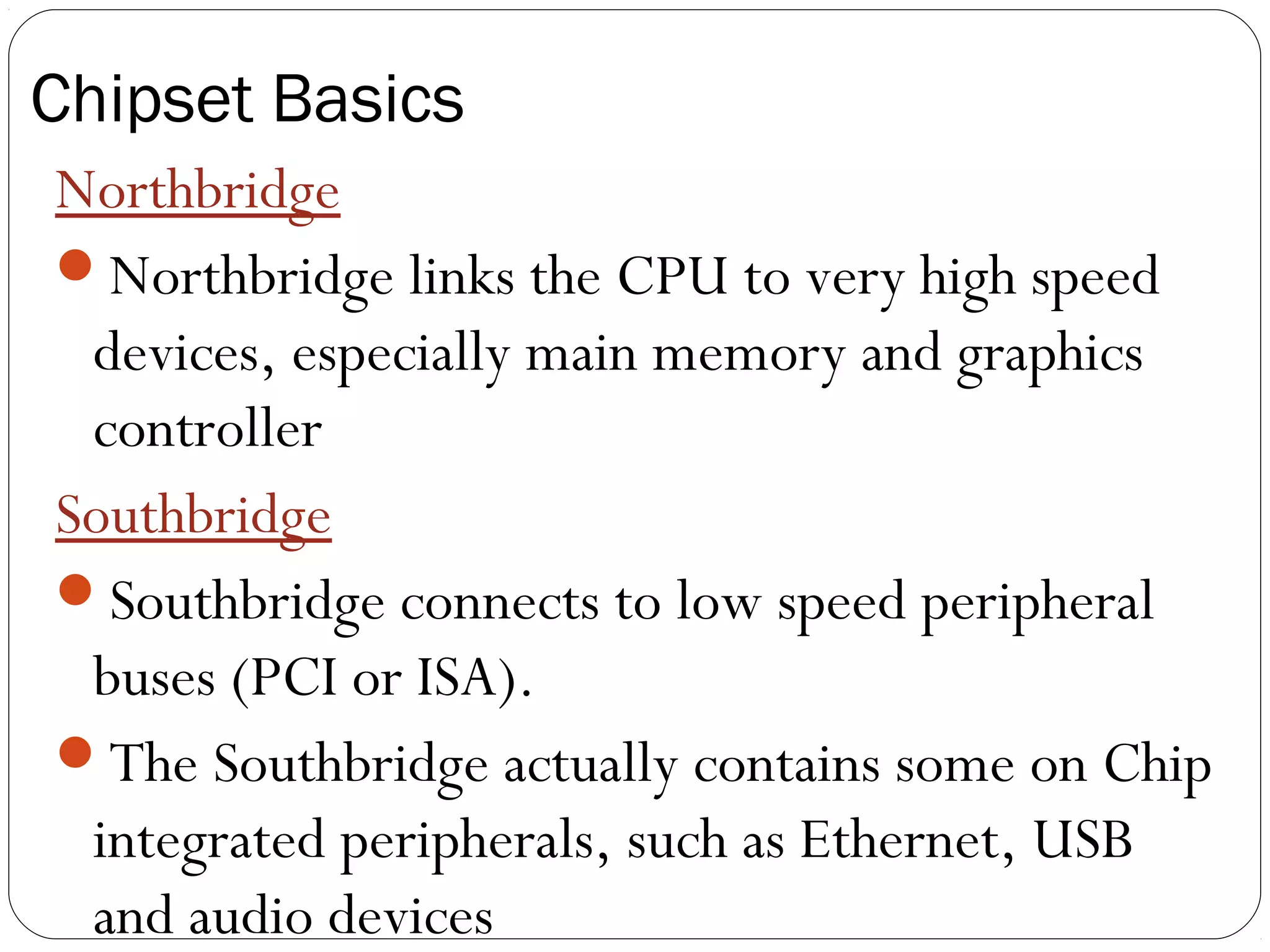
Chipset Basics
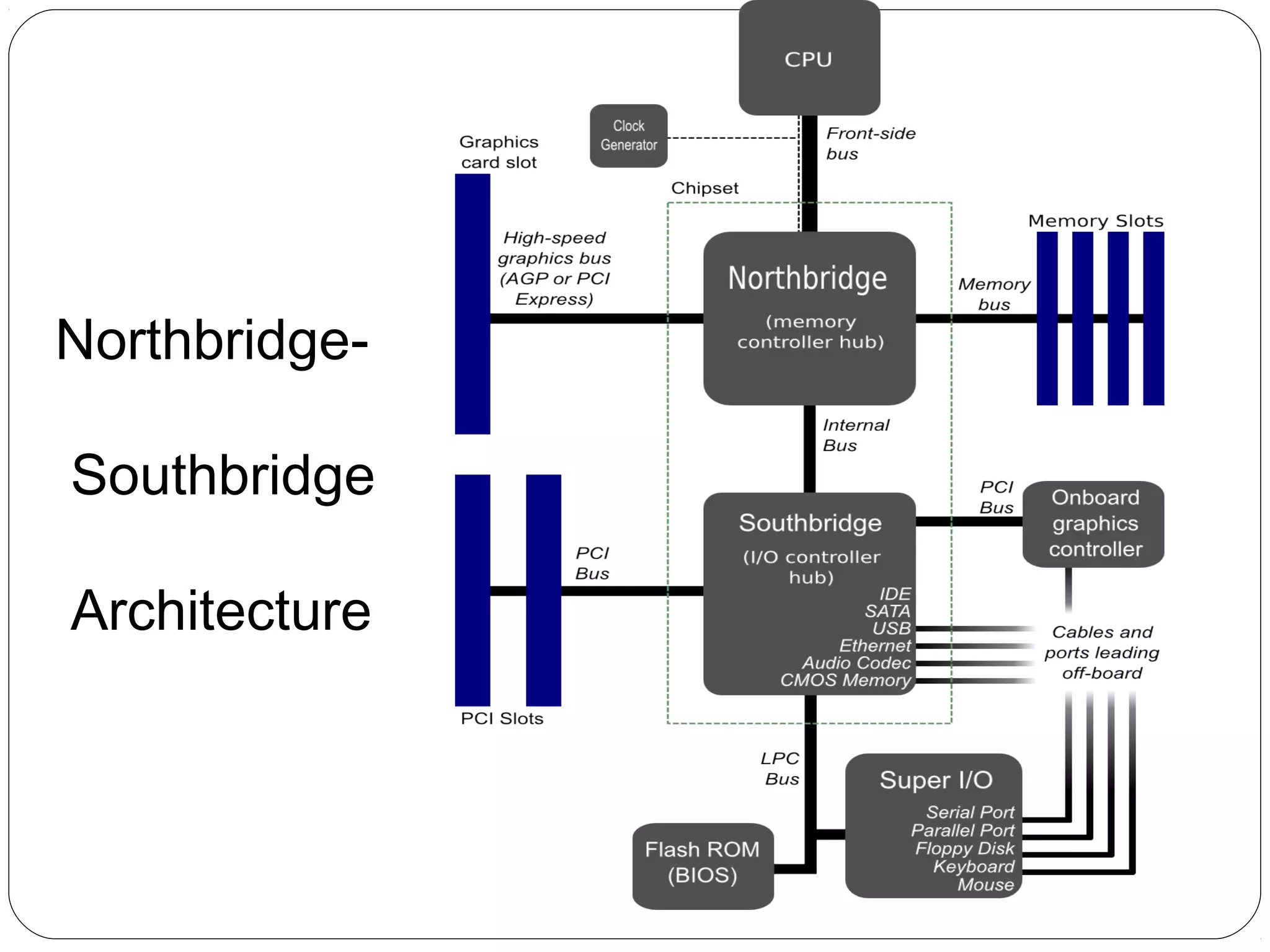
Northbridge
Northbridge links the CPU to very high speed
devices, especially main memory and graphics
controller
Southbridge
Southbridge connects to low speed peripheral
buses (PCI or ISA).
The Southbridge actually contains some on Chip
integrated peripherals, such as Ethernet, USB
and audio devices
Manufacturers
Some of the manufacturers of the chipset are
NVIDIA
AMD
VIA technologies
SiS
Intel
Broadcom
Chipset Architechture
There are two different architecture
1. North/ South bridge architecture
2. Hub architecture
Northbridge-
Southbridge
Architecture
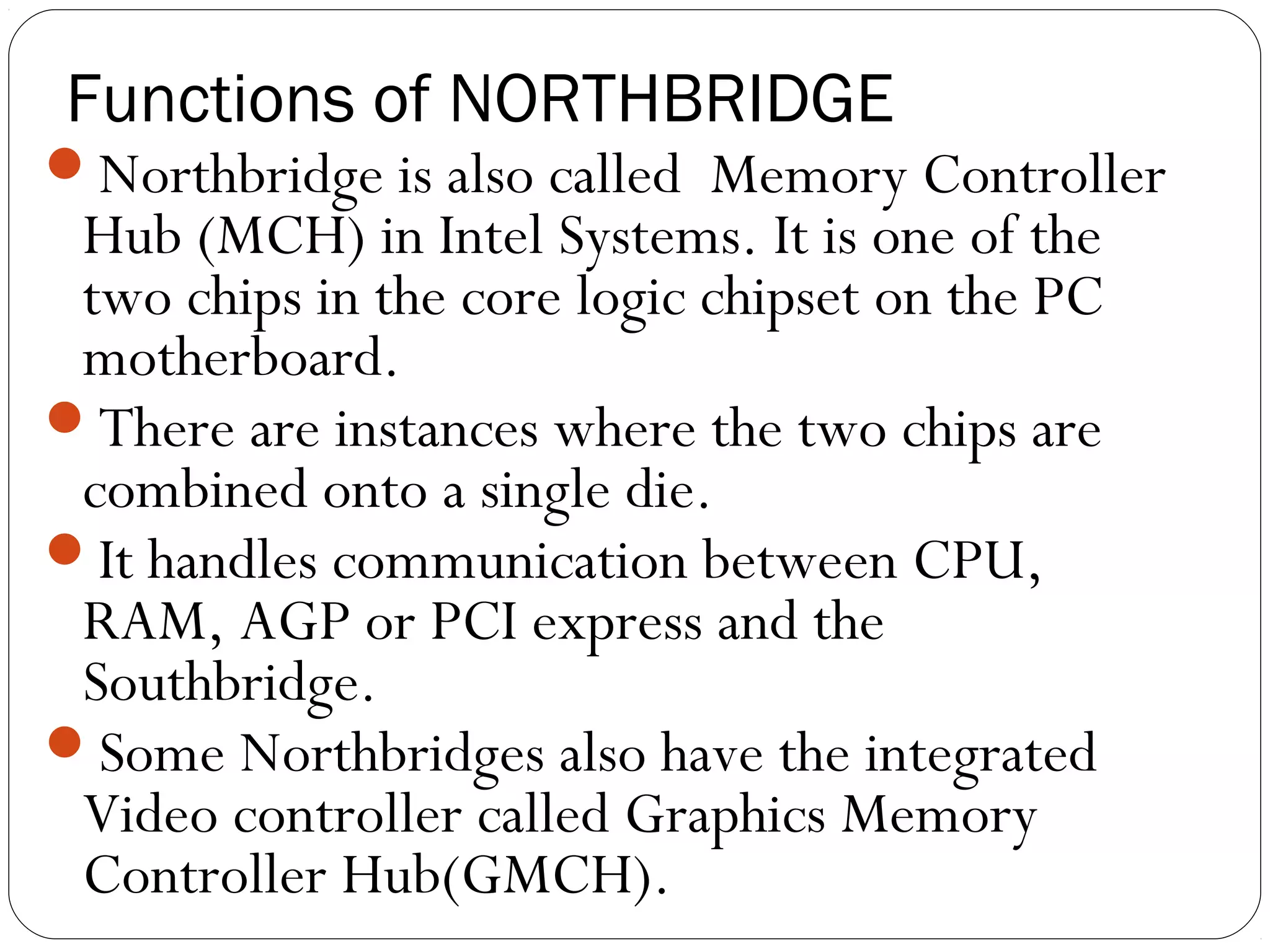
Functions of NORTHBRIDGE
Northbridge is also called Memory Controller
Hub (MCH) in Intel Systems. It is one of the
two chips in the core logic chipset on the PC
motherboard.
There are instances where the two chips are
combined onto a single die.
It handles communication between CPU,
RAM, AGP or PCI express and the
Southbridge.
Some Northbridges also have the integrated
Video controller called Graphics Memory
Controller Hub(GMCH).
Functions of NORTHBRIDGE
Since different processors and RAM require
different signaling, a Northbridge will work with
one or two types of CPU and only one type of
RAM
It provides the number, Speed, type of CPU,
Size, type of RAM that can be used.
The Northbridge plays an important role in
deciding how far a computer can be over clocked.
It uses a heat sink and some kind of cooling.
( Fan)
South bridge
The Southbridge, also known as the I/O
Controller Hub (ICH)
It is a chip that implements the "slower" capabilities
of the motherboard in a Northbridge/Southbridge
chipset computer architecture
It is not directly connected to the CPU. Rather, the
Northbridge ties the Southbridge to the CPU.
A particular type of Southbridge may work with
different Northbridge chipsets
The interface between the Northbridge and the
Southbridge is the PCI bus
Southbridge Functionality
It contains following component and functions
PCI bus: The PCI bus support includes the traditional
PCI specification, but may also include support for PCI-
X and PCI Express.
ISA bus or LPC Bridge: The LPC Bridge provides a data
and control path to the Super I/O (the normal
attachment for the keyboard, mouse, parallel port, serial
port, IR port, and floppy controller) and FWH
(firmware hub which provides access to BIOS flash
storage).
SPI bus: The SPI bus is a simple serial bus mostly used
for firmware (e.g., BIOS) flash storage access.
SMBus: The SMBus is used to communicate with other
devices on the motherboard (e.g. system fans).
Southbridge Functionality
DMA controller: The DMA controller allows ISA or
LPC devices direct access to main memory without
needing help from the CPU.
Interrupt controller: The interrupt controller provides a
mechanism for attached devices to get attention from the
CPU
IDE (SATA or PATA) controller: The IDE interface
allows direct attachment of system hard drives.
Real Time Clock. The real time clock provides a
persistent time account.
Power management (APM and ACPI). The APM or
ACPI functions provide methods and signaling to allow
the computer to sleep or shut down to save power.
Hub Architecture
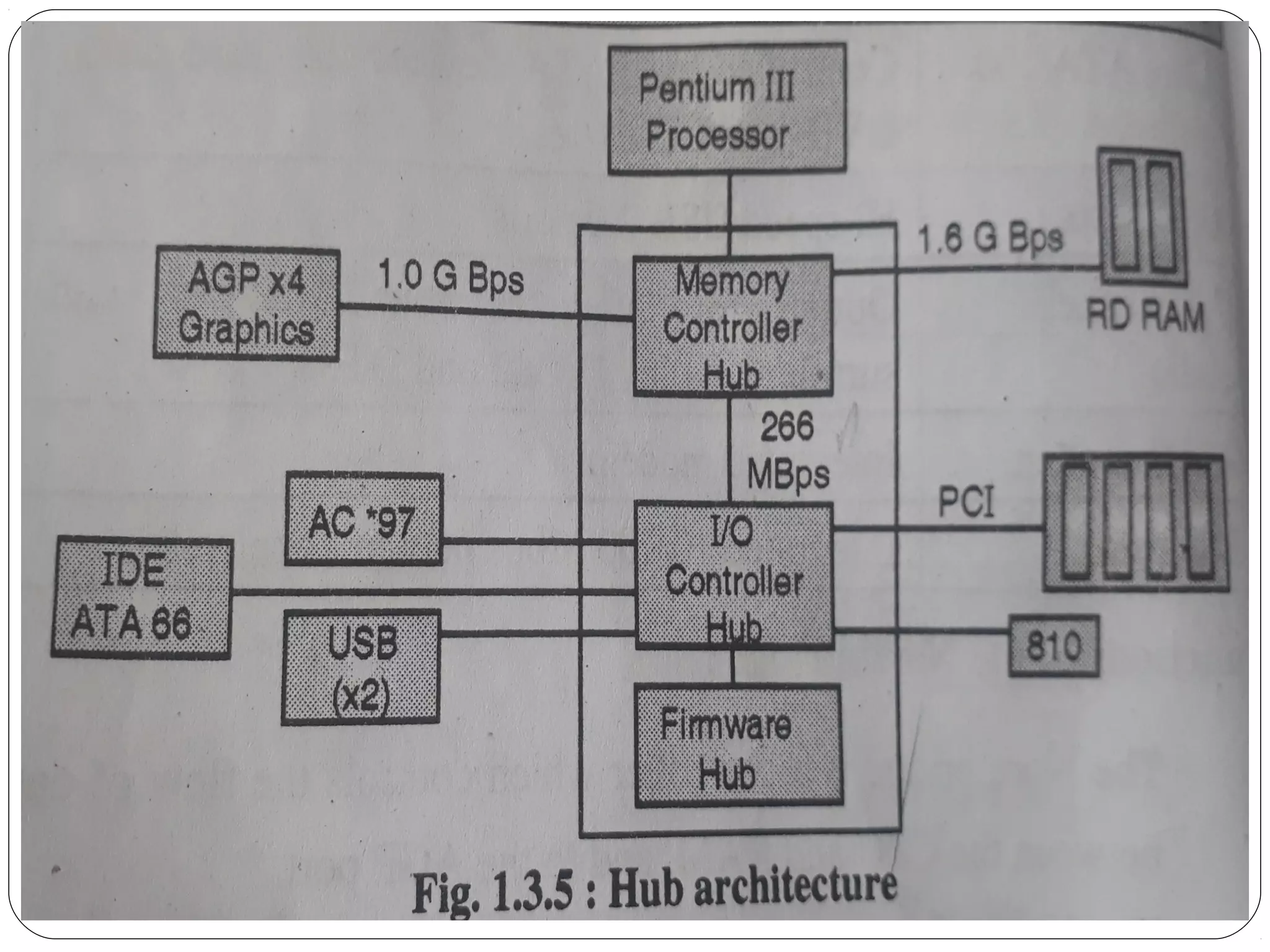
Intel Hub Architecture (IHA) is also known as Accelerated
Hub Architecture (AHA) shown in Fig. It is Intel’s
architecture for the 8xx family of chipsets, starting with
the Intel 810
It uses a Memory Controller Hub (MCH) that is
connected to an I/O Controller Hub (ICH) via a 266
MB/s bus. This connection is sometimes called Direct
Media Interface (DMI).
The MCH chip supports memory and AGP, while the ICH
chip provides connectivity for PCI, USB, sound, IDE hard
disks and LAN.
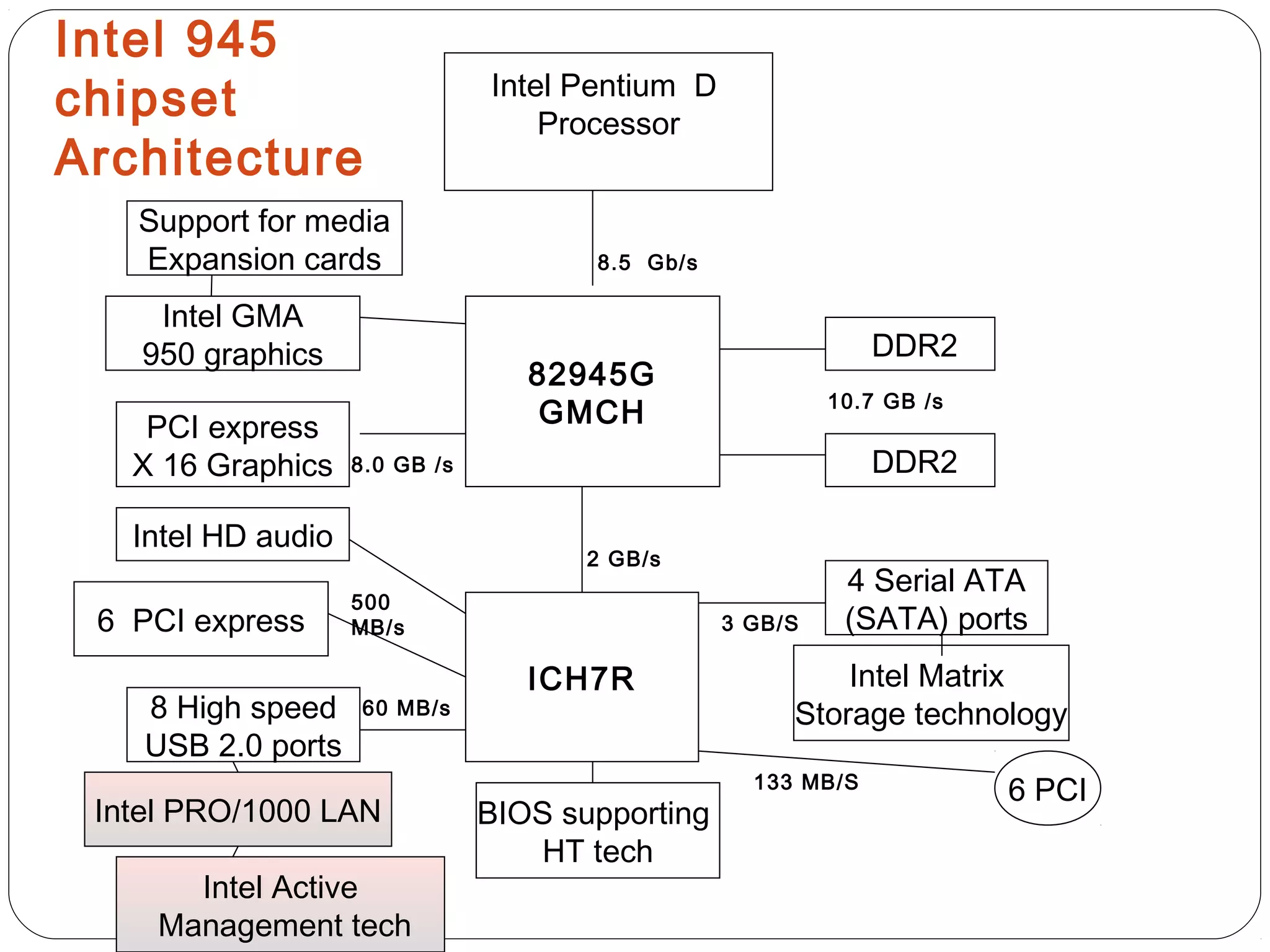
Intel Pentium D
Processor
82945G
GMCH
ICH7R
BIOS supporting
HT tech
DDR2
DDR2
4 Serial ATA
(SATA) ports
Intel PRO/1000 LAN
Intel GMA
950 graphics
PCI express
X 16 Graphics
Intel HD audio
8 High speed
USB 2.0 ports
6 PCI express
6 PCI
8.0 GB /s
2 GB/s
60 MB/s
500
MB/s
Support for media
Expansion cards
Intel Active
Management tech
133 MB/S
3 GB/S
8.5 Gb/s
Intel Matrix
Storage technology
10.7 GB /s
Intel 945
chipset
Architecture
Architecture of Intel 945G
chipset
The Intel 945G Express Chipset delivers outstanding
system performance through high-bandwidth interfaces.
such as dual-channel DDR2 memory, 1066 MHz system
bus, PCI Express  x16 graphics port and PCI Express x1
I/O ports, next-generation Serial ATA and Hi-Speed
USB 2.0 connectivity. This chipset also supports
stunning displays with the Intel Graphics Media
Accelerator 950 (Intel GMA 950) enhanced integrated
graphics controller.
The PCI Express : The PCI Express architecture
enables increased bi-directional bandwidth to the graphics
and I/O interfaces can provide more than three and a half
times the graphics bandwidth over previous high-
performance discrete graphics solutions
Memory Architecture : To support faster memory,
increased graphics requirements, and I/O bandwidth,
the Intel 945G Express Chipset incorporates an updated
Memory Controller Hub (MCH) backbone architecture.
-This new design includes wider internal data buses that
support dual-channel DDR2 memory technology at 667
MHz for greater platform performance and memory
flexibility.
Intel Graphics Media Accelerator 950 :
-An improved graphics core. Intel GMA 950 enhances
the user experience with faster graphics, improved
Microsoft DirectX* 9.0 3D performance, and better
video playback and quality.
-The increased performance supports both smooth
standard and high-definition video playback can deliver
significant graphics performance over previous Intel
platforms.
-Allow a user to take advantage of several video output
options (DVI, Dual Independent Display, Component,
Composite, HDTV and LVDS) in a single-card solution.
Intel I/O Controller Hub (Intel ICH7/R) :
-The Intel 945G Express Chipset integrates Intel® High
Definition Audio enabling premium home theatre sound
and delivers advanced features such as multiple audio
streams and jack re-tasking.
-This chipset has four integrated SATA ports for
transfer rates up to 3 Gb/s (300 MB/s) to SATA hard
drives or optical devices. Support for RAID 0, 1, 5 and
10 allows for different RAID capabilities that address
specific needs and usages.
The Advanced Host Controller Interface (AHCI)
provides native hot plug and boosts performance with
Native Command Queuing (NCQ) for faster boot
times and file transfers.
Intel Stable Image Platform Program : The Intel
945G Express Chipset is a critical element of 2005
Intel Stable Image Platform Program. Businesses can
take advantage of this program to help reduce the cost
of software image qualification and maintenance.
A bus is a shared linear pathway that connects multiple
devices to provide a communication channel between
them. Any device connected to the bus can communicate
bi-directionally with other devices connected to that bus.
Computer components - processor, cache, RAM,
expansion cards, disks and others - communicate using
one or more of the multiple buses that exist in the
computer.
The external bus is also referred as the
expansion bus.
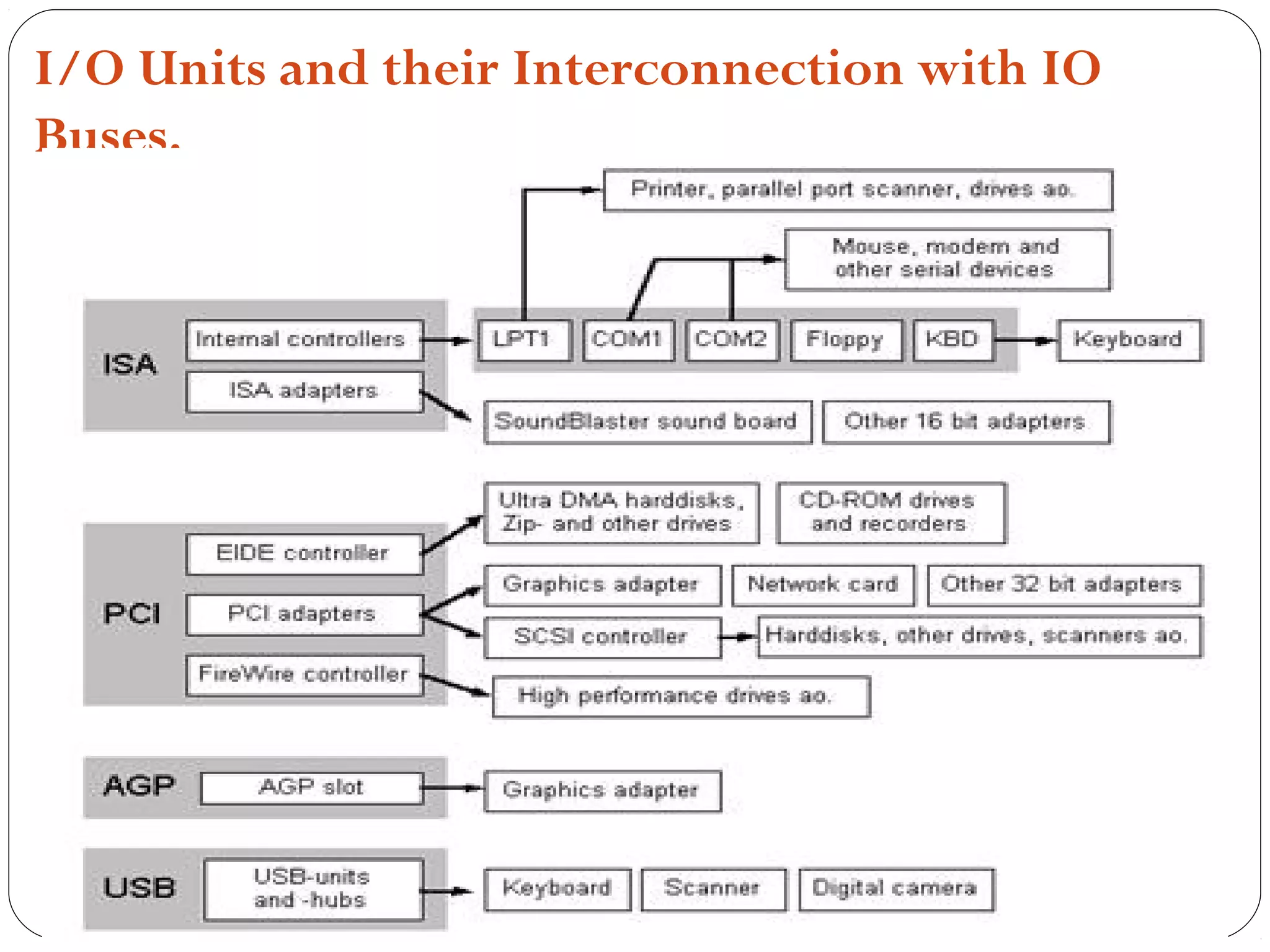
I/O Units and their Interconnection with IO
Buses.
Industry Standard Architecture (ISA) is the bus architecture that
was introduced two buses :
1.8 bit bus with the original IBM PC
2.16 bits with the IBM PC/AT
3.32 bit ISA
1. 8 bit ISA bus :
Features of ISA bus :
1. Eight data lines
2. Four DMA channel
3. Eight IRQ levels
4. Address lines
5. Enable to handle 1 MB of memory
Advantages :
It support old type of card.
Disadvantages :
1. It is slower.
2. Support only 8 bit devices.
3. Not used in modern PCs.
2.16 bit ISA Bus:
It introduced the AT with 286 processor. It also called AT-
bus.
Features:
1. It supports 8 more data lines.
2. It supports four more address lines.
3. It supports four DMA channels.
4. Five more IRQ levels
3. EISA bus:
Features:
1. 32 bit data path.
2. Compatible with 8, 16 also
3. Enough address line for 4 GB of memory.
4. More I/O addresses up to 64 KB.
5. Software setup i.e. no jumpers or DIP switches.
6. 8 MHz clock rate.
7. No more interrupts or DMA channels.
8. Support older 8 bit, 16 bit ISA cards.
9. Bus mastering.( Support many bus architecture)
- The Peripheral Component Interconnect, or PCI Standard,
specifies a computer bus for attaching peripheral devices to a
computer motherboard
- The PCI bus is a high speed bus that connects high-performance
peripherals like video adapters, disk adapters and network
adapters to the chipset, processor and memory.
PCI bus width and speed :
-PCI expansion bus differ in two respects that determine their
performance : PCI bus width and bus speed.
-PCI with 32 bits width at 33.33 MHz. generating 133.33
Mbytes/s is found in Desktops and servers.
PCI with 64 bits width at 66.66 MHz. generating 533.33
Mbytes/s is more commonly found in Mid-range to High-end
servers.
PCI- The Peripheral Component
Interconnect:
1.Extremely high-speed data transfer : 32-bit wide data
transfer @ 33 MHz gives a maximum throughput of 132 Mega
bytes per second. Data transfer @ 66 MHz with 64 bit wide data
is now being offered.
2. Plug and play facility :  A PCI board inserted in any PCI
slot is automatically detected and the required I/O and memory
resources are allotted by system.
3.New approach : It moves peripherals off the I/O bus and
places them closer to the system processor bus, thereby
providing faster data transfer between the processor and
peripherals.4.Processor independence : The PCI local bus fulfils the
need for a local bus standard that is not directly dependent on
the speed and structure of the processor bus, and that is both
reliable and expandable.
features of PCI buses:
7.Forward and backward compatibility between 66 MHz
and 33 MHz PCI.
6.Parity on both data and address lines: This allows
implementation of robust systems. Support for both 5 V and 3.3
V operated logic.
5.Full multi-master capability: This allows any PCI master
to communicate directly with other PCI master/slave.
PCI-X:
- PCI-X (Peripheral Component Interconnect Extended) is a
computer bus and expansion card standard designed to supersede
PCI.
- It is essentially a faster version of PCI, running at twice the
speed, similar in physical implementation and basic design. It has
itself been replaced in modern designs by the similar-sounding
PCI Express, which features a very different logical design.
-PCI-X is a revision of the PCI standard that doubles the clock
speed and hence the amount of data exchanged between the
computer processor and peripherals.
-Maximum amount of data exchanged between the processor
and peripherals with PCI-X is 1.06 GB/s, compared to 532
MB/s with standard PCI.
1.Up to 133 MHz bus speed
2.64 bit bandwidth
Features of PCI-X :
3.1GB/sec throughput ( max transfer rate)
4.More efficient bus operation for easier interface.
5.Split Transactions allows an indicator device to make only one
data request and control (relinquish) the bus, instead of constantly
needing to poll the bus for a response.
6.Byte count that enables indicator to specify, in advance, The
specific number of bytes requested, eliminating the inefficiency of
speculative prefetches.
7.Backwards compatibility
PCI express:
-PCI Express, officially abbreviated as PCI-E or PCIE, is a
computer expansion card interface format. It was designed to
replace PCI, PCI-X and AGP (graphics card interface).
-PCI-Express is the new standard for faster Video cards. Most
new video cards coming out today are designed for PCI-Express
as newer motherboards and computers being made today are
supporting this new connection.
2.I/O simplification  : Relates to the streamlining of the
plethora of both chip-to-chip and internal user-accessible buses,
such as AGP, PCI-X, and Hub Link. This feature reduces the
complexity of design and cost of implementation.
3.Layered architecture : PCI Express establishes an
architecture that can adapt to new technologies while preserving
software investment. Two key areas that benefit from the
layered architectures are the physical layer, with increased
signalling rates, and software compatibility.
1.High performance : Due to the bandwidth, which is more
than double that of PCI in a x1 link, and grows linearly as more
lanes are added.
Features :
5.Ease of use : PCI Express greatly simplifies how users add and
upgrade systems. IT offers both hot-swap and hot-plug. In
addition, the variety of formats for PCI Express boards,
especially SIOM and Express Card, greatly increases the ability
to add high-performance peripherals in servers and notebooks.
4.Next-generation I/O : PCI Express provides new
capabilities for data acquisition and multimedia through
isochronous (transmitting real-time information such as audio
and video data, and must be sent at a constant rate) data
transfers

Computer hardware and networking by Pradeep Kudale

  • 1.
  • 2.
    PC Configuration: The PCconfiguration means the description of the components of the computer. It means details of CPU system box internally and externally physically connected all components are called as PC configuration. It includes the following components : System board or Motherboard type. CPU or Processor Primary Memory Cache Memory
  • 3.
    Secondary Memory Keyboard Mouse Display (Monitor)CRT/TFT Switch Mode Power Supply USB Port] DVD etc.
  • 4.
    Block diagram showsexample of PC configuration system
  • 5.
    A type ofPC configuration depends on type of processor, motherboard chipset, size of cache memory, size of primary memory, etc. 1.Intel Processor Configuration 2.AMD Processor Configuration Intel based processor configuration: • Intel® Core™ i3-2130 (3.40 GHz, 3 MB cache, 2 cores) or Intel® Core™ i5-2400S (2.50 GHz, 6 MB cache, 4 cores) or Intel® Core™ i5-2500S (2.70 GHz, 6 MB cache, 4 cores) or Intel® Core™ i7- 2600 (3.40 GHz, 8 MB cache, 4 cores) Different Types of PC Configuration :
  • 6.
    Intel Intel® H61Express Chipset Motherboard. Monitor 15/17” Wide Screen Flat Panel LCD Monitor. Memory 4/8 GB 1333/1066 MHz DDR3 Un-buffered SDRAM. Hard Drive 500GB SATA 3.0Gb/s Hard Drive with Native Command Queuing. Optical Drives DVD/Blu-ray. Video Card 768MB PCIe(TM) x16 NVIDIA(R) GeForce (R) 8800 GTX w/TV-Out and Dual DVI (optional). Sound Card Sound Blaster(R) X-Fi(R) Xtreme-Music
  • 7.
    • Keyboard • Mouse •Integrated Gigabit Ethernet 10/100/1000. 2. AMD Processor Configuration: • AMD FX-300 Hexa core CPU @ 3.5 GHz. • 4/8 GB DDR3-1600. • 300/500 GB 7200 RPM SATA HDD. • DVD ± RW Drive. • AS Rock 960GM/U3S3 FX Motherboard. • 17” TFT or 17” pure flat CRT. • Integrated 7.1 Channel Audio. • Integrated 10/100/1000 Ethernet.
  • 9.
  • 10.
    Chipset Motherboard consists ofcontroller chips besides the processor chip E.g.: Interrupt Controller DMA controller Timer chip Clock chip Bus Controller chip I/O peripheral interface chip etc.. VLSI chips can perform these functions
  • 11.
    Chipset A Chipset isa group of ICs that are designed to work together and are usually marketed as a single product It refers to a set of specialized chips on the motherboard or an expansion card. It refers to a pair of chips on the motherboard – Northbridge and Southbridge A Chipset controls communication between processor and external devices , thus plays an important role in determining system performance
  • 12.
  • 13.
    Chipset Basics Northbridge Northbridge linksthe CPU to very high speed devices, especially main memory and graphics controller Southbridge Southbridge connects to low speed peripheral buses (PCI or ISA). The Southbridge actually contains some on Chip integrated peripherals, such as Ethernet, USB and audio devices
  • 14.
    Manufacturers Some of themanufacturers of the chipset are NVIDIA AMD VIA technologies SiS Intel Broadcom
  • 15.
    Chipset Architechture There aretwo different architecture 1. North/ South bridge architecture 2. Hub architecture
  • 16.
  • 17.
    Functions of NORTHBRIDGE Northbridgeis also called Memory Controller Hub (MCH) in Intel Systems. It is one of the two chips in the core logic chipset on the PC motherboard. There are instances where the two chips are combined onto a single die. It handles communication between CPU, RAM, AGP or PCI express and the Southbridge. Some Northbridges also have the integrated Video controller called Graphics Memory Controller Hub(GMCH).
  • 18.
    Functions of NORTHBRIDGE Sincedifferent processors and RAM require different signaling, a Northbridge will work with one or two types of CPU and only one type of RAM It provides the number, Speed, type of CPU, Size, type of RAM that can be used. The Northbridge plays an important role in deciding how far a computer can be over clocked. It uses a heat sink and some kind of cooling. ( Fan)
  • 19.
    South bridge The Southbridge,also known as the I/O Controller Hub (ICH) It is a chip that implements the "slower" capabilities of the motherboard in a Northbridge/Southbridge chipset computer architecture It is not directly connected to the CPU. Rather, the Northbridge ties the Southbridge to the CPU. A particular type of Southbridge may work with different Northbridge chipsets The interface between the Northbridge and the Southbridge is the PCI bus
  • 20.
    Southbridge Functionality It containsfollowing component and functions PCI bus: The PCI bus support includes the traditional PCI specification, but may also include support for PCI- X and PCI Express. ISA bus or LPC Bridge: The LPC Bridge provides a data and control path to the Super I/O (the normal attachment for the keyboard, mouse, parallel port, serial port, IR port, and floppy controller) and FWH (firmware hub which provides access to BIOS flash storage). SPI bus: The SPI bus is a simple serial bus mostly used for firmware (e.g., BIOS) flash storage access. SMBus: The SMBus is used to communicate with other devices on the motherboard (e.g. system fans).
  • 21.
    Southbridge Functionality DMA controller:The DMA controller allows ISA or LPC devices direct access to main memory without needing help from the CPU. Interrupt controller: The interrupt controller provides a mechanism for attached devices to get attention from the CPU IDE (SATA or PATA) controller: The IDE interface allows direct attachment of system hard drives. Real Time Clock. The real time clock provides a persistent time account. Power management (APM and ACPI). The APM or ACPI functions provide methods and signaling to allow the computer to sleep or shut down to save power.
  • 23.
    Hub Architecture Intel HubArchitecture (IHA) is also known as Accelerated Hub Architecture (AHA) shown in Fig. It is Intel’s architecture for the 8xx family of chipsets, starting with the Intel 810 It uses a Memory Controller Hub (MCH) that is connected to an I/O Controller Hub (ICH) via a 266 MB/s bus. This connection is sometimes called Direct Media Interface (DMI). The MCH chip supports memory and AGP, while the ICH chip provides connectivity for PCI, USB, sound, IDE hard disks and LAN.
  • 24.
    Intel Pentium D Processor 82945G GMCH ICH7R BIOSsupporting HT tech DDR2 DDR2 4 Serial ATA (SATA) ports Intel PRO/1000 LAN Intel GMA 950 graphics PCI express X 16 Graphics Intel HD audio 8 High speed USB 2.0 ports 6 PCI express 6 PCI 8.0 GB /s 2 GB/s 60 MB/s 500 MB/s Support for media Expansion cards Intel Active Management tech 133 MB/S 3 GB/S 8.5 Gb/s Intel Matrix Storage technology 10.7 GB /s Intel 945 chipset Architecture
  • 25.
    Architecture of Intel945G chipset The Intel 945G Express Chipset delivers outstanding system performance through high-bandwidth interfaces. such as dual-channel DDR2 memory, 1066 MHz system bus, PCI Express  x16 graphics port and PCI Express x1 I/O ports, next-generation Serial ATA and Hi-Speed USB 2.0 connectivity. This chipset also supports stunning displays with the Intel Graphics Media Accelerator 950 (Intel GMA 950) enhanced integrated graphics controller.
  • 26.
    The PCI Express: The PCI Express architecture enables increased bi-directional bandwidth to the graphics and I/O interfaces can provide more than three and a half times the graphics bandwidth over previous high- performance discrete graphics solutions Memory Architecture : To support faster memory, increased graphics requirements, and I/O bandwidth, the Intel 945G Express Chipset incorporates an updated Memory Controller Hub (MCH) backbone architecture. -This new design includes wider internal data buses that support dual-channel DDR2 memory technology at 667 MHz for greater platform performance and memory flexibility.
  • 27.
    Intel Graphics MediaAccelerator 950 : -An improved graphics core. Intel GMA 950 enhances the user experience with faster graphics, improved Microsoft DirectX* 9.0 3D performance, and better video playback and quality. -The increased performance supports both smooth standard and high-definition video playback can deliver significant graphics performance over previous Intel platforms. -Allow a user to take advantage of several video output options (DVI, Dual Independent Display, Component, Composite, HDTV and LVDS) in a single-card solution.
  • 28.
    Intel I/O ControllerHub (Intel ICH7/R) : -The Intel 945G Express Chipset integrates Intel® High Definition Audio enabling premium home theatre sound and delivers advanced features such as multiple audio streams and jack re-tasking. -This chipset has four integrated SATA ports for transfer rates up to 3 Gb/s (300 MB/s) to SATA hard drives or optical devices. Support for RAID 0, 1, 5 and 10 allows for different RAID capabilities that address specific needs and usages.
  • 29.
    The Advanced HostController Interface (AHCI) provides native hot plug and boosts performance with Native Command Queuing (NCQ) for faster boot times and file transfers. Intel Stable Image Platform Program : The Intel 945G Express Chipset is a critical element of 2005 Intel Stable Image Platform Program. Businesses can take advantage of this program to help reduce the cost of software image qualification and maintenance.
  • 30.
    A bus isa shared linear pathway that connects multiple devices to provide a communication channel between them. Any device connected to the bus can communicate bi-directionally with other devices connected to that bus. Computer components - processor, cache, RAM, expansion cards, disks and others - communicate using one or more of the multiple buses that exist in the computer. The external bus is also referred as the expansion bus.
  • 31.
    I/O Units andtheir Interconnection with IO Buses.
  • 32.
    Industry Standard Architecture(ISA) is the bus architecture that was introduced two buses : 1.8 bit bus with the original IBM PC 2.16 bits with the IBM PC/AT 3.32 bit ISA 1. 8 bit ISA bus : Features of ISA bus : 1. Eight data lines 2. Four DMA channel 3. Eight IRQ levels 4. Address lines 5. Enable to handle 1 MB of memory
  • 33.
    Advantages : It supportold type of card. Disadvantages : 1. It is slower. 2. Support only 8 bit devices. 3. Not used in modern PCs. 2.16 bit ISA Bus: It introduced the AT with 286 processor. It also called AT- bus. Features: 1. It supports 8 more data lines. 2. It supports four more address lines. 3. It supports four DMA channels. 4. Five more IRQ levels
  • 34.
    3. EISA bus: Features: 1.32 bit data path. 2. Compatible with 8, 16 also 3. Enough address line for 4 GB of memory. 4. More I/O addresses up to 64 KB. 5. Software setup i.e. no jumpers or DIP switches. 6. 8 MHz clock rate. 7. No more interrupts or DMA channels. 8. Support older 8 bit, 16 bit ISA cards. 9. Bus mastering.( Support many bus architecture)
  • 35.
    - The PeripheralComponent Interconnect, or PCI Standard, specifies a computer bus for attaching peripheral devices to a computer motherboard - The PCI bus is a high speed bus that connects high-performance peripherals like video adapters, disk adapters and network adapters to the chipset, processor and memory. PCI bus width and speed : -PCI expansion bus differ in two respects that determine their performance : PCI bus width and bus speed. -PCI with 32 bits width at 33.33 MHz. generating 133.33 Mbytes/s is found in Desktops and servers. PCI with 64 bits width at 66.66 MHz. generating 533.33 Mbytes/s is more commonly found in Mid-range to High-end servers. PCI- The Peripheral Component Interconnect:
  • 36.
    1.Extremely high-speed datatransfer : 32-bit wide data transfer @ 33 MHz gives a maximum throughput of 132 Mega bytes per second. Data transfer @ 66 MHz with 64 bit wide data is now being offered. 2. Plug and play facility :  A PCI board inserted in any PCI slot is automatically detected and the required I/O and memory resources are allotted by system. 3.New approach : It moves peripherals off the I/O bus and places them closer to the system processor bus, thereby providing faster data transfer between the processor and peripherals.4.Processor independence : The PCI local bus fulfils the need for a local bus standard that is not directly dependent on the speed and structure of the processor bus, and that is both reliable and expandable. features of PCI buses:
  • 37.
    7.Forward and backwardcompatibility between 66 MHz and 33 MHz PCI. 6.Parity on both data and address lines: This allows implementation of robust systems. Support for both 5 V and 3.3 V operated logic. 5.Full multi-master capability: This allows any PCI master to communicate directly with other PCI master/slave. PCI-X: - PCI-X (Peripheral Component Interconnect Extended) is a computer bus and expansion card standard designed to supersede PCI. - It is essentially a faster version of PCI, running at twice the speed, similar in physical implementation and basic design. It has itself been replaced in modern designs by the similar-sounding PCI Express, which features a very different logical design.
  • 38.
    -PCI-X is arevision of the PCI standard that doubles the clock speed and hence the amount of data exchanged between the computer processor and peripherals. -Maximum amount of data exchanged between the processor and peripherals with PCI-X is 1.06 GB/s, compared to 532 MB/s with standard PCI. 1.Up to 133 MHz bus speed 2.64 bit bandwidth Features of PCI-X : 3.1GB/sec throughput ( max transfer rate) 4.More efficient bus operation for easier interface. 5.Split Transactions allows an indicator device to make only one data request and control (relinquish) the bus, instead of constantly needing to poll the bus for a response.
  • 39.
    6.Byte count thatenables indicator to specify, in advance, The specific number of bytes requested, eliminating the inefficiency of speculative prefetches. 7.Backwards compatibility PCI express: -PCI Express, officially abbreviated as PCI-E or PCIE, is a computer expansion card interface format. It was designed to replace PCI, PCI-X and AGP (graphics card interface). -PCI-Express is the new standard for faster Video cards. Most new video cards coming out today are designed for PCI-Express as newer motherboards and computers being made today are supporting this new connection.
  • 40.
    2.I/O simplification  :Relates to the streamlining of the plethora of both chip-to-chip and internal user-accessible buses, such as AGP, PCI-X, and Hub Link. This feature reduces the complexity of design and cost of implementation. 3.Layered architecture : PCI Express establishes an architecture that can adapt to new technologies while preserving software investment. Two key areas that benefit from the layered architectures are the physical layer, with increased signalling rates, and software compatibility. 1.High performance : Due to the bandwidth, which is more than double that of PCI in a x1 link, and grows linearly as more lanes are added. Features :
  • 41.
    5.Ease of use: PCI Express greatly simplifies how users add and upgrade systems. IT offers both hot-swap and hot-plug. In addition, the variety of formats for PCI Express boards, especially SIOM and Express Card, greatly increases the ability to add high-performance peripherals in servers and notebooks. 4.Next-generation I/O : PCI Express provides new capabilities for data acquisition and multimedia through isochronous (transmitting real-time information such as audio and video data, and must be sent at a constant rate) data transfers