CHAPTER 8: SALTS
WHO IS SALT ?
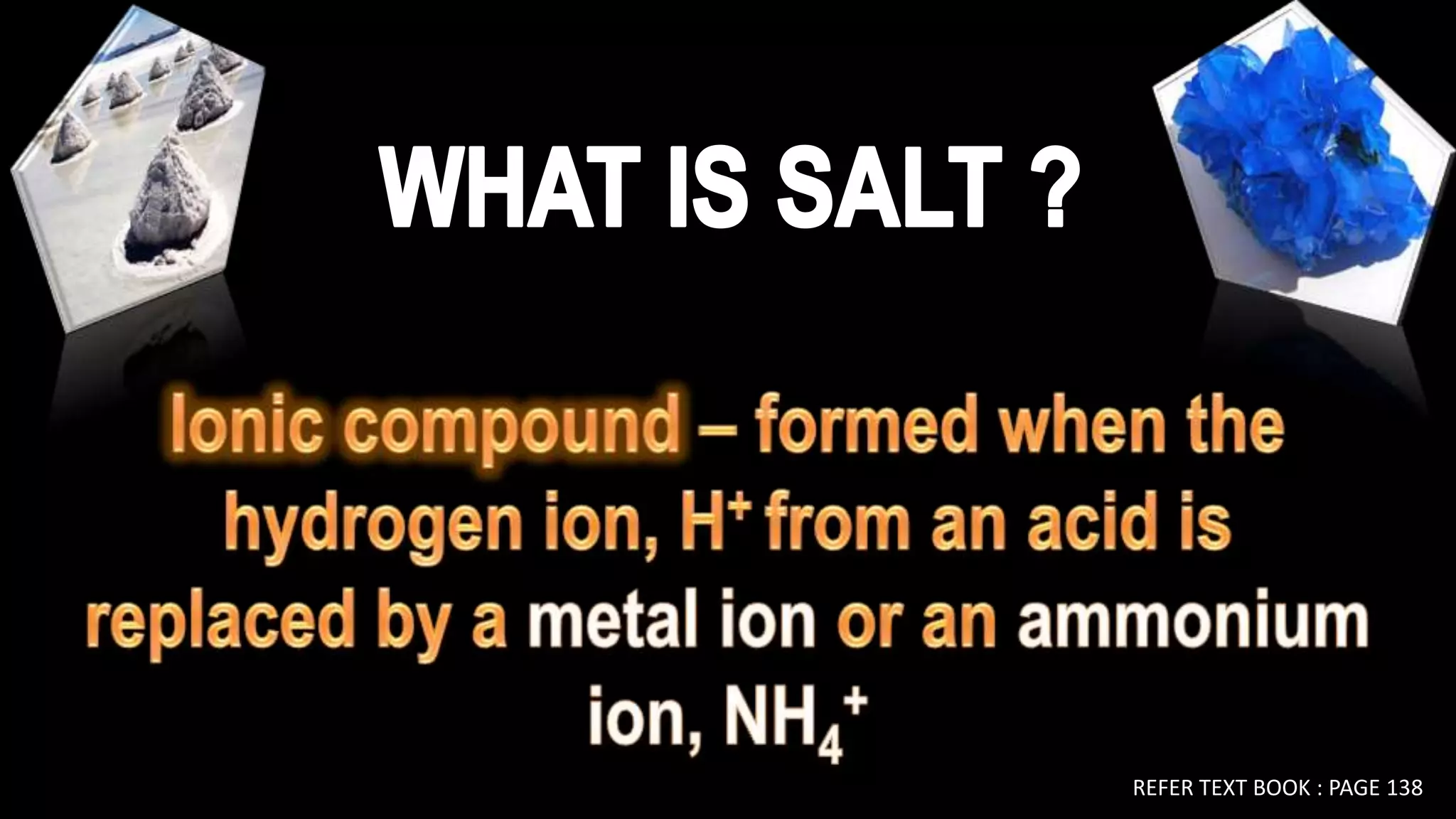
WHAT IS SALT ?WHO IS SALT ?Ionic compound – formed when the hydrogen ion, H+ from an acid is replaced by a metal ion or an ammonium ion, NH4+REFER TEXT BOOK : PAGE 138
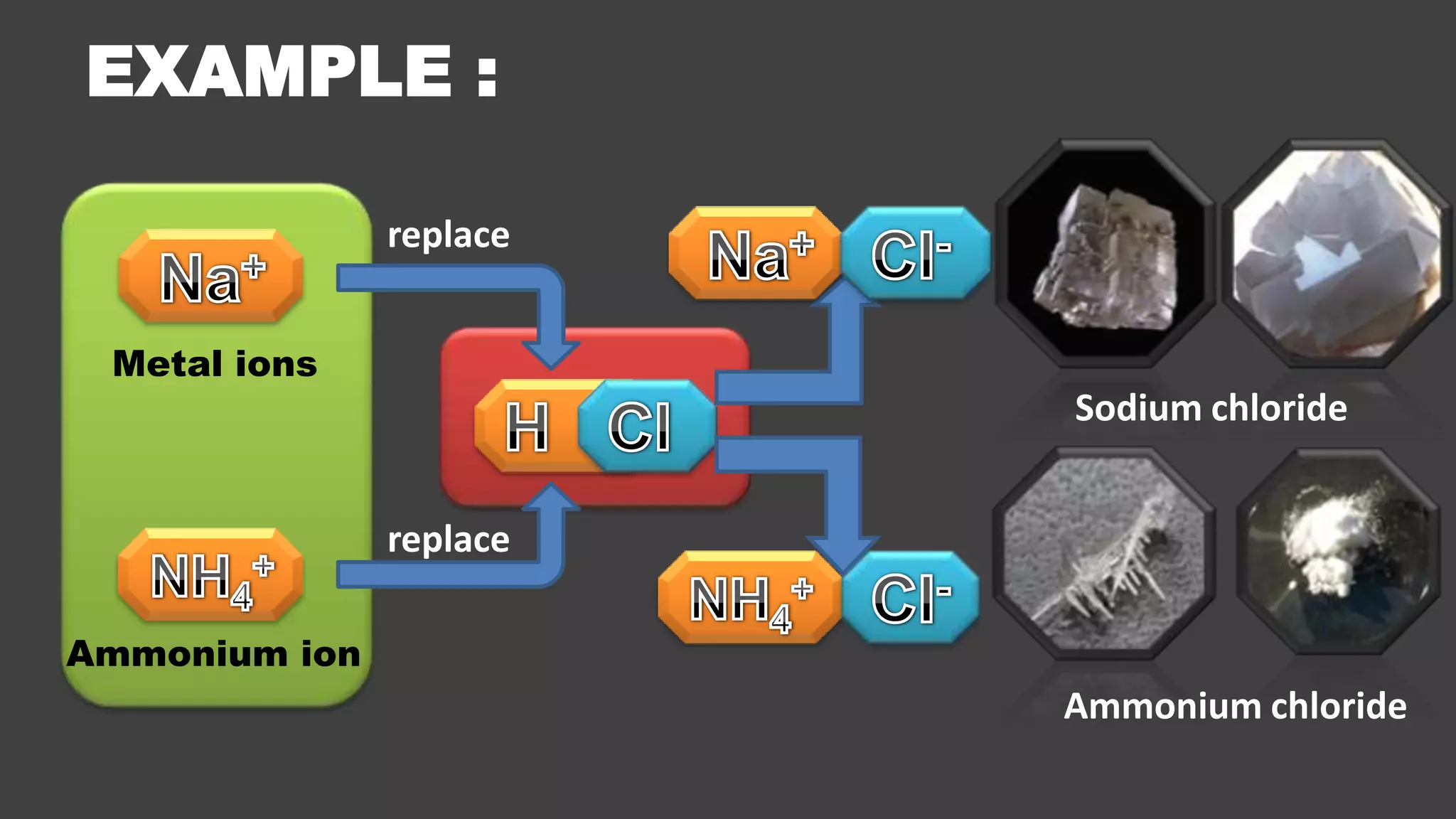
EXAMPLE :replaceNa+Na+Cl-Metal ionsSodium chlorideHClreplaceNH4+NH4+Cl-Ammonium ionAmmonium chloride
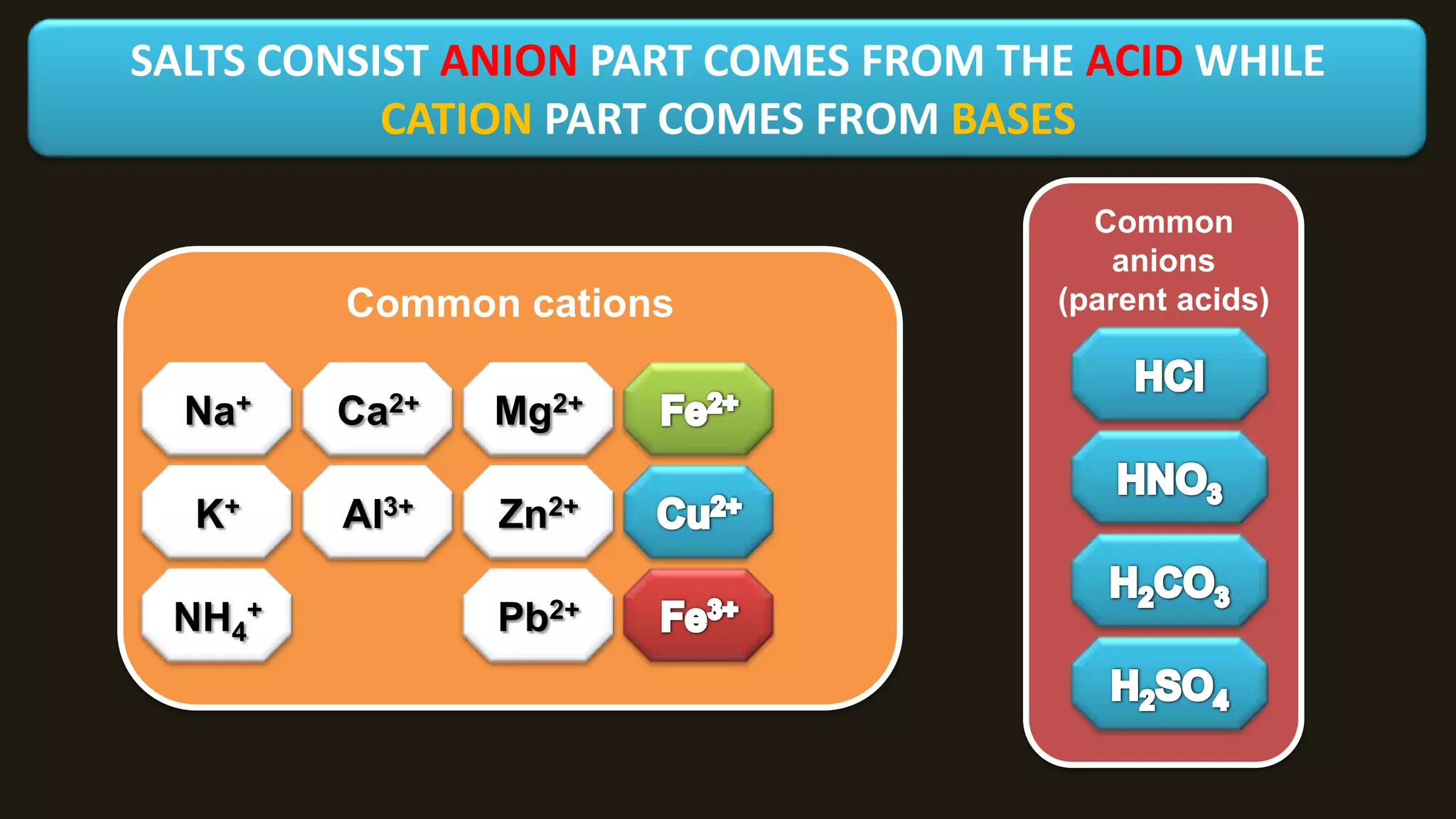
SALTS CONSIST ANION PART COMES FROM THE ACID WHILE CATION PART COMES FROM BASESCommon anions (parent acids)Common cationsHClNa+Ca2+Mg2+Fe2+HNO3K+Cu2+Al3+Zn2+H2CO3NH4+Fe3+Pb2+H2SO4
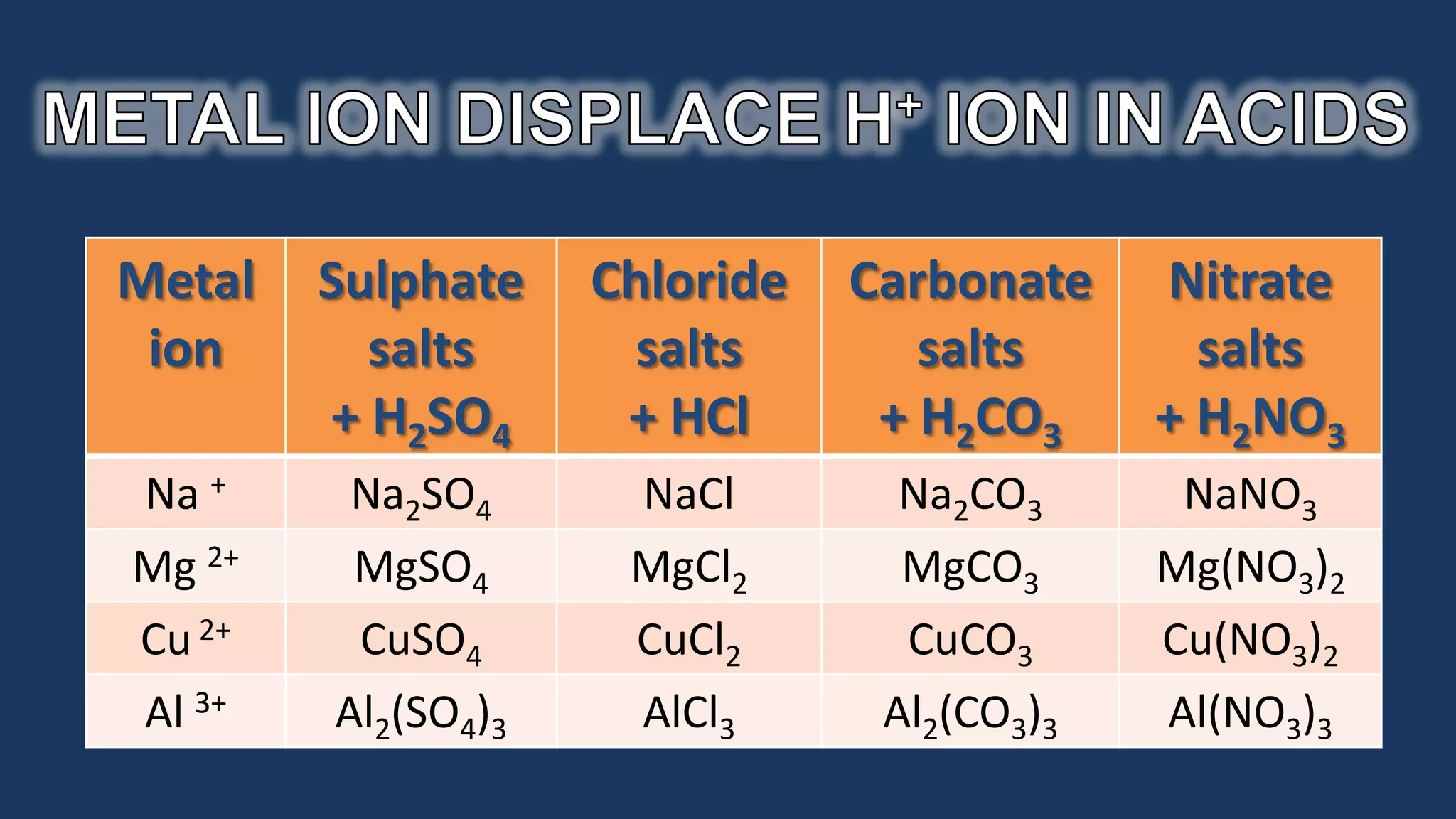
METAL ION DISPLACE H+ ION IN ACIDS
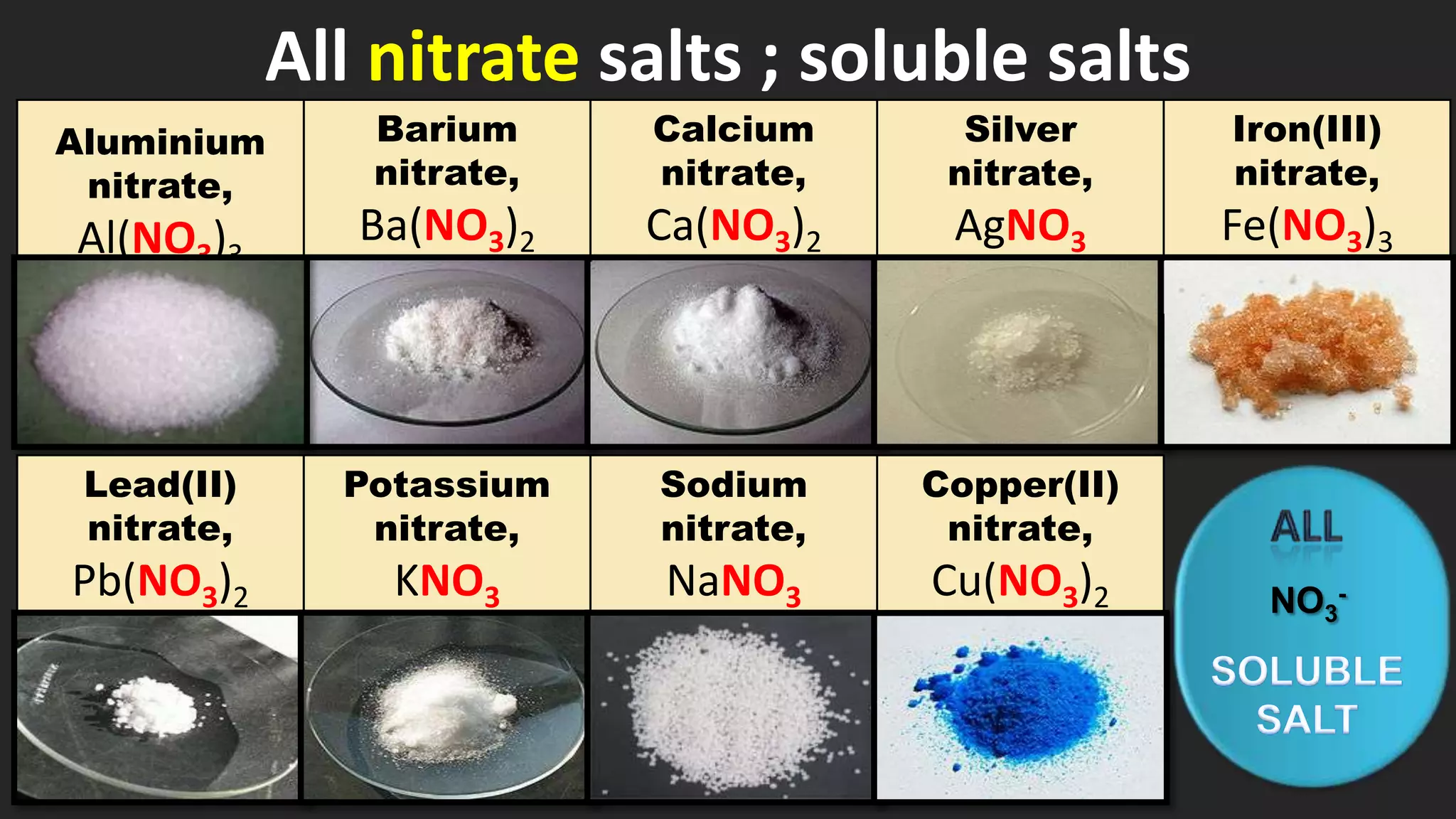
All nitrate salts ; soluble saltsALLNO3-SOLUBLE SALT
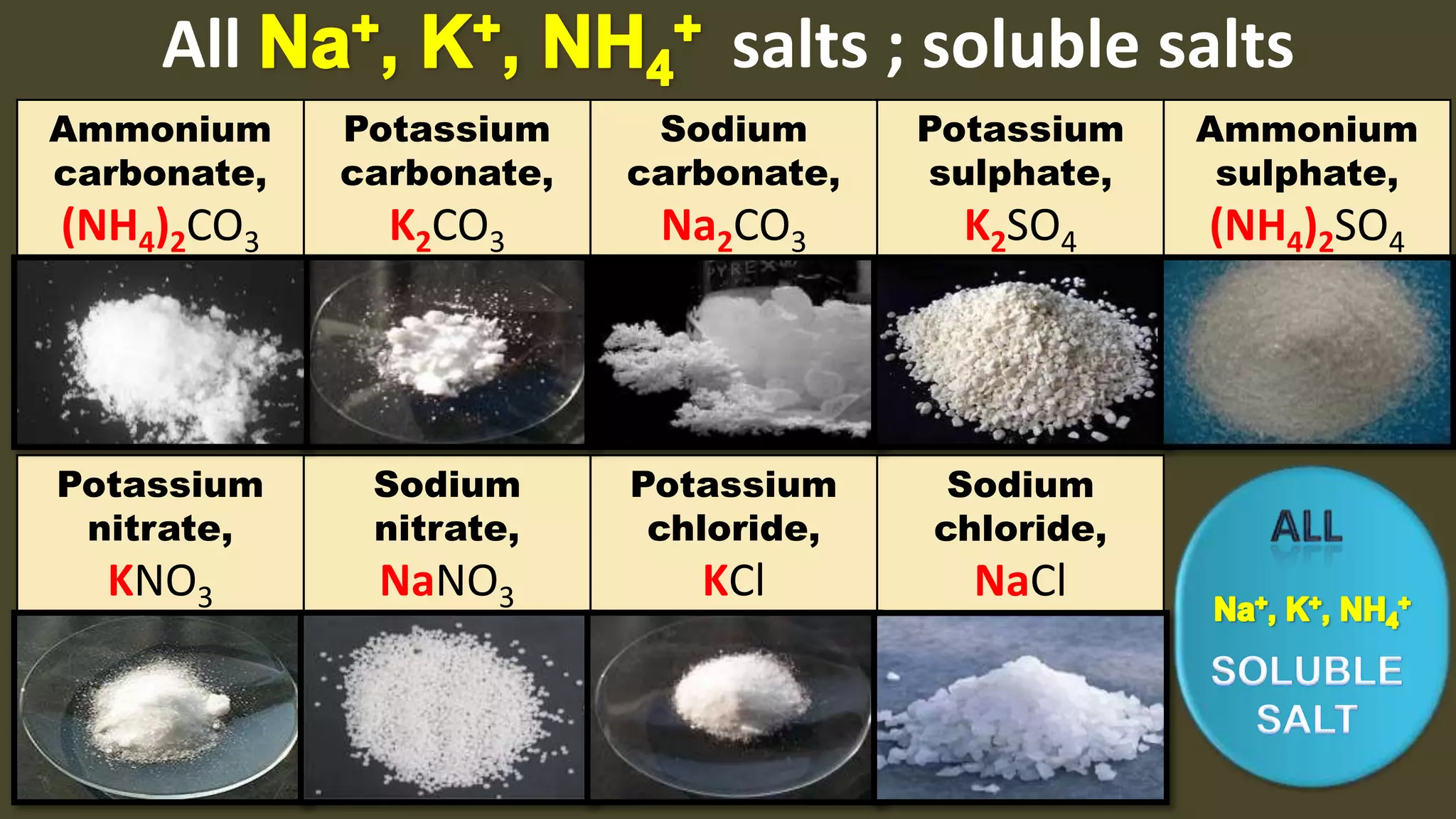
All Na+, K+, NH4+  salts ; soluble saltsALLNa+, K+, NH4+SOLUBLE SALT
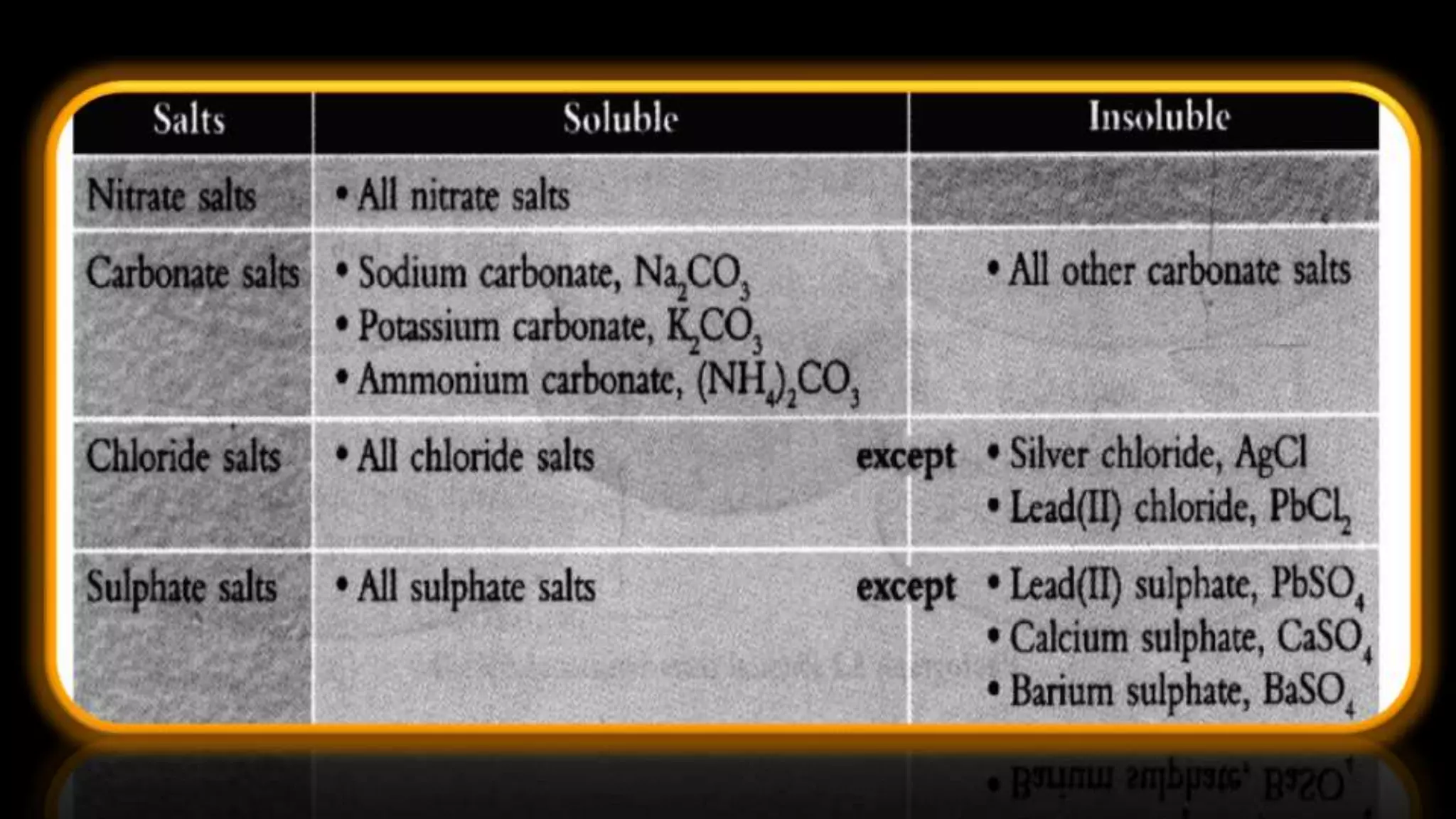
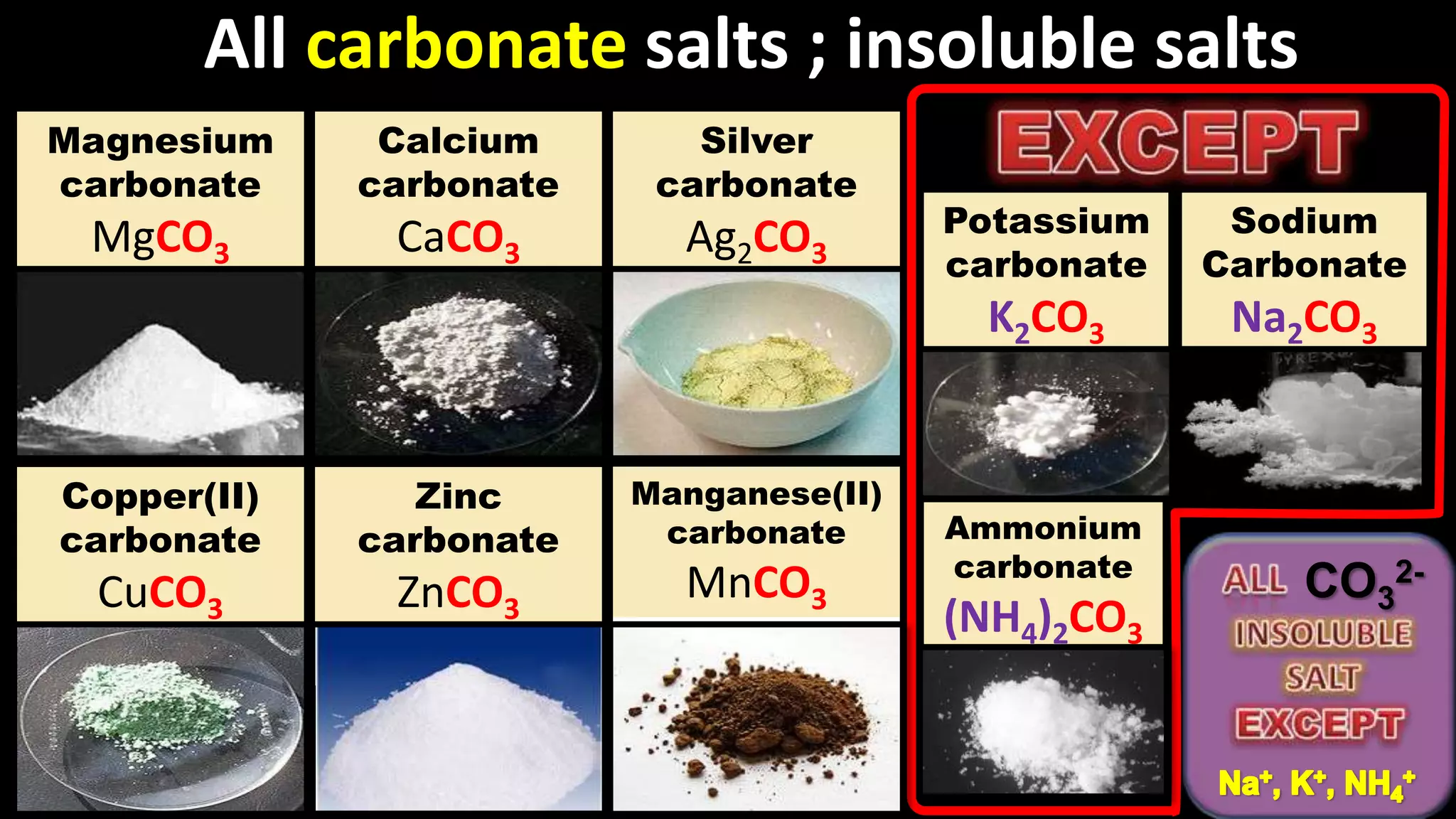
All carbonate salts ; insoluble saltsEXCEPTCO32-ALLINSOLUBLE SALTEXCEPTNa+, K+, NH4+
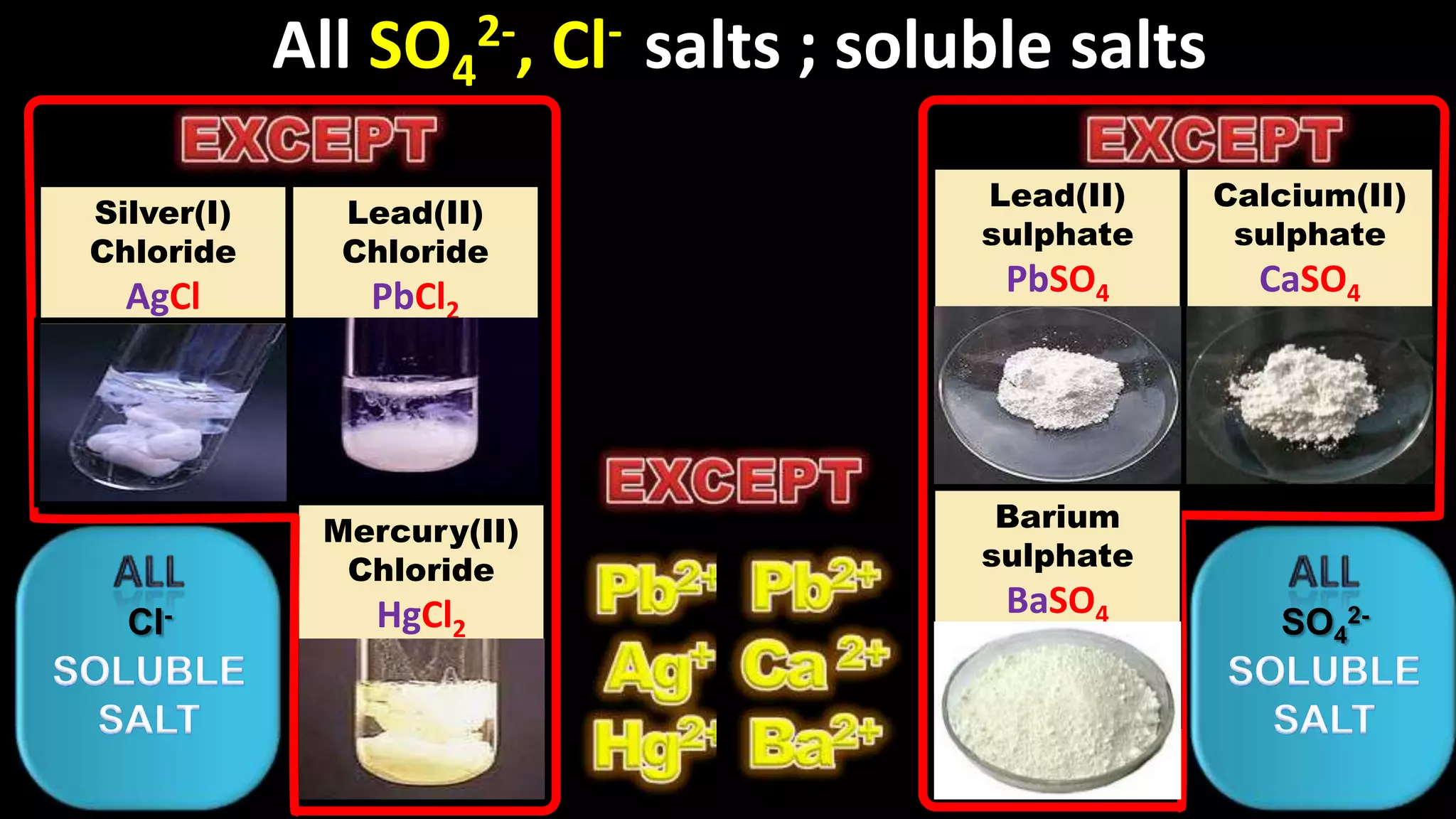
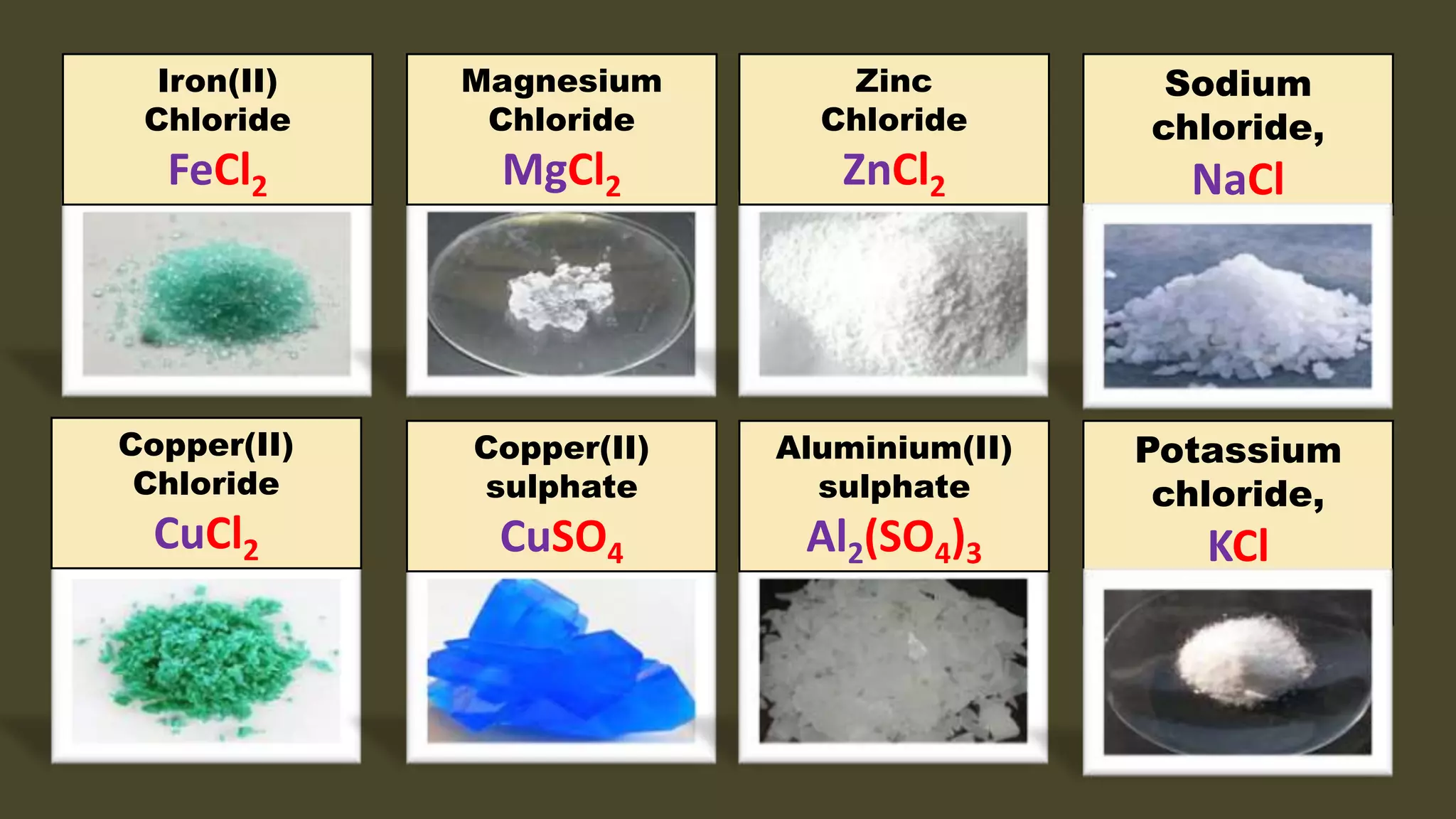
All SO42-, Cl-  salts ; soluble saltsEXCEPTEXCEPTEXCEPTALLALLPb2+Ag+ Hg2+Pb2+Ca 2+Ba2+Cl-SO42-SOLUBLE SALTSOLUBLE SALT
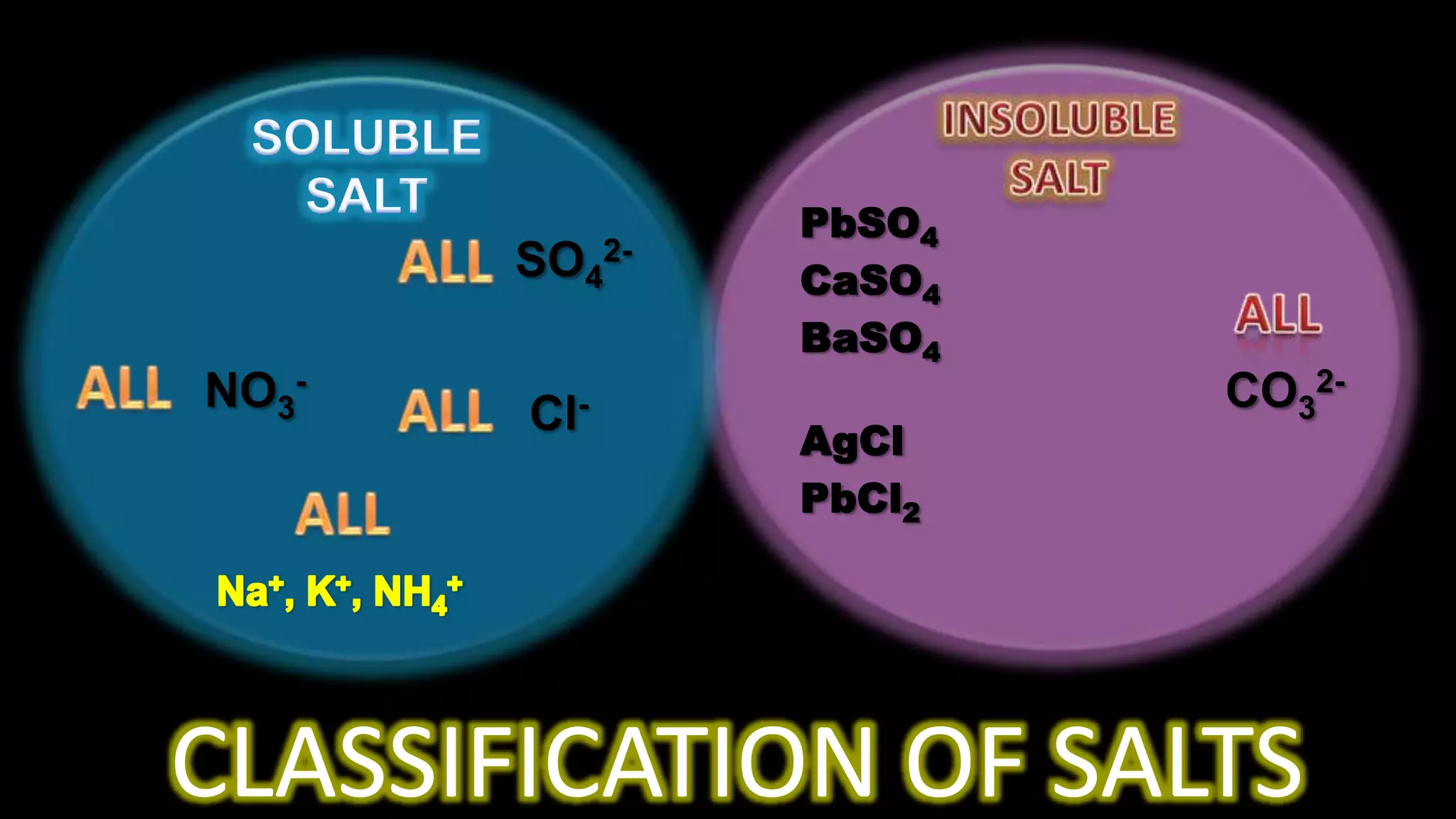
INSOLUBLE SALTSOLUBLE SALTPbSO4ALLSO42-CaSO4ALLBaSO4ALLNO3-CO32-ALLCl-AgClALLPbCl2Na+, K+, NH4+CLASSIFICATION OF SALTS
PREPARATION OF SALTSSOLUBLE SALTSINSOLUBLE SALTSNEUTRALISATIONOTHER METHODPRECIPITATIONACID + METALACID + ALKALISOLUBLE SALT +SOLUBLE SALTACID + METAL OXIDE[SPA]Sodium ,Na+ saltsPotassium, K+ saltsAmmonium, NH4+ saltsINSOLUBLE SALT & SOLUBLE SALTACID + METAL CARBONATEOTHER SOLUBLE SALTS
PREPARATION OF SOLUBLE SALTS[ SODIUM SALTS / POTASSIUM SALTS / AMMONIUM SALTS ]NEUTRALISATION REACTIONEXAMPLEPREPARATION OF POTASSIUM CHLORIDEKOHHClClKH2OALKALIACIDSALTSTITRATION METHOD – FIND OUT THE EXACTLY VOLUME OF ACID REQUIRED TO NEUTRALISE ALKALI.END POINT – POINT WHEN INDICATOR CHANGES COLOUR DURING TITRATIONNOTE : CONCENTRATION AND VOLUME OF ALKALI ARE KNOWN.
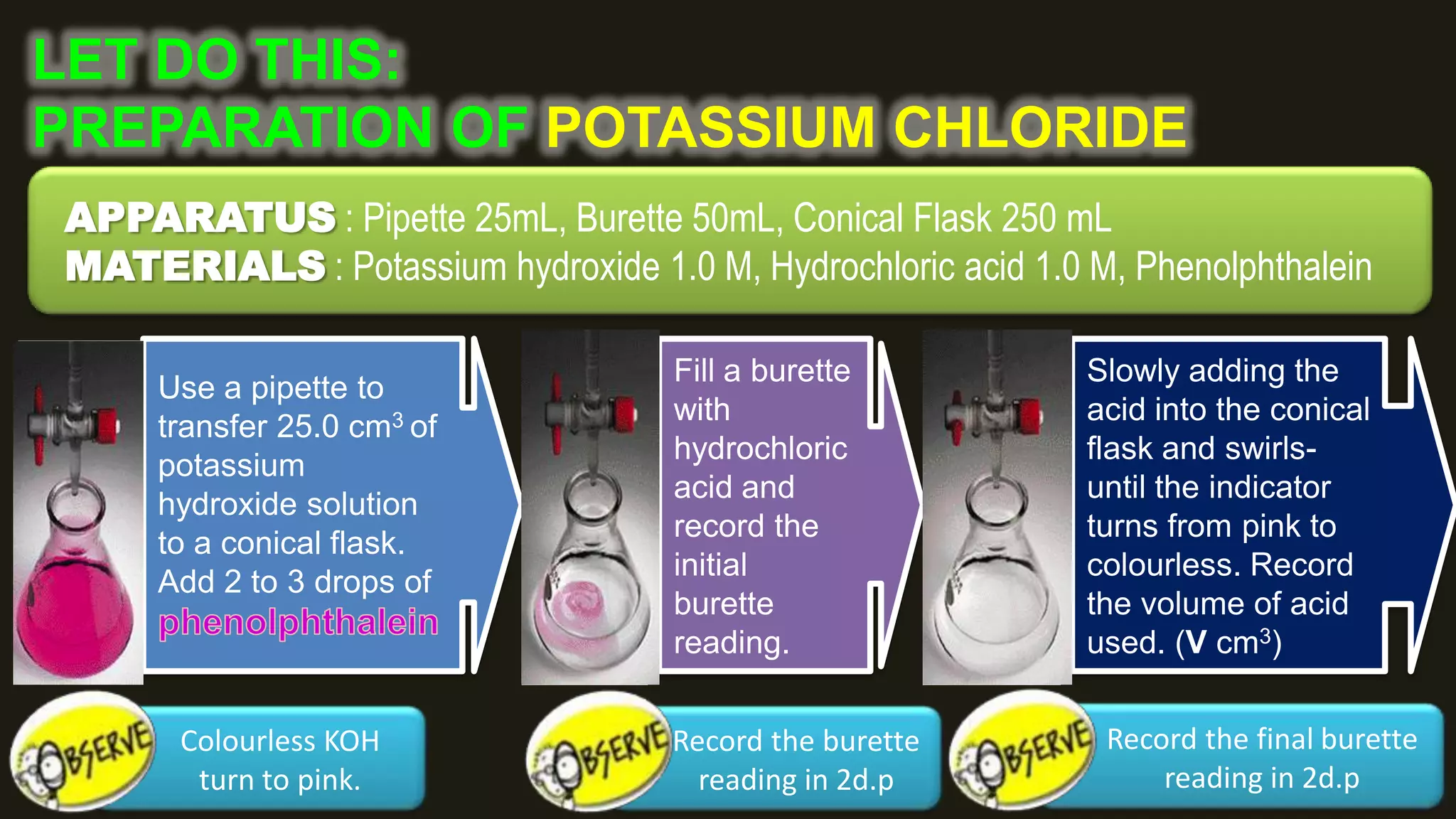
LET DO THIS: PREPARATION OF POTASSIUM CHLORIDEAPPARATUS : Pipette 25mL, Burette 50mL, Conical Flask 250 mLMATERIALS : Potassium hydroxide 1.0 M, Hydrochloric acid 1.0 M, PhenolphthaleinUse a pipette to transfer 25.0 cm3 of potassium hydroxide solution to a conical flask.Add 2 to 3 drops of phenolphthaleinFill a burette with hydrochloric acid and record the initial burette reading.Slowly adding the acid into the conical flask and swirls- until the indicator turns from pink to colourless. Record the volume of acid used. (V cm3)Record the final burette reading in 2d.pColourless KOH turn to pink.Record the burette reading in 2d.p
PREPARATION OF POTASSIUM CHLORIDESTART OVER AGAIN BUT WITHOUT INDICATOR : To get the pure and neutral salt solutionPipette 25.0 cm3 of the same potassium hydroxide solution into a conical flask.Do not add any indicator.From the burette, add exactly V cm3 of hydrochloric acid to the alkali and swirls and shake well.RECRYSTALLISATION PROCESS[PURIFIED SOLUBLE SALTS]HEATING/EVAPORATECOOLINGFILTRATIONDRYSolution salt contains impurities continuous with recrystallisation process    CRYSTAL SALT
PREPARATION OF SOLUBLE SALTS[  OTHER SALTS EXCEPT Na+, K+, NH4+]OTHER METHOD : DISSOLVE METAL IN ACIDPour 50 cm3of sulphuric acid into a beaker. Warm the acidUse a spatula to add copper(II) oxide powder bit by bit into the acid. Stir the mixture well. Continue adding copper(II) oxide until some of it no longer dissolves(excess unreacted metalMetal/ metal oxide/ metal carbonateExcess unreactedmetal (residue)Glass rodAcidEvaporating basin with salt solution (filtrate)Solution salt contains impurities continuous with recrystallisation process    See the change of metal solid colour and dissolve
RECRYSTALLISATION PROCESS [PURIFIED SOLUBLE SALTS]HEATING/EVAPORATECOOLINGSalt solutionEvaporating basinCrystal salt
RECRYSTALLISATION PROCESS [PURIFIED SOLUBLE SALTS]FILTRATIONDRYCRYSTAL SALTThese physical characteristics:Regulars geometry shapes, such as cubic or hexagonal.
Flat faces, straight edges and sharp angles.
Same angle between adjacent faces.Glass rodRinse with distilled waterFilter PaperSalt CystalsThe crystals are filtered and rinsed with a little cold distilled water.
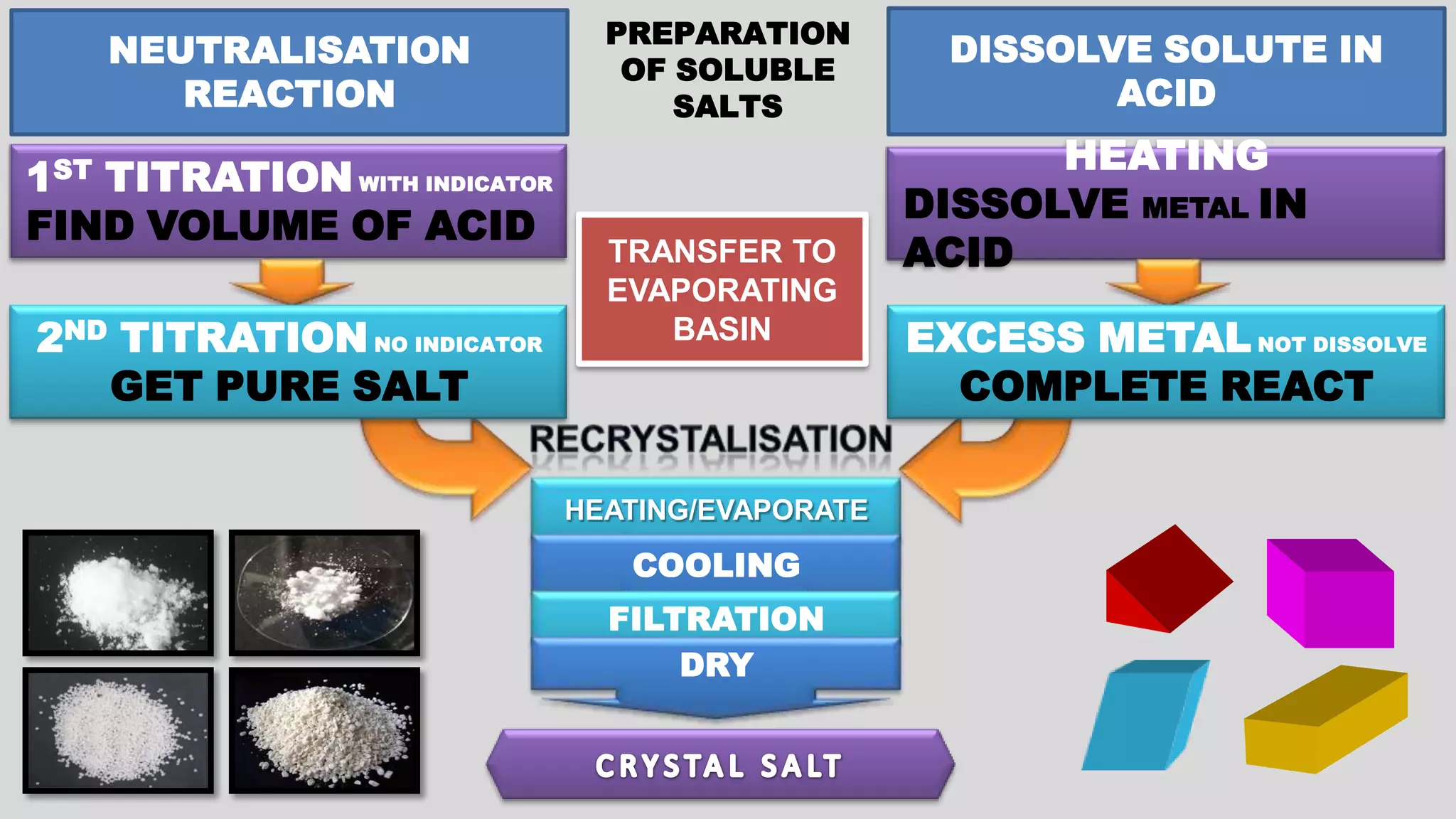
DISSOLVE SOLUTE IN ACIDPREPARATION OF SOLUBLE SALTSNEUTRALISATION REACTION1ST TITRATION WITH INDICATORFIND VOLUME OF ACIDHEATINGDISSOLVE METAL IN ACIDTRANSFER TO EVAPORATING BASINEXCESS METAL NOT DISSOLVECOMPLETE REACT2ND TITRATION NO INDICATORGET PURE SALTrecrystalisationHEATING/EVAPORATECOOLINGFILTRATIONDRYCRYSTAL SALT
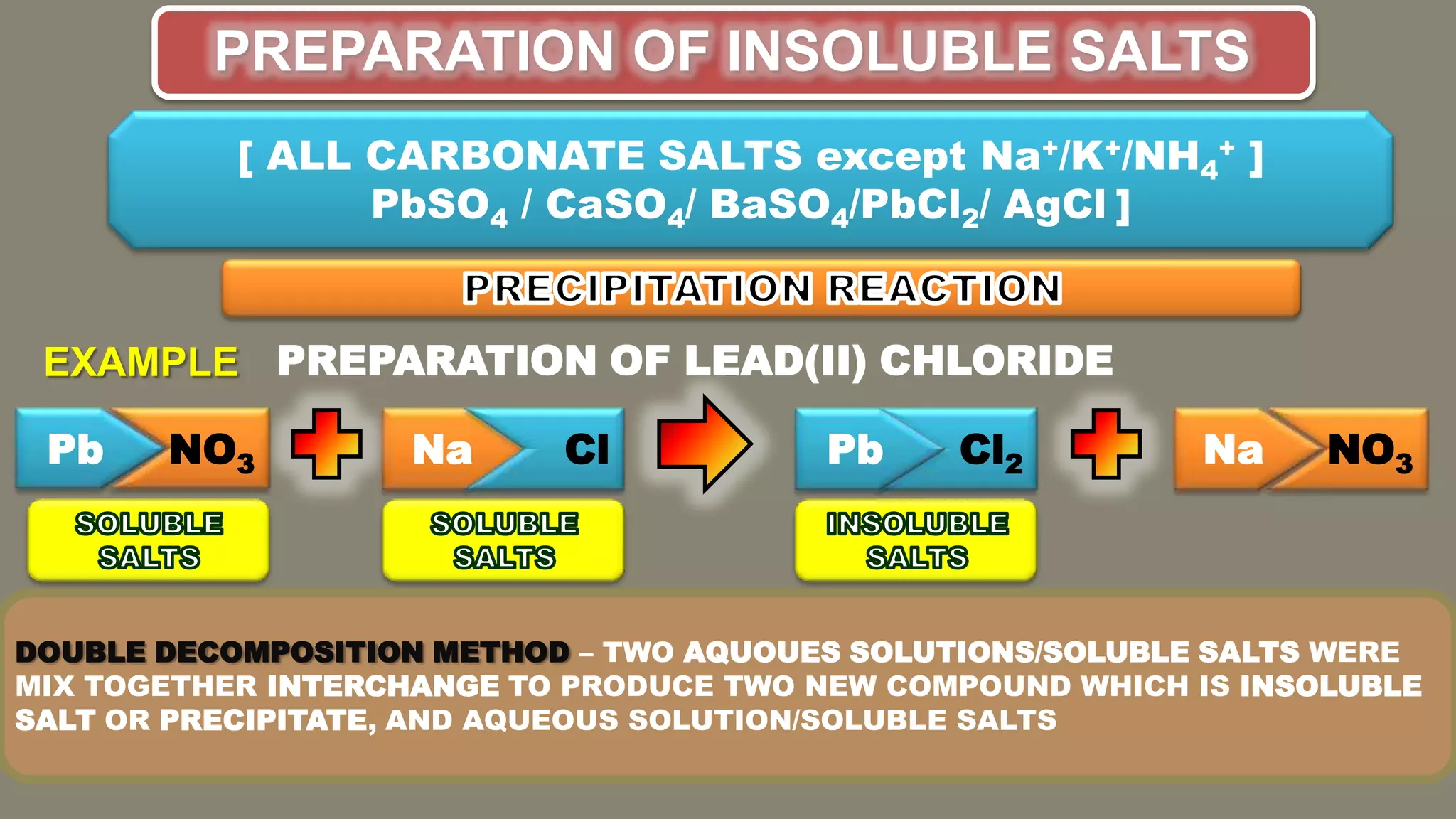
PREPARATION OF INSOLUBLE SALTS[ ALL CARBONATE SALTS except Na+/K+/NH4+ ]PbSO4 / CaSO4/ BaSO4/PbCl2/ AgCl]PRECIPITATION REACTIONPREPARATION OF LEAD(II) CHLORIDEEXAMPLEPbNO3NaClCl2PbNO3NaSOLUBLE SALTSSOLUBLE SALTSINSOLUBLESALTSDOUBLE DECOMPOSITION METHOD – TWO AQUOUES SOLUTIONS/SOLUBLE SALTS WERE MIX TOGETHER INTERCHANGE TO PRODUCE TWO NEW COMPOUND WHICH IS INSOLUBLESALT OR PRECIPITATE, AND AQUEOUS SOLUTION/SOLUBLE SALTS
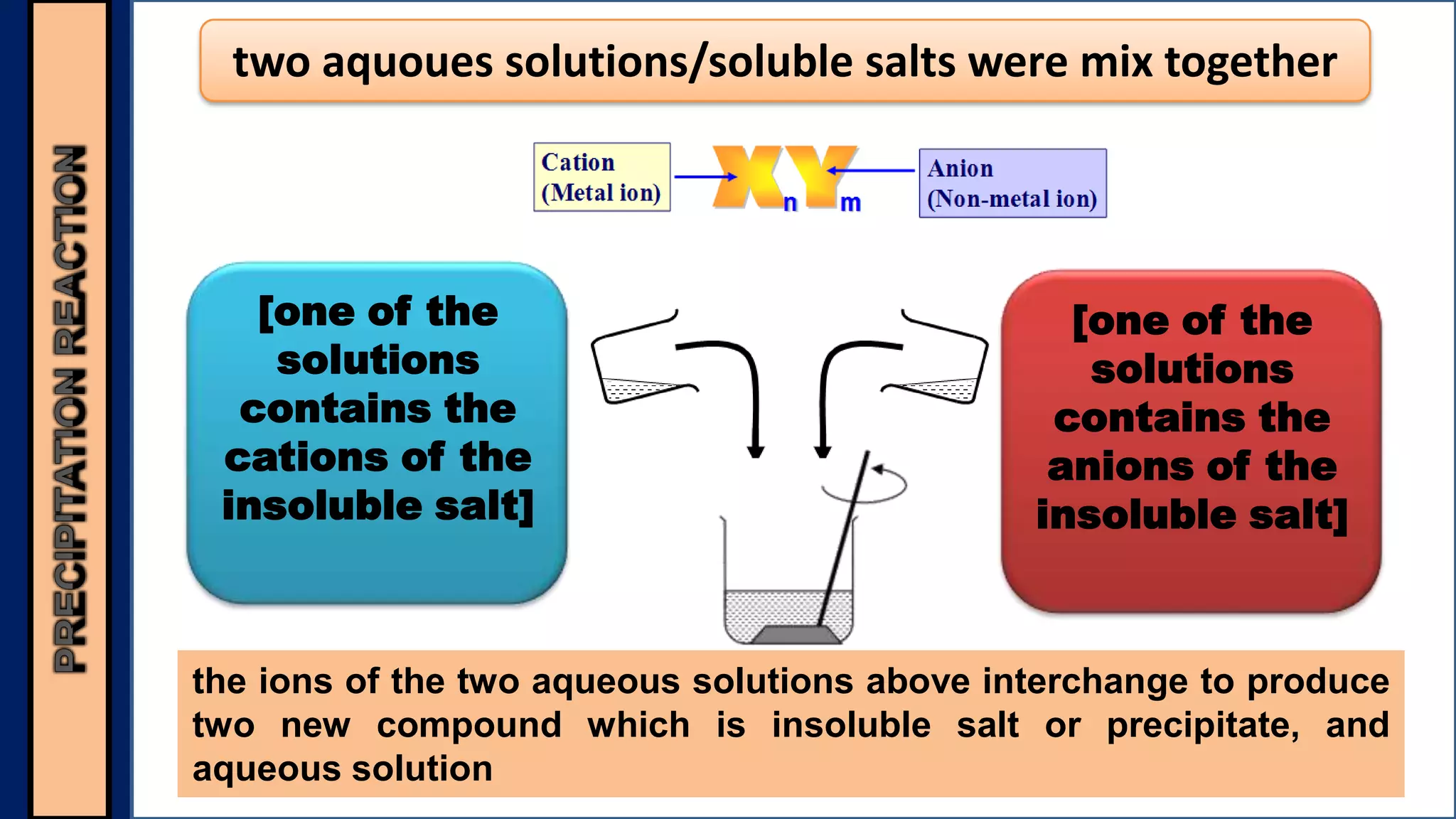
PRECIPITATION REACTIONtwo aquoues solutions/soluble salts were mix together[one of the solutions contains the cations of the insoluble salt] [one of the solutions contains the anions of the insoluble salt]the ions of the two aqueous solutions above interchange to produce two new compound which is insoluble salt or precipitate, and aqueous solution
PRECIPITATION REACTIONGlass rodGlass rodDistilled waterMixture solutionsFilter paperPrecipitate (residue)Precipitate (residue)Filter funnelRetort standAqueous Solution (filterate)Rinse : remove other ions from precipitateFiltration : Remove solution from precipitateFILTRATIONRINSE
PRECIPITATION REACTIONFLOW CHART : PREPARATION OF INSOLUBLE SALTSPrecipitate/Soluble saltsFilter paperMIX - STIRTWO SOLUBLE SALTSDry : Dried by pressing between two pieces of filter paper. FILTRATIONREMOVE FILTRATERINSEREMOVE OTHER IONS DRYPRESS BETWEEN FILTER PAPER
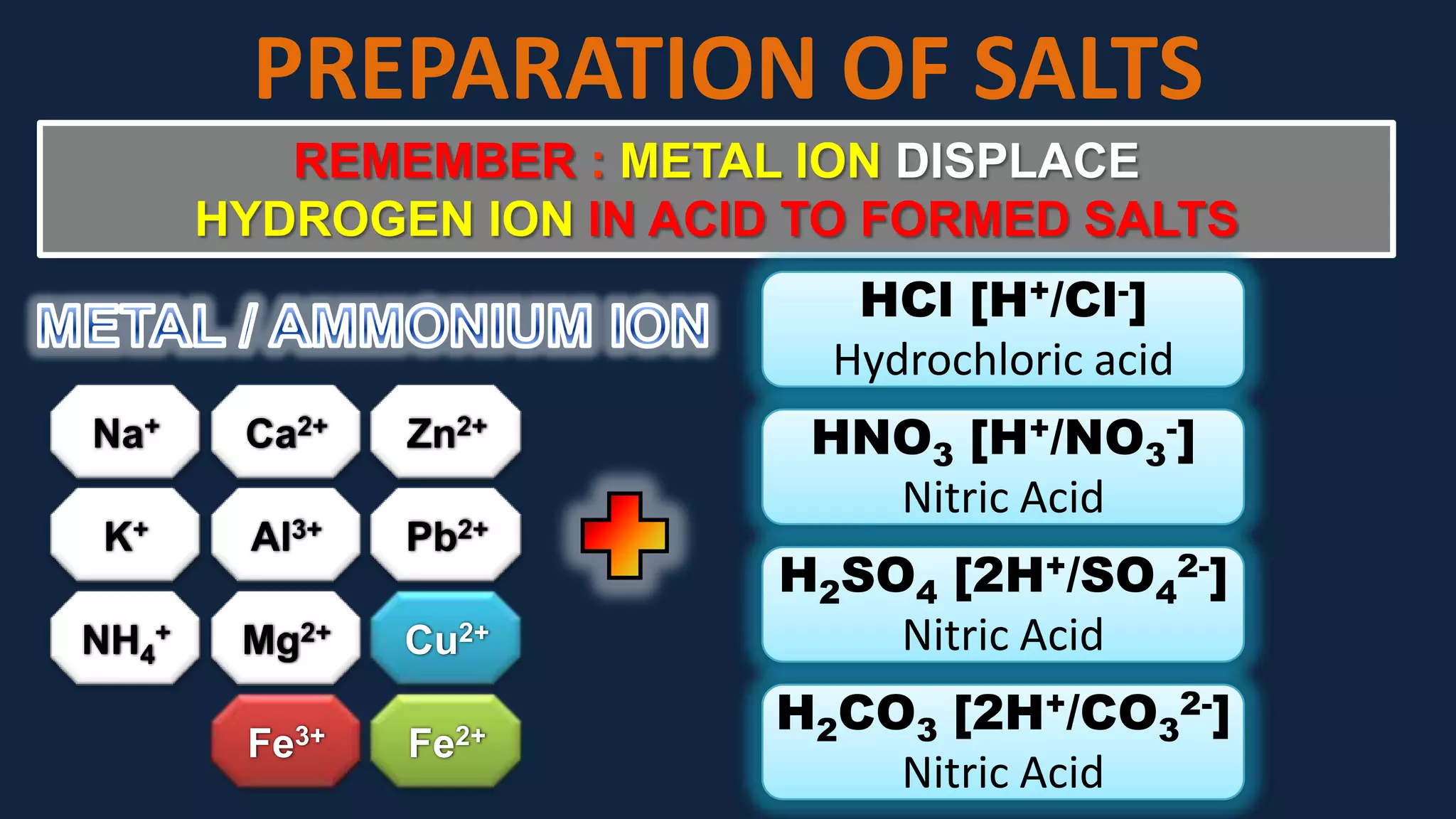
PREPARATION OF SALTSREMEMBER : METAL ION DISPLACEHYDROGEN ION IN ACID TO FORMED SALTSHCl [H+/Cl-]Hydrochloric acidMETAL / AMMONIUM IONNa+Ca2+Zn2+HNO3 [H+/NO3-]Nitric AcidK+Al3+Pb2+H2SO4 [2H+/SO42-]Nitric AcidNH4+Mg2+Cu2+H2CO3 [2H+/CO32-]Nitric AcidFe2+Fe3+
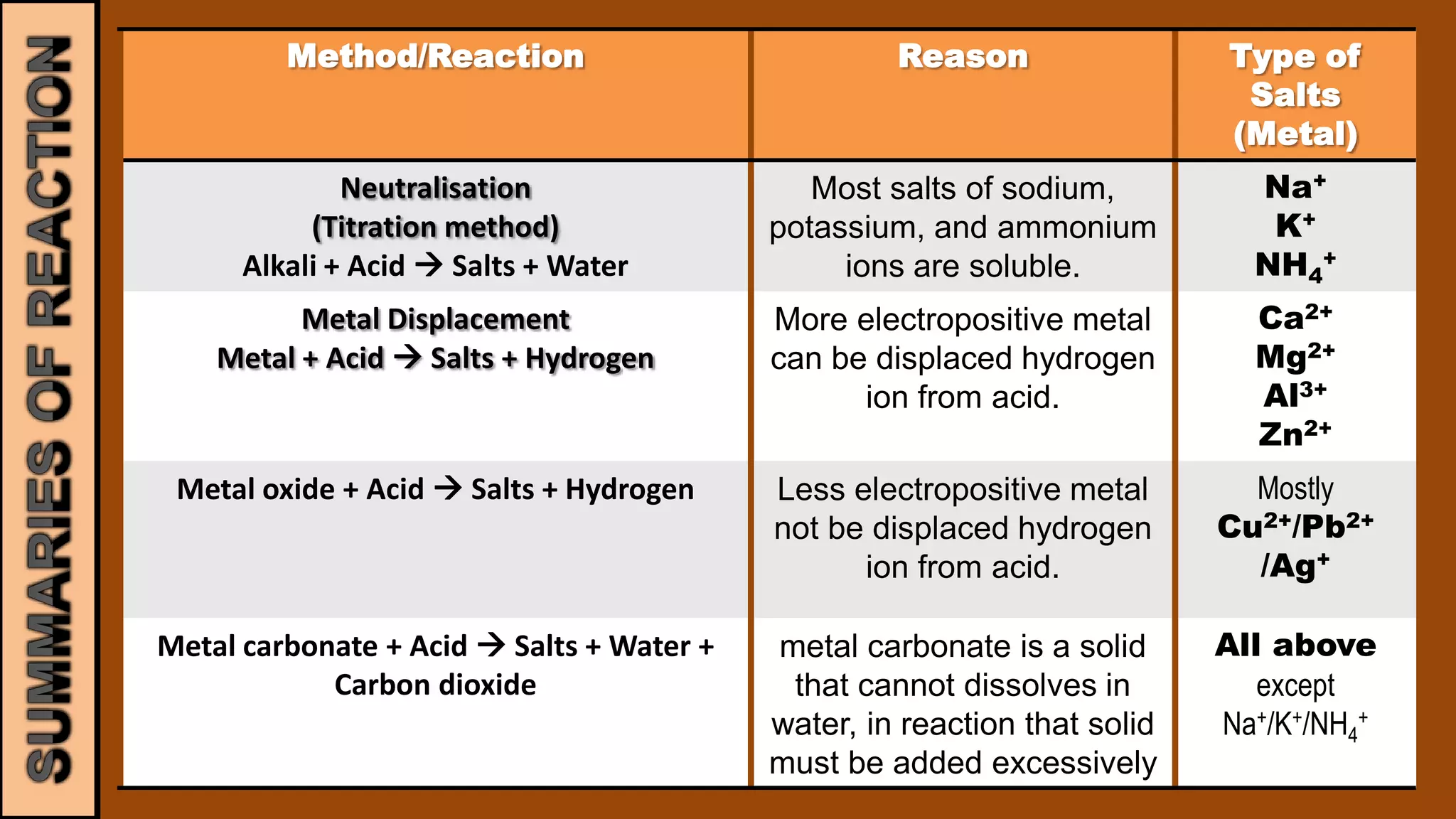
SUMMARIES OF REACTION
EXTRA INFO : REMEMBERReactive metal is magnesium, aluminium, and zinc. Unreactivemetal is iron, lead, silver Metal that is less reactive from hydrogen such as copper, lead and silver did not react with dilute acid. Soluble salts of sodium, potassium and ammonium can be prepared by the reaction between an acid and alkali.

Chapter 8 : SALTS

  • 1.
  • 2.
  • 3.
    WHAT IS SALT?WHO IS SALT ?Ionic compound – formed when the hydrogen ion, H+ from an acid is replaced by a metal ion or an ammonium ion, NH4+REFER TEXT BOOK : PAGE 138
  • 4.
    EXAMPLE :replaceNa+Na+Cl-Metal ionsSodiumchlorideHClreplaceNH4+NH4+Cl-Ammonium ionAmmonium chloride
  • 5.
    SALTS CONSIST ANIONPART COMES FROM THE ACID WHILE CATION PART COMES FROM BASESCommon anions (parent acids)Common cationsHClNa+Ca2+Mg2+Fe2+HNO3K+Cu2+Al3+Zn2+H2CO3NH4+Fe3+Pb2+H2SO4
  • 6.
    METAL ION DISPLACEH+ ION IN ACIDS
  • 8.
    All nitrate salts; soluble saltsALLNO3-SOLUBLE SALT
  • 9.
    All Na+, K+,NH4+ salts ; soluble saltsALLNa+, K+, NH4+SOLUBLE SALT
  • 10.
    All carbonate salts; insoluble saltsEXCEPTCO32-ALLINSOLUBLE SALTEXCEPTNa+, K+, NH4+
  • 11.
    All SO42-, Cl- salts ; soluble saltsEXCEPTEXCEPTEXCEPTALLALLPb2+Ag+ Hg2+Pb2+Ca 2+Ba2+Cl-SO42-SOLUBLE SALTSOLUBLE SALT
  • 13.
  • 14.
    PREPARATION OF SALTSSOLUBLESALTSINSOLUBLE SALTSNEUTRALISATIONOTHER METHODPRECIPITATIONACID + METALACID + ALKALISOLUBLE SALT +SOLUBLE SALTACID + METAL OXIDE[SPA]Sodium ,Na+ saltsPotassium, K+ saltsAmmonium, NH4+ saltsINSOLUBLE SALT & SOLUBLE SALTACID + METAL CARBONATEOTHER SOLUBLE SALTS
  • 15.
    PREPARATION OF SOLUBLESALTS[ SODIUM SALTS / POTASSIUM SALTS / AMMONIUM SALTS ]NEUTRALISATION REACTIONEXAMPLEPREPARATION OF POTASSIUM CHLORIDEKOHHClClKH2OALKALIACIDSALTSTITRATION METHOD – FIND OUT THE EXACTLY VOLUME OF ACID REQUIRED TO NEUTRALISE ALKALI.END POINT – POINT WHEN INDICATOR CHANGES COLOUR DURING TITRATIONNOTE : CONCENTRATION AND VOLUME OF ALKALI ARE KNOWN.
  • 16.
    LET DO THIS:PREPARATION OF POTASSIUM CHLORIDEAPPARATUS : Pipette 25mL, Burette 50mL, Conical Flask 250 mLMATERIALS : Potassium hydroxide 1.0 M, Hydrochloric acid 1.0 M, PhenolphthaleinUse a pipette to transfer 25.0 cm3 of potassium hydroxide solution to a conical flask.Add 2 to 3 drops of phenolphthaleinFill a burette with hydrochloric acid and record the initial burette reading.Slowly adding the acid into the conical flask and swirls- until the indicator turns from pink to colourless. Record the volume of acid used. (V cm3)Record the final burette reading in 2d.pColourless KOH turn to pink.Record the burette reading in 2d.p
  • 17.
    PREPARATION OF POTASSIUMCHLORIDESTART OVER AGAIN BUT WITHOUT INDICATOR : To get the pure and neutral salt solutionPipette 25.0 cm3 of the same potassium hydroxide solution into a conical flask.Do not add any indicator.From the burette, add exactly V cm3 of hydrochloric acid to the alkali and swirls and shake well.RECRYSTALLISATION PROCESS[PURIFIED SOLUBLE SALTS]HEATING/EVAPORATECOOLINGFILTRATIONDRYSolution salt contains impurities continuous with recrystallisation process CRYSTAL SALT
  • 18.
    PREPARATION OF SOLUBLESALTS[ OTHER SALTS EXCEPT Na+, K+, NH4+]OTHER METHOD : DISSOLVE METAL IN ACIDPour 50 cm3of sulphuric acid into a beaker. Warm the acidUse a spatula to add copper(II) oxide powder bit by bit into the acid. Stir the mixture well. Continue adding copper(II) oxide until some of it no longer dissolves(excess unreacted metalMetal/ metal oxide/ metal carbonateExcess unreactedmetal (residue)Glass rodAcidEvaporating basin with salt solution (filtrate)Solution salt contains impurities continuous with recrystallisation process See the change of metal solid colour and dissolve
  • 19.
    RECRYSTALLISATION PROCESS [PURIFIEDSOLUBLE SALTS]HEATING/EVAPORATECOOLINGSalt solutionEvaporating basinCrystal salt
  • 20.
    RECRYSTALLISATION PROCESS [PURIFIEDSOLUBLE SALTS]FILTRATIONDRYCRYSTAL SALTThese physical characteristics:Regulars geometry shapes, such as cubic or hexagonal.
  • 21.
    Flat faces, straightedges and sharp angles.
  • 22.
    Same angle betweenadjacent faces.Glass rodRinse with distilled waterFilter PaperSalt CystalsThe crystals are filtered and rinsed with a little cold distilled water.
  • 23.
    DISSOLVE SOLUTE INACIDPREPARATION OF SOLUBLE SALTSNEUTRALISATION REACTION1ST TITRATION WITH INDICATORFIND VOLUME OF ACIDHEATINGDISSOLVE METAL IN ACIDTRANSFER TO EVAPORATING BASINEXCESS METAL NOT DISSOLVECOMPLETE REACT2ND TITRATION NO INDICATORGET PURE SALTrecrystalisationHEATING/EVAPORATECOOLINGFILTRATIONDRYCRYSTAL SALT
  • 24.
    PREPARATION OF INSOLUBLESALTS[ ALL CARBONATE SALTS except Na+/K+/NH4+ ]PbSO4 / CaSO4/ BaSO4/PbCl2/ AgCl]PRECIPITATION REACTIONPREPARATION OF LEAD(II) CHLORIDEEXAMPLEPbNO3NaClCl2PbNO3NaSOLUBLE SALTSSOLUBLE SALTSINSOLUBLESALTSDOUBLE DECOMPOSITION METHOD – TWO AQUOUES SOLUTIONS/SOLUBLE SALTS WERE MIX TOGETHER INTERCHANGE TO PRODUCE TWO NEW COMPOUND WHICH IS INSOLUBLESALT OR PRECIPITATE, AND AQUEOUS SOLUTION/SOLUBLE SALTS
  • 25.
    PRECIPITATION REACTIONtwo aquouessolutions/soluble salts were mix together[one of the solutions contains the cations of the insoluble salt] [one of the solutions contains the anions of the insoluble salt]the ions of the two aqueous solutions above interchange to produce two new compound which is insoluble salt or precipitate, and aqueous solution
  • 26.
    PRECIPITATION REACTIONGlass rodGlassrodDistilled waterMixture solutionsFilter paperPrecipitate (residue)Precipitate (residue)Filter funnelRetort standAqueous Solution (filterate)Rinse : remove other ions from precipitateFiltration : Remove solution from precipitateFILTRATIONRINSE
  • 27.
    PRECIPITATION REACTIONFLOW CHART: PREPARATION OF INSOLUBLE SALTSPrecipitate/Soluble saltsFilter paperMIX - STIRTWO SOLUBLE SALTSDry : Dried by pressing between two pieces of filter paper. FILTRATIONREMOVE FILTRATERINSEREMOVE OTHER IONS DRYPRESS BETWEEN FILTER PAPER
  • 28.
    PREPARATION OF SALTSREMEMBER: METAL ION DISPLACEHYDROGEN ION IN ACID TO FORMED SALTSHCl [H+/Cl-]Hydrochloric acidMETAL / AMMONIUM IONNa+Ca2+Zn2+HNO3 [H+/NO3-]Nitric AcidK+Al3+Pb2+H2SO4 [2H+/SO42-]Nitric AcidNH4+Mg2+Cu2+H2CO3 [2H+/CO32-]Nitric AcidFe2+Fe3+
  • 29.
  • 30.
    EXTRA INFO :REMEMBERReactive metal is magnesium, aluminium, and zinc. Unreactivemetal is iron, lead, silver Metal that is less reactive from hydrogen such as copper, lead and silver did not react with dilute acid. Soluble salts of sodium, potassium and ammonium can be prepared by the reaction between an acid and alkali.
  • 31.
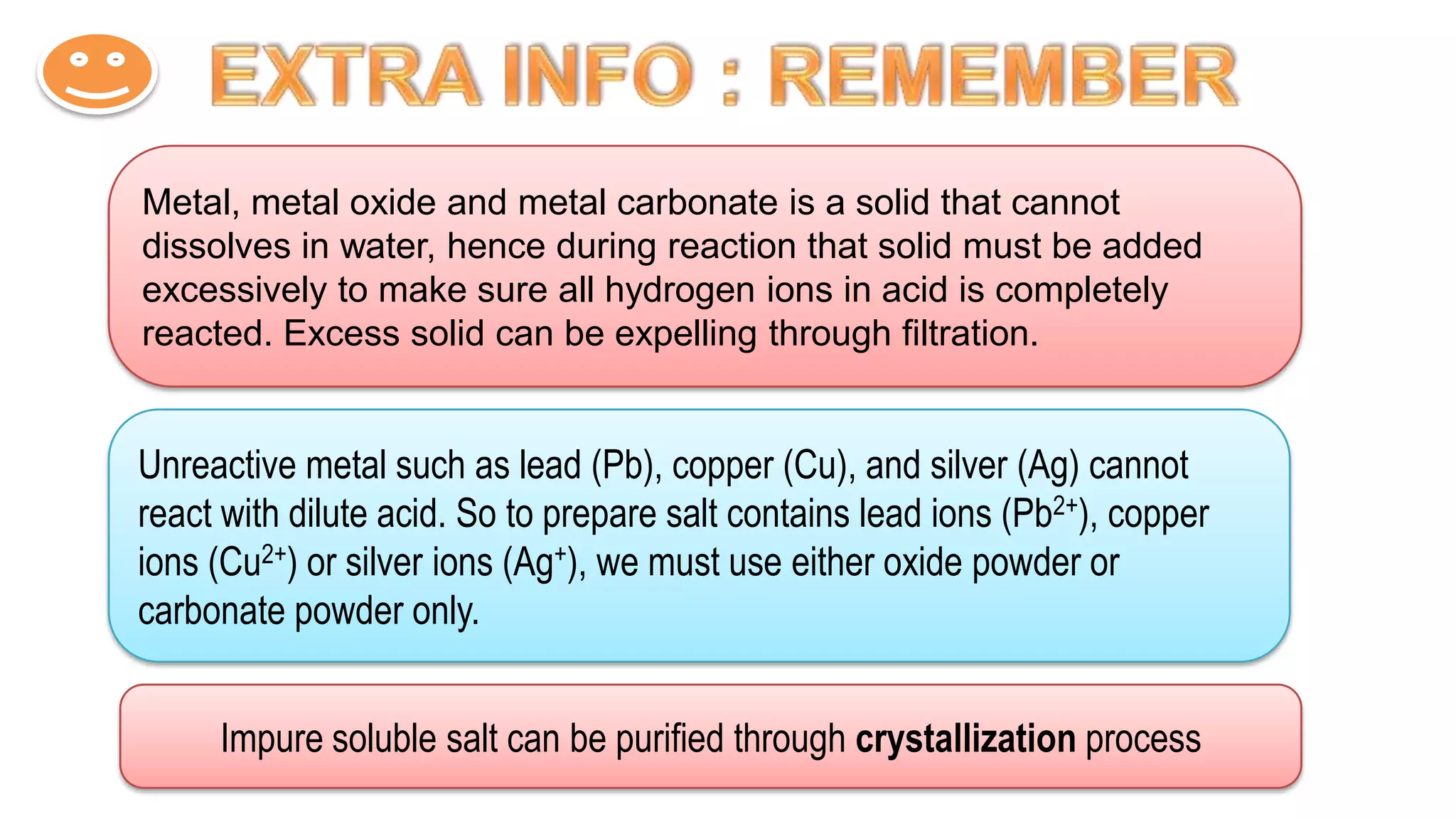
    EXTRA INFO :REMEMBERMetal, metal oxide and metal carbonate is a solid that cannot dissolves in water, hence during reaction that solid must be added excessively to make sure all hydrogen ions in acid is completely reacted. Excess solid can be expelling through filtration.Unreactive metal such as lead (Pb), copper (Cu), and silver (Ag) cannot react with dilute acid. So to prepare salt contains lead ions (Pb2+), copper ions (Cu2+) or silver ions (Ag+), we must use either oxide powder or carbonate powder only.Impure soluble salt can be purified through crystallization process
  • 32.
    Copyright © 2010AlchemistFreestyle.blogspot.com