

Sample Size Issues on 
                         Reliability Test Design 
                         R li bilit T t D i
                    (可靠性试验设计中的样本量问
                           题)

                 Dr. Huairui Guo (郭怀瑞博士)
                            ©2012 ASQ & Presentation Guo
                            Presented live on Sep 15th, 2012


http://reliabilitycalendar.org/The_Re
liability_Calendar/Webinars_
liability Calendar/Webinars ‐
_Chinese/Webinars_‐_Chinese.html
ASQ Reliability Division 
                ASQ Reliability Division
                Chinese Webinar Series
                Chinese Webinar Series
                  One of the monthly webinars 
                  One of the monthly webinars
                    on topics of interest to 
                      reliability engineers.
                    To view recorded webinar (available to ASQ Reliability 
                        Division members only) visit asq.org/reliability
                                             )              /

                     To sign up for the free and available to anyone live 
                    webinars visit reliabilitycalendar.org and select English 
                    Webinars to find links to register for upcoming events


http://reliabilitycalendar.org/The_Re
liability_Calendar/Webinars_
liability Calendar/Webinars ‐
_Chinese/Webinars_‐_Chinese.html
可靠性试验设计中的样本量
 问题 (Sample Size Issues on
    Reliability Test Design)

  郭怀瑞, Ph.D., CRE, CQE, CRP

               ©1992-2012 ReliaSoft Corporation - ALL RIGHTS RESERVED
2


                                    Outlines
Part 1: Methods for determining sample size
    Parameter estimation based approaches
    Risk control based approaches


Part 2: Examples using software tools from
ReliaSoft
3

                                       EDUCATION


    Part I: Methods for Determining Sample
                    Sizes in Reliability Tests
4


    Sample Size Issues on Reliability Test Design
                                      Introduction
One of the most critical questions when
designing a reliability test is determining the
appropriate sample size.

If sample size is too large, unnecessary costs
may be incurred.

If sample size too small, the uncertainty of the
reliability estimates will be unacceptably high.
5


    Sample Size Issues on Reliability Test Design
                                              Introduction (cont’d)
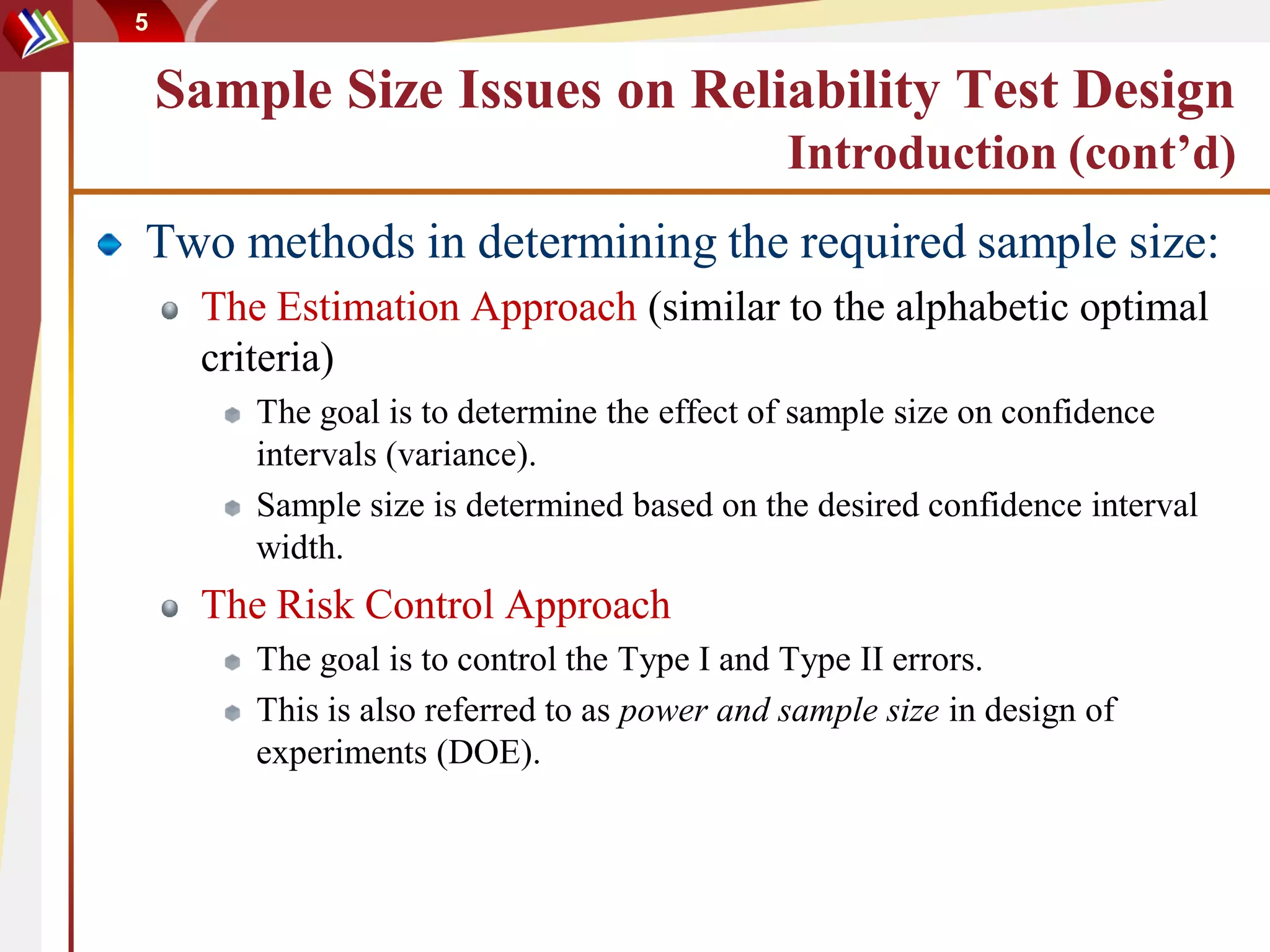
Two methods in determining the required sample size:
     The Estimation Approach (similar to the alphabetic optimal
     criteria)
        The goal is to determine the effect of sample size on confidence
        intervals (variance).
        Sample size is determined based on the desired confidence interval
        width.
     The Risk Control Approach
        The goal is to control the Type I and Type II errors.
        This is also referred to as power and sample size in design of
        experiments (DOE).
6


                       The Estimation Approach
         Effect of Sample Size on Confidence Interval
From historical information an engineer knows that
component’s life follows a Weibull distribution with:
    beta=2.3
    eta=1,000 hours.
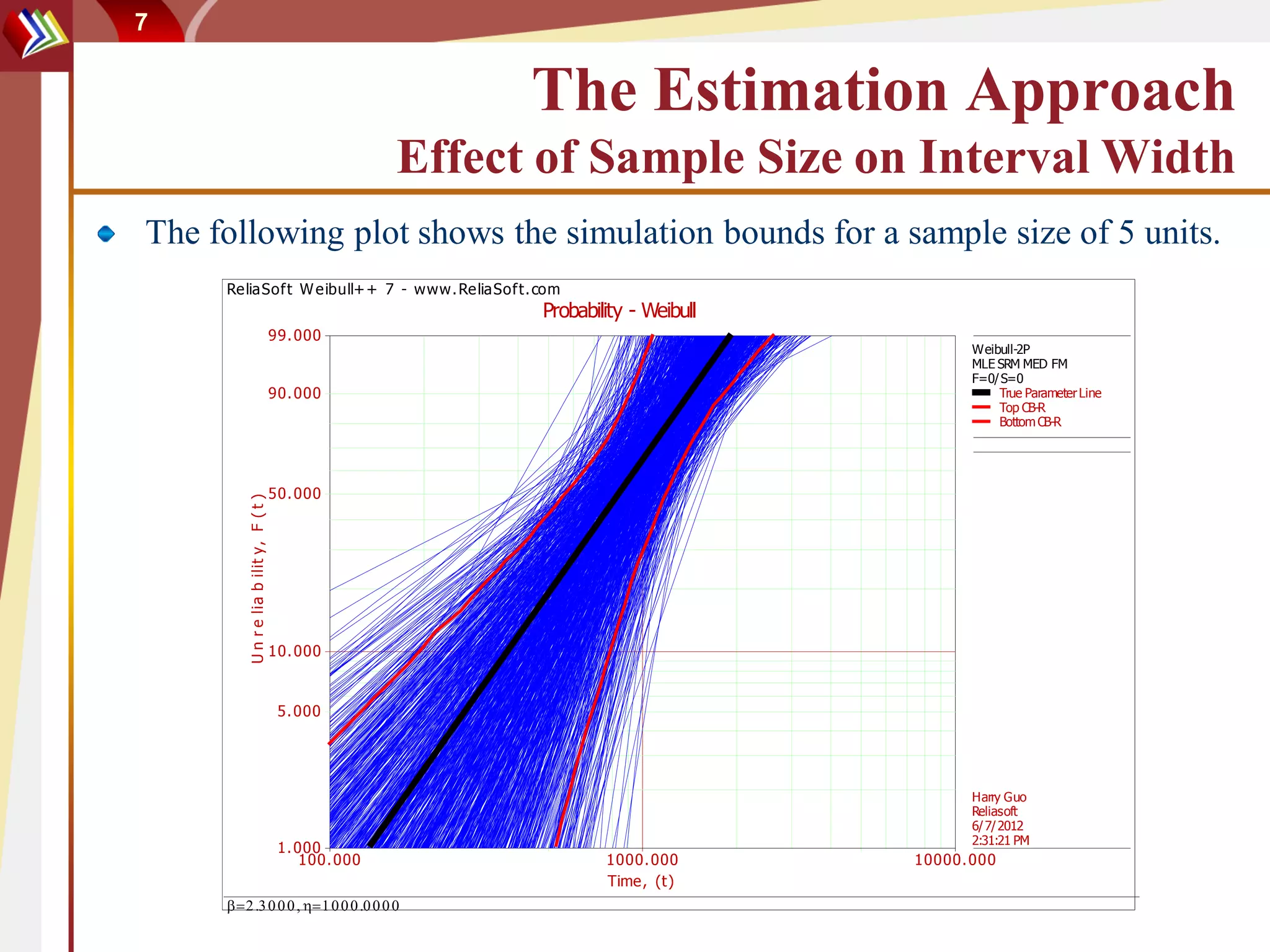
The engineer first wants to see how the sample
size affecting the confidence bounds of the
estimated reliabilities.
7


                                                               The Estimation Approach
                                                         Effect of Sample Size on Interval Width
The following plot shows the simulation bounds for a sample size of 5 units.
     ReliaSof t W eibull+ + 7 - www. ReliaSoft. com
                                                               Probability - Weibull
                                         99. 000
                                                                                              Weibull-2P
                                                                                              MLE SRM MED FM
                                                                                              F=0/ S=0
                                         90. 000                                                  True Parameter Line
                                                                                                  Top CB-R
                                                                                                  Bottom CB-R


                                         50. 000
        U n r e lia b ilit y , F ( t )


                                         10. 000


                                          5. 000


                                                                                              Harry Guo
                                                                                              Reliasoft
                                                                                              6/ 7/ 2012
                                                                                              2:31:21 PM
                                          1. 000
                                              100. 000                 1000. 000       10000. 000
                                                                       Time, (t)
                 
8

    The Effect of Sample Size on Interval Width
                                        (cont’d)
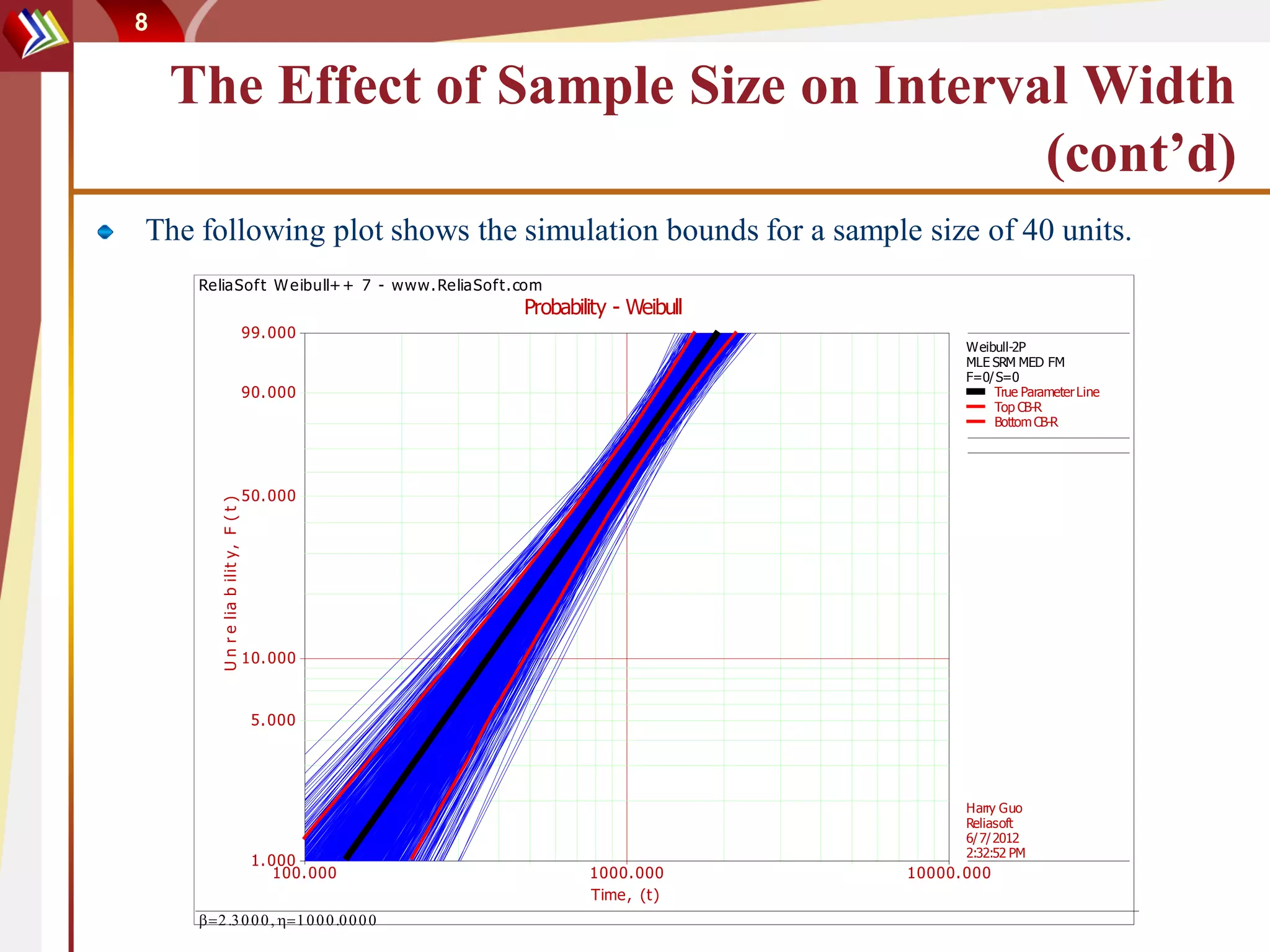
The following plot shows the simulation bounds for a sample size of 40 units.
     ReliaSof t W eibull+ + 7 - www. ReliaSoft. com
                                                         Probability - Weibull
                                         99. 000
                                                                                        Weibull-2P
                                                                                        MLE SRM MED FM
                                                                                        F=0/ S=0
                                         90. 000                                            True Parameter Line
                                                                                            Top CB-R
                                                                                            Bottom CB-R


                                         50. 000
        U n r e lia b ilit y , F ( t )


                                         10. 000


                                          5. 000


                                                                                        Harry Guo
                                                                                        Reliasoft
                                                                                        6/ 7/ 2012
                                                                                        2:32:52 PM
                                          1. 000
                                              100. 000           1000. 000       10000. 000
                                                                 Time, (t)
                 
9


                 The Estimation Approach
             Example for Determining Sample Size
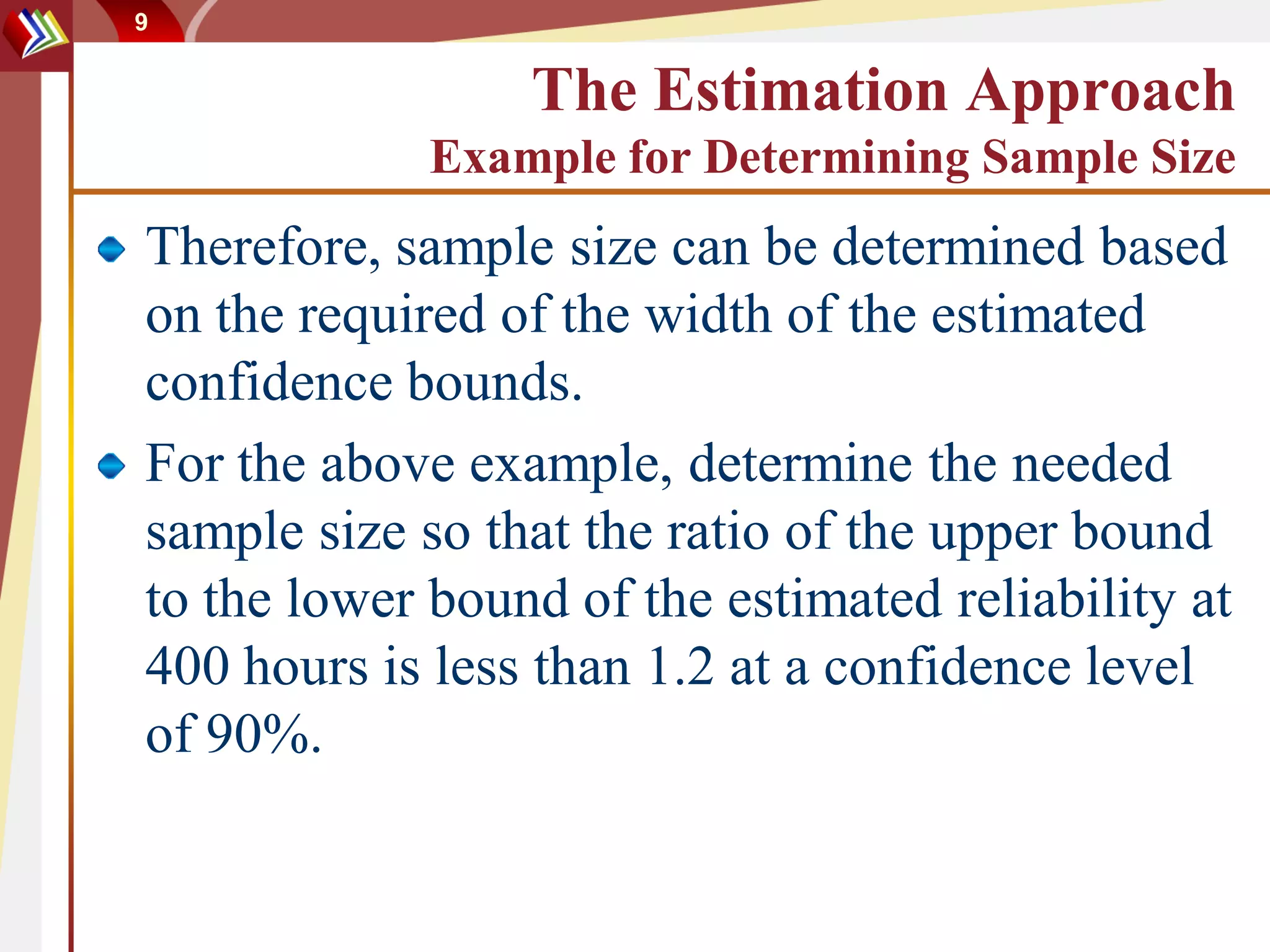
Therefore, sample size can be determined based
on the required of the width of the estimated
confidence bounds.
For the above example, determine the needed
sample size so that the ratio of the upper bound
to the lower bound of the estimated reliability at
400 hours is less than 1.2 at a confidence level
of 90%.
10


                               The Estimation Approach
       Example for Determining Sample Size (cont’d)
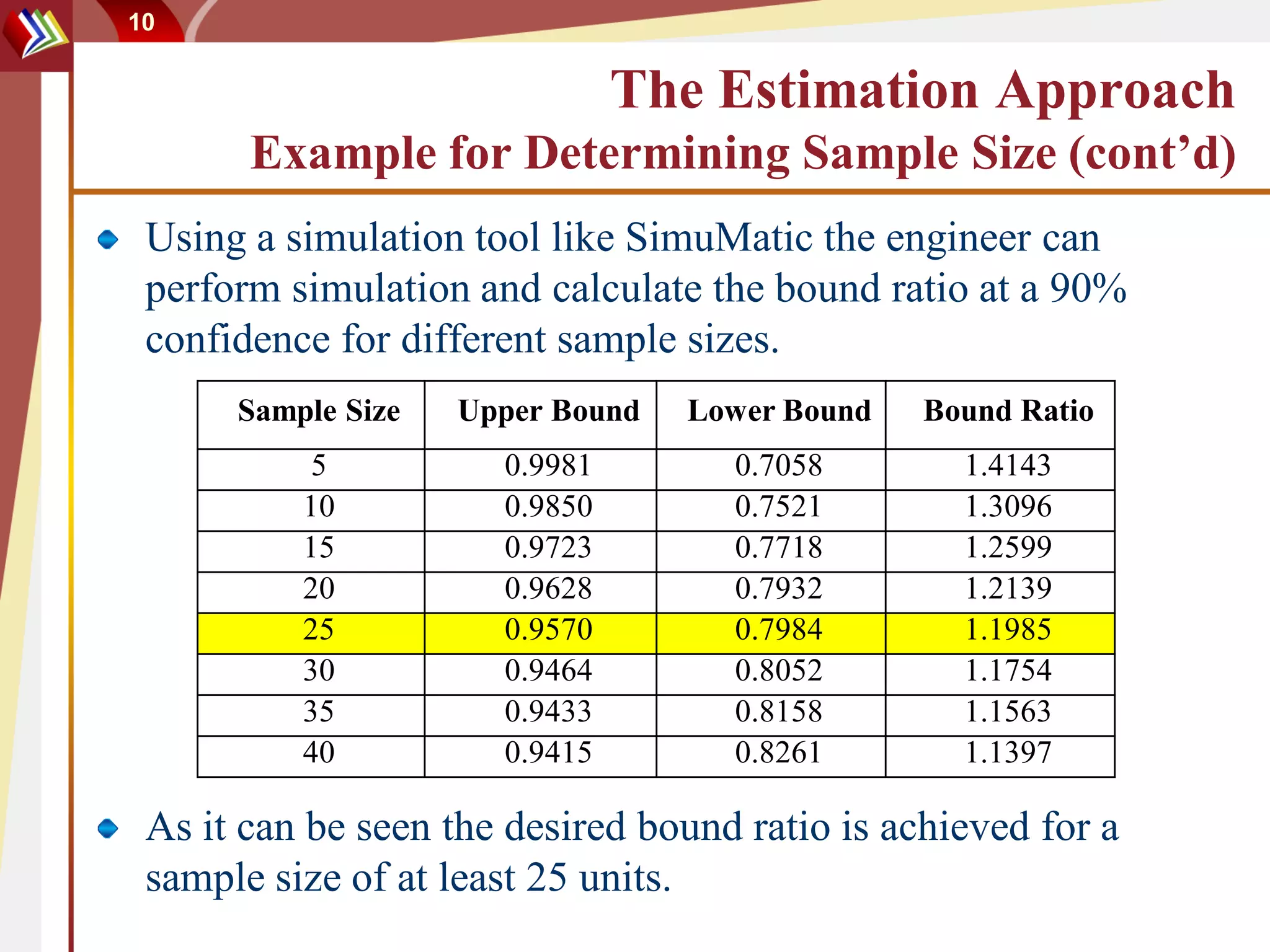
 Using a simulation tool like SimuMatic the engineer can
 perform simulation and calculate the bound ratio at a 90%
 confidence for different sample sizes.
      Sample Size   Upper Bound   Lower Bound   Bound Ratio
           5          0.9981        0.7058        1.4143
          10          0.9850        0.7521        1.3096
          15          0.9723        0.7718        1.2599
          20          0.9628        0.7932        1.2139
          25          0.9570        0.7984        1.1985
          30          0.9464        0.8052        1.1754
          35          0.9433        0.8158        1.1563
          40          0.9415        0.8261        1.1397

 As it can be seen the desired bound ratio is achieved for a
 sample size of at least 25 units.
11

     Estimation Approach for Determining
                    Sample Size for ALT
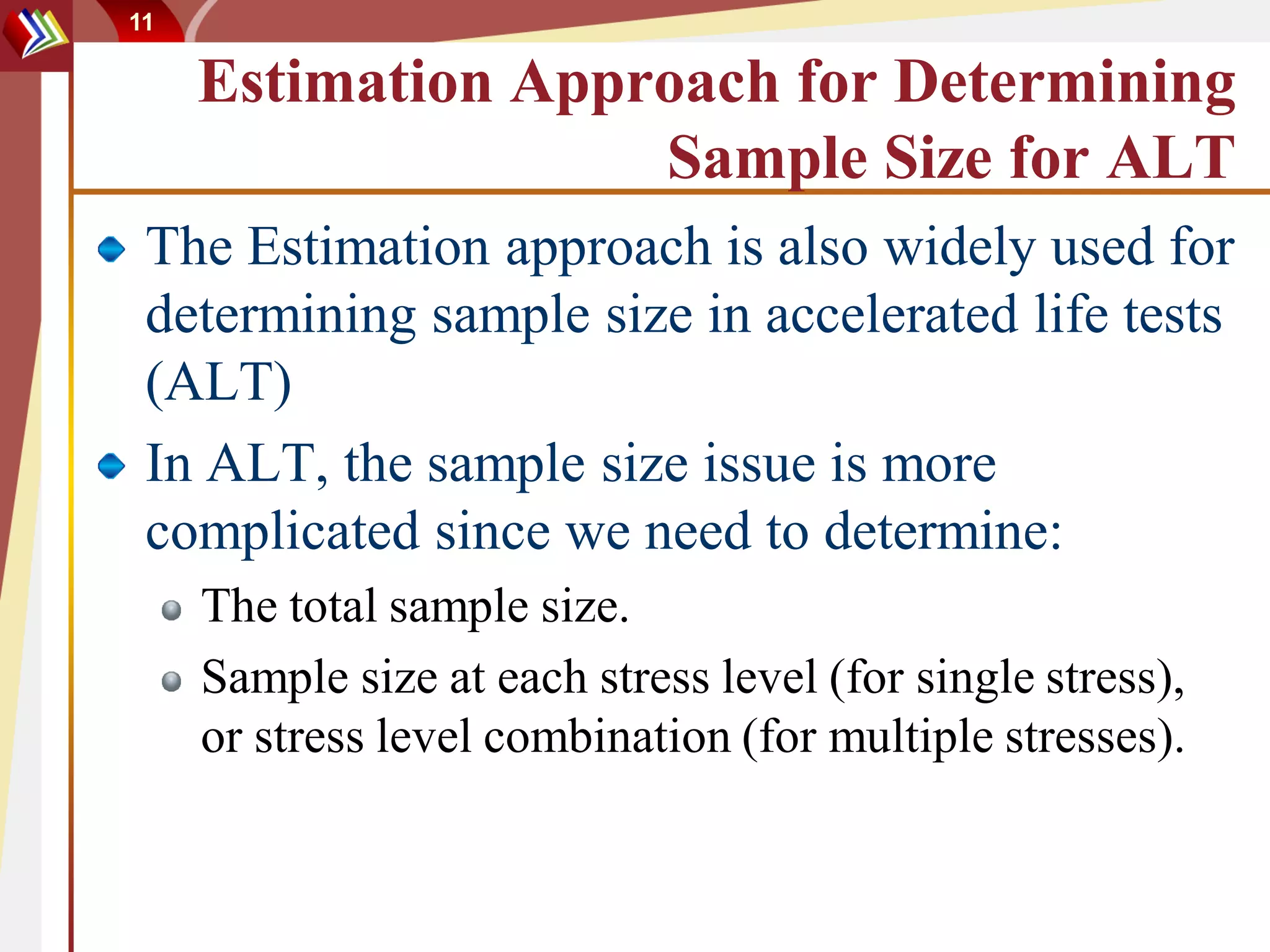
 The Estimation approach is also widely used for
 determining sample size in accelerated life tests
 (ALT)
 In ALT, the sample size issue is more
 complicated since we need to determine:
     The total sample size.
     Sample size at each stress level (for single stress),
     or stress level combination (for multiple stresses).
12

     Optimal Design Criteria in Design of
                    Experiments (DOE)
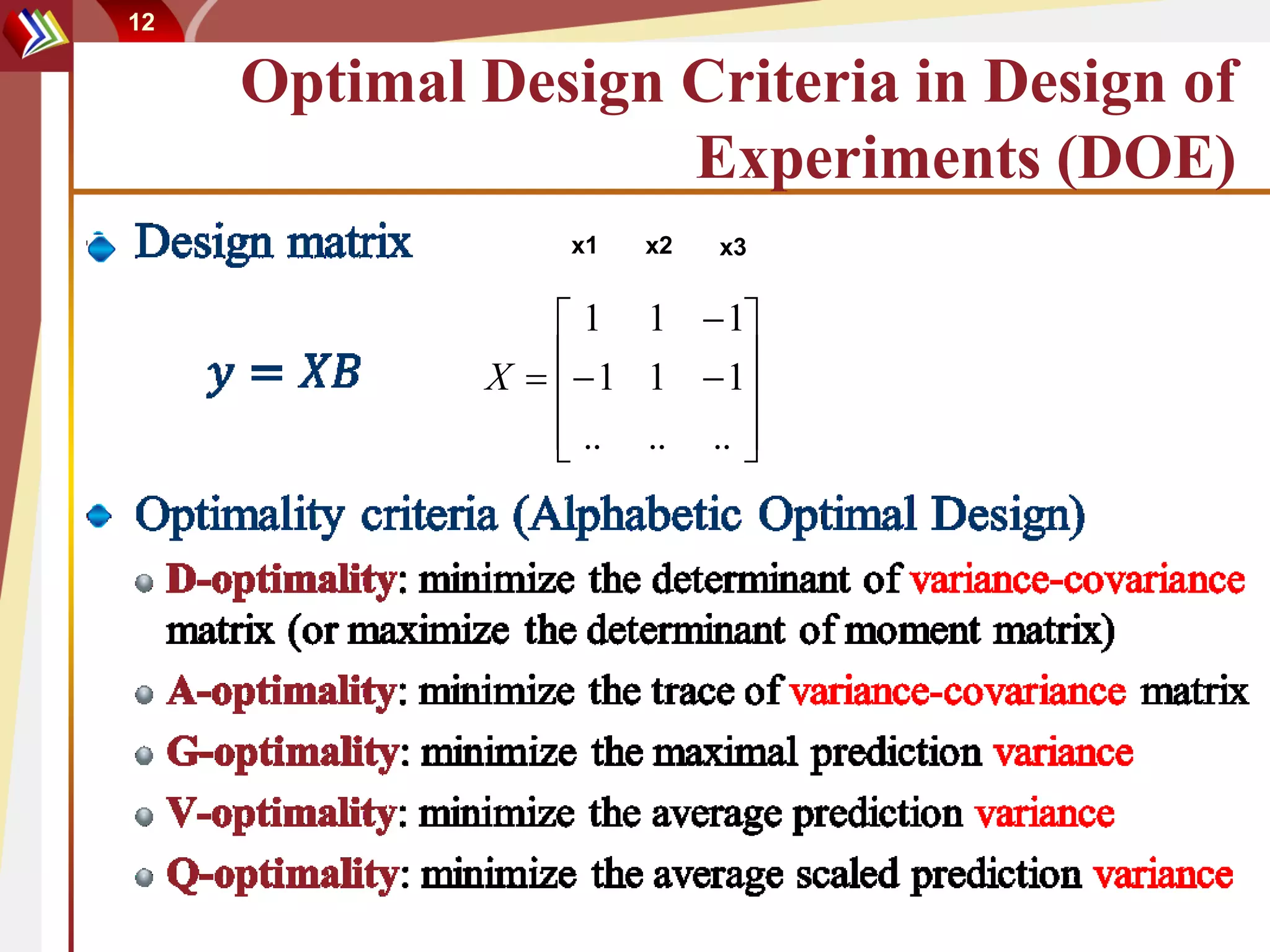
                  x1   x2   x3


                  1 1  1
             X   1 1  1
                           
                  .. .. .. 
                           
13


                 Distributions and Models in ALT
Failure time distribution
     Exponential
     Weibull
     Lognormal
Life-stress model
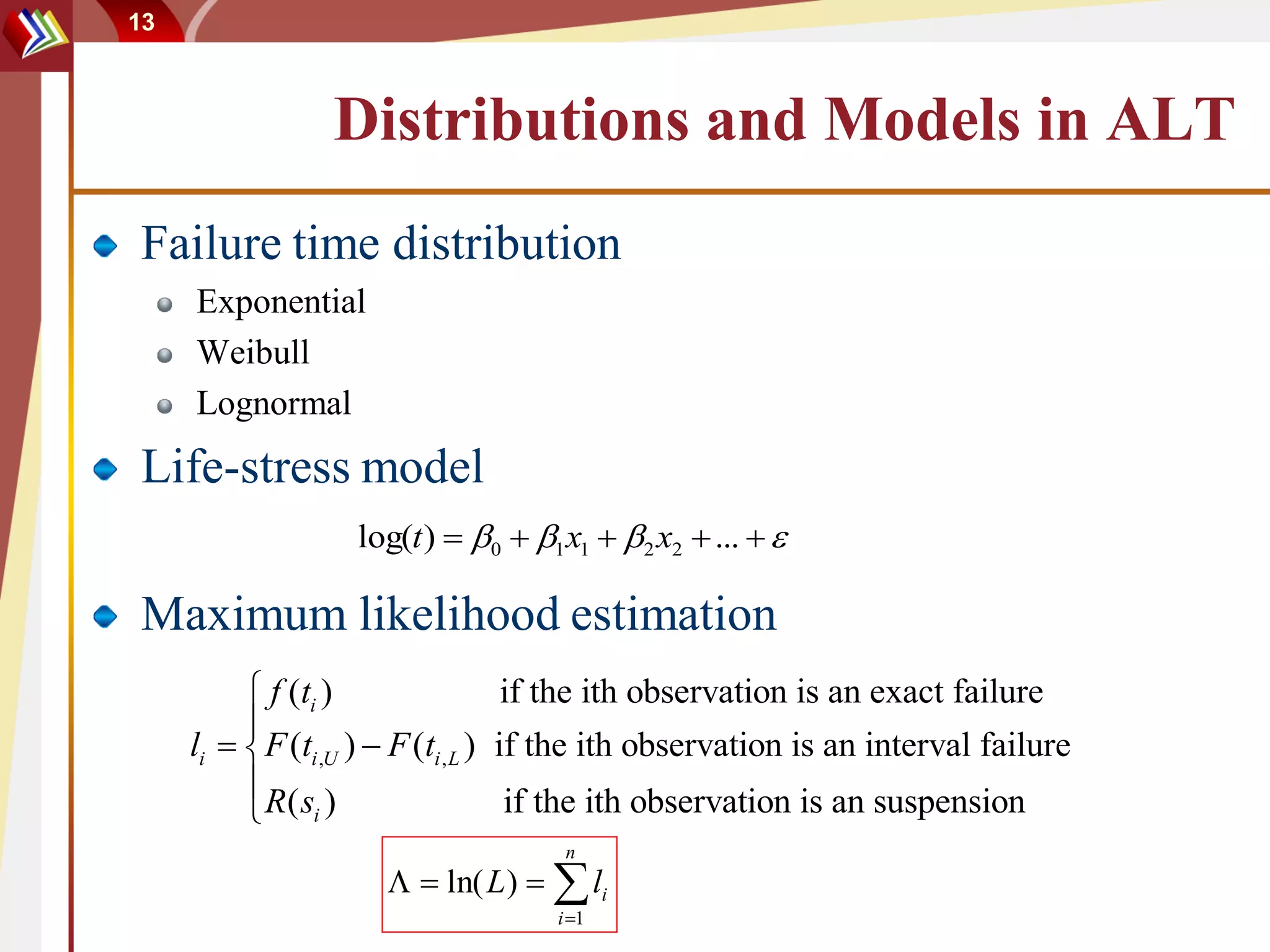
                   log(t )  0  1 x1  2 x2  ...  

Maximum likelihood estimation
           f (ti )                   if the ith observation is an exact failure
          
     li   F (ti ,U )  F (ti , L ) if the ith observation is an interval failure
           R( s )                    if the ith observation is an suspension
           i
                                      n
                        ln( L )   li
                                     i 1
14


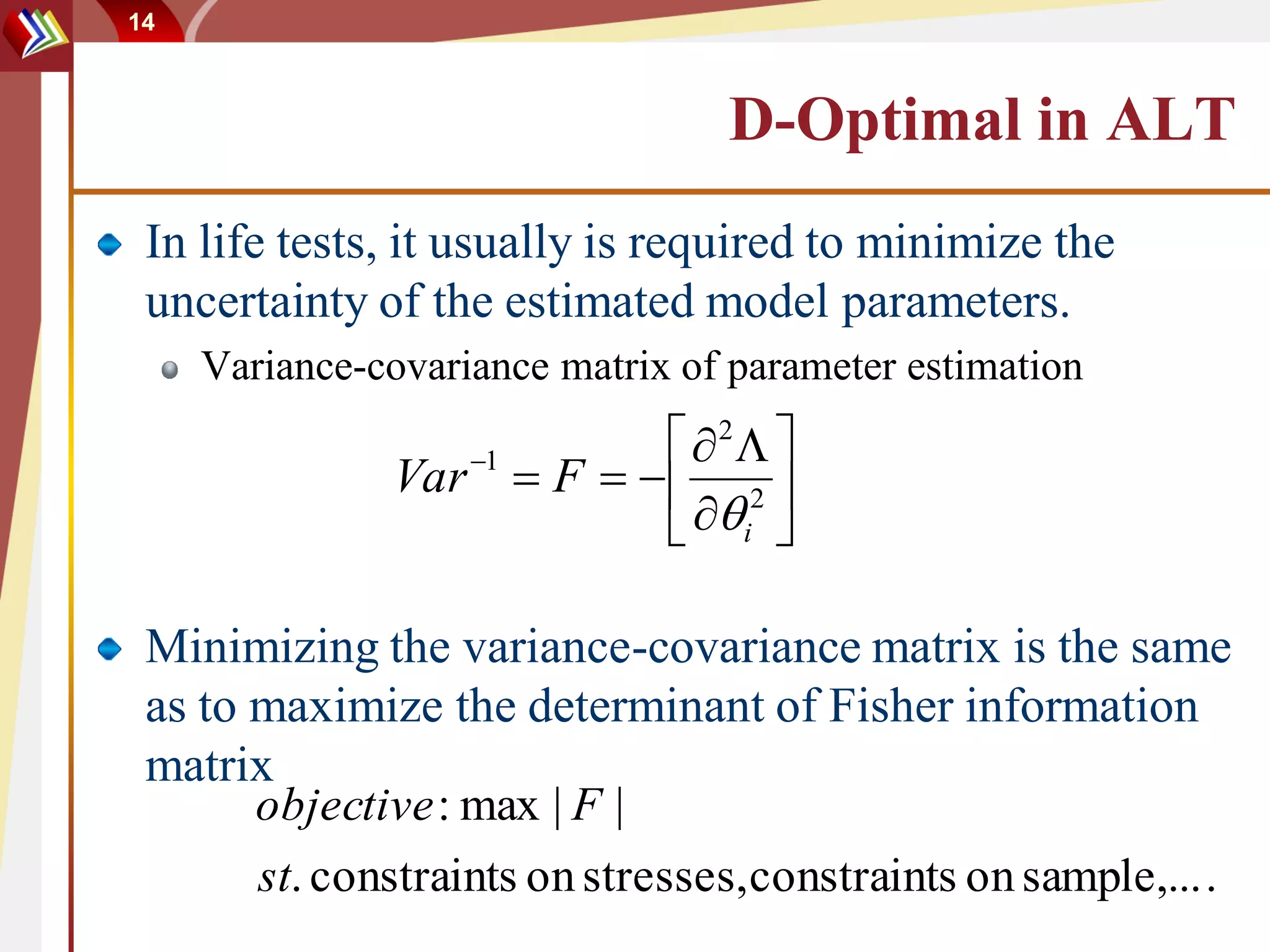
                                  D-Optimal in ALT
 In life tests, it usually is required to minimize the
 uncertainty of the estimated model parameters.
     Variance-covariance matrix of parameter estimation
                                2 
               Var 1  F    2 
                               i 

 Minimizing the variance-covariance matrix is the same
 as to maximize the determinant of Fisher information
 matrix
       objective : max | F |
       st. constraints on stresses, constraints on sample,... .
15

              Example: Time-Censored ALT with 2
                                       Stresses
 Log-likelihood function                                                                                              si 
                                                                                                                                    ( 0  1 X i ,1   2 X i , 2  12 X i ,1 X i , 2 )
                                                                                                                                                         
                                  1        zi2, j                                                                                                    1           Yij  
 li , j (  ,  )  I ij   ln   ln 2 
                         
                                                     (1  I ij ) ln(1   ( si ))                                                                         if
                                  2         2    
                                                                                                                                                I ij  
                                                                                                                                                       0   if       Yij  
                                                                                                                                                                                E[ I ij ]  ( si )


 Fisher information matrix
             n A n x A n x A n x x A
               i   i   i i ,1       i     i i ,2       i       i i ,1 i ,2        i            n A  si           i           i     i


                  n A n x x A n x A
                         i      i       i i ,1 i ,2        i     i i ,2       i               n A  s x
                                                                                                      i           i           i       i i ,1


F
     1                   n A   n x A       i     i             i i ,1       i               n A  s x
                                                                                                      i           i           i       i i ,2

                                                                                                                                                                                      i 
         2

                                 n A                               i     i                   n A  s x x
                                                                                                  i           i           i       i i ,1 i ,2
                                                                                                                                                                 Ai   i  i  si         
                                                                                                                                                                                     1  i 
                                                                                                                         s 
                                                                                                                                                                                            
                                                                                       n 2
                                                                                          i
                                                                                          
                                                                                                  i    i si  si2  1  i i  
                                                                                                                         1  i 
                                                                                      i                                        


             Find ni to maximize |F|. Planned distribution
             parameter values are needed
16


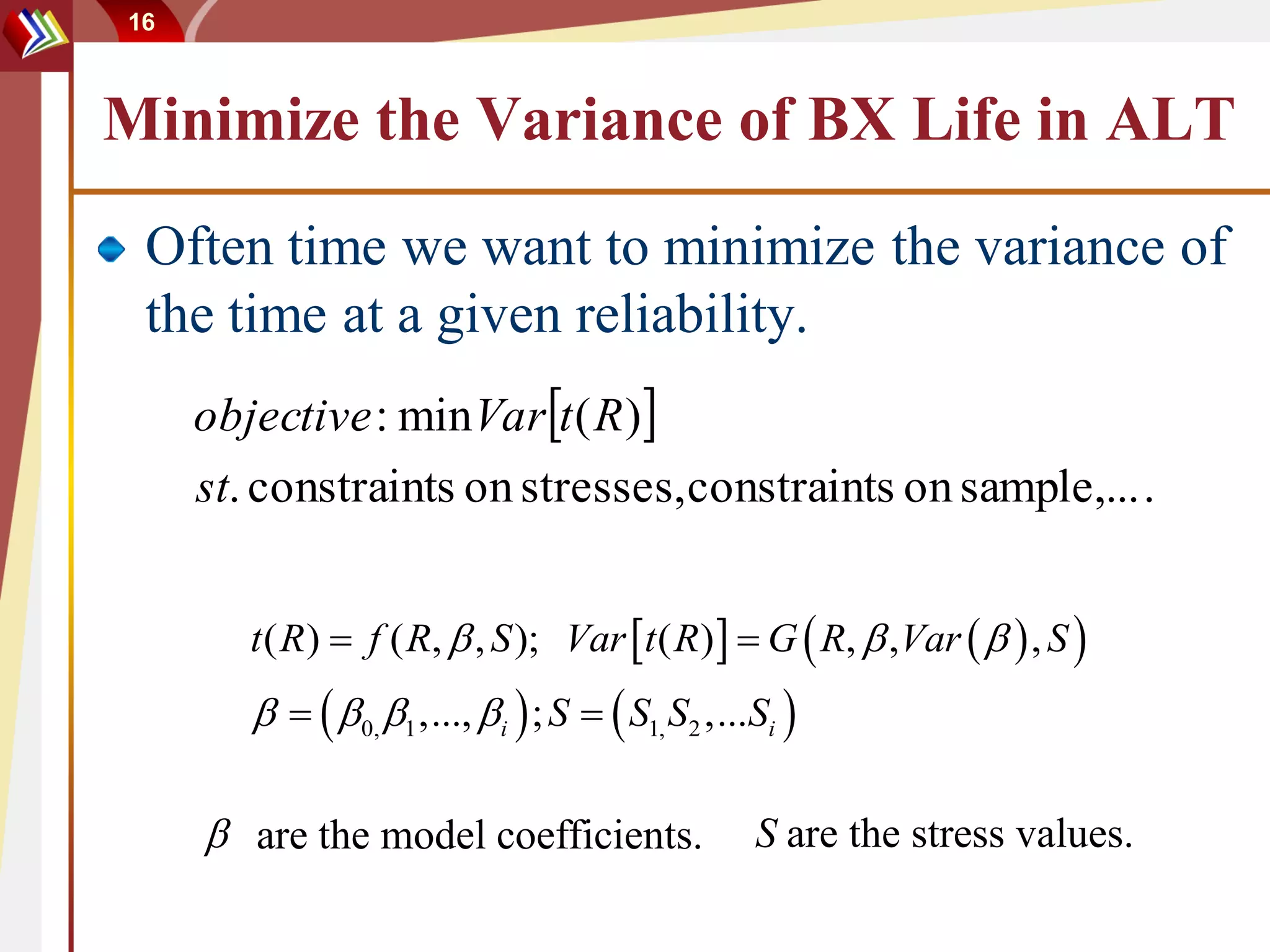
Minimize the Variance of BX Life in ALT
 Often time we want to minimize the variance of
 the time at a given reliability.
     objective : min Vart ( R )
     st. constraints on stresses, constraints on sample,... .


        t ( R)  f ( R,  , S ); Var t ( R)   G  R,  ,Var    , S 
           0, 1 ,..., i  ; S   S1, S2 ,...Si 

      are the model coefficients.                 S are the stress values.
17


                          The Risk Control Approach
                                                                 Introduction
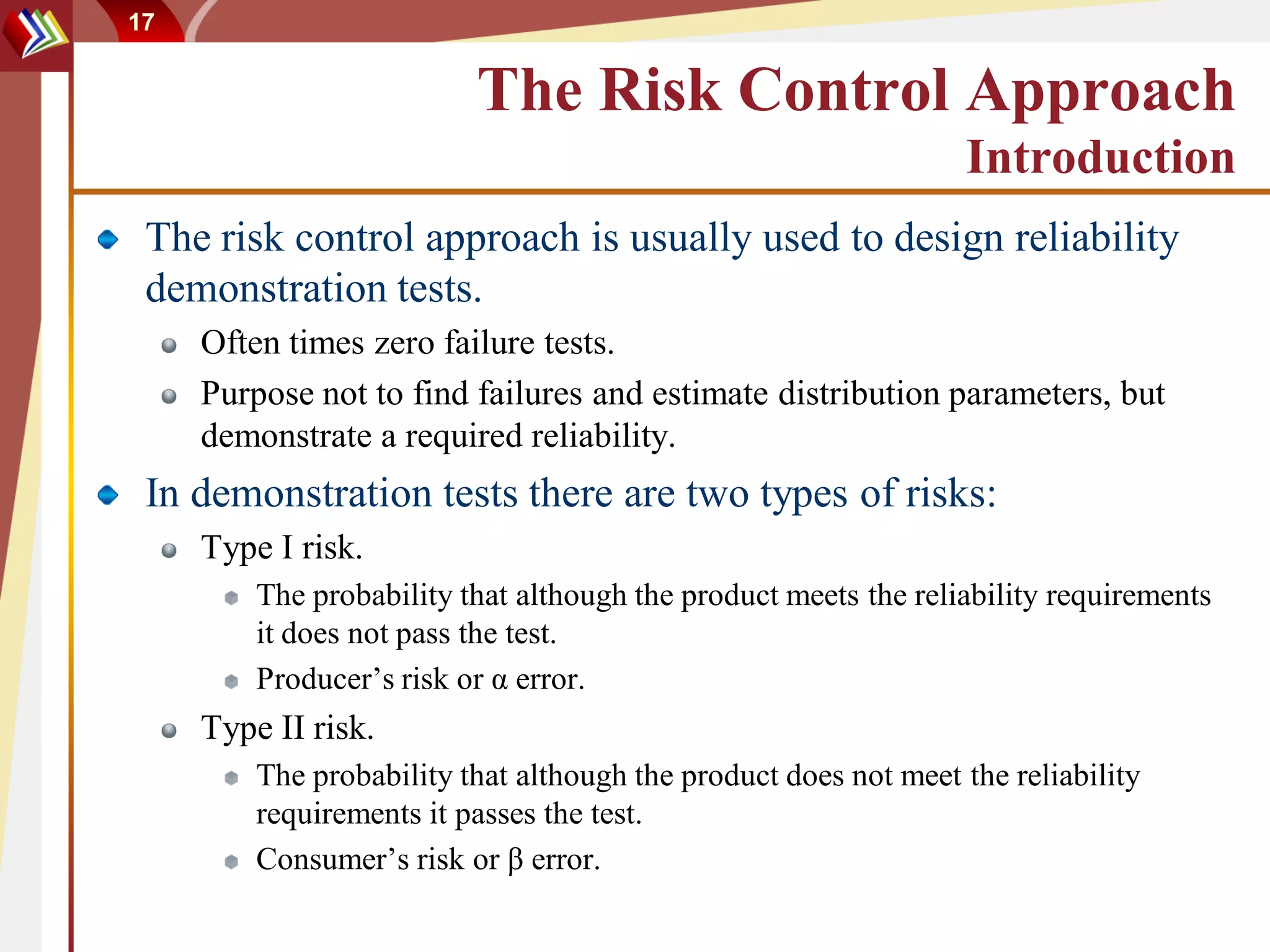
 The risk control approach is usually used to design reliability
 demonstration tests.
     Often times zero failure tests.
     Purpose not to find failures and estimate distribution parameters, but
     demonstrate a required reliability.
 In demonstration tests there are two types of risks:
     Type I risk.
         The probability that although the product meets the reliability requirements
         it does not pass the test.
         Producer’s risk or α error.
     Type II risk.
         The probability that although the product does not meet the reliability
         requirements it passes the test.
         Consumer’s risk or β error.
18


                           The Risk Control Approach
                                                                  Introduction
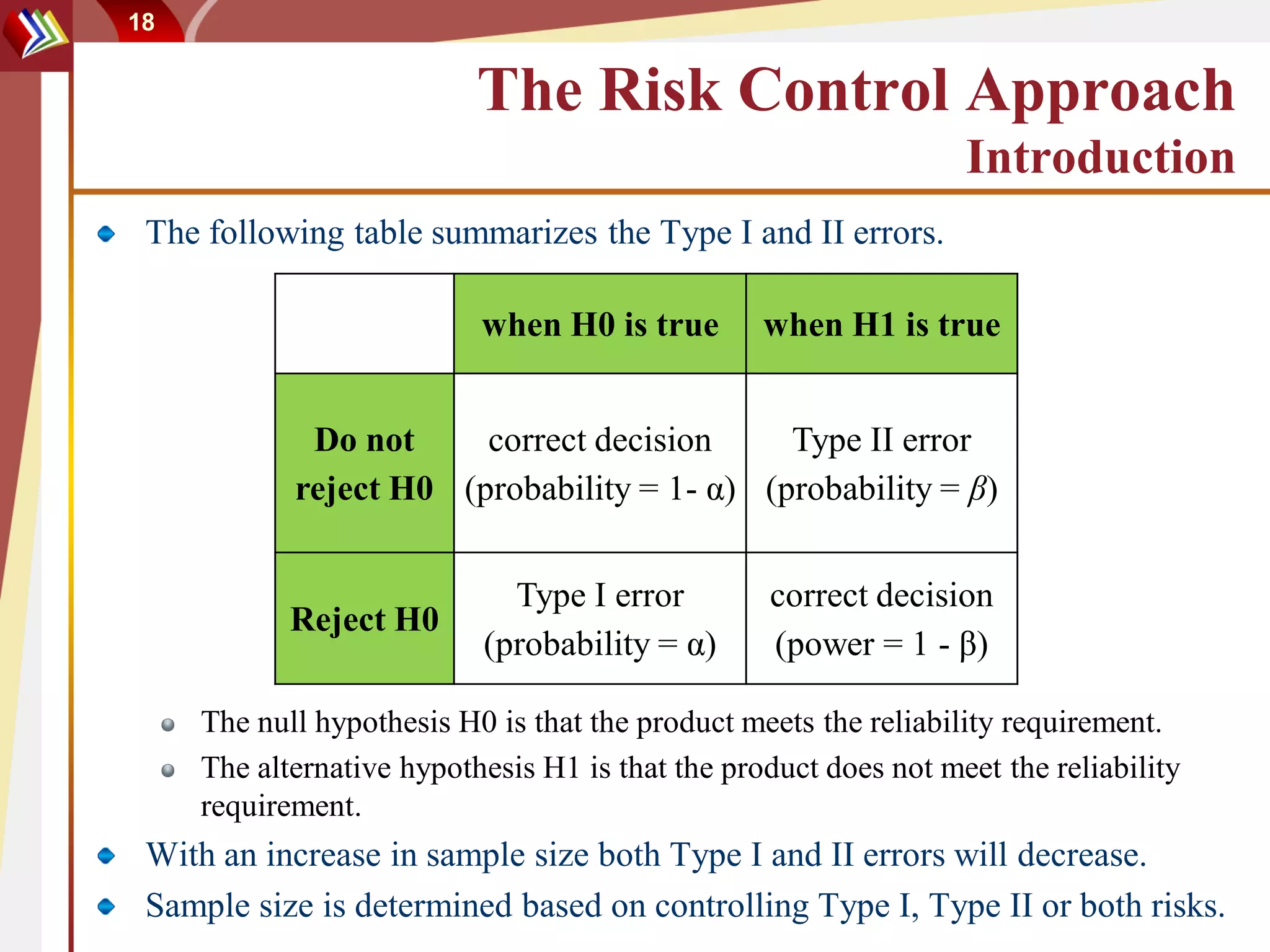
 The following table summarizes the Type I and II errors.

                           when H0 is true        when H1 is true


             Do not     correct decision     Type II error
            reject H0 (probability = 1- α) (probability = β)


                             Type I error         correct decision
            Reject H0
                           (probability = α)      (power = 1 - β)

     The null hypothesis H0 is that the product meets the reliability requirement.
     The alternative hypothesis H1 is that the product does not meet the reliability
     requirement.
 With an increase in sample size both Type I and II errors will decrease.
 Sample size is determined based on controlling Type I, Type II or both risks.
19


                  The Risk Control Approach
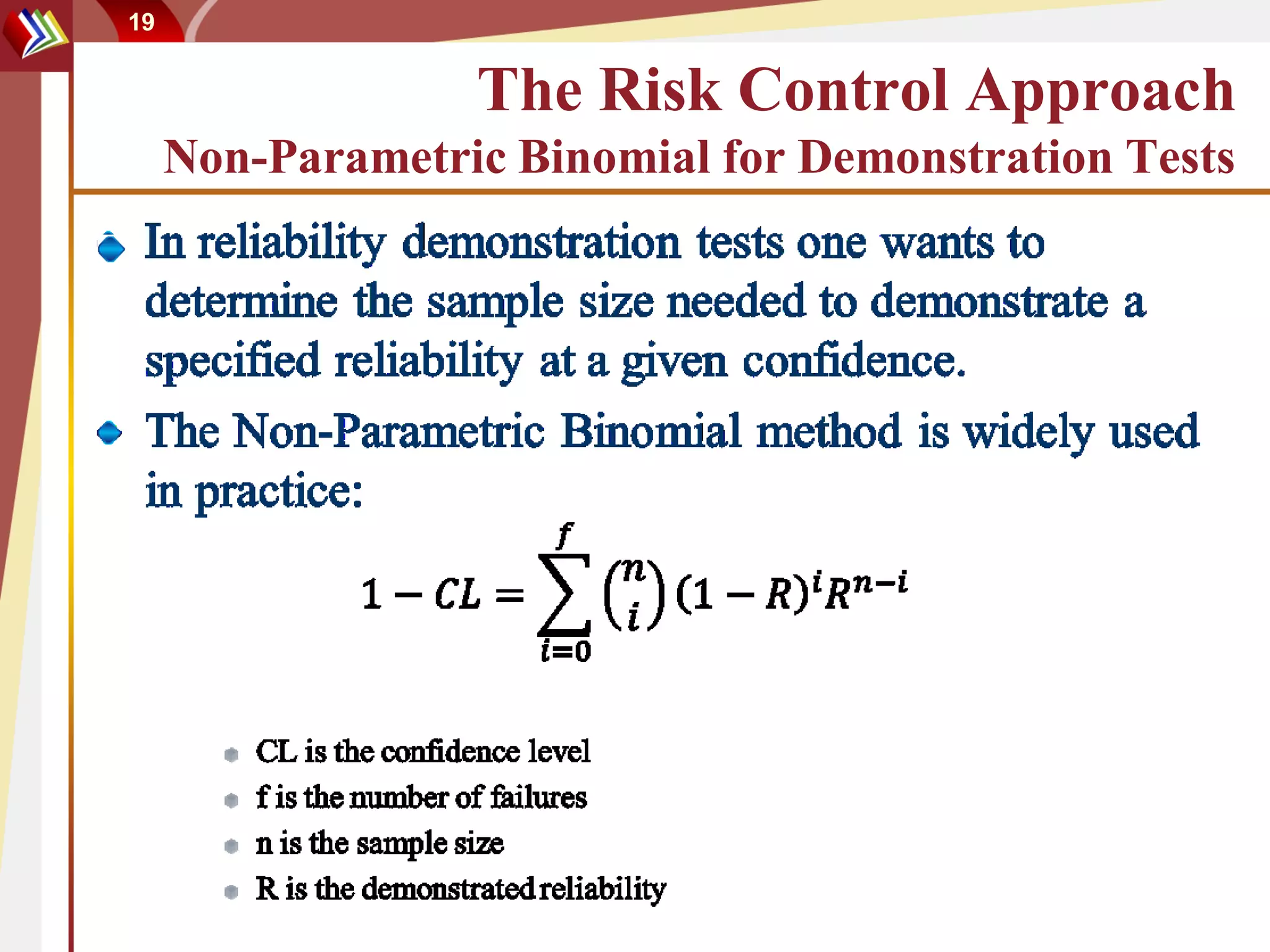
     Non-Parametric Binomial for Demonstration Tests
20


                      The Risk Control Approach
     Non-Parametric Binomial for Demonstration Tests
 In the Non-Parametric Binomial equation time is not a
 factor.
 The Non-Parametric method is used:
      For one-shot devices where time is not a factor.
      For cases when the test time is the same as the time at which
      we require the demonstrated reliability.
 When time is a factor, the so called parametric
 Binomial should be used, and a failure time
 distribution is assumed.
21


               The Risk Control Approach
                                       Example
 A reliability engineer wants to design a zero
 failure demonstration test.
 The target reliability is 80% at 100 hours.
 The required confidence level is 90% (the Type
 II error is 10%).
 The available test time is 100 hours.
 What is the required sample size?
22


     The Risk Control Approach
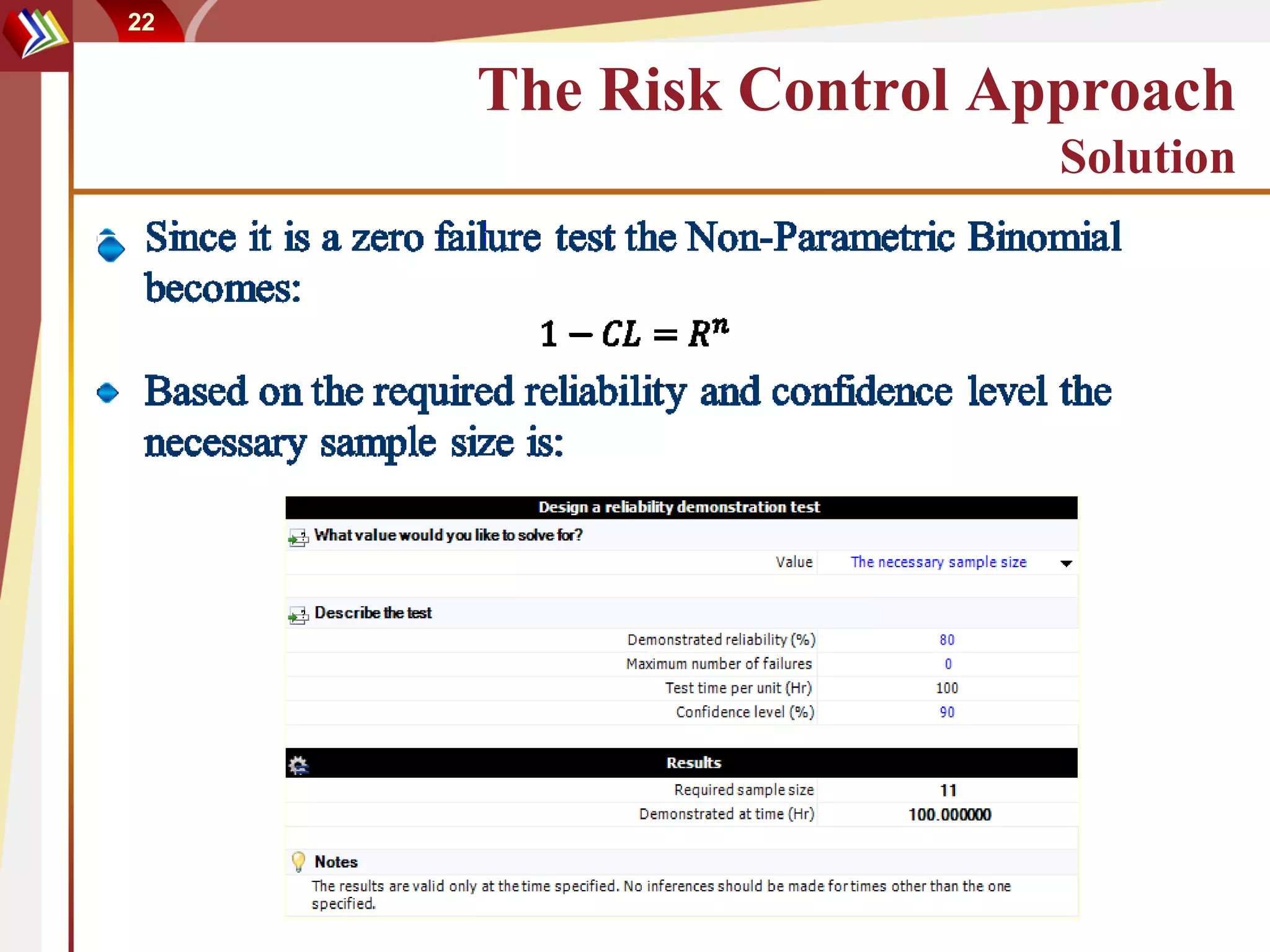
                        Solution
23


                The Risk Control Approach
                        Example: Solution (cont’d)
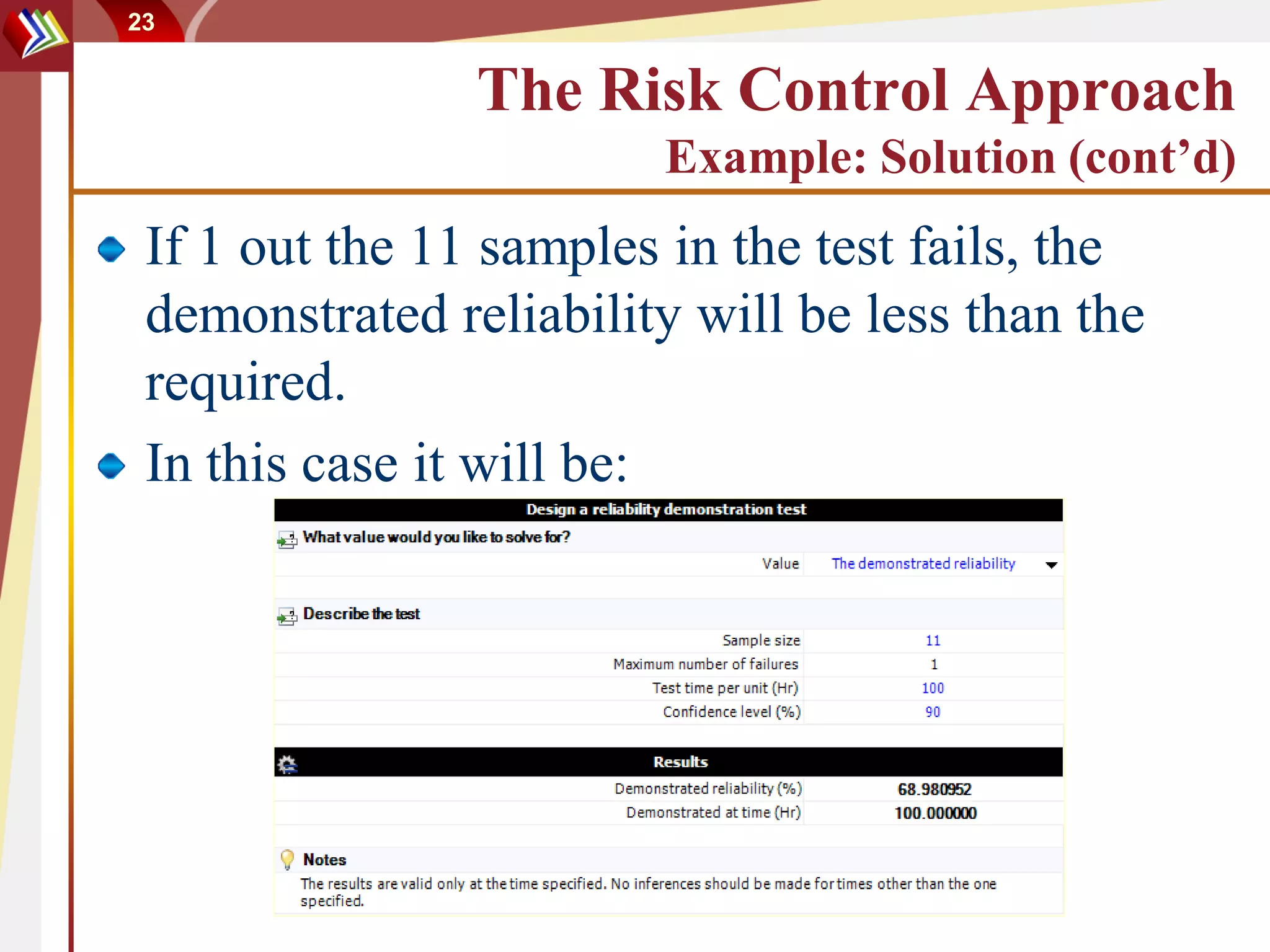
 If 1 out the 11 samples in the test fails, the
 demonstrated reliability will be less than the
 required.
 In this case it will be:
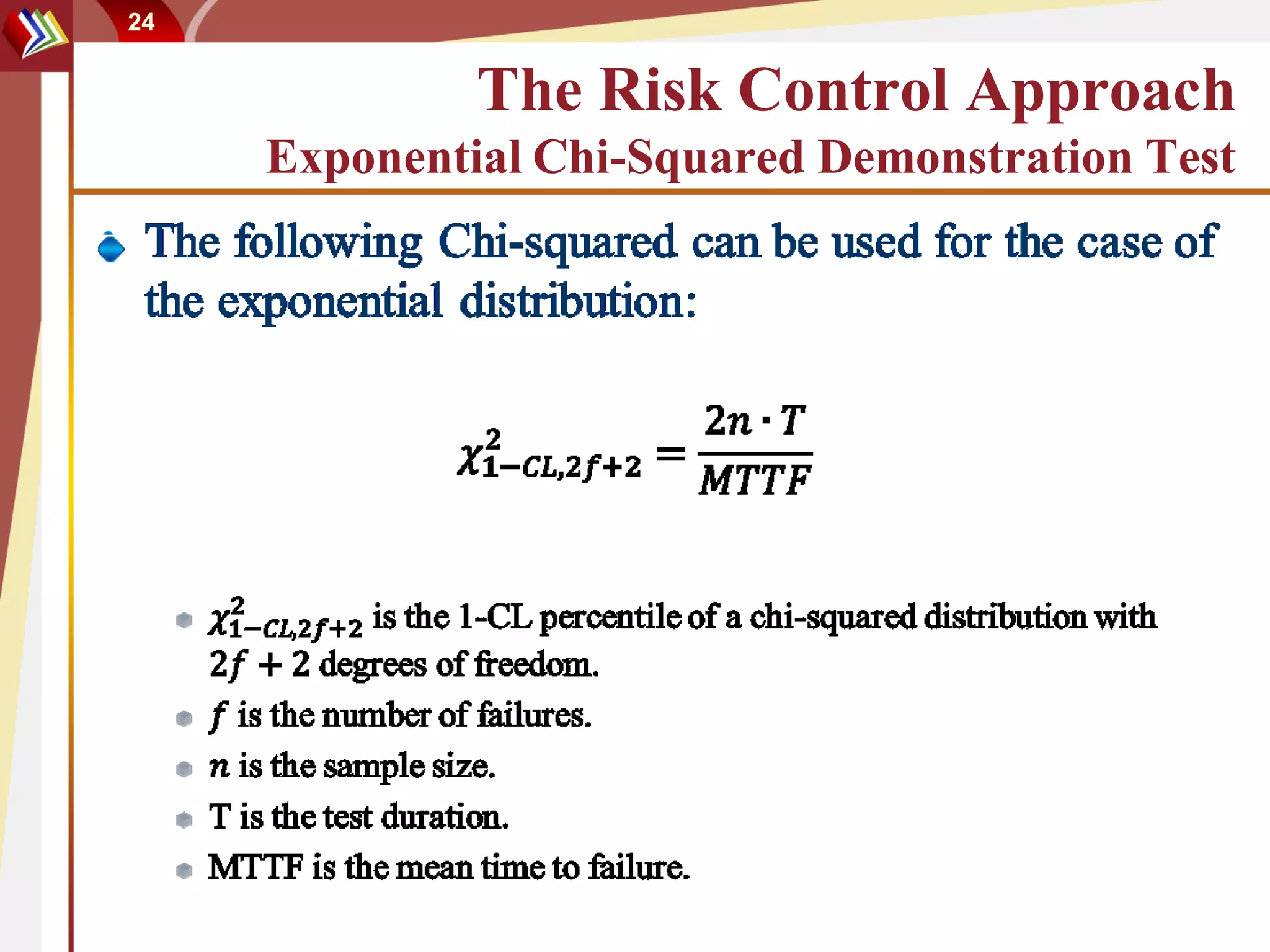
24


              The Risk Control Approach
     Exponential Chi-Squared Demonstration Test
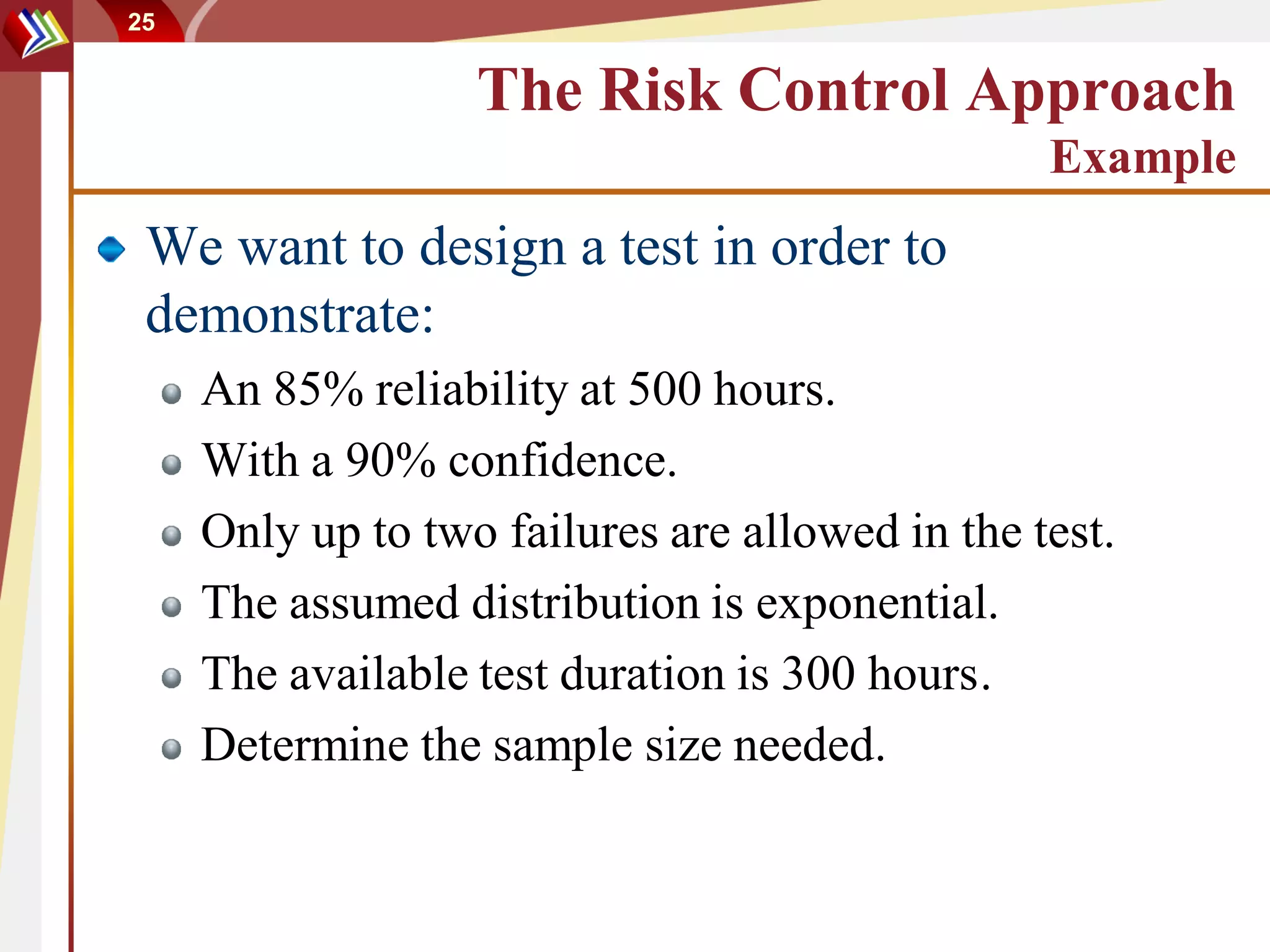
25


                   The Risk Control Approach
                                                 Example
 We want to design a test in order to
 demonstrate:
     An 85% reliability at 500 hours.
     With a 90% confidence.
     Only up to two failures are allowed in the test.
     The assumed distribution is exponential.
     The available test duration is 300 hours.
     Determine the sample size needed.
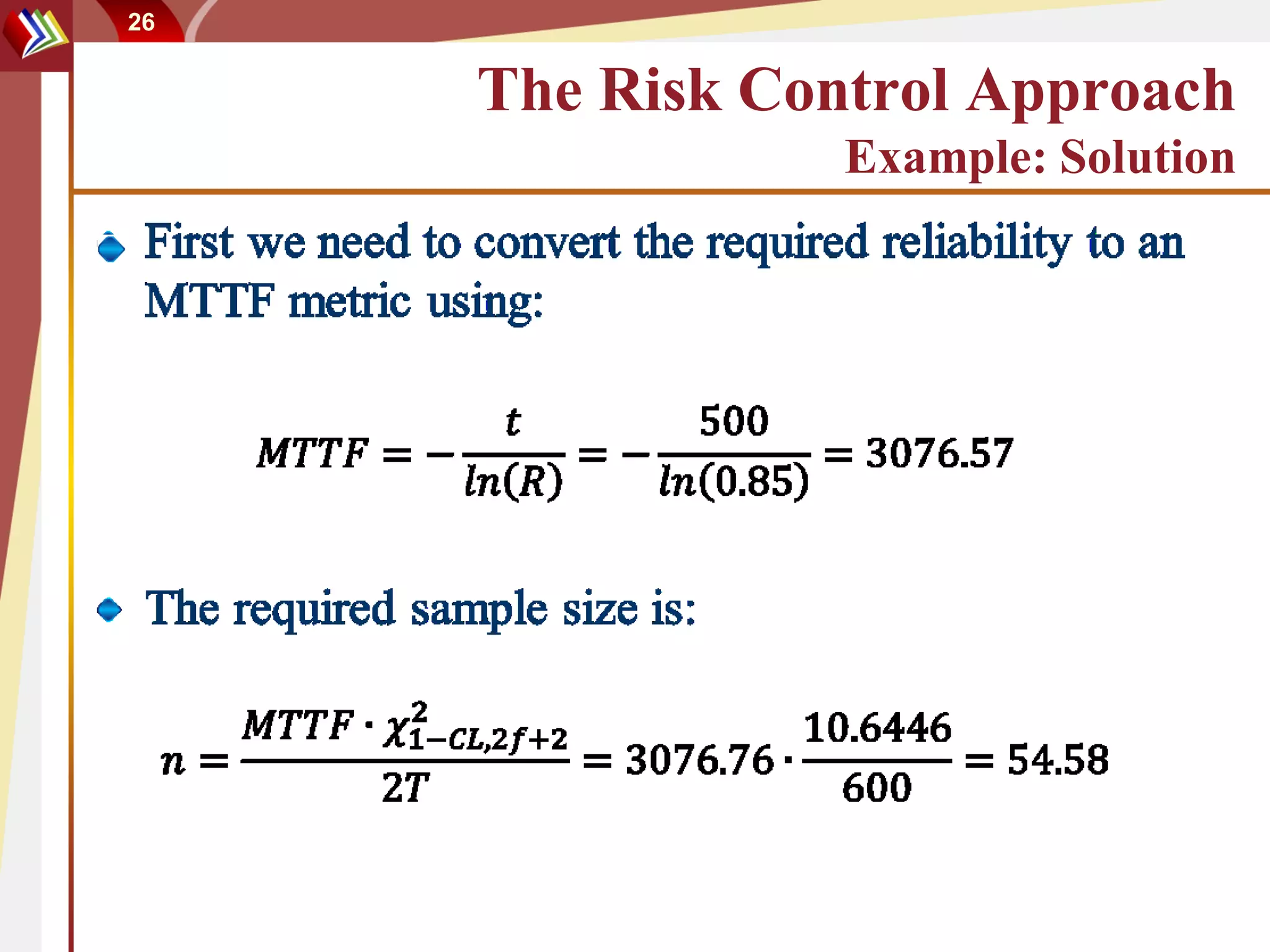
26


     The Risk Control Approach
                 Example: Solution
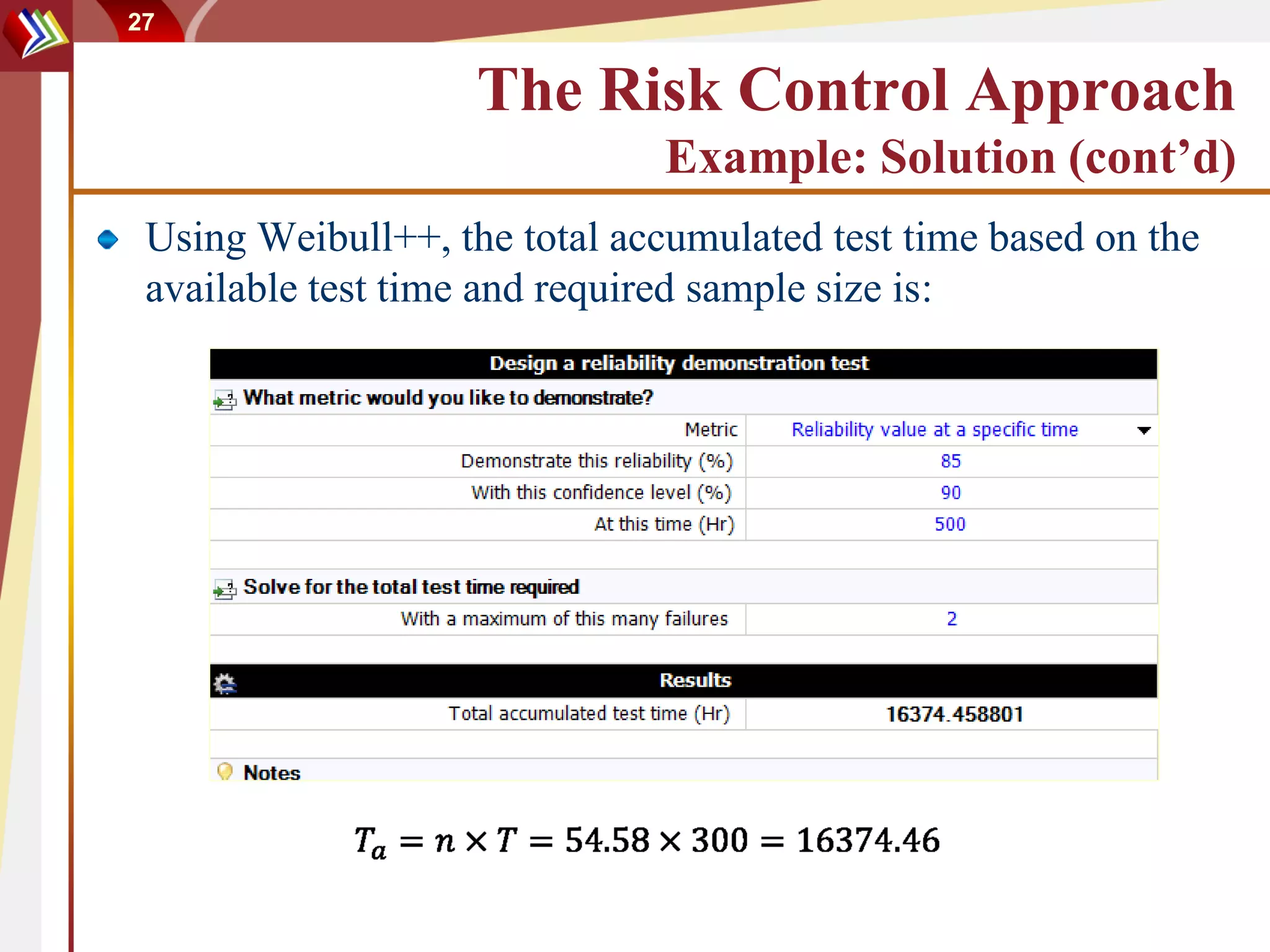
27


                    The Risk Control Approach
                               Example: Solution (cont’d)
 Using Weibull++, the total accumulated test time based on the
 available test time and required sample size is:
28


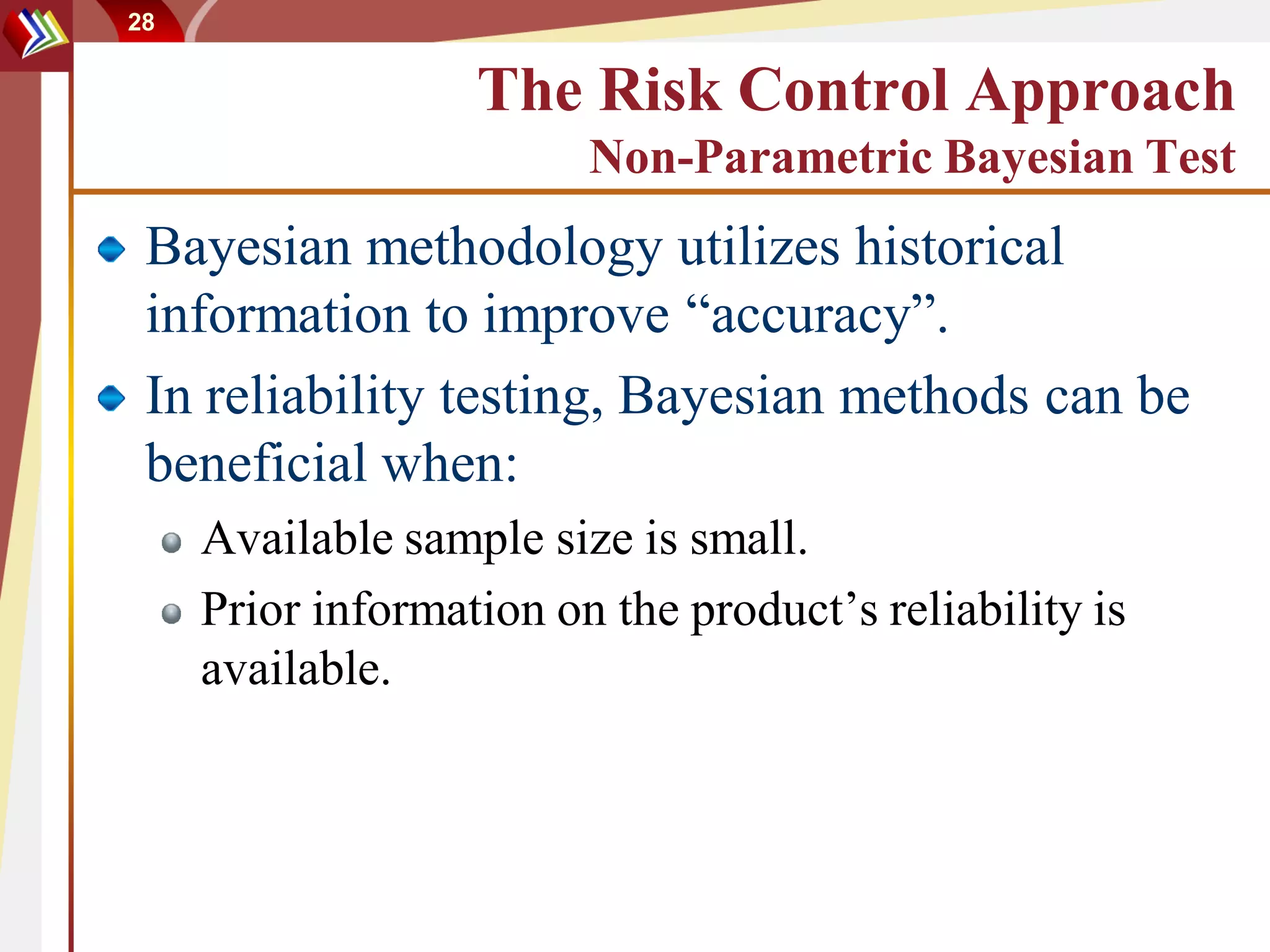
                   The Risk Control Approach
                         Non-Parametric Bayesian Test
 Bayesian methodology utilizes historical
 information to improve “accuracy”.
 In reliability testing, Bayesian methods can be
 beneficial when:
     Available sample size is small.
     Prior information on the product’s reliability is
     available.
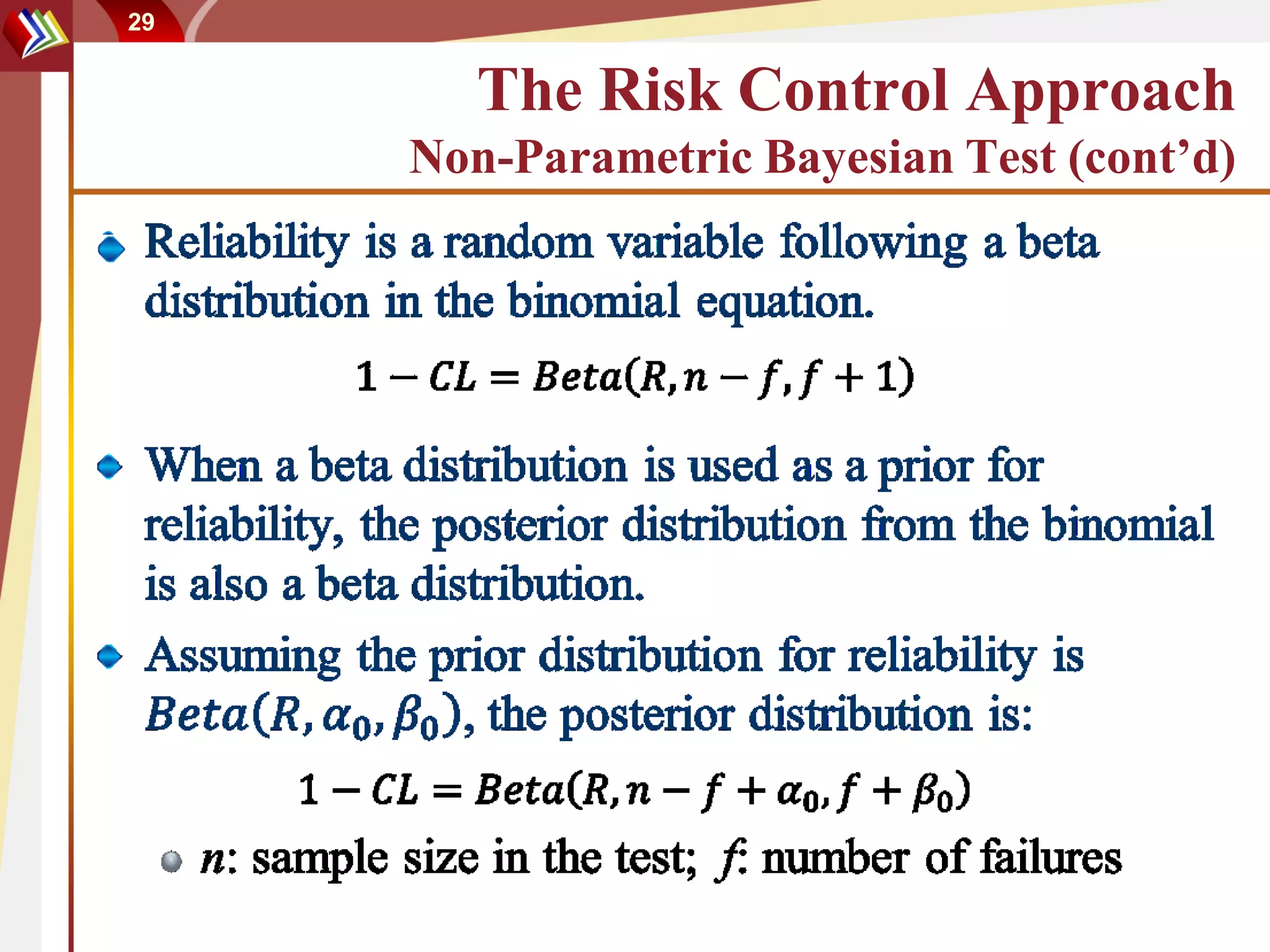
29


        The Risk Control Approach
     Non-Parametric Bayesian Test (cont’d)
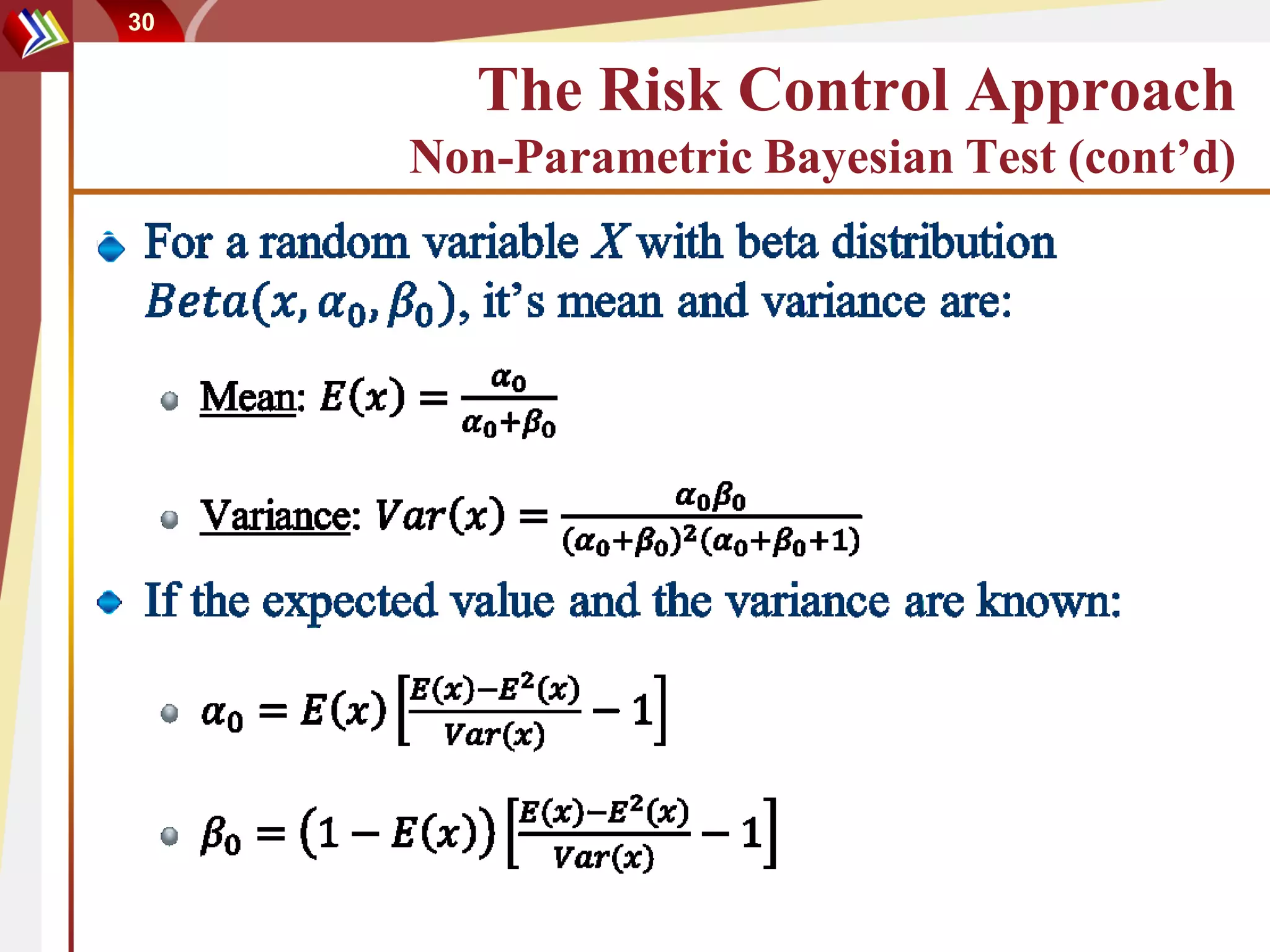
30


        The Risk Control Approach
     Non-Parametric Bayesian Test (cont’d)
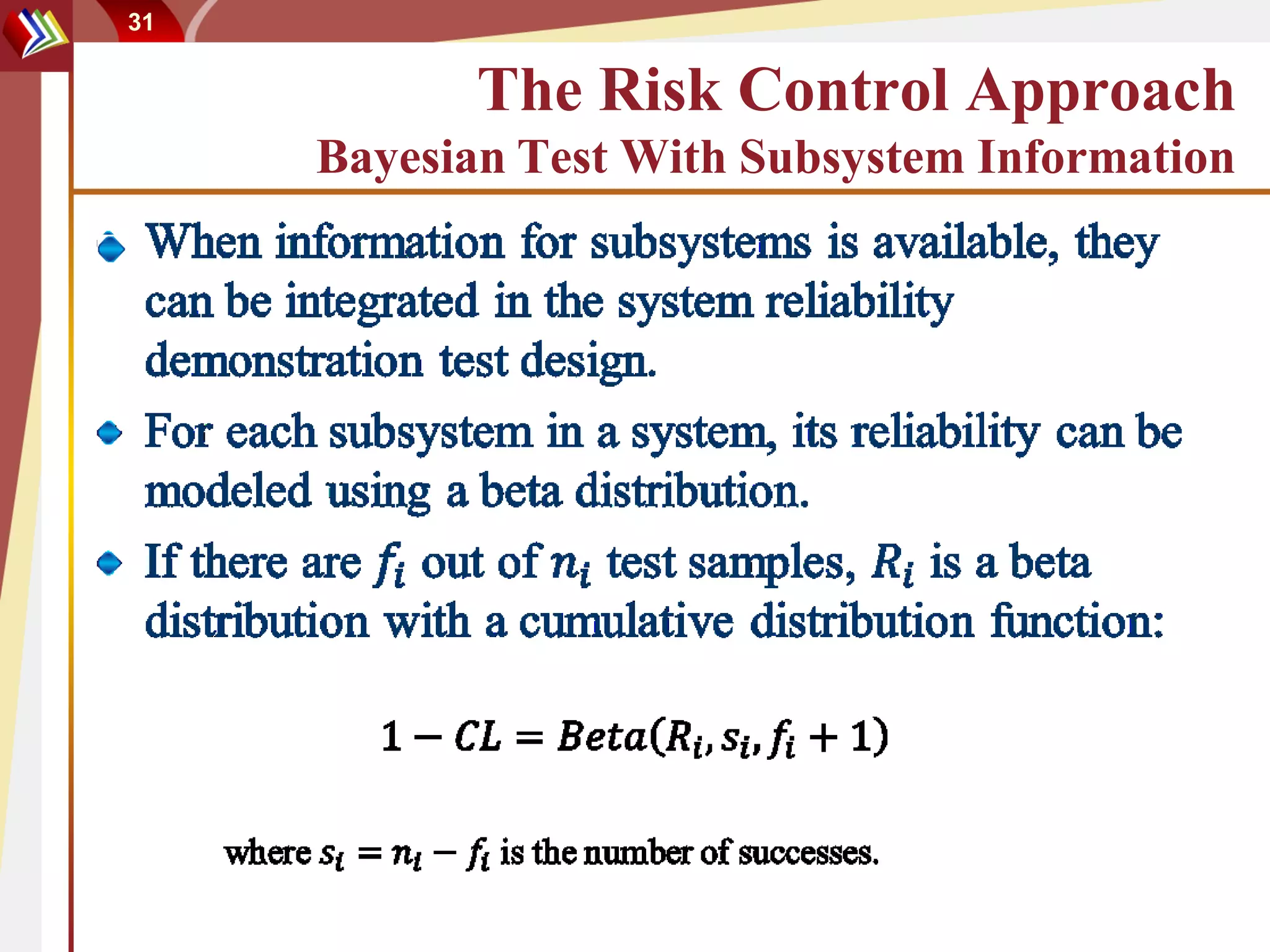
31


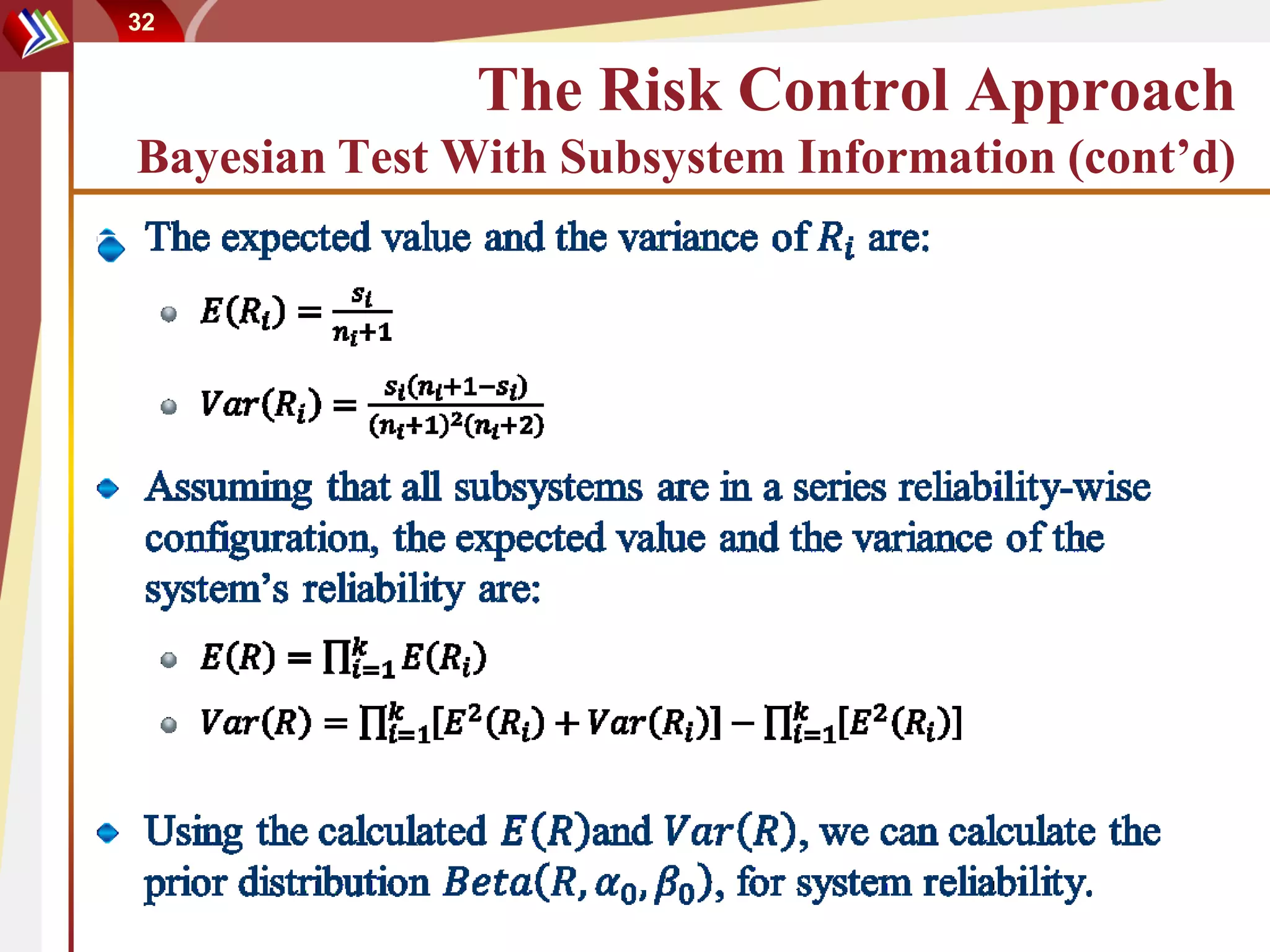
           The Risk Control Approach
     Bayesian Test With Subsystem Information
32


               The Risk Control Approach
Bayesian Test With Subsystem Information (cont’d)
33


                        The Risk Control Approach
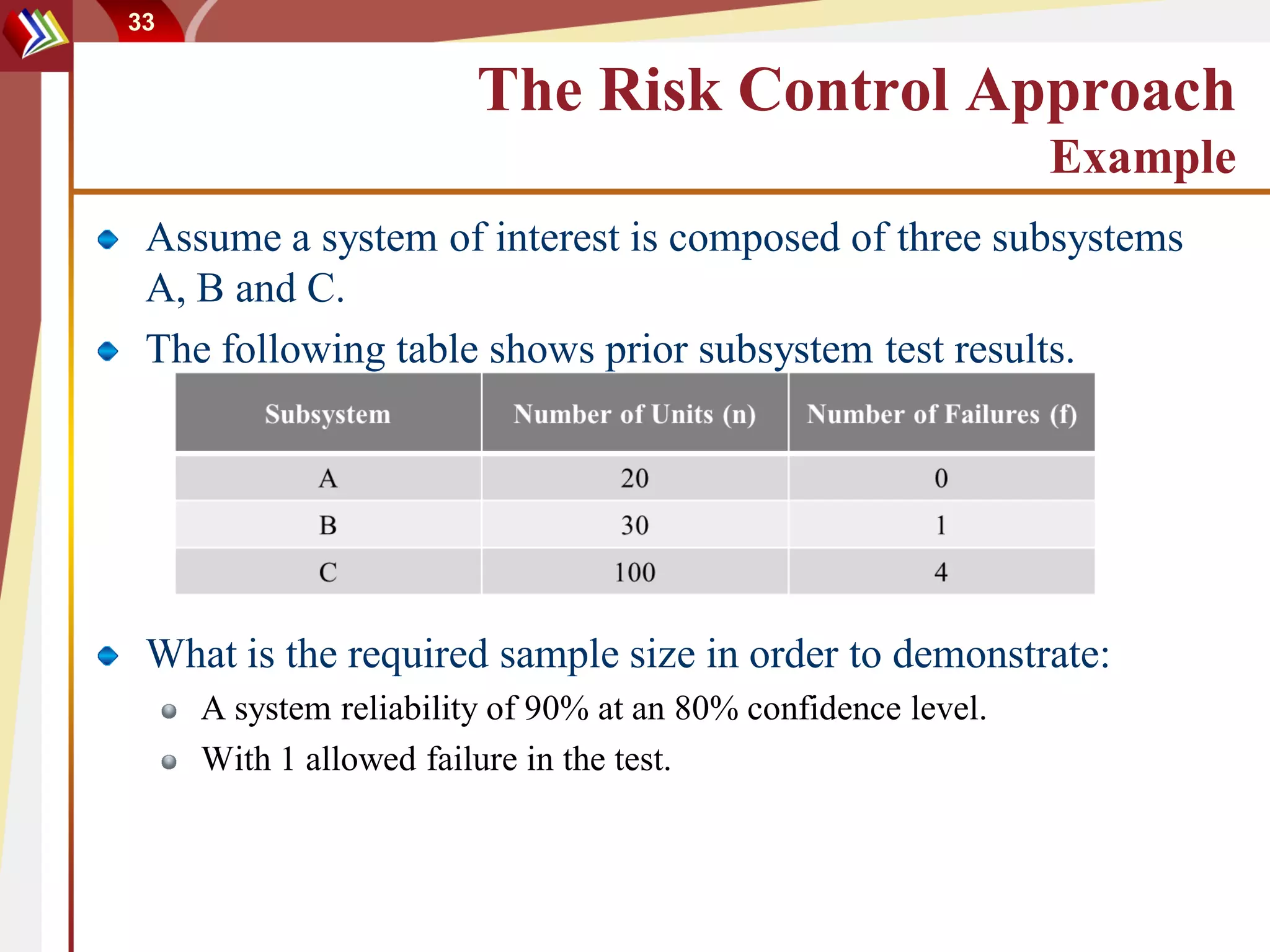
                                                               Example
 Assume a system of interest is composed of three subsystems
 A, B and C.
 The following table shows prior subsystem test results.


 What is the required sample size in order to demonstrate:
     A system reliability of 90% at an 80% confidence level.
     With 1 allowed failure in the test.
34


               The Risk Control Approach
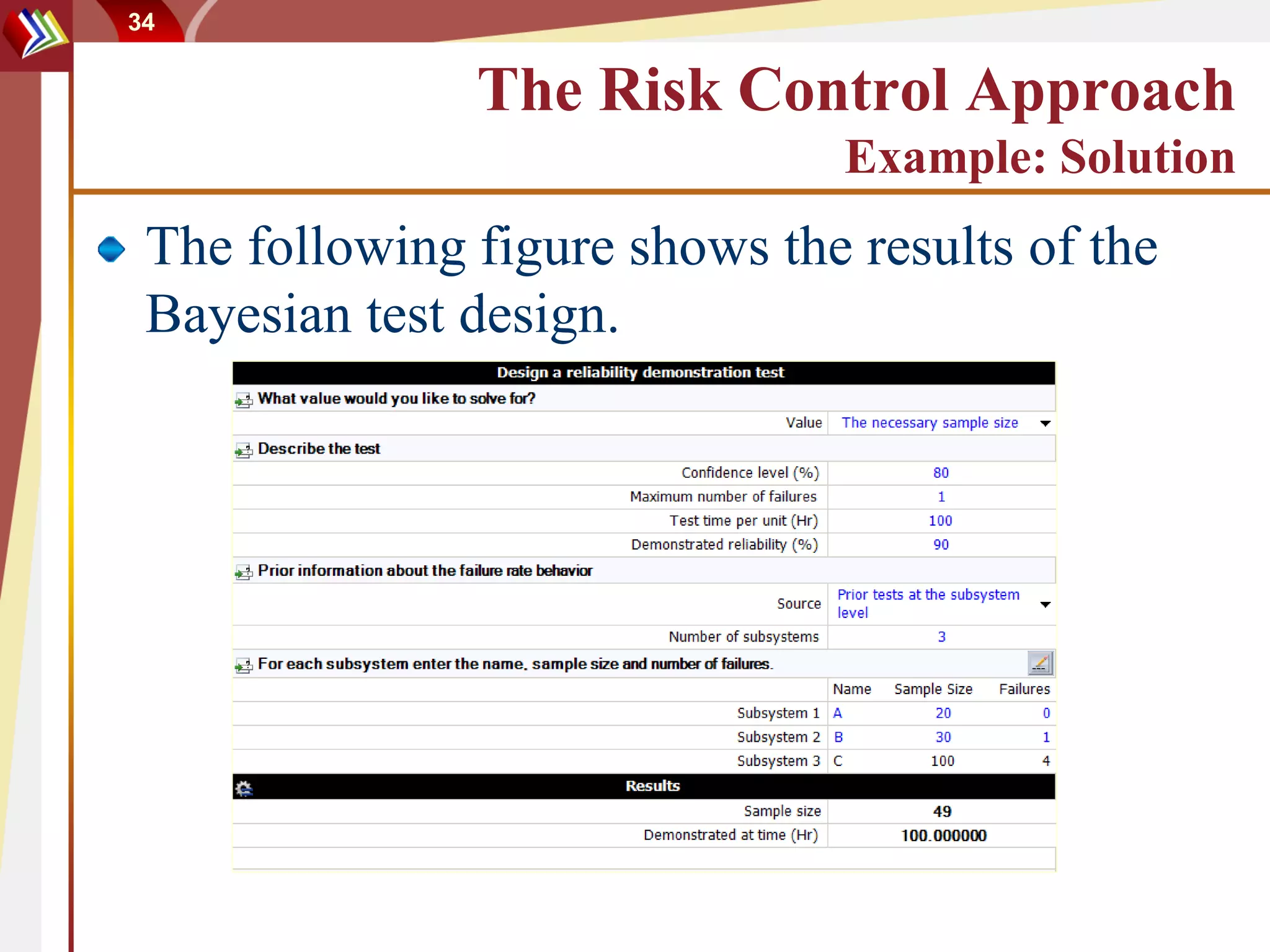
                                Example: Solution
 The following figure shows the results of the
 Bayesian test design.
35

                           EDUCATION


     Part II: Examples of Using
                 Software Tools
36


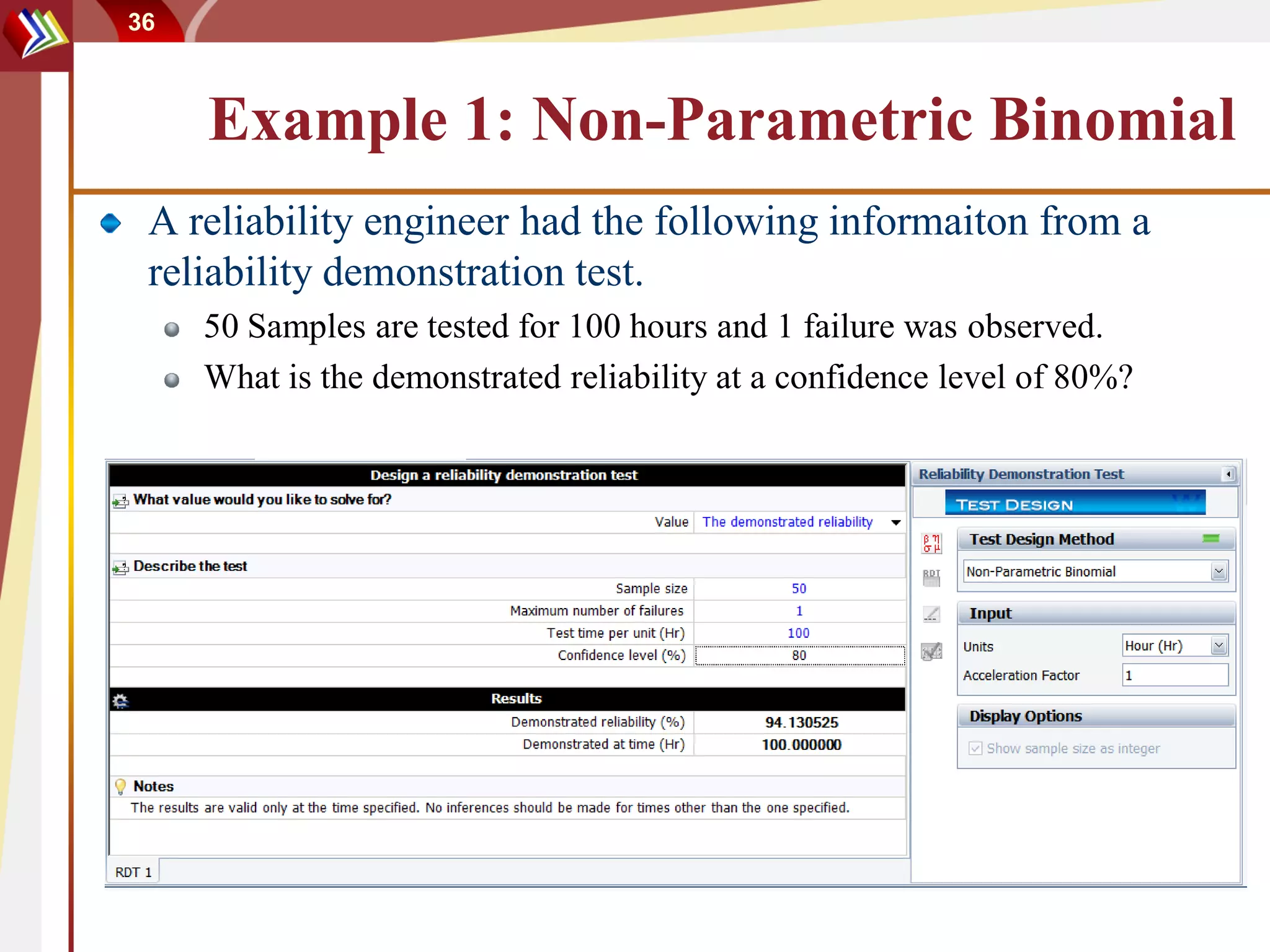
     Example 1: Non-Parametric Binomial
 A reliability engineer had the following informaiton from a
 reliability demonstration test.
     50 Samples are tested for 100 hours and 1 failure was observed.
     What is the demonstrated reliability at a confidence level of 80%?
37


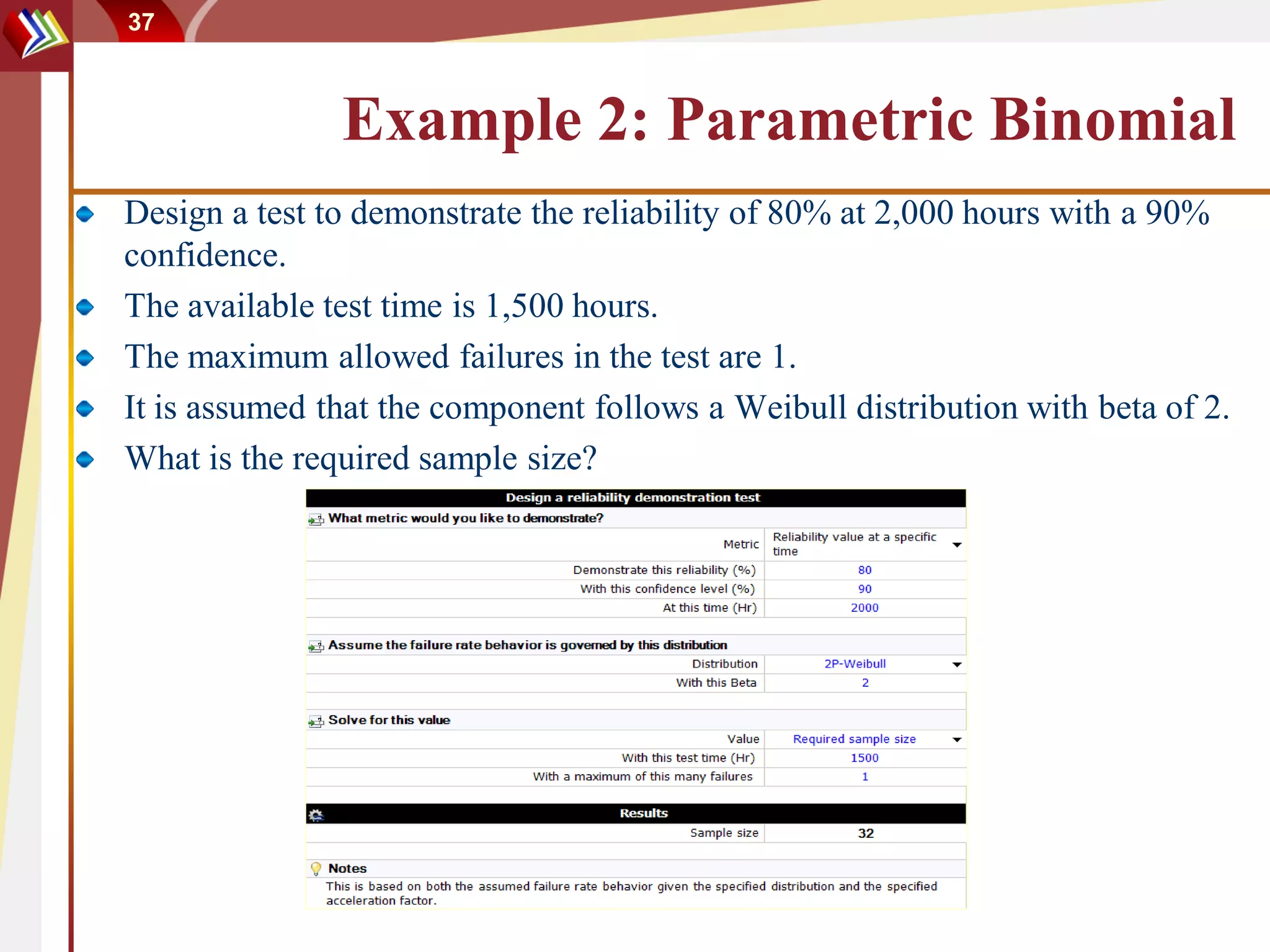
               Example 2: Parametric Binomial
Design a test to demonstrate the reliability of 80% at 2,000 hours with a 90%
confidence.
The available test time is 1,500 hours.
The maximum allowed failures in the test are 1.
It is assumed that the component follows a Weibull distribution with beta of 2.
What is the required sample size?
38


                        Example 3: One Stress ALT
 A reliability engineer wants to design an ALT for an
 electronic component.
 Use temperature is 300K while design limit is 380K.
 The engineer has:
     2 months or 1,440 hours available for testing and 2 available chambers.
 From historical data:
     The beta parameter of the Weibull distribution is 3.
     The probability of failure at use temperature at time 1,440 is 0.00014, at
     the design limit is 0.97651.
 The engineer wants to determine:
     The appropriate temperature that should be set at each chamber.
     The number of units that should be allocated at each chamber.
39


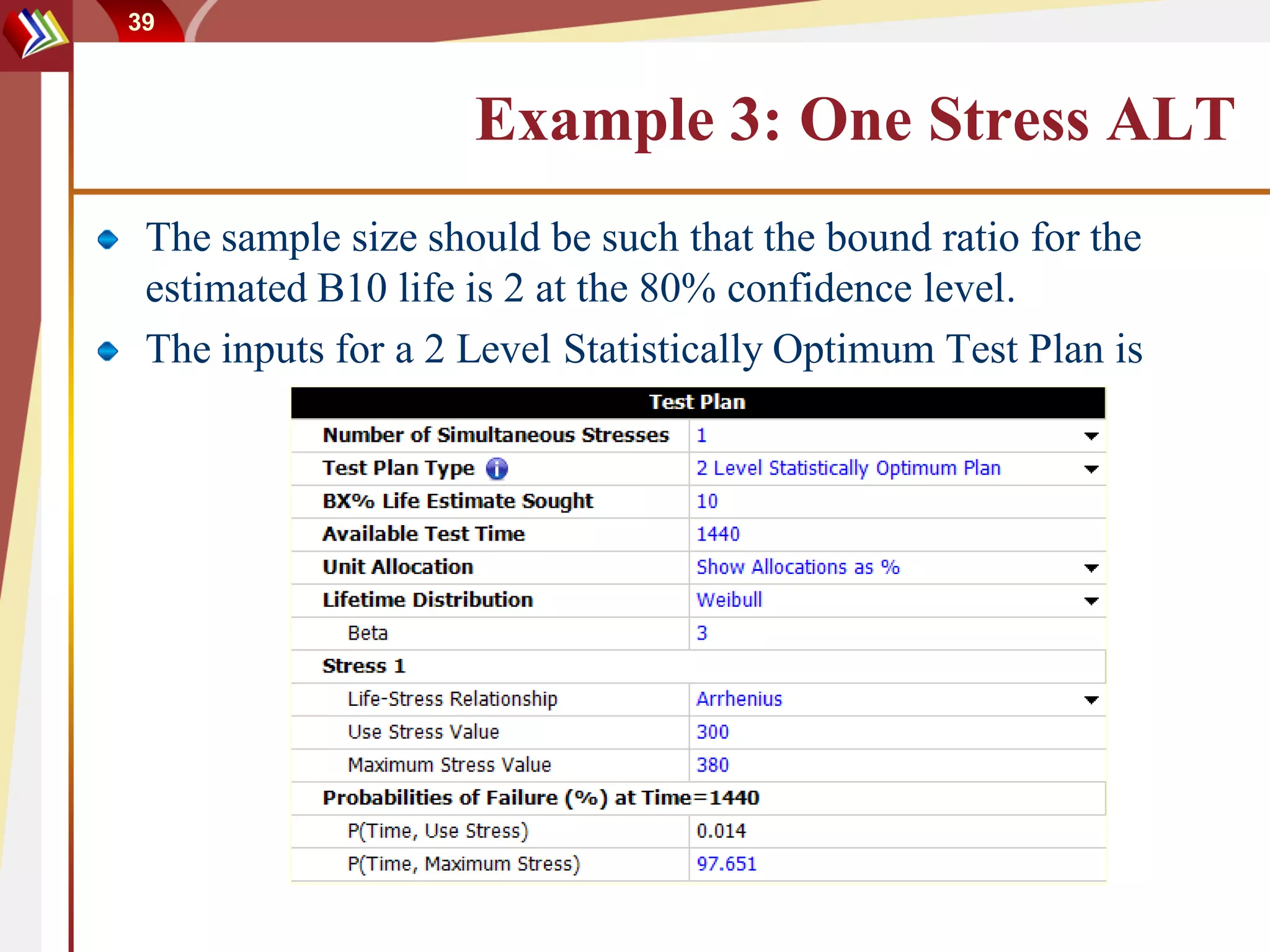
                    Example 3: One Stress ALT
 The sample size should be such that the bound ratio for the
 estimated B10 life is 2 at the 80% confidence level.
 The inputs for a 2 Level Statistically Optimum Test Plan is
40


Example 3: Results for The Optimal Plan
 The following figure shows the output of the
 test plan.


 The results show that:
     68.2% of the units should be allocated at 355.8K and 31.8% at 380K.
     This test plan will give minimal variance for the estimated B10 life.
41


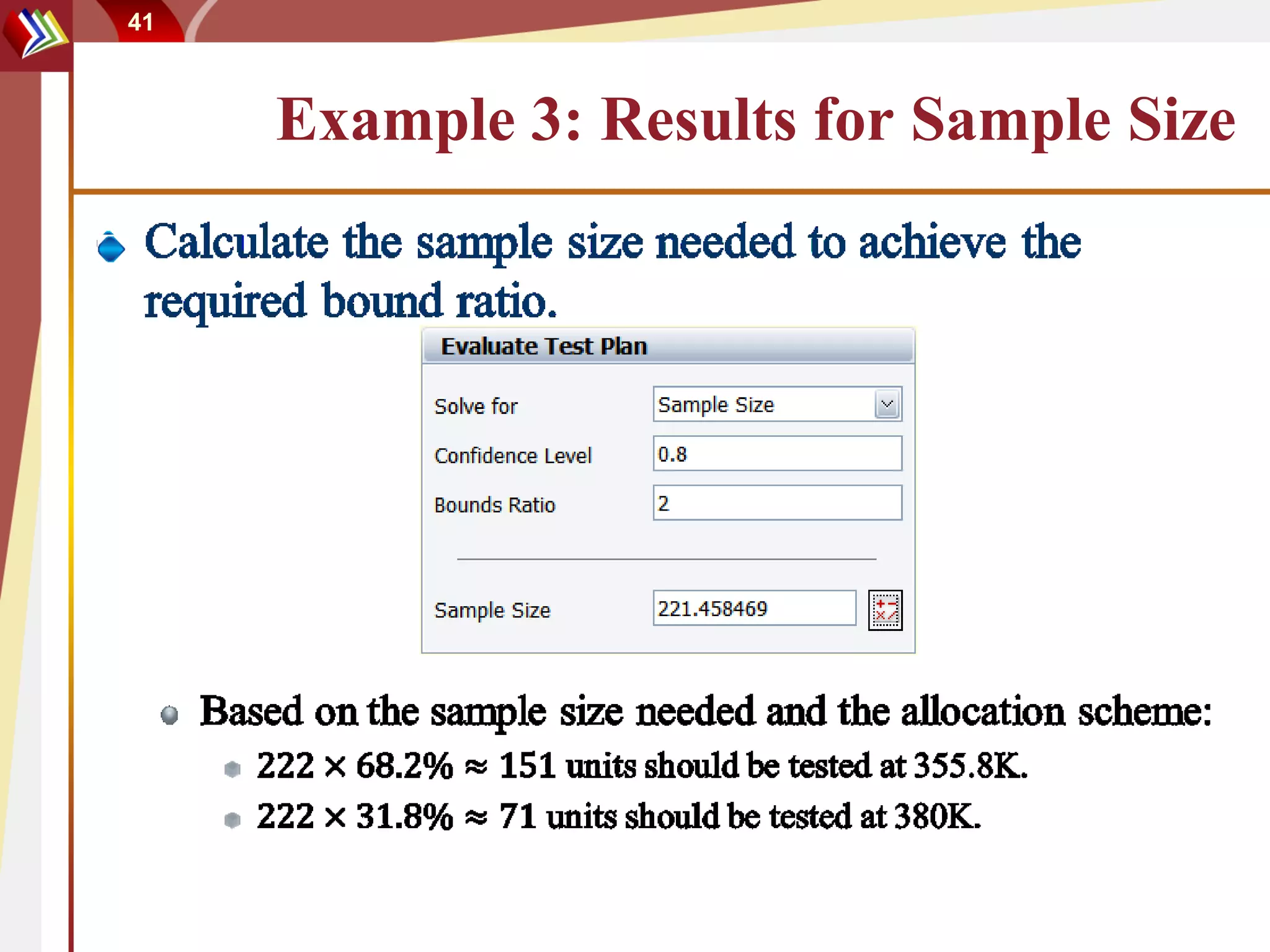
     Example 3: Results for Sample Size
42


                        Where to Get More Information
1.   http://www.itl.nist.gov/div898/handbook/
2.   www.Weibull.com


 3. http://www.reliawiki.org/index.php/ReliaSoft_Books

Sample size issues on reliability test design

  • 1.
    Sample Size Issues on  Reliability Test Design  R li bilit T t D i (可靠性试验设计中的样本量问 题) Dr. Huairui Guo (郭怀瑞博士) ©2012 ASQ & Presentation Guo Presented live on Sep 15th, 2012 http://reliabilitycalendar.org/The_Re liability_Calendar/Webinars_ liability Calendar/Webinars ‐ _Chinese/Webinars_‐_Chinese.html
  • 2.
    ASQ Reliability Division  ASQ Reliability Division Chinese Webinar Series Chinese Webinar Series One of the monthly webinars  One of the monthly webinars on topics of interest to  reliability engineers. To view recorded webinar (available to ASQ Reliability  Division members only) visit asq.org/reliability ) / To sign up for the free and available to anyone live  webinars visit reliabilitycalendar.org and select English  Webinars to find links to register for upcoming events http://reliabilitycalendar.org/The_Re liability_Calendar/Webinars_ liability Calendar/Webinars ‐ _Chinese/Webinars_‐_Chinese.html
  • 3.
    可靠性试验设计中的样本量 问题 (SampleSize Issues on Reliability Test Design) 郭怀瑞, Ph.D., CRE, CQE, CRP ©1992-2012 ReliaSoft Corporation - ALL RIGHTS RESERVED
  • 4.
    2 Outlines Part 1: Methods for determining sample size Parameter estimation based approaches Risk control based approaches Part 2: Examples using software tools from ReliaSoft
  • 5.
    3 EDUCATION Part I: Methods for Determining Sample Sizes in Reliability Tests
  • 6.
    4 Sample Size Issues on Reliability Test Design Introduction One of the most critical questions when designing a reliability test is determining the appropriate sample size. If sample size is too large, unnecessary costs may be incurred. If sample size too small, the uncertainty of the reliability estimates will be unacceptably high.
  • 7.
    5 Sample Size Issues on Reliability Test Design Introduction (cont’d) Two methods in determining the required sample size: The Estimation Approach (similar to the alphabetic optimal criteria) The goal is to determine the effect of sample size on confidence intervals (variance). Sample size is determined based on the desired confidence interval width. The Risk Control Approach The goal is to control the Type I and Type II errors. This is also referred to as power and sample size in design of experiments (DOE).
  • 8.
    6 The Estimation Approach Effect of Sample Size on Confidence Interval From historical information an engineer knows that component’s life follows a Weibull distribution with: beta=2.3 eta=1,000 hours. The engineer first wants to see how the sample size affecting the confidence bounds of the estimated reliabilities.
  • 9.
    7 The Estimation Approach Effect of Sample Size on Interval Width The following plot shows the simulation bounds for a sample size of 5 units. ReliaSof t W eibull+ + 7 - www. ReliaSoft. com Probability - Weibull 99. 000 Weibull-2P MLE SRM MED FM F=0/ S=0 90. 000 True Parameter Line Top CB-R Bottom CB-R 50. 000 U n r e lia b ilit y , F ( t ) 10. 000 5. 000 Harry Guo Reliasoft 6/ 7/ 2012 2:31:21 PM 1. 000 100. 000 1000. 000 10000. 000 Time, (t)             
  • 10.
    8 The Effect of Sample Size on Interval Width (cont’d) The following plot shows the simulation bounds for a sample size of 40 units. ReliaSof t W eibull+ + 7 - www. ReliaSoft. com Probability - Weibull 99. 000 Weibull-2P MLE SRM MED FM F=0/ S=0 90. 000 True Parameter Line Top CB-R Bottom CB-R 50. 000 U n r e lia b ilit y , F ( t ) 10. 000 5. 000 Harry Guo Reliasoft 6/ 7/ 2012 2:32:52 PM 1. 000 100. 000 1000. 000 10000. 000 Time, (t)             
  • 11.
    9 The Estimation Approach Example for Determining Sample Size Therefore, sample size can be determined based on the required of the width of the estimated confidence bounds. For the above example, determine the needed sample size so that the ratio of the upper bound to the lower bound of the estimated reliability at 400 hours is less than 1.2 at a confidence level of 90%.
  • 12.
    10 The Estimation Approach Example for Determining Sample Size (cont’d) Using a simulation tool like SimuMatic the engineer can perform simulation and calculate the bound ratio at a 90% confidence for different sample sizes. Sample Size Upper Bound Lower Bound Bound Ratio 5 0.9981 0.7058 1.4143 10 0.9850 0.7521 1.3096 15 0.9723 0.7718 1.2599 20 0.9628 0.7932 1.2139 25 0.9570 0.7984 1.1985 30 0.9464 0.8052 1.1754 35 0.9433 0.8158 1.1563 40 0.9415 0.8261 1.1397 As it can be seen the desired bound ratio is achieved for a sample size of at least 25 units.
  • 13.
    11 Estimation Approach for Determining Sample Size for ALT The Estimation approach is also widely used for determining sample size in accelerated life tests (ALT) In ALT, the sample size issue is more complicated since we need to determine: The total sample size. Sample size at each stress level (for single stress), or stress level combination (for multiple stresses).
  • 14.
    12 Optimal Design Criteria in Design of Experiments (DOE) x1 x2 x3  1 1  1 X   1 1  1    .. .. ..   
  • 15.
    13 Distributions and Models in ALT Failure time distribution Exponential Weibull Lognormal Life-stress model log(t )  0  1 x1  2 x2  ...   Maximum likelihood estimation  f (ti ) if the ith observation is an exact failure  li   F (ti ,U )  F (ti , L ) if the ith observation is an interval failure  R( s ) if the ith observation is an suspension  i n   ln( L )   li i 1
  • 16.
    14 D-Optimal in ALT In life tests, it usually is required to minimize the uncertainty of the estimated model parameters. Variance-covariance matrix of parameter estimation   2  Var 1  F    2   i  Minimizing the variance-covariance matrix is the same as to maximize the determinant of Fisher information matrix objective : max | F | st. constraints on stresses, constraints on sample,... .
  • 17.
    15 Example: Time-Censored ALT with 2 Stresses Log-likelihood function si    ( 0  1 X i ,1   2 X i , 2  12 X i ,1 X i , 2 )   1 zi2, j  1 Yij   li , j (  ,  )  I ij   ln   ln 2     (1  I ij ) ln(1   ( si )) if  2 2   I ij   0 if Yij   E[ I ij ]  ( si ) Fisher information matrix n A n x A n x A n x x A i i i i ,1 i i i ,2 i i i ,1 i ,2 i n A  si i i i n A n x x A n x A i i i i ,1 i ,2 i i i ,2 i n A  s x i i i i i ,1 F 1 n A n x A i i i i ,1 i n A  s x i i i i i ,2   i  2 n A i i n A  s x x i i i i i ,1 i ,2 Ai   i  i  si    1  i     s     n 2 i  i  i si  si2  1  i i   1  i  i    Find ni to maximize |F|. Planned distribution parameter values are needed
  • 18.
    16 Minimize the Varianceof BX Life in ALT Often time we want to minimize the variance of the time at a given reliability. objective : min Vart ( R ) st. constraints on stresses, constraints on sample,... . t ( R)  f ( R,  , S ); Var t ( R)   G  R,  ,Var    , S     0, 1 ,..., i  ; S   S1, S2 ,...Si   are the model coefficients. S are the stress values.
  • 19.
    17 The Risk Control Approach Introduction The risk control approach is usually used to design reliability demonstration tests. Often times zero failure tests. Purpose not to find failures and estimate distribution parameters, but demonstrate a required reliability. In demonstration tests there are two types of risks: Type I risk. The probability that although the product meets the reliability requirements it does not pass the test. Producer’s risk or α error. Type II risk. The probability that although the product does not meet the reliability requirements it passes the test. Consumer’s risk or β error.
  • 20.
    18 The Risk Control Approach Introduction The following table summarizes the Type I and II errors. when H0 is true when H1 is true Do not correct decision Type II error reject H0 (probability = 1- α) (probability = β) Type I error correct decision Reject H0 (probability = α) (power = 1 - β) The null hypothesis H0 is that the product meets the reliability requirement. The alternative hypothesis H1 is that the product does not meet the reliability requirement. With an increase in sample size both Type I and II errors will decrease. Sample size is determined based on controlling Type I, Type II or both risks.
  • 21.
    19 The Risk Control Approach Non-Parametric Binomial for Demonstration Tests
  • 22.
    20 The Risk Control Approach Non-Parametric Binomial for Demonstration Tests In the Non-Parametric Binomial equation time is not a factor. The Non-Parametric method is used: For one-shot devices where time is not a factor. For cases when the test time is the same as the time at which we require the demonstrated reliability. When time is a factor, the so called parametric Binomial should be used, and a failure time distribution is assumed.
  • 23.
    21 The Risk Control Approach Example A reliability engineer wants to design a zero failure demonstration test. The target reliability is 80% at 100 hours. The required confidence level is 90% (the Type II error is 10%). The available test time is 100 hours. What is the required sample size?
  • 24.
    22 The Risk Control Approach Solution
  • 25.
    23 The Risk Control Approach Example: Solution (cont’d) If 1 out the 11 samples in the test fails, the demonstrated reliability will be less than the required. In this case it will be:
  • 26.
    24 The Risk Control Approach Exponential Chi-Squared Demonstration Test
  • 27.
    25 The Risk Control Approach Example We want to design a test in order to demonstrate: An 85% reliability at 500 hours. With a 90% confidence. Only up to two failures are allowed in the test. The assumed distribution is exponential. The available test duration is 300 hours. Determine the sample size needed.
  • 28.
    26 The Risk Control Approach Example: Solution
  • 29.
    27 The Risk Control Approach Example: Solution (cont’d) Using Weibull++, the total accumulated test time based on the available test time and required sample size is:
  • 30.
    28 The Risk Control Approach Non-Parametric Bayesian Test Bayesian methodology utilizes historical information to improve “accuracy”. In reliability testing, Bayesian methods can be beneficial when: Available sample size is small. Prior information on the product’s reliability is available.
  • 31.
    29 The Risk Control Approach Non-Parametric Bayesian Test (cont’d)
  • 32.
    30 The Risk Control Approach Non-Parametric Bayesian Test (cont’d)
  • 33.
    31 The Risk Control Approach Bayesian Test With Subsystem Information
  • 34.
    32 The Risk Control Approach Bayesian Test With Subsystem Information (cont’d)
  • 35.
    33 The Risk Control Approach Example Assume a system of interest is composed of three subsystems A, B and C. The following table shows prior subsystem test results. What is the required sample size in order to demonstrate: A system reliability of 90% at an 80% confidence level. With 1 allowed failure in the test.
  • 36.
    34 The Risk Control Approach Example: Solution The following figure shows the results of the Bayesian test design.
  • 37.
    35 EDUCATION Part II: Examples of Using Software Tools
  • 38.
    36 Example 1: Non-Parametric Binomial A reliability engineer had the following informaiton from a reliability demonstration test. 50 Samples are tested for 100 hours and 1 failure was observed. What is the demonstrated reliability at a confidence level of 80%?
  • 39.
    37 Example 2: Parametric Binomial Design a test to demonstrate the reliability of 80% at 2,000 hours with a 90% confidence. The available test time is 1,500 hours. The maximum allowed failures in the test are 1. It is assumed that the component follows a Weibull distribution with beta of 2. What is the required sample size?
  • 40.
    38 Example 3: One Stress ALT A reliability engineer wants to design an ALT for an electronic component. Use temperature is 300K while design limit is 380K. The engineer has: 2 months or 1,440 hours available for testing and 2 available chambers. From historical data: The beta parameter of the Weibull distribution is 3. The probability of failure at use temperature at time 1,440 is 0.00014, at the design limit is 0.97651. The engineer wants to determine: The appropriate temperature that should be set at each chamber. The number of units that should be allocated at each chamber.
  • 41.
    39 Example 3: One Stress ALT The sample size should be such that the bound ratio for the estimated B10 life is 2 at the 80% confidence level. The inputs for a 2 Level Statistically Optimum Test Plan is
  • 42.
    40 Example 3: Resultsfor The Optimal Plan The following figure shows the output of the test plan. The results show that: 68.2% of the units should be allocated at 355.8K and 31.8% at 380K. This test plan will give minimal variance for the estimated B10 life.
  • 43.
    41 Example 3: Results for Sample Size
  • 44.
    42 Where to Get More Information 1. http://www.itl.nist.gov/div898/handbook/ 2. www.Weibull.com 3. http://www.reliawiki.org/index.php/ReliaSoft_Books