Patient Diaries


Abhina a Sa hu
      nd n nd
Fa ulty a C
  c      t linic l Re e rc Ins
                a s a h titute
a hi_g
 b    ill@ ya o o
             ho .c .in
Objective
   W t a P tie d irie ?
      ha re a nt a s
   W ta P
      ha re ROs  ?
   Ne dfo p tie d rie
      e r a nt ia s
   W w sin thed ry?
      ho rite       ia
   Typ so d rie
       e f ia s
   C m a o o p p r a e c nicd rie
     o p ris n f a e nd le tro ia s
   C a n o d rie
     re tio f ia s
   Sub c p fe nc s
       je t re re e
What are Patient Dairy?
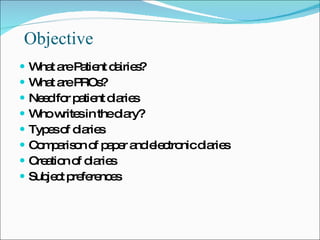
 Patient Diary is a to l us d d
                       o e uring a
 clinic l tria o a d e s tre tm nt to
       a      l r   is a e a e
 m a uretre tm nt c m lia e
   es         a e o p nc
 P tie s Dia a o p vid s w a
   a nt’     ry ls ro e ith
 s le ha y p c to d c e he lth
  ing , nd la e     o um nt a
 ins nc p lic info a n, d c r’
    ura e o y      rm tio o to s
 vis , p s rip ns a q s ns fo
    its re c tio , nd ue tio   r
 yo ur d c rs
          o to ,  p rm c t a
                   ha a is    nd
 ins nc c m a
    ura e o p ny
What are PROs
 P tie
   a nt-re o d o o e (P
          p rte utc m s RO)
 ha lo b e e s ntia s urc s o
   ve ng e n s e l o e f
 d ta
  a      in      b p rm c utic l
                   io ha a e a
 c ma sc
  o p nie ' linic l re e rc
                 a sa h
 A PRO is a m a ure e o a
              e s m nt f ny
 a p c o a p tie s he lth s tus
  s et f     a nt’ a       ta
 tha c m s d c fro thep tie
     t o e ire tly m      a nt
 (i.e w ut the inte re tio o
     ., itho        rp ta n f
 the p tie s re p ns s b a
        a nt’     so e    y
 p ic n o a nee e
   hys ia r nyo ls )
Emergence of Psychometrics

 P rha s the m s im o nt d ve p e ha b e
   e p         o t p rta e lo m nt s e n
 g a r a ntio to p yc m tric , the s ie e o
  re te tte n      s ho e s         c nc f
 a s s ingp tie e e nc
  ses      a nt xp rie e

 Qua tive w rk is inc a ing to e ure tha the
     lita   o         re s ly    ns      t
 inte e m a ure ta s the full ra e o p tie
     nd d e s      p            ng f a nt
 e e nc s a q s nna s a s je te to
  xp rie e nd ue tio ire re ub c d
 rig ro q ntita s tis a te ts
    o us ua    tive ta tic l s
Need of Diaries in Clinical Trials
 So etreatment effects a known only to the patient
    m                    re

 To know the patient perspective a o the e c ne s
                                   b ut    ffe tive s
   o atre tm nt
    f    a e

 Sys m tic a s s m nt o the patient’s perspective may
     te a    ses e f
   provide valuable information tha c n b lo t w n tha
                                     t a e s he       t
   p rs e tive is filte d thro h a c
    e pc               re     ug    linic n’ e lua n o
                                         ia s va tio f
   thep tie sre p ns toc
       a nt’ s o e linic l inte wq s ns
                                 a    rvie ue tio
PROs Objectives
 Thefo us o P
       c f RO m a ure is s
               e s s hifting fro b a
                                m ro d
  q lity o life a s s m nts to measures of signs
   ua     f      ses e
  and symptoms, w h m y b d e s s e ific
                   hic a e is a e p c
 Tre tm nt-re te changes in quality of life
     a e      la d
 Direct consequences of disease and treatment,
  the ha m reo n s rve a p a e p ints
     y ve o fte e d s rim ry nd o
  in clinic l tria
           a      ls
When can the Diary be started

 In clinic l tria , d iry iss re p r tous o
           a      ls a        ta d rio    e f
  inve tig tio l a e
      s a na g nt

 In inte ivec re d rie a us lly s rte o the
         ns   a , ia s re ua ta d n
  p tie sthirdd y b c us p tie w s y
   a nt’       a e a e a nts ho ta
  lo e us lly e e nc m rem m ry g p
    ng r ua xp rie e o        e o as
Who writes in the Diary ?
    P tie him e re o stheo s rva ns
      a nt    s lf c rd    b e tio
    A d ry ke t b nurs s w n in the
         ia    p y      e , ritte
     IC d
        U uring p rio s o c a illne s
                  e d f ritic l      s,
     w h isha e o r to thep tie w n
       hic     nd d ve      a nts he
     the a c ns e d a le to re e it in
        y re o id re b         c ive
     c s o inte ivec re
      ae f     ns   a
    In c s o c re e r the p re o
         a e f hild n, ithe     a nts r
     c re und r thes e io o p re
      hild n   e     up rvis n f a nts
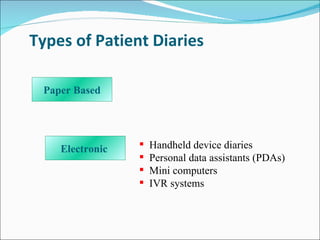
Types of Patient Diaries

 Paper Based


    Electronic      Handheld device diaries
                    Personal data assistants (PDAs)
                    Mini computers
                    IVR systems
Paper Diary

 P tie
   a nts ke p a d ily p p r d ry
           e     a     ae    ia
  thro ho
       ug ut the s y a
                    tud     nd re o
                                  c rd
  s p m w n the e e nc dthe
   ym to s he       y xp rie e       m
 P p r p tie d rie c nno b tra ke fo
    a e a nt ia s a t e c d r
  a he nc tothere o
   d re e          p rtings he ule
                           c d
 If thep tie fo e to c m le thed ry
          a nt rg ts o p te          ia
  o the d te the s p m o c d the
   n        a     ym to     c urre ,    y
  c n c m le the d ry la r, inc a ing
   a o p te          ia    te     re s
  thelike o tha d taw h ise re is
          liho d t a hic         nte d
  ina c te
      c ura
Paper Diaries
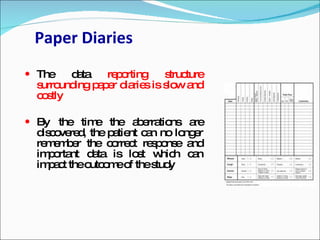
 The    d ta re o
          a     p rting s ture
                         truc
  s und p p r d rie is s w a
   urro ing a e ia s    lo nd
  cs
   o tly

 By the tim the a e tio
            e     b rra ns are
  d c ve d the p tie c n no lo e
   is o re ,     a nt a        ng r
  re e b r the c rre t re p ns a
    mm e         o c s o e nd
  im o nt d ta is lo t w h c n
    p rta    a        s    hic a
  im a t theo o eo thes y
    pc       utc m f      tud
Paper Diaries
 The a ila ility o re va d ta
       va b        f le nt a
 o re uire tim is q
  n    q d     e    uite
 c m lic te a d ult
  o p a d nd iffic


 Re e rc r
    s a he     ha s to s a h
                           e rc
 m nua
   a lly fo re o
              r    p rts in the
 e us
  xha tive file a b the tim
                s nd y         e
 he find the s e ific d ry he
        s        pc      ia
 m y s the p int he w nts to
   a kip         o        a
 put
PROs go Electronic
 Clinic l re e rc rs ha
        a    s a he     ve us d p p r
                             e   ae
  d rie fo tha p o e s e the 19 0 ,
   ia s r     t urp s inc        4s
  b in a a m t to o rc m s je t
   ut     n tte p     ve o e ub c
  no o p nc a d ta ua p b m
     nc m lia e nd a -q lity ro le s
  a s c te w p p r d rie , the no
   s o ia d ith a e ia s      y w
  o n us EDs
   fte e
 Re e s ie ha s w tha p tie
    c nt tud s s ho n t a nt
  c m lia e in va us c
   o p nc           rio linic l tria
                             a      ls
  inc a e totrip w theus o e ia s
     re s s     le ith  e f -d rie
Rationale for Developing EDs

 The a p a n o EDs ha its ro ts in the e
       p lic tio f    s      o         s
  p rs te p b m a s c te w
   e is nt ro le s s o ia d ith p p r
                                 ae
  d rie
   ia s
    P o d taq lity
      o r a ua
    Lo d la to d talo k
       ng e ys   a c
    P o s je t c m lia e
      o r ub c o p nc
    Theris p te l fo lo s d m g
           ks o ntia r s , a a e
    Ina c c
        c ura y
Electronic based Patient Diaries
 Ele tro
     c nic d ry m tho s fo c lle ting d ta fro
            ia   e d      r o c        a      m
  p tie in c
   a nts linic l tria w sd ve p d in 19 7
              a      ls a e lo e       8
 An Electronic Patient Diary re is rs thed ry in a
                                g te       ia
  s ra ed vic a a w fo m nito
   to g e e nd llo s r o ringthetim the
                                    e
  m d a n w s ta n, a s p m o Qua o
    e ic tio a ke nd ym to s r    lity f
  Lifed tare o e
        a c rd d
 Sp ns rs s uld e ta lis a ‘ o
    o o ho        s b h     to lkit’o p fe d
                                     f re rre
  te hno g a a a o
    c lo y nd n lg rithm b w h the c n
                          y hic     y a
  d c e w h te hno g to a p to a p rtic r
   e id   hic c lo y     p ly     a ula
  s y
   tud
Handheld Device diaries
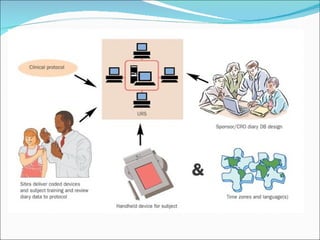
 De e c n b c nfig d to b e o fla h to re ind the
    vic s a e o ure       le p r s        m
  p tie o as he ule d ry e
   a nt f c d d ia ntry
 The in-built s re n fa ilita s the e
                c e c te              ntry o fre te a
                                            f   e xt nd
  vis l a lo ue s a d ta a c n a o b us d to p s nt
     ua na g c le a , nd a ls e e             re e
  o c e d
   n-s re n uringd ry c m le n
                  ia o p tio
 The m in lim tio c ntre a und the e s o us , the
     ir a     ita ns e     ro      ir a e f e
  re uire e to d p y a
    q m nt           e lo nd m inta ha w re a
                              a in    rd a , nd
  c nne tivity is ue
   o c           s
Personal Data Assistants (PDAs)
 The e d vic s ha
     s   e e      ve a s a s re n to d p y
                        m ll c e      is la
  q s ns a
   ue tio , nd a num e o b ns to c ntro
                     b r f utto       o l
  na a n thro h q s ns a to a s n a re p ns
    vig tio   ug ue tio nd    s ig    so e
  toaq s n
       ue tio
 Da c lle te o the P
    ta o c d n       DA is tra m d b the
                              ns itte y
  s je t,
   ub c       thro h
                  ug     w le s
                           ire s     o r    a lo
                                             na g
  te c m unic tio , to a c ntra s rve ho te b the
    le o m a ns           e l e r s d y
  e RO s lutio p vid r
   P     o    n ro e
 The PDAs c n b p g m e to he p tie
            a e ro ra m d     lp a nts
  re e b r tore o the d ta
    mm e       c rd ir a
IVR systems
 IVR s te s a a c s e b the p tie w
       ys m re c e s d y      a nt ho
  te p ne into a c ntra c m ute s te via a to
    le ho s       e l o p r ys m             ll-
  fre num e
     e    br

 P -re o e m s a e c m ris the d ry q s ns
   re c rd d e s g s o p e       ia ue tio ,
  a re p ns s a m d us
   nd s o e re a e ing the ke o the
                             ys f
  te p neke a
    le ho  yp d
IVR systems
 IVRS re o s the info a n in vo e fo a a
         c rd         rm tio    ic   rm t nd
  tha c nve it intofilefo a
     n o rt              rm t
 Da a e re d c
    ta re nte d ire tly onto the c ntra IVR
                                  e l
  d ta a e e ina
   a b s , lim ting d w a a
                       o nlo d nd c nne tivity
                                     o c
  is ue a m king a d ry d ta a ila le fo re w
    s s nd a      ll ia a va b          r vie
  in re l-tim
       a     e
 IVR d rie us the te p ne ke a to e r d ta
       ia s e        le ho   yp d   nte a ,
  m king it id a fo c lle tio o num ric b ry,
    a         el r o c n f          e , ina
  o ina s a , a c te o a ultip -c ic
   rd l c le nd a g ric l/m     le ho e
IVR Systems
 Ea h p tie e
    c a nt ntry is tim s m e w the p tie s
                      e ta p d ith  a nt’
  lo a tim d c e
    cl    e o um ntinge c w n thec ll ism d
                       xa tly he  a      ae
 The IVR    s te d fine a w o o tim d
              ys m e s      ind w f     e uring
  w h the p tie re o s p m tha the a
    hic       a nt p rts ym to s      t   y re
  e e nc
   xp rie ing a the m m nt o w
                t     o e   r ithin the p vio
                                         re us
  12 4ho
     -2   urs
 Re o
    p rting p ra e rs a s t d p nd w re o the
             a m te re e e e ing he n
  g b thep tie re id s
   lo e   a nt s e
IVR Systems
 P g m e to g ne tea a rt w n d taise re
   ro ra m d  e ra n le he a          nte d
    w h isinva o o id a c p dra e
     hic      lid r uts e c e te ng s

 Re p nd nts a im e ia ly p m te to re nte
    so e       re m d te    ro p d     -e r
    d ta
     a

    Thus c nflic a re o dre o ly a ins ntly
         , o     ts re s lve m te nd ta
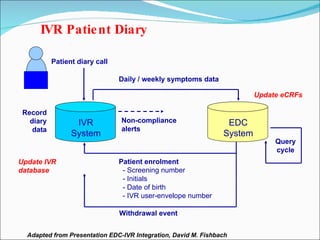
IVR Patie nt Diary

           Patient diary call

                                Daily / weekly symptoms data

                                                                         Update eCRFs

 Record
   diary          IVR           Non-compliance                   EDC
    data                        alerts
                 System                                         System
                                                                              Query
                                                                              cycle
Update IVR                      Patient enrolment
database                         - Screening number
                                 - Initials
                                 - Date of birth
                                 - IVR user-envelope number

                                Withdrawal event


  Adapted from Presentation EDC-IVR Integration, David M. Fishbach
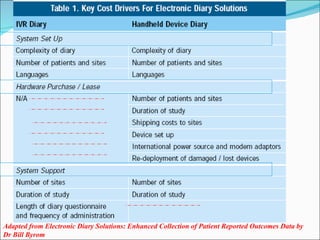
Adapted from Electronic Diary Solutions: Enhanced Collection of Patient Reported Outcomes Data by
Dr Bill Byrom
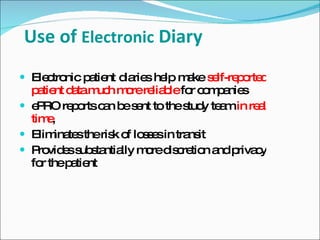
Use of Electronic Diary
 Ele tro p tie d rie he m ke s lf-re o d
     c nic a nt ia s lp a e p rte
  p tie d tam h m rere b fo c m a s
    a nt a uc o        lia le r o p nie
 e RO re o c n b s nt to thes y te min re l
    P      p rts a e e         tud a      a
  tim ,e
 Elim te theris o lo s sin tra it
        ina s     k f se       ns
 P vid ss s ntia m red c tio a p c
    ro e ub ta lly o is re n nd riva y
  fo thep tie
     r     a nt
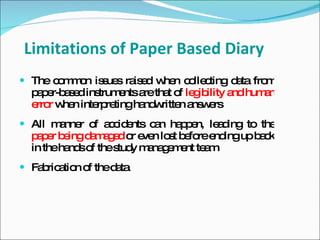
Limitations of Paper Based Diary
 The c m o is ue ra e w n c lle ting d ta fro
       o m n s s is d he o c           a      m
  p p r-b s d ins
   a e ae        trum ntsa tha o le ib
                     e    re t f g ility a hum n
                                          nd  a
  e r w n inte re
   rro he       rp tingha w n a w rs
                          nd ritte ns e
 All m nne o a c e
       a r f c id nts c n ha p n, le d
                       a    pe      a ing to the
  p p r b ingd m g d o e n lo t b fo e ingup b c
   ae e       a a e r ve s e re nd            ak
  in theha so thes y m na e e te m
          nd f     tud a g m nt a
 Fa ric tio o thed ta
    b a n f        a
Limitations of Paper Based Diary

 Sp llingc n a oa c thea c c o thed ta a this
    e      a ls ffe t    c ura y f  a , s
  c n le dthete mtom keap s ib s rio
   a a         a    a    o s ly e us
  m inte re tio
   is rp ta n
 W thea m tra
   ith  d inis tiveb e o typ upthe
                    urd n f ing
  ha w n re p ns s
    nd ritte s o e
Benefits of e-Patient Diary
   Re l-tim , 2 /7 a c s
      a     e 4 c es
   P m te p tie c m lia e
     ro o s a nt o p nc
   P vid sp c s c ns te y
     ro e ro e s o is nc
   Dra a a re uc shum n e r
       m tic lly d e       a rro
   Im ro sd tare b
      p ve a lia ility
   Sa stim a m ne
      ve     e nd o y
   He re e rc rs m re e c ly m na e p tie
      lp s a he        o ffe tive a g a nts
    in s ie w re s lf-re o d d ta a a ke
        tud s he        e p rte a   re     y
    e p int
     nd o
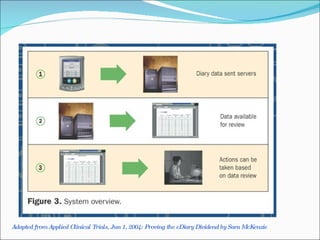
Adapted from Applied Clinical Trials, Jun 1, 2004: Proving the eDiary Dividend by Sara McKenzie
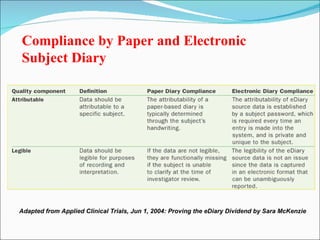
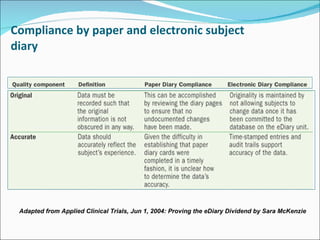
FDA's ALCOA
 The FDA's ALCOA (Attributable, Legible,
 Contemporaneous, Original, Accurate) criteria
 for patient data in labelling claims have helped
 to substantiate the argument for using ePRO, as
 patient data is far more accurate when collected
 electronically
Compliance by Paper and Electronic
Subject Diary


Adapted from Applied Clinical Trials, Jun 1, 2004: Proving the eDiary Dividend by Sara McKenzie
Compliance by paper and electronic subject
diary


 Adapted from Applied Clinical Trials, Jun 1, 2004: Proving the eDiary Dividend by Sara McKenzie
Aim of the Patient diary

   Atte p to m a ureb th thee c ne s a
        mt     es     o       ffe tive s nd
    thes ee c o tre tm nt
        id ffe ts f a e
   Me s
       a ure the a ve e c ns q nc s o
                     d rs     o e ue e      f
    tre tm nt s p ra ly fro the e c ne s o
       a e e a te          m     ffe tive s f
    tre tm nt
       a e
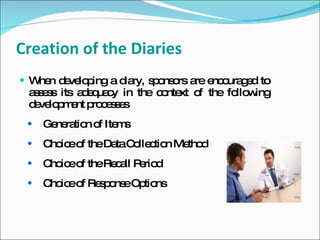
Creation of the Diaries
 W n d ve p
   he e lo ing a d ry, s o o a e o g d to
                  ia    p ns rs re nc ura e
 a s s its a e ua y in the c nte o the fo w
  ses       dq c            o xt f       llo ing
 d ve p e p c s e
  e lo m nt ro e s s
    Ge ra n o Ite s
       ne tio f m
    C ic o theDa C lle tio Me d
      ho e f     ta o c n tho
    C ic o theRe a P rio
      ho e f     c ll e d
    C ic o Re p ns Op ns
      ho e f s o e tio
Creation of the Diaries
 Eva tio o P tie Und rs nd
     lua n f a nt    e ta ing
 De lo m nt
    ve p e     of   Fo a
                      rm t,   Ins tio ,
                                 truc ns   and
  Training
 C nfirm tio o the C nc p l Fra e o a
   o     a n f       o e tua    m w rk nd
  Fina tio o theDAIRY
      liza n f
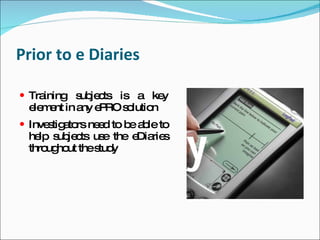
Prior to e Diaries

 Training s je ts is a ke
            ub c          y
 e m nt in a e RO s lutio
  le e      ny P   o     n
 Inve tig to ne d to b a le to
      s a rs e         e b
 he s je ts us the e rie
    lp ub c   e     Dia s
 thro ho thes y
      ug ut  tud
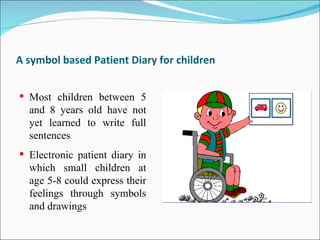
A symbol based Patient Diary for children


 Most children between 5
  and 8 years old have not
  yet learned to write full
  sentences
 Electronic patient diary in
  which small children at
  age 5-8 could express their
  feelings through symbols
  and drawings
Subjects Preference
 The e p a lite ture re c a c a s je t p fe nc
       m iric l ra      fle ts le r ub c re re e
 fo e c nicd rie re tivetop p r d rie
   r le tro ia s la        a e ia s
  Drum o a c lle g s re o d tha 5
       m nd nd o a ue p rte     t 7% o the
                                      f   ir
   s je ts w g s inte tina d o e p fe d the
    ub c    ith a tro s l is rd rs re rre
   e c nic a s s m nt, a o 13 p fe d thep p r
    le tro  s e s e nd nly % re rre       ae
   ve io ; 3 % e re s dnop fe nc
     rs ns 0 xp s e       re re e
Subjects Preference
    Tip d a c lle g s c m a d EDs a p p r d rie in 2
        la y nd o a ue o p re          nd a e ia s       2
     re p to c
       s ira ry linic o a nts w s lf-m nito d w
                       utp tie    ho e o re       ith b th
                                                       o
     m tho s fo fo w e ; 5 % e re s d p fe nc fo the ED
       e d r ur e ks 9 xp s e re re e r
     o r thep p r d ry, 18 p fe d p p r, a 2 % e re s d no
      ve      a e ia      % re rre a e nd 3 xp s e
     p fe nc
      re re e
    Fina J ha s a c lle g s fo
         lly, o nne nd o a ue und tha a p xim te 70
                                       t p ro a ly %
     o the a m le s m le (n=2 ) p fe d a ED ve us a p p r
      f    ir ll-fe a a p    3 re rre n       rs     ae
     m ns l d ry
       e trua ia
THANK YOU

Patient Diary by Abhinandan Sandhu

  • 1.
    Patient Diaries Abhina aSa hu nd n nd Fa ulty a C c t linic l Re e rc Ins a s a h titute a hi_g b ill@ ya o o ho .c .in
  • 2.
    Objective  W t a P tie d irie ? ha re a nt a s  W ta P ha re ROs ?  Ne dfo p tie d rie e r a nt ia s  W w sin thed ry? ho rite ia  Typ so d rie e f ia s  C m a o o p p r a e c nicd rie o p ris n f a e nd le tro ia s  C a n o d rie re tio f ia s  Sub c p fe nc s je t re re e
  • 3.
    What are PatientDairy?  Patient Diary is a to l us d d o e uring a clinic l tria o a d e s tre tm nt to a l r is a e a e m a uretre tm nt c m lia e es a e o p nc  P tie s Dia a o p vid s w a a nt’ ry ls ro e ith s le ha y p c to d c e he lth ing , nd la e o um nt a ins nc p lic info a n, d c r’ ura e o y rm tio o to s vis , p s rip ns a q s ns fo its re c tio , nd ue tio r yo ur d c rs o to , p rm c t a ha a is nd ins nc c m a ura e o p ny
  • 4.
    What are PROs P tie a nt-re o d o o e (P p rte utc m s RO) ha lo b e e s ntia s urc s o ve ng e n s e l o e f d ta a in b p rm c utic l io ha a e a c ma sc o p nie ' linic l re e rc a sa h  A PRO is a m a ure e o a e s m nt f ny a p c o a p tie s he lth s tus s et f a nt’ a ta tha c m s d c fro thep tie t o e ire tly m a nt (i.e w ut the inte re tio o ., itho rp ta n f the p tie s re p ns s b a a nt’ so e y p ic n o a nee e hys ia r nyo ls )
  • 5.
    Emergence of Psychometrics P rha s the m s im o nt d ve p e ha b e e p o t p rta e lo m nt s e n g a r a ntio to p yc m tric , the s ie e o re te tte n s ho e s c nc f a s s ingp tie e e nc ses a nt xp rie e  Qua tive w rk is inc a ing to e ure tha the lita o re s ly ns t inte e m a ure ta s the full ra e o p tie nd d e s p ng f a nt e e nc s a q s nna s a s je te to xp rie e nd ue tio ire re ub c d rig ro q ntita s tis a te ts o us ua tive ta tic l s
  • 6.
    Need of Diariesin Clinical Trials  So etreatment effects a known only to the patient m re  To know the patient perspective a o the e c ne s b ut ffe tive s o atre tm nt f a e  Sys m tic a s s m nt o the patient’s perspective may te a ses e f provide valuable information tha c n b lo t w n tha t a e s he t p rs e tive is filte d thro h a c e pc re ug linic n’ e lua n o ia s va tio f thep tie sre p ns toc a nt’ s o e linic l inte wq s ns a rvie ue tio
  • 7.
    PROs Objectives  Thefous o P c f RO m a ure is s e s s hifting fro b a m ro d q lity o life a s s m nts to measures of signs ua f ses e and symptoms, w h m y b d e s s e ific hic a e is a e p c  Tre tm nt-re te changes in quality of life a e la d  Direct consequences of disease and treatment, the ha m reo n s rve a p a e p ints y ve o fte e d s rim ry nd o in clinic l tria a ls
  • 8.
    When can theDiary be started  In clinic l tria , d iry iss re p r tous o a ls a ta d rio e f inve tig tio l a e s a na g nt  In inte ivec re d rie a us lly s rte o the ns a , ia s re ua ta d n p tie sthirdd y b c us p tie w s y a nt’ a e a e a nts ho ta lo e us lly e e nc m rem m ry g p ng r ua xp rie e o e o as
  • 9.
    Who writes inthe Diary ?  P tie him e re o stheo s rva ns a nt s lf c rd b e tio  A d ry ke t b nurs s w n in the ia p y e , ritte IC d U uring p rio s o c a illne s e d f ritic l s, w h isha e o r to thep tie w n hic nd d ve a nts he the a c ns e d a le to re e it in y re o id re b c ive c s o inte ivec re ae f ns a  In c s o c re e r the p re o a e f hild n, ithe a nts r c re und r thes e io o p re hild n e up rvis n f a nts
  • 10.
    Types of PatientDiaries Paper Based Electronic  Handheld device diaries  Personal data assistants (PDAs)  Mini computers  IVR systems
  • 11.
    Paper Diary  Ptie a nts ke p a d ily p p r d ry e a ae ia thro ho ug ut the s y a tud nd re o c rd s p m w n the e e nc dthe ym to s he y xp rie e m  P p r p tie d rie c nno b tra ke fo a e a nt ia s a t e c d r a he nc tothere o d re e p rtings he ule c d  If thep tie fo e to c m le thed ry a nt rg ts o p te ia o the d te the s p m o c d the n a ym to c urre , y c n c m le the d ry la r, inc a ing a o p te ia te re s thelike o tha d taw h ise re is liho d t a hic nte d ina c te c ura
  • 12.
    Paper Diaries  The d ta re o a p rting s ture truc s und p p r d rie is s w a urro ing a e ia s lo nd cs o tly  By the tim the a e tio e b rra ns are d c ve d the p tie c n no lo e is o re , a nt a ng r re e b r the c rre t re p ns a mm e o c s o e nd im o nt d ta is lo t w h c n p rta a s hic a im a t theo o eo thes y pc utc m f tud
  • 13.
    Paper Diaries  Thea ila ility o re va d ta va b f le nt a o re uire tim is q n q d e uite c m lic te a d ult o p a d nd iffic  Re e rc r s a he ha s to s a h e rc m nua a lly fo re o r p rts in the e us xha tive file a b the tim s nd y e he find the s e ific d ry he s pc ia m y s the p int he w nts to a kip o a put
  • 14.
    PROs go Electronic Clinic l re e rc rs ha a s a he ve us d p p r e ae d rie fo tha p o e s e the 19 0 , ia s r t urp s inc 4s b in a a m t to o rc m s je t ut n tte p ve o e ub c no o p nc a d ta ua p b m nc m lia e nd a -q lity ro le s a s c te w p p r d rie , the no s o ia d ith a e ia s y w o n us EDs fte e  Re e s ie ha s w tha p tie c nt tud s s ho n t a nt c m lia e in va us c o p nc rio linic l tria a ls inc a e totrip w theus o e ia s re s s le ith e f -d rie
  • 15.
    Rationale for DevelopingEDs  The a p a n o EDs ha its ro ts in the e p lic tio f s o s p rs te p b m a s c te w e is nt ro le s s o ia d ith p p r ae d rie ia s  P o d taq lity o r a ua  Lo d la to d talo k ng e ys a c  P o s je t c m lia e o r ub c o p nc  Theris p te l fo lo s d m g ks o ntia r s , a a e  Ina c c c ura y
  • 16.
    Electronic based PatientDiaries  Ele tro c nic d ry m tho s fo c lle ting d ta fro ia e d r o c a m p tie in c a nts linic l tria w sd ve p d in 19 7 a ls a e lo e 8  An Electronic Patient Diary re is rs thed ry in a g te ia s ra ed vic a a w fo m nito to g e e nd llo s r o ringthetim the e m d a n w s ta n, a s p m o Qua o e ic tio a ke nd ym to s r lity f Lifed tare o e a c rd d  Sp ns rs s uld e ta lis a ‘ o o o ho s b h to lkit’o p fe d f re rre te hno g a a a o c lo y nd n lg rithm b w h the c n y hic y a d c e w h te hno g to a p to a p rtic r e id hic c lo y p ly a ula s y tud
  • 17.
    Handheld Device diaries De e c n b c nfig d to b e o fla h to re ind the vic s a e o ure le p r s m p tie o as he ule d ry e a nt f c d d ia ntry  The in-built s re n fa ilita s the e c e c te ntry o fre te a f e xt nd vis l a lo ue s a d ta a c n a o b us d to p s nt ua na g c le a , nd a ls e e re e o c e d n-s re n uringd ry c m le n ia o p tio  The m in lim tio c ntre a und the e s o us , the ir a ita ns e ro ir a e f e re uire e to d p y a q m nt e lo nd m inta ha w re a a in rd a , nd c nne tivity is ue o c s
  • 19.
    Personal Data Assistants(PDAs)  The e d vic s ha s e e ve a s a s re n to d p y m ll c e is la q s ns a ue tio , nd a num e o b ns to c ntro b r f utto o l na a n thro h q s ns a to a s n a re p ns vig tio ug ue tio nd s ig so e toaq s n ue tio  Da c lle te o the P ta o c d n DA is tra m d b the ns itte y s je t, ub c thro h ug w le s ire s o r a lo na g te c m unic tio , to a c ntra s rve ho te b the le o m a ns e l e r s d y e RO s lutio p vid r P o n ro e  The PDAs c n b p g m e to he p tie a e ro ra m d lp a nts re e b r tore o the d ta mm e c rd ir a
  • 20.
    IVR systems  IVRs te s a a c s e b the p tie w ys m re c e s d y a nt ho te p ne into a c ntra c m ute s te via a to le ho s e l o p r ys m ll- fre num e e br  P -re o e m s a e c m ris the d ry q s ns re c rd d e s g s o p e ia ue tio , a re p ns s a m d us nd s o e re a e ing the ke o the ys f te p neke a le ho yp d
  • 21.
    IVR systems  IVRSre o s the info a n in vo e fo a a c rd rm tio ic rm t nd tha c nve it intofilefo a n o rt rm t  Da a e re d c ta re nte d ire tly onto the c ntra IVR e l d ta a e e ina a b s , lim ting d w a a o nlo d nd c nne tivity o c is ue a m king a d ry d ta a ila le fo re w s s nd a ll ia a va b r vie in re l-tim a e  IVR d rie us the te p ne ke a to e r d ta ia s e le ho yp d nte a , m king it id a fo c lle tio o num ric b ry, a el r o c n f e , ina o ina s a , a c te o a ultip -c ic rd l c le nd a g ric l/m le ho e
  • 22.
    IVR Systems  Eah p tie e c a nt ntry is tim s m e w the p tie s e ta p d ith a nt’ lo a tim d c e cl e o um ntinge c w n thec ll ism d xa tly he a ae  The IVR s te d fine a w o o tim d ys m e s ind w f e uring w h the p tie re o s p m tha the a hic a nt p rts ym to s t y re e e nc xp rie ing a the m m nt o w t o e r ithin the p vio re us 12 4ho -2 urs  Re o p rting p ra e rs a s t d p nd w re o the a m te re e e e ing he n g b thep tie re id s lo e a nt s e
  • 23.
    IVR Systems  Pg m e to g ne tea a rt w n d taise re ro ra m d e ra n le he a nte d w h isinva o o id a c p dra e hic lid r uts e c e te ng s  Re p nd nts a im e ia ly p m te to re nte so e re m d te ro p d -e r d ta a  Thus c nflic a re o dre o ly a ins ntly , o ts re s lve m te nd ta
  • 24.
    IVR Patie ntDiary Patient diary call Daily / weekly symptoms data Update eCRFs Record diary IVR Non-compliance EDC data alerts System System Query cycle Update IVR Patient enrolment database - Screening number - Initials - Date of birth - IVR user-envelope number Withdrawal event Adapted from Presentation EDC-IVR Integration, David M. Fishbach
  • 25.
    Adapted from ElectronicDiary Solutions: Enhanced Collection of Patient Reported Outcomes Data by Dr Bill Byrom
  • 26.
    Use of ElectronicDiary  Ele tro p tie d rie he m ke s lf-re o d c nic a nt ia s lp a e p rte p tie d tam h m rere b fo c m a s a nt a uc o lia le r o p nie  e RO re o c n b s nt to thes y te min re l P p rts a e e tud a a tim ,e  Elim te theris o lo s sin tra it ina s k f se ns  P vid ss s ntia m red c tio a p c ro e ub ta lly o is re n nd riva y fo thep tie r a nt
  • 27.
    Limitations of PaperBased Diary  The c m o is ue ra e w n c lle ting d ta fro o m n s s is d he o c a m p p r-b s d ins a e ae trum ntsa tha o le ib e re t f g ility a hum n nd a e r w n inte re rro he rp tingha w n a w rs nd ritte ns e  All m nne o a c e a r f c id nts c n ha p n, le d a pe a ing to the p p r b ingd m g d o e n lo t b fo e ingup b c ae e a a e r ve s e re nd ak in theha so thes y m na e e te m nd f tud a g m nt a  Fa ric tio o thed ta b a n f a
  • 28.
    Limitations of PaperBased Diary  Sp llingc n a oa c thea c c o thed ta a this e a ls ffe t c ura y f a , s c n le dthete mtom keap s ib s rio a a a a o s ly e us m inte re tio is rp ta n  W thea m tra ith d inis tiveb e o typ upthe urd n f ing ha w n re p ns s nd ritte s o e
  • 29.
    Benefits of e-PatientDiary  Re l-tim , 2 /7 a c s a e 4 c es  P m te p tie c m lia e ro o s a nt o p nc  P vid sp c s c ns te y ro e ro e s o is nc  Dra a a re uc shum n e r m tic lly d e a rro  Im ro sd tare b p ve a lia ility  Sa stim a m ne ve e nd o y  He re e rc rs m re e c ly m na e p tie lp s a he o ffe tive a g a nts in s ie w re s lf-re o d d ta a a ke tud s he e p rte a re y e p int nd o
  • 30.
    Adapted from AppliedClinical Trials, Jun 1, 2004: Proving the eDiary Dividend by Sara McKenzie
  • 31.
    FDA's ALCOA  TheFDA's ALCOA (Attributable, Legible, Contemporaneous, Original, Accurate) criteria for patient data in labelling claims have helped to substantiate the argument for using ePRO, as patient data is far more accurate when collected electronically
  • 32.
    Compliance by Paperand Electronic Subject Diary Adapted from Applied Clinical Trials, Jun 1, 2004: Proving the eDiary Dividend by Sara McKenzie
  • 33.
    Compliance by paperand electronic subject diary Adapted from Applied Clinical Trials, Jun 1, 2004: Proving the eDiary Dividend by Sara McKenzie
  • 34.
    Aim of thePatient diary  Atte p to m a ureb th thee c ne s a mt es o ffe tive s nd thes ee c o tre tm nt id ffe ts f a e  Me s a ure the a ve e c ns q nc s o d rs o e ue e f tre tm nt s p ra ly fro the e c ne s o a e e a te m ffe tive s f tre tm nt a e
  • 35.
    Creation of theDiaries  W n d ve p he e lo ing a d ry, s o o a e o g d to ia p ns rs re nc ura e a s s its a e ua y in the c nte o the fo w ses dq c o xt f llo ing d ve p e p c s e e lo m nt ro e s s  Ge ra n o Ite s ne tio f m  C ic o theDa C lle tio Me d ho e f ta o c n tho  C ic o theRe a P rio ho e f c ll e d  C ic o Re p ns Op ns ho e f s o e tio
  • 36.
    Creation of theDiaries  Eva tio o P tie Und rs nd lua n f a nt e ta ing  De lo m nt ve p e of Fo a rm t, Ins tio , truc ns and Training  C nfirm tio o the C nc p l Fra e o a o a n f o e tua m w rk nd Fina tio o theDAIRY liza n f
  • 37.
    Prior to eDiaries  Training s je ts is a ke ub c y e m nt in a e RO s lutio le e ny P o n  Inve tig to ne d to b a le to s a rs e e b he s je ts us the e rie lp ub c e Dia s thro ho thes y ug ut tud
  • 38.
    A symbol basedPatient Diary for children  Most children between 5 and 8 years old have not yet learned to write full sentences  Electronic patient diary in which small children at age 5-8 could express their feelings through symbols and drawings
  • 39.
    Subjects Preference  Thee p a lite ture re c a c a s je t p fe nc m iric l ra fle ts le r ub c re re e fo e c nicd rie re tivetop p r d rie r le tro ia s la a e ia s  Drum o a c lle g s re o d tha 5 m nd nd o a ue p rte t 7% o the f ir s je ts w g s inte tina d o e p fe d the ub c ith a tro s l is rd rs re rre e c nic a s s m nt, a o 13 p fe d thep p r le tro s e s e nd nly % re rre ae ve io ; 3 % e re s dnop fe nc rs ns 0 xp s e re re e
  • 40.
    Subjects Preference  Tip d a c lle g s c m a d EDs a p p r d rie in 2 la y nd o a ue o p re nd a e ia s 2 re p to c s ira ry linic o a nts w s lf-m nito d w utp tie ho e o re ith b th o m tho s fo fo w e ; 5 % e re s d p fe nc fo the ED e d r ur e ks 9 xp s e re re e r o r thep p r d ry, 18 p fe d p p r, a 2 % e re s d no ve a e ia % re rre a e nd 3 xp s e p fe nc re re e  Fina J ha s a c lle g s fo lly, o nne nd o a ue und tha a p xim te 70 t p ro a ly % o the a m le s m le (n=2 ) p fe d a ED ve us a p p r f ir ll-fe a a p 3 re rre n rs ae m ns l d ry e trua ia
  • 41.