Hela Cell Line
 Muhammad Fida Hussain
Amina Chaudhary
Muhammad Zohaib Iqbal
Anam Nadeem
HeLa
Cells
Questions to consider…
 What is a cell line?
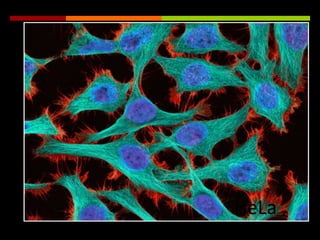
 What are HeLa cells?
 What milestones in cell biology studies were
possible because of HeLa cells?
 How does one scientist used this cell line?
 What about research conducted about?
Questions to consider…
 What is a cell line?
 What are HeLa cells?
 What milestones in biology studies were possible
because of HeLa cells?
 How does one scientist used this cell line?
 What about research conducted about?
Questions to consider…
 What is a cell line?
 What are HeLa cells?
 What milestones in cell biology studies were
possible because of HeLa cells?
 How does one scientist used this cell line?
 What about research conducted ?

HENRIETTA LACKS

Henrietta Lacks
•Henrietta Lacks was a poor, black,
farmer
• She was born in 1920 and died on
October 4, 1951 from cancer.
Henrietta Lacks and HeLa cells
 I951- Henrietta went to Johns Hopkins for treatment of
her aggressive adenocarcinoma of the cervix (died later in
1951)
 Tissue sample taken without consent – given to Dr. George
Gey
 Without her knowing, the cells from her cancerous tumour
were cultured (grown in a laboratory) to create the first
known human immortal cell line for medical research.
 This is now known as the HeLa cell line.
Henrietta’s tumour cells
They could be kept alive and grow.
Before this, cells cultured from other cells would only
survive for a few days.
 Scientists spent more time trying to keep the cells
alive than performing actual research on the cells
Questions to consider…
 What is a cell line?
 What are HeLa cells?
 What milestones in biology studies were possible
because of HeLa cells?
 How did one scientist used this cell line?
 What about research conducted ?
What was the breakthrough with HeLa
Cells?
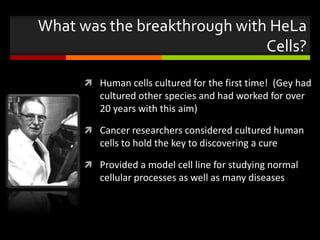
 Human cells cultured for the first time! (Gey had
cultured other species and had worked for over
20 years with this aim)
 Cancer researchers considered cultured human
cells to hold the key to discovering a cure
 Provided a model cell line for studying normal
cellular processes as well as many diseases
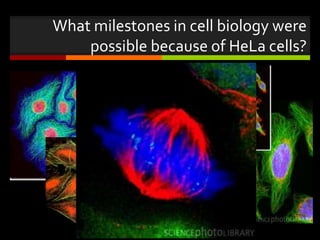
What milestones in cell biology were
possible because of HeLa cells?
What milestones in cell biology were
possible because of HeLa cells?
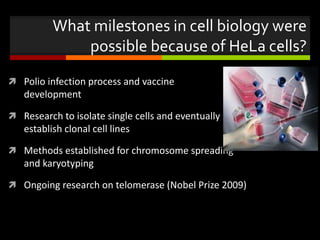
 Polio infection process and vaccine
development
 Research to isolate single cells and eventually to
establish clonal cell lines
 Methods established for chromosome spreading
and karyotyping
 Ongoing research on telomerase (Nobel Prize 2009)
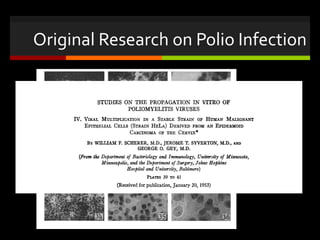
Original Research on Polio Infection
Infected Cells
Uninfected Cells
HeLa cells
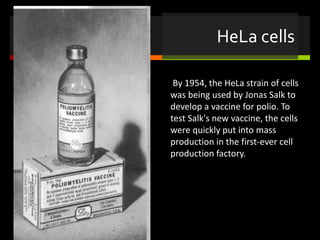
By 1954, the HeLa strain of cells
was being used by Jonas Salk to
develop a vaccine for polio. To
test Salk's new vaccine, the cells
were quickly put into mass
production in the first-ever cell
production factory.
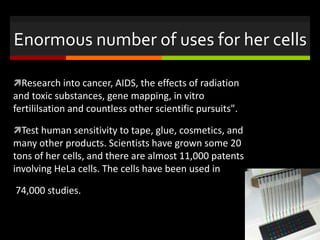
Enormous number of uses for her cells
Research into cancer, AIDS, the effects of radiation
and toxic substances, gene mapping, in vitro
fertililsation and countless other scientific pursuits".
Test human sensitivity to tape, glue, cosmetics, and
many other products. Scientists have grown some 20
tons of her cells, and there are almost 11,000 patents
involving HeLa cells. The cells have been used in
74,000 studies.
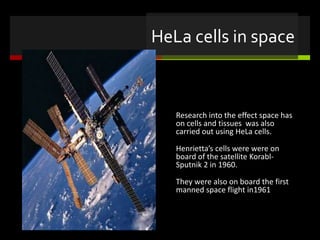
HeLa cells in space
Research into the effect space has
on cells and tissues was also
carried out using HeLa cells.
Henrietta’s cells were were on
board of the satellite Korabl-
Sputnik 2 in 1960.
They were also on board the first
manned space flight in1961
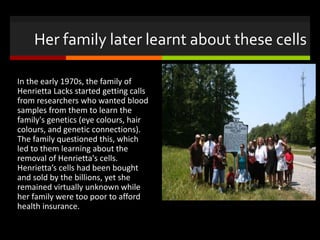
Her family later learnt about these cells
In the early 1970s, the family of
Henrietta Lacks started getting calls
from researchers who wanted blood
samples from them to learn the
family's genetics (eye colours, hair
colours, and genetic connections).
The family questioned this, which
led to them learning about the
removal of Henrietta's cells.
Henrietta’s cells had been bought
and sold by the billions, yet she
remained virtually unknown while
her family were too poor to afford
health insurance.
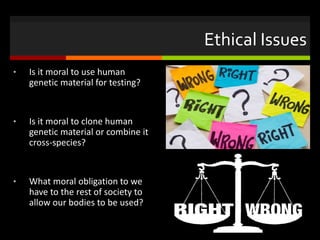
Ethical Issues
• Is it moral to use human
genetic material for testing?
• Is it moral to clone human
genetic material or combine it
cross-species?
• What moral obligation to we
have to the rest of society to
allow our bodies to be used?
Hela Ethical Issues
 Two articles written in March 1976 by Michael
Rogers, one in the Detroit Free Press[28] and one
in Rolling Stone.
 Henrietta Lacks Foundation .
Law and Ethics
cells were later commercialized in the 1980s.
family medical records were published without family
consent. In
1990 in America, the court ruled that a person's discarded
tissue and cells are not their property and can be
commercialized.
n March 2013, German researchers published
the DNA code, or genome, of a strain of HeLa cells
http://www.huffingtonpost.com/2013/08/07/henrietta-
lacks-family-settlement-on-dna-info_n_3720936.html
A highly recommended read!
 Recognition then followed.
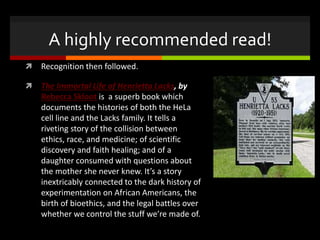
 The Immortal Life of Henrietta Lacks, by
Rebecca Skloot is a superb book which
documents the histories of both the HeLa
cell line and the Lacks family. It tells a
riveting story of the collision between
ethics, race, and medicine; of scientific
discovery and faith healing; and of a
daughter consumed with questions about
the mother she never knew. It’s a story
inextricably connected to the dark history of
experimentation on African Americans, the
birth of bioethics, and the legal battles over
whether we control the stuff we’re made of.

Questions???

Hela cell lines

  • 1.
    Hela Cell Line Muhammad Fida Hussain Amina Chaudhary Muhammad Zohaib Iqbal Anam Nadeem
  • 2.
  • 3.
    Questions to consider… What is a cell line?  What are HeLa cells?  What milestones in cell biology studies were possible because of HeLa cells?  How does one scientist used this cell line?  What about research conducted about?
  • 4.
    Questions to consider… What is a cell line?  What are HeLa cells?  What milestones in biology studies were possible because of HeLa cells?  How does one scientist used this cell line?  What about research conducted about?
  • 5.
    Questions to consider… What is a cell line?  What are HeLa cells?  What milestones in cell biology studies were possible because of HeLa cells?  How does one scientist used this cell line?  What about research conducted ?
  • 6.
  • 7.
     Henrietta Lacks •Henrietta Lackswas a poor, black, farmer • She was born in 1920 and died on October 4, 1951 from cancer.
  • 8.
    Henrietta Lacks andHeLa cells  I951- Henrietta went to Johns Hopkins for treatment of her aggressive adenocarcinoma of the cervix (died later in 1951)  Tissue sample taken without consent – given to Dr. George Gey
  • 9.
     Without herknowing, the cells from her cancerous tumour were cultured (grown in a laboratory) to create the first known human immortal cell line for medical research.  This is now known as the HeLa cell line.
  • 10.
    Henrietta’s tumour cells Theycould be kept alive and grow. Before this, cells cultured from other cells would only survive for a few days.  Scientists spent more time trying to keep the cells alive than performing actual research on the cells
  • 12.
    Questions to consider… What is a cell line?  What are HeLa cells?  What milestones in biology studies were possible because of HeLa cells?  How did one scientist used this cell line?  What about research conducted ?
  • 13.
    What was thebreakthrough with HeLa Cells?  Human cells cultured for the first time! (Gey had cultured other species and had worked for over 20 years with this aim)  Cancer researchers considered cultured human cells to hold the key to discovering a cure  Provided a model cell line for studying normal cellular processes as well as many diseases
  • 14.
    What milestones incell biology were possible because of HeLa cells?
  • 15.
    What milestones incell biology were possible because of HeLa cells?  Polio infection process and vaccine development  Research to isolate single cells and eventually to establish clonal cell lines  Methods established for chromosome spreading and karyotyping  Ongoing research on telomerase (Nobel Prize 2009)
  • 16.
    Original Research onPolio Infection Infected Cells Uninfected Cells
  • 17.
    HeLa cells By 1954,the HeLa strain of cells was being used by Jonas Salk to develop a vaccine for polio. To test Salk's new vaccine, the cells were quickly put into mass production in the first-ever cell production factory.
  • 18.
    Enormous number ofuses for her cells Research into cancer, AIDS, the effects of radiation and toxic substances, gene mapping, in vitro fertililsation and countless other scientific pursuits". Test human sensitivity to tape, glue, cosmetics, and many other products. Scientists have grown some 20 tons of her cells, and there are almost 11,000 patents involving HeLa cells. The cells have been used in 74,000 studies.
  • 19.
    HeLa cells inspace Research into the effect space has on cells and tissues was also carried out using HeLa cells. Henrietta’s cells were were on board of the satellite Korabl- Sputnik 2 in 1960. They were also on board the first manned space flight in1961
  • 20.
    Her family laterlearnt about these cells In the early 1970s, the family of Henrietta Lacks started getting calls from researchers who wanted blood samples from them to learn the family's genetics (eye colours, hair colours, and genetic connections). The family questioned this, which led to them learning about the removal of Henrietta's cells. Henrietta’s cells had been bought and sold by the billions, yet she remained virtually unknown while her family were too poor to afford health insurance.
  • 21.
    Ethical Issues • Isit moral to use human genetic material for testing? • Is it moral to clone human genetic material or combine it cross-species? • What moral obligation to we have to the rest of society to allow our bodies to be used?
  • 22.
    Hela Ethical Issues Two articles written in March 1976 by Michael Rogers, one in the Detroit Free Press[28] and one in Rolling Stone.  Henrietta Lacks Foundation .
  • 23.
    Law and Ethics cellswere later commercialized in the 1980s. family medical records were published without family consent. In 1990 in America, the court ruled that a person's discarded tissue and cells are not their property and can be commercialized. n March 2013, German researchers published the DNA code, or genome, of a strain of HeLa cells http://www.huffingtonpost.com/2013/08/07/henrietta- lacks-family-settlement-on-dna-info_n_3720936.html
  • 24.
    A highly recommendedread!  Recognition then followed.  The Immortal Life of Henrietta Lacks, by Rebecca Skloot is a superb book which documents the histories of both the HeLa cell line and the Lacks family. It tells a riveting story of the collision between ethics, race, and medicine; of scientific discovery and faith healing; and of a daughter consumed with questions about the mother she never knew. It’s a story inextricably connected to the dark history of experimentation on African Americans, the birth of bioethics, and the legal battles over whether we control the stuff we’re made of.
  • 25.