Assignment Prewriting Find a Story Idea Plan Your Story Practice and Apply Feature Menu
Assignment:  Write a short story in which you use your imagination to express yourself and entertain others.  Have you ever had an exciting experience and thought to yourself, “This would make a good story”? Ideas for stories are everywhere—in your own life, in other people’s lives, and in your imagination. Here is your chance to try out one of those ideas and write your own  short story.   [End of Section]
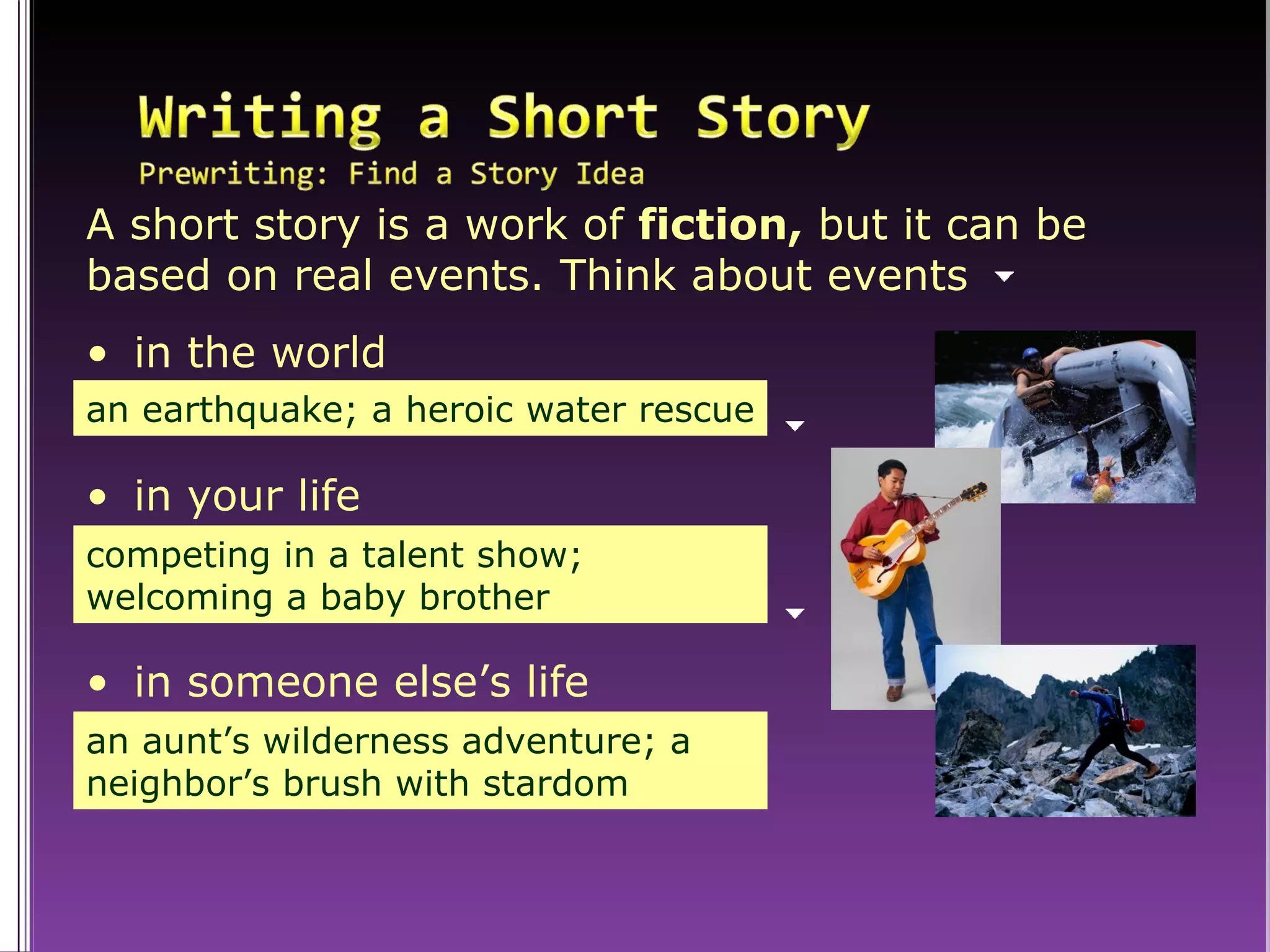
A short story is a work of  fiction,  but it can be based on real events. Think about events an earthquake; a heroic water rescue in the world competing in a talent show; welcoming a baby brother in your life an aunt’s wilderness adventure; a neighbor’s brush with stardom in someone else’s life
Use your imagination for story ideas. Dream up a quirky young princess; a man who sleeps standing up people and animals a city in 2050; an icy planet places and worlds coming face to face with an crocodile; opening a soup kitchen adventures and problems [End of Section]
Every story has five basic ingredients: Plot —What happens in the story? Characters —Who are the people in your story? Point of   View —Who will  narrate,  or tell, your story? Setting —Where and when does your story take place?  Theme —What idea about life does your story illustrate?
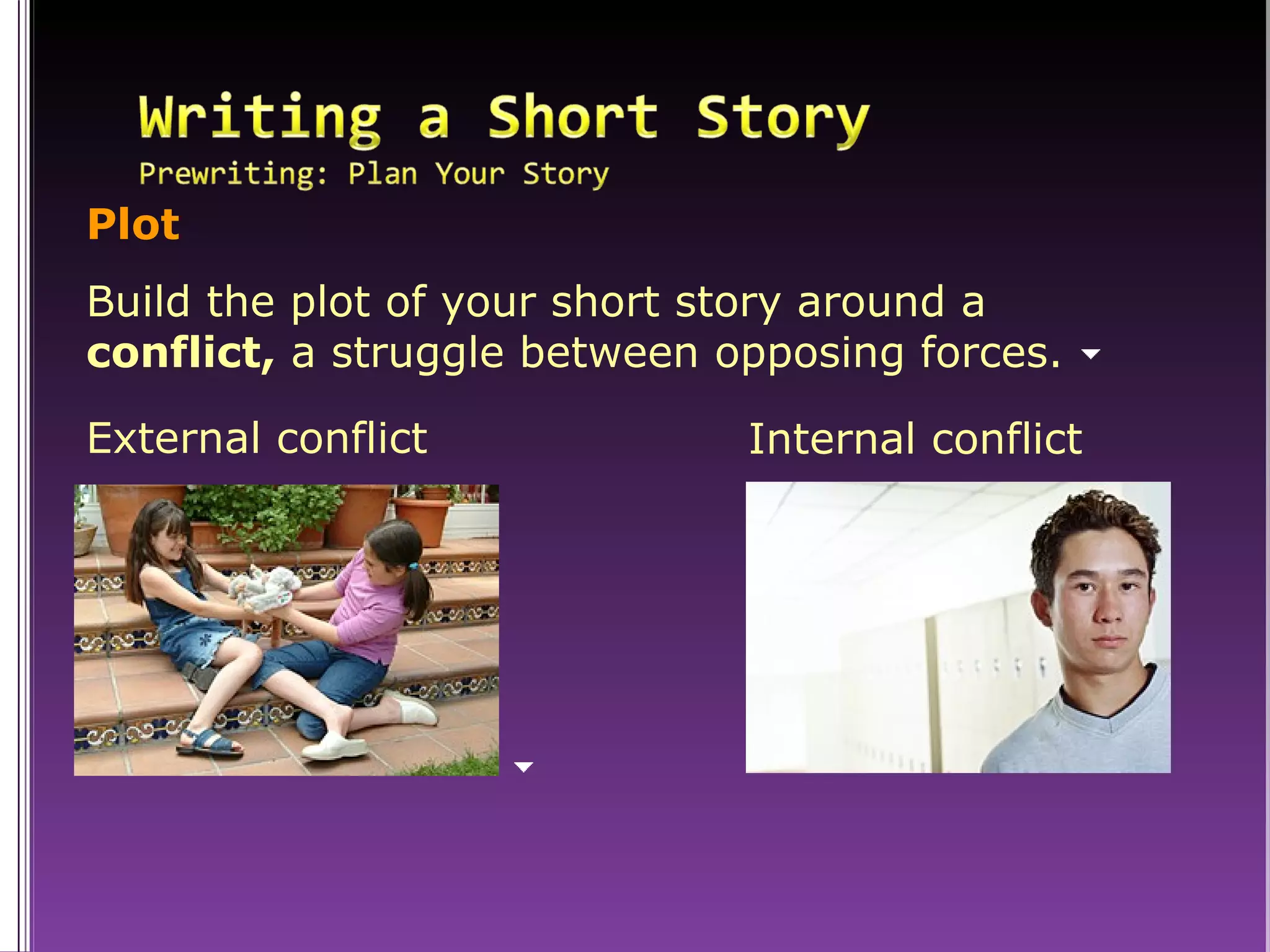
Plot Build the plot of your short story around a  conflict,  a struggle between opposing forces. External conflict  Internal conflict
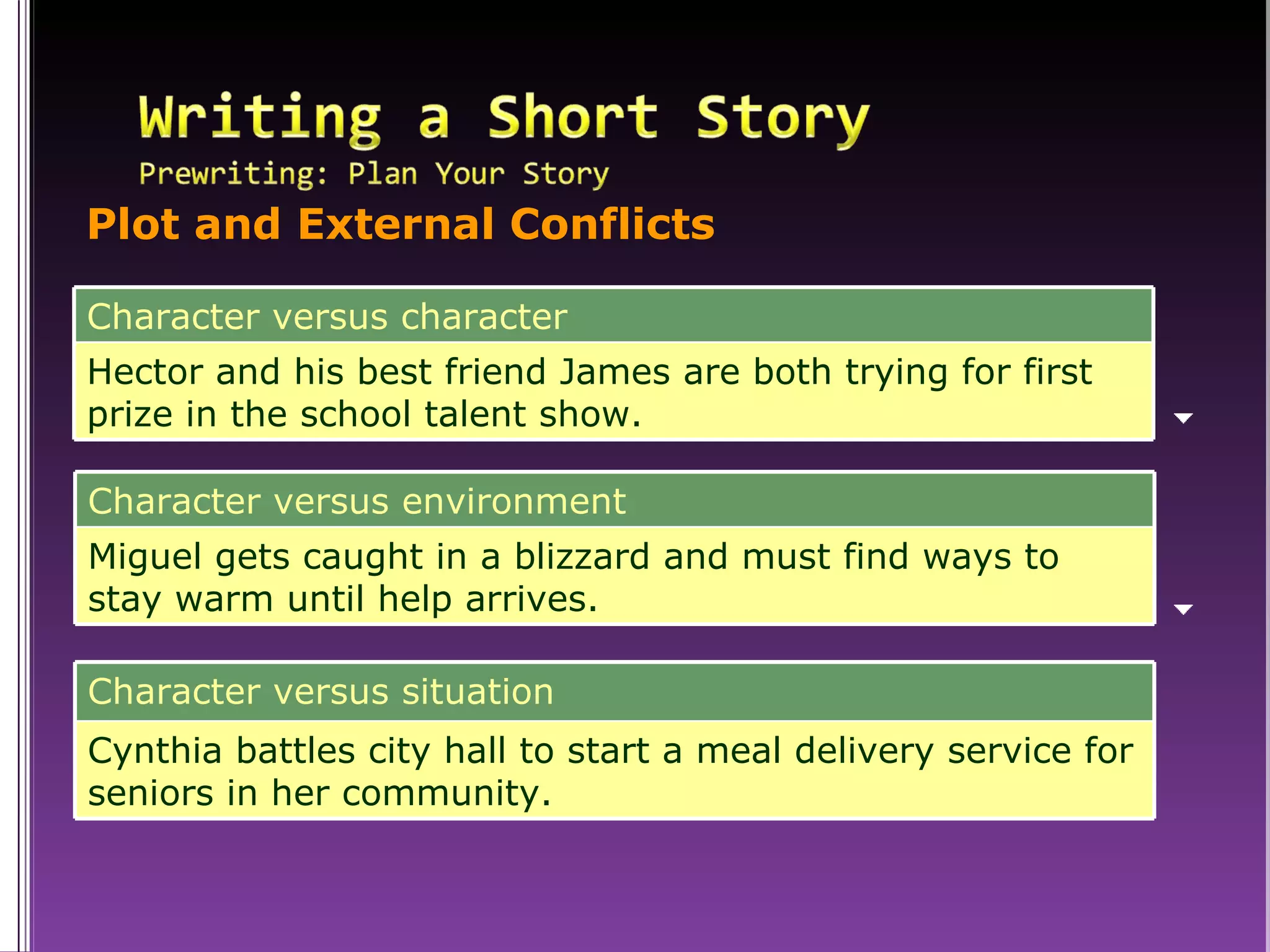
Plot and External Conflicts Character versus character Hector and his best friend James are both trying for first prize in the school talent show. Character versus environment Miguel gets caught in a blizzard and must find ways to stay warm until help arrives. Character versus situation Cynthia battles city hall to start a meal delivery service for seniors in her community.
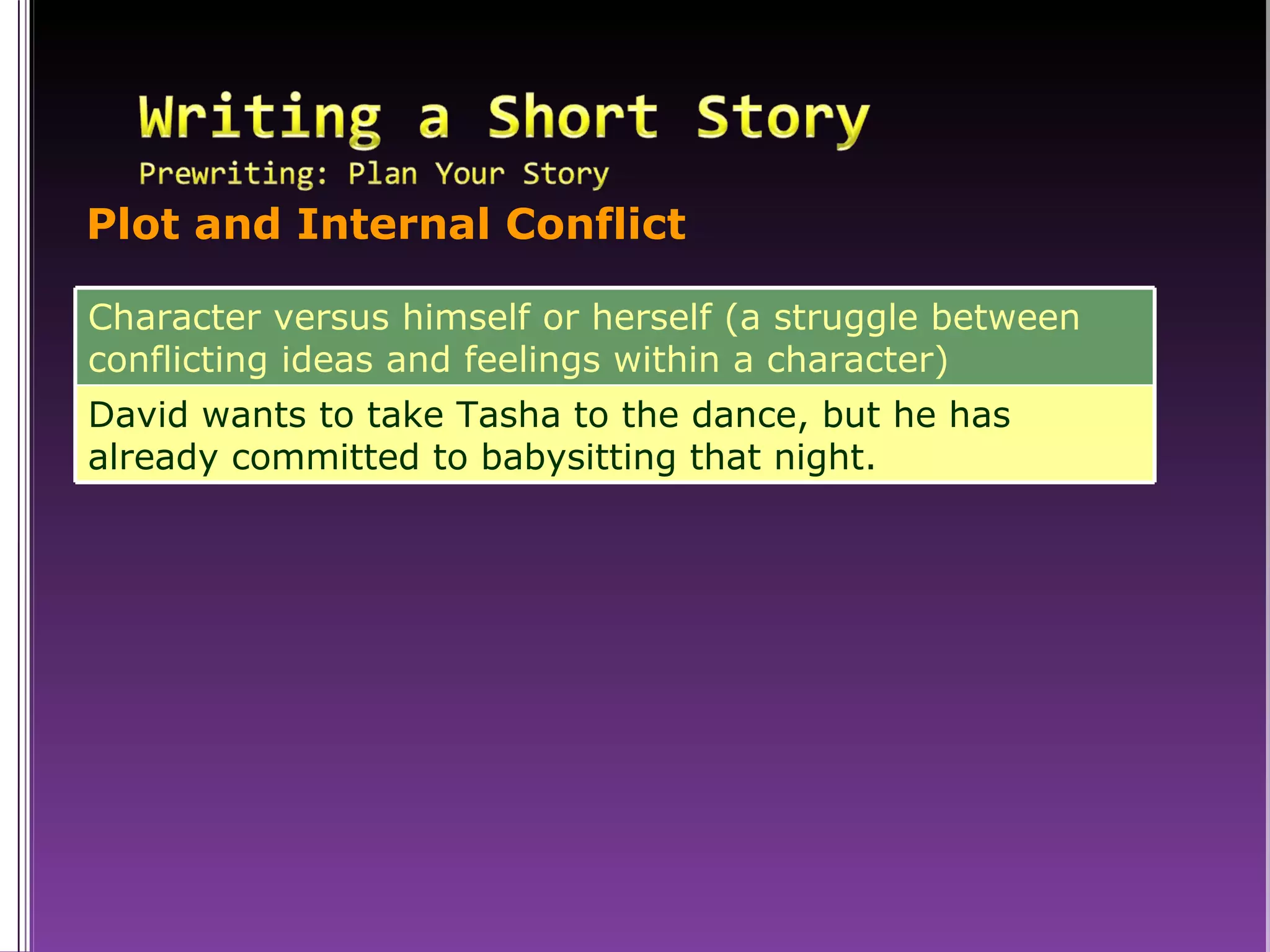
Plot and Internal Conflict Character versus himself or herself (a struggle between conflicting ideas and feelings within a character) David wants to take Tasha to the dance, but he has already committed to babysitting that night.
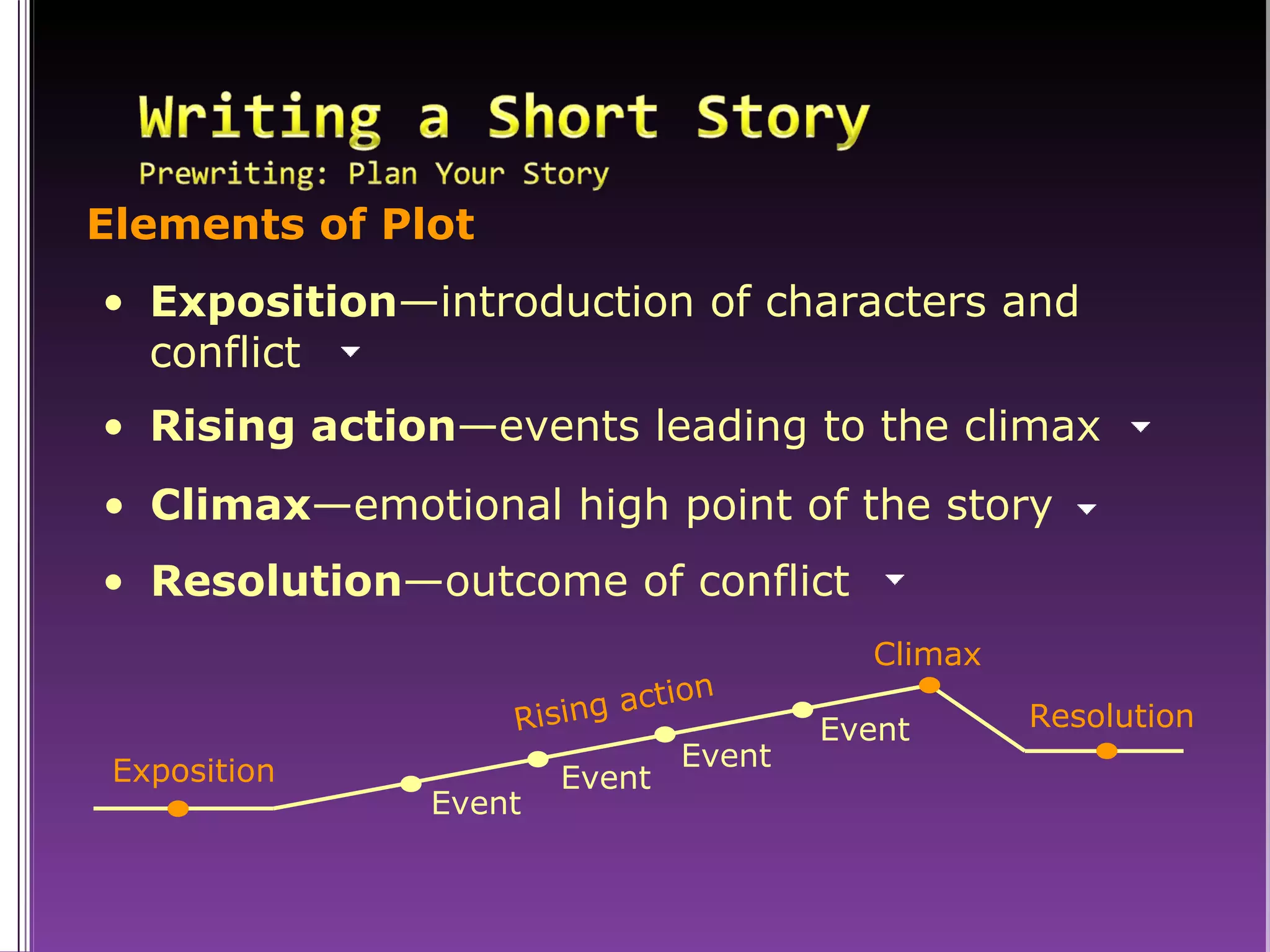
Climax —emotional high point of the story Resolution —outcome of conflict Elements of Plot Exposition —introduction of characters and conflict Rising action —events leading to the climax Exposition Resolution Event Event Event Event Rising action Climax
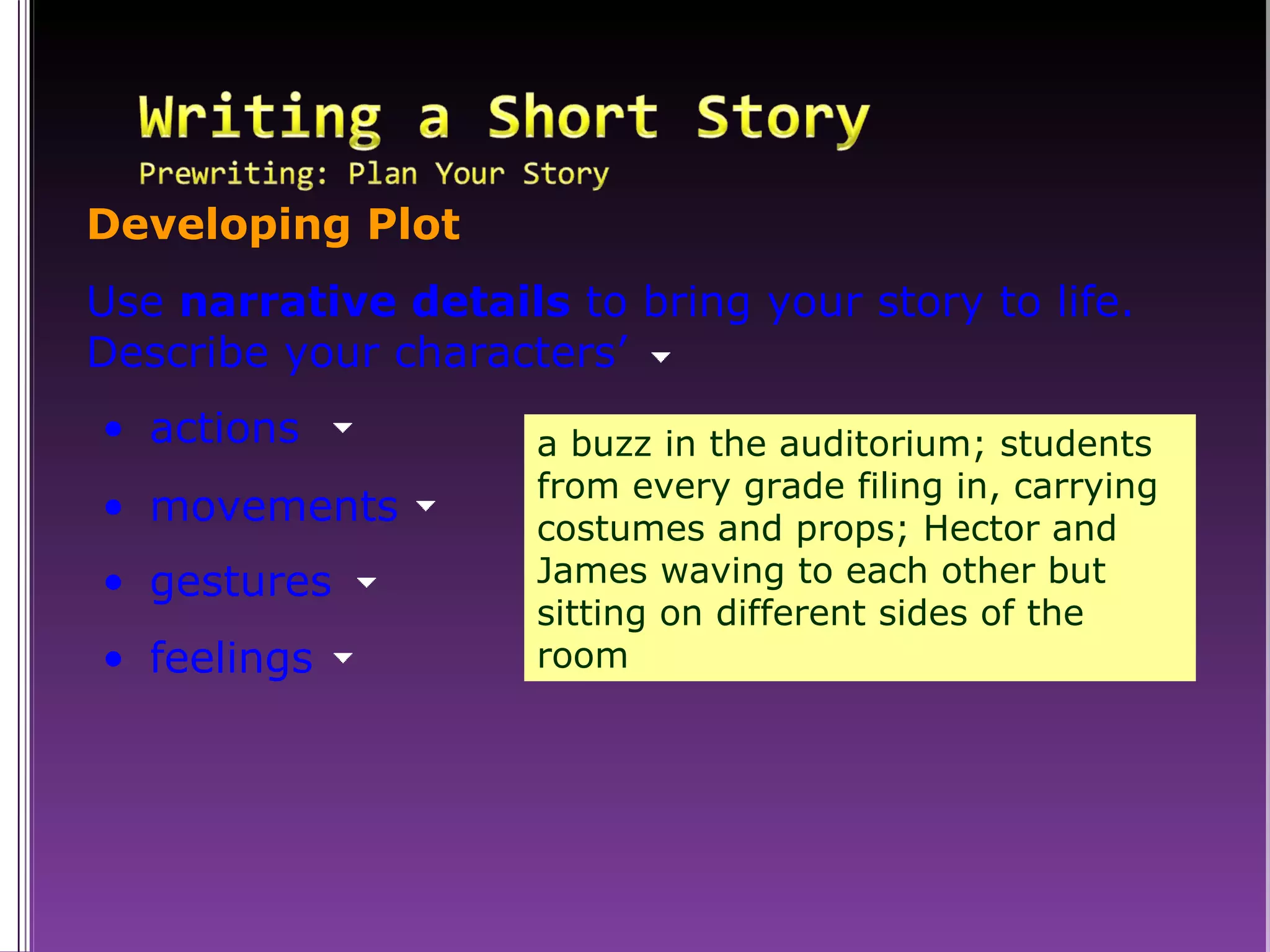
a buzz in the auditorium; students from every grade filing in, carrying costumes and props; Hector and James waving to each other but sitting on different sides of the room Developing Plot Use  narrative details  to bring your story to life. Describe your characters’ actions movements gestures feelings
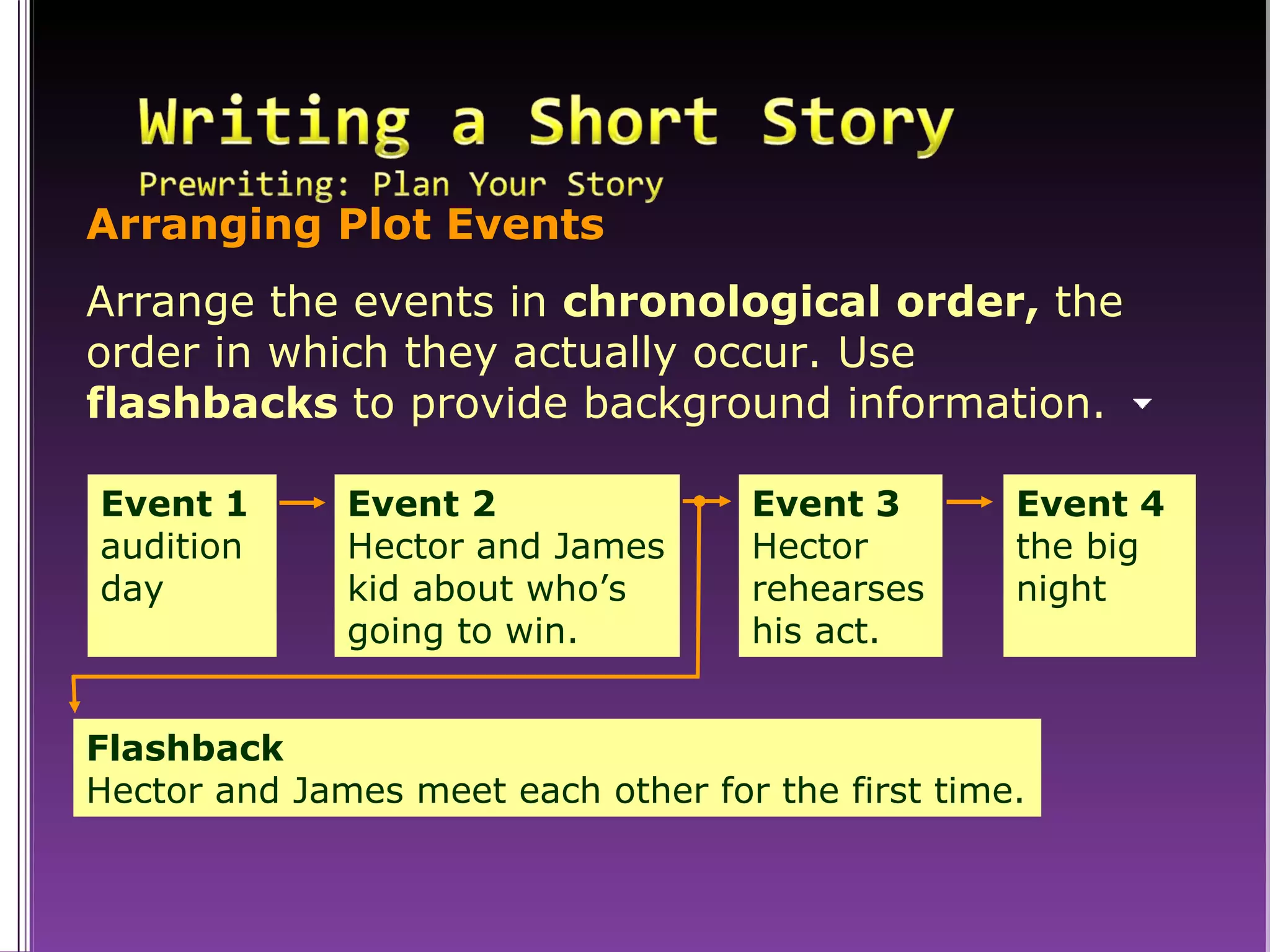
Event 2 Hector and James kid about who’s going to win. Arranging Plot Events Arrange the events in  chronological order,  the order in which they actually occur. Use  flashbacks  to provide background information. Event 1  audition day Event 3 Hector rehearses his act. Event 4 the big night Flashback   Hector and James meet each other for the first time.
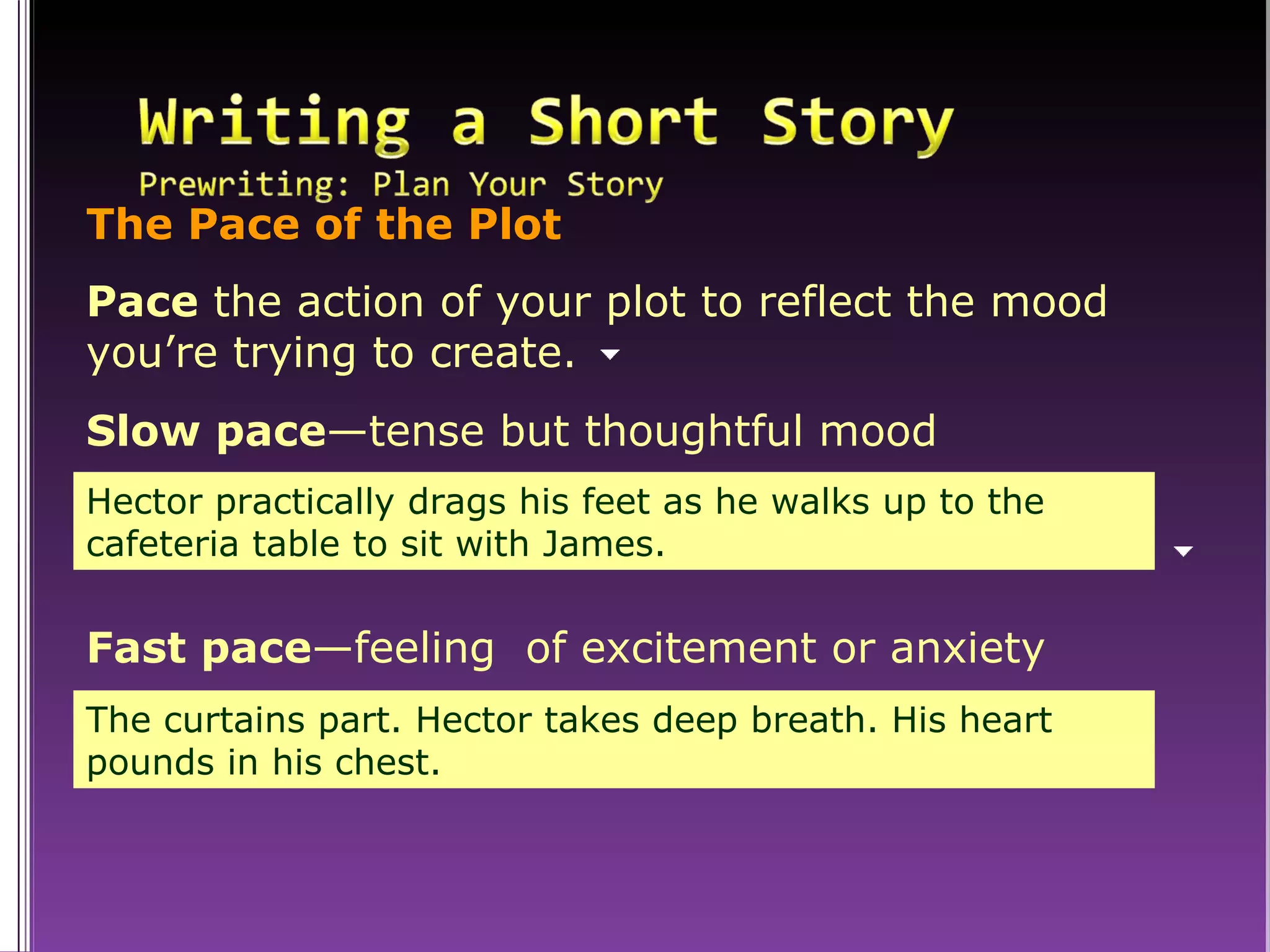
The Pace of the Plot Pace  the action of your plot to reflect the mood you’re trying to create. Hector practically drags his feet as he walks up to the cafeteria table to sit with James. Slow pace —tense but thoughtful mood The curtains part. Hector takes deep breath. His heart pounds in his chest.  Fast pace —feeling  of excitement or anxiety
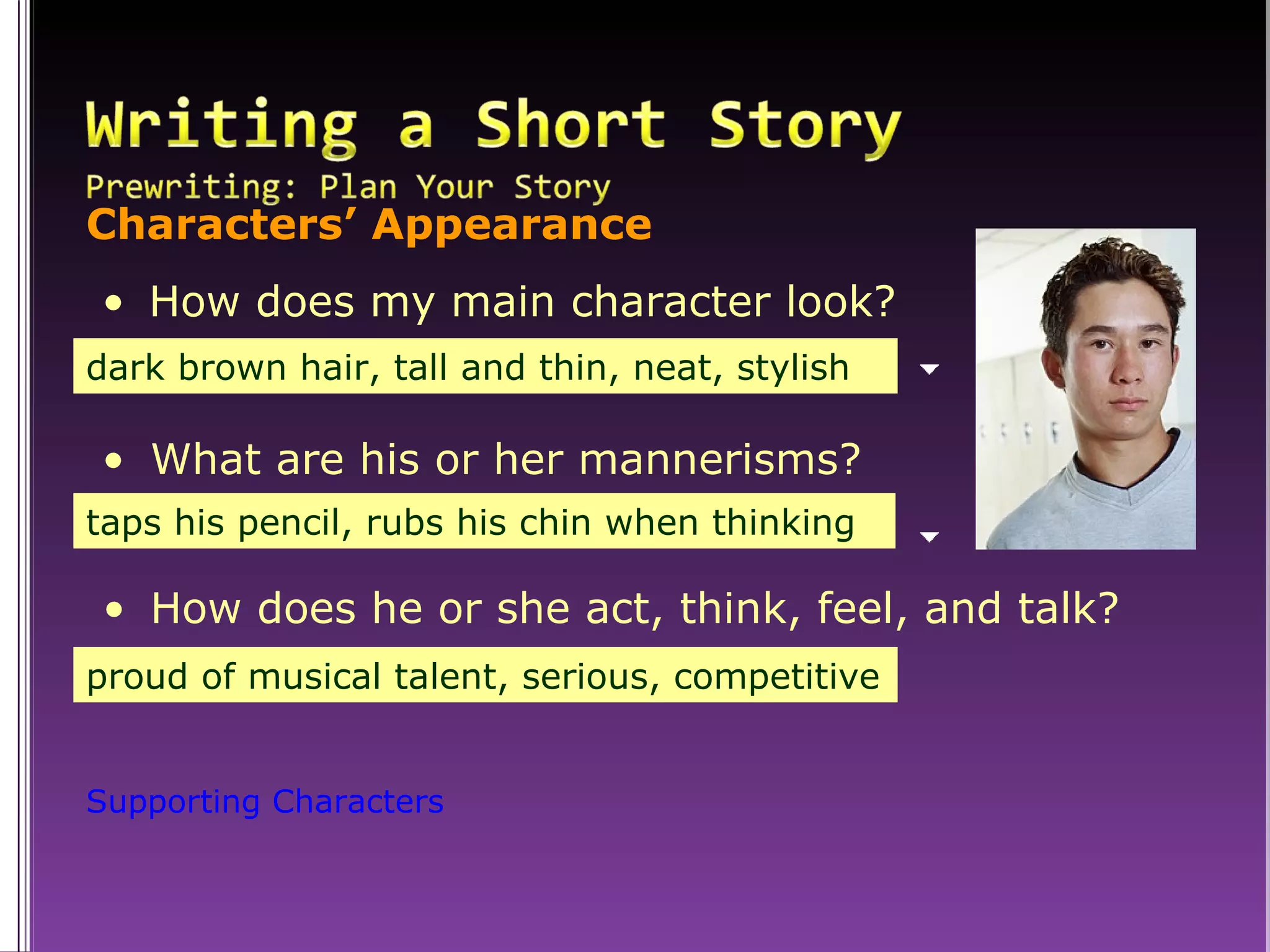
dark brown hair, tall and thin, neat, stylish proud of musical talent, serious, competitive  Characters’ Appearance How does my main character look? How does he or she act, think, feel, and talk?  taps his pencil, rubs his chin when thinking What are his or her mannerisms?  Supporting Characters
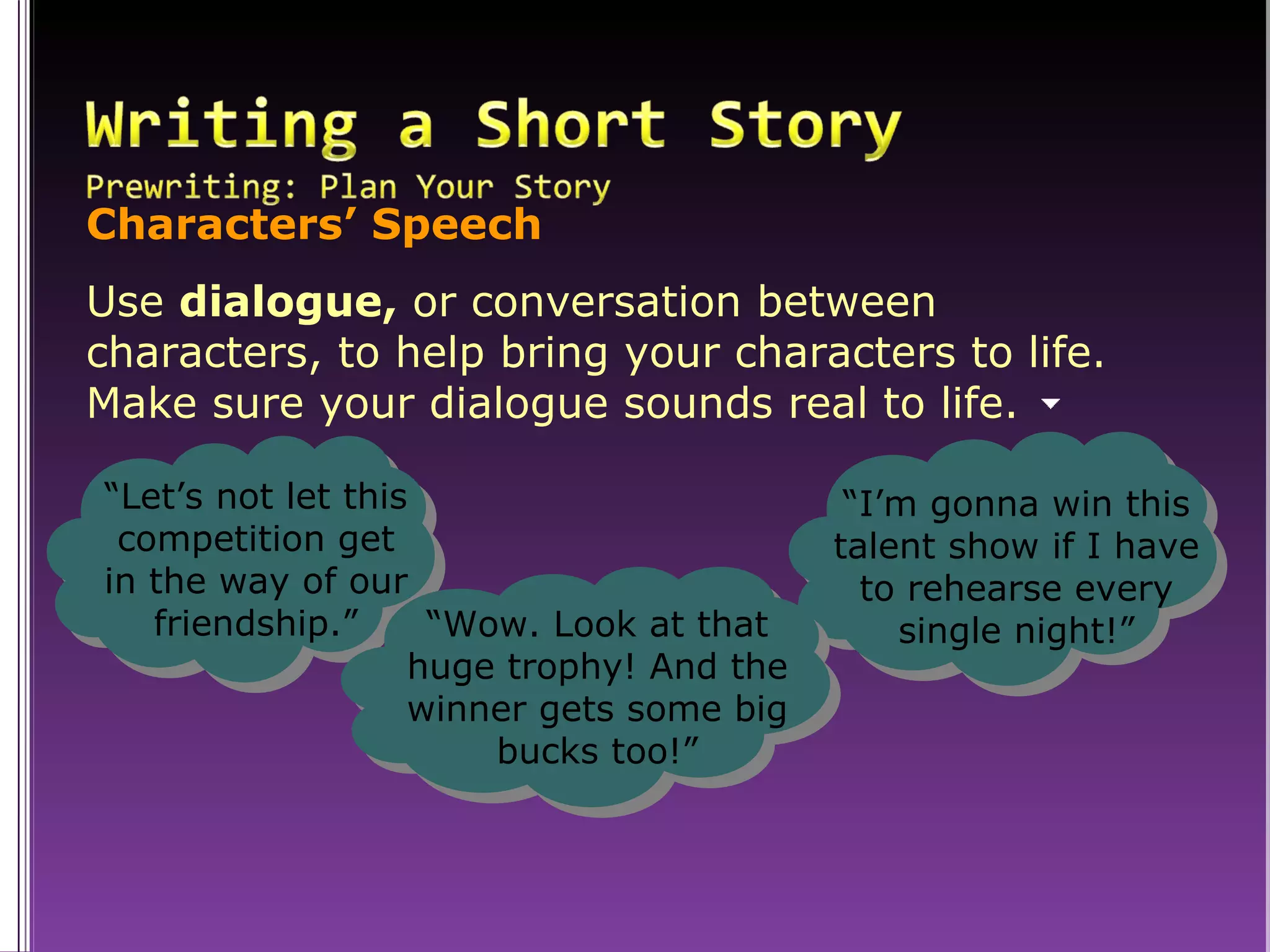
Characters’ Speech Use  dialogue,  or conversation between  characters, to help bring your characters to life.  Make sure your dialogue sounds real to life. “ Let’s not let this competition get in the way of our friendship.” “ I’m gonna win this talent show if I have to rehearse every single night!” “ Wow. Look at that huge trophy! And the winner gets some big bucks too!”
Point of View First Person —a character  narrates  the story using the first-person pronoun  I.  The character can tell only what he or she could logically know and what he or she feels, thinks, or experiences. I could hardly believe how many people were auditioning. When I saw James standing on the other side of the room next to some props, I could feel myself tense up. Why did he have to try out, too?
Hector walked into the crowded auditorium. The whole room was buzzing with excitement. When Hector and his best friend James spotted each other, they both tensed. Interior Monologue Point of View Third Person Omniscient —an outside observer tells the story using third-person pronouns  (he, she, they ) .  This narrator sees all and knows all and can use  shifting perspectives  to reveal different characters’ thoughts, feelings, and attitudes.
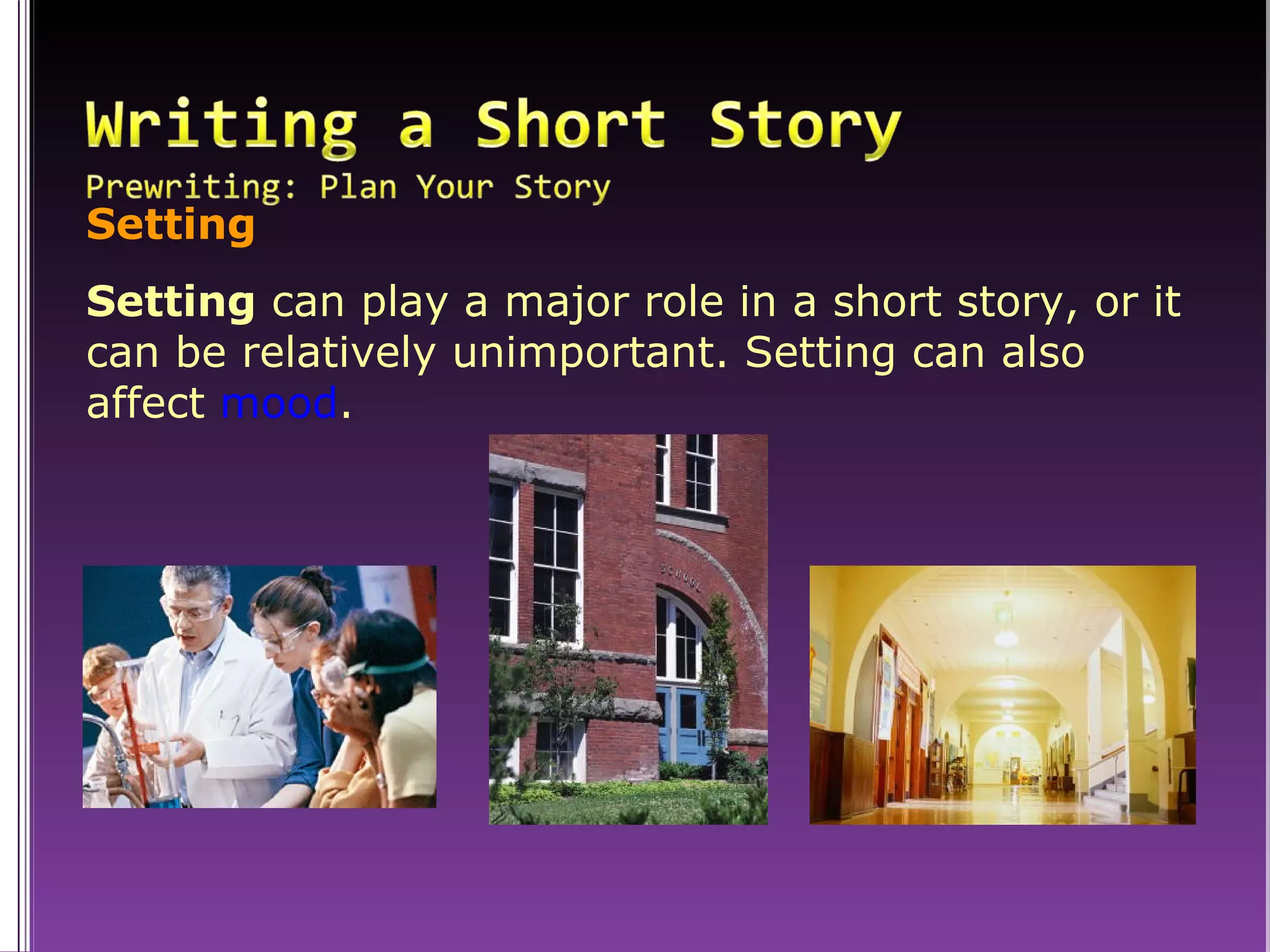
Setting Setting  can play a major role in a short story, or it can be relatively unimportant. Setting can also affect  mood .
a student warming up on trumpet; microphone feedback; muffled conversations Sounds Smells faint hint of wood cleaner; musty clothing and mothballs; a girl’s strong perfume; hairspray Sights a jam-packed auditorium, students pacing backstage, red velvet stage curtains  Setting Use  sensory details —words describing sights, sounds, and smells—to help readers picture the setting.
As long as the spirit of competition does not turn bitter, good friends can compete with each other and still remain close. Their friendship might even become stronger. Theme What idea about life does your story illustrate? Use your characters, plot, setting, and point of view to suggest your theme.  [End of Section]
Use the instructions in this section to develop the plot, characters, setting, and theme of a short story. Add sensory details to enhance your story. [End of Section]
 
Supporting Characters Don’t spend a lot of time developing a  supporting character  who appears only briefly in your story. If a supporting character plays a key role in your story, give more detail about the character’s appearance, mannerisms, and actions.
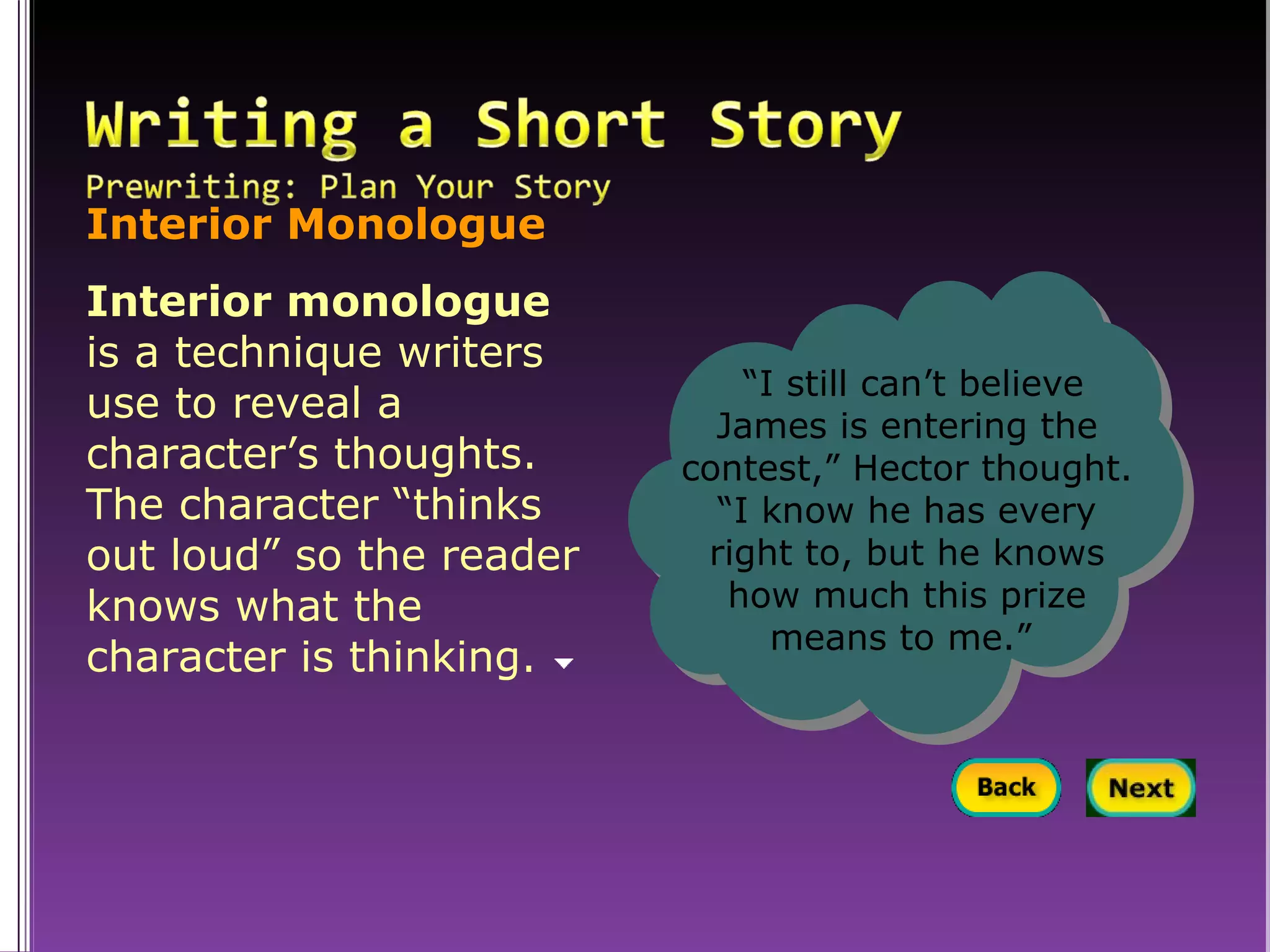
Interior Monologue Interior monologue  is a technique writers use to reveal a character’s thoughts. The character “thinks out loud” so the reader knows what the character is thinking.  “ I still can’t believe James is entering the contest,” Hector thought. “I know he has every right to, but he knows how much this prize means to me.”
Interior Monologue If you write from the first-person point of  view, you must limit your use of interior  monologue to the narrator. With a third-person-omniscient narrator, you can use interior monologue for any character.
Mood The details of your setting can affect the story’s  mood —the feeling or atmosphere of the story. What feeling would you like your story to have? thoughtful, tense festive, lively eerie, mysterious

Writing a short story

  • 1.
    Assignment Prewriting Finda Story Idea Plan Your Story Practice and Apply Feature Menu
  • 2.
    Assignment: Writea short story in which you use your imagination to express yourself and entertain others. Have you ever had an exciting experience and thought to yourself, “This would make a good story”? Ideas for stories are everywhere—in your own life, in other people’s lives, and in your imagination. Here is your chance to try out one of those ideas and write your own short story. [End of Section]
  • 3.
    A short storyis a work of fiction, but it can be based on real events. Think about events an earthquake; a heroic water rescue in the world competing in a talent show; welcoming a baby brother in your life an aunt’s wilderness adventure; a neighbor’s brush with stardom in someone else’s life
  • 4.
    Use your imaginationfor story ideas. Dream up a quirky young princess; a man who sleeps standing up people and animals a city in 2050; an icy planet places and worlds coming face to face with an crocodile; opening a soup kitchen adventures and problems [End of Section]
  • 5.
    Every story hasfive basic ingredients: Plot —What happens in the story? Characters —Who are the people in your story? Point of View —Who will narrate, or tell, your story? Setting —Where and when does your story take place? Theme —What idea about life does your story illustrate?
  • 6.
    Plot Build theplot of your short story around a conflict, a struggle between opposing forces. External conflict Internal conflict
  • 7.
    Plot and ExternalConflicts Character versus character Hector and his best friend James are both trying for first prize in the school talent show. Character versus environment Miguel gets caught in a blizzard and must find ways to stay warm until help arrives. Character versus situation Cynthia battles city hall to start a meal delivery service for seniors in her community.
  • 8.
    Plot and InternalConflict Character versus himself or herself (a struggle between conflicting ideas and feelings within a character) David wants to take Tasha to the dance, but he has already committed to babysitting that night.
  • 9.
    Climax —emotional highpoint of the story Resolution —outcome of conflict Elements of Plot Exposition —introduction of characters and conflict Rising action —events leading to the climax Exposition Resolution Event Event Event Event Rising action Climax
  • 10.
    a buzz inthe auditorium; students from every grade filing in, carrying costumes and props; Hector and James waving to each other but sitting on different sides of the room Developing Plot Use narrative details to bring your story to life. Describe your characters’ actions movements gestures feelings
  • 11.
    Event 2 Hectorand James kid about who’s going to win. Arranging Plot Events Arrange the events in chronological order, the order in which they actually occur. Use flashbacks to provide background information. Event 1 audition day Event 3 Hector rehearses his act. Event 4 the big night Flashback Hector and James meet each other for the first time.
  • 12.
    The Pace ofthe Plot Pace the action of your plot to reflect the mood you’re trying to create. Hector practically drags his feet as he walks up to the cafeteria table to sit with James. Slow pace —tense but thoughtful mood The curtains part. Hector takes deep breath. His heart pounds in his chest. Fast pace —feeling of excitement or anxiety
  • 13.
    dark brown hair,tall and thin, neat, stylish proud of musical talent, serious, competitive Characters’ Appearance How does my main character look? How does he or she act, think, feel, and talk? taps his pencil, rubs his chin when thinking What are his or her mannerisms? Supporting Characters
  • 14.
    Characters’ Speech Use dialogue, or conversation between characters, to help bring your characters to life. Make sure your dialogue sounds real to life. “ Let’s not let this competition get in the way of our friendship.” “ I’m gonna win this talent show if I have to rehearse every single night!” “ Wow. Look at that huge trophy! And the winner gets some big bucks too!”
  • 15.
    Point of ViewFirst Person —a character narrates the story using the first-person pronoun I. The character can tell only what he or she could logically know and what he or she feels, thinks, or experiences. I could hardly believe how many people were auditioning. When I saw James standing on the other side of the room next to some props, I could feel myself tense up. Why did he have to try out, too?
  • 16.
    Hector walked intothe crowded auditorium. The whole room was buzzing with excitement. When Hector and his best friend James spotted each other, they both tensed. Interior Monologue Point of View Third Person Omniscient —an outside observer tells the story using third-person pronouns (he, she, they ) . This narrator sees all and knows all and can use shifting perspectives to reveal different characters’ thoughts, feelings, and attitudes.
  • 17.
    Setting Setting can play a major role in a short story, or it can be relatively unimportant. Setting can also affect mood .
  • 18.
    a student warmingup on trumpet; microphone feedback; muffled conversations Sounds Smells faint hint of wood cleaner; musty clothing and mothballs; a girl’s strong perfume; hairspray Sights a jam-packed auditorium, students pacing backstage, red velvet stage curtains Setting Use sensory details —words describing sights, sounds, and smells—to help readers picture the setting.
  • 19.
    As long asthe spirit of competition does not turn bitter, good friends can compete with each other and still remain close. Their friendship might even become stronger. Theme What idea about life does your story illustrate? Use your characters, plot, setting, and point of view to suggest your theme. [End of Section]
  • 20.
    Use the instructionsin this section to develop the plot, characters, setting, and theme of a short story. Add sensory details to enhance your story. [End of Section]
  • 21.
  • 22.
    Supporting Characters Don’tspend a lot of time developing a supporting character who appears only briefly in your story. If a supporting character plays a key role in your story, give more detail about the character’s appearance, mannerisms, and actions.
  • 23.
    Interior Monologue Interiormonologue is a technique writers use to reveal a character’s thoughts. The character “thinks out loud” so the reader knows what the character is thinking. “ I still can’t believe James is entering the contest,” Hector thought. “I know he has every right to, but he knows how much this prize means to me.”
  • 24.
    Interior Monologue Ifyou write from the first-person point of view, you must limit your use of interior monologue to the narrator. With a third-person-omniscient narrator, you can use interior monologue for any character.
  • 25.
    Mood The detailsof your setting can affect the story’s mood —the feeling or atmosphere of the story. What feeling would you like your story to have? thoughtful, tense festive, lively eerie, mysterious