An introduction to theater for middle school – by Mrs.
LaCasse
 What is a Character?
 Who the actor pretends to be.
 Characters WANT things
they have GOALS and
OBJECTIVES.
 What is Dialogue?
 Conversation between 2
or more characters.
 Conflict:
 Obstacles that GET IN THE WAY of a CHARACTER
achieving what he or she WANTS.
 What the characters struggle against.
 Scene:
 A single situation or unit of dialogue in a play.
 Stage Directions:
 Messages from the playwright to the actors, technicians,
and others in the theater telling them what to do and
how to do it.
 Setting:
 Time and place of a scene
 Biography:
 Character’s life story that a playwright creates.
 Monologue:
 A long speech one character gives on stage.
 Dramatic Action:
 An explanation of what the characters are trying to do.
 Beat:
 A smaller section of a scene, divided where a shift in
emotion or topic occurs.
 Plot:
 The structure of a play, includes all of the play elements.
 Exposition:
 The beginning part of a plot that provides important
background information.
 Rising action:
 The middle part of a plot, consisting of complications
and discoveries that create conflice.
 Climax:
 The turning point in a plot
 Falling action:
 The series of events following the climax of a plot.
 Denouement
 The final resolution of the conflict in a plot.
 Break into groups of 4-5. Each person needs to write
the information.
 Each group will get 1 photo containing 2-4 people.
 Your job is to examine the photo, and look for clues as
to what type of characters these people are, and what
type of situation they are in.
 1. Give each character a:
 Name
 Age
 Occupation (job)
 Short family biography (family members)
 Unique characteristics (physical or personality)
 2. Briefly describe the relationship between the characters.
 3. In 1-2 sentences, describe what is happening in the
photo.
 4. Note how each character perceives the situation and
what they want out of it. Remember, each character has his
or her own point of view and will think that he or she
knows best.
 After you’ve completed steps 1-4 in groups, work on
writing a story in narrative form. The story should
have a beginning, middle, and end. All of the
characters from the photo should be involved.
 When you’ve finished writing the story, turn it into 3
scenes with dialogue.
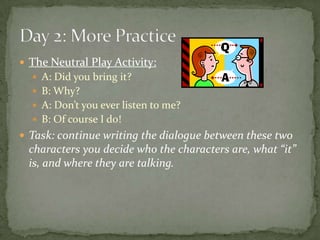
 The Neutral Play Activity:
 A: Did you bring it?
 B: Why?
 A: Don’t you ever listen to me?
 B: Of course I do!
 Task: continue writing the dialogue between these two
characters you decide who the characters are, what “it”
is, and where they are talking.
1. Darnell, who is ten years old, is constantly being harassed by Reed, an eleven-
year-old bully. Reed has even been extorting money from Darnell. What can
Darnell do to stop Reed from harassing him?
2. Elizabeth’s parents are going away for a three-day weekend. Although Elizabeth
has a license, her parents do not want her to drive while they are away. What does
Elizabeth do when her boyfriend comes over and wants to go out with her?
3. Ellis is the fourth-grade clown. He will do anything for a laugh. Some of his
classmates love him for it, others hate him for it. Underneath, Ellis is very lonely
and has no real friends. One day, a new boy, James, comes to town. Immediately,
no one (including Ellis) likes him. One day Ellis and James meet by chance in the
park. No one else is around. What happens?
4. Eddie, an eighth-grader in middle school, is suddenly stricken with love for
Sonya, a ninth-grader in high school who hardly notices him at all. Eddie
desperately wants to go out with Sonya, but is nervous and afraid that he will be
rejected. What does he do? Who, if anyone, does he elicit help from?
5. Bob and Barbara who are good friends, go out shopping for a birthday
present for another friend; but they both want to buy the same gift. What
happens?
6. Jill and Joe, who are friends, are both suspended from school for the
same reason. What happens when they go home and tell their respective
parents? Do they both tell the same story?
7. Tammy likes Tom, a boy in her class. She wants to ask him to have
dinner at her house, but she is afraid he will say “no”. What happens?
8. Steve wants Susan to go to a rock concert with him, but Susan’s father
doesn’t think she should go. Why? What happens?
9. Lee builds a rocket in the family garage. What happens when it is
stolen? Who stole it?
10. Chris finds a magic lantern and is granted three wishes. What happens
when the first wish brings misfortune?
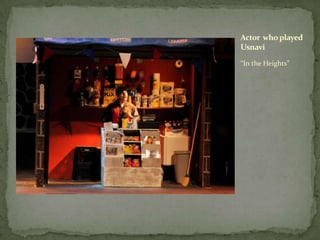
 Usnavi De La Vega
 24 year old owner of De La Vega’s Bodega,
 his parents emigrated from the Dominican Republic
and have since passed away.
 He lives with Abuela Claudia (Grandmother Claudia),
who isn’t actually his grandmother but they are as close
as family.
 Usnavi is in love with Vanessa and remains the eyes and
ears of his Washington Heights neighborhood.
“In the Heights”
Actor whoplayed
Usnavi
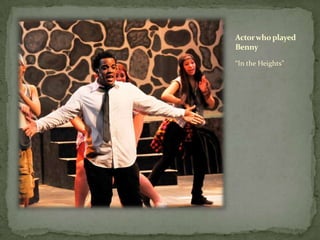
 Benny
 Now a 24 year old cab driver for Rosario Car and
Limousine, he once was a street punk and hoodlum,
often finding himself in trouble.
 Kevin saw promise in Benny and helped shape him into
a responsible, hard-working young man.
 Benny has enormous respect for Kevin and sees him as a
father figure.
 Eventually falling in love with Nina, Benny sees a future
for them by becoming a businessman.
 He and Usnavi are best friends.
Actorwhoplayed
Benny
“In the Heights”
1. Characters are not unique—They do not have an individual way of speaking. This is one of
the most common problems for new playwrights—every character sounds the same, uses the
same slang, dialect, etc..., normally the characters’ voices are identical to the playwright’s
manner of speaking.
2. Believability—The characters do or say unbelievable things, behaving contrary to their nature
without causation. (i.e. A grumpy man suddenly buying presents for the neighborhood
children is unbelievable; when he has been visited by three ghosts, shown the error of his
ways, and then buys the presents, the activity becomes believable.)
3. Too many characters—There are characters present who are unnecessary to the story being
told. A surplus of characters can confuse or muddle the story and burden the playwright as
well.
4. Characters not fully developed—Characters are incomplete or not “whole,” which prevents
people from connecting with them and caring what happens to them.
 Who is this character?
‱ What else might this character do?
‱ What might this character say?
‱ Why does the character do/say what he does?
‱ Does your character have a secret?
‱ What kind of mood is he in now?
‱ Are all of these characters necessary?
‱ Where is the focus of the scene?
‱ How does the character’s background affect what he says?
‱ What is his relation to the other characters?
‱ Do you care about this character? Why?
‱ Who is the story about?
 Conflict - a storyteller's best friend
 The stronger the story problem, the stronger the story.
 Don't be nice to your character! Create obstacles to the goal. The story is more exciting that way, the
character learns more, and the reward is more valuable since the character worked so hard for it.
 The classic conflicts: These are ideas to get you started.:
 Person versus person: The most popular, since conflicts between people are the most interesting to readers.
(Example: Cinderella and her wicked stepmother)
 Person versus himself: Conflict between good and evil or strengths and weaknesses in a character. This is deep
stuff and not usually the main conflict. (Example: The Grinch is evil and hates Christmas, but he is not evil at
heart -- he is like that because someone hurt him. The Grinch feels inner conflict over the good and evil inside of
him.)
 Person versus nature: Usually involves natural disasters or survival skills. This conflict is exciting, but often
difficult to write about at length. (Example: The character in Jurassic Park must survive in and escape from a
dangerous land of dinosaurs.)
 Tips on creating conflict:
 Combine different types of conflict. Maybe your characters struggle to survive and fight among themselves.
 Add more conflicts and obstacles if your story seems slow or not "big" enough.
 Before you write, know how the problem will be solved. Don't write yourself into a hole!
 The main character must solve the problem. Don't have someone (or something) enter at the last minute and save
the day
Common Problems (Conflict):
1. More scenes needed—More scenes are needed to understand how the conflict/plot
developed to this point, what happens in the scene, or what happens next.
2. Unnecessary information—Information provided in the scene does not help us learn
about the characters in a meaningful way. Excessive details muddle the story and detract
from the plot line.
3. Settings change too fast—There are two many mini-scenes which might be more
effective if combined into a few larger scenes in one or two locations.
4. Setting is not specific enough—More details are needed to let the audience know the
location—character reference, set dressing, etc.
5. Special effects—The scenes are more feasible for film or television (i.e. they contain car
chases, jumping from one elaborate location to another, large explosions).
 What happened before this?
‱ What happens next?
‱ When does the scene take place?
‱ What can be done in this scene to further the story/plot?
‱ Why does this action have to happen here?
‱ What story does the scene tell?
‱ What information do we get from this scene?
‱ How do the characters feel in this scene? How might they
show it through their actions?
‱ What is this character doing when
?
‱ What else could this character have been doing?
‱ What other things could happen in this scene?
 Zwiers & Harvey, 2006 “Move over Shakespeare :
Playwriting in the classroom.
 Centerstage, Teaching playwrights in schools.
 Corey Green, 2010-2011, “Storywriting tips for kids.”
 “In the Heights” Script
 LPS SFA Theater group
 MA Common Core Standards

Playwriting- the basics

  • 1.
    An introduction totheater for middle school – by Mrs. LaCasse
  • 2.
     What isa Character?  Who the actor pretends to be.  Characters WANT things
they have GOALS and OBJECTIVES.  What is Dialogue?  Conversation between 2 or more characters.
  • 3.
     Conflict:  Obstaclesthat GET IN THE WAY of a CHARACTER achieving what he or she WANTS.  What the characters struggle against.  Scene:  A single situation or unit of dialogue in a play.
  • 4.
     Stage Directions: Messages from the playwright to the actors, technicians, and others in the theater telling them what to do and how to do it.  Setting:  Time and place of a scene
  • 5.
     Biography:  Character’slife story that a playwright creates.  Monologue:  A long speech one character gives on stage.  Dramatic Action:  An explanation of what the characters are trying to do.
  • 6.
     Beat:  Asmaller section of a scene, divided where a shift in emotion or topic occurs.  Plot:  The structure of a play, includes all of the play elements.  Exposition:  The beginning part of a plot that provides important background information.
  • 7.
     Rising action: The middle part of a plot, consisting of complications and discoveries that create conflice.  Climax:  The turning point in a plot  Falling action:  The series of events following the climax of a plot.  Denouement  The final resolution of the conflict in a plot.
  • 8.
     Break intogroups of 4-5. Each person needs to write the information.  Each group will get 1 photo containing 2-4 people.  Your job is to examine the photo, and look for clues as to what type of characters these people are, and what type of situation they are in.
  • 9.
     1. Giveeach character a:  Name  Age  Occupation (job)  Short family biography (family members)  Unique characteristics (physical or personality)  2. Briefly describe the relationship between the characters.  3. In 1-2 sentences, describe what is happening in the photo.  4. Note how each character perceives the situation and what they want out of it. Remember, each character has his or her own point of view and will think that he or she knows best.
  • 10.
     After you’vecompleted steps 1-4 in groups, work on writing a story in narrative form. The story should have a beginning, middle, and end. All of the characters from the photo should be involved.  When you’ve finished writing the story, turn it into 3 scenes with dialogue.
  • 11.
     The NeutralPlay Activity:  A: Did you bring it?  B: Why?  A: Don’t you ever listen to me?  B: Of course I do!  Task: continue writing the dialogue between these two characters you decide who the characters are, what “it” is, and where they are talking.
  • 12.
    1. Darnell, whois ten years old, is constantly being harassed by Reed, an eleven- year-old bully. Reed has even been extorting money from Darnell. What can Darnell do to stop Reed from harassing him? 2. Elizabeth’s parents are going away for a three-day weekend. Although Elizabeth has a license, her parents do not want her to drive while they are away. What does Elizabeth do when her boyfriend comes over and wants to go out with her? 3. Ellis is the fourth-grade clown. He will do anything for a laugh. Some of his classmates love him for it, others hate him for it. Underneath, Ellis is very lonely and has no real friends. One day, a new boy, James, comes to town. Immediately, no one (including Ellis) likes him. One day Ellis and James meet by chance in the park. No one else is around. What happens? 4. Eddie, an eighth-grader in middle school, is suddenly stricken with love for Sonya, a ninth-grader in high school who hardly notices him at all. Eddie desperately wants to go out with Sonya, but is nervous and afraid that he will be rejected. What does he do? Who, if anyone, does he elicit help from?
  • 13.
    5. Bob andBarbara who are good friends, go out shopping for a birthday present for another friend; but they both want to buy the same gift. What happens? 6. Jill and Joe, who are friends, are both suspended from school for the same reason. What happens when they go home and tell their respective parents? Do they both tell the same story? 7. Tammy likes Tom, a boy in her class. She wants to ask him to have dinner at her house, but she is afraid he will say “no”. What happens? 8. Steve wants Susan to go to a rock concert with him, but Susan’s father doesn’t think she should go. Why? What happens? 9. Lee builds a rocket in the family garage. What happens when it is stolen? Who stole it? 10. Chris finds a magic lantern and is granted three wishes. What happens when the first wish brings misfortune?
  • 14.
     Usnavi DeLa Vega  24 year old owner of De La Vega’s Bodega,  his parents emigrated from the Dominican Republic and have since passed away.  He lives with Abuela Claudia (Grandmother Claudia), who isn’t actually his grandmother but they are as close as family.  Usnavi is in love with Vanessa and remains the eyes and ears of his Washington Heights neighborhood.
  • 15.
  • 16.
     Benny  Nowa 24 year old cab driver for Rosario Car and Limousine, he once was a street punk and hoodlum, often finding himself in trouble.  Kevin saw promise in Benny and helped shape him into a responsible, hard-working young man.  Benny has enormous respect for Kevin and sees him as a father figure.  Eventually falling in love with Nina, Benny sees a future for them by becoming a businessman.  He and Usnavi are best friends.
  • 17.
  • 18.
    1. Characters arenot unique—They do not have an individual way of speaking. This is one of the most common problems for new playwrights—every character sounds the same, uses the same slang, dialect, etc..., normally the characters’ voices are identical to the playwright’s manner of speaking. 2. Believability—The characters do or say unbelievable things, behaving contrary to their nature without causation. (i.e. A grumpy man suddenly buying presents for the neighborhood children is unbelievable; when he has been visited by three ghosts, shown the error of his ways, and then buys the presents, the activity becomes believable.) 3. Too many characters—There are characters present who are unnecessary to the story being told. A surplus of characters can confuse or muddle the story and burden the playwright as well. 4. Characters not fully developed—Characters are incomplete or not “whole,” which prevents people from connecting with them and caring what happens to them.
  • 19.
     Who isthis character? ‱ What else might this character do? ‱ What might this character say? ‱ Why does the character do/say what he does? ‱ Does your character have a secret? ‱ What kind of mood is he in now? ‱ Are all of these characters necessary? ‱ Where is the focus of the scene? ‱ How does the character’s background affect what he says? ‱ What is his relation to the other characters? ‱ Do you care about this character? Why? ‱ Who is the story about?
  • 20.
     Conflict -a storyteller's best friend  The stronger the story problem, the stronger the story.  Don't be nice to your character! Create obstacles to the goal. The story is more exciting that way, the character learns more, and the reward is more valuable since the character worked so hard for it.  The classic conflicts: These are ideas to get you started.:  Person versus person: The most popular, since conflicts between people are the most interesting to readers. (Example: Cinderella and her wicked stepmother)  Person versus himself: Conflict between good and evil or strengths and weaknesses in a character. This is deep stuff and not usually the main conflict. (Example: The Grinch is evil and hates Christmas, but he is not evil at heart -- he is like that because someone hurt him. The Grinch feels inner conflict over the good and evil inside of him.)  Person versus nature: Usually involves natural disasters or survival skills. This conflict is exciting, but often difficult to write about at length. (Example: The character in Jurassic Park must survive in and escape from a dangerous land of dinosaurs.)  Tips on creating conflict:  Combine different types of conflict. Maybe your characters struggle to survive and fight among themselves.  Add more conflicts and obstacles if your story seems slow or not "big" enough.  Before you write, know how the problem will be solved. Don't write yourself into a hole!  The main character must solve the problem. Don't have someone (or something) enter at the last minute and save the day
  • 21.
    Common Problems (Conflict): 1.More scenes needed—More scenes are needed to understand how the conflict/plot developed to this point, what happens in the scene, or what happens next. 2. Unnecessary information—Information provided in the scene does not help us learn about the characters in a meaningful way. Excessive details muddle the story and detract from the plot line. 3. Settings change too fast—There are two many mini-scenes which might be more effective if combined into a few larger scenes in one or two locations. 4. Setting is not specific enough—More details are needed to let the audience know the location—character reference, set dressing, etc. 5. Special effects—The scenes are more feasible for film or television (i.e. they contain car chases, jumping from one elaborate location to another, large explosions).
  • 22.
     What happenedbefore this? ‱ What happens next? ‱ When does the scene take place? ‱ What can be done in this scene to further the story/plot? ‱ Why does this action have to happen here? ‱ What story does the scene tell? ‱ What information do we get from this scene? ‱ How do the characters feel in this scene? How might they show it through their actions? ‱ What is this character doing when
? ‱ What else could this character have been doing? ‱ What other things could happen in this scene?
  • 23.
     Zwiers &Harvey, 2006 “Move over Shakespeare : Playwriting in the classroom.  Centerstage, Teaching playwrights in schools.  Corey Green, 2010-2011, “Storywriting tips for kids.”  “In the Heights” Script  LPS SFA Theater group  MA Common Core Standards