“Show, Don’t Tell”
“Show, Don’t Tell”
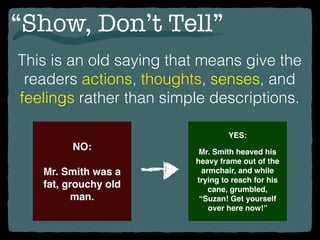
This is an old saying that means give the
readers actions, thoughts, senses, and
feelings rather than simple descriptions.
NO:
Mr. Smith was a
fat, grouchy old
man.
YES:
Mr. Smith heaved his
heavy frame out of the
armchair, and while
trying to reach for his
cane, grumbled,
“Suzan! Get yourself
over here now!”
“Show, Don’t Tell”
How do you do this?
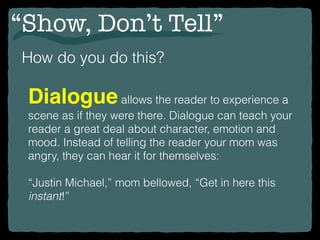
Dialogueallows the reader to experience a
scene as if they were there. Dialogue can teach your
reader a great deal about character, emotion and
mood. Instead of telling the reader your mom was
angry, they can hear it for themselves:
“Justin Michael,” mom bellowed, “Get in here this
instant!”
“Show, Don’t Tell”
How do you do this?
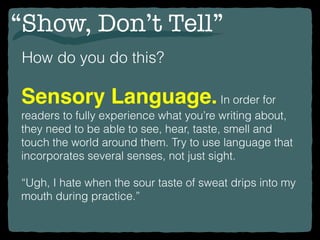
Sensory Language.In order for
readers to fully experience what you’re writing about,
they need to be able to see, hear, taste, smell and
touch the world around them. Try to use language that
incorporates several senses, not just sight.
“Ugh, I hate when the sour taste of sweat drips into my
mouth during practice.”
“Show, Don’t Tell”
How do you do this?
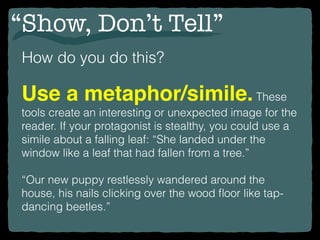
Use a metaphor/simile.These
tools create an interesting or unexpected image for the
reader. If your protagonist is stealthy, you could use a
simile about a falling leaf: “She landed under the
window like a leaf that had fallen from a tree.”
“Our new puppy restlessly wandered around the
house, his nails clicking over the wood floor like tap-
dancing beetles.”
“Show, Don’t Tell”
How do you do this?
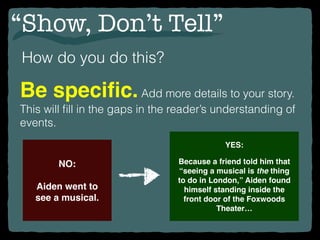
Be specific.Add more details to your story.
This will fill in the gaps in the reader’s understanding of
events.
NO:
Aiden went to
see a musical.
YES:
Because a friend told him that
“seeing a musical is the thing
to do in London,” Aiden found
himself standing inside the
front door of the Foxwoods
Theater…
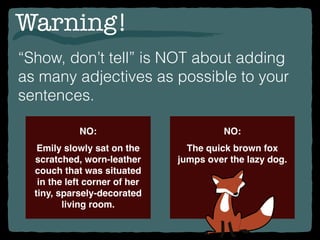
Warning!
“Show, don’t tell” is NOT about adding
as many adjectives as possible to your
sentences.
NO:
Emily slowly sat on the
scratched, worn-leather
couch that was situated
in the left corner of her
tiny, sparsely-decorated
living room.
NO:
The quick brown fox
jumps over the lazy dog.
Warning!
Rather than saying “show, don’t tell,” we
should say this:
“Show as much as you can, tell as little
as you can.”
Why? Because it’s impossible to “show”
all the time. Sometimes, you will need to
directly tell the reader what’s on your
mind.
Open your class writing journal.
Date it August 21.
Title: “‘Show, Don’t Tell’ Challenge”
Activity:
I will give you a simple passage that relies too much
on “telling”. It is your job to re-write the passage to
include more elements of “show” than “tell.” We will
read and discuss your stories as a class, and we will
vote to decide which ones are the best.
Re-Write It:
When Victor found out that his
best friend Dan had betrayed him,
he went to Dan’s house to search
for him. He found Dan, and the
two got into a fight.
Criteria:
Vote for the story that:
• You find the most engaging
• Creates a vivid image in your mind
of the characters and events
• Succeeds at “showing, not telling”

"Show, Don't Tell"

  • 1.
  • 2.
    “Show, Don’t Tell” Thisis an old saying that means give the readers actions, thoughts, senses, and feelings rather than simple descriptions. NO: Mr. Smith was a fat, grouchy old man. YES: Mr. Smith heaved his heavy frame out of the armchair, and while trying to reach for his cane, grumbled, “Suzan! Get yourself over here now!”
  • 3.
    “Show, Don’t Tell” Howdo you do this? Dialogueallows the reader to experience a scene as if they were there. Dialogue can teach your reader a great deal about character, emotion and mood. Instead of telling the reader your mom was angry, they can hear it for themselves: “Justin Michael,” mom bellowed, “Get in here this instant!”
  • 4.
    “Show, Don’t Tell” Howdo you do this? Sensory Language.In order for readers to fully experience what you’re writing about, they need to be able to see, hear, taste, smell and touch the world around them. Try to use language that incorporates several senses, not just sight. “Ugh, I hate when the sour taste of sweat drips into my mouth during practice.”
  • 5.
    “Show, Don’t Tell” Howdo you do this? Use a metaphor/simile.These tools create an interesting or unexpected image for the reader. If your protagonist is stealthy, you could use a simile about a falling leaf: “She landed under the window like a leaf that had fallen from a tree.” “Our new puppy restlessly wandered around the house, his nails clicking over the wood floor like tap- dancing beetles.”
  • 6.
    “Show, Don’t Tell” Howdo you do this? Be specific.Add more details to your story. This will fill in the gaps in the reader’s understanding of events. NO: Aiden went to see a musical. YES: Because a friend told him that “seeing a musical is the thing to do in London,” Aiden found himself standing inside the front door of the Foxwoods Theater…
  • 7.
    Warning! “Show, don’t tell”is NOT about adding as many adjectives as possible to your sentences. NO: Emily slowly sat on the scratched, worn-leather couch that was situated in the left corner of her tiny, sparsely-decorated living room. NO: The quick brown fox jumps over the lazy dog.
  • 8.
    Warning! Rather than saying“show, don’t tell,” we should say this: “Show as much as you can, tell as little as you can.” Why? Because it’s impossible to “show” all the time. Sometimes, you will need to directly tell the reader what’s on your mind.
  • 9.
    Open your classwriting journal. Date it August 21. Title: “‘Show, Don’t Tell’ Challenge” Activity: I will give you a simple passage that relies too much on “telling”. It is your job to re-write the passage to include more elements of “show” than “tell.” We will read and discuss your stories as a class, and we will vote to decide which ones are the best.
  • 10.
    Re-Write It: When Victorfound out that his best friend Dan had betrayed him, he went to Dan’s house to search for him. He found Dan, and the two got into a fight.
  • 11.
    Criteria: Vote for thestory that: • You find the most engaging • Creates a vivid image in your mind of the characters and events • Succeeds at “showing, not telling”