• Your Sub Points
Fiction is the dream of the writer,
made visible on the page. It may be the
writer’s lived experience or it may be
entirely imagined.
Fiction, literature created from the
imagination, not presented as fact, though it
may be based on a true story or situation.
1. Definition
2. Elements of Fiction
a. Character-a person, an animal, or an imaginary
creature that takes the part in the action of the story.
http://s3.amazonaws.com/ppt-download/elements-of-fiction-1220634613791037-8.ppt?response-content-
disposition=attachment&Signature=iiUfPOsBHJ95GDaQrG%2BwF%2FBx%2Bo4%3D&Expires=1477533719&AW
SAccessKeyId=AKIAJ6D6SEMXSASXHDAQ
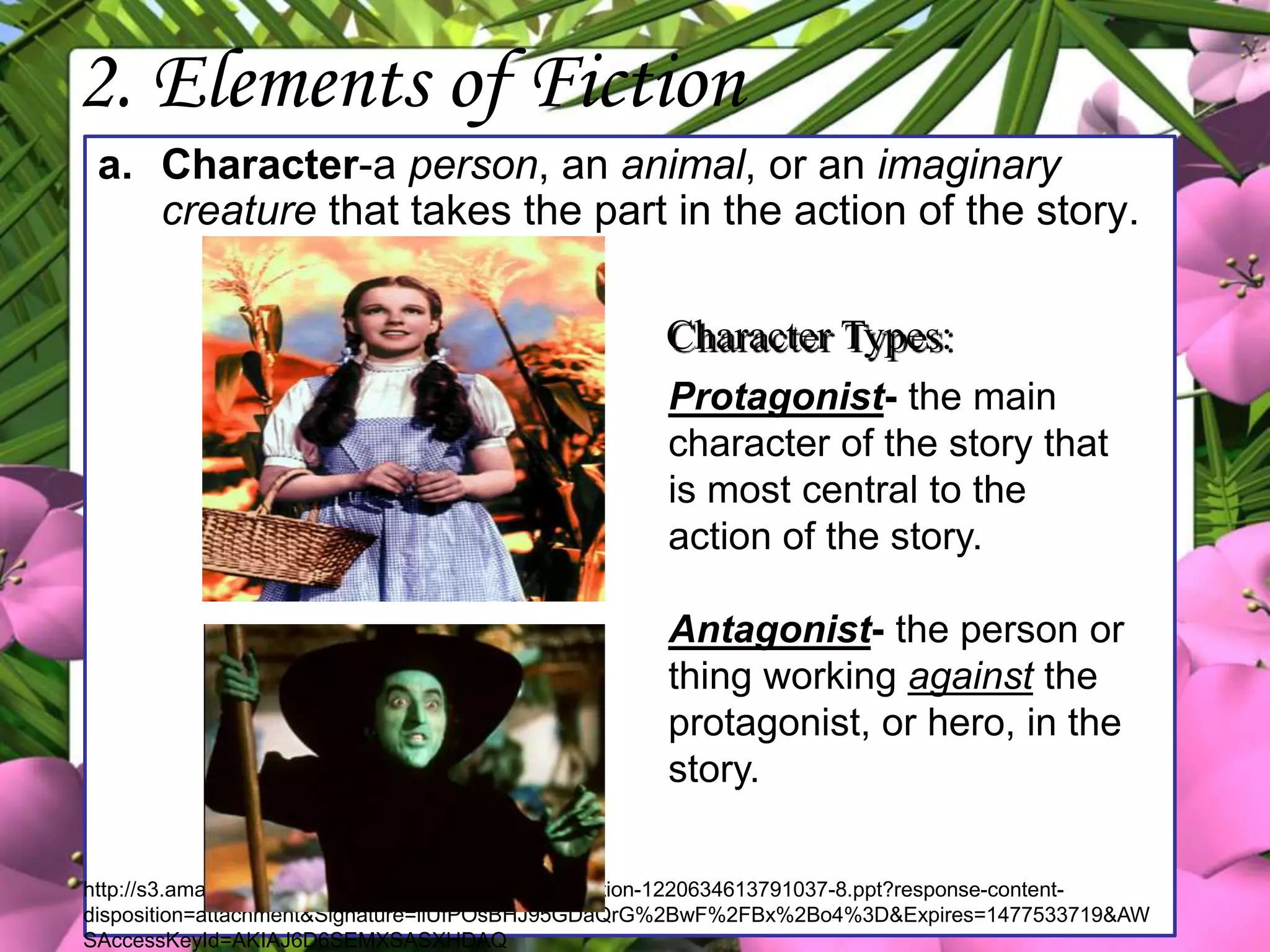
Character Types:
Protagonist- the main
character of the story that
is most central to the
action of the story.
Antagonist- the person or
thing working against the
protagonist, or hero, in the
story.
– Static Characters- characters that stay the same
throughout the story.
– Dynamic Characters- characters that change and
learn something during the story.
Flat – very few personality traits, do not change throughout the
story, sometimes can be symbols or stereotypes
Round –convincing and true to life, many different personality
traits, usually undergo a change during the story
– physical appearance and personality
– speech, behavior , and actions
– thoughts and feelings
– interactions with other characters
b. Characterization - the techniques an author uses to
develop the personality of a character in a literary work.
c. Setting
The time and place in which the action
occurs. Look for clues in the opening
paragraphs of the story or novel.
It is refers to who tells the story and how
it is told
• 1st person- the story is told by one of the
characters in the story. The character uses
the pronouns I and we.
• 3rd person- the story is told by the narrator
who stands outside of the story and
observes the events as they unfold. The
narrator uses the pronouns she, he, and
they.
d. Point of view
.
e. Plot
Plot, the action element in fiction, is the arrangement of
events that make up a story. It is based on a key
conflict.
There are five basic parts of plot:
• Exposition- the first part of the story. The author
establishes the setting, introduces characters, gives
additional background information.
• Rising Action/Complications- the series of conflicts or
struggles that build a story toward its climax. Tension
rises.
• Climax- the high point, or turning point, of a
story. It is the most intense point. A decision is
made that will decide the outcome of the
conflict.
• Falling Action- the action that works out the
decision arrived at during the climax. The
conflict is –or begins to be –settled.
• Resolution- the ending. It ties up loose ends
and brings the story to a close.
f. Theme
Theme is the central idea or meaning of a story.
f. Theme
A symbol is a person, object, image, word, or event
that evokes a range of additional meaning beyond
and usually more abstract that is literal significance.
Universal Symbols:
• water = purity
• black clouds = evil approaching
g. Symbolization
Tone is the author’s implicit attitude toward the
reader, subject, and/or the people, places, and
events in a work as revealed by the elements of
the author’s style.
h. Tone
Genres of Fiction
The two main types of fiction
1. Commercial fiction attracts a broad
audience and may also fall into
any subgenre, like mystery, romance,
legal thriller, western, science fiction, etc.
2. Literary fiction tends to appeal to a
smaller, more intellectually adventurous
audience.
Other types of fiction
1. Mystery is a popular genre, boasting a huge
established audience. All mysteries focus on a
crime, usually murder.
2. Romance is a type of category fiction in which
the love relationship between a man and a
woman pervades the plot.
3. Science fiction can be defined as literature
involving elements of science and technology
as a basis for conflict, or as the setting for a
story.
4. Suspense novels and thrillers are tense, exciting, often
sensational works with ingenious plotting, swift action,
and continuous suspense.
5. Mainstream fiction is transcends popular novel
categories—mystery, romance or science fiction, etc.
6. Western, these novels about life on America’s post Civil
War western frontier usually involve conflicts between
cowboys and outlaws, cowboys and Native Americans, or
Easterners and Westerners.
7. Horror, the characteristic is the intention
to frighten readers by exploiting their
fears, both conscious and
subconscious.
8. Young adults, this genre includes any
type of novel with a protagonist in the
12 to 16 age range that speaks to the
concerns of teenagers.
a. Historical fiction
b. Realistic fiction
c. Fantasy
d. Science fiction
e. Mystery
2. Fiction Genres
a. Historical fiction
A fictional story set in a recognizable
period of history. As well as telling the
stories of ordinary people’s lives, historical
fiction may involve political or social events
of the time.
b. Realistic fiction
Imaginative writing that accurately reflects
life as it could be lived today. Everything is a
realistic fiction story could conceivably happen
to real people living in today’s natural physical
world. Realistic fiction helps children move
toward a fuller understanding of themselves and
others.
https://www2.k12albemarle.org/dept/instruction/languagearts/Curriculum%20Appendices/Appen
dixF_GenreDef.pdf
Requires the willing suspension of disbelief. Fantasy
creates another world for characters and readers, asking that
the reader believe this other world could exist. There are two
types of fantasy – fantastic stories and high fantasy.
1. Fantastic stories - are realistic in most details but still
require the reader to willingly suspend disbelief. They
contain fantastic elements, such as talking animals,
eccentric characters in preposterous situations,
anthropomorphism, or extraordinary worlds. Charlotte’s Web
(White) and Tuck Everlasting (Babbitt) are examples.
c. Fantasy
https://www2.k12albemarle.org/dept/instruction/languagearts/Curriculum%20Appendices/Appen
dixF_GenreDef.pdf
2. High fantasy - takes place is a created world or imaginary
kingdom. Serious in tone, the story primarily focuses on the
conflict between opposing forces, and concerns itself with cosmic
questions and ultimate values, such as goodness, truth, courage,
or wisdom. The Book of Three (Alexander), The Chronicles of
Narnia (Lewis), and The Hobbit (Tolkien) are examples.
Science fiction can be defined as literature involving elements of
science and technology as a basis for conflict, or as the setting for
a story.
Example:
d. Science fiction
Humans and Technology-
Stories describing how humans interact with
computers, nanotechnology, bioengineering, virtual
reality, artificial intelligences, or other parts of
technologically driven society. These stories often
question the concept of what it means to be
human. (I, Robot, Terminator)
Presents a puzzle or riddle to be solved.
Mysteries contain a character who acts as the
detective, and contain clues to help he reader
solve the puzzle. Mysteries written for older
students have a suspenseful mood and
contain foreshadowing.
e. Mystery
https://www2.k12albemarle.org/dept/instruction/languagearts/Curriculum%20Appendices/Appen
dixF_GenreDef.pdf
Example
:
Moving on…..
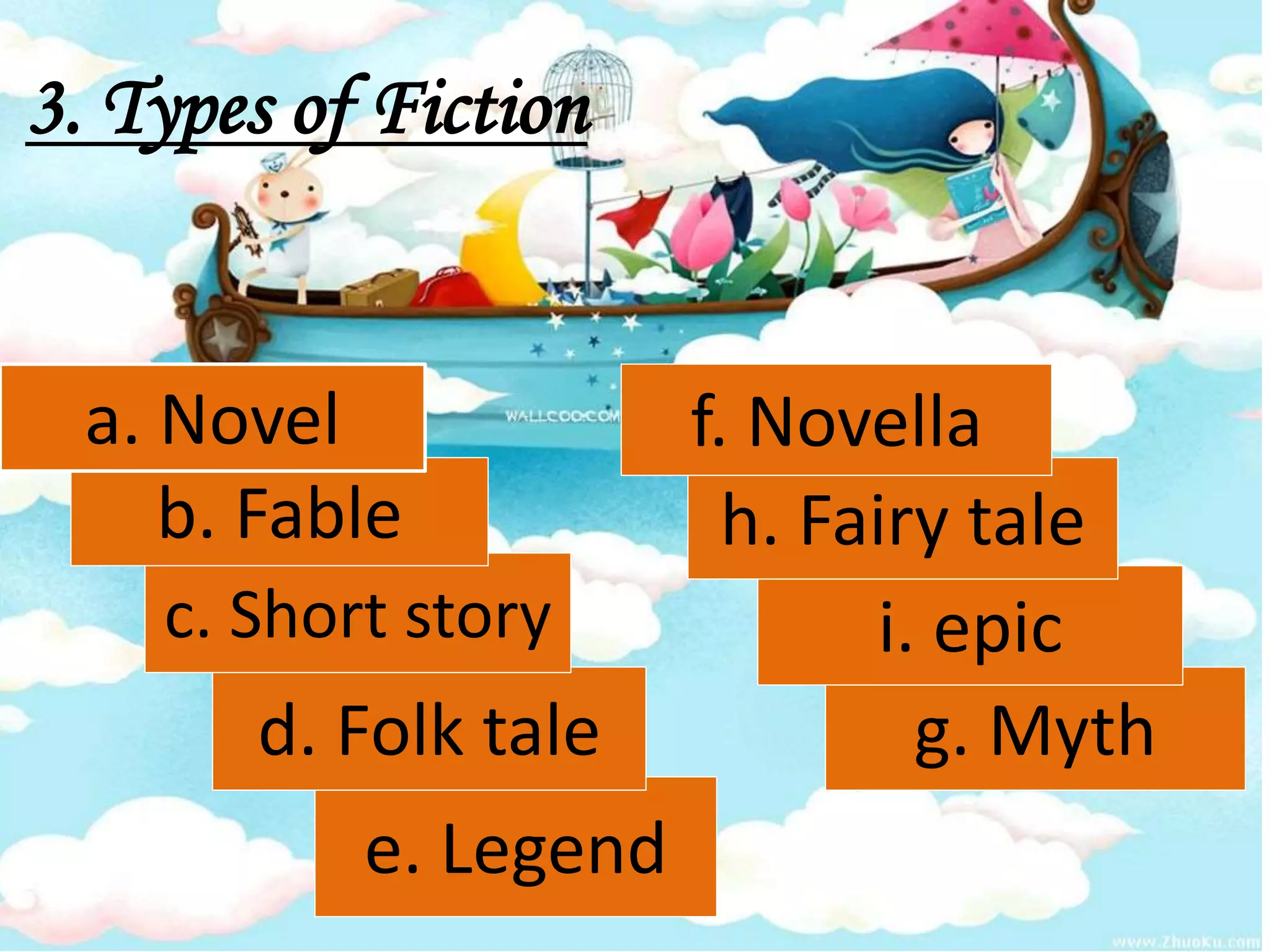
3. Types of Fiction
g. Myth
e. Legend
d. Folk tale
c. Short story
b. Fable
a. Novel
i. epic
h. Fairy tale
f. Novella
a. Novel
Novel, an invented prose narrative of considerable
length and a certain complexity that deals imaginatively
with human experience, usually through a connected
sequence of events involving a group of persons in a
specific setting. Within its broad framework, the genre of
the novel has encompassed an extensive range of types and
styles: picaresque, epistolary, Gothic, romantic, realist,
historical—to name only some of the more important ones.
https://www.britannica.com/art/novella
b. Short Story
Short story, brief fictional prose
narrative that is shorter than a novel and
that usually deals with only a few
characters.
A brief story usually 5-20 pages long. only
has 1-2 main characters and one main
setting.
c. Fable
A fable is a very brief story in prose or in verse that teaches a
moral or a practical lesson about how to succeed in life.
A fable is a very brief story in prose or in verse that teaches a moral or a
practical lesson about how to succeed in life.
http://schoolwires.henry.k12.ga.us/cms/lib08/GA01000549/Centricity/Domain/6909/Folklore%
20PPT-fables-myths-folktales-%20fairytales.ppt
http://myths.e2bn.org/teachers/info311-what-are-myths-legends-and-folktales.html
The Tortoise and Fable the Hare
• The Hare was once boasting of his speed before the other animals. "I have
never yet been beaten," said he, "when I put forth my full speed. I
challenge any one here to race with me."
The Tortoise said quietly, "I accept your challenge."
"That is a good joke," said the Hare; "I could dance round you all the
way."
"Keep your boasting till you've beaten," answered the Tortoise. "Shall we
race?"
So a course was fixed and a start was made. The Hare darted almost out of
sight at once, but soon stopped and, to show his contempt for the Tortoise,
lay down to have a nap. The Tortoise plodded on and plodded on, and
when the Hare awoke from his nap, he saw the Tortoise just near the
winning-post and could not run up in time to save the race.
• Then said the Tortoise: Slow and steady wins the race.
http://schoolwires.henry.k12.ga.us/cms/lib08/GA01000549/Centricity/Domain/6909/Folklore%
20PPT-fables-myths-folktales-%20fairytales.ppt
d. Folk tale
• A folk tale is a story with no known author. Folk tales are
passed down from one generation to another by word of
mouth.
• They teach lessons & teach you about the consequences of
certain kinds of behaviors or attitudes.
http://schoolwires.henry.k12.ga.us/cms/lib08/GA01000549/Centricity/Domain/6909/Folklore%
20PPT-fables-myths-folktales-%20fairytales.ppt
http://www.slideshare.net/bogeybear/folk-fairy-tales
e. Legend
A legend is a semi-true story, which has been passed on
from person-to-person and has important meaning or symbolism
for the culture in which it originates. A legend usually includes an
element of truth, or is based on historic facts, but with 'mythical
qualities'. Legends usually involve heroic characters or fantastic
places and often encompass the spiritual beliefs of the culture in
which they originate.
http://myths.e2bn.org/teachers/info311-what-are-myths-legends-and-folktales.html
Example:
http://www.slideshare.net/mckeemarque1/legend-fables-myths-and-tales
f. Novella
Story between 20-100 pages; can also be
a collection of short stories.
Example:
Joseph Conrad's Heart of Darkness(1899)
g. Myth
A myth is a story passeddown
fromgenerations trying to explain how our worldworks or
how we should treat eachother.
Some myths have gods
or ‘super-beings’ that use
powers to make events happen.
http://schoolwires.henry.k12.ga.us/cms/lib08/GA01000549/Centricity/Domain/6909/Folklore%
20PPT-fables-myths-folktales-%20fairytales.ppt
Hera, thegoddessof marriage and childbirth,
is the wife of Zeus and Queen of the Gods.
Often portrayed as jealous andvengeful, she
is definitelynot one to be crossed. She created
the Medusaand was the reason Herculeshad
to performthe 12 labors.
Zeus, the god of thunder
and lightning
Zeus, thegodof thunderandlightning,alwaysfigures
predominatelyinthemyths.He isthefatherof the
lessergodsandrulesallof themfromatopMount
Olympus.He usuallyhasthelastsayonpunishmentof
bothgodsandhumans, andisquickto dispatcha
lightningboltto destroythosewhocheat,lieor treat
otherswithdisrespect.
goddess of
marriage and
childbirth
http://schoolwires.henry.k12.ga.us/cms/lib08/GA01000549/Centricity/Domain/6909/Folklore
%20PPT-fables-myths-folktales-%20fairytales.ppt
• A fairy tale is a type of imaginative
writing that carries the reader into
an invented world where the laws of
nature, as we know them, do not
operate.
• Usually starts with…”Once upon a
time & ends with “They lived happily
ever after”.
• Good & evil characters
• Magic happens!
• Problem & Solution
• Things of ten happen in “threes” or
“sevens”http://schoolwires.henry.k12.ga.us/cms/lib08/GA01000549/Centricity/Domain/6909/Folklore%2
0PPT-fables-myths-folktales-%20fairytales.ppt
h. Fairy tale
i. Epic
• Stories and songs emerged as an oral means of communication and
preserving the past: tales of heroic battles or struggles, myths, or
religious beliefs. In a time before mass communication, the oral
tradition enabled people to pass down stories, most often in the
form of rhyming poems.
• Thus, the earliest forms of fiction were in fact poetry. Eventually
written down, these extended narratives developed into epics,
which were long narrative poems about heroic figures whose
actions determine the fate of a nation or entire race.What other
stories or films do you know of that follow this common theme?
https://www.hccfl.edu/media/188434/fiction%20powerpoint%20.doc%20version.ppt
Thanks for watching!

Definition, elements, genres, and types of fiction

  • 2.
    • Your SubPoints Fiction is the dream of the writer, made visible on the page. It may be the writer’s lived experience or it may be entirely imagined. Fiction, literature created from the imagination, not presented as fact, though it may be based on a true story or situation. 1. Definition
  • 3.
    2. Elements ofFiction a. Character-a person, an animal, or an imaginary creature that takes the part in the action of the story. http://s3.amazonaws.com/ppt-download/elements-of-fiction-1220634613791037-8.ppt?response-content- disposition=attachment&Signature=iiUfPOsBHJ95GDaQrG%2BwF%2FBx%2Bo4%3D&Expires=1477533719&AW SAccessKeyId=AKIAJ6D6SEMXSASXHDAQ Character Types: Protagonist- the main character of the story that is most central to the action of the story. Antagonist- the person or thing working against the protagonist, or hero, in the story.
  • 4.
    – Static Characters-characters that stay the same throughout the story. – Dynamic Characters- characters that change and learn something during the story. Flat – very few personality traits, do not change throughout the story, sometimes can be symbols or stereotypes Round –convincing and true to life, many different personality traits, usually undergo a change during the story
  • 5.
    – physical appearanceand personality – speech, behavior , and actions – thoughts and feelings – interactions with other characters b. Characterization - the techniques an author uses to develop the personality of a character in a literary work.
  • 6.
    c. Setting The timeand place in which the action occurs. Look for clues in the opening paragraphs of the story or novel.
  • 7.
    It is refersto who tells the story and how it is told • 1st person- the story is told by one of the characters in the story. The character uses the pronouns I and we. • 3rd person- the story is told by the narrator who stands outside of the story and observes the events as they unfold. The narrator uses the pronouns she, he, and they. d. Point of view .
  • 8.
    e. Plot Plot, theaction element in fiction, is the arrangement of events that make up a story. It is based on a key conflict. There are five basic parts of plot: • Exposition- the first part of the story. The author establishes the setting, introduces characters, gives additional background information. • Rising Action/Complications- the series of conflicts or struggles that build a story toward its climax. Tension rises.
  • 9.
    • Climax- thehigh point, or turning point, of a story. It is the most intense point. A decision is made that will decide the outcome of the conflict. • Falling Action- the action that works out the decision arrived at during the climax. The conflict is –or begins to be –settled. • Resolution- the ending. It ties up loose ends and brings the story to a close.
  • 10.
    f. Theme Theme isthe central idea or meaning of a story. f. Theme
  • 11.
    A symbol isa person, object, image, word, or event that evokes a range of additional meaning beyond and usually more abstract that is literal significance. Universal Symbols: • water = purity • black clouds = evil approaching g. Symbolization
  • 12.
    Tone is theauthor’s implicit attitude toward the reader, subject, and/or the people, places, and events in a work as revealed by the elements of the author’s style. h. Tone
  • 13.
  • 14.
    The two maintypes of fiction 1. Commercial fiction attracts a broad audience and may also fall into any subgenre, like mystery, romance, legal thriller, western, science fiction, etc. 2. Literary fiction tends to appeal to a smaller, more intellectually adventurous audience.
  • 15.
    Other types offiction 1. Mystery is a popular genre, boasting a huge established audience. All mysteries focus on a crime, usually murder. 2. Romance is a type of category fiction in which the love relationship between a man and a woman pervades the plot. 3. Science fiction can be defined as literature involving elements of science and technology as a basis for conflict, or as the setting for a story.
  • 16.
    4. Suspense novelsand thrillers are tense, exciting, often sensational works with ingenious plotting, swift action, and continuous suspense. 5. Mainstream fiction is transcends popular novel categories—mystery, romance or science fiction, etc. 6. Western, these novels about life on America’s post Civil War western frontier usually involve conflicts between cowboys and outlaws, cowboys and Native Americans, or Easterners and Westerners.
  • 17.
    7. Horror, thecharacteristic is the intention to frighten readers by exploiting their fears, both conscious and subconscious. 8. Young adults, this genre includes any type of novel with a protagonist in the 12 to 16 age range that speaks to the concerns of teenagers.
  • 18.
    a. Historical fiction b.Realistic fiction c. Fantasy d. Science fiction e. Mystery 2. Fiction Genres
  • 19.
    a. Historical fiction Afictional story set in a recognizable period of history. As well as telling the stories of ordinary people’s lives, historical fiction may involve political or social events of the time.
  • 20.
    b. Realistic fiction Imaginativewriting that accurately reflects life as it could be lived today. Everything is a realistic fiction story could conceivably happen to real people living in today’s natural physical world. Realistic fiction helps children move toward a fuller understanding of themselves and others. https://www2.k12albemarle.org/dept/instruction/languagearts/Curriculum%20Appendices/Appen dixF_GenreDef.pdf
  • 21.
    Requires the willingsuspension of disbelief. Fantasy creates another world for characters and readers, asking that the reader believe this other world could exist. There are two types of fantasy – fantastic stories and high fantasy. 1. Fantastic stories - are realistic in most details but still require the reader to willingly suspend disbelief. They contain fantastic elements, such as talking animals, eccentric characters in preposterous situations, anthropomorphism, or extraordinary worlds. Charlotte’s Web (White) and Tuck Everlasting (Babbitt) are examples. c. Fantasy https://www2.k12albemarle.org/dept/instruction/languagearts/Curriculum%20Appendices/Appen dixF_GenreDef.pdf
  • 22.
    2. High fantasy- takes place is a created world or imaginary kingdom. Serious in tone, the story primarily focuses on the conflict between opposing forces, and concerns itself with cosmic questions and ultimate values, such as goodness, truth, courage, or wisdom. The Book of Three (Alexander), The Chronicles of Narnia (Lewis), and The Hobbit (Tolkien) are examples.
  • 23.
    Science fiction canbe defined as literature involving elements of science and technology as a basis for conflict, or as the setting for a story. Example: d. Science fiction
  • 24.
    Humans and Technology- Storiesdescribing how humans interact with computers, nanotechnology, bioengineering, virtual reality, artificial intelligences, or other parts of technologically driven society. These stories often question the concept of what it means to be human. (I, Robot, Terminator)
  • 25.
    Presents a puzzleor riddle to be solved. Mysteries contain a character who acts as the detective, and contain clues to help he reader solve the puzzle. Mysteries written for older students have a suspenseful mood and contain foreshadowing. e. Mystery https://www2.k12albemarle.org/dept/instruction/languagearts/Curriculum%20Appendices/Appen dixF_GenreDef.pdf
  • 26.
  • 27.
  • 28.
    3. Types ofFiction g. Myth e. Legend d. Folk tale c. Short story b. Fable a. Novel i. epic h. Fairy tale f. Novella
  • 29.
    a. Novel Novel, aninvented prose narrative of considerable length and a certain complexity that deals imaginatively with human experience, usually through a connected sequence of events involving a group of persons in a specific setting. Within its broad framework, the genre of the novel has encompassed an extensive range of types and styles: picaresque, epistolary, Gothic, romantic, realist, historical—to name only some of the more important ones. https://www.britannica.com/art/novella
  • 30.
    b. Short Story Shortstory, brief fictional prose narrative that is shorter than a novel and that usually deals with only a few characters. A brief story usually 5-20 pages long. only has 1-2 main characters and one main setting.
  • 31.
    c. Fable A fableis a very brief story in prose or in verse that teaches a moral or a practical lesson about how to succeed in life. A fable is a very brief story in prose or in verse that teaches a moral or a practical lesson about how to succeed in life. http://schoolwires.henry.k12.ga.us/cms/lib08/GA01000549/Centricity/Domain/6909/Folklore% 20PPT-fables-myths-folktales-%20fairytales.ppt
  • 32.
  • 33.
    The Tortoise andFable the Hare • The Hare was once boasting of his speed before the other animals. "I have never yet been beaten," said he, "when I put forth my full speed. I challenge any one here to race with me." The Tortoise said quietly, "I accept your challenge." "That is a good joke," said the Hare; "I could dance round you all the way." "Keep your boasting till you've beaten," answered the Tortoise. "Shall we race?" So a course was fixed and a start was made. The Hare darted almost out of sight at once, but soon stopped and, to show his contempt for the Tortoise, lay down to have a nap. The Tortoise plodded on and plodded on, and when the Hare awoke from his nap, he saw the Tortoise just near the winning-post and could not run up in time to save the race. • Then said the Tortoise: Slow and steady wins the race. http://schoolwires.henry.k12.ga.us/cms/lib08/GA01000549/Centricity/Domain/6909/Folklore% 20PPT-fables-myths-folktales-%20fairytales.ppt
  • 34.
    d. Folk tale •A folk tale is a story with no known author. Folk tales are passed down from one generation to another by word of mouth. • They teach lessons & teach you about the consequences of certain kinds of behaviors or attitudes. http://schoolwires.henry.k12.ga.us/cms/lib08/GA01000549/Centricity/Domain/6909/Folklore% 20PPT-fables-myths-folktales-%20fairytales.ppt
  • 35.
  • 36.
    e. Legend A legendis a semi-true story, which has been passed on from person-to-person and has important meaning or symbolism for the culture in which it originates. A legend usually includes an element of truth, or is based on historic facts, but with 'mythical qualities'. Legends usually involve heroic characters or fantastic places and often encompass the spiritual beliefs of the culture in which they originate. http://myths.e2bn.org/teachers/info311-what-are-myths-legends-and-folktales.html
  • 37.
  • 38.
    f. Novella Story between20-100 pages; can also be a collection of short stories. Example: Joseph Conrad's Heart of Darkness(1899)
  • 39.
    g. Myth A mythis a story passeddown fromgenerations trying to explain how our worldworks or how we should treat eachother. Some myths have gods or ‘super-beings’ that use powers to make events happen. http://schoolwires.henry.k12.ga.us/cms/lib08/GA01000549/Centricity/Domain/6909/Folklore% 20PPT-fables-myths-folktales-%20fairytales.ppt
  • 40.
    Hera, thegoddessof marriageand childbirth, is the wife of Zeus and Queen of the Gods. Often portrayed as jealous andvengeful, she is definitelynot one to be crossed. She created the Medusaand was the reason Herculeshad to performthe 12 labors. Zeus, the god of thunder and lightning Zeus, thegodof thunderandlightning,alwaysfigures predominatelyinthemyths.He isthefatherof the lessergodsandrulesallof themfromatopMount Olympus.He usuallyhasthelastsayonpunishmentof bothgodsandhumans, andisquickto dispatcha lightningboltto destroythosewhocheat,lieor treat otherswithdisrespect. goddess of marriage and childbirth http://schoolwires.henry.k12.ga.us/cms/lib08/GA01000549/Centricity/Domain/6909/Folklore %20PPT-fables-myths-folktales-%20fairytales.ppt
  • 41.
    • A fairytale is a type of imaginative writing that carries the reader into an invented world where the laws of nature, as we know them, do not operate. • Usually starts with…”Once upon a time & ends with “They lived happily ever after”. • Good & evil characters • Magic happens! • Problem & Solution • Things of ten happen in “threes” or “sevens”http://schoolwires.henry.k12.ga.us/cms/lib08/GA01000549/Centricity/Domain/6909/Folklore%2 0PPT-fables-myths-folktales-%20fairytales.ppt h. Fairy tale
  • 43.
    i. Epic • Storiesand songs emerged as an oral means of communication and preserving the past: tales of heroic battles or struggles, myths, or religious beliefs. In a time before mass communication, the oral tradition enabled people to pass down stories, most often in the form of rhyming poems. • Thus, the earliest forms of fiction were in fact poetry. Eventually written down, these extended narratives developed into epics, which were long narrative poems about heroic figures whose actions determine the fate of a nation or entire race.What other stories or films do you know of that follow this common theme? https://www.hccfl.edu/media/188434/fiction%20powerpoint%20.doc%20version.ppt
  • 45.