Building Tension
The 5 sensesWhat can you SEEWhat can you HEARWhat can you TOUCHWhat can you SMELLWhat can you TASTEwhat do all these things make you FEEL?
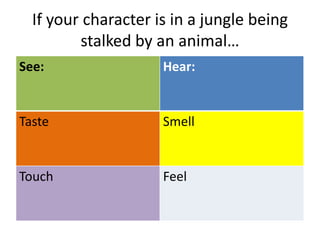
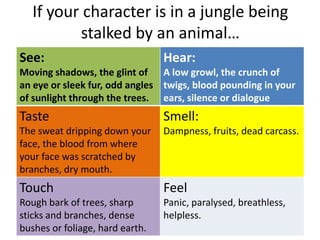
If your character is in a jungle being stalked by an animal…
You could say….A panther was chasing him, and he had to run away. So he ran for a long time, but the panther was too fast, and it caught him. OR…
If your character is in a jungle being stalked by an animal…
Why would we do this?Audience feels more involved in the actionAudience can sympathise and relate to the characterAudience can get information about the setting, the character and the possible outcomes of the story.
What do these descriptions say about the character or the setting?-location: berries, types of trees-isolation: silence, or companionship: dialogue-time or season: sunlight, sweat-personality: paralysed, helpless
What kind of symbols can we use in our descriptions to create tension?-shadows: the unknown, eerie mood, foreboding-smell of dead carcass: foreboding-not a lot of hope of getting out alive-hard earth, rough, sharp trees: nature as harsh, man’s enemySymbols about character, about setting, or about the events of the story.Can include stereotypes.
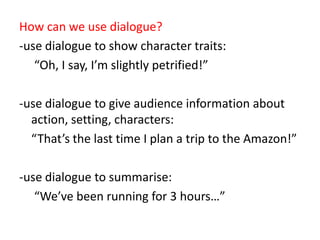
How can we use dialogue?-use dialogue to show character traits:    “Oh, I say, I’m slightly petrified!”     -use dialogue to give audience information about action, setting, characters:“That’s the last time I plan a trip to the Amazon!”-use dialogue to summarise:    “We’ve been running for 3 hours…”
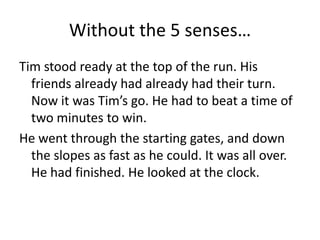
Without the 5 senses…Tim stood ready at the top of the run. His friends already had already had their turn. Now it was Tim’s go. He had to beat a time of two minutes to win.He went through the starting gates, and down the slopes as fast as he could. It was all over. He had finished. He looked at the clock.
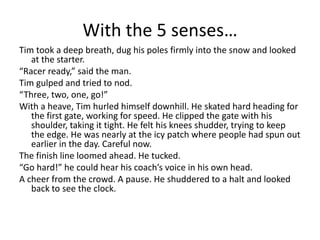
With the 5 senses…Tim took a deep breath, dug his poles firmly into the snow and looked at the starter.“Racer ready,” said the man. Tim gulped and tried to nod. “Three, two, one, go!”With a heave, Tim hurled himself downhill. He skated hard heading for the first gate, working for speed. He clipped the gate with his shoulder, taking it tight. He felt his knees shudder, trying to keep the edge. He was nearly at the icy patch where people had spun out earlier in the day. Careful now.The finish line loomed ahead. He tucked. “Go hard!” he could hear his coach’s voice in his own head.A cheer from the crowd. A pause. He shuddered to a halt and looked back to see the clock.
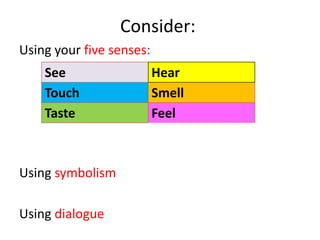
Consider:Using your five senses:Using symbolismUsing dialogue

Building tension

  • 1.
  • 2.
    The 5 sensesWhatcan you SEEWhat can you HEARWhat can you TOUCHWhat can you SMELLWhat can you TASTEwhat do all these things make you FEEL?
  • 3.
    If your characteris in a jungle being stalked by an animal…
  • 4.
    You could say….Apanther was chasing him, and he had to run away. So he ran for a long time, but the panther was too fast, and it caught him. OR…
  • 5.
    If your characteris in a jungle being stalked by an animal…
  • 6.
    Why would wedo this?Audience feels more involved in the actionAudience can sympathise and relate to the characterAudience can get information about the setting, the character and the possible outcomes of the story.
  • 7.
    What do thesedescriptions say about the character or the setting?-location: berries, types of trees-isolation: silence, or companionship: dialogue-time or season: sunlight, sweat-personality: paralysed, helpless
  • 8.
    What kind ofsymbols can we use in our descriptions to create tension?-shadows: the unknown, eerie mood, foreboding-smell of dead carcass: foreboding-not a lot of hope of getting out alive-hard earth, rough, sharp trees: nature as harsh, man’s enemySymbols about character, about setting, or about the events of the story.Can include stereotypes.
  • 9.
    How can weuse dialogue?-use dialogue to show character traits: “Oh, I say, I’m slightly petrified!” -use dialogue to give audience information about action, setting, characters:“That’s the last time I plan a trip to the Amazon!”-use dialogue to summarise: “We’ve been running for 3 hours…”
  • 10.
    Without the 5senses…Tim stood ready at the top of the run. His friends already had already had their turn. Now it was Tim’s go. He had to beat a time of two minutes to win.He went through the starting gates, and down the slopes as fast as he could. It was all over. He had finished. He looked at the clock.
  • 11.
    With the 5senses…Tim took a deep breath, dug his poles firmly into the snow and looked at the starter.“Racer ready,” said the man. Tim gulped and tried to nod. “Three, two, one, go!”With a heave, Tim hurled himself downhill. He skated hard heading for the first gate, working for speed. He clipped the gate with his shoulder, taking it tight. He felt his knees shudder, trying to keep the edge. He was nearly at the icy patch where people had spun out earlier in the day. Careful now.The finish line loomed ahead. He tucked. “Go hard!” he could hear his coach’s voice in his own head.A cheer from the crowd. A pause. He shuddered to a halt and looked back to see the clock.
  • 12.
    Consider:Using your fivesenses:Using symbolismUsing dialogue