Narrative Writing
• Narrative writing tells a story
• When you are asked to write a short story, or asked to do
some "creative writing", you are doing what is called
"Narrative Writing."
• A narrative story is containing specific elements that work
together to create interest for not only the author but also the
reader
Elements of Narrative Writing
Plot
Characters
SettingStyle
Theme
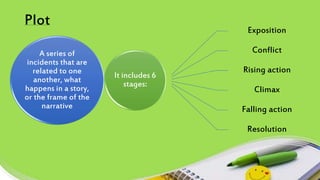
Plot
A series of
incidents that are
related to one
another, what
happens in a story,
or the frame of the
narrative
It includes 6
stages:
Exposition
Conflict
Rising action
Climax
Falling action
Resolution
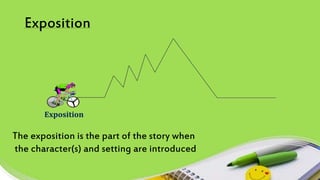
Exposition
Exposition
The exposition is the part of the story when
the character(s) and setting are introduced
Conflict
Exposition
Conflict is a struggle or problem. This adds
suspense and excitement to a story.
Four major types of conflict
Rising Action
Rising action are the events that increase the
tension. These events lead to the climax.
Exposition
Climax
Climax
Exposition
• It is the turning point of the narrative
• Usually at the climax you can
foreshadow the story’s ending
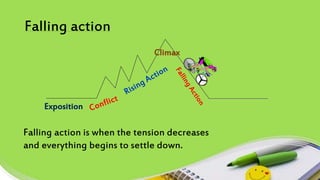
Falling action
Exposition
Climax
Falling action is when the tension decreases
and everything begins to settle down.
Resolution
Exposition
Climax
Resolution is when the conflict has been solved
and usually indicates the ending… and possibly
even “happily ever after”.
Resolution
Characters
The people Animals
Or imaginary
creatures
that take
part in a
story
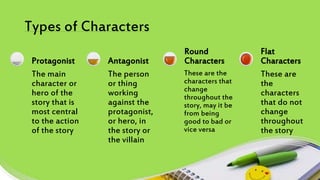
Types of Characters
The main
character or
hero of the
story that is
most central
to the action
of the story
Protagonist
The person
or thing
working
against the
protagonist,
or hero, in
the story or
the villain
Antagonist
These are the
characters that
change
throughout the
story, may it be
from being
good to bad or
vice versa
Round
Characters
These are
the
characters
that do not
change
throughout
the story
Flat
Characters
Setting
• The time and place in which the action occurs
• Look for clues in the opening paragraphs of the story or
novel
• Allows the readers to visualize the scenes and the
characters in those scenes
• Although the setting may be clear for the author,
he/she must create a picture for the readers
Style
• The figurative language (similes, metaphors, etc.),
sensory imagery, vivid verbs, strong sentences,
dialogue, and point of view that makes each author
unique
• Every student has his/her own style and technique.
Although we have the same topic, everyone will write
differently
First Person point of view
• The story is told by one of the characters in the story
• Character speaks directly to the reader
• The character uses the pronouns I and we
• Helps author to reveal thoughts and feelings in an intimate
way
• E.g. Humpty Dumpty:
I am sitting on top of the cold sandstone wall, gazing at the
horizon. I am worried I might fall off and hurt myself.
Third person point of view
• The story is told by the narrator who stands outside of the story
and observes the events as they unfold
• The narrator uses the pronouns she, he, and they
• The narrator can see inside their minds
• The narrator knows what they are thinking and feeling
• E.g. Humpty Dumpty:
Humpty Dumpty is sitting calmly on top of the sandstone
wall, gazing at the horizon. He wonders whether he might
fall off and hurt himself.
Sensory Imagery
• Using the five senses when writing a narrative
• Words and phrases that help readers see, hear, taste,
feel, or smell what the author is describing
• Example:
• Visual: Huge trees in the dark forest
• Taste: Sweet and juicy oranges
Metaphor
• If we write a comparison between two things and omit
the word ‘like’ then we are using a metaphor
• Example:
• He proved a lion in the fight
Theme
• A theme is a message revealed in the story
• It may be directly stated, like in a fable where the moral is
told at the conclusion
• It may be indirect, leaving the reader to decide the story’s
message
• There can be more than one theme for a narrative
Best of luck and
enjoy writing!

Narrative Writing

  • 3.
    Narrative Writing • Narrativewriting tells a story • When you are asked to write a short story, or asked to do some "creative writing", you are doing what is called "Narrative Writing." • A narrative story is containing specific elements that work together to create interest for not only the author but also the reader
  • 4.
    Elements of NarrativeWriting Plot Characters SettingStyle Theme
  • 5.
    Plot A series of incidentsthat are related to one another, what happens in a story, or the frame of the narrative It includes 6 stages: Exposition Conflict Rising action Climax Falling action Resolution
  • 6.
    Exposition Exposition The exposition isthe part of the story when the character(s) and setting are introduced
  • 7.
    Conflict Exposition Conflict is astruggle or problem. This adds suspense and excitement to a story.
  • 8.
    Four major typesof conflict
  • 9.
    Rising Action Rising actionare the events that increase the tension. These events lead to the climax. Exposition
  • 10.
    Climax Climax Exposition • It isthe turning point of the narrative • Usually at the climax you can foreshadow the story’s ending
  • 11.
    Falling action Exposition Climax Falling actionis when the tension decreases and everything begins to settle down.
  • 12.
    Resolution Exposition Climax Resolution is whenthe conflict has been solved and usually indicates the ending… and possibly even “happily ever after”. Resolution
  • 13.
    Characters The people Animals Orimaginary creatures that take part in a story
  • 14.
    Types of Characters Themain character or hero of the story that is most central to the action of the story Protagonist The person or thing working against the protagonist, or hero, in the story or the villain Antagonist These are the characters that change throughout the story, may it be from being good to bad or vice versa Round Characters These are the characters that do not change throughout the story Flat Characters
  • 15.
    Setting • The timeand place in which the action occurs • Look for clues in the opening paragraphs of the story or novel • Allows the readers to visualize the scenes and the characters in those scenes • Although the setting may be clear for the author, he/she must create a picture for the readers
  • 16.
    Style • The figurativelanguage (similes, metaphors, etc.), sensory imagery, vivid verbs, strong sentences, dialogue, and point of view that makes each author unique • Every student has his/her own style and technique. Although we have the same topic, everyone will write differently
  • 17.
    First Person pointof view • The story is told by one of the characters in the story • Character speaks directly to the reader • The character uses the pronouns I and we • Helps author to reveal thoughts and feelings in an intimate way • E.g. Humpty Dumpty: I am sitting on top of the cold sandstone wall, gazing at the horizon. I am worried I might fall off and hurt myself.
  • 18.
    Third person pointof view • The story is told by the narrator who stands outside of the story and observes the events as they unfold • The narrator uses the pronouns she, he, and they • The narrator can see inside their minds • The narrator knows what they are thinking and feeling • E.g. Humpty Dumpty: Humpty Dumpty is sitting calmly on top of the sandstone wall, gazing at the horizon. He wonders whether he might fall off and hurt himself.
  • 19.
    Sensory Imagery • Usingthe five senses when writing a narrative • Words and phrases that help readers see, hear, taste, feel, or smell what the author is describing • Example: • Visual: Huge trees in the dark forest • Taste: Sweet and juicy oranges
  • 20.
    Metaphor • If wewrite a comparison between two things and omit the word ‘like’ then we are using a metaphor • Example: • He proved a lion in the fight
  • 21.
    Theme • A themeis a message revealed in the story • It may be directly stated, like in a fable where the moral is told at the conclusion • It may be indirect, leaving the reader to decide the story’s message • There can be more than one theme for a narrative
  • 22.
    Best of luckand enjoy writing!