Writing a Personal
Narrative
Personal Narrative
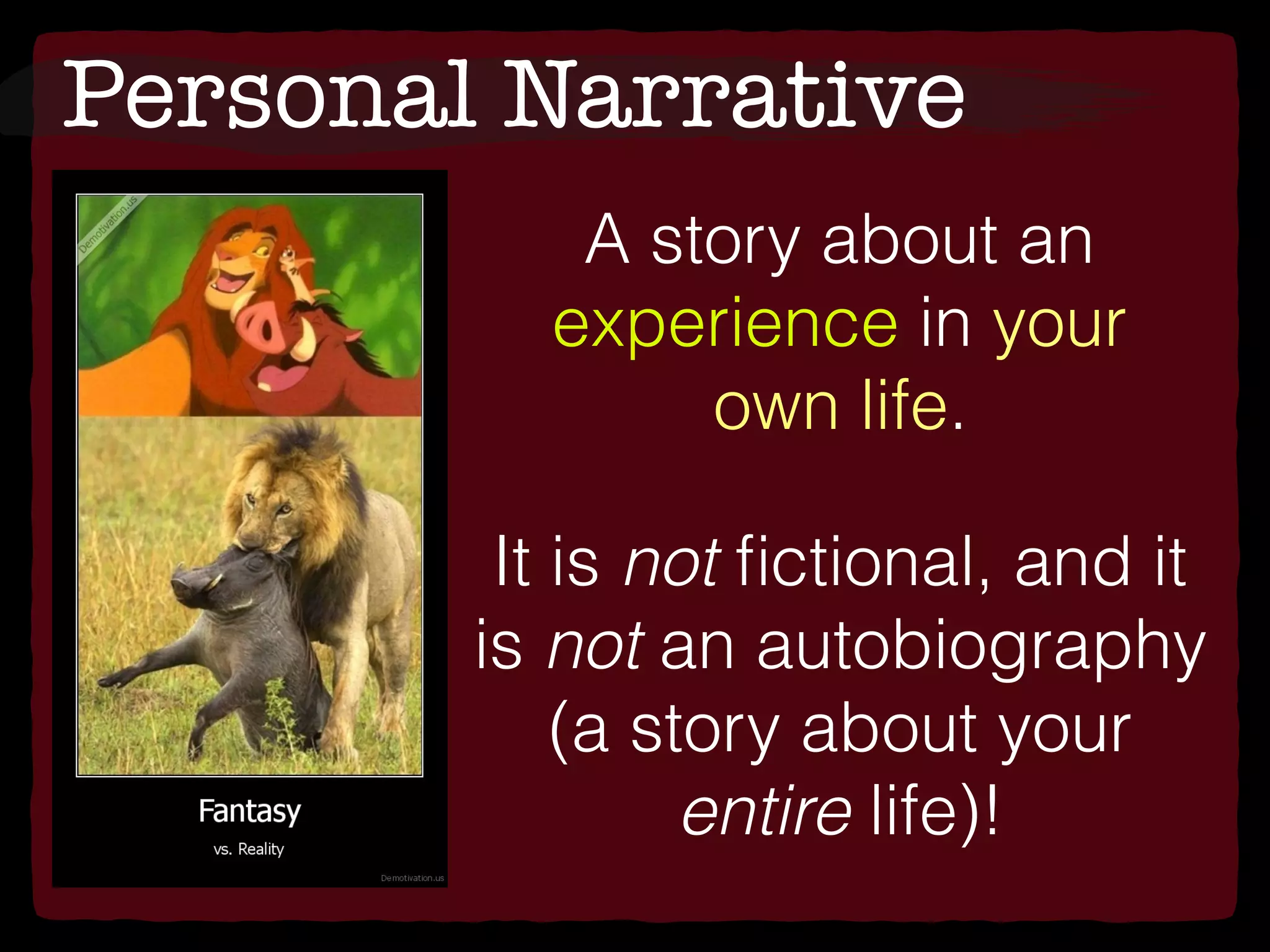
A story about an
experience in your
own life.
It is not fictional, and it
is not an autobiography
(a story about your
entire life)!
Point of View
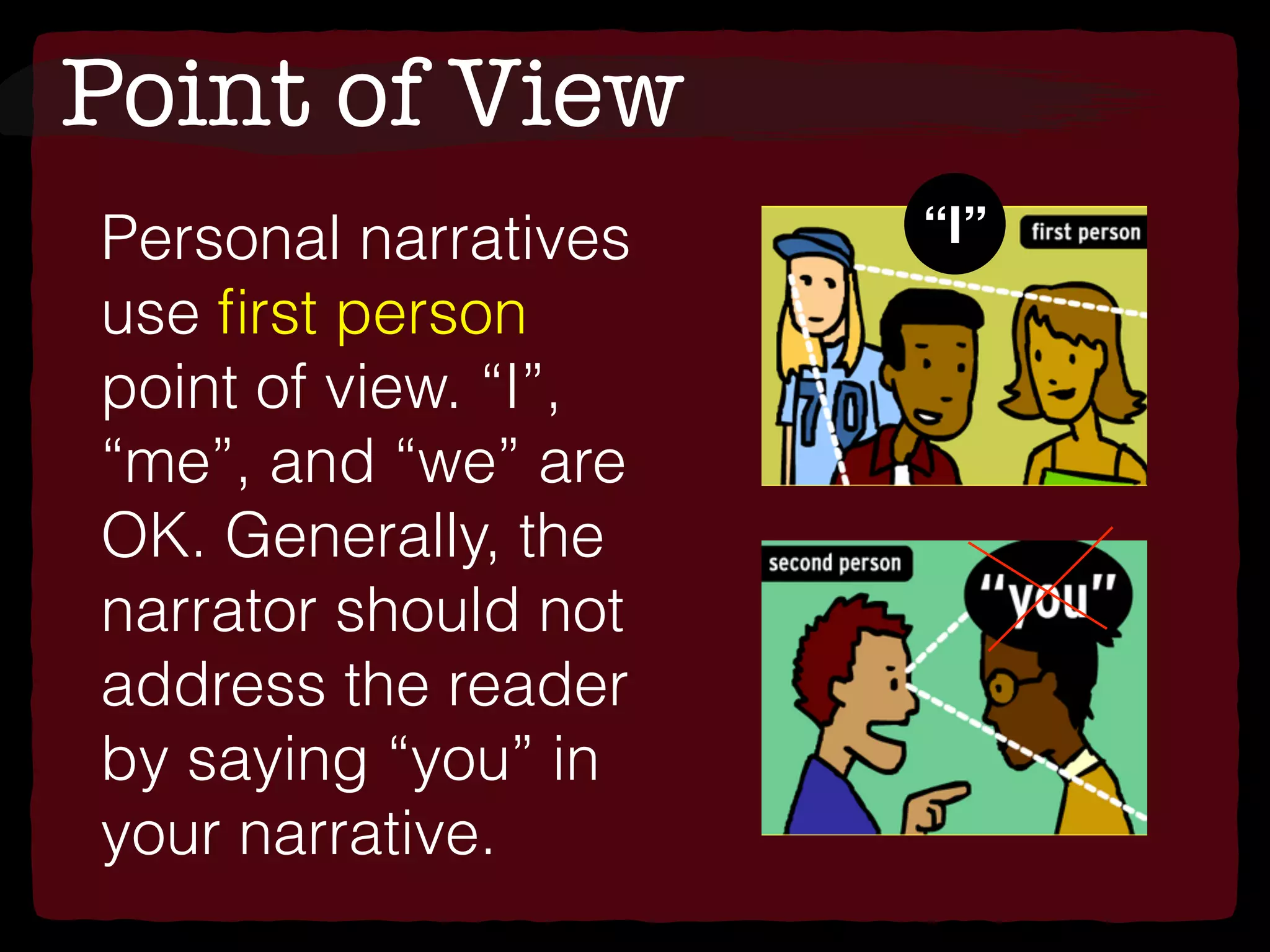
Personal narratives
use first person
point of view. “I”,
“me”, and “we” are
OK. Generally, the
narrator should not
address the reader
by saying “you” in
your narrative.
“I”
Point of View:
1st Person:
“I never thought that
owning a dog would be
so challenging. When I
brought Fluffy home for
the first time, she
destroyed my favorite
pair of shoes within five
minutes. After I found
the damage, I locked
Fluffy in her crate.”
3rd Person:
“Amber used to think that
owning a dog would be
easy, but when she
brought Fluffy home for
the first time, she
discovered she was
wrong. Fluffy had
destroyed her favorite pair
of shoes. When amber
saw them, she locked
Fluffy in her crate.”
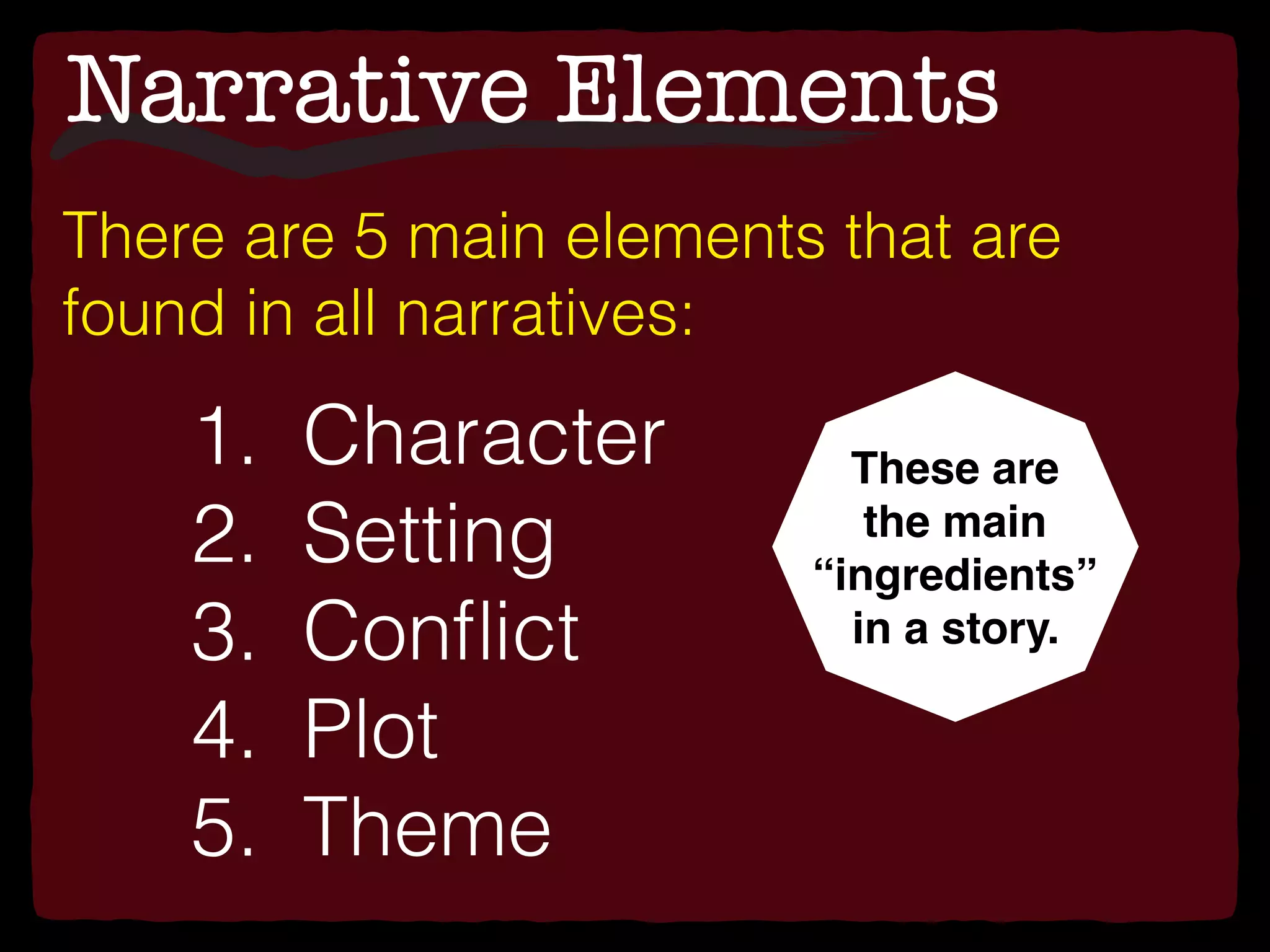
Narrative Elements
There are 5 main elements that are
found in all narratives:
1. Character
2. Setting
3. Conflict
4. Plot
5. Theme
These are
the main
“ingredients”
in a story.
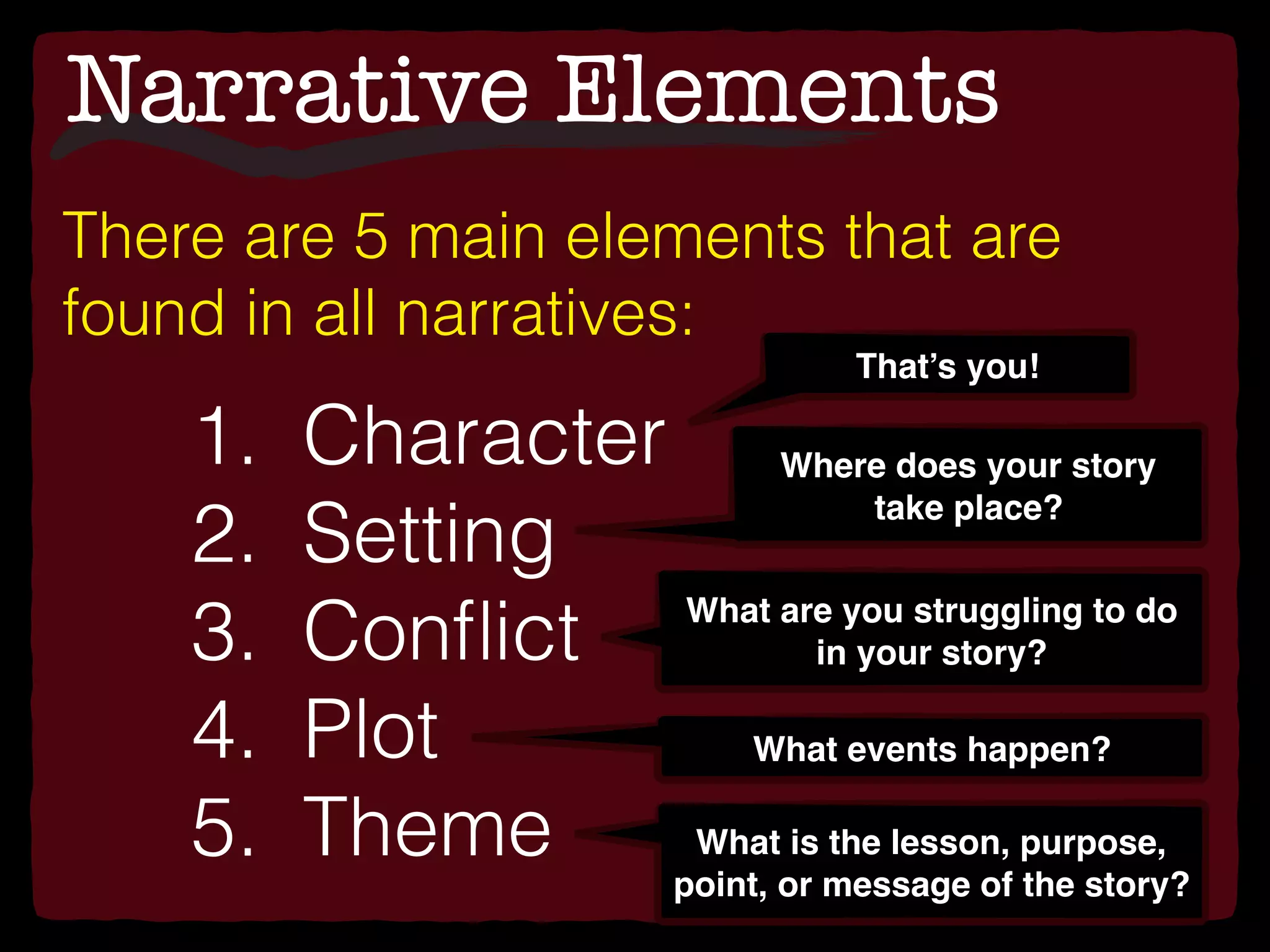
Narrative Elements
There are 5 main elements that are
found in all narratives:
1. Character
2. Setting
3. Conflict
4. Plot
5. Theme
Where does your story
take place?
What are you struggling to do
in your story?
What events happen?
That’s you!
What is the lesson, purpose,
point, or message of the story?
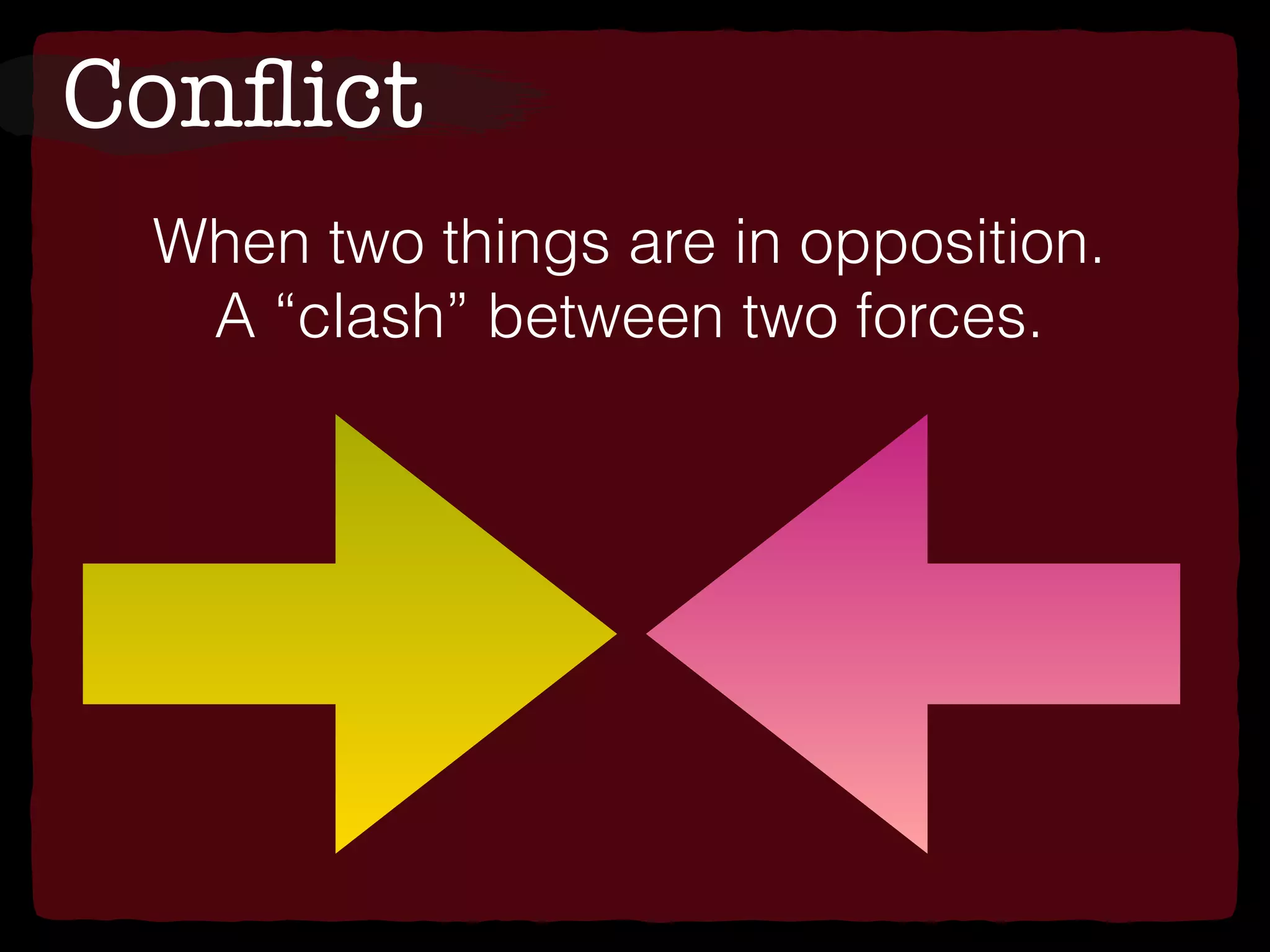
Conflict
When two things are in opposition.
A “clash” between two forces.
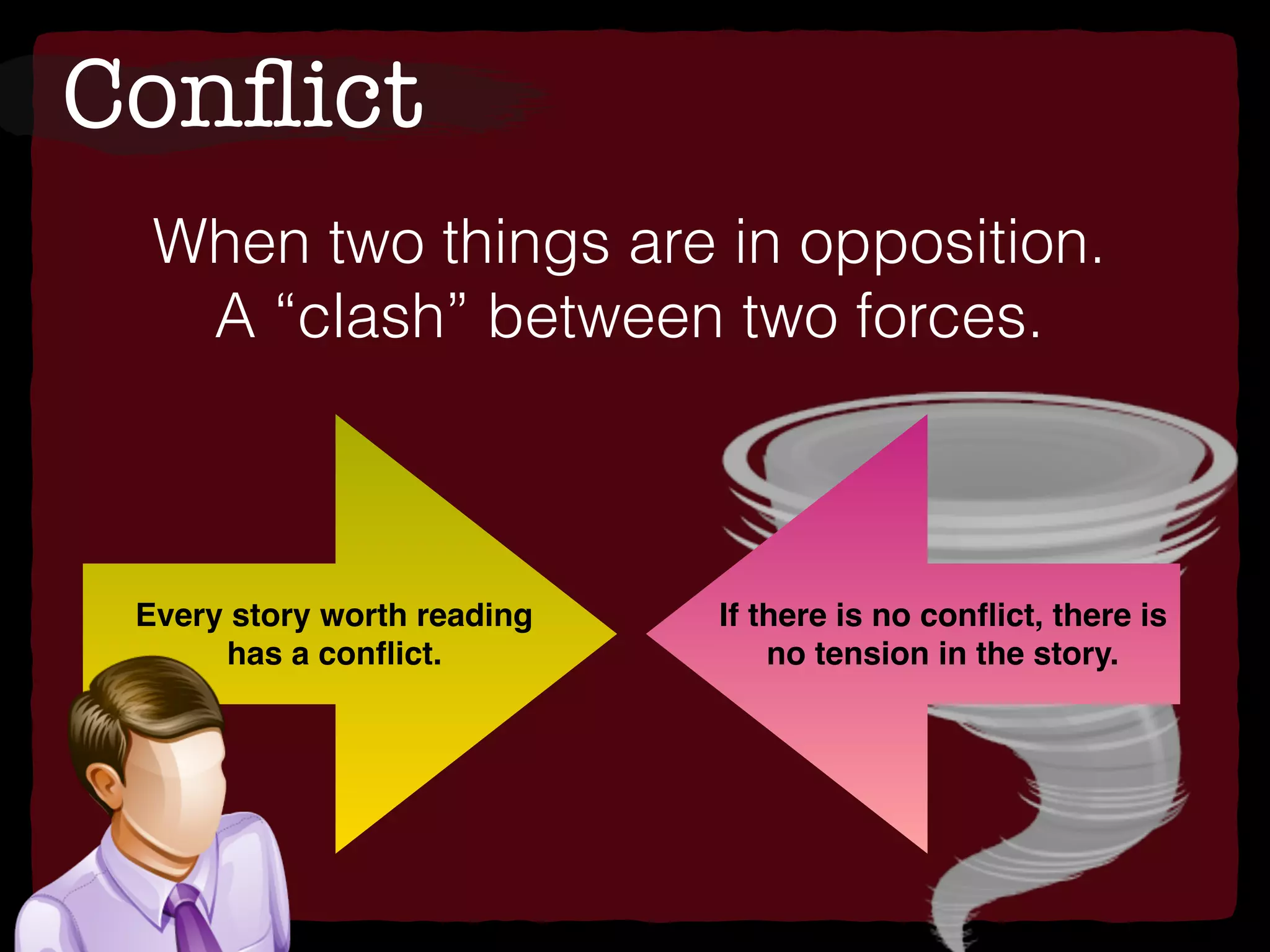
When two things are in opposition.
A “clash” between two forces.
Every story worth reading
has a conflict.
If there is no conflict, there is
no tension in the story.
Conflict
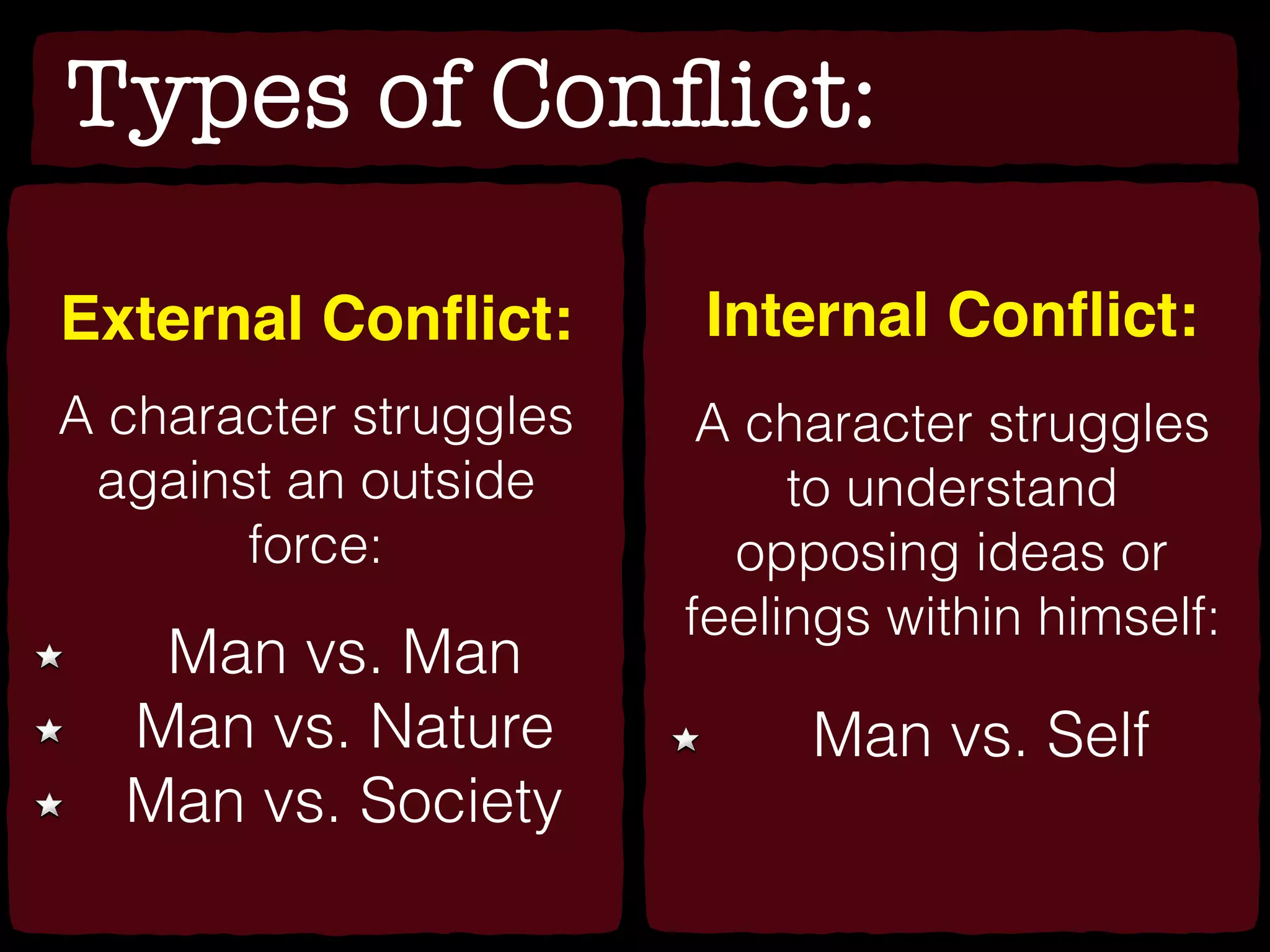
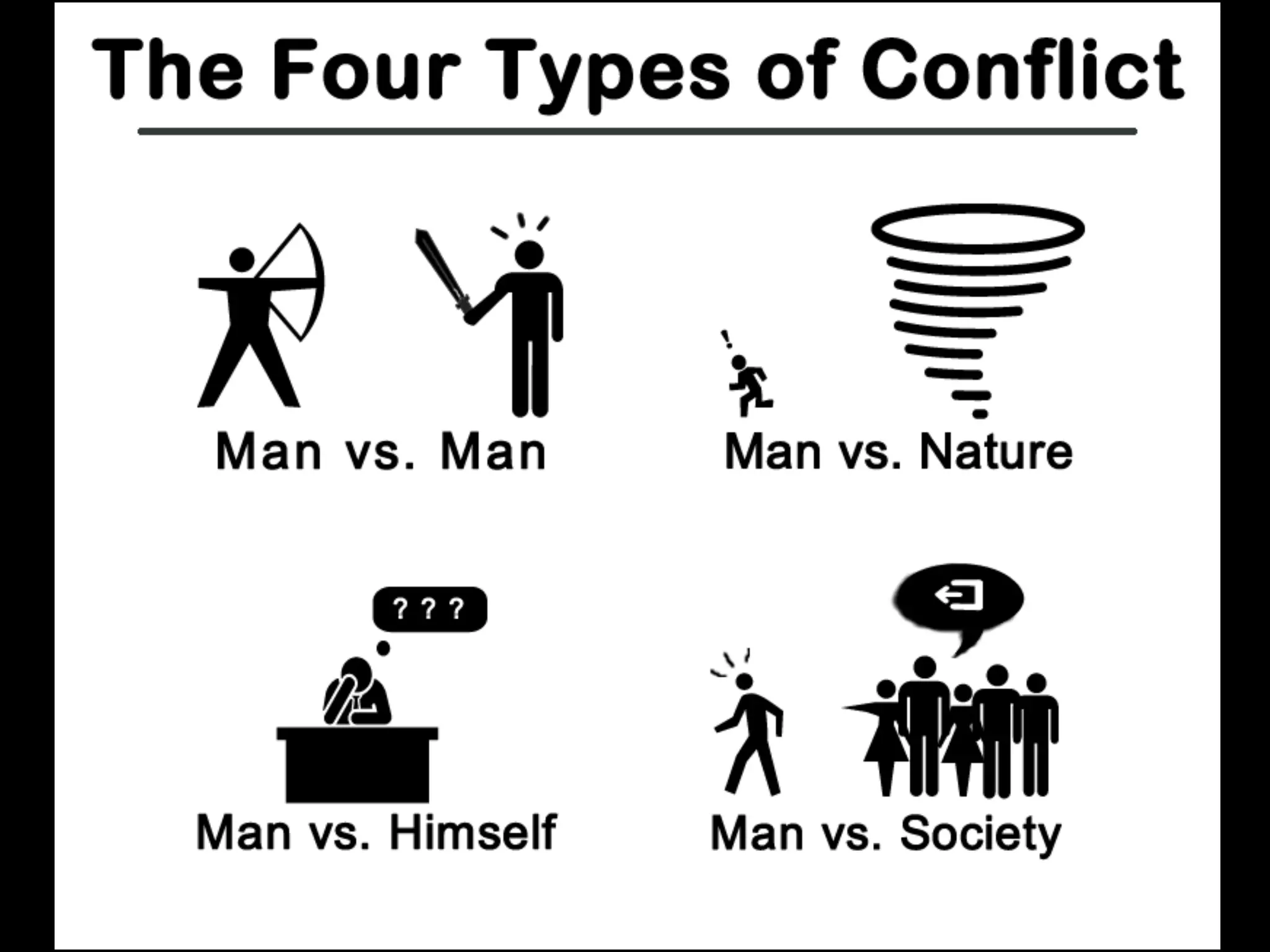
Types of Conflict:
External Conflict:
A character struggles
against an outside
force:
Man vs. Man
Man vs. Nature
Man vs. Society
Internal Conflict:
A character struggles
to understand
opposing ideas or
feelings within himself:
Man vs. Self
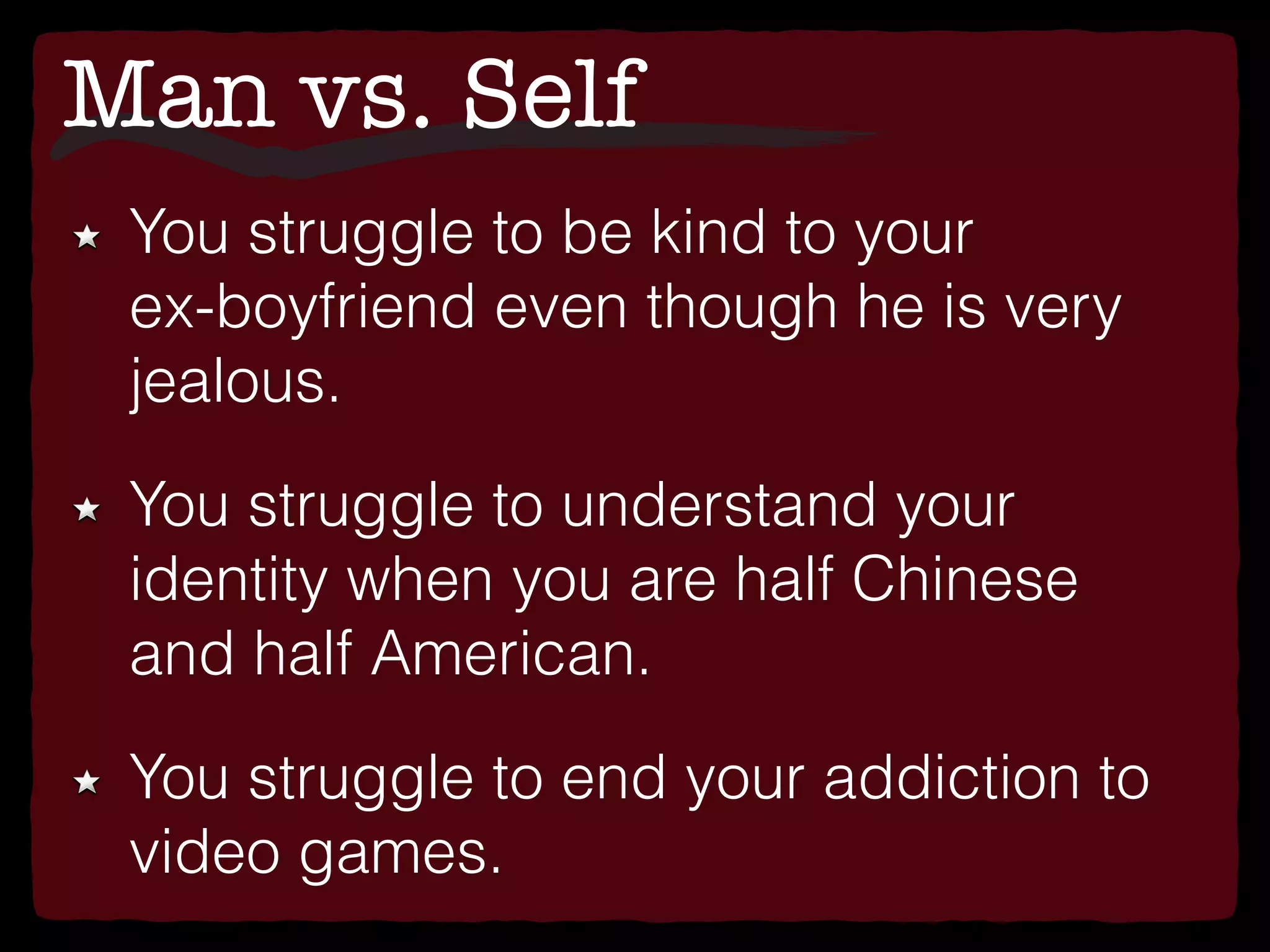
Man vs. Self
You struggle to be kind to your
ex-boyfriend even though he is very
jealous.
You struggle to understand your
identity when you are half Chinese
and half American.
You struggle to end your addiction to
video games.
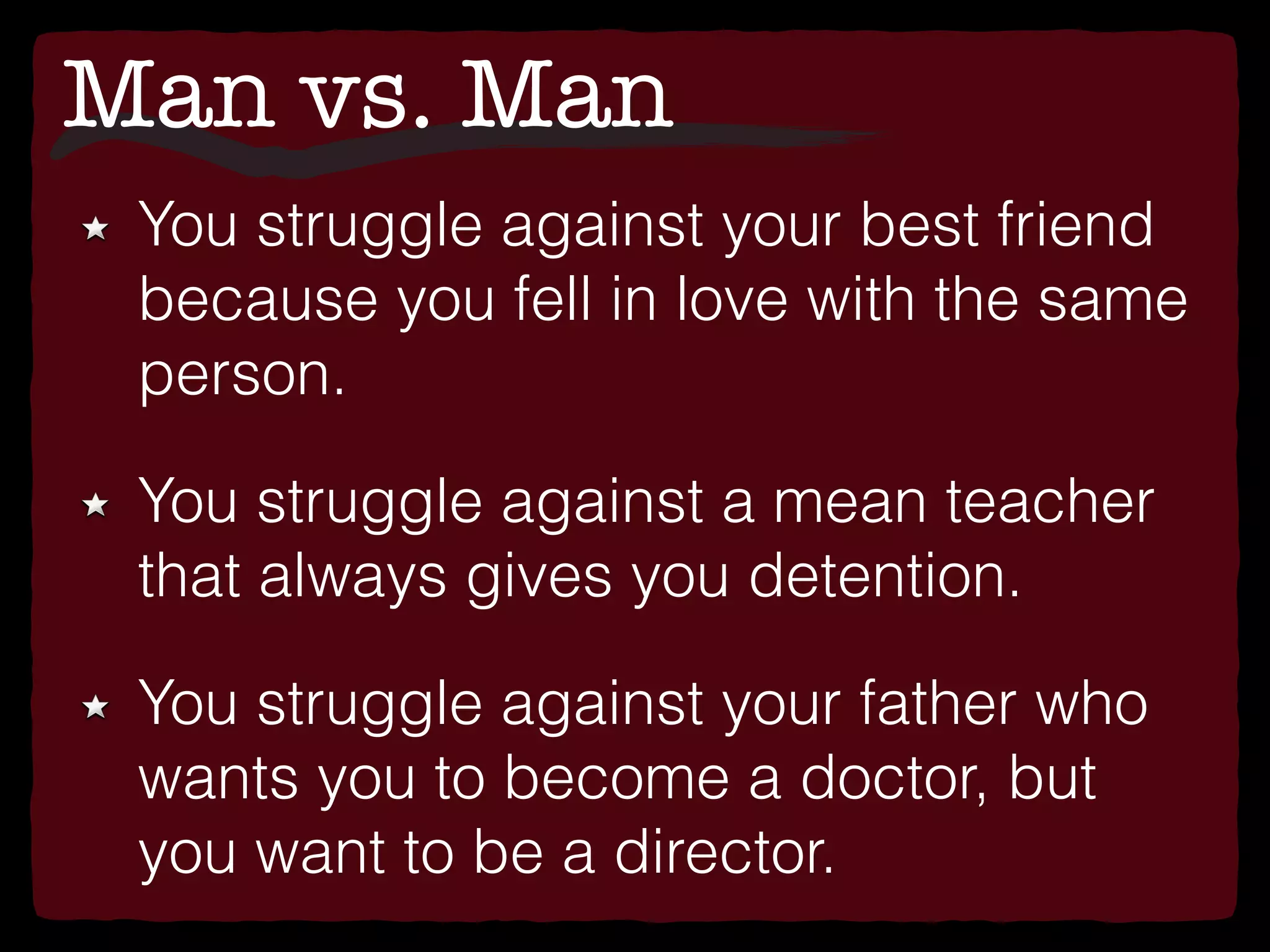
Man vs. Man
You struggle against your best friend
because you fell in love with the same
person.
You struggle against a mean teacher
that always gives you detention.
You struggle against your father who
wants you to become a doctor, but
you want to be a director.
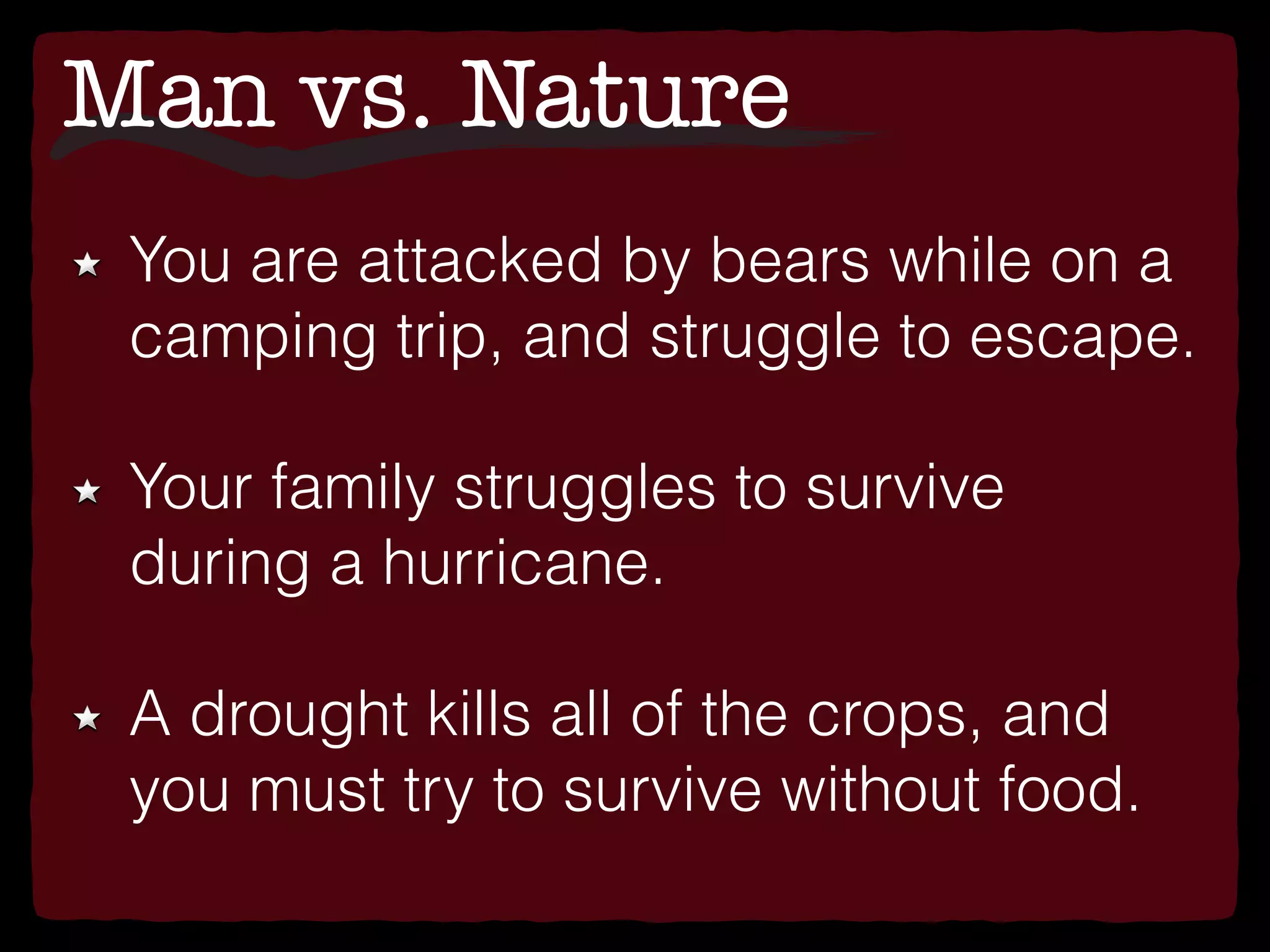
Man vs. Nature
You are attacked by bears while on a
camping trip, and struggle to escape.
Your family struggles to survive
during a hurricane.
A drought kills all of the crops, and
you must try to survive without food.
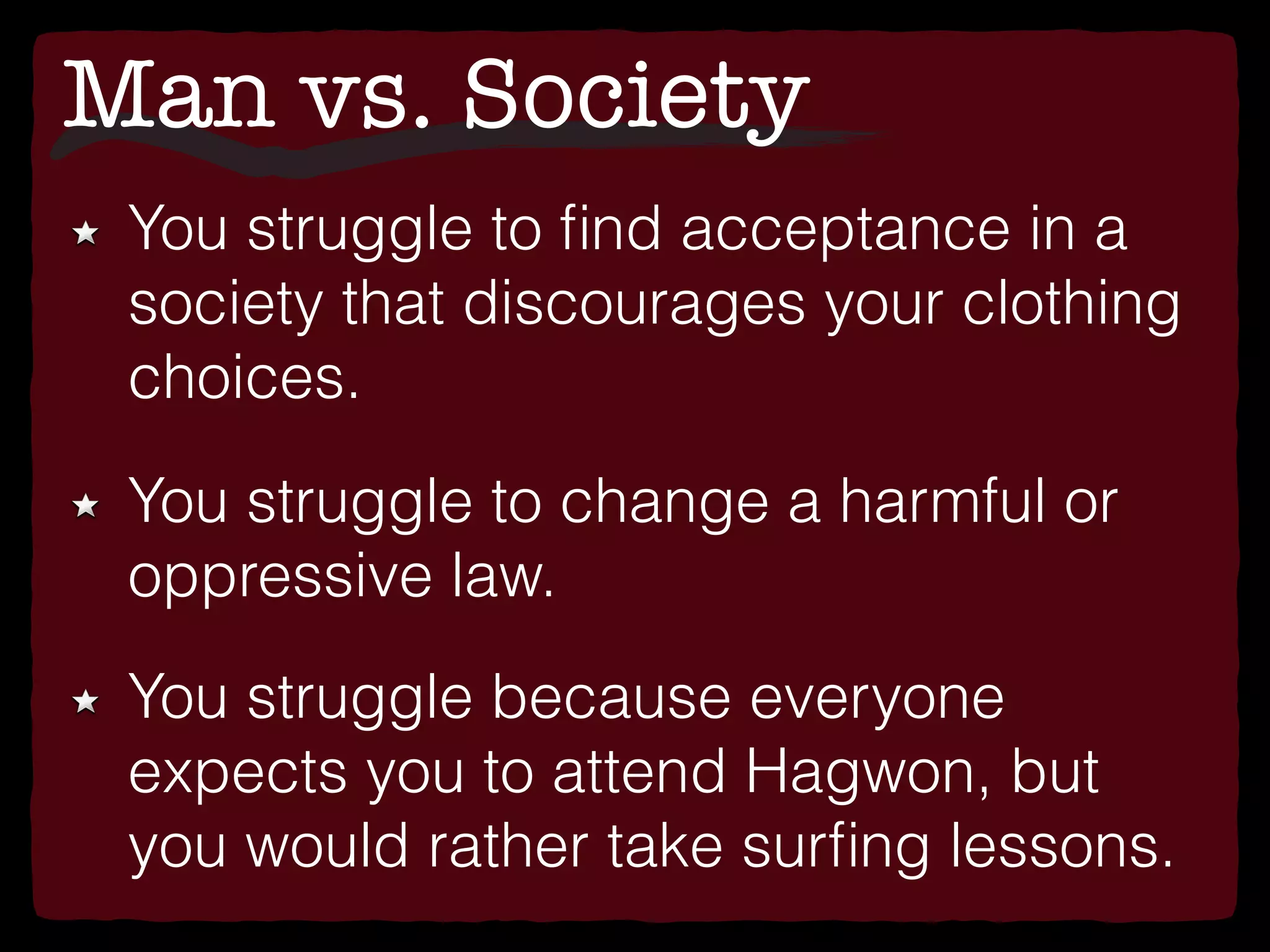
Man vs. Society
You struggle to find acceptance in a
society that discourages your clothing
choices.
You struggle to change a harmful or
oppressive law.
You struggle because everyone
expects you to attend Hagwon, but
you would rather take surfing lessons.
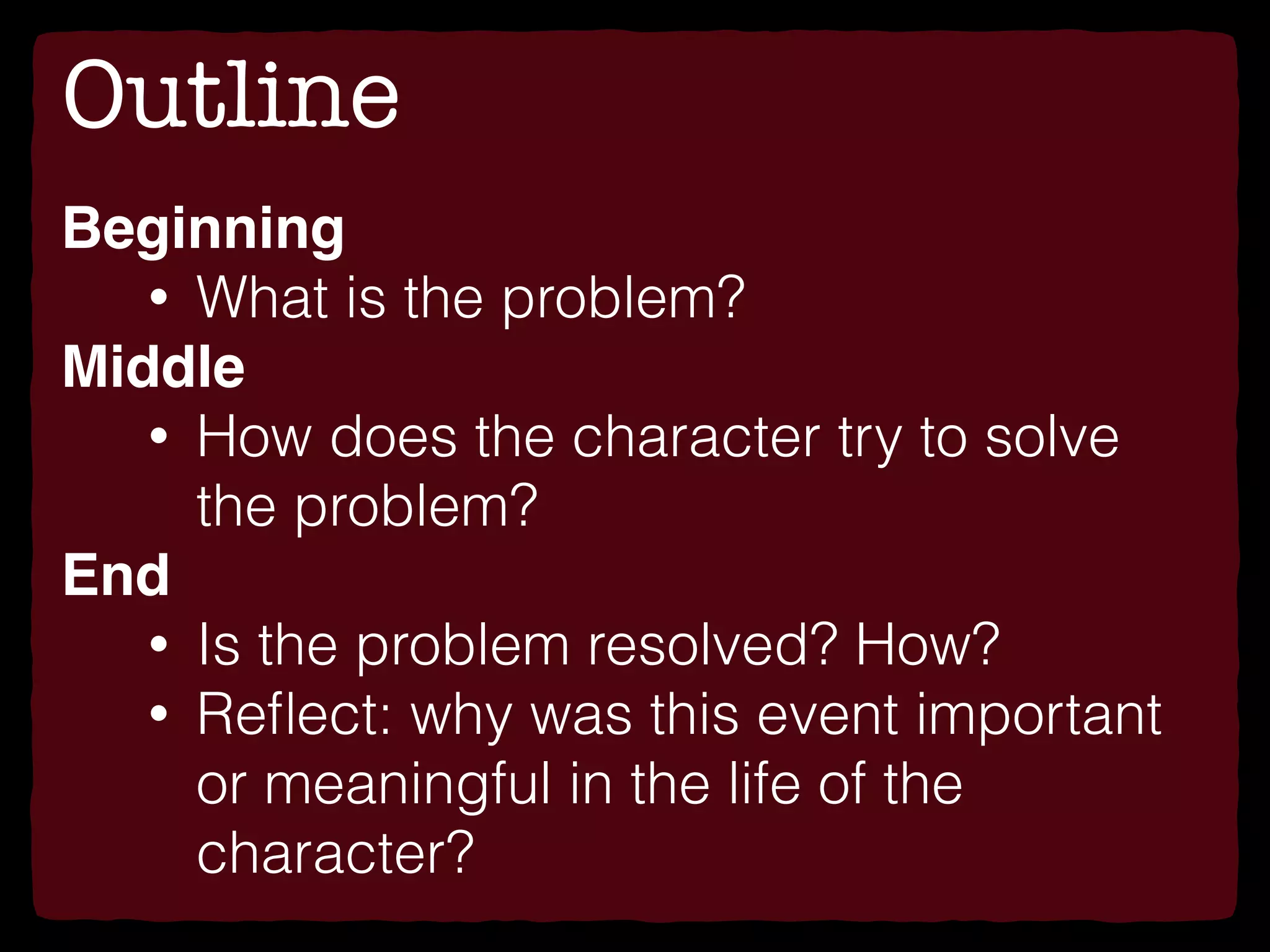
Outline
Beginning
• What is the problem?
Middle
• How does the character try to solve
the problem?
End
• Is the problem resolved? How?
• Reflect: why was this event important
or meaningful in the life of the
character?
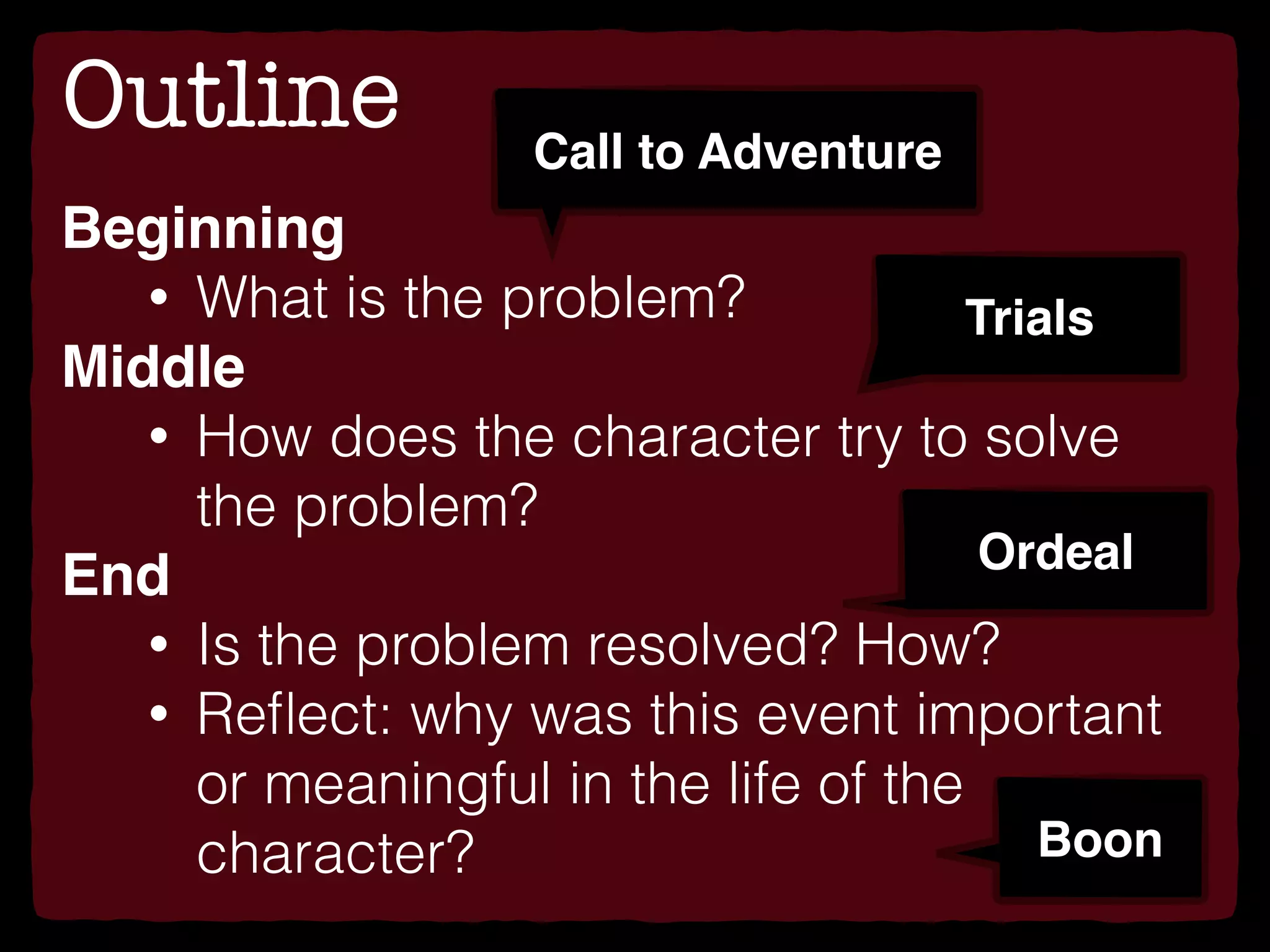
Outline
Beginning
• What is the problem?
Middle
• How does the character try to solve
the problem?
End
• Is the problem resolved? How?
• Reflect: why was this event important
or meaningful in the life of the
character?
Call to Adventure
Trials
Ordeal
Boon

Personal Narratives Introduction

  • 1.
  • 2.
    Personal Narrative A storyabout an experience in your own life. It is not fictional, and it is not an autobiography (a story about your entire life)!
  • 3.
    Point of View Personalnarratives use first person point of view. “I”, “me”, and “we” are OK. Generally, the narrator should not address the reader by saying “you” in your narrative. “I”
  • 4.
    Point of View: 1stPerson: “I never thought that owning a dog would be so challenging. When I brought Fluffy home for the first time, she destroyed my favorite pair of shoes within five minutes. After I found the damage, I locked Fluffy in her crate.” 3rd Person: “Amber used to think that owning a dog would be easy, but when she brought Fluffy home for the first time, she discovered she was wrong. Fluffy had destroyed her favorite pair of shoes. When amber saw them, she locked Fluffy in her crate.”
  • 5.
    Narrative Elements There are5 main elements that are found in all narratives: 1. Character 2. Setting 3. Conflict 4. Plot 5. Theme These are the main “ingredients” in a story.
  • 6.
    Narrative Elements There are5 main elements that are found in all narratives: 1. Character 2. Setting 3. Conflict 4. Plot 5. Theme Where does your story take place? What are you struggling to do in your story? What events happen? That’s you! What is the lesson, purpose, point, or message of the story?
  • 7.
    Conflict When two thingsare in opposition. A “clash” between two forces.
  • 8.
    When two thingsare in opposition. A “clash” between two forces. Every story worth reading has a conflict. If there is no conflict, there is no tension in the story. Conflict
  • 9.
    Types of Conflict: ExternalConflict: A character struggles against an outside force: Man vs. Man Man vs. Nature Man vs. Society Internal Conflict: A character struggles to understand opposing ideas or feelings within himself: Man vs. Self
  • 11.
    Man vs. Self Youstruggle to be kind to your ex-boyfriend even though he is very jealous. You struggle to understand your identity when you are half Chinese and half American. You struggle to end your addiction to video games.
  • 12.
    Man vs. Man Youstruggle against your best friend because you fell in love with the same person. You struggle against a mean teacher that always gives you detention. You struggle against your father who wants you to become a doctor, but you want to be a director.
  • 13.
    Man vs. Nature Youare attacked by bears while on a camping trip, and struggle to escape. Your family struggles to survive during a hurricane. A drought kills all of the crops, and you must try to survive without food.
  • 14.
    Man vs. Society Youstruggle to find acceptance in a society that discourages your clothing choices. You struggle to change a harmful or oppressive law. You struggle because everyone expects you to attend Hagwon, but you would rather take surfing lessons.
  • 15.
    Outline Beginning • What isthe problem? Middle • How does the character try to solve the problem? End • Is the problem resolved? How? • Reflect: why was this event important or meaningful in the life of the character?
  • 16.
    Outline Beginning • What isthe problem? Middle • How does the character try to solve the problem? End • Is the problem resolved? How? • Reflect: why was this event important or meaningful in the life of the character? Call to Adventure Trials Ordeal Boon