Team Member’s Varun Aggarwal Jyoti chauhan Shashank Rana Preeti Pawaria Rahul Yadav Vijay Kundra Nitin Kumar Sapna Rana
Perfect Competition
Perfect Competition The concept of competition is used in two ways in economics. Competition as a process is a rivalry among firms. Competition as the perfectly competitive market structure.
A Perfectly Competitive Market A  perfectly competitive market  is one in which economic forces operate unimpeded.
A Perfectly Competitive Market A perfectly competitive market must meet the following requirements: Both buyers and sellers are price takers. The number of firms is large. There are no barriers to entry. The firms’ products are identical. There is complete information. Firms are profit maximizers.
The Necessary Conditions for Perfect Competition Both buyers and sellers are price takers. A   price taker  is a firm or individual who takes the market price as given. In most markets, households are price takers – they accept the price offered in stores.
The Necessary Conditions for Perfect Competition Both buyers and sellers are price takers. The retailer is not perfectly competitive. A retail store is not a price taker but a price maker.
The Necessary Conditions for Perfect Competition The number of firms is large. Large means that what one firm does has no bearing on what other firms do. Any one firm's output is minuscule when compared with the total market.
The Necessary Conditions for Perfect Competition There are no barriers to entry. Barriers to entry  are social, political, or economic impediments that prevent other firms from entering the market. Barriers sometimes take the form of patents granted to produce a certain good.
The Necessary Conditions for Perfect Competition There are no barriers to entry. Technology may prevent some firms from entering the market. Social forces such as bankers only lending to certain people may create barriers.
The Necessary Conditions for Perfect Competition The firms' products are identical. This requirement means that each firm's output is indistinguishable from any competitor's product.
The Necessary Conditions for Perfect Competition There is complete information. Firms and consumers know all there is to know about the market – prices, products, and available technology. Any technological breakthrough would be instantly known to all in the market.
The Necessary Conditions for Perfect Competition Firms are profit maximizers. The goal of all firms in a perfectly competitive market is profit and only profit. The only compensation firm owners receive is profit, not salaries.
The Definition of Supply and Perfect Competition If all the necessary conditions for perfect competition exist, we can talk formally about the supply of a produced good.
The Definition of Supply and Perfect Competition Supply  is a schedule of quantities of goods that will be offered to the market at various prices.
The Definition of Supply and Perfect Competition When a firm operates in a perfectly competitive market, it’s supply curve is that portion of its short-run marginal cost curve above average variable cost.
Demand Curves for the Firm and the Industry The demand curves facing the firm is different from the industry demand curve. A perfectly competitive firm’s demand schedule is perfectly elastic even though the demand curve for the market is downward sloping.
Demand Curves for the Firm and the Industry Individual firms will increase their output in response to an increase in demand even though that will cause the price to fall thus making all firms collectively worse off.
Market Demand Versus Individual Firm Demand Curve Market Firm Individual firm demand  Market supply Market demand 1,000 3,000 Price $10 8 6 4 2 0 Quantity 10 20 30 Price $10 8 6 4 2 0 Quantity
Profit-Maximizing Level of Output The goal of the firm is to maximize profits. Profit is the difference between total revenue and total cost.
Profit-Maximizing Level of Output What happens to profit in response to a change in output is determined by marginal revenue ( MR ) and marginal cost ( MC ). A firm maximizes profit when  MC  =  MR .
Profit-Maximizing Level of Output Marginal revenue  ( MR ) – the change in total revenue associated with a change in quantity. Marginal cost  ( MC ) – the change in total cost associated with a change in quantity.
Marginal Revenue A perfect competitor accepts the market price as given. As a result, marginal revenue equals price ( MR = P ).
Marginal Cost Initially, marginal cost falls and then begins to rise. Marginal concepts are best defined between the numbers.
Profit Maximization:  MC = MR To maximize profits, a firm should produce where marginal cost equals marginal revenue.
How to Maximize Profit If marginal revenue does not equal marginal cost, a firm can increase profit by changing output. The supplier will continue to produce as long as marginal cost is less than marginal revenue.
How to Maximize Profit The supplier will cut back on production if marginal cost is greater than marginal revenue. Thus, the profit-maximizing condition of a competitive firm is  MC = MR = P .
Marginal Cost, Marginal Revenue, and Price McGraw-Hill/Irwin © 2004 The McGraw-Hill Companies, Inc., All Rights Reserved. C A P = D = MR Costs 1 2 3 4 5 6 7 8 9 10 Quantity 60 50 40 30 20 10 0 A B MC 0 1 2 3 4 5 6 7 8 9 10 $28.00 20.00 16.00 14.00 12.00 17.00 22.00 30.00 40.00 54.00 68.00 Price =  MR Quantity Produced  Marginal Cost $35.00 35.00 35.00 35.00 35.00 35.00 35.00 35.00 35.00 35.00 35.00
The Marginal Cost Curve Is the Supply Curve The marginal cost curve is the firm's supply curve above the point where price exceeds average variable cost.
The Marginal Cost Curve Is the Supply Curve The MC curve tells the competitive firm how much it should produce at a given price. The firm can do no better than produce the quantity at which marginal cost equals marginal revenue which in turn equals price.
The Marginal Cost Curve Is the Firm’s Supply Curve A B C Marginal cost Cost, Price $70 60 50 40 30 20 10 0 1 Quantity 2 3 4 5 6 7 8 9 10
Firms Maximize Total Profit Firms seek to maximize total profit, not profit per unit. Firms do not care about profit per unit. As long as increasing output increases total profits, a profit-maximizing firm should produce more.
Profit Maximization Using Total Revenue and Total Cost Profit is maximized where the vertical distance between total revenue and total cost is greatest. At that output,  MR  (the slope of the total revenue curve) and  MC  (the slope of the total cost curve) are equal.
Profit Determination Using Total Cost and Revenue Curves Profit =$45 McGraw-Hill/Irwin © 2004 The McGraw-Hill Companies, Inc., All Rights Reserved. TC TR 0 Total cost, revenue $385 350 315 280 245 210 175 140 105 70 35 Quantity 1 2 3 4 5 6 7 8 9 Maximum profit =$81 $130 Loss Loss Profit
Total Profit at the Profit-Maximizing Level of Output The  P = MR = MC  condition tells us how much output a competitive firm should produce to maximize profit. It does not tell us how much profit the firm makes.
Determining Profit and Loss From a Table of Costs Profit can be calculated from a table of costs and revenues. Profit is determined by total revenue minus total cost.
Costs Relevant to a Firm McGraw-Hill/Irwin © 2004 The McGraw-Hill Companies, Inc., All Rights Reserved.
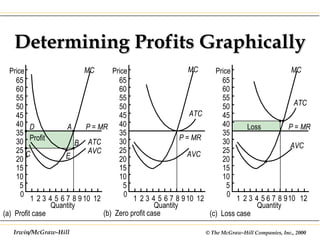
Determining Profit and Loss From a Graph Find output where  MC = MR . The intersection of  MC = MR  ( P ) determines the quantity the firm will produce if it wishes to maximize profits.
Determining Profit and Loss From a Graph Find profit per unit where MC = MR. Drop a line down from where MC equals MR, and then to the ATC curve. This is the profit per unit. Extend a line back to the vertical axis to identify total profit.
Determining Profit and Loss From a Graph The firm makes a profit when the ATC curve is below the MR curve. The firm incurs a loss when the ATC curve is above the MR curve.
Determining Profit and Loss From a Graph Zero profit or loss where MC=MR. Firms can earn zero profit or even a loss where MC = MR. Even though economic profit is zero, all resources, including entrepreneurs, are being paid their opportunity costs.
Determining Profits Graphically (a)  Profit case (b)  Zero profit case (c)  Loss case © The McGraw-Hill Companies, Inc., 2000 Irwin/McGraw-Hill Quantity Quantity Quantity Price 65  60  55  50  45  40  35  30  25  20  15  10  5  0 65  60  55  50  45  40  35  30  25  20  15  10  5  0 1 2 3 4 5 6 7 8 9 10 12 1 2 3 4 5 6 7 8 9 10 12 D MC A P = MR B ATC AVC E Profit C MC ATC AVC MC ATC AVC Loss 65  60  55  50  45  40  35  30  25  20  15  10  5  0 1 2 3 4 5 6 7 8 9 10 12 P = MR P = MR Price Price
The Shutdown Point The firm will shut down if it cannot cover average variable costs.  A firm should continue to produce as long as price is greater than average variable cost. If price falls below that point it makes sense to shut down temporarily and save the variable costs.
The Shutdown Point The  shutdown point  is the point at which the firm will be better off it shuts down than it will if it stays in business.
The Shutdown Point If total revenue is more than total variable cost, the firm’s best strategy is to temporarily produce at a loss. It is taking less of a loss than it would by shutting down.
The Shutdown Decision MC P = MR 2 4 6 8 Quantity Price 60 50 40 30 20 10 0 ATC AVC Loss A $17.80
Short-Run Market Supply and Demand While the firm's demand curve is perfectly elastic, the industry's is downward sloping. For the industry's supply curve we use a market supply curve.
Short-Run Market Supply and Demand The market supply curve is the horizontal sum of all the firms' marginal cost curves, taking account of any changes in input prices that might occur.
Long-Run Competitive Equilibrium Profits and losses are inconsistent with long-run equilibrium. Profits create incentives for new firms to enter, output will increase, and the price will fall until zero profits are made. The existence of losses will cause firms to leave the industry.
Long-Run Competitive Equilibrium Only at zero profit will entry and exit stop. The zero profit condition defines the long-run equilibrium of a competitive industry.
Long-Run Competitive Equilibrium 0 MC P = MR 60 50 40 30 20 10 Price 2 4 6 8 Quantity SRATC LRATC
Long-Run Competitive Equilibrium Zero profit does not mean that the entrepreneur does not get anything for his efforts. Normal profit  – the amount the owners of business would have received in the next-best alternative.
Long-Run Competitive Equilibrium Normal profits are included as a cost and are not included in economic profit. Economic profits are profits above normal profits.
Long-Run Competitive Equilibrium Firms with super-efficient workers or machines will find that the price of these specialized inputs will rise. Rent  is the income received by those specialized factors of production.
Long-Run Competitive Equilibrium The zero profit condition makes the analysis of competitive markets applicable to the real world. To determine whether markets are competitive, many economist focus on whether barriers to entry exist.
Adjustment from the Long Run to the Short Run Industry supply and demand curves come together to lead to long-run equilibrium.
An Increase in Demand An increase in demand leads to higher prices and higher profits. Existing firms increase output. New firms enter the market, increasing output still more. Price falls until all profit is competed away.
An Increase in Demand If input prices remain constant, the new equilibrium will be at the original price but with a higher output.
An Increase in Demand The original firms return to their original output but since there are more firms in the market, the total market output increases.
An Increase in Demand In the short run, the price does more of the adjusting. In the long run, more of the adjustment is done by quantity.
Market Response to an Increase in Demand Profit B A B A C McGraw-Hill/Irwin © 2004 The McGraw-Hill Companies, Inc., All Rights Reserved. $9 10 12 0 Firm Price Quantity Market Quantity Price 0 MC AC S LR S 0 SR D 0 7 700 $9 840 1,200 D 1 S 1 SR 7
Long-Run Market Supply In the long run firms earn zero profits. If the long-run industry supply curve is perfectly elastic, the market is a  constant-cost industry .
Long-Run Market Supply Two other possibilities exist: Increasing-cost industry  –  factor prices rise as new firms enter the market and existing firms expand capacity. Decreasing-cost industry  –  factor prices fall as industry output expands.
An Increasing-Cost Industry If inputs are specialized, factor prices are likely to rise when the increase in the industry-wide demand for inputs to production increases.
An Increasing-Cost Industry This rise in factor costs would force costs up for each firm in the industry and increases the price at which firms earn zero profit.
An Increasing-Cost Industry Therefore, in increasing-cost industries, the long-run supply curve is upward sloping.
A Decreasing-Cost Industry If input prices decline when industry output expands, individual firms' marginal cost curves shift down and the long-run supply curve is downward sloping.
A Decreasing-Cost Industry Input prices may decline to the zero-profit condition when output rises. New entrants make it more cost-effective for other firms to provide services to all firms in the market.
An Example in the Real World K-mart decided to close over 300 stores after experiencing two years of losses (a shutdown decision). K-mart thought its losses would be temporary.
An Example in the Real World Price exceeded average variable cost, so it continued to keep some stores open even though those stores were losing money.
An Example in the Real World Price Quantity MC ATC AVC P = MR Loss
An Example in the Real World After two years of losses, its prospective changed. The company moved from the short run to the long run.
An Example in the Real World They began to think that demand was not temporarily low, but permanently low. At that point they shut down those stores for which  P < AVC .
Thank you!

Perfect Competition

  • 1.
    Team Member’s VarunAggarwal Jyoti chauhan Shashank Rana Preeti Pawaria Rahul Yadav Vijay Kundra Nitin Kumar Sapna Rana
  • 2.
  • 3.
    Perfect Competition Theconcept of competition is used in two ways in economics. Competition as a process is a rivalry among firms. Competition as the perfectly competitive market structure.
  • 4.
    A Perfectly CompetitiveMarket A perfectly competitive market is one in which economic forces operate unimpeded.
  • 5.
    A Perfectly CompetitiveMarket A perfectly competitive market must meet the following requirements: Both buyers and sellers are price takers. The number of firms is large. There are no barriers to entry. The firms’ products are identical. There is complete information. Firms are profit maximizers.
  • 6.
    The Necessary Conditionsfor Perfect Competition Both buyers and sellers are price takers. A price taker is a firm or individual who takes the market price as given. In most markets, households are price takers – they accept the price offered in stores.
  • 7.
    The Necessary Conditionsfor Perfect Competition Both buyers and sellers are price takers. The retailer is not perfectly competitive. A retail store is not a price taker but a price maker.
  • 8.
    The Necessary Conditionsfor Perfect Competition The number of firms is large. Large means that what one firm does has no bearing on what other firms do. Any one firm's output is minuscule when compared with the total market.
  • 9.
    The Necessary Conditionsfor Perfect Competition There are no barriers to entry. Barriers to entry are social, political, or economic impediments that prevent other firms from entering the market. Barriers sometimes take the form of patents granted to produce a certain good.
  • 10.
    The Necessary Conditionsfor Perfect Competition There are no barriers to entry. Technology may prevent some firms from entering the market. Social forces such as bankers only lending to certain people may create barriers.
  • 11.
    The Necessary Conditionsfor Perfect Competition The firms' products are identical. This requirement means that each firm's output is indistinguishable from any competitor's product.
  • 12.
    The Necessary Conditionsfor Perfect Competition There is complete information. Firms and consumers know all there is to know about the market – prices, products, and available technology. Any technological breakthrough would be instantly known to all in the market.
  • 13.
    The Necessary Conditionsfor Perfect Competition Firms are profit maximizers. The goal of all firms in a perfectly competitive market is profit and only profit. The only compensation firm owners receive is profit, not salaries.
  • 14.
    The Definition ofSupply and Perfect Competition If all the necessary conditions for perfect competition exist, we can talk formally about the supply of a produced good.
  • 15.
    The Definition ofSupply and Perfect Competition Supply is a schedule of quantities of goods that will be offered to the market at various prices.
  • 16.
    The Definition ofSupply and Perfect Competition When a firm operates in a perfectly competitive market, it’s supply curve is that portion of its short-run marginal cost curve above average variable cost.
  • 17.
    Demand Curves forthe Firm and the Industry The demand curves facing the firm is different from the industry demand curve. A perfectly competitive firm’s demand schedule is perfectly elastic even though the demand curve for the market is downward sloping.
  • 18.
    Demand Curves forthe Firm and the Industry Individual firms will increase their output in response to an increase in demand even though that will cause the price to fall thus making all firms collectively worse off.
  • 19.
    Market Demand VersusIndividual Firm Demand Curve Market Firm Individual firm demand Market supply Market demand 1,000 3,000 Price $10 8 6 4 2 0 Quantity 10 20 30 Price $10 8 6 4 2 0 Quantity
  • 20.
    Profit-Maximizing Level ofOutput The goal of the firm is to maximize profits. Profit is the difference between total revenue and total cost.
  • 21.
    Profit-Maximizing Level ofOutput What happens to profit in response to a change in output is determined by marginal revenue ( MR ) and marginal cost ( MC ). A firm maximizes profit when MC = MR .
  • 22.
    Profit-Maximizing Level ofOutput Marginal revenue ( MR ) – the change in total revenue associated with a change in quantity. Marginal cost ( MC ) – the change in total cost associated with a change in quantity.
  • 23.
    Marginal Revenue Aperfect competitor accepts the market price as given. As a result, marginal revenue equals price ( MR = P ).
  • 24.
    Marginal Cost Initially,marginal cost falls and then begins to rise. Marginal concepts are best defined between the numbers.
  • 25.
    Profit Maximization: MC = MR To maximize profits, a firm should produce where marginal cost equals marginal revenue.
  • 26.
    How to MaximizeProfit If marginal revenue does not equal marginal cost, a firm can increase profit by changing output. The supplier will continue to produce as long as marginal cost is less than marginal revenue.
  • 27.
    How to MaximizeProfit The supplier will cut back on production if marginal cost is greater than marginal revenue. Thus, the profit-maximizing condition of a competitive firm is MC = MR = P .
  • 28.
    Marginal Cost, MarginalRevenue, and Price McGraw-Hill/Irwin © 2004 The McGraw-Hill Companies, Inc., All Rights Reserved. C A P = D = MR Costs 1 2 3 4 5 6 7 8 9 10 Quantity 60 50 40 30 20 10 0 A B MC 0 1 2 3 4 5 6 7 8 9 10 $28.00 20.00 16.00 14.00 12.00 17.00 22.00 30.00 40.00 54.00 68.00 Price = MR Quantity Produced Marginal Cost $35.00 35.00 35.00 35.00 35.00 35.00 35.00 35.00 35.00 35.00 35.00
  • 29.
    The Marginal CostCurve Is the Supply Curve The marginal cost curve is the firm's supply curve above the point where price exceeds average variable cost.
  • 30.
    The Marginal CostCurve Is the Supply Curve The MC curve tells the competitive firm how much it should produce at a given price. The firm can do no better than produce the quantity at which marginal cost equals marginal revenue which in turn equals price.
  • 31.
    The Marginal CostCurve Is the Firm’s Supply Curve A B C Marginal cost Cost, Price $70 60 50 40 30 20 10 0 1 Quantity 2 3 4 5 6 7 8 9 10
  • 32.
    Firms Maximize TotalProfit Firms seek to maximize total profit, not profit per unit. Firms do not care about profit per unit. As long as increasing output increases total profits, a profit-maximizing firm should produce more.
  • 33.
    Profit Maximization UsingTotal Revenue and Total Cost Profit is maximized where the vertical distance between total revenue and total cost is greatest. At that output, MR (the slope of the total revenue curve) and MC (the slope of the total cost curve) are equal.
  • 34.
    Profit Determination UsingTotal Cost and Revenue Curves Profit =$45 McGraw-Hill/Irwin © 2004 The McGraw-Hill Companies, Inc., All Rights Reserved. TC TR 0 Total cost, revenue $385 350 315 280 245 210 175 140 105 70 35 Quantity 1 2 3 4 5 6 7 8 9 Maximum profit =$81 $130 Loss Loss Profit
  • 35.
    Total Profit atthe Profit-Maximizing Level of Output The P = MR = MC condition tells us how much output a competitive firm should produce to maximize profit. It does not tell us how much profit the firm makes.
  • 36.
    Determining Profit andLoss From a Table of Costs Profit can be calculated from a table of costs and revenues. Profit is determined by total revenue minus total cost.
  • 37.
    Costs Relevant toa Firm McGraw-Hill/Irwin © 2004 The McGraw-Hill Companies, Inc., All Rights Reserved.
  • 38.
    Costs Relevant toa Firm McGraw-Hill/Irwin © 2004 The McGraw-Hill Companies, Inc., All Rights Reserved.
  • 39.
    Determining Profit andLoss From a Graph Find output where MC = MR . The intersection of MC = MR ( P ) determines the quantity the firm will produce if it wishes to maximize profits.
  • 40.
    Determining Profit andLoss From a Graph Find profit per unit where MC = MR. Drop a line down from where MC equals MR, and then to the ATC curve. This is the profit per unit. Extend a line back to the vertical axis to identify total profit.
  • 41.
    Determining Profit andLoss From a Graph The firm makes a profit when the ATC curve is below the MR curve. The firm incurs a loss when the ATC curve is above the MR curve.
  • 42.
    Determining Profit andLoss From a Graph Zero profit or loss where MC=MR. Firms can earn zero profit or even a loss where MC = MR. Even though economic profit is zero, all resources, including entrepreneurs, are being paid their opportunity costs.
  • 43.
    Determining Profits Graphically(a) Profit case (b) Zero profit case (c) Loss case © The McGraw-Hill Companies, Inc., 2000 Irwin/McGraw-Hill Quantity Quantity Quantity Price 65 60 55 50 45 40 35 30 25 20 15 10 5 0 65 60 55 50 45 40 35 30 25 20 15 10 5 0 1 2 3 4 5 6 7 8 9 10 12 1 2 3 4 5 6 7 8 9 10 12 D MC A P = MR B ATC AVC E Profit C MC ATC AVC MC ATC AVC Loss 65 60 55 50 45 40 35 30 25 20 15 10 5 0 1 2 3 4 5 6 7 8 9 10 12 P = MR P = MR Price Price
  • 44.
    The Shutdown PointThe firm will shut down if it cannot cover average variable costs. A firm should continue to produce as long as price is greater than average variable cost. If price falls below that point it makes sense to shut down temporarily and save the variable costs.
  • 45.
    The Shutdown PointThe shutdown point is the point at which the firm will be better off it shuts down than it will if it stays in business.
  • 46.
    The Shutdown PointIf total revenue is more than total variable cost, the firm’s best strategy is to temporarily produce at a loss. It is taking less of a loss than it would by shutting down.
  • 47.
    The Shutdown DecisionMC P = MR 2 4 6 8 Quantity Price 60 50 40 30 20 10 0 ATC AVC Loss A $17.80
  • 48.
    Short-Run Market Supplyand Demand While the firm's demand curve is perfectly elastic, the industry's is downward sloping. For the industry's supply curve we use a market supply curve.
  • 49.
    Short-Run Market Supplyand Demand The market supply curve is the horizontal sum of all the firms' marginal cost curves, taking account of any changes in input prices that might occur.
  • 50.
    Long-Run Competitive EquilibriumProfits and losses are inconsistent with long-run equilibrium. Profits create incentives for new firms to enter, output will increase, and the price will fall until zero profits are made. The existence of losses will cause firms to leave the industry.
  • 51.
    Long-Run Competitive EquilibriumOnly at zero profit will entry and exit stop. The zero profit condition defines the long-run equilibrium of a competitive industry.
  • 52.
    Long-Run Competitive Equilibrium0 MC P = MR 60 50 40 30 20 10 Price 2 4 6 8 Quantity SRATC LRATC
  • 53.
    Long-Run Competitive EquilibriumZero profit does not mean that the entrepreneur does not get anything for his efforts. Normal profit – the amount the owners of business would have received in the next-best alternative.
  • 54.
    Long-Run Competitive EquilibriumNormal profits are included as a cost and are not included in economic profit. Economic profits are profits above normal profits.
  • 55.
    Long-Run Competitive EquilibriumFirms with super-efficient workers or machines will find that the price of these specialized inputs will rise. Rent is the income received by those specialized factors of production.
  • 56.
    Long-Run Competitive EquilibriumThe zero profit condition makes the analysis of competitive markets applicable to the real world. To determine whether markets are competitive, many economist focus on whether barriers to entry exist.
  • 57.
    Adjustment from theLong Run to the Short Run Industry supply and demand curves come together to lead to long-run equilibrium.
  • 58.
    An Increase inDemand An increase in demand leads to higher prices and higher profits. Existing firms increase output. New firms enter the market, increasing output still more. Price falls until all profit is competed away.
  • 59.
    An Increase inDemand If input prices remain constant, the new equilibrium will be at the original price but with a higher output.
  • 60.
    An Increase inDemand The original firms return to their original output but since there are more firms in the market, the total market output increases.
  • 61.
    An Increase inDemand In the short run, the price does more of the adjusting. In the long run, more of the adjustment is done by quantity.
  • 62.
    Market Response toan Increase in Demand Profit B A B A C McGraw-Hill/Irwin © 2004 The McGraw-Hill Companies, Inc., All Rights Reserved. $9 10 12 0 Firm Price Quantity Market Quantity Price 0 MC AC S LR S 0 SR D 0 7 700 $9 840 1,200 D 1 S 1 SR 7
  • 63.
    Long-Run Market SupplyIn the long run firms earn zero profits. If the long-run industry supply curve is perfectly elastic, the market is a constant-cost industry .
  • 64.
    Long-Run Market SupplyTwo other possibilities exist: Increasing-cost industry – factor prices rise as new firms enter the market and existing firms expand capacity. Decreasing-cost industry – factor prices fall as industry output expands.
  • 65.
    An Increasing-Cost IndustryIf inputs are specialized, factor prices are likely to rise when the increase in the industry-wide demand for inputs to production increases.
  • 66.
    An Increasing-Cost IndustryThis rise in factor costs would force costs up for each firm in the industry and increases the price at which firms earn zero profit.
  • 67.
    An Increasing-Cost IndustryTherefore, in increasing-cost industries, the long-run supply curve is upward sloping.
  • 68.
    A Decreasing-Cost IndustryIf input prices decline when industry output expands, individual firms' marginal cost curves shift down and the long-run supply curve is downward sloping.
  • 69.
    A Decreasing-Cost IndustryInput prices may decline to the zero-profit condition when output rises. New entrants make it more cost-effective for other firms to provide services to all firms in the market.
  • 70.
    An Example inthe Real World K-mart decided to close over 300 stores after experiencing two years of losses (a shutdown decision). K-mart thought its losses would be temporary.
  • 71.
    An Example inthe Real World Price exceeded average variable cost, so it continued to keep some stores open even though those stores were losing money.
  • 72.
    An Example inthe Real World Price Quantity MC ATC AVC P = MR Loss
  • 73.
    An Example inthe Real World After two years of losses, its prospective changed. The company moved from the short run to the long run.
  • 74.
    An Example inthe Real World They began to think that demand was not temporarily low, but permanently low. At that point they shut down those stores for which P < AVC .
  • 75.