Monopolistic Competition Imperfect competition refers to those market structures that fall between perfect competition and pure monopoly.
Monopolistic Competition Types of Imperfectly Competitive Markets Monopolistic Competition Many firms selling products that are similar but not identical. Oligopoly Only a few sellers, each offering a similar or identical product to the others.
Monopolistic Competition Attributes of Monopolistic Competition Many sellers Product differentiation Free entry and exit
Monopolistic Competition  Many Sellers There are many firms competing for the same group of customers. Product examples include books, CDs, movies, computer games, restaurants, piano lessons, cookies, furniture, etc.
Monopolistic Competition  Product Differentiation Each firm produces a product that is at least  slightly different  from those of other firms. Rather than being a price taker, each firm faces a  downward-sloping demand curve .
Monopolistic Competition  Free Entry or Exit Firms can enter or exit the market without restriction. The number of firms in the market adjusts until economic profits are zero.
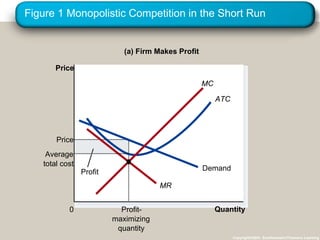
Figure 1 Monopolistic Competition in the Short Run Copyright©2003  Southwestern/Thomson Learning Quantity 0 Price (a) Firm Makes Profit Profit- maximizing quantity Price Demand MR ATC Average total cost Profit MC
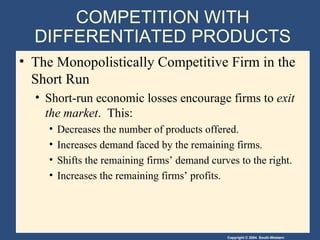
COMPETITION WITH DIFFERENTIATED PRODUCTS The Monopolistically Competitive Firm in the Short Run  Short-run economic losses encourage firms to  exit the market .  This:  Decreases the number of products offered. Increases demand faced by the remaining firms. Shifts the remaining firms’ demand curves to the right. Increases the remaining firms’ profits.
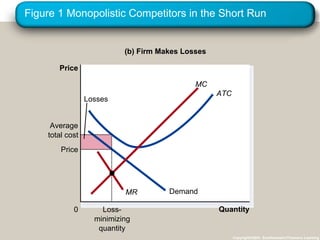
Figure 1 Monopolistic Competitors in the Short Run Copyright©2003  Southwestern/Thomson Learning Quantity 0 Price (b) Firm Makes Losses Demand Price Loss- minimizing quantity Average total cost MR Losses ATC MC
The Long-Run Equilibrium Firms will enter and exit until the firms are making exactly zero economic profits.
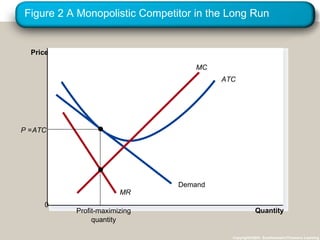
Figure 2 A Monopolistic Competitor in the Long Run Copyright©2003  Southwestern/Thomson Learning Quantity Price 0 Demand MR ATC MC Profit-maximizing quantity P =  ATC
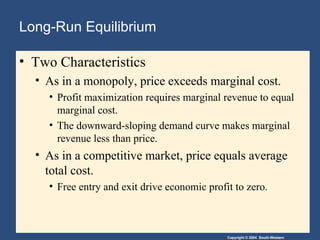
Long-Run Equilibrium Two Characteristics  As in a monopoly, price exceeds marginal cost. Profit maximization requires marginal revenue to equal marginal cost. The downward-sloping demand curve makes marginal revenue less than price. As in a competitive market, price equals average total cost. Free entry and exit drive economic profit to zero.

6 monopolistic competition

  • 1.
    Monopolistic Competition Imperfectcompetition refers to those market structures that fall between perfect competition and pure monopoly.
  • 2.
    Monopolistic Competition Typesof Imperfectly Competitive Markets Monopolistic Competition Many firms selling products that are similar but not identical. Oligopoly Only a few sellers, each offering a similar or identical product to the others.
  • 3.
    Monopolistic Competition Attributesof Monopolistic Competition Many sellers Product differentiation Free entry and exit
  • 4.
    Monopolistic Competition Many Sellers There are many firms competing for the same group of customers. Product examples include books, CDs, movies, computer games, restaurants, piano lessons, cookies, furniture, etc.
  • 5.
    Monopolistic Competition Product Differentiation Each firm produces a product that is at least slightly different from those of other firms. Rather than being a price taker, each firm faces a downward-sloping demand curve .
  • 6.
    Monopolistic Competition Free Entry or Exit Firms can enter or exit the market without restriction. The number of firms in the market adjusts until economic profits are zero.
  • 7.
    Figure 1 MonopolisticCompetition in the Short Run Copyright©2003 Southwestern/Thomson Learning Quantity 0 Price (a) Firm Makes Profit Profit- maximizing quantity Price Demand MR ATC Average total cost Profit MC
  • 8.
    COMPETITION WITH DIFFERENTIATEDPRODUCTS The Monopolistically Competitive Firm in the Short Run Short-run economic losses encourage firms to exit the market . This: Decreases the number of products offered. Increases demand faced by the remaining firms. Shifts the remaining firms’ demand curves to the right. Increases the remaining firms’ profits.
  • 9.
    Figure 1 MonopolisticCompetitors in the Short Run Copyright©2003 Southwestern/Thomson Learning Quantity 0 Price (b) Firm Makes Losses Demand Price Loss- minimizing quantity Average total cost MR Losses ATC MC
  • 10.
    The Long-Run EquilibriumFirms will enter and exit until the firms are making exactly zero economic profits.
  • 11.
    Figure 2 AMonopolistic Competitor in the Long Run Copyright©2003 Southwestern/Thomson Learning Quantity Price 0 Demand MR ATC MC Profit-maximizing quantity P = ATC
  • 12.
    Long-Run Equilibrium TwoCharacteristics As in a monopoly, price exceeds marginal cost. Profit maximization requires marginal revenue to equal marginal cost. The downward-sloping demand curve makes marginal revenue less than price. As in a competitive market, price equals average total cost. Free entry and exit drive economic profit to zero.