CHECKLIST AND
RATING SCALE
THANUJA ELEENA MATHEW
OBSERVATION CHECKLIST
◦It is the most commonly used instrument for performance
evaluation.
◦A checklist enables the observer to note to only whether a trait
is present or not.
◦If consist of a listening of steps, activities or behaviours the
observer records when an incident occurs.
◦The observer has to judge a certain behaviour has taken place.
DEFINITION OF CHECKLIST
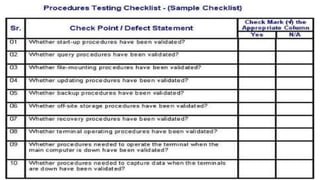
◦A checklist is a simple instrument consisting prepared list of
expected items of performance or attributes which are checked
by an evaluator for the presence or absence.
◦Checklist are constructed by breaking a performance and
quality of a product, which specifies the presence or absence
of an attribute or trait which is then ‘checked’ by the traitor or
observer.
CHARACTERISTICS OF CHECKLIST
◦Observe one respondent at one time
◦Clearly specify the characteristics of the behaviour to the observer
◦Use only carefully prepared checklists to avoid more complex traits.
◦The observer should be trained how to observe, how to record the
observed behaviour.
◦Use checklist only when you are interested in calculating in particular
characteristics
CONSTRUCTION OF A CHECKLIST
◦Express each item in clear, simple language.
◦The type of checklist to be used in particular assessment/
evaluation
◦The list of items in the checklist may be continuous or divided
into groups of related items.
◦These lists of the items are formulated on the basis of the
judgement of experts and each item is evaluated with respect
to the number of favourable and unfavourable responses.
◦Avoid negative statement whenever possible.
◦Avoid lifting statements verbatim from the text.
◦Ensure that each item has a clear response: yes or no,
true or false.
◦Review the items independently.
◦Checklists must have a quality of completeness and
comprehensiveness.
ADVANTAGES OF CHECKLIST
A checklist allows inter individual comparisons.
They provide a simple method to record observations.
They are adaptable to subject matter areas.
It is useful in evaluating learning activities expected to be performed.
They are helpful in evaluating procedure work.
Properly prepared checklists allow the observer to constrains the direct
attention.
Checklist have objectively to evaluate the characteristics.
Decreases the chances of errors in observation
DISADVANTAGES OF CHECKLIST
Checklist don’t indicate quality of performance so the usefulness of
checklists is limited.
Only a limited component of overall clinical performance can be
evaluated.
Only the presence or absence of an attribute, behaviour or
performance or parameter may be assured.
It has limited use in qualitative observations.
Checklist are not easy to prepare.
RATING SCALE
RATING SCALE
◦Rating is the term used to express opinion or judgement
regarding some performance of a person, object,
situation and character.
◦The rating scale involves qualitative description of a
limited number of aspects of a thing or traits of a
person.
DEFINITION OF RATING SCALE
◦Rating scale refers to a scale with a set of opinion, which
describes varying degree of the dimensions of an attitude or a
phenomenon being observed.
◦Rating scale is a device by which judgements may be
qualified or an opinion concerning a trait can be systematized.
-Suresh. K. Sharma.
◦A rating scale is a tool in which one person simply checks off
another person’s level of performance.
◦It could be a 3- point, 5- point or 7- point rating scale.
◦Rating scalers measure how much or how well something
happened, where generally quantitative and qualitative terms
are used to judge the performance.
◦A wide variety of attributes may be assessed by using rating
scales.
TYPES OF RATING SCALES
◦A)Graphic rating scale:
◦B)Descriptive rating scale
◦C)Numerical rating scale
◦D)Comparative rating scale
TYPES OF RATING SCALES
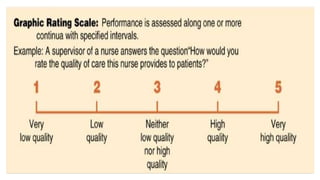
◦Graphic rating scale:
◦In this scale, the performance is printed horizontally at various
points from lowest to highest. It includes the numerical point
on the scales. It is anchored by two extremes presented to the
respondents for the evaluation of a concept or object.
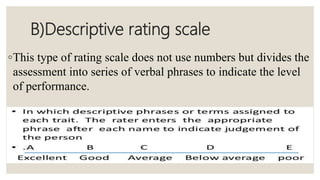
B)Descriptive rating scale
◦This type of rating scale does not use numbers but divides the
assessment into series of verbal phrases to indicate the level
of performance.
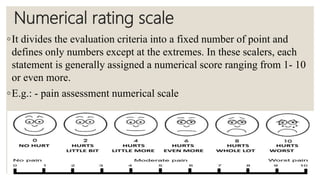
Numerical rating scale
◦It divides the evaluation criteria into a fixed number of point and
defines only numbers except at the extremes. In these scalers, each
statement is generally assigned a numerical score ranging from 1- 10
or even more.
◦E.g.: - pain assessment numerical scale
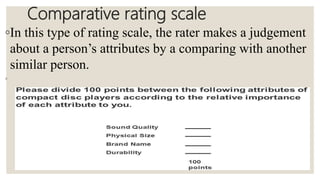
Comparative rating scale
◦In this type of rating scale, the rater makes a judgement
about a person’s attributes by a comparing with another
similar person.
◦
CHARACTERISTICS OF A RATING SCALE
◦They are value judgements of the attributes of one person by another
person.
◦These scales are most commonly used tools to carry out structured
observations.
◦They are generally developed to make quantitative judgements about
qualitative attributes.
◦They provide more flexibility to judge the level of performance or
presence of attributes among subjects.
◦ GUIFORD [1954] CHARACTERISTICS.
◦ Clarity: it must be constructed using short, concise statements in simple and
unambiguous language.
◦ Relevance: the statement should be relevant to the phenomenon and should be
exactly in accordance with the variables understudy.
◦ Variety: monotony of the statements must be avoided and variety and difference
statements must be ensured.
◦ Objectivity: it must be objective in a nature so that it is convenient for the rater to
judge the attributes or performances of the subjects under study.
◦ Uniqueness: each statement constructed must be unique in itself so that the
attributers can be judged appropriately.
ADVANTAGES OF A RATING SCALE
Rating scale are easy to administer and score the measured attributes.
They have a wide range of application in nursing educational;
evaluation.
Graphic rating scale in easier to make and less time- consuming.
Rating can be easy used to a large group.
They are also used for quantitative methods.
Assessment of interest and attitudes and personal characteristics.
They are used to evaluate performance, skills and product outcomes.
Rating scales are adaptable and flexible assessment instruments
DISADVANTAGES OF RATING SCALES
◦It is difficult or dangerous to fix up rating about aspects of an
individual.
◦Misuse can result in a decrease in objectivity.
◦There are chances of subjective evaluation thus the scales
may become unscientific and un reliable.
BIBLIOGRAPHY
◦ SURESH K. SHARMA, REENA SHARMA “COMMUNICATION AND EDUCATIONAL TECHNOLOGY” 2ND
EDITION, ELSEVIER PUBLICATION, PAGE NO: 376-380.
◦ B. T BASAVANTHAPPA, “NURSING EDUCATION”, 1ST EDITION, 2003, JAYPEE PUBLICATIONS, PAGE
NO: 508-514.
◦ R. SUDHA, “NURSING EDUCATION, PRINCIPLES AND CONCEPTS” 2013, JAYPEE PUBLICATIONS,
PAGE NO:181-184.
◦ NEELAM KUMARI, “A TEXT BOOK OF COMMUNICATION AND EDUCATIONAL TECHNOLOGY,” 2014,
PEEVEE BOOKS PRIVATE LIMITED PAGE NO: 279-282.
◦ BARBARA CHERRY, SUSAN.R. JACOB, “CONTEMPORARY NURSING ISSUES, TRENDS AND
MANAGEMENT,” 5TH EDITION, MOSBY ELSEVIER PUBLICATIONS, PAGE NO: 503-504.
◦ PAMELA EVANS SMITH, MARILEELEBON, “SKILL CHECKLIST TO ACCOMPANY TAYLORS CLINICAL
NURSING SKILLS A NURSING PROCESS APPROACH, LIPPINCOTT WILLIAMS AND WILKINS
PUBLICATIONS.
◦ D. ELAKUVANABHASKARA RAJ, NIMA BHASKER, “A TEXT BOOK OF NURSING EDUCATION”
EMMESS PUBLICATIONS, PAGE NO: 282-283.
◦NET REFERENCE
◦www.wikipedia.org
◦www.kkhsource.in
◦www.eduhk.hk
◦https://content.wisestep.com
◦https://www.slideshare.net
◦JOURNEL REFERENCE
◦www.nejm.org
◦www.Bcg.perpectives
◦www.geopolitica.hu/en
◦Sgo.sagepub.com
◦https://www.ncbi.nlm.nih.gov

Checklist and rating scale

  • 1.
  • 2.
    OBSERVATION CHECKLIST ◦It isthe most commonly used instrument for performance evaluation. ◦A checklist enables the observer to note to only whether a trait is present or not. ◦If consist of a listening of steps, activities or behaviours the observer records when an incident occurs. ◦The observer has to judge a certain behaviour has taken place.
  • 3.
    DEFINITION OF CHECKLIST ◦Achecklist is a simple instrument consisting prepared list of expected items of performance or attributes which are checked by an evaluator for the presence or absence. ◦Checklist are constructed by breaking a performance and quality of a product, which specifies the presence or absence of an attribute or trait which is then ‘checked’ by the traitor or observer.
  • 4.
    CHARACTERISTICS OF CHECKLIST ◦Observeone respondent at one time ◦Clearly specify the characteristics of the behaviour to the observer ◦Use only carefully prepared checklists to avoid more complex traits. ◦The observer should be trained how to observe, how to record the observed behaviour. ◦Use checklist only when you are interested in calculating in particular characteristics
  • 6.
    CONSTRUCTION OF ACHECKLIST ◦Express each item in clear, simple language. ◦The type of checklist to be used in particular assessment/ evaluation ◦The list of items in the checklist may be continuous or divided into groups of related items. ◦These lists of the items are formulated on the basis of the judgement of experts and each item is evaluated with respect to the number of favourable and unfavourable responses.
  • 7.
    ◦Avoid negative statementwhenever possible. ◦Avoid lifting statements verbatim from the text. ◦Ensure that each item has a clear response: yes or no, true or false. ◦Review the items independently. ◦Checklists must have a quality of completeness and comprehensiveness.
  • 8.
    ADVANTAGES OF CHECKLIST Achecklist allows inter individual comparisons. They provide a simple method to record observations. They are adaptable to subject matter areas. It is useful in evaluating learning activities expected to be performed. They are helpful in evaluating procedure work. Properly prepared checklists allow the observer to constrains the direct attention. Checklist have objectively to evaluate the characteristics. Decreases the chances of errors in observation
  • 9.
    DISADVANTAGES OF CHECKLIST Checklistdon’t indicate quality of performance so the usefulness of checklists is limited. Only a limited component of overall clinical performance can be evaluated. Only the presence or absence of an attribute, behaviour or performance or parameter may be assured. It has limited use in qualitative observations. Checklist are not easy to prepare.
  • 10.
  • 11.
    RATING SCALE ◦Rating isthe term used to express opinion or judgement regarding some performance of a person, object, situation and character. ◦The rating scale involves qualitative description of a limited number of aspects of a thing or traits of a person.
  • 12.
    DEFINITION OF RATINGSCALE ◦Rating scale refers to a scale with a set of opinion, which describes varying degree of the dimensions of an attitude or a phenomenon being observed. ◦Rating scale is a device by which judgements may be qualified or an opinion concerning a trait can be systematized. -Suresh. K. Sharma.
  • 13.
    ◦A rating scaleis a tool in which one person simply checks off another person’s level of performance. ◦It could be a 3- point, 5- point or 7- point rating scale. ◦Rating scalers measure how much or how well something happened, where generally quantitative and qualitative terms are used to judge the performance. ◦A wide variety of attributes may be assessed by using rating scales.
  • 14.
    TYPES OF RATINGSCALES ◦A)Graphic rating scale: ◦B)Descriptive rating scale ◦C)Numerical rating scale ◦D)Comparative rating scale
  • 15.
    TYPES OF RATINGSCALES ◦Graphic rating scale: ◦In this scale, the performance is printed horizontally at various points from lowest to highest. It includes the numerical point on the scales. It is anchored by two extremes presented to the respondents for the evaluation of a concept or object.
  • 17.
    B)Descriptive rating scale ◦Thistype of rating scale does not use numbers but divides the assessment into series of verbal phrases to indicate the level of performance.
  • 18.
    Numerical rating scale ◦Itdivides the evaluation criteria into a fixed number of point and defines only numbers except at the extremes. In these scalers, each statement is generally assigned a numerical score ranging from 1- 10 or even more. ◦E.g.: - pain assessment numerical scale
  • 19.
    Comparative rating scale ◦Inthis type of rating scale, the rater makes a judgement about a person’s attributes by a comparing with another similar person. ◦
  • 20.
    CHARACTERISTICS OF ARATING SCALE ◦They are value judgements of the attributes of one person by another person. ◦These scales are most commonly used tools to carry out structured observations. ◦They are generally developed to make quantitative judgements about qualitative attributes. ◦They provide more flexibility to judge the level of performance or presence of attributes among subjects.
  • 21.
    ◦ GUIFORD [1954]CHARACTERISTICS. ◦ Clarity: it must be constructed using short, concise statements in simple and unambiguous language. ◦ Relevance: the statement should be relevant to the phenomenon and should be exactly in accordance with the variables understudy. ◦ Variety: monotony of the statements must be avoided and variety and difference statements must be ensured. ◦ Objectivity: it must be objective in a nature so that it is convenient for the rater to judge the attributes or performances of the subjects under study. ◦ Uniqueness: each statement constructed must be unique in itself so that the attributers can be judged appropriately.
  • 22.
    ADVANTAGES OF ARATING SCALE Rating scale are easy to administer and score the measured attributes. They have a wide range of application in nursing educational; evaluation. Graphic rating scale in easier to make and less time- consuming. Rating can be easy used to a large group. They are also used for quantitative methods. Assessment of interest and attitudes and personal characteristics. They are used to evaluate performance, skills and product outcomes. Rating scales are adaptable and flexible assessment instruments
  • 23.
    DISADVANTAGES OF RATINGSCALES ◦It is difficult or dangerous to fix up rating about aspects of an individual. ◦Misuse can result in a decrease in objectivity. ◦There are chances of subjective evaluation thus the scales may become unscientific and un reliable.
  • 24.
    BIBLIOGRAPHY ◦ SURESH K.SHARMA, REENA SHARMA “COMMUNICATION AND EDUCATIONAL TECHNOLOGY” 2ND EDITION, ELSEVIER PUBLICATION, PAGE NO: 376-380. ◦ B. T BASAVANTHAPPA, “NURSING EDUCATION”, 1ST EDITION, 2003, JAYPEE PUBLICATIONS, PAGE NO: 508-514. ◦ R. SUDHA, “NURSING EDUCATION, PRINCIPLES AND CONCEPTS” 2013, JAYPEE PUBLICATIONS, PAGE NO:181-184. ◦ NEELAM KUMARI, “A TEXT BOOK OF COMMUNICATION AND EDUCATIONAL TECHNOLOGY,” 2014, PEEVEE BOOKS PRIVATE LIMITED PAGE NO: 279-282. ◦ BARBARA CHERRY, SUSAN.R. JACOB, “CONTEMPORARY NURSING ISSUES, TRENDS AND MANAGEMENT,” 5TH EDITION, MOSBY ELSEVIER PUBLICATIONS, PAGE NO: 503-504. ◦ PAMELA EVANS SMITH, MARILEELEBON, “SKILL CHECKLIST TO ACCOMPANY TAYLORS CLINICAL NURSING SKILLS A NURSING PROCESS APPROACH, LIPPINCOTT WILLIAMS AND WILKINS PUBLICATIONS. ◦ D. ELAKUVANABHASKARA RAJ, NIMA BHASKER, “A TEXT BOOK OF NURSING EDUCATION” EMMESS PUBLICATIONS, PAGE NO: 282-283.
  • 25.