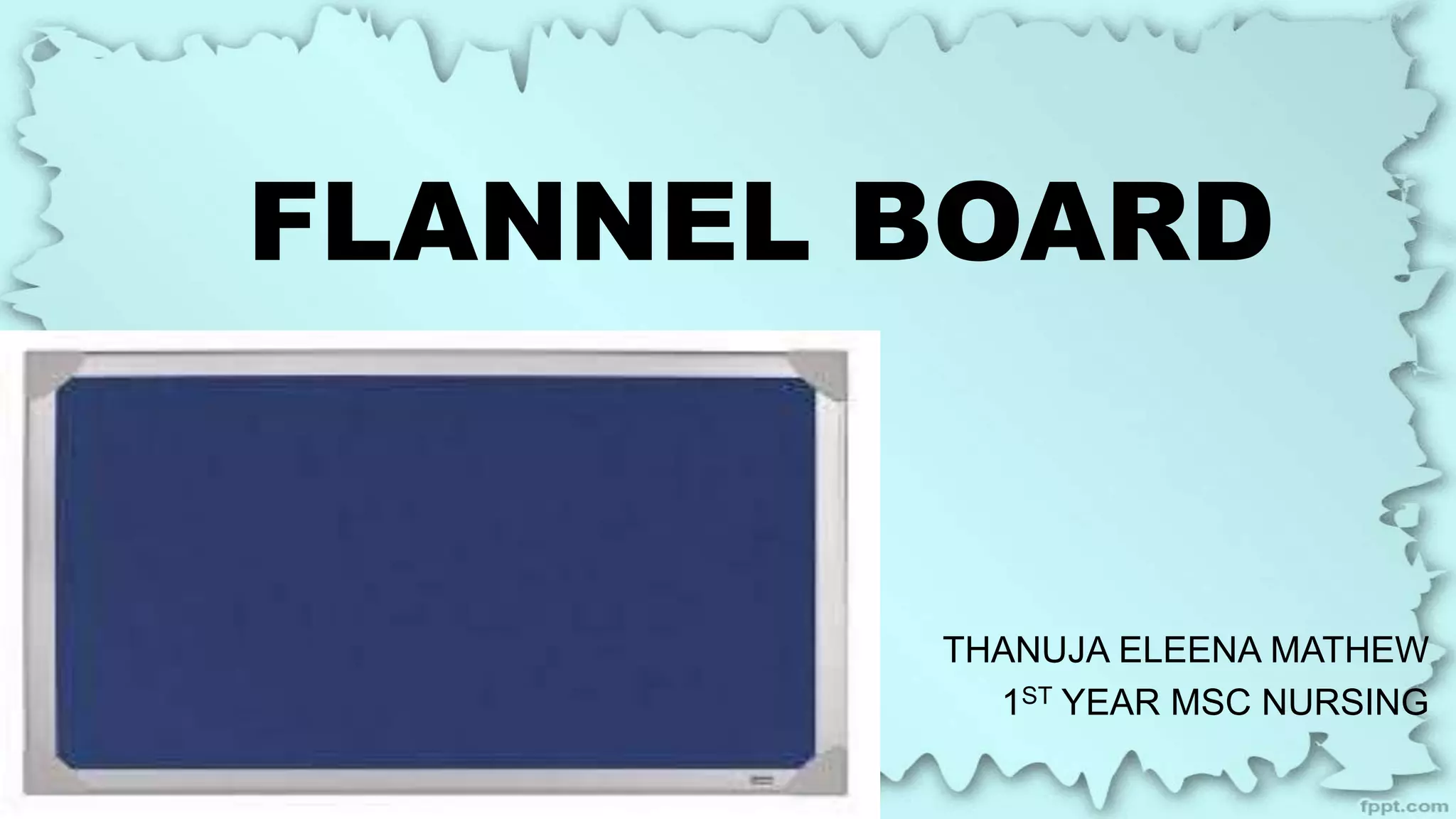
FLANNEL BOARD
THANUJA ELEENA MATHEW
1ST YEAR MSC NURSING
INTRODUCTION
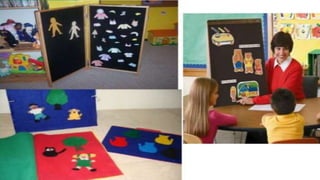
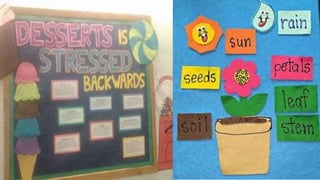
• Flannel graph is storytelling system that uses a board covered with
flannel fabric, usually resting on an easel. It is very similar to Fuzzy
felt. Although its primary use is a storytelling medium, rather than
as toy.
• Flannel board Sometimes called as flannel graph, visual board,
Frick board, slap board, felt board, choreograph, video graph.
DEFINITION
• “A flannel board is a display made up of wood, cardboard or
strawboard covered with colour flannel or woollen cloth”.
• According to Omayal achi CON /”flannel or felt board is a
rigid surface covered with cotton flannel, wool terry cloth or
felt cloth”.
PRINCIPLE
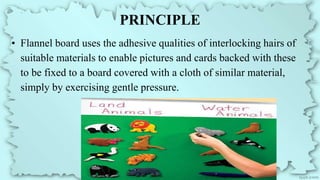
• Flannel board uses the adhesive qualities of interlocking hairs of
suitable materials to enable pictures and cards backed with these
to be fixed to a board covered with a cloth of similar material,
simply by exercising gentle pressure.
PURPOSES
 To enable the teacher develop an idea step by step in a very dramatic
and impressive manner.
 To add variety to the class room activity.
 To provide information and motivate the learner.
 To convey idea more expressively.
 To broaden sensory experience of the learners.
 To educate both illiterate and literate people.
 To present an idea in a more appealing way to children.
USES
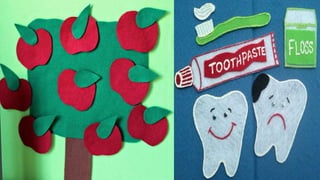
 The teacher adheres various pictures on the flannel board along
with commentary of descriptions.
 It is used for recognition and work formation during language
teaching in primary classes.
 It can be used for recognition and recall testing.
 Flannel graph is useful in teaching elementary lessons on numbers,
 It is of great help in playing educative puzzles and show
interrelationship between different parts of a process
TYPES
1.Hanging type
 This flannel graph does not have support.
 It has to be hanged on the wall surface to adhere material.
2. Self supporting flannel graph
 It has a support, usually made up of wood.
 It can be placed without support of wall or surface on its own stand
PREPARATION OF FLANNEL GRAPH
• Articles Needed
1. Materials/ board made of plywood or hardboard or thick cardboard. Size –
120 x 80 cm, these boards is cut and edges are smoothened.
2. Cloth
• Flannel or felt material is used
• Colour – dark
• Secured on a board with pins, glue or staples.
• The flannel is spread over the board evenly without wrinkles and secured.
3. Cut-out or pictures
4. Pins or staples to fix flannel cloth
5. Glue or adhesive cloth.
•Substitutes for these articles
1.Woollen cloth can be used instead of flannel cloth
2.Sandpaper, cloth, welcome stickers can be used to stick the cut out.
PREPARATIONS STEPS
1.Gather all the articles.
2.The board is cut and its edges are smoothened.
3.The board is folded in the middle to make it portable.
4.The flannel cloth is spread on the board without wrinkles and
secured with pins, glue or staples.
5.An adhesive material or glued sand can be put on backside of cut
outs and then it is pressed on flannel graph is desired sequence.
USING A FLANNEL GRAPH
a)Collect pictures, cut outs or light objects and back them with sand
paper pieces.
b)Keep all sets of flannel graph material in separate clearly marked
envelopes.
c)Plan before the lessons as to where each piece will be placed on
black cloth.
d)Average the pieces in exact order in which they will be used.
e)Place the flannel graph at backward slant (10- 150 degree) so that
pictures will not fall.
f)Build up scenes and illustrate points as they occur in the study.
g)Change the picture or cut out as you talk to students.
h)Aim to conclude the talk with a picture or arrangement that will
leave a lasting impression on the students.
• Replace the pieces in the envelope at the end of the lesson.
GUIDELINES FOR USING A FLANNEL GRAPH.
 The contents of the board should be organized around the central
theme.
 Appearances must be neat and orderly.
 The material should be displayed in an attractive manner.
 Avoid overcrowding on the board.
 It should be clearly seen by the group members.
 The displayed pictures should be sufficiently large in size.
 Remove the pictures as soon as their purposes over.
ADVANTAGES OF FLANNEL GRAPH
 It is inexpensive, easily made from locally available materials.
 Flannel graph holds the attention of the audience.
 It is ideal for exhibiting dramatic story telling.
 It can be easily maintained and carried to remote areas.
 On flannel graph, figures can be used in different presentations.
 It ideal for showing of events.
 It can be adopted for group participation.
 They display materials can be changed without use of drawing pins or paste.
DISADVANTAGE OF FLANNEL GRAPH
 It requires considerable advance preparation.
 If pictures are not properly placed, it may fall in between.
 Efficient use of flannel graphs requires much practice.
 Artistic ability is needed.
 Limited audience can only be accommodated.
CONCLUSION
• A flannel graph is a type of visual display aid made of wood,
cardboard etc, and covered with flannel cloth to display cut pouts or
pictures on it, simply by applying pressure. Use of flannel graph
serves variety of purposes in education and it has several advantages.
• It is inexpensive and can be prepared in local settings. Flannel graph
is useful visual aid. If used correctly and skilfully, it can be helpful in
nursing education in both theoretical and clinical settings.
BIBLIOGRAPHY
Shabeer. P. Basheer, a text book of nursing education, EMMESS
publications, page no: 56-67
R. Sudha, ‘nursing education principles and concepts’, Jaypee publishers
private limited new Delhi, page no: 102-107
Cunningham, D.J Duffy, the textbook of the future center for Research
on learning and technology, Retrieved publications, page no:6-8
K.P Neeraja, textbook of nursing education, 1st edition, Jaypee
publications, page no:288-294
J.C Agarwal, essentials of educational technology, 2nd edition, Vikas
publications private limited, page no:35-37
Elsa Santhombi Devi, ‘Manipal manual of nursing education’,
CBS publishers and distributors, new Delhi, page no: 288-295
B.T Basavanthappa, nursing education,1st edition, Jaypee
publications, page no:91-93
D. Elakkuvana Bhaskar raj, Nima Bhasker, textbook of nursing
education, EMMESS publications, page no:34-44
J.C Agarwal, ‘principles and techniques of teaching’ ,2nd
revised edition, Vikas publishing house private limited,
page:296-305
NET REFERENCE
 www.wikipedia.org
 www.kkhsource.in
 www.eduhk.hk
 https://content.wisestep.com
 https://www.slideshare.net
Flannel board

Flannel board

  • 1.
    FLANNEL BOARD THANUJA ELEENAMATHEW 1ST YEAR MSC NURSING
  • 2.
    INTRODUCTION • Flannel graphis storytelling system that uses a board covered with flannel fabric, usually resting on an easel. It is very similar to Fuzzy felt. Although its primary use is a storytelling medium, rather than as toy. • Flannel board Sometimes called as flannel graph, visual board, Frick board, slap board, felt board, choreograph, video graph.
  • 3.
    DEFINITION • “A flannelboard is a display made up of wood, cardboard or strawboard covered with colour flannel or woollen cloth”. • According to Omayal achi CON /”flannel or felt board is a rigid surface covered with cotton flannel, wool terry cloth or felt cloth”.
  • 4.
    PRINCIPLE • Flannel boarduses the adhesive qualities of interlocking hairs of suitable materials to enable pictures and cards backed with these to be fixed to a board covered with a cloth of similar material, simply by exercising gentle pressure.
  • 5.
    PURPOSES  To enablethe teacher develop an idea step by step in a very dramatic and impressive manner.  To add variety to the class room activity.  To provide information and motivate the learner.  To convey idea more expressively.  To broaden sensory experience of the learners.  To educate both illiterate and literate people.  To present an idea in a more appealing way to children.
  • 6.
    USES  The teacheradheres various pictures on the flannel board along with commentary of descriptions.  It is used for recognition and work formation during language teaching in primary classes.  It can be used for recognition and recall testing.  Flannel graph is useful in teaching elementary lessons on numbers,  It is of great help in playing educative puzzles and show interrelationship between different parts of a process
  • 8.
    TYPES 1.Hanging type  Thisflannel graph does not have support.  It has to be hanged on the wall surface to adhere material. 2. Self supporting flannel graph  It has a support, usually made up of wood.  It can be placed without support of wall or surface on its own stand
  • 10.
    PREPARATION OF FLANNELGRAPH • Articles Needed 1. Materials/ board made of plywood or hardboard or thick cardboard. Size – 120 x 80 cm, these boards is cut and edges are smoothened. 2. Cloth • Flannel or felt material is used • Colour – dark • Secured on a board with pins, glue or staples. • The flannel is spread over the board evenly without wrinkles and secured.
  • 11.
    3. Cut-out orpictures 4. Pins or staples to fix flannel cloth 5. Glue or adhesive cloth. •Substitutes for these articles 1.Woollen cloth can be used instead of flannel cloth 2.Sandpaper, cloth, welcome stickers can be used to stick the cut out.
  • 12.
    PREPARATIONS STEPS 1.Gather allthe articles. 2.The board is cut and its edges are smoothened. 3.The board is folded in the middle to make it portable. 4.The flannel cloth is spread on the board without wrinkles and secured with pins, glue or staples. 5.An adhesive material or glued sand can be put on backside of cut outs and then it is pressed on flannel graph is desired sequence.
  • 13.
    USING A FLANNELGRAPH a)Collect pictures, cut outs or light objects and back them with sand paper pieces. b)Keep all sets of flannel graph material in separate clearly marked envelopes. c)Plan before the lessons as to where each piece will be placed on black cloth. d)Average the pieces in exact order in which they will be used.
  • 14.
    e)Place the flannelgraph at backward slant (10- 150 degree) so that pictures will not fall. f)Build up scenes and illustrate points as they occur in the study. g)Change the picture or cut out as you talk to students. h)Aim to conclude the talk with a picture or arrangement that will leave a lasting impression on the students. • Replace the pieces in the envelope at the end of the lesson.
  • 16.
    GUIDELINES FOR USINGA FLANNEL GRAPH.  The contents of the board should be organized around the central theme.  Appearances must be neat and orderly.  The material should be displayed in an attractive manner.  Avoid overcrowding on the board.  It should be clearly seen by the group members.  The displayed pictures should be sufficiently large in size.  Remove the pictures as soon as their purposes over.
  • 18.
    ADVANTAGES OF FLANNELGRAPH  It is inexpensive, easily made from locally available materials.  Flannel graph holds the attention of the audience.  It is ideal for exhibiting dramatic story telling.  It can be easily maintained and carried to remote areas.  On flannel graph, figures can be used in different presentations.  It ideal for showing of events.  It can be adopted for group participation.  They display materials can be changed without use of drawing pins or paste.
  • 19.
    DISADVANTAGE OF FLANNELGRAPH  It requires considerable advance preparation.  If pictures are not properly placed, it may fall in between.  Efficient use of flannel graphs requires much practice.  Artistic ability is needed.  Limited audience can only be accommodated.
  • 20.
    CONCLUSION • A flannelgraph is a type of visual display aid made of wood, cardboard etc, and covered with flannel cloth to display cut pouts or pictures on it, simply by applying pressure. Use of flannel graph serves variety of purposes in education and it has several advantages. • It is inexpensive and can be prepared in local settings. Flannel graph is useful visual aid. If used correctly and skilfully, it can be helpful in nursing education in both theoretical and clinical settings.
  • 21.
    BIBLIOGRAPHY Shabeer. P. Basheer,a text book of nursing education, EMMESS publications, page no: 56-67 R. Sudha, ‘nursing education principles and concepts’, Jaypee publishers private limited new Delhi, page no: 102-107 Cunningham, D.J Duffy, the textbook of the future center for Research on learning and technology, Retrieved publications, page no:6-8 K.P Neeraja, textbook of nursing education, 1st edition, Jaypee publications, page no:288-294 J.C Agarwal, essentials of educational technology, 2nd edition, Vikas publications private limited, page no:35-37
  • 22.
    Elsa Santhombi Devi,‘Manipal manual of nursing education’, CBS publishers and distributors, new Delhi, page no: 288-295 B.T Basavanthappa, nursing education,1st edition, Jaypee publications, page no:91-93 D. Elakkuvana Bhaskar raj, Nima Bhasker, textbook of nursing education, EMMESS publications, page no:34-44 J.C Agarwal, ‘principles and techniques of teaching’ ,2nd revised edition, Vikas publishing house private limited, page:296-305
  • 23.
    NET REFERENCE  www.wikipedia.org www.kkhsource.in  www.eduhk.hk  https://content.wisestep.com  https://www.slideshare.net