HISTORICAL DEVELOPMENT OF
MEDICAL- SURGICAL NURSING
ASHISHA.C
1ST YEAR MSC NURSING
T.M.M COLLEGE OF NURSING
THIRUVALLA
 Medical surgical Nursing is a nursing speciality which is
concerned with care of adult patients in a broad range of
settings.
 Traditionally, medical surgical nursing was an entry level
position, a stepping stone to speciality areas.
 Advances in medicine and surgery have resulted in medical-
surgical nursing evolving into its own specialty.
 The ACADEMY OF MEDICAL SURGICAL NURSES (AMSN) is a specialty
nursing organization dedicated to nurturing medical-surgical
nurses as they advance their careers.
 Nursing encompasses autonomous and collaborative care of individuals of all
ages, families, groups and communities, sick or well and in all settings. It
includes the promotion of health, the prevention of illness, and the care of ill,
disabled and dying people.
-WHO
 The unique function of the nurse is to assist the individual, sick or well, in
performance of those activities contributing to health or its recovery (or
peaceful death) that he/she would perform unaided if he/she had the
necessary strength, will or knowledge.
-VIRGINA HENDERSON(1966)
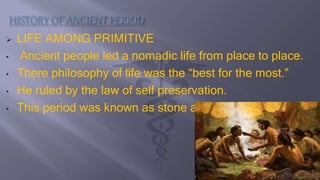
 LIFE AMONG PRIMITIVE
• Ancient people led a nomadic life from place to place.
• There philosophy of life was the ā€œbest for the most.ā€
• He ruled by the law of self preservation.
• This period was known as stone age
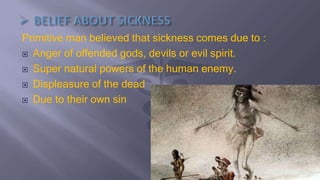
Primitive man believed that sickness comes due to :
 Anger of offended gods, devils or evil spirit.
 Super natural powers of the human enemy.
 Displeasure of the dead
 Due to their own sin
 SORCERER
 MAGIC
 BREAKING A TABOO
 INTRUSION OF A DISEASE
OBJECT
 BODILY INVASION BY SPIRIT
 LOSS OT THE SOUL
 DREAMS
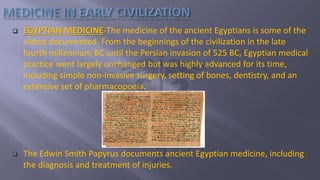
 EGYPTIAN MEDICINE-The medicine of the ancient Egyptians is some of the
oldest documented. From the beginnings of the civilization in the late
fourth millennium BC until the Persian invasion of 525 BC, Egyptian medical
practice went largely unchanged but was highly advanced for its time,
including simple non-invasive surgery, setting of bones, dentistry, and an
extensive set of pharmacopoeia.
 The Edwin Smith Papyrus documents ancient Egyptian medicine, including
the diagnosis and treatment of injuries.
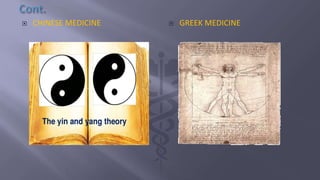
 GREEK MEDICINE CHINESE MEDICINE
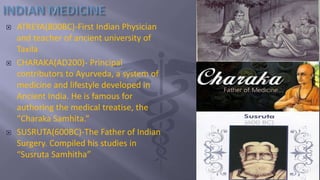
 ATREYA(800BC)-First Indian Physician
and teacher of ancient university of
Taxila
 CHARAKA(AD200)- Principal
contributors to Ayurveda, a system of
medicine and lifestyle developed in
Ancient India. He is famous for
authoring the medical treatise, the
ā€œCharaka Samhita.ā€
 SUSRUTA(600BC)-The Father of Indian
Surgery. Compiled his studies in
ā€œSusruta Samhithaā€
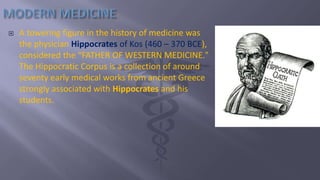
 A towering figure in the history of medicine was
the physician Hippocrates of Kos (460 – 370 BCE),
considered the ā€œFATHER OF WESTERN MEDICINE."
The Hippocratic Corpus is a collection of around
seventy early medical works from ancient Greece
strongly associated with Hippocrates and his
students.
 In 300 AD. the Roman Empire endeavoured to build a hospital
in each town that was under its rule, leading to a high
requirement for nurses to provide medical care alongside the
doctors.
 The profession of nursing became considerably more
prominent in Europe in the middle ages, due to the drive for
medical care from the Catholic church.
 The first Spanish hospital was built in the late 500s to early
600s in Merida, Spain, with the intent to care for any sick
individuals regardless of ethnic origin or religion.
 Throughout the 10th and 11th centuries, the nursing profession
expanded due to changes in rulings in Europe. Hospitals began to be
included as part of monasteries and other religious places and the
nurses provided a range of medical care services, as was required,
even beyond traditional healthcare
 At the beginning of the 17th century, the nursing as a profession was
rare due to various reasons, such as the closing of monasteries that
housed the hospitals. However, in some regions of Europe where the
Catholic church remained in power, the hospitals remained and
nurses retained their role.
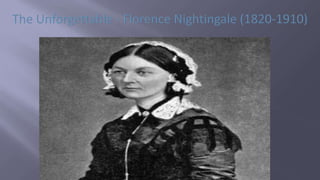
 , the pioneer of nursing profession. She was
born to English parents on May 12, 1820 in Florence, Italy. She was
entitled ' Lady of the lamp'. Her work is well known and well
recognized world wide.
 She had got the opportunity of recienney good (best) education and
also travelled throughout Europe and could make good contacts
which really helped her to achieve the "mission" in her life. She came
across individuals who were concerned with the reforms of social
institutions such as prisons and hospitals. In 1853, she spent three
months in Kaiser worth, Germany . In the same year she was
appointed as Superintendent of Institution for the care of sick -
gentle women in London.
 In 1854, during the Crimean war, when women nurses were
considered to be revolutionary, Florence Nightingale demonstrated
quality nursing care along with 38 other nurses. After her extensive
service at the Crimean war, efforts of Florence resulted in the
appointment of the Royal Commission on the health of the Army. As
one of the consequence, The Army Medical School was founded in
1857.
 During her lifetime, her work and devotion enlightened the whole
society. She was the founder of Nightingale School for nurses, the
first ever of its kind. In 1907, she was conferred "The Order of Merit"
by the King.
 1840s - Operate on a client who was free from pain. It was a revolution for
surgery. Development of safer anaesthetic gases allowed surgeons
to conduct longer operative procedures. All the surgery was
conducted in hospital setting and nurses are required special training
for new responsibilities such as assisting, preparing, caring for a
patient in surgical unit.
 1876s- In Massachusetts, general hospital provided the first operating room
education for nurse’s. The trend continued to1900s as nursing schools
included operating room experience in each nurses clinical instruction.
 1956- The association of operating room nurses was formed to
gain knowledge of surgical principles and explore methods to
improve nursing care of surgical clients. The associations of
operating room nurses overcame the idea that operating
room nurses were only technically skilled practitioners. This
organization also developed standard of nursing practice to
establish the need for registered nurses in the operating
room.
 1970s-A change occurred in nursing education with a focus on the
importance of nurses acquiring a broad knowledge base, resulted in
less emphasis on operating room techniques. There has also been a
new development in the setting for operative procedures:
• Ambulatory surgery: It was also referred to as outpatient.
• One-day surgery: This health care service is presently growing
rapidly in numbers and various types of procedures such as invasive
non invasive procedures are performed.
Ambulatory surgery is a scheduled surgical procedure provided for a
client who does not remain overnight in a hospital, e.g. biopsies,
cosmetic surgery, cataract extractions
The nursing profession is among the largest labour pools in the
world. Nursing profession advocates and the demand for more
capable healthcare staff in the medical field during wartime were
catalysts for the trade’s evolution. In the 1800’s, nursing began
as a job performing domestic duties in the medical environment.
Many hospitals trained nurses directly during the profession’s
early days – a task now fulfilled by academic institutions. Today,
formalized licensing and training ensure a medical environment
that vastly improves patient outcomes compared to
institutionalized healthcare’s infancy.
 Usha Ravindran Nair. (2009) , ā€œText book of Medical Surgical Nursingā€,
1st edition, Jaypee Brothers Publication P. Lt , New Delhi
Page1-7
 The Trained Nurses Association of India, (2001), ā€œHistory and Trend's in
Nursing in Indiaā€, 1st edition, TNAI, New Delhi page no.1-7
 Javed Ansari, Davinder Kaur (2015)' ā€œMedial surgical Nursingā€
1s edition, PeeVee Publication, Jalandhar, Page no.4-16
 Arlene Polaski, suzanne E Tatro. (2010), ā€œLuckmann's
Core Principle and Practice of Medical Surgical Nursingā€
1st edition, Elsevier Publication, India Page no 26-28
Msn history