Social Behavior
Social Psychology
The field of Psychology that focuses on how we
behave in the presence of others. Particularly -
how different types of social pressure influence us.
How do we behave when we want to fit into a group?
How do we behave when someone asks us to do something?
How do we behave when we think others are watching?
How do we behave when an authority figure is present?
How do we behave when we think we are the authority figure?
Groups
In order for social influence to exist, people must
interact within groups.
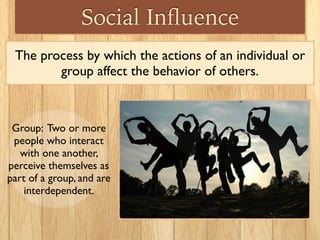
Group: Two or more
people who interact
with one another,
perceive themselves as
part of a group, and are
interdependent.
Norms
Groups develop “norms”: expectations regarding what behavior
is appropriate within the group, and what behavior is not.
AmishKids
Punk-rockKids
Norms
Groups develop “norms”: expectations regarding what behavior
is appropriate within the group, and what behavior is not.
BaptistPreacher
KKKMembers
Norms
Groups develop “norms”: expectations regarding what behavior
is appropriate within the group, and what behavior is not.
MariachiBand
ElvisImpersonators
Norms
Groups develop “norms”: expectations regarding what behavior
is appropriate within the group, and what behavior is not.
Prisoners
Cheerleaders
Notes Question #1
In general, what happens when someone does
not follow the norms of a group they are in?
?
?
?
?
Notes Question #2
Make a list of groups that you belong to.
(Yes, we all belong to many groups that each
have different behavioral norms!)
Georgi family
Friends from middle/
high school
Friends from
college
KIS Faculty
Psych Class
Yearbook Club
Global Studies Class
Me + Sister
* note: when you change your behavior from one group to the next, it is called “code switching.”
Types of Social Pressure
Conformity
A change in behavior or attitudes
brought about by a desire to follow the
beliefs or standards of other people.
Compliance
A type of social influence where an
individual is persuaded or urged to do
what someone else wants them to do,
following his or her request.
Obedience
A change in behavior in response to
the commands of others.
Conformity
A change in behavior or attitudes brought about
by a desire to follow the beliefs or standards
of other people.
If we do not
conform to the
behavior of the
groups we are in,
we may face
rejection,
exclusion, or loss
of reputation.
What if your friends are having a costume party, but you
decide to go without wearing one?
In school, your friends
expect you to behave
in certain ways.What
happens when you
don’t?
Solomon Asch Experiment
In the 1950s, psychologist Solomon Asch studied the practice of
conformity by giving a perception test to a group of students.
All of the students taking the test were actors - except for one.
Asch wanted to see how this subject would respond when all of
the other students unanimously gave wrong answers to very
simple questions.
RESULTS:
1/3 of the test subjects
conformed to the group,
and chose the wrong
answer simply because
everyone else did.
Video 1
Conformity
Facts about conformity:
• The more attractive a group appears to
its members, the greater its ability to
produce conformity.
• The lower a person’s rank or status is
within a group, the easier it is for the
group to modify that person’s behavior.
• Conformity is more likely in public
situations (when people are watching)
• Fact vs. Opinion: it is easier to create
conformity when asked to give an
opinion on something.
• Groups that are unanimous create the
greatest conformity pressures.
Compliance
A type of social influence where an individual
is persuaded or urged to do what someone
else wants them to do.
• Foot-in-the-Door Technique
• Door-in-the-Face Technique
• “That’s Not All” Technique
• Not-so-free Sample Technique
• Low-Ball Technique
• Bait-and-Switch Technique
“door
in the
face”
Obedience
A change in behavior in response to the commands
of others (following orders). Obedience usually only
occurs in special relationships with authority figures
(such as a parent, teacher, or boss).
Discuss:
We don’t follow the suggestions or
orders of all people equally.
What characteristics can you find in the people/groups
that we are most willing to change our behavior for?

Social Behavior Part 1

  • 1.
  • 2.
    Social Psychology The fieldof Psychology that focuses on how we behave in the presence of others. Particularly - how different types of social pressure influence us. How do we behave when we want to fit into a group? How do we behave when someone asks us to do something? How do we behave when we think others are watching? How do we behave when an authority figure is present? How do we behave when we think we are the authority figure?
  • 3.
    Groups In order forsocial influence to exist, people must interact within groups. Group: Two or more people who interact with one another, perceive themselves as part of a group, and are interdependent.
  • 4.
    Norms Groups develop “norms”:expectations regarding what behavior is appropriate within the group, and what behavior is not. AmishKids Punk-rockKids
  • 5.
    Norms Groups develop “norms”:expectations regarding what behavior is appropriate within the group, and what behavior is not. BaptistPreacher KKKMembers
  • 6.
    Norms Groups develop “norms”:expectations regarding what behavior is appropriate within the group, and what behavior is not. MariachiBand ElvisImpersonators
  • 7.
    Norms Groups develop “norms”:expectations regarding what behavior is appropriate within the group, and what behavior is not. Prisoners Cheerleaders
  • 8.
    Notes Question #1 Ingeneral, what happens when someone does not follow the norms of a group they are in? ? ? ? ?
  • 9.
    Notes Question #2 Makea list of groups that you belong to. (Yes, we all belong to many groups that each have different behavioral norms!) Georgi family Friends from middle/ high school Friends from college KIS Faculty Psych Class Yearbook Club Global Studies Class Me + Sister * note: when you change your behavior from one group to the next, it is called “code switching.”
  • 10.
    Types of SocialPressure Conformity A change in behavior or attitudes brought about by a desire to follow the beliefs or standards of other people. Compliance A type of social influence where an individual is persuaded or urged to do what someone else wants them to do, following his or her request. Obedience A change in behavior in response to the commands of others.
  • 11.
    Conformity A change inbehavior or attitudes brought about by a desire to follow the beliefs or standards of other people. If we do not conform to the behavior of the groups we are in, we may face rejection, exclusion, or loss of reputation. What if your friends are having a costume party, but you decide to go without wearing one? In school, your friends expect you to behave in certain ways.What happens when you don’t?
  • 12.
    Solomon Asch Experiment Inthe 1950s, psychologist Solomon Asch studied the practice of conformity by giving a perception test to a group of students. All of the students taking the test were actors - except for one. Asch wanted to see how this subject would respond when all of the other students unanimously gave wrong answers to very simple questions. RESULTS: 1/3 of the test subjects conformed to the group, and chose the wrong answer simply because everyone else did.
  • 13.
  • 14.
    Conformity Facts about conformity: •The more attractive a group appears to its members, the greater its ability to produce conformity. • The lower a person’s rank or status is within a group, the easier it is for the group to modify that person’s behavior. • Conformity is more likely in public situations (when people are watching) • Fact vs. Opinion: it is easier to create conformity when asked to give an opinion on something. • Groups that are unanimous create the greatest conformity pressures.
  • 15.
    Compliance A type ofsocial influence where an individual is persuaded or urged to do what someone else wants them to do. • Foot-in-the-Door Technique • Door-in-the-Face Technique • “That’s Not All” Technique • Not-so-free Sample Technique • Low-Ball Technique • Bait-and-Switch Technique “door in the face”
  • 16.
    Obedience A change inbehavior in response to the commands of others (following orders). Obedience usually only occurs in special relationships with authority figures (such as a parent, teacher, or boss).
  • 17.
    Discuss: We don’t followthe suggestions or orders of all people equally. What characteristics can you find in the people/groups that we are most willing to change our behavior for?