VASOPRESSIN
Dr. S P SRINIVAS NAYAK,
PharmD, RPh, (MSc), (PGDND) (PhD)
ASSISTANT PROFESSOR, DEPT. OF PHARMACY PRACTICE, PU.
• Vasopressin an arginine
vasopressin (AVP)
• Also called as antidiuretic
hormone (ADH)
• It is a peptide hormone
synthesized in the supraoptic
and paraventricular nuclei of
the hypothalamus and stored
in posterior pituitary
VASOPRESSIN
Sunday, October 31, 2021
PIPR, PARUL UNIVERSITY
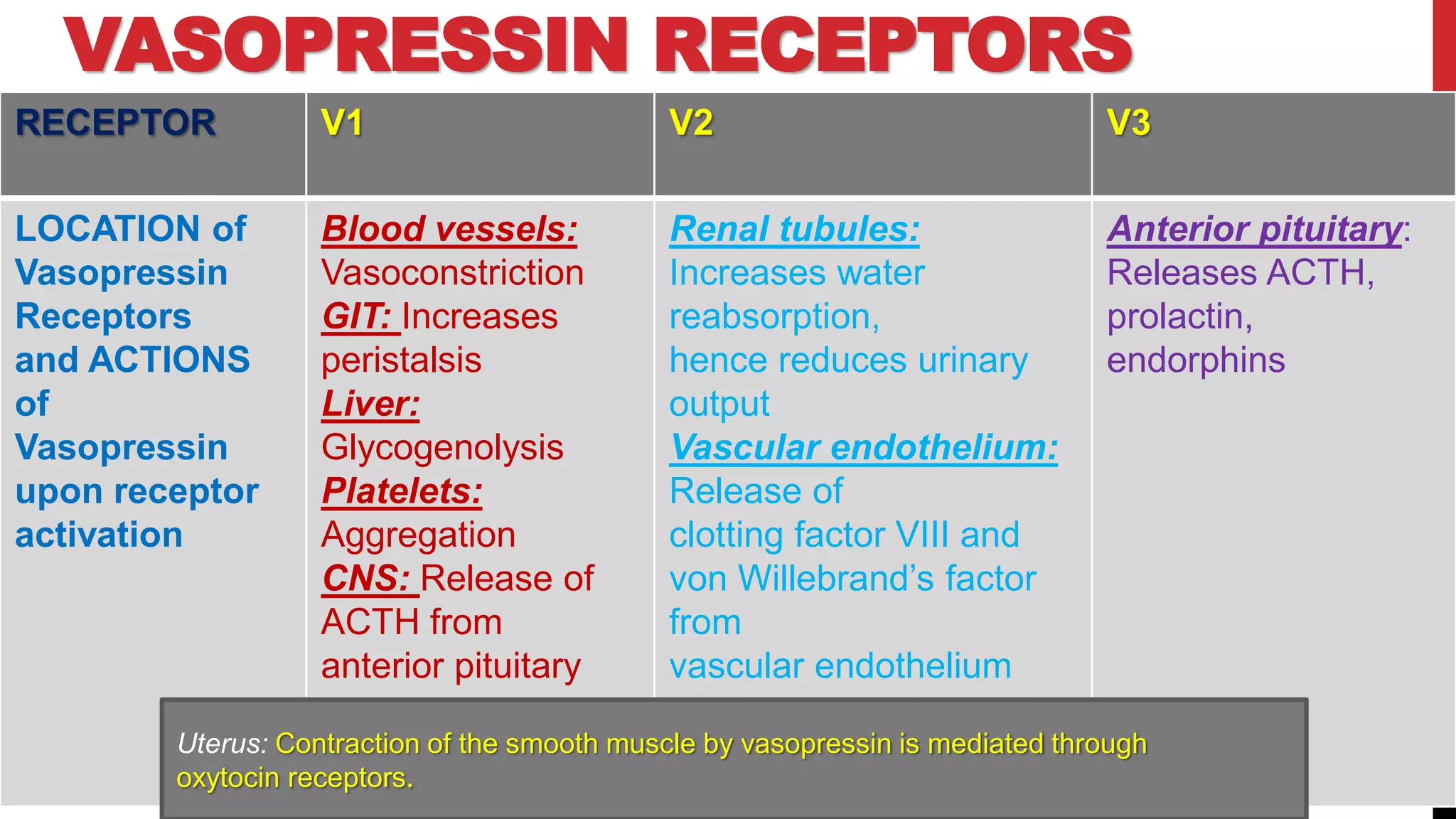
VASOPRESSIN RECEPTORS
RECEPTOR V1 V2 V3
LOCATION of
Vasopressin
Receptors
and ACTIONS
of
Vasopressin
upon receptor
activation
Blood vessels:
Vasoconstriction
GIT: Increases
peristalsis
Liver:
Glycogenolysis
Platelets:
Aggregation
CNS: Release of
ACTH from
anterior pituitary
Renal tubules:
Increases water
reabsorption,
hence reduces urinary
output
Vascular endothelium:
Release of
clotting factor VIII and
von Willebrand’s factor
from
vascular endothelium
Anterior pituitary:
Releases ACTH,
prolactin,
endorphins
Uterus: Contraction of the smooth muscle by vasopressin is mediated through
oxytocin receptors.
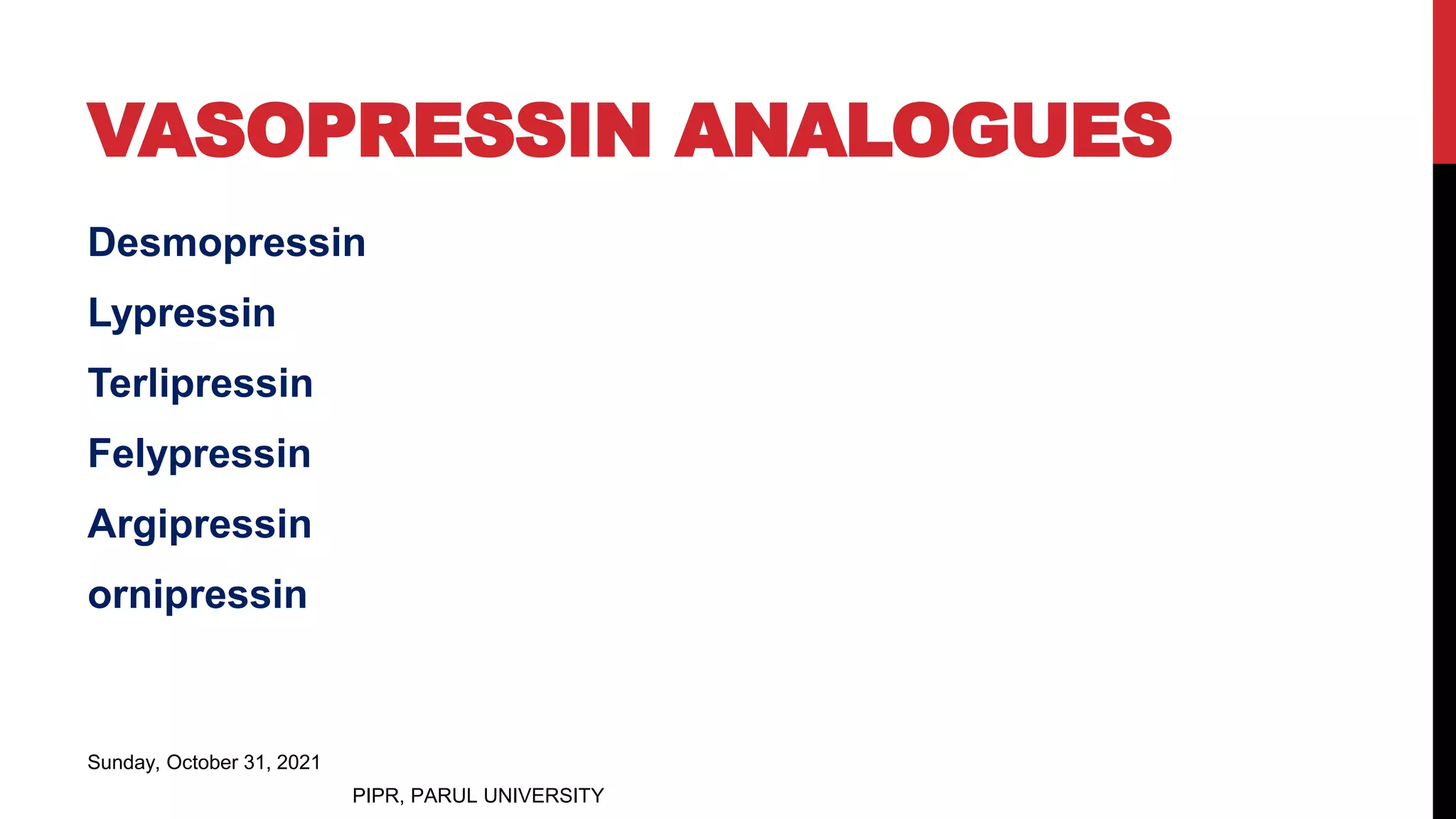
VASOPRESSIN ANALOGUES
Desmopressin
Lypressin
Terlipressin
Felypressin
Argipressin
ornipressin
Sunday, October 31, 2021
PIPR, PARUL UNIVERSITY
VASOPRESSIN ANALOGUES
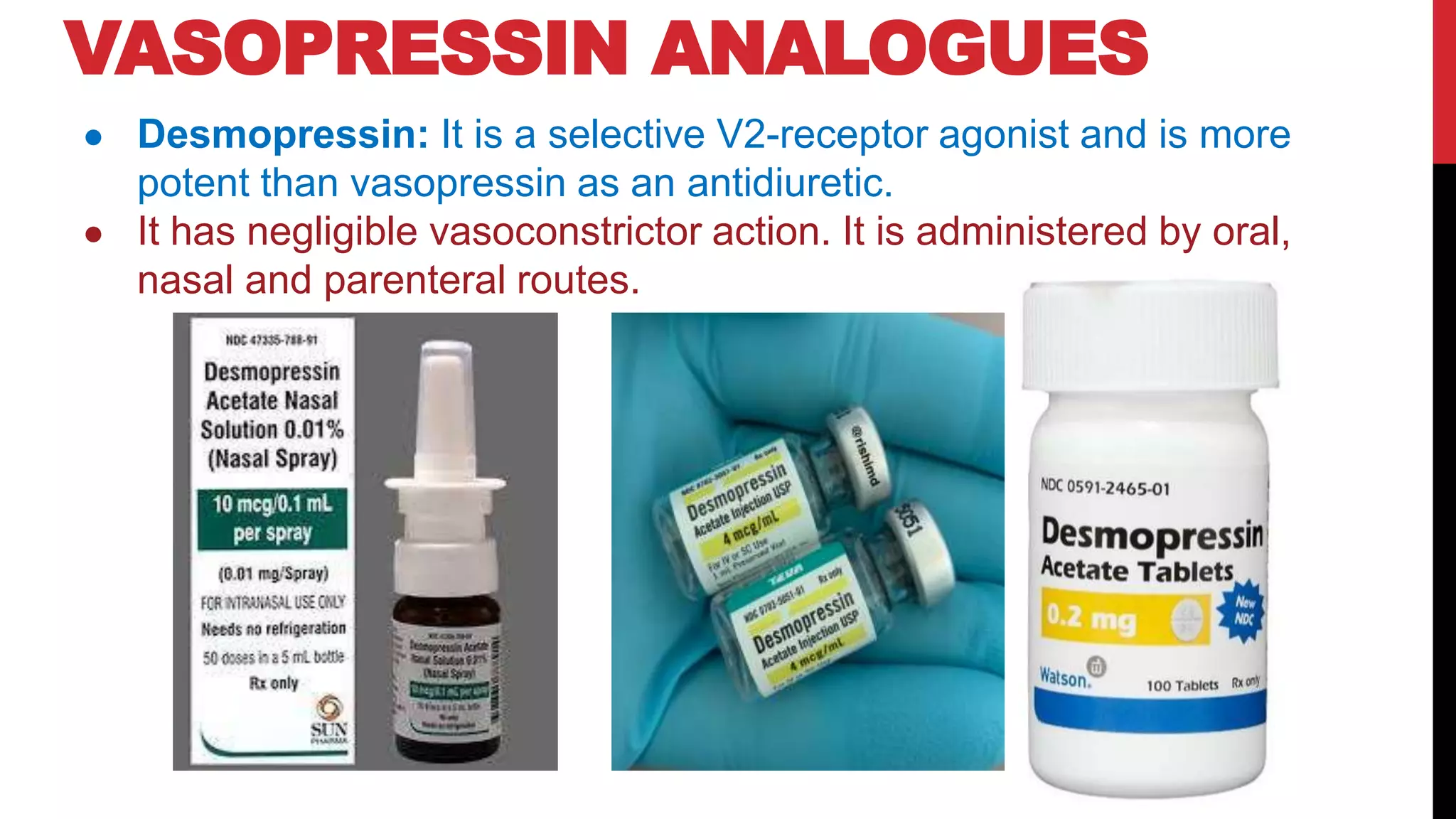
● Desmopressin: It is a selective V2-receptor agonist and is more
potent than vasopressin as an antidiuretic.
● It has negligible vasoconstrictor action. It is administered by oral,
nasal and parenteral routes.
USES OF DESMOPRESSIN
● USED IN Haemophilia and von Willebrand’s disease:
Desmopressin, administered intravenously, controls bleeding by
increasing factor VIII and von Willebrand’s factor.
● Primary nocturnal enuresis: Administration of desmopressin at
bedtime reduces nocturnal urine volume.
● Neurogenic diabetes insipidus (DI): Desmopressin is the drug of
choice.
● DI is a condition characterized by excretion of large volume of urine
either due to
● Neurogenic DI: Decreased secretion of ADH from the
neurohypophysis or due to
● Nephrogenic DI: inadequate renal tubular response to ADH.
● OTHER DRUGS TO REMEMBER:
● Thiazides are useful for both central and nephrogenic DI.
● Amiloride is used for the treatment of lithium-induced nephrogenic DI.
● Indomethacin reduces urine volume in nephrogenic DI by inhibiting
renal prostaglandin synthesis.
● Lypressin: It acts on both V1 and V2 receptors. It is less potent but
longer acting than vasopressin. It is administered parenterally.
● Terlipressin: It is a prodrug of vasopressin with selective V1 action.
It is administered intravenously.
● USAGE:
● For emergency control of bleeding oesophageal varices: ADH
controls bleeding by constricting mesenteric blood vessels.
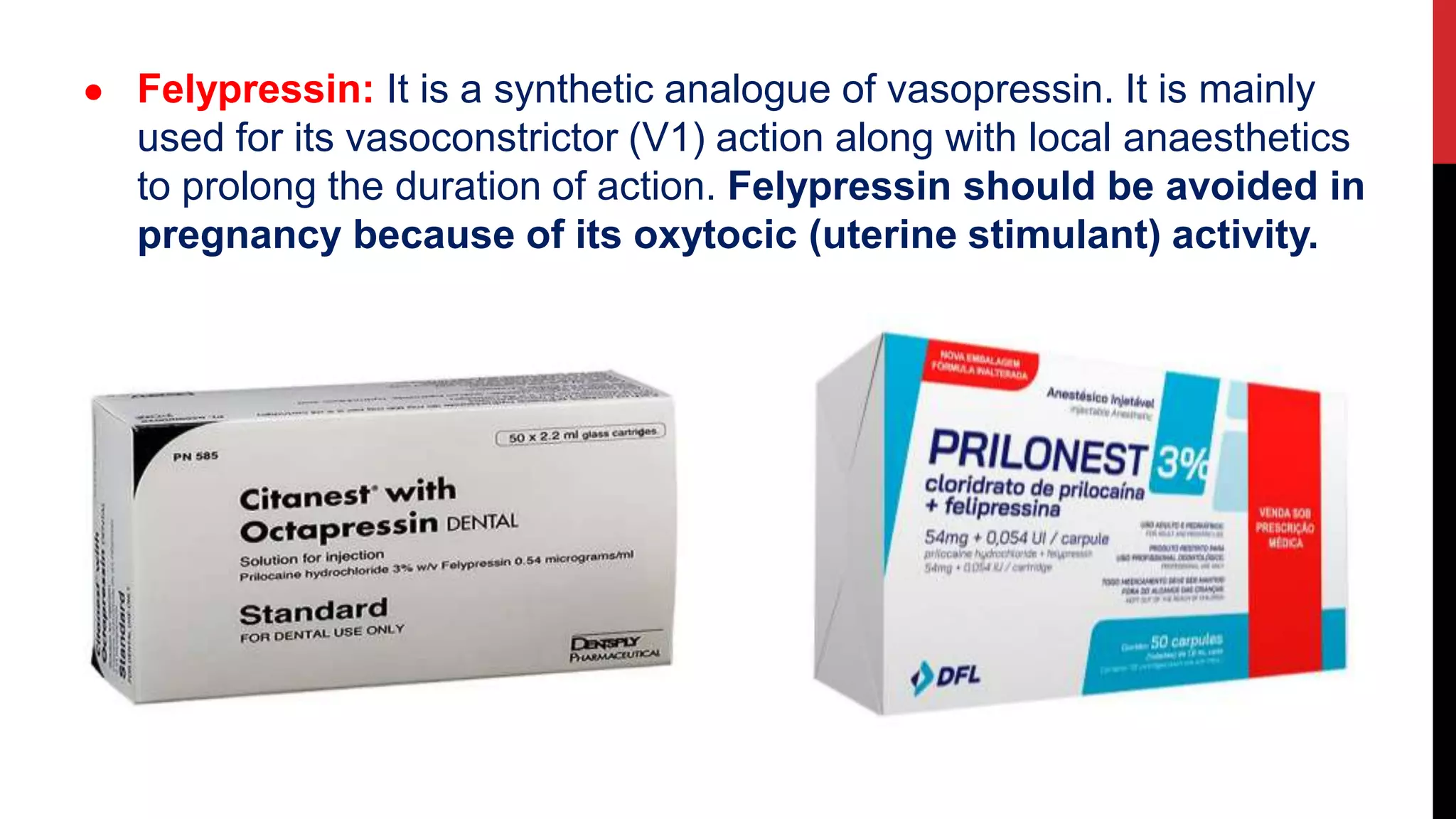
● Felypressin: It is a synthetic analogue of vasopressin. It is mainly
used for its vasoconstrictor (V1) action along with local anaesthetics
to prolong the duration of action. Felypressin should be avoided in
pregnancy because of its oxytocic (uterine stimulant) activity.
ADVERSE EFFECTS
● Nausea, vomiting, diarrhoea, belching and abdominal cramps.
● Backache is due to uterine contraction.
● Intranasal administration may cause local irritation and ulceration.
● Fluid retention and hyponatraemia can occur.
THANK YOU

Vasopressin PHARMACOLOGY

  • 1.
    VASOPRESSIN Dr. S PSRINIVAS NAYAK, PharmD, RPh, (MSc), (PGDND) (PhD) ASSISTANT PROFESSOR, DEPT. OF PHARMACY PRACTICE, PU.
  • 2.
    • Vasopressin anarginine vasopressin (AVP) • Also called as antidiuretic hormone (ADH) • It is a peptide hormone synthesized in the supraoptic and paraventricular nuclei of the hypothalamus and stored in posterior pituitary VASOPRESSIN
  • 3.
    Sunday, October 31,2021 PIPR, PARUL UNIVERSITY
  • 4.
    VASOPRESSIN RECEPTORS RECEPTOR V1V2 V3 LOCATION of Vasopressin Receptors and ACTIONS of Vasopressin upon receptor activation Blood vessels: Vasoconstriction GIT: Increases peristalsis Liver: Glycogenolysis Platelets: Aggregation CNS: Release of ACTH from anterior pituitary Renal tubules: Increases water reabsorption, hence reduces urinary output Vascular endothelium: Release of clotting factor VIII and von Willebrand’s factor from vascular endothelium Anterior pituitary: Releases ACTH, prolactin, endorphins Uterus: Contraction of the smooth muscle by vasopressin is mediated through oxytocin receptors.
  • 5.
  • 6.
    VASOPRESSIN ANALOGUES ● Desmopressin:It is a selective V2-receptor agonist and is more potent than vasopressin as an antidiuretic. ● It has negligible vasoconstrictor action. It is administered by oral, nasal and parenteral routes.
  • 7.
    USES OF DESMOPRESSIN ●USED IN Haemophilia and von Willebrand’s disease: Desmopressin, administered intravenously, controls bleeding by increasing factor VIII and von Willebrand’s factor. ● Primary nocturnal enuresis: Administration of desmopressin at bedtime reduces nocturnal urine volume.
  • 8.
    ● Neurogenic diabetesinsipidus (DI): Desmopressin is the drug of choice. ● DI is a condition characterized by excretion of large volume of urine either due to ● Neurogenic DI: Decreased secretion of ADH from the neurohypophysis or due to ● Nephrogenic DI: inadequate renal tubular response to ADH. ● OTHER DRUGS TO REMEMBER: ● Thiazides are useful for both central and nephrogenic DI. ● Amiloride is used for the treatment of lithium-induced nephrogenic DI. ● Indomethacin reduces urine volume in nephrogenic DI by inhibiting renal prostaglandin synthesis.
  • 9.
    ● Lypressin: Itacts on both V1 and V2 receptors. It is less potent but longer acting than vasopressin. It is administered parenterally.
  • 10.
    ● Terlipressin: Itis a prodrug of vasopressin with selective V1 action. It is administered intravenously. ● USAGE: ● For emergency control of bleeding oesophageal varices: ADH controls bleeding by constricting mesenteric blood vessels.
  • 11.
    ● Felypressin: Itis a synthetic analogue of vasopressin. It is mainly used for its vasoconstrictor (V1) action along with local anaesthetics to prolong the duration of action. Felypressin should be avoided in pregnancy because of its oxytocic (uterine stimulant) activity.
  • 12.
    ADVERSE EFFECTS ● Nausea,vomiting, diarrhoea, belching and abdominal cramps. ● Backache is due to uterine contraction. ● Intranasal administration may cause local irritation and ulceration. ● Fluid retention and hyponatraemia can occur.
  • 13.