SUXAMETHONIUM
Other names (Dacetylcholine or Succinylcholine )
By: Kpehe Jig Maimie, M.D.
ANESTHESIA DEPARTMENT
Amino Kano Teaching Hospital, Zaria Rd, Kano
OUTLINE
 Introduction
 Description of Events at Neuromuscular Junction
 Classification of Neuromuscular Blocking Agents
 Depolarizing Neuromuscular Blocking Agents
 Succinylcholine
Mechanism of Action
Pharmokinetics
Effect Plasma Cholinesterase Deficiency
Indications
Contra – indications
Complications
INTRODUCTION
ļ‚§ The Only Depolarizing Muscle Relaxant in clinical use
ļ‚§ Discovered by REID HUNT and RENƉ DE M. TAVEAU in 1906 .
ļ‚§ DANIEL BOVET in 1949, described the chemical & physiological
properties of SCh
ļ‚§ SCh was introduced in clinical practice around 1951
ļ‚§ Since its arrival, SCh remains the best drug for tracheal intubation
Events at Neuromuscular Junction
Classification of Neuromuscular Blocking Agent
• NMBAs are classified into:
a) Depolarizing NMBAs
- Noncompetitive
- Binds directly with nAChRs →
prolonged depolarization
b) Non-depolarizing NMBAs
- Competitive
ļ‚§ - Competes with ACh to bind at nAChRs thus, preventing the initiation
of action potential.
Depolarizing NMBA
• Consists of
ļ‚§ Succinylcholine
 available in clinical practice
 Composed of 2 molecules of Acetylcholine
Linked back to back by Acetate methyl group
formed by esterification of succinic acid with
choline
quaternary ammonium compound
Molecular wt = 290.9 g/mol
ļ‚§ Decamethonium
- use for research purposes
Succinylcholine
Ultra fast onset & half life of all NMBAs
Mechanism of Action
ļ‚§ Mimics the effects of Acetycholine (Agonist)
- Binds to Nicotinic Receptors → Open Na+ Channels → depolarization of end plates
ļ‚§ Block neurotransmission after initial stimulation
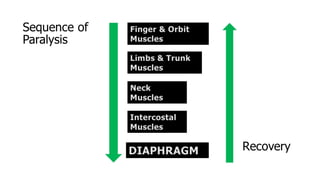
ļ‚§ Achieved through a Biphasic Action of SCh on muscles
a) PHASE I (Depolarizing Phase)
o Membrane depolarizes producing initial discharge
o This results into the transient fasciculation's followed by flaccid paralysis
<
b) PHASE I (Desensitizing Phase)
o Membrane repolarizes
o However, the receptors are desensitized to the effects of ACh
Dosing & Onset of Action
 Route of Administration - IV & IM
 IV dose of 1 to 1.5 mg/kg, or 3 to 5 x ED95,
- yields flaccid paralysis & profound block within 1 to 2 minutes.
 If IV access is unavailable, SCh is given intramuscularly
(3 to 4 mg/kg)
- paralysis will occur in approximately 4 minutes.
 Administered via Infusion for Electroconvulsive Therapy
ā–ŗā–ŗ Recovery begins within 3min after NM blockade & ends within 12–15min
Pharmacokinetics
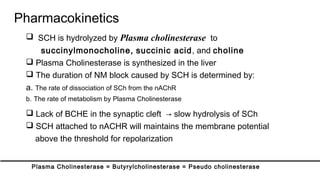
 SCH is hydrolyzed by Plasma cholinesterase to
succinylmonocholine, succinic acid, and choline <
 Plasma Cholinesterase is synthesized in the liver
 The duration of NM block caused by SCH is determined by:
a. The rate of dissociation of SCh from the nAChR
b. The rate of metabolism by Plasma Cholinesterase
 Lack of BCHE in the synaptic cleft → slow hydrolysis of SCh
 SCH attached to nACHR will maintains the membrane potential
above the threshold for repolarization
Plasma Cholinesterase = Butyrylcholinesterase = Pseudo cholinesterase
Effect of Plasma cholinesterase deficiency
ļ‚§ Causes prolonged recovery from SCh
- Can be : - Inherited or Acquired
ļ‚§ Inherited Causes
- genetically, atypical [ Ea
1] occurs in about 4% of Caucasian population
- Heterozygote for atypical [Ea
1 Ea
1 ] prolong recovery from SCh by 30mins
- Homozygote for atypical [Ea
1 Ea
1 ] recovery may exceed 2 hrs
- A rarer abnormality recognized as silent [Es
1 ], homozygote state may
exceed 3hrs
 Normal Enzyme structure but reduce activity
 NM blockade prolonged by minutes rather than hours
o Liver disease
o Carcinomatosis & Starvation
o Pregnancy
o Anticholinesterase
o Hypothyroidism
o Hypothermia
o Renal disease
o Advanced age
o Major burns
Acquired Causes
Drugs
Indications
 Medical Procedures requiring short term muscle paralysis
ļ‚§ Endotracheal Intubation - RSII
ļ‚§ Neuromuscular Surgeries
ļ‚§ Electroconvulsive therapy
ļ‚§ Orthopedics surgery
Fractures alignment & correction of dislocation
ļ‚§ Procedures
eg: laryngoscopy, bronchoscopy, esophagoscopy
Contra – Indications
ļ‚§ Muscular disorders
Muscular Dystrophy,
Myasthenia gravis
Crush Injury
Rhabdomylosis
ļ‚§ Burns
ļ‚§ Glaucoma
ļ‚§ Head injury
ļ‚§ Neurological Disorders
Gullain Barre Syn
Stroke Paralysis
- Paraplegia
- Hemiplegia
Complications of
Succinylcholine
 Fasciculation
 Hyperkalemia
 Bradycardia
 Myalgia
 Prolonged NMB
 Increased Intraocular Pressure
 Increased Intragastric Pressure
 Anaphylaxis
 Malignant hyperthermia
References
ļ‚§ Allan R. Aitkenhead et al ā€˜Smith & Aitkenhead Textbook of
Anesthesia’, 6th
Edition, 2013
ļ‚§ John F. Butterwork et al ā€˜Morgan & Mikhail’s Clinical Anesthesiology’ ,
5th
Edition, 2013
ļ‚§ Keith G. Hilman et al ā€˜ Oxford Handbook of Anesthesiaā€ , 4th
Edition,
2016
ļ‚§ Manuel R. Pardo & Roland D. Miller ā€˜Basics Science of Anesthesia’
7th
Edition, 2018
ļ‚§ Uptodate Clinical Research Tool
ļ‚§ Video (Youtube)
Nagode