A Micro Project Report.
Submitted in the Partial Fulfilment of the Requirement for the
"Third Semester Diploma in Mechanical Engineering
Under the guidance of
Dr . Minakshi Deshpande.
(Lecturer Mechanical Engineering Dept.)
GOVERNMENT POLYTECHNIC THANEPHADKEPADA, OPS BHARAT GEARS
LTD.MUMBRA-SHIL PHATA ROAD THANE 4006122021-2022
This is to certify that the micro project report entitled
Zener diode
"Submitted to the Maharashtra State Board of Technical Education, Mumbai. For
partial fulfilment of the requirement for the award of Third Semester Diploma in
Mechanical b. Engineering during the academic year 2021-2022
PROF
( Head of Department) Dr.Minakshi Deshpande
(lect.in M.E Department)
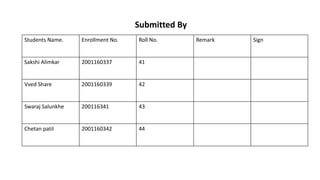
Students Name. Enrollment No. Roll No. Remark Sign
Sakshi Alimkar 2001160337 41
Vved Share 2001160339 42
Swaraj Salunkhe 200116341 43
Chetan patil 2001160342 44
Submitted By
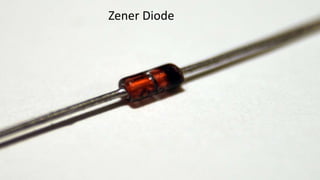
Zener Diode
Introduction.
A Zener diode is a particular type of diode that allows current to flow not only from its anode to
its cathode ,but also in the reverse direction when the so-called "Zener voltage is reached.
Carence Melvin Zener the American physicist invented Zener diode.
A Zener diode is a special type of diode designed to allow current to flow
"backwards" when a certain set reverse voltage, known as the Zener volt-
-age, is reached.
Zener diodes are manufactured with a great variety of Zener voltages
and some are even variable. Some Zener diodes have a sharp, highly
doped p–n junction with a low Zener voltage, in which case the reverse
conduction occurs due to electron quantum tunnelling in the short space
between p and n regions − this is known as the Zener effect, after Clarence Zener. Diodes with a
higher Zener voltage have a more gradual junction and their mode of operation also involves
avalanche breakdown. Both breakdown types are present in Zener diodes with the Zener effect
predominating at lower voltages and avalanche breakdown at higher voltages.
Zener diode not only allows current to flow from anode to cathode but also, in the reverse
direction on reaching the Zener voltage. Due to this functionality, Zener diodes are more
commonly used as semiconductor diodes. In this article, let us learn the function of Zener diodes
along with its construction, operation and more . Zener Diode Explanation-A Zener Diode, also
known as a breakdown diode, is a heavily doped semiconductor device that is designed to
operate in the reverse direction.
When the voltage across the terminals of a Zener diode is reversed and the potential reaches the
Zener Voltage (knee voltage), the junction breaks down and the current flows in the reverse
direction. This effect is known as the Zener Effect . Zener Diode Definition A Zener diode is a
heavily doped semiconductor device that is designed to operate in the reverse direction.
Zener diodes are widely used in electronic equipment of all kinds and are one of the basic
building blocks of electronic circuits. They are used to generate low-power stabilized supply rails
from a higher voltage and to provide reference voltages for circuits, especially stabilized power
supplies. They are also used to protect circuits from overvoltage, especially electrostatic
discharge (ESD).
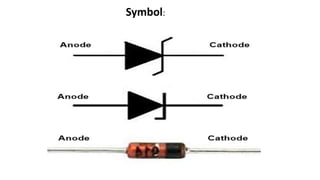
Symbol:
How Zener Diodes Regulate Voltage?
If larger regulated voltages are required, we could either use more diodes in series or try a
fundamentally different approach.
We know that diode forward voltage is a fairly constant figure under a wide range of conditions,
but so is reverse breakdown voltage. Breakdown voltage is typically much, much greater than
forward voltage.
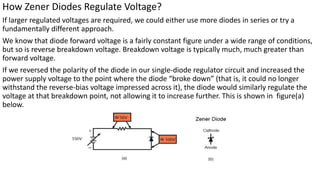
If we reversed the polarity of the diode in our single-diode regulator circuit and increased the
power supply voltage to the point where the diode “broke down” (that is, it could no longer
withstand the reverse-bias voltage impressed across it), the diode would similarly regulate the
voltage at that breakdown point, not allowing it to increase further. This is shown in figure(a)
below.
(a) Reverse biased Si small-signal diode breaks down at about 100V. (b) Symbol for Zener diode.
Unfortunately, when normal rectifying diodes “break down,” they usually do so destructively.
However, it is possible to build a special type of diode that can handle breakdown without failing
completely. This type of diode is called a Zener diode, and its symbol is shown in the figure(b)
above .
When forward-biased, Zener diodes behave much the same as standard rectifying diodes: they
have a forward voltage drop which follows the “diode equation” and is about 0.7 volts. In
reverse-bias mode, they do not conduct until the applied voltage reaches or exceeds the so-
called Zener voltage, at which point the diode is able to conduct substantial current, and in doing
so will try to limit the voltage dropped across it to that Zener voltage point.
So long as the power dissipated by this reverse current does not exceed the diode’s thermal
limits, the diode will not be harmed. For this reason, Zener diodes are sometimes referred to as
“breakdown diodes.”
Zener Diode Circuit
Zener diodes are manufactured with Zener voltages ranging anywhere from a few volts to hundreds of
volts. This
Zener voltage changes slightly with temperature, and like common carbon-composition resistor values,
may be anywhere from 5 percent to 10 percent in error from the manufacturer’s specifications. However,
this stability and accuracy is generally good enough for the Zener diode to be used as a voltage regulator
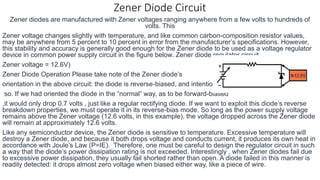
device in common power supply circuit in the figure below. Zener diode regulator circuit,
Zener voltage = 12.6V)
Zener Diode Operation Please take note of the Zener diode’s
orientation in the above circuit: the diode is reverse-biased, and intentionally
so. If we had oriented the diode in the “normal” way, as to be forward-biased
,it would only drop 0.7 volts , just like a regular rectifying diode. If we want to exploit this diode’s reverse
breakdown properties, we must operate it in its reverse-bias mode. So long as the power supply voltage
remains above the Zener voltage (12.6 volts, in this example), the voltage dropped across the Zener diode
will remain at approximately 12.6 volts.
Like any semiconductor device, the Zener diode is sensitive to temperature. Excessive temperature will
destroy a Zener diode, and because it both drops voltage and conducts current, it produces its own heat in
accordance with Joule’s Law (P=IE). Therefore, one must be careful to design the regulator circuit in such
a way that the diode’s power dissipation rating is not exceeded. Interestingly , when Zener diodes fail due
to excessive power dissipation, they usually fail shorted rather than open. A diode failed in this manner is
readily detected: it drops almost zero voltage when biased either way, like a piece of wire.
As Voltage Regulator.
• In a DC circuit. Zener diode can be used as a voltage regulator or to provide voltage reference.
• The main use of zener diode lies in the fact that the voltage across a Zener diode remains
constant for a larger change in current.
• This makes it possible to use a Zener diode as a constantvoltage device or a voltage regulator.
• In any power supply circut, a regulator is used to provide aconstant output (load) voltage.
• While designing a voltage regulator using zener diode
• The latter is chosen with respect to its maximum power rating.
• The maximum current through the device should be
• Imax= PowerZaner Voltage
• Since the input voltage and the required output voltage is known.
• It is easier to choose a zener diode with a voltage approximately equal to the load
voltage.i.e.Vz=Vo
• The value of the series resistor is chosen to be
• R (Vin Vz)(Iz min + II.), where IL=Load Voltage/Load Lesistance
• It is advisable to use a forward biased diode in series with the Zener diode
• This is because the Zener diode at higher voltage follows the avalanche
breakdown principle, having a positive temperature of coefficient.
• Hence a negative temperature coefficient diode is used for compensation.
Resources
zenerdiode-definition-vicharacteristics-
breakdowns
https://www.britannica.com/technology/voltage-
regulator
https://www.electrical4u.com/what-is-zener-
diode
EVALUATION SHEET FOR MICROPROJECT
Academic Year:(2020-2021)
Roll No of the student:41 to 44
Subject: Bee( electronics)
Course: ME-31
Title of the project : Zener diode
Outcome: Locate the Zener voltage on the given V-l
characteristic with justification .
Bee Electronic microproject Roll No.41 to 44.pptx

Bee Electronic microproject Roll No.41 to 44.pptx

  • 1.
    A Micro ProjectReport. Submitted in the Partial Fulfilment of the Requirement for the "Third Semester Diploma in Mechanical Engineering Under the guidance of Dr . Minakshi Deshpande. (Lecturer Mechanical Engineering Dept.) GOVERNMENT POLYTECHNIC THANEPHADKEPADA, OPS BHARAT GEARS LTD.MUMBRA-SHIL PHATA ROAD THANE 4006122021-2022
  • 2.
    This is tocertify that the micro project report entitled Zener diode "Submitted to the Maharashtra State Board of Technical Education, Mumbai. For partial fulfilment of the requirement for the award of Third Semester Diploma in Mechanical b. Engineering during the academic year 2021-2022 PROF ( Head of Department) Dr.Minakshi Deshpande (lect.in M.E Department)
  • 3.
    Students Name. EnrollmentNo. Roll No. Remark Sign Sakshi Alimkar 2001160337 41 Vved Share 2001160339 42 Swaraj Salunkhe 200116341 43 Chetan patil 2001160342 44 Submitted By
  • 4.
  • 5.
    Introduction. A Zener diodeis a particular type of diode that allows current to flow not only from its anode to its cathode ,but also in the reverse direction when the so-called "Zener voltage is reached. Carence Melvin Zener the American physicist invented Zener diode. A Zener diode is a special type of diode designed to allow current to flow "backwards" when a certain set reverse voltage, known as the Zener volt- -age, is reached. Zener diodes are manufactured with a great variety of Zener voltages and some are even variable. Some Zener diodes have a sharp, highly doped p–n junction with a low Zener voltage, in which case the reverse conduction occurs due to electron quantum tunnelling in the short space between p and n regions − this is known as the Zener effect, after Clarence Zener. Diodes with a higher Zener voltage have a more gradual junction and their mode of operation also involves avalanche breakdown. Both breakdown types are present in Zener diodes with the Zener effect predominating at lower voltages and avalanche breakdown at higher voltages.
  • 6.
    Zener diode notonly allows current to flow from anode to cathode but also, in the reverse direction on reaching the Zener voltage. Due to this functionality, Zener diodes are more commonly used as semiconductor diodes. In this article, let us learn the function of Zener diodes along with its construction, operation and more . Zener Diode Explanation-A Zener Diode, also known as a breakdown diode, is a heavily doped semiconductor device that is designed to operate in the reverse direction. When the voltage across the terminals of a Zener diode is reversed and the potential reaches the Zener Voltage (knee voltage), the junction breaks down and the current flows in the reverse direction. This effect is known as the Zener Effect . Zener Diode Definition A Zener diode is a heavily doped semiconductor device that is designed to operate in the reverse direction. Zener diodes are widely used in electronic equipment of all kinds and are one of the basic building blocks of electronic circuits. They are used to generate low-power stabilized supply rails from a higher voltage and to provide reference voltages for circuits, especially stabilized power supplies. They are also used to protect circuits from overvoltage, especially electrostatic discharge (ESD).
  • 7.
  • 8.
    How Zener DiodesRegulate Voltage? If larger regulated voltages are required, we could either use more diodes in series or try a fundamentally different approach. We know that diode forward voltage is a fairly constant figure under a wide range of conditions, but so is reverse breakdown voltage. Breakdown voltage is typically much, much greater than forward voltage. If we reversed the polarity of the diode in our single-diode regulator circuit and increased the power supply voltage to the point where the diode “broke down” (that is, it could no longer withstand the reverse-bias voltage impressed across it), the diode would similarly regulate the voltage at that breakdown point, not allowing it to increase further. This is shown in figure(a) below.
  • 9.
    (a) Reverse biasedSi small-signal diode breaks down at about 100V. (b) Symbol for Zener diode. Unfortunately, when normal rectifying diodes “break down,” they usually do so destructively. However, it is possible to build a special type of diode that can handle breakdown without failing completely. This type of diode is called a Zener diode, and its symbol is shown in the figure(b) above . When forward-biased, Zener diodes behave much the same as standard rectifying diodes: they have a forward voltage drop which follows the “diode equation” and is about 0.7 volts. In reverse-bias mode, they do not conduct until the applied voltage reaches or exceeds the so- called Zener voltage, at which point the diode is able to conduct substantial current, and in doing so will try to limit the voltage dropped across it to that Zener voltage point. So long as the power dissipated by this reverse current does not exceed the diode’s thermal limits, the diode will not be harmed. For this reason, Zener diodes are sometimes referred to as “breakdown diodes.”
  • 10.
    Zener Diode Circuit Zenerdiodes are manufactured with Zener voltages ranging anywhere from a few volts to hundreds of volts. This Zener voltage changes slightly with temperature, and like common carbon-composition resistor values, may be anywhere from 5 percent to 10 percent in error from the manufacturer’s specifications. However, this stability and accuracy is generally good enough for the Zener diode to be used as a voltage regulator device in common power supply circuit in the figure below. Zener diode regulator circuit, Zener voltage = 12.6V) Zener Diode Operation Please take note of the Zener diode’s orientation in the above circuit: the diode is reverse-biased, and intentionally so. If we had oriented the diode in the “normal” way, as to be forward-biased ,it would only drop 0.7 volts , just like a regular rectifying diode. If we want to exploit this diode’s reverse breakdown properties, we must operate it in its reverse-bias mode. So long as the power supply voltage remains above the Zener voltage (12.6 volts, in this example), the voltage dropped across the Zener diode will remain at approximately 12.6 volts. Like any semiconductor device, the Zener diode is sensitive to temperature. Excessive temperature will destroy a Zener diode, and because it both drops voltage and conducts current, it produces its own heat in accordance with Joule’s Law (P=IE). Therefore, one must be careful to design the regulator circuit in such a way that the diode’s power dissipation rating is not exceeded. Interestingly , when Zener diodes fail due to excessive power dissipation, they usually fail shorted rather than open. A diode failed in this manner is readily detected: it drops almost zero voltage when biased either way, like a piece of wire.
  • 11.
    As Voltage Regulator. •In a DC circuit. Zener diode can be used as a voltage regulator or to provide voltage reference. • The main use of zener diode lies in the fact that the voltage across a Zener diode remains constant for a larger change in current. • This makes it possible to use a Zener diode as a constantvoltage device or a voltage regulator. • In any power supply circut, a regulator is used to provide aconstant output (load) voltage. • While designing a voltage regulator using zener diode • The latter is chosen with respect to its maximum power rating. • The maximum current through the device should be • Imax= PowerZaner Voltage • Since the input voltage and the required output voltage is known. • It is easier to choose a zener diode with a voltage approximately equal to the load voltage.i.e.Vz=Vo
  • 12.
    • The valueof the series resistor is chosen to be • R (Vin Vz)(Iz min + II.), where IL=Load Voltage/Load Lesistance • It is advisable to use a forward biased diode in series with the Zener diode • This is because the Zener diode at higher voltage follows the avalanche breakdown principle, having a positive temperature of coefficient. • Hence a negative temperature coefficient diode is used for compensation.
  • 13.
  • 14.
    EVALUATION SHEET FORMICROPROJECT Academic Year:(2020-2021) Roll No of the student:41 to 44 Subject: Bee( electronics) Course: ME-31 Title of the project : Zener diode Outcome: Locate the Zener voltage on the given V-l characteristic with justification .