Beyond Diagnostics: Insights and Recommendations from Remote Sensing
CIMMYT – México, December 2013

Stress detection using fluorescence,
narrow-band spectral indices and thermal
imagery acquired from manned and
unmanned aerial vehicles
Pablo Zarco-Tejada (JRC IES & IAS-CSIC)
http://quantalab.ias.csic.es
pablo.zarco@csic.es / pablo.zarco@jrc.ec.europa.eu
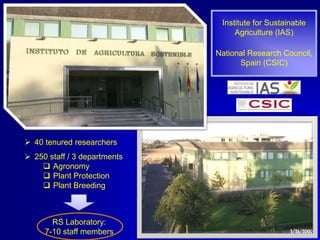
Institute for Sustainable
Agriculture (IAS)
National Research Council,
Spain (CSIC)

 40 tenured researchers

 250 staff / 3 departments
 Agronomy
 Plant Protection
 Plant Breeding

RS Laboratory:
7-10 staff members
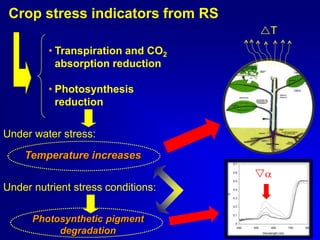
Crop stress indicators from RS
T
• Transpiration and CO2
absorption reduction
• Photosynthesis
reduction

Under water stress:
Temperature increases


Under nutrient stress conditions:
Photosynthetic pigment
degradation
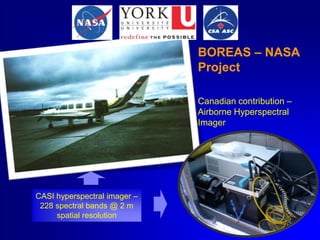
BOREAS – NASA
Project
Canadian contribution –
Airborne Hyperspectral
Imager

CASI hyperspectral imager –
228 spectral bands @ 2 m
spatial resolution
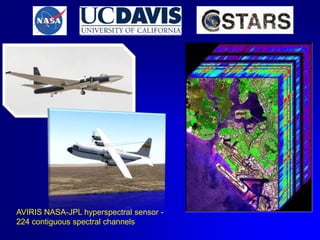
AVIRIS NASA-JPL hyperspectral sensor 224 contiguous spectral channels
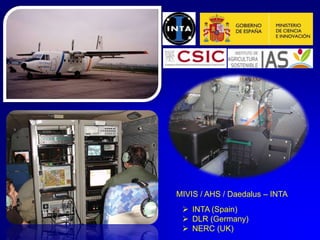
MIVIS / AHS / Daedalus – INTA
 INTA (Spain)
 DLR (Germany)
 NERC (UK)
Are these platforms
/ sensors “useful”
for our application ?
Questions
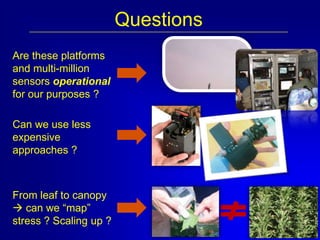
Are these platforms
and multi-million
sensors operational
for our purposes ?
Can we use less
expensive
approaches ?

From leaf to canopy
 can we “map”
stress ? Scaling up ?
Objectives
1. Identify pre-visual indicators of stress related to
physiological status (i.e. not only structure)
2. Evaluate thermal and hyperspectral indices in the context
of Precision Agriculture (and Phenotyping studies)
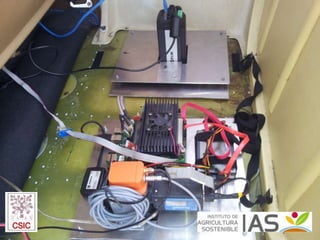
3. Test methods using micro-sensors on board UAVs and
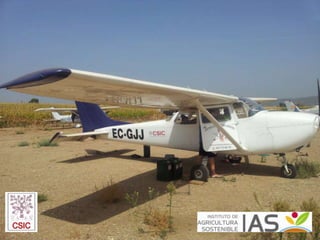
small manned aircraft platforms

4. Develop the facility to provide 24-hour turn-around times
for flights conducted over thousands of hectares
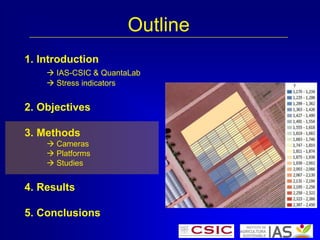
Outline
1. Introduction
 IAS-CSIC & QuantaLab
 Stress indicators

2. Objectives

3. Methods
 Cameras
 Platforms
 Studies

4. Results
5. Conclusions
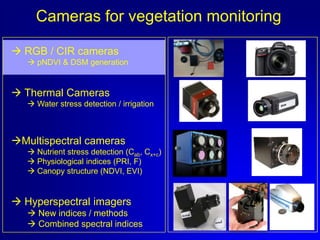
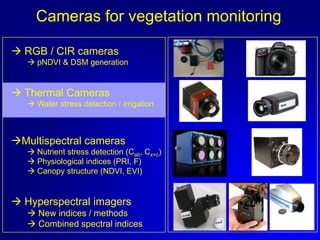
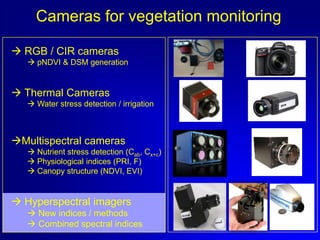
Cameras for vegetation monitoring
 RGB / CIR cameras
 pNDVI & DSM generation

 Thermal Cameras
 Water stress detection / irrigation

Multispectral cameras
 Nutrient stress detection (Cab, Cx+c)
 Physiological indices (PRI, F)
 Canopy structure (NDVI, EVI)

 Hyperspectral imagers
 New indices / methods
 Combined spectral indices
12

7 January 2014
Cameras for vegetation monitoring
 RGB / CIR cameras
 pNDVI & DSM generation

 Thermal Cameras
 Water stress detection / irrigation

Multispectral cameras
 Nutrient stress detection (Cab, Cx+c)
 Physiological indices (PRI, F)
 Canopy structure (NDVI, EVI)

 Hyperspectral imagers
 New indices / methods
 Combined spectral indices
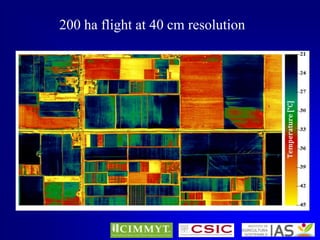
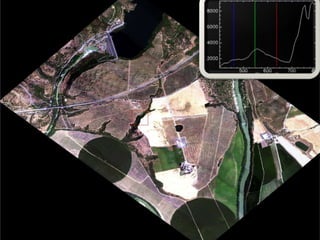
200 ha flight at 40 cm resolution
Cameras for vegetation monitoring
 RGB / CIR cameras
 pNDVI & DSM generation

 Thermal Cameras
 Water stress detection / irrigation

Multispectral cameras
 Nutrient stress detection (Cab, Cx+c)
 Physiological indices (PRI, F)
 Canopy structure (NDVI, EVI)

 Hyperspectral imagers
 New indices / methods
 Combined spectral indices
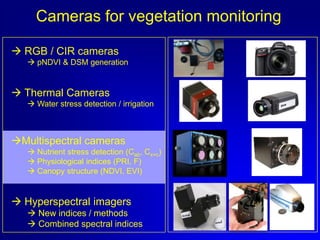
Cameras for vegetation monitoring
 RGB / CIR cameras
 pNDVI & DSM generation

 Thermal Cameras
 Water stress detection / irrigation

Multispectral cameras
 Nutrient stress detection (Cab, Cx+c)
 Physiological indices (PRI, F)
 Canopy structure (NDVI, EVI)

 Hyperspectral imagers
 New indices / methods
 Combined spectral indices
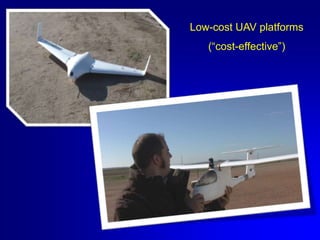
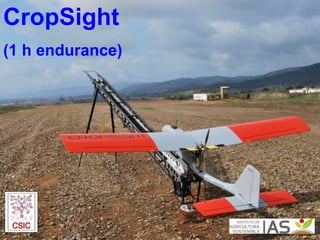
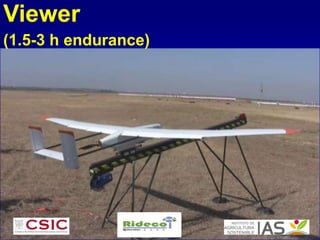
Low-cost UAV platforms
(“cost-effective”)
CropSight
(1 h endurance)
Viewer
(1.5-3 h endurance)
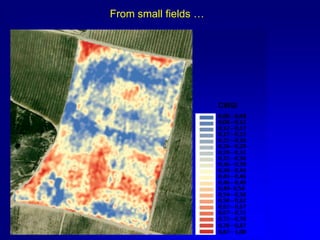
From small fields …
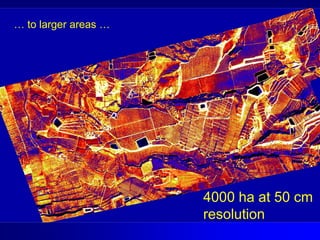
… to larger areas …

4000 ha at 50 cm
resolution
Outline
1. Introduction
 IAS-CSIC & QuantaLab
 Stress indicators

2. Objectives

3. Methods
 Cameras
 Platforms
 Studies

4. Results
5. Conclusions
Are these just
“pretty” pictures ?
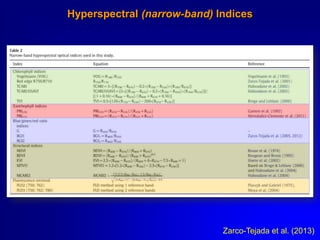
Hyperspectral (narrow-band) Indices

Zarco-Tejada et al. (2013)
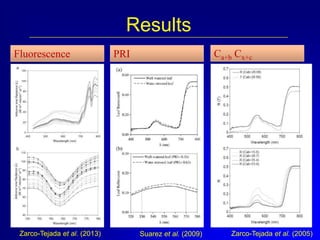
Results
Fluorescence

Zarco-Tejada et al. (2013)

Ca+b Cx+c

PRI

Suarez et al. (2009)

Zarco-Tejada et al. (2005)
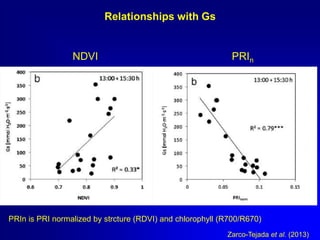
Relationships with Gs

NDVI

PRIn

PRIn is PRI normalized by strcture (RDVI) and chlorophyll (R700/R670)
Zarco-Tejada et al. (2013)
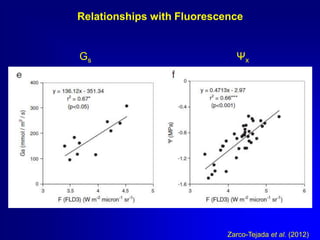
Relationships with Fluorescence

Gs

Ψx

Zarco-Tejada et al. (2012)
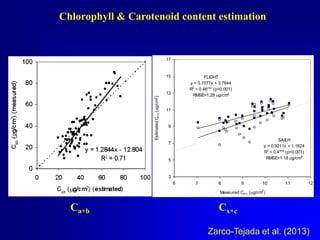
Chlorophyll & Carotenoid content estimation

17

15

FLIGHT
y = 0.7077x + 3.7644
R2 = 0.46*** (p<0.001)
RMSE=1.28 g/cm2

Estimated C ( g/cm2)
x+c

13

11

9
SAILH
y = 0.9211x + 1.1824
R2 = 0.4*** (p<0.001)
RMSE=1.18 g/cm2

7

5

3
6

7

8

9

10

11

12

Measured Cx+c ( g/cm2)

Ca+b

Cx+c
Zarco-Tejada et al. (2013)
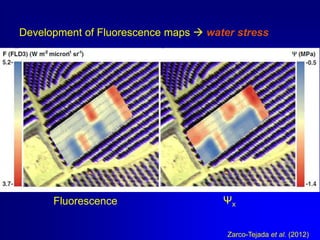
Development of Fluorescence maps  water stress

Fluorescence

Ψx
Zarco-Tejada et al. (2012)
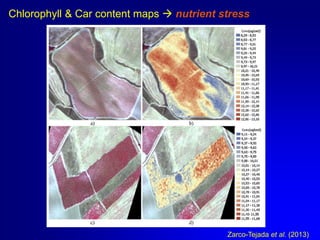
Chlorophyll & Car content maps  nutrient stress

Zarco-Tejada et al. (2013)
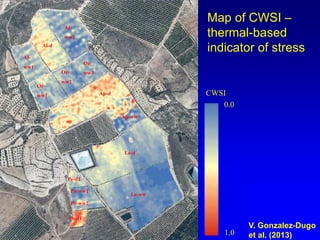
Map of CWSI –
thermal-based
indicator of stress

Alww2
Al-d
AlOr-

ww1

OrOr-

ww3

ww2

CWSI
0.0

Ap-d

ww1

Ap-ww

Le-d

Pe-d1
Pe-ww1

Le-ww

Pe-ww2
Pe-d1

1.0

V. Gonzalez-Dugo
et al. (2013)
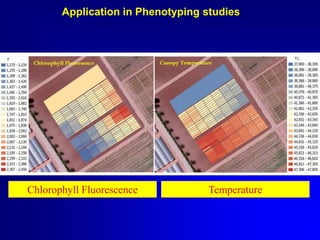
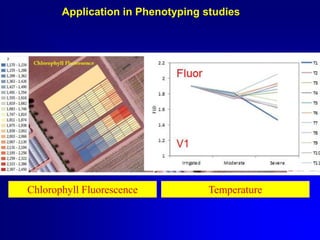
Application in Phenotyping studies

Chlorophyll Fluorescence

Temperature
Application in Phenotyping studies

Chlorophyll Fluorescence

Temperature
Conclusions
1. Micro-hyperspectral and thermal cameras on board UAVs
and manned aircrafts enable the generation of stress maps
2. F, T and narrow-band indices demonstrate good relationships
with physiological indicators such as Gs, x and Pn

3. F retrieval using the FLD principle from micro hyperspectral
cameras is feasible from manned and UAVs
4. Low-cost remote sensing platforms and sensors can be used
with success in precision farming, conservation agriculture
and phenotyping studies
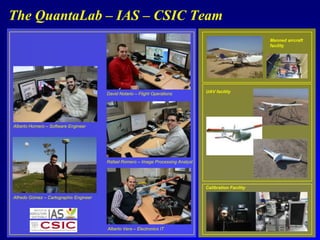
The QuantaLab – IAS – CSIC Team
Manned aircraft
facility

David Notario – Flight Operations

UAV facility

Alberto Hornero – Software Engineer

Rafael Romero – Image Processing Analyst

Calibration Facility
Alfredo Gómez – Cartographic Engineer

Alberto Vera – Electronics IT
Beyond Diagnostics: Insights and Recommendations from Remote Sensing
CIMMYT – México, December 2013

Stress detection using fluorescence,
narrow-band spectral indices and thermal
imagery acquired from manned and
unmanned aerial vehicles
Pablo Zarco-Tejada (JRC IES & IAS-CSIC)
http://quantalab.ias.csic.es
pablo.zarco@csic.es / pablo.zarco@jrc.ec.europa.eu

Stress detection using fluorescence, narrow-band spectral indices and thermal imagery acquired from manned and unmanned aerial vehicles

  • 1.
    Beyond Diagnostics: Insightsand Recommendations from Remote Sensing CIMMYT – México, December 2013 Stress detection using fluorescence, narrow-band spectral indices and thermal imagery acquired from manned and unmanned aerial vehicles Pablo Zarco-Tejada (JRC IES & IAS-CSIC) http://quantalab.ias.csic.es pablo.zarco@csic.es / pablo.zarco@jrc.ec.europa.eu
  • 2.
    Institute for Sustainable Agriculture(IAS) National Research Council, Spain (CSIC)  40 tenured researchers  250 staff / 3 departments  Agronomy  Plant Protection  Plant Breeding RS Laboratory: 7-10 staff members
  • 3.
    Crop stress indicatorsfrom RS T • Transpiration and CO2 absorption reduction • Photosynthesis reduction Under water stress: Temperature increases  Under nutrient stress conditions: Photosynthetic pigment degradation
  • 4.
    BOREAS – NASA Project Canadiancontribution – Airborne Hyperspectral Imager CASI hyperspectral imager – 228 spectral bands @ 2 m spatial resolution
  • 5.
    AVIRIS NASA-JPL hyperspectralsensor 224 contiguous spectral channels
  • 6.
    MIVIS / AHS/ Daedalus – INTA  INTA (Spain)  DLR (Germany)  NERC (UK)
  • 7.
    Are these platforms /sensors “useful” for our application ?
  • 8.
    Questions Are these platforms andmulti-million sensors operational for our purposes ? Can we use less expensive approaches ? From leaf to canopy  can we “map” stress ? Scaling up ?
  • 9.
    Objectives 1. Identify pre-visualindicators of stress related to physiological status (i.e. not only structure) 2. Evaluate thermal and hyperspectral indices in the context of Precision Agriculture (and Phenotyping studies) 3. Test methods using micro-sensors on board UAVs and small manned aircraft platforms 4. Develop the facility to provide 24-hour turn-around times for flights conducted over thousands of hectares
  • 10.
    Outline 1. Introduction  IAS-CSIC& QuantaLab  Stress indicators 2. Objectives 3. Methods  Cameras  Platforms  Studies 4. Results 5. Conclusions
  • 11.
    Cameras for vegetationmonitoring  RGB / CIR cameras  pNDVI & DSM generation  Thermal Cameras  Water stress detection / irrigation Multispectral cameras  Nutrient stress detection (Cab, Cx+c)  Physiological indices (PRI, F)  Canopy structure (NDVI, EVI)  Hyperspectral imagers  New indices / methods  Combined spectral indices
  • 12.
  • 13.
    Cameras for vegetationmonitoring  RGB / CIR cameras  pNDVI & DSM generation  Thermal Cameras  Water stress detection / irrigation Multispectral cameras  Nutrient stress detection (Cab, Cx+c)  Physiological indices (PRI, F)  Canopy structure (NDVI, EVI)  Hyperspectral imagers  New indices / methods  Combined spectral indices
  • 14.
    200 ha flightat 40 cm resolution
  • 15.
    Cameras for vegetationmonitoring  RGB / CIR cameras  pNDVI & DSM generation  Thermal Cameras  Water stress detection / irrigation Multispectral cameras  Nutrient stress detection (Cab, Cx+c)  Physiological indices (PRI, F)  Canopy structure (NDVI, EVI)  Hyperspectral imagers  New indices / methods  Combined spectral indices
  • 17.
    Cameras for vegetationmonitoring  RGB / CIR cameras  pNDVI & DSM generation  Thermal Cameras  Water stress detection / irrigation Multispectral cameras  Nutrient stress detection (Cab, Cx+c)  Physiological indices (PRI, F)  Canopy structure (NDVI, EVI)  Hyperspectral imagers  New indices / methods  Combined spectral indices
  • 19.
  • 20.
  • 21.
  • 24.
  • 25.
    … to largerareas … 4000 ha at 50 cm resolution
  • 26.
    Outline 1. Introduction  IAS-CSIC& QuantaLab  Stress indicators 2. Objectives 3. Methods  Cameras  Platforms  Studies 4. Results 5. Conclusions
  • 27.
  • 28.
  • 29.
    Results Fluorescence Zarco-Tejada et al.(2013) Ca+b Cx+c PRI Suarez et al. (2009) Zarco-Tejada et al. (2005)
  • 30.
    Relationships with Gs NDVI PRIn PRInis PRI normalized by strcture (RDVI) and chlorophyll (R700/R670) Zarco-Tejada et al. (2013)
  • 31.
  • 32.
    Chlorophyll & Carotenoidcontent estimation 17 15 FLIGHT y = 0.7077x + 3.7644 R2 = 0.46*** (p<0.001) RMSE=1.28 g/cm2 Estimated C ( g/cm2) x+c 13 11 9 SAILH y = 0.9211x + 1.1824 R2 = 0.4*** (p<0.001) RMSE=1.18 g/cm2 7 5 3 6 7 8 9 10 11 12 Measured Cx+c ( g/cm2) Ca+b Cx+c Zarco-Tejada et al. (2013)
  • 33.
    Development of Fluorescencemaps  water stress Fluorescence Ψx Zarco-Tejada et al. (2012)
  • 34.
    Chlorophyll & Carcontent maps  nutrient stress Zarco-Tejada et al. (2013)
  • 35.
    Map of CWSI– thermal-based indicator of stress Alww2 Al-d AlOr- ww1 OrOr- ww3 ww2 CWSI 0.0 Ap-d ww1 Ap-ww Le-d Pe-d1 Pe-ww1 Le-ww Pe-ww2 Pe-d1 1.0 V. Gonzalez-Dugo et al. (2013)
  • 36.
    Application in Phenotypingstudies Chlorophyll Fluorescence Temperature
  • 37.
    Application in Phenotypingstudies Chlorophyll Fluorescence Temperature
  • 38.
    Conclusions 1. Micro-hyperspectral andthermal cameras on board UAVs and manned aircrafts enable the generation of stress maps 2. F, T and narrow-band indices demonstrate good relationships with physiological indicators such as Gs, x and Pn 3. F retrieval using the FLD principle from micro hyperspectral cameras is feasible from manned and UAVs 4. Low-cost remote sensing platforms and sensors can be used with success in precision farming, conservation agriculture and phenotyping studies
  • 39.
    The QuantaLab –IAS – CSIC Team Manned aircraft facility David Notario – Flight Operations UAV facility Alberto Hornero – Software Engineer Rafael Romero – Image Processing Analyst Calibration Facility Alfredo Gómez – Cartographic Engineer Alberto Vera – Electronics IT
  • 40.
    Beyond Diagnostics: Insightsand Recommendations from Remote Sensing CIMMYT – México, December 2013 Stress detection using fluorescence, narrow-band spectral indices and thermal imagery acquired from manned and unmanned aerial vehicles Pablo Zarco-Tejada (JRC IES & IAS-CSIC) http://quantalab.ias.csic.es pablo.zarco@csic.es / pablo.zarco@jrc.ec.europa.eu