

P R E P A R E D B Y
J A N H A V I S O D H A
S E M – 7 , A P I P J A M N A G A R
G U I D E B Y : M R S . P O O J A K H A N P A R A
GALO
 Plant Part Used : stem
 Synonyms : Heartleaved Moonseed , Guduchi.
 Common Vernacular Names
 1) Sanskrit : Anirtavalf , Amrta , Madlitiparni ,
Guducika
 2) Gujarati : Galac , Garo .
 3) Hindi : Giloe , Gurcha .
 4) Kannada : Amrutaballi .
Biological source : It is consist of dried , matured
pieces of stem of Tinospora cordifolia Miers.
Family : Menispermaceae.
Distribution : It is an herbaceous vine and
indigenous to the tropical areas of India , Myanmar ,
Shrilanka.
The plant is a glabrous climbing shrub found
throughout India , typically growing in deciduous
and dry forests.
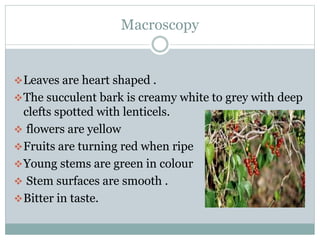
Macroscopy
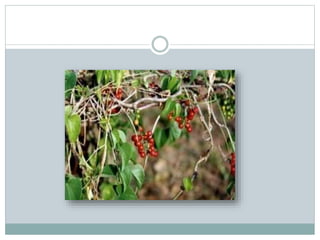
Leaves are heart shaped .
The succulent bark is creamy white to grey with deep
clefts spotted with lenticels.
 flowers are yellow
Fruits are turning red when ripe
Young stems are green in colour
 Stem surfaces are smooth .
Bitter in taste.
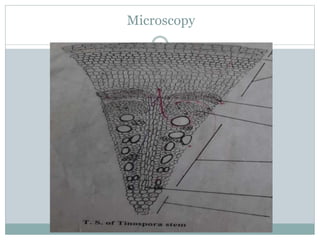
Microscopy
 Cork : 5 to 6 layers thick walled tangentionally
elongated cells with brownish pigments.
 Cortex : It consists of 3 to 5 layers of regularly
arranged cells of chlorenchyama and the inner side
cells are polygonal parenchyma which starch grains .
 Pericycle : 7 to 9 layers of lignified
sclerenchymatous cells , forming a continuous circle
of arches.
 Medullary rays : they are 2 to 8 seriate , 10to12 in
number , extended from pith to the cortex .
 Vascular bundles : 16-20 open and collateral.
Consist of :
 1) Phloem : Appear like caps over the metaxylem.
Calcium oxalate crystals present .
 2) Cambium : strip of thin wallled cambium cell.
 3) Xylem : Wedge shaped patches separated by
multiseriate medullary rays . Large number of
lignified pitted xylem vessels. Xylem parenchyma ,
tracheids and xylem fibres are comparatively less.
METHOD OF PREPARATION
 Guduchi satva is prepared from root braches and
stem pieces of Tinospora cordifolia .
 Upper thin skin is removed and bruished in stone or
in wooden mortar and ground to paste , soaked in
water for 6-12 hours.
 Material is mashed , rubbed, squeezed and separated
from the fluid by straining later through cloth.
 The fluid is evaporated in the sun and the residue is
genuine “Guduchi Satva”
CHENICAL CONSTITUENTS
Columbin , tinosporaside , tetrahydrofuran
Alkaloids like palmatine , berberine , jactrorhizine
,tembeterine.
Tinocordifolioside , cordifolioside A and B
Tinosporic acid , tinosporal , tinosporone.
COMMON USE
 Rejuvinator
 Immunodulator
 Astringent
 Antipyretic
 Blood purifier
 Antineoplatic
 Cardiotonic
 Antiasthanatic
 Also use in skin diseases , gout ,rheumatic arthritis.
Marketed formulations
 Guduchi tablet
 Abana bomnisan
 Rumalaya
Galo

Galo

  • 1.
    P R EP A R E D B Y J A N H A V I S O D H A S E M – 7 , A P I P J A M N A G A R G U I D E B Y : M R S . P O O J A K H A N P A R A GALO
  • 2.
     Plant PartUsed : stem  Synonyms : Heartleaved Moonseed , Guduchi.  Common Vernacular Names  1) Sanskrit : Anirtavalf , Amrta , Madlitiparni , Guducika  2) Gujarati : Galac , Garo .  3) Hindi : Giloe , Gurcha .  4) Kannada : Amrutaballi .
  • 3.
    Biological source :It is consist of dried , matured pieces of stem of Tinospora cordifolia Miers. Family : Menispermaceae. Distribution : It is an herbaceous vine and indigenous to the tropical areas of India , Myanmar , Shrilanka. The plant is a glabrous climbing shrub found throughout India , typically growing in deciduous and dry forests.
  • 4.
    Macroscopy Leaves are heartshaped . The succulent bark is creamy white to grey with deep clefts spotted with lenticels.  flowers are yellow Fruits are turning red when ripe Young stems are green in colour  Stem surfaces are smooth . Bitter in taste.
  • 6.
  • 7.
     Cork :5 to 6 layers thick walled tangentionally elongated cells with brownish pigments.  Cortex : It consists of 3 to 5 layers of regularly arranged cells of chlorenchyama and the inner side cells are polygonal parenchyma which starch grains .  Pericycle : 7 to 9 layers of lignified sclerenchymatous cells , forming a continuous circle of arches.  Medullary rays : they are 2 to 8 seriate , 10to12 in number , extended from pith to the cortex .
  • 8.
     Vascular bundles: 16-20 open and collateral. Consist of :  1) Phloem : Appear like caps over the metaxylem. Calcium oxalate crystals present .  2) Cambium : strip of thin wallled cambium cell.  3) Xylem : Wedge shaped patches separated by multiseriate medullary rays . Large number of lignified pitted xylem vessels. Xylem parenchyma , tracheids and xylem fibres are comparatively less.
  • 9.
    METHOD OF PREPARATION Guduchi satva is prepared from root braches and stem pieces of Tinospora cordifolia .  Upper thin skin is removed and bruished in stone or in wooden mortar and ground to paste , soaked in water for 6-12 hours.  Material is mashed , rubbed, squeezed and separated from the fluid by straining later through cloth.  The fluid is evaporated in the sun and the residue is genuine “Guduchi Satva”
  • 10.
    CHENICAL CONSTITUENTS Columbin ,tinosporaside , tetrahydrofuran Alkaloids like palmatine , berberine , jactrorhizine ,tembeterine. Tinocordifolioside , cordifolioside A and B Tinosporic acid , tinosporal , tinosporone.
  • 11.
    COMMON USE  Rejuvinator Immunodulator  Astringent  Antipyretic  Blood purifier  Antineoplatic  Cardiotonic  Antiasthanatic  Also use in skin diseases , gout ,rheumatic arthritis.
  • 12.
    Marketed formulations  Guduchitablet  Abana bomnisan  Rumalaya