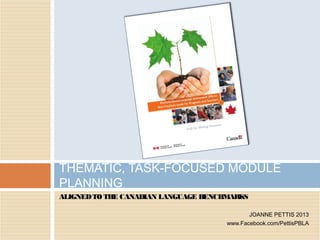
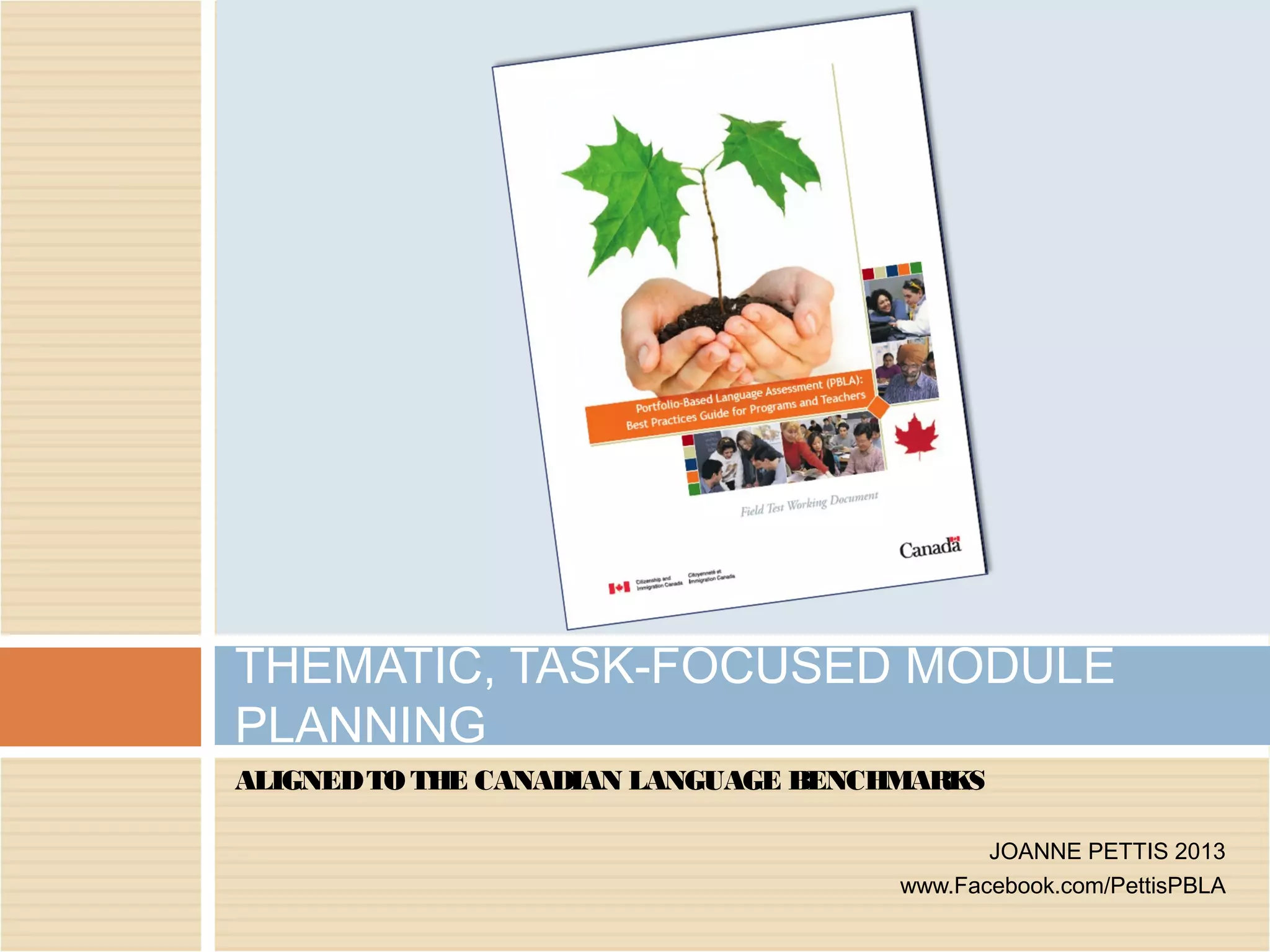
THEMATIC, TASK-FOCUSED MODULE
PLANNING
ALIGNED TO THE CANADIAN LANGUAGE BENCHMARKS

                                             JOANNE PETTIS 2013
                                      www.Facebook.com/PettisPBLA
WHAT IS A MODULE?
   A module is the blueprint that drives individual
    lessons. 
       It provides an overall coherence and specifies the
        particular elements that will be addressed
        throughout the series of lessons. 
        It keeps teachers on track, ensures everything is
        covered that needs to be covered and sets up the
        assessment process. 
       Module planning precedes lesson planning. 
MODULE PLANNING

THERE ARE
               Competency focused module plans
DIFFERENT          Organized around specific CLB
APPROACH
ES TO
                    competencies. They are embedded in a
MODULE              variety of relevant language tasks.
PLANNING.              Giving directions, being tactful, giving
                        opinions
TWO
APPROACH
               Task-focused module plans
ES                 Organized around specific language
COMMON
IN CLB-
                    tasks Students need to carry out in
ALIGNED             particular social situations. They embed I
COURSES             or more CLB competencies.
INCLUDE:               Making a doctor’s appointment, calling in
                        sick, writing a cheque
N.B.
As long as the module contains certain key
elements: language tasks and CLB
competencies, language skills and
strategies, propose assessment tasks, the
format can vary.

IT IS FUNDAMENTAL, HOWEVER, THAT
TEACHERS UNDERTAKE MODULE
PLANNING PRIOR TO LESSON
PREPARATION
TASK-FOCUSED MODULE
PLANNING
        Conduct a Needs Assessment to
         determine:
            the social situations in which Students
             need to communicate in English, and,
             if possible
            some specific events/tasks Students
             might want to carry out in those
             situations.
TASK-FOCUSED MODULE
PLANNING
        Select a theme (e.g. Employment)
         and a communication event from
         your Needs Assessment results
         (e.g. Applying for a Job).
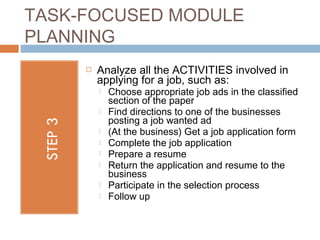
TASK-FOCUSED MODULE
PLANNING
        Analyze all the ACTIVITIES involved in
         applying for a job, such as:
            Choose appropriate job ads in the classified
             section of the paper
            Find directions to one of the businesses
             posting a job wanted ad
            (At the business) Get a job application form
            Complete the job application
            Prepare a resume
            Return the application and resume to the
             business
            Participate in the selection process
            Follow up
TASK-FOCUSED MODULE
PLANNING
        For each activity, identify possible
         LANGUAGE TASKS and note the
         skills.  You might suggest others,
         but here are a few examples:
            Choose job ads to respond to
              Read   job ads in the newspaper
               classifieds (Reading task)
              Read an ad on a job board at an
               employment centre (Reading)
              Read a job posting in a window
               (Reading)
TASK-FOCUSED MODULE
PLANNING
        Find directions to business
            Do a Google Map search
             (Computer/Reading & Writing task)
            Read a map to find a location
             (Reading)
        Get a job application form
            Request a job application
             (Listening/Speaking)
        Complete the job application
         (Writing)
TASK-FOCUSED MODULE
PLANNING
        Prepare a resume
            Writ a Resume (Writing)
        Return application and resume
            Write a cover letter (Writing)
            Address an envelope (Writing)
            Submit an application F/F (Listening &
             Speaking)
        Selection Process
            Participate in a job interview (Listening &
             Speaking)
        Follow Up
            Make a follow-up phone call (Listening &
             Speaking)
TASK-FOCUSED MODULE
PLANNING
        Select tasks appropriate the
         Students CLB level. 
             Teachers can choose as many tasks
             as they want; however, the Manitoba
             template we use provides for 4 tasks
             – Listening, Speaking, Reading, and
             Writing.
            This approach generally works well
             for a well-integrated thematic module
             plan. 
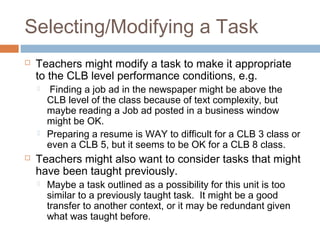
Selecting/Modifying a Task
   Teachers might modify a task to make it appropriate
    to the CLB level performance conditions, e.g. 
       Finding a job ad in the newspaper might be above the
        CLB level of the class because of text complexity, but
        maybe reading a Job ad posted in a business window
        might be OK.
       Preparing a resume is WAY to difficult for a CLB 3 class or
        even a CLB 5, but it seems to be OK for a CLB 8 class.
   Teachers might also want to consider tasks that might
    have been taught previously.
       Maybe a task outlined as a possibility for this unit is too
        similar to a previously taught task.  It might be a good
        transfer to another context, or it may be redundant given
        what was taught before.
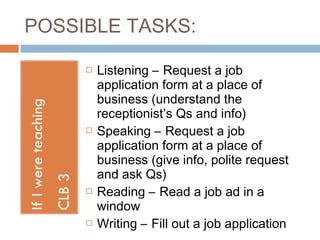
POSSIBLE TASKS:

        Listening – Request a job
         application form at a place of
         business (understand the
         receptionist’s Qs and info)
        Speaking – Request a job
         application form at a place of
         business (give info, polite request
         and ask Qs)
        Reading – Read a job ad in a
         window
        Writing – Fill out a job application
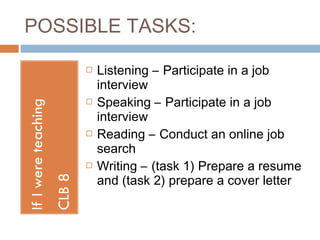
POSSIBLE TASKS:

        Listening – Participate in a job
         interview
        Speaking – Participate in a job
         interview
        Reading – Conduct an online job
         search
        Writing – (task 1) Prepare a resume
         and (task 2) prepare a cover letter
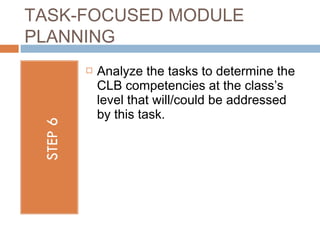
TASK-FOCUSED MODULE
PLANNING
        Analyze the tasks to determine the
         CLB competencies at the class’s
         level that will/could be addressed
         by this task.
TASK-FOCUSED MODULE
PLANNING
        Analyze the tasks to determine:
            the functions/speech acts that would
             need to be taught,
            the grammar, vocabulary,
             orthography/pronunciation needed,
            the genre and textual features,
            the pragmatic conventions/concerns,
             and
            the language and learning strategies
             that could be taught.
TASK-FOCUSED MODULE
PLANNING
        Specify any particular background
         information required to carry out
         these tasks successfully in this
         particular social context.
            E.g. In this module, it would be
             important for Ss to understand the
             process, services and assumptions of
             looking for work in Canada.
TASK-FOCUSED MODULE
PLANNING
        Identify any resources that
         would need to be developed or
         acquired. This includes noting
         any guest speakers to book.
TASK-FOCUSED MODULE
PLANNING
        Identify how the tasks could be
         assessed.
            (Teachers may choose not to formally
             assess all the tasks.
                Some tasks might be self-assessed or peer-
                 assessed for the portfolio, but the teacher
                 should formally assess at least one of the
                 tasks).  
            Remember, an assessment task is
             usually a skill-using activity administered
             under test-like conditions with pre-
             determined criteria selected. 
Benefits of Module Planning
   Easy for the teacher to keep on track with
    well-sequenced inter-related lesson plans. 
   Module plans, once developed can be used
    again or modified for other classes.
   Module plans be shared in a module bank with
    colleagues.

Module Planning in Adult ESL

  • 1.
    THEMATIC, TASK-FOCUSED MODULE PLANNING ALIGNEDTO THE CANADIAN LANGUAGE BENCHMARKS JOANNE PETTIS 2013 www.Facebook.com/PettisPBLA
  • 2.
    WHAT IS AMODULE?  A module is the blueprint that drives individual lessons.   It provides an overall coherence and specifies the particular elements that will be addressed throughout the series of lessons.   It keeps teachers on track, ensures everything is covered that needs to be covered and sets up the assessment process.   Module planning precedes lesson planning. 
  • 3.
    MODULE PLANNING THERE ARE  Competency focused module plans DIFFERENT  Organized around specific CLB APPROACH ES TO competencies. They are embedded in a MODULE variety of relevant language tasks. PLANNING.  Giving directions, being tactful, giving opinions TWO APPROACH  Task-focused module plans ES  Organized around specific language COMMON IN CLB- tasks Students need to carry out in ALIGNED particular social situations. They embed I COURSES or more CLB competencies. INCLUDE:  Making a doctor’s appointment, calling in sick, writing a cheque
  • 4.
    N.B. As long asthe module contains certain key elements: language tasks and CLB competencies, language skills and strategies, propose assessment tasks, the format can vary. IT IS FUNDAMENTAL, HOWEVER, THAT TEACHERS UNDERTAKE MODULE PLANNING PRIOR TO LESSON PREPARATION
  • 5.
    TASK-FOCUSED MODULE PLANNING  Conduct a Needs Assessment to determine:  the social situations in which Students need to communicate in English, and, if possible  some specific events/tasks Students might want to carry out in those situations.
  • 6.
    TASK-FOCUSED MODULE PLANNING  Select a theme (e.g. Employment) and a communication event from your Needs Assessment results (e.g. Applying for a Job).
  • 7.
    TASK-FOCUSED MODULE PLANNING  Analyze all the ACTIVITIES involved in applying for a job, such as:  Choose appropriate job ads in the classified section of the paper  Find directions to one of the businesses posting a job wanted ad  (At the business) Get a job application form  Complete the job application  Prepare a resume  Return the application and resume to the business  Participate in the selection process  Follow up
  • 8.
    TASK-FOCUSED MODULE PLANNING  For each activity, identify possible LANGUAGE TASKS and note the skills.  You might suggest others, but here are a few examples:  Choose job ads to respond to  Read job ads in the newspaper classifieds (Reading task)  Read an ad on a job board at an employment centre (Reading)  Read a job posting in a window (Reading)
  • 9.
    TASK-FOCUSED MODULE PLANNING  Find directions to business  Do a Google Map search (Computer/Reading & Writing task)  Read a map to find a location (Reading)  Get a job application form  Request a job application (Listening/Speaking)  Complete the job application (Writing)
  • 10.
    TASK-FOCUSED MODULE PLANNING  Prepare a resume  Writ a Resume (Writing)  Return application and resume  Write a cover letter (Writing)  Address an envelope (Writing)  Submit an application F/F (Listening & Speaking)  Selection Process  Participate in a job interview (Listening & Speaking)  Follow Up  Make a follow-up phone call (Listening & Speaking)
  • 11.
    TASK-FOCUSED MODULE PLANNING  Select tasks appropriate the Students CLB level.   Teachers can choose as many tasks as they want; however, the Manitoba template we use provides for 4 tasks – Listening, Speaking, Reading, and Writing.  This approach generally works well for a well-integrated thematic module plan. 
  • 12.
    Selecting/Modifying a Task  Teachers might modify a task to make it appropriate to the CLB level performance conditions, e.g.   Finding a job ad in the newspaper might be above the CLB level of the class because of text complexity, but maybe reading a Job ad posted in a business window might be OK.  Preparing a resume is WAY to difficult for a CLB 3 class or even a CLB 5, but it seems to be OK for a CLB 8 class.  Teachers might also want to consider tasks that might have been taught previously.  Maybe a task outlined as a possibility for this unit is too similar to a previously taught task.  It might be a good transfer to another context, or it may be redundant given what was taught before.
  • 13.
    POSSIBLE TASKS:  Listening – Request a job application form at a place of business (understand the receptionist’s Qs and info)  Speaking – Request a job application form at a place of business (give info, polite request and ask Qs)  Reading – Read a job ad in a window  Writing – Fill out a job application
  • 14.
    POSSIBLE TASKS:  Listening – Participate in a job interview  Speaking – Participate in a job interview  Reading – Conduct an online job search  Writing – (task 1) Prepare a resume and (task 2) prepare a cover letter
  • 15.
    TASK-FOCUSED MODULE PLANNING  Analyze the tasks to determine the CLB competencies at the class’s level that will/could be addressed by this task.
  • 16.
    TASK-FOCUSED MODULE PLANNING  Analyze the tasks to determine:  the functions/speech acts that would need to be taught,  the grammar, vocabulary, orthography/pronunciation needed,  the genre and textual features,  the pragmatic conventions/concerns, and  the language and learning strategies that could be taught.
  • 17.
    TASK-FOCUSED MODULE PLANNING  Specify any particular background information required to carry out these tasks successfully in this particular social context.  E.g. In this module, it would be important for Ss to understand the process, services and assumptions of looking for work in Canada.
  • 18.
    TASK-FOCUSED MODULE PLANNING  Identify any resources that would need to be developed or acquired. This includes noting any guest speakers to book.
  • 19.
    TASK-FOCUSED MODULE PLANNING  Identify how the tasks could be assessed.  (Teachers may choose not to formally assess all the tasks.  Some tasks might be self-assessed or peer- assessed for the portfolio, but the teacher should formally assess at least one of the tasks).    Remember, an assessment task is usually a skill-using activity administered under test-like conditions with pre- determined criteria selected. 
  • 20.
    Benefits of ModulePlanning  Easy for the teacher to keep on track with well-sequenced inter-related lesson plans.   Module plans, once developed can be used again or modified for other classes.  Module plans be shared in a module bank with colleagues.

Editor's Notes

  • #15 Listening – Participate in a job interview Speaking – Participate in a job interview Reading – Conduct an online job search Writing – (task 1) Prepare a resume and (task 2) prepare a cover letter
  • #19 Identify any resources that would need to be developed or acquired. This includes noting any guest speakers to book.