Gagné Instructional Model
9 conditions of Learning
Description
“[Gagnés nine steps are] general considerations
to be taken into account when designing
instruction. Although some steps might need to be
rearranged (or might be unnecessary) for certain
types of lessons, the general set of considerations
provide a good checklist of key design steps”
(Good, Brophy, 1977).
• Correlates specific events of instruction with
cognitive learning process

• Demonstrates a concern for the different levels
of learning
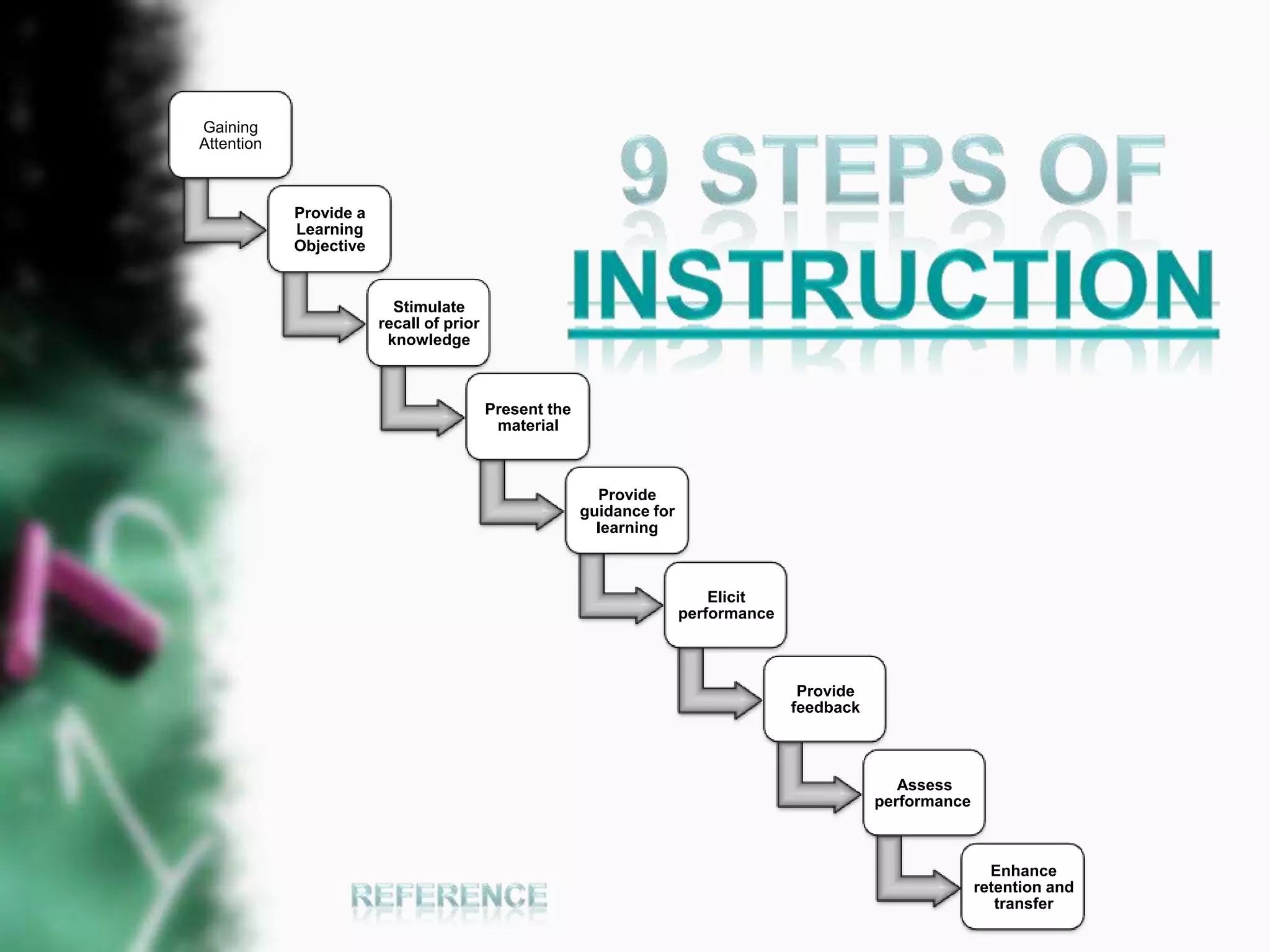
Gaining
Attention

Provide a
Learning
Objective

Stimulate
recall of prior
knowledge

Present the
material

Provide
guidance for
learning

Elicit
performance

Provide
feedback

Assess
performance

Enhance
retention and
transfer
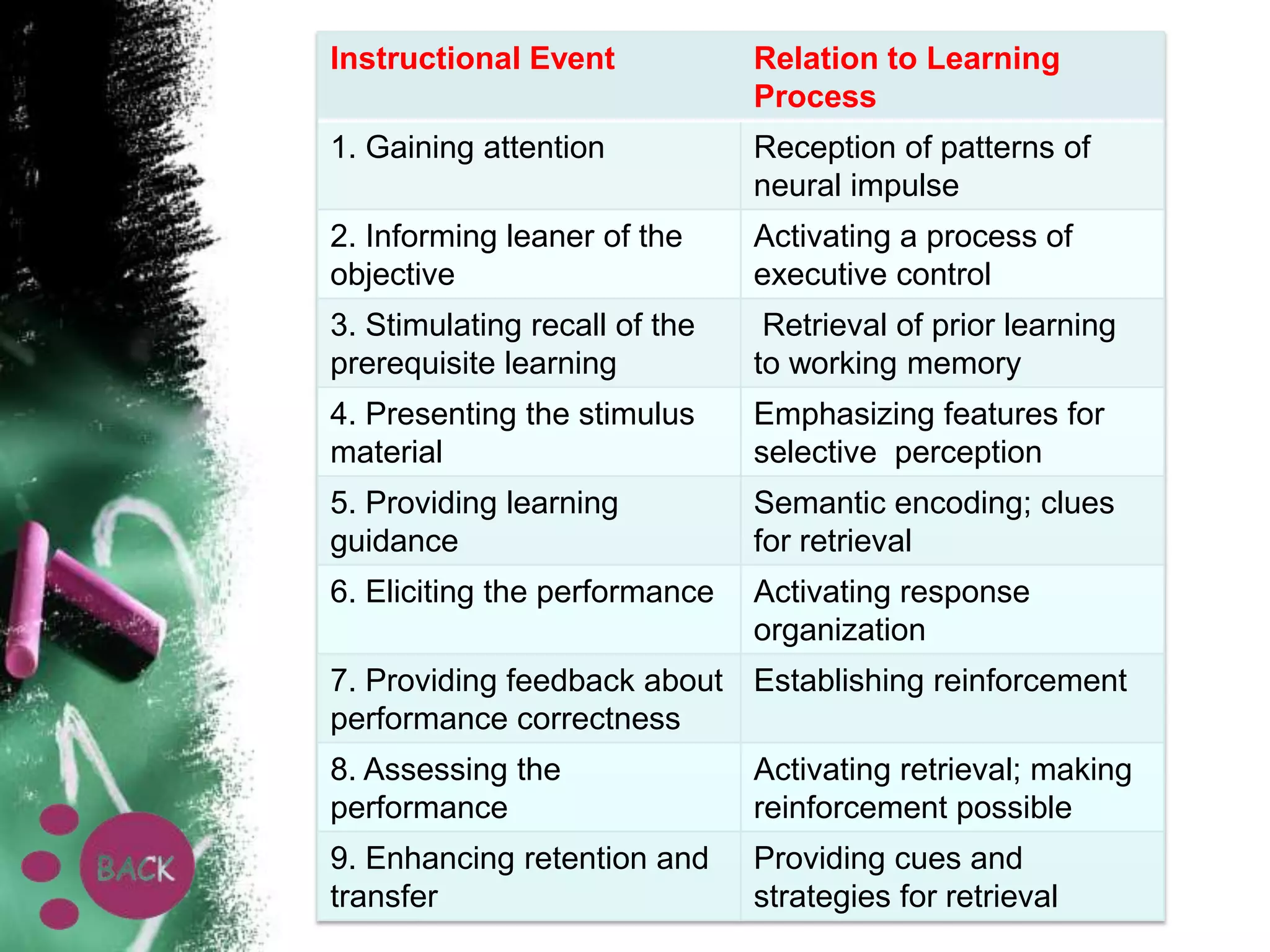
Instructional Event

Relation to Learning
Process

1. Gaining attention

Reception of patterns of
neural impulse

2. Informing leaner of the
objective

Activating a process of
executive control

3. Stimulating recall of the
prerequisite learning

Retrieval of prior learning
to working memory

4. Presenting the stimulus
material

Emphasizing features for
selective perception

5. Providing learning
guidance

Semantic encoding; clues
for retrieval

6. Eliciting the performance

Activating response
organization

7. Providing feedback about Establishing reinforcement
performance correctness
8. Assessing the
performance

Activating retrieval; making
reinforcement possible

9. Enhancing retention and
transfer

Providing cues and
strategies for retrieval
Gain attention
• Present a story, problem, or a new situation
that will grab the learners' attention.

• The ideal is to grab the learners' attention
E.g.
• Storytelling

• Demonstrations
• Presenting a problem to be solved
• Stressing why it is important to them

• discuss what they need to learn and
achieving it at the end
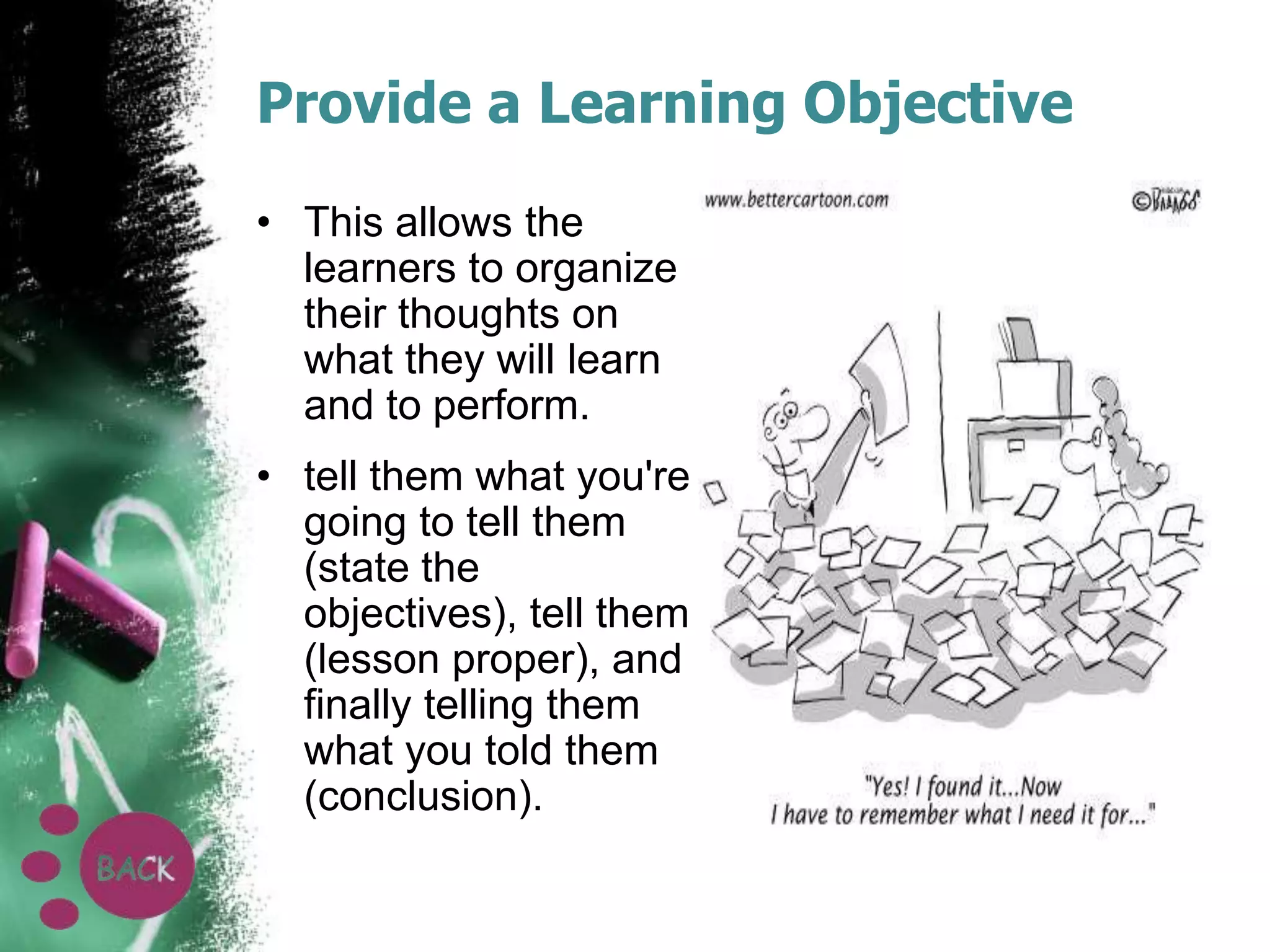
Provide a Learning Objective
• This allows the
learners to organize
their thoughts on
what they will learn
and to perform.
• tell them what you're
going to tell them
(state the
objectives), tell them
(lesson proper), and
finally telling them
what you told them
(conclusion).
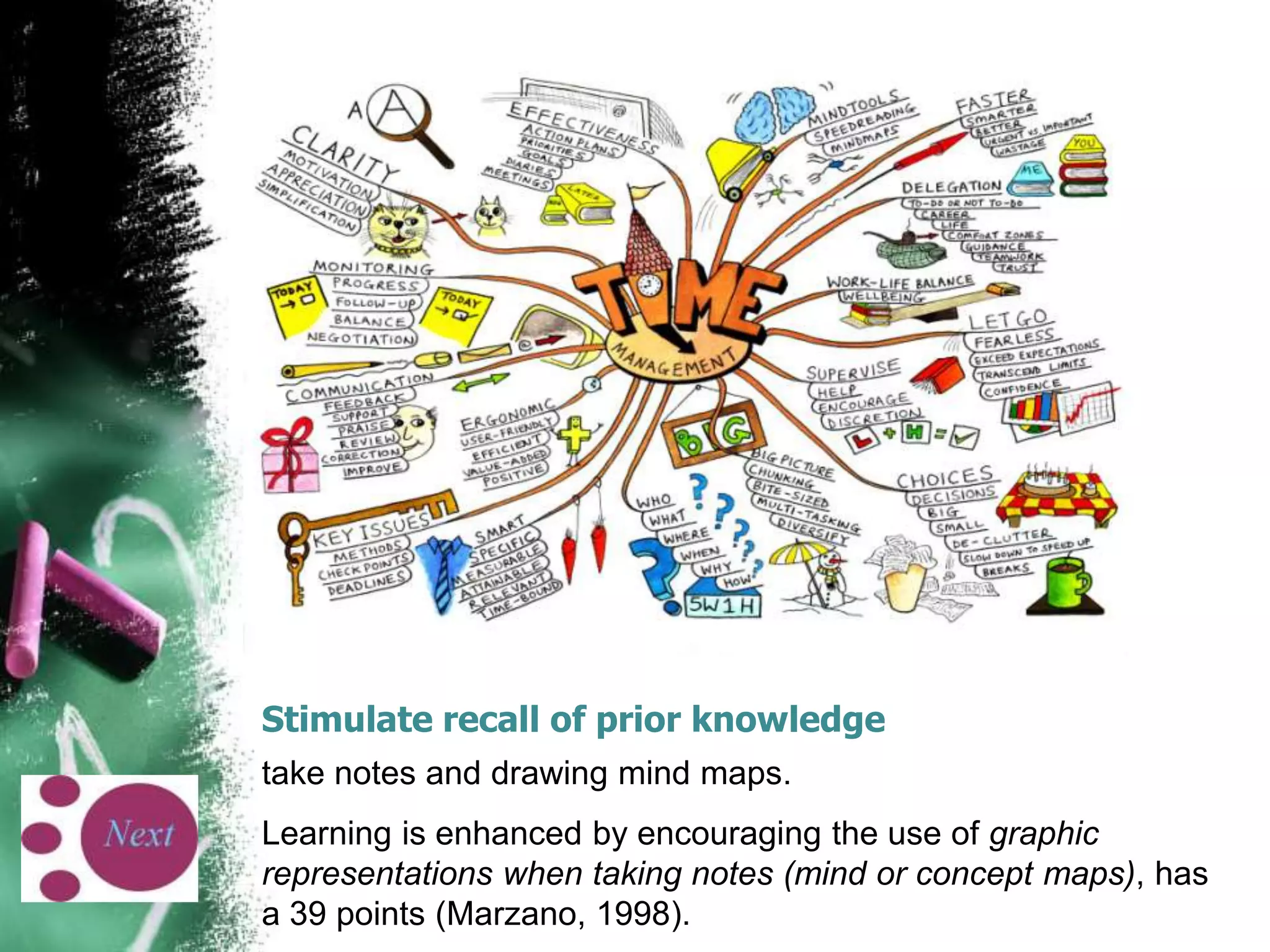
Stimulate recall of prior knowledge
take notes and drawing mind maps.
Learning is enhanced by encouraging the use of graphic
representations when taking notes (mind or concept maps), has
a 39 points (Marzano, 1998).
Stimulate recall of prior
knowledge
Ways:
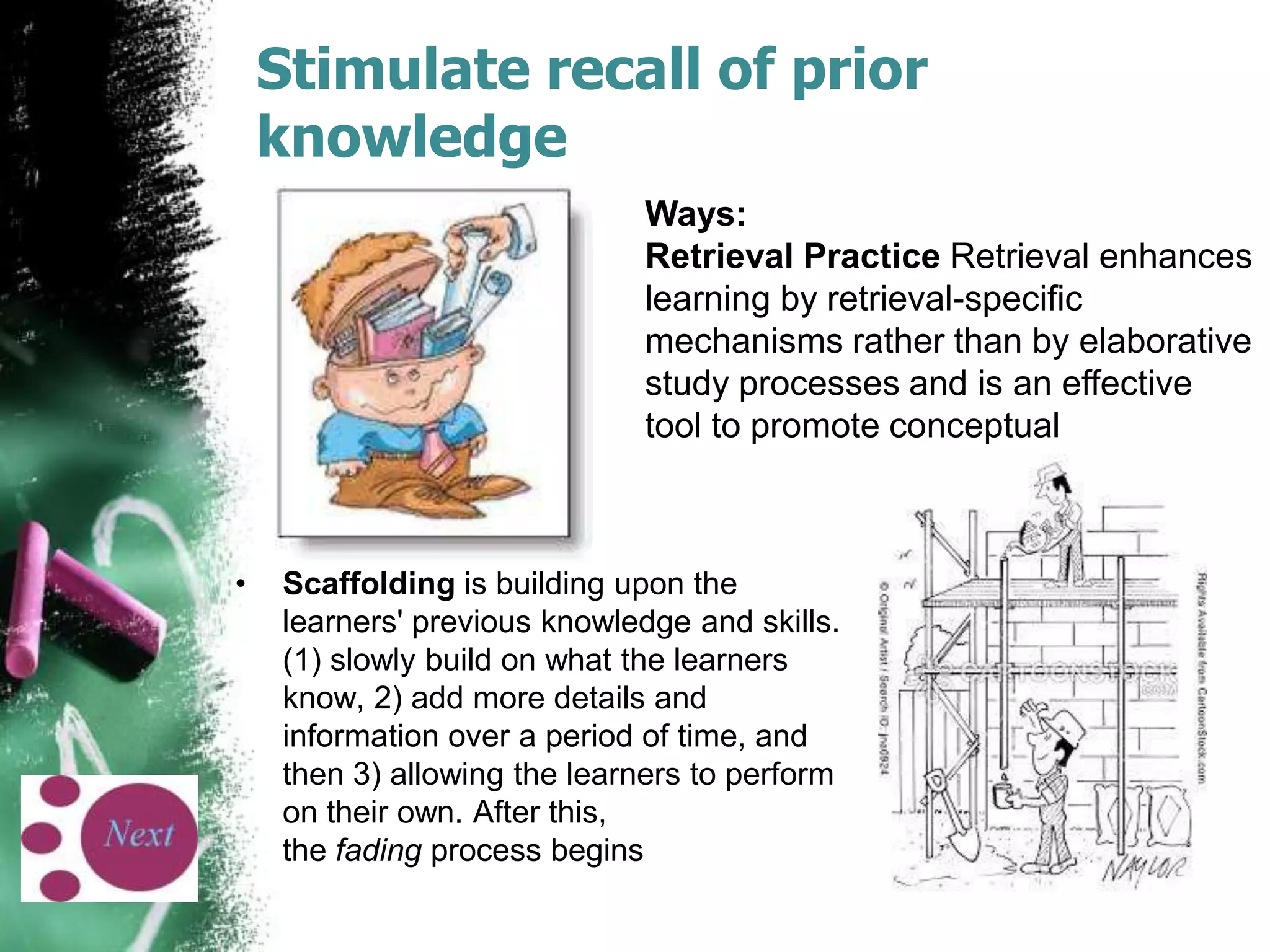
Retrieval Practice Retrieval enhances
learning by retrieval-specific
mechanisms rather than by elaborative
study processes and is an effective
tool to promote conceptual

•

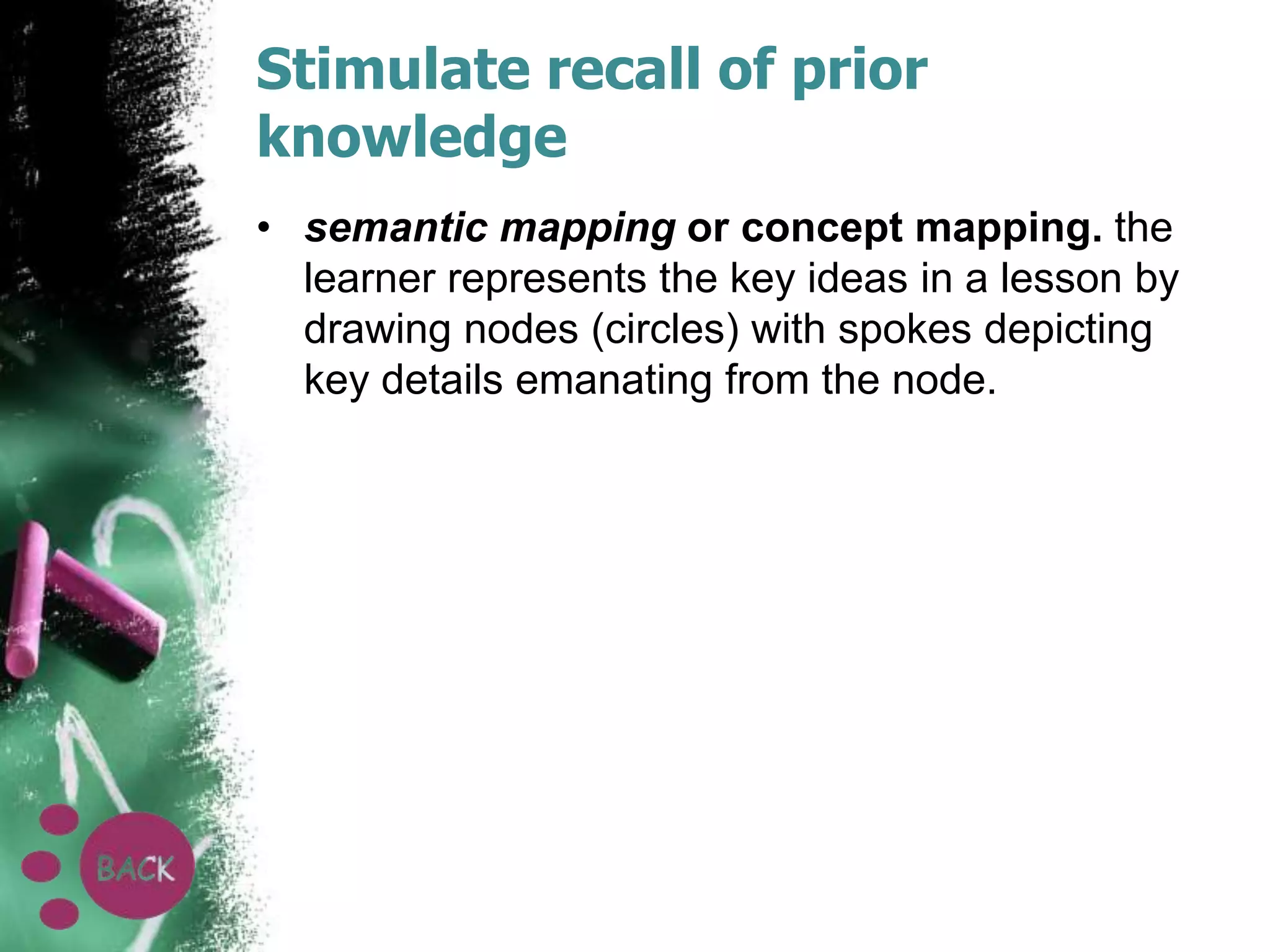
Scaffolding is building upon the
learners' previous knowledge and skills.
(1) slowly build on what the learners
know, 2) add more details and
information over a period of time, and
then 3) allowing the learners to perform
on their own. After this,
the fading process begins
Stimulate recall of prior
knowledge
• semantic mapping or concept mapping. the
learner represents the key ideas in a lesson by
drawing nodes (circles) with spokes depicting
key details emanating from the node.
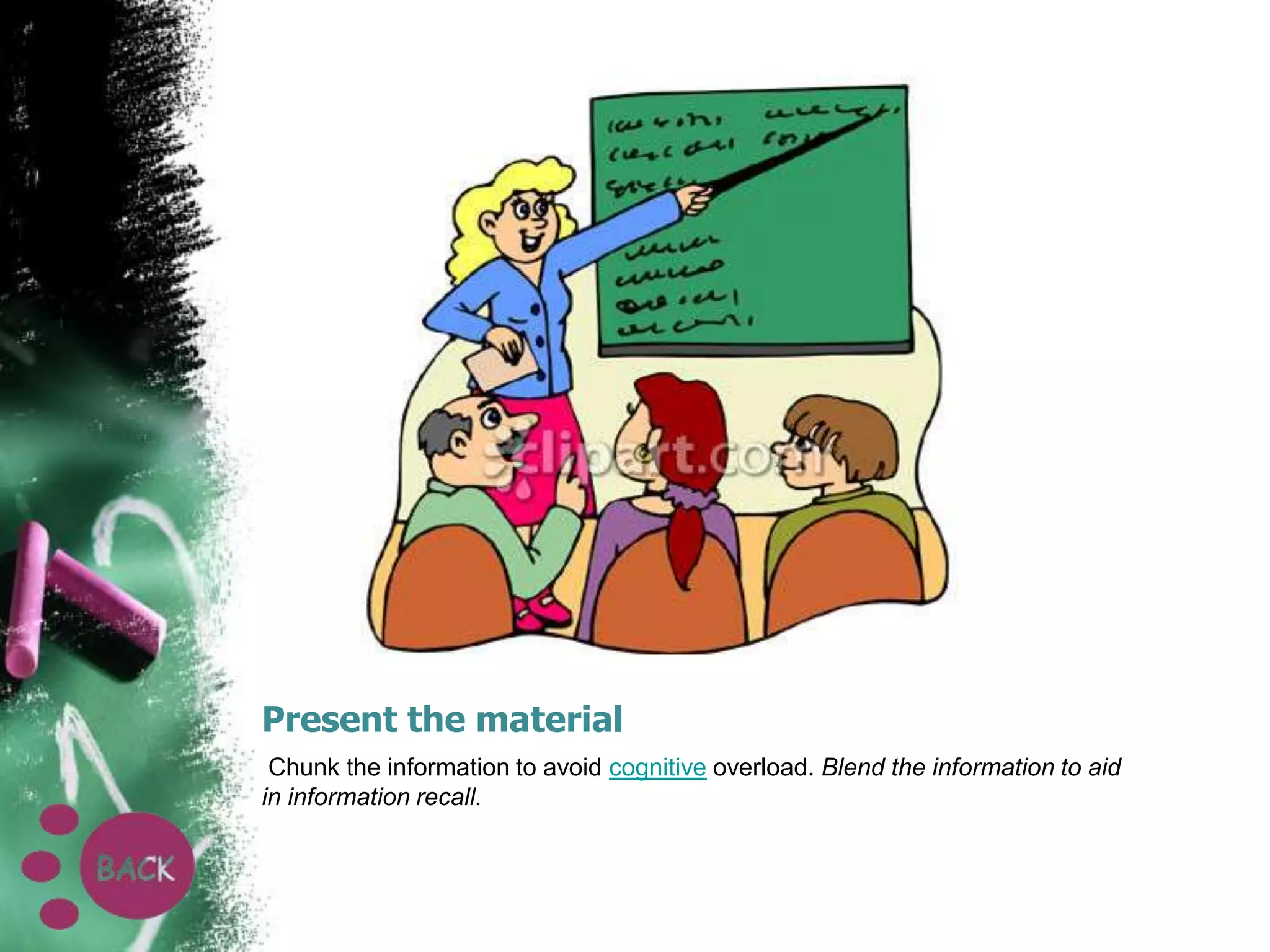
Present the material
Chunk the information to avoid cognitive overload. Blend the information to aid
in information recall.
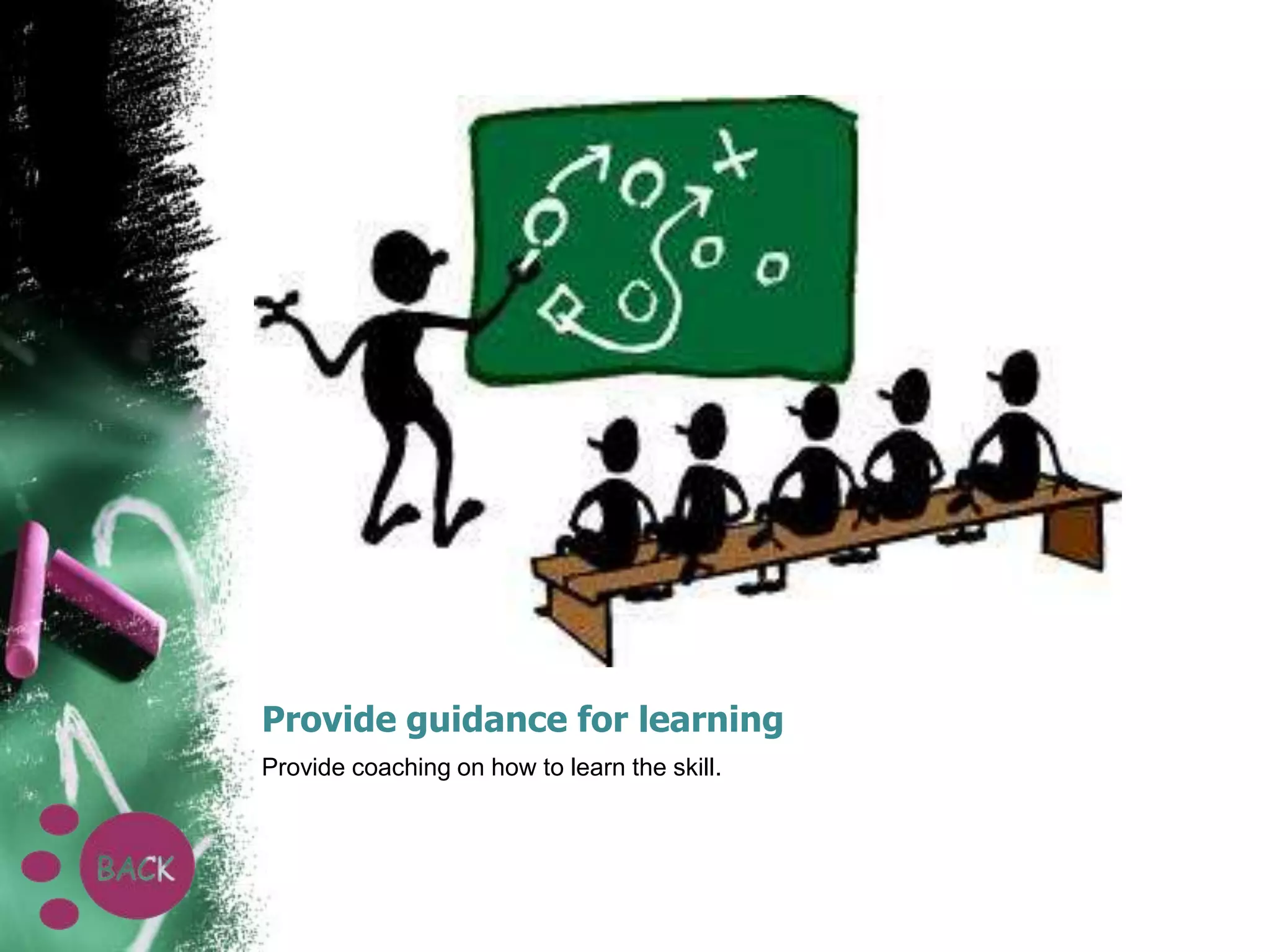
Provide guidance for learning
Provide coaching on how to learn the skill.
Elicit performance
•

Practice by letting the learner do something with the newly
acquired behavior, skills, or knowledge. (In addition,
demonstrate as required.

Modeling has several affects on learners:
•

Acquisition - New responses are learned by observing the
model.

•

Inhibition - A response that otherwise may be made is
changed when the observer sees a model being punished.

•

Disinhibition - A reduction in fear by observing a model's
behavior go unpunished in a feared activity.

•

Facilitation - A model elicits from an observer a response
that has already been learned.

•

Creativity - Observing several models performing and then
adapting a combination of characteristics or styles.
Provide feedback
• This can be a
test, quiz, or
verbal comments.
The feedback nee
ds to be
specific, not, “you
are doing a good
job.” Tell them
why they are
doing a good job
and/or provide
specific guidance.
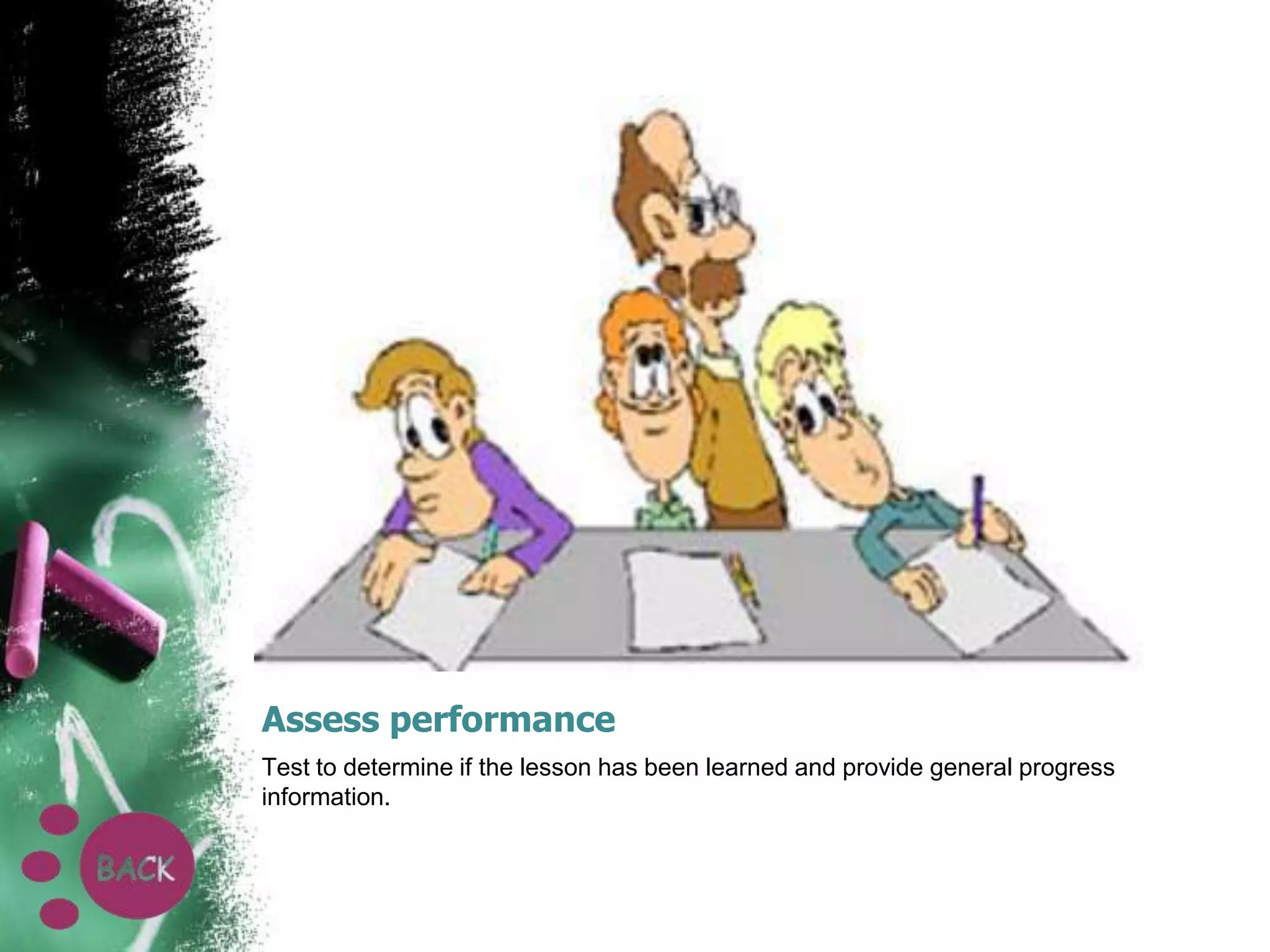
Assess performance
Test to determine if the lesson has been learned and provide general progress
information.
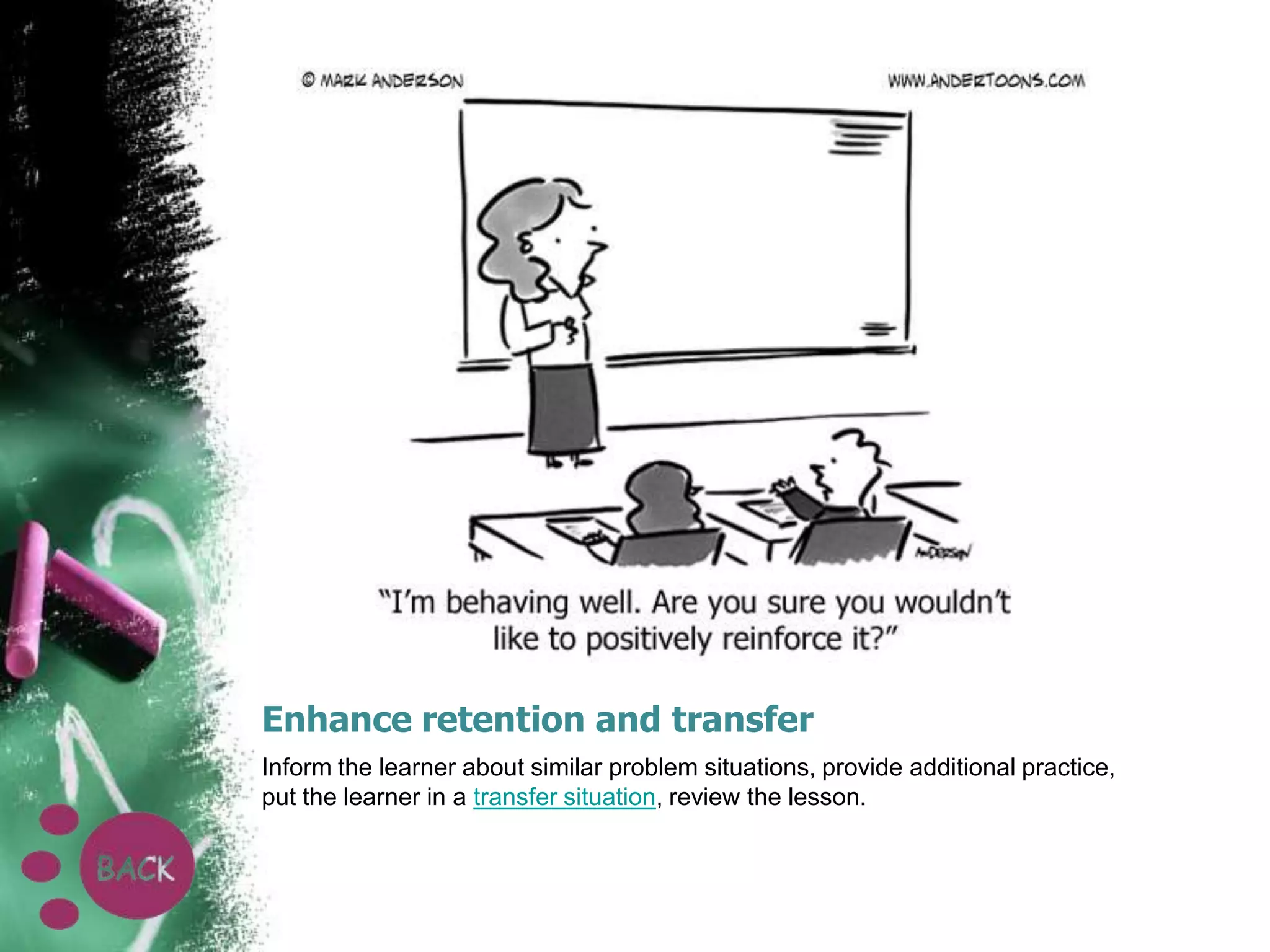
Enhance retention and transfer
Inform the learner about similar problem situations, provide additional practice,
put the learner in a transfer situation, review the lesson.
Reference
• Clark, D.C. (2004). Robert Gagné's Nine Steps
of Instruction. Retrieved from:
http://www.nwlink.com/~donclark/hrd/learning/id
/nine_step_id.html on: Dec. 6, 2013

Gagné's Instructional Model

  • 1.
    Gagné Instructional Model 9conditions of Learning
  • 2.
    Description “[Gagnés nine stepsare] general considerations to be taken into account when designing instruction. Although some steps might need to be rearranged (or might be unnecessary) for certain types of lessons, the general set of considerations provide a good checklist of key design steps” (Good, Brophy, 1977). • Correlates specific events of instruction with cognitive learning process • Demonstrates a concern for the different levels of learning
  • 3.
    Gaining Attention Provide a Learning Objective Stimulate recall ofprior knowledge Present the material Provide guidance for learning Elicit performance Provide feedback Assess performance Enhance retention and transfer
  • 4.
    Instructional Event Relation toLearning Process 1. Gaining attention Reception of patterns of neural impulse 2. Informing leaner of the objective Activating a process of executive control 3. Stimulating recall of the prerequisite learning Retrieval of prior learning to working memory 4. Presenting the stimulus material Emphasizing features for selective perception 5. Providing learning guidance Semantic encoding; clues for retrieval 6. Eliciting the performance Activating response organization 7. Providing feedback about Establishing reinforcement performance correctness 8. Assessing the performance Activating retrieval; making reinforcement possible 9. Enhancing retention and transfer Providing cues and strategies for retrieval
  • 5.
    Gain attention • Presenta story, problem, or a new situation that will grab the learners' attention. • The ideal is to grab the learners' attention E.g. • Storytelling • Demonstrations • Presenting a problem to be solved • Stressing why it is important to them • discuss what they need to learn and achieving it at the end
  • 6.
    Provide a LearningObjective • This allows the learners to organize their thoughts on what they will learn and to perform. • tell them what you're going to tell them (state the objectives), tell them (lesson proper), and finally telling them what you told them (conclusion).
  • 7.
    Stimulate recall ofprior knowledge take notes and drawing mind maps. Learning is enhanced by encouraging the use of graphic representations when taking notes (mind or concept maps), has a 39 points (Marzano, 1998).
  • 8.
    Stimulate recall ofprior knowledge Ways: Retrieval Practice Retrieval enhances learning by retrieval-specific mechanisms rather than by elaborative study processes and is an effective tool to promote conceptual • Scaffolding is building upon the learners' previous knowledge and skills. (1) slowly build on what the learners know, 2) add more details and information over a period of time, and then 3) allowing the learners to perform on their own. After this, the fading process begins
  • 9.
    Stimulate recall ofprior knowledge • semantic mapping or concept mapping. the learner represents the key ideas in a lesson by drawing nodes (circles) with spokes depicting key details emanating from the node.
  • 10.
    Present the material Chunkthe information to avoid cognitive overload. Blend the information to aid in information recall.
  • 11.
    Provide guidance forlearning Provide coaching on how to learn the skill.
  • 12.
    Elicit performance • Practice byletting the learner do something with the newly acquired behavior, skills, or knowledge. (In addition, demonstrate as required. Modeling has several affects on learners: • Acquisition - New responses are learned by observing the model. • Inhibition - A response that otherwise may be made is changed when the observer sees a model being punished. • Disinhibition - A reduction in fear by observing a model's behavior go unpunished in a feared activity. • Facilitation - A model elicits from an observer a response that has already been learned. • Creativity - Observing several models performing and then adapting a combination of characteristics or styles.
  • 13.
    Provide feedback • Thiscan be a test, quiz, or verbal comments. The feedback nee ds to be specific, not, “you are doing a good job.” Tell them why they are doing a good job and/or provide specific guidance.
  • 14.
    Assess performance Test todetermine if the lesson has been learned and provide general progress information.
  • 15.
    Enhance retention andtransfer Inform the learner about similar problem situations, provide additional practice, put the learner in a transfer situation, review the lesson.
  • 16.
    Reference • Clark, D.C.(2004). Robert Gagné's Nine Steps of Instruction. Retrieved from: http://www.nwlink.com/~donclark/hrd/learning/id /nine_step_id.html on: Dec. 6, 2013