



Writing the research report
for 271.720
National Centre for Teaching & Learning
ctlalb@massey.ac.nz
See these slides online at: tinyurl.com/271120
Research question
Contents
Interactive Quiz: Advanced APA
Research report structure and style
Introduction
Literature review
Method
Results
Discussion
Conclusion
Selected readings on research methods
Interactive Quiz:
Advanced APA
You’ll see questions on the screen – e.g.
After a few seconds, you’ll be given four
possible answers – e.g.
You need to select the correct answer
by pressing the appropriate square on your
device.
You’ll receive points not only for correct answers
but also according to the speed of your selection.
• Open kahoot.it
in your browser
• Enter the game pin
which I will show you
in a minute
• Enter your nickname
(and you will see it
appear on the public
screen)
To join the quiz you need to:
Your developing research
question
Your topic of interest
Integration of individuals with communication
disorders in the education system
Your issue / context
The use of AAC devices in NZ preschools
What are the perceptions and practices of NZ
preschool teachers in relation to children’s use of
AAC devices in the preschool classroom?
Your research
question(s)
Discuss in pairs or groups of three: What’s your …..
What’s your …..
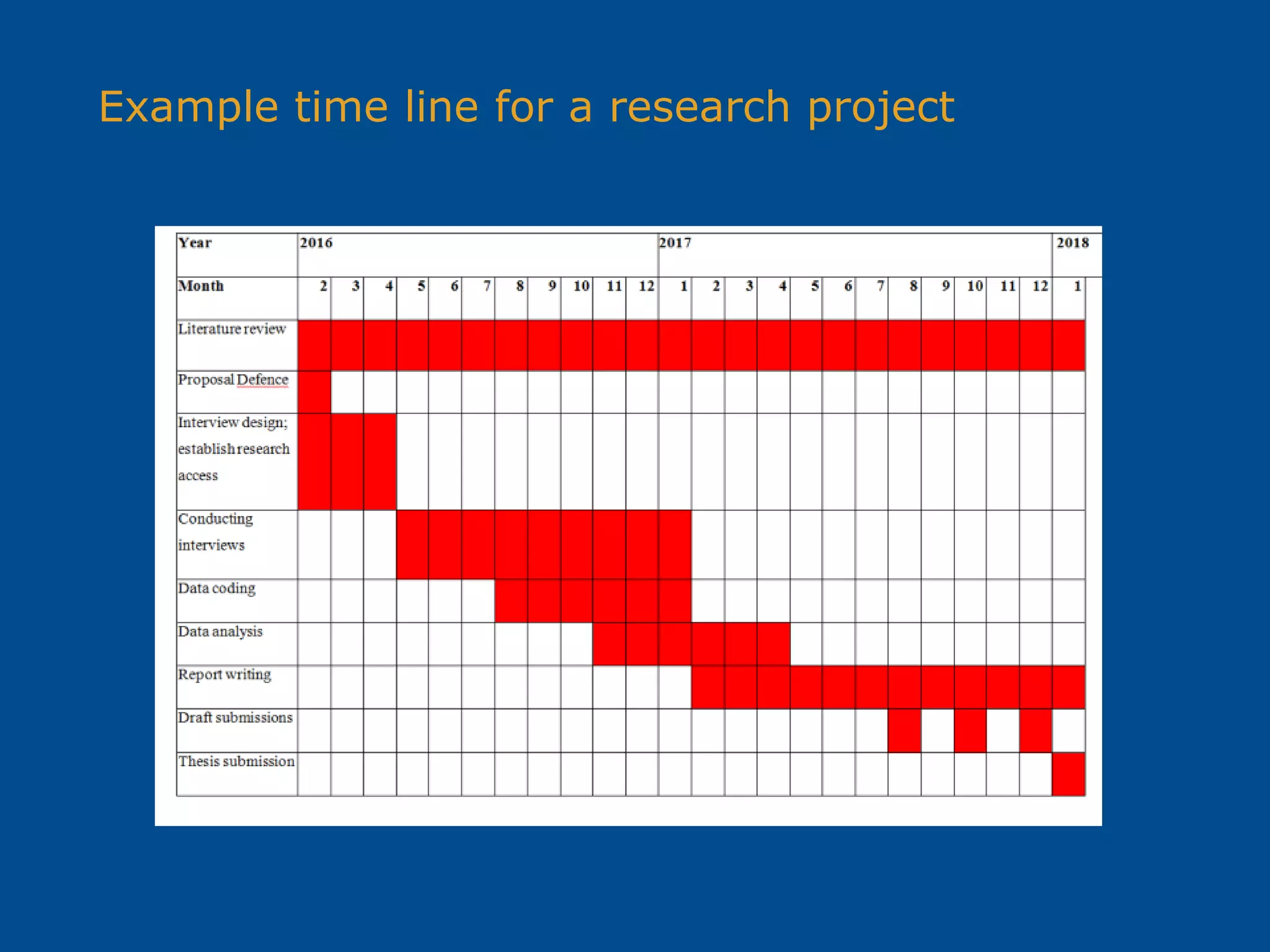
Example time line for a research project
Selected reading on
research methods
Kumar, R. (2011). Research methodology: A step-by-step guide for
beginners (3rd. ed). Los Angeles, CA: Sage.
Phipps, M. (2016). Introduction to psychological research. North Ryde,
NSW: McGraw-Hill Education.
Punch, K., (2003). Survey research: The basics. London, England: Sage
Publications.
Rountree, K. & Laing, T. (1996). Writing by degrees: A practical guide to
writing theses and research papers. Auckland, New Zealand: Longman.
These are just a few of the hundreds of books (and e-books) on research
methods in the library – you may find a book or book chapters about your
specific research method too. Sage is particularly strong in publications
about research methods.
Also take a look at this sample research report from APA:
tinyurl.com/APAreport1
Research report structure
Report A Report B Report C
Total Pages [excl.
refs & appendices]
29 36 24
Introduction
200 350 350
Lit review
1, 800 3, 700 1, 700
Method
1, 200 3, 500
(combined
350
Results
4, 000 (incl.
words in tables)
Method &
Results)
1, 350
Discussion
2, 800 2, 300 1, 000
Conclusion
200 300 500
References
33 60 25
Approximate word length of sections of selected 271.720 research reports
Basic info about the communication
disorder / issue
Basic info about the SLT practice
Rationale and objectives of the study
Suggested length:
200 – 400 words / 2 – 4 paragraphs
Preview of structure of report
Introduction
Sample introductory phrases
Children with disorder X often experience difficulty ….. One factor
that affects their difficulty adjusting to …. is ….
Disorder X is the impairment of …, as a result of …
Practice Y plays a vital role in the management of disorder X …
Method Z is one of the most widely-used … However, researchers
and clinicians have questioned …
For those who ….., a technique known as …. is recommended to
facilitate development of …..
Therefore, the aim of the present study was to …
This research study explores the perceptions of …. about practices X
and Y. ‘X’ refers to … ; in contrast, ‘Y’ refers to …
The study explored … Method Z for … was examined in order to …
In the following literature review, key concepts will be introduced and
discussed including …
Sample comments on introductions
Strong introduction. Sets the scene for your study and
the structure of your literature review.
Clear outline of the aim.
Consider your paragraphs. This is a new topic so
should be in a different paragraph.
Could be more specific.
Explain what you mean by _____.
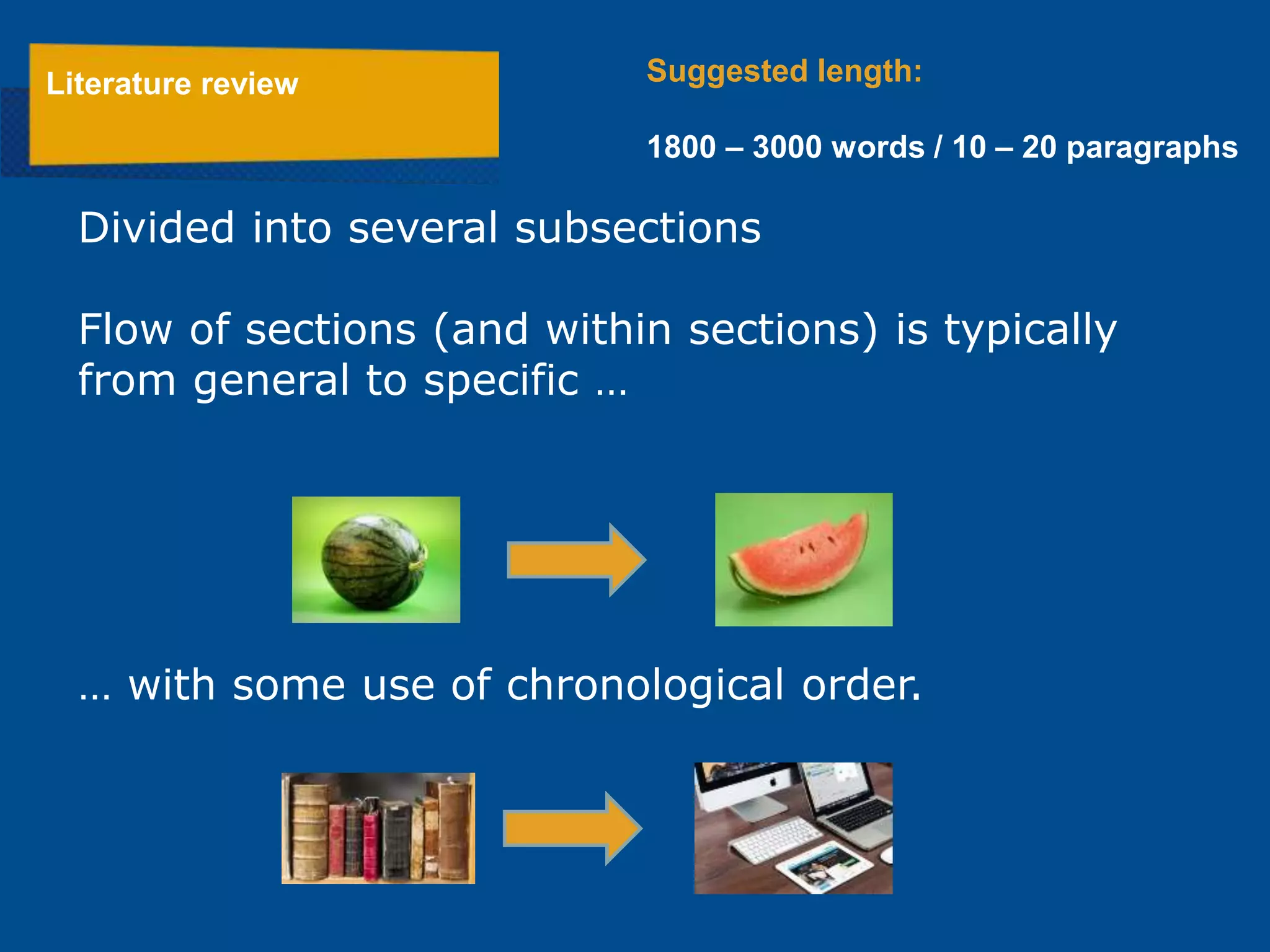
Literature review Suggested length:
1800 – 3000 words / 10 – 20 paragraphs
Divided into several subsections
Flow of sections (and within sections) is typically
from general to specific …
… with some use of chronological order.
Example Lit review flow
Language
development of
children with ….
Intervention X for
individuals with …
Parental
involvement in
intervention X for
children with …
Barriers to and
facilitators of
parental
involvement in
intervention X for
children with …
Early approaches to
assessment of individuals
with disorder X
Post-war approaches to
assessment of individuals
with disorder X
Sociocultural changes in
perceptions of disability
in the late 20thc
Development of the ICF
Implications of the ICF
for assessment of
individuals with disorder
X
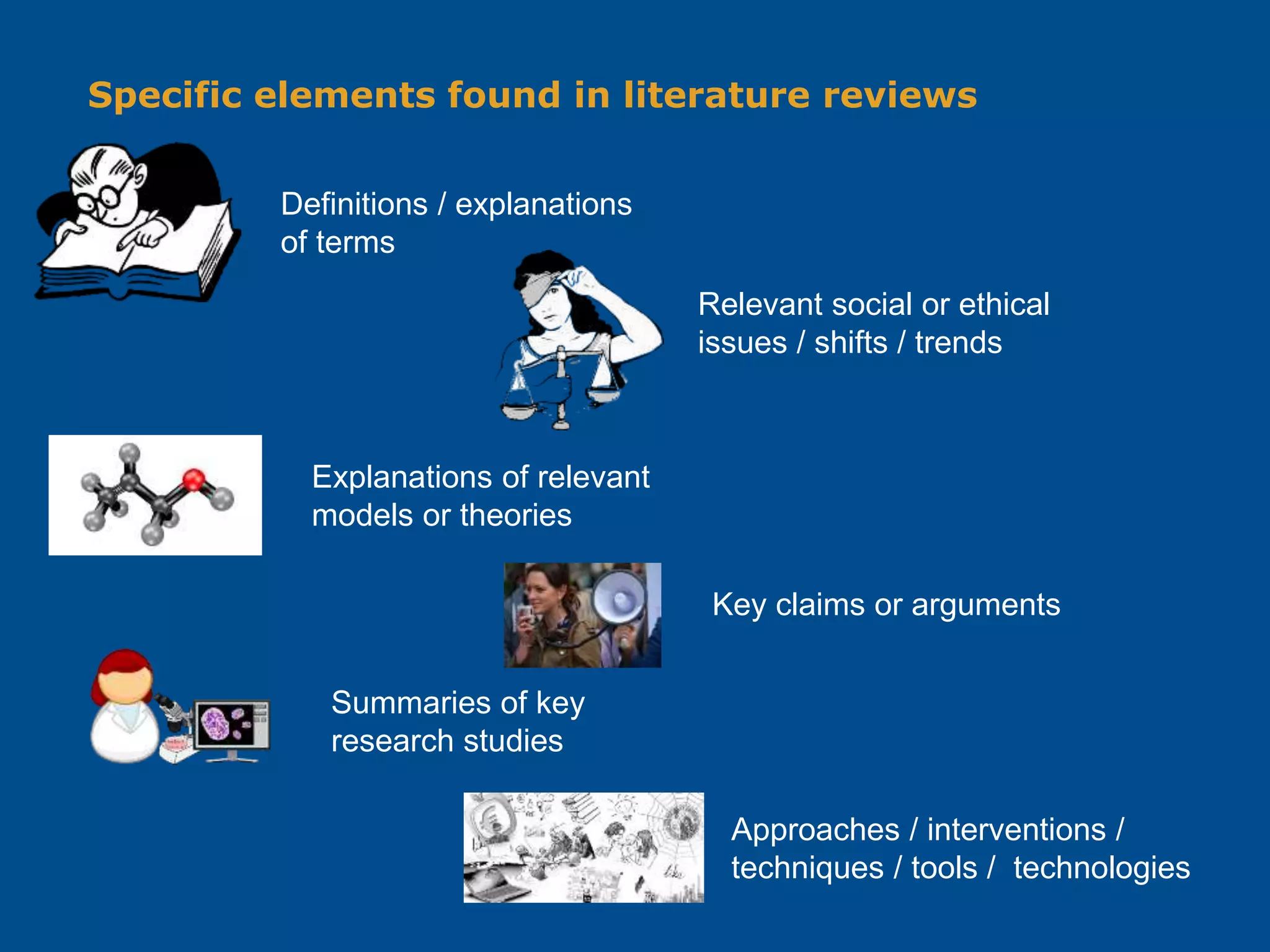
Specific elements found in literature reviews
Definitions / explanations
of terms
Relevant social or ethical
issues / shifts / trends
Summaries of key
research studies
Explanations of relevant
models or theories
Key claims or arguments
Approaches / interventions /
techniques / tools / technologies
In each section, refer to gaps or limitations in
methods and / or research
Summarise these gaps / limitations in a conclusion
paragraph which provides a rationale for your study
“Build an argument, not a library”
(Rudestam & Newton, as cited in Punch, 2006)
Punch, K.F. (2006). Developing Effective Research Proposals. London: Sage Publications.
Sample literature review phrases
Researchers have defined xxxx as …. (Cummings & Gowings, 2002;
Pype & Slipper, 2012).
The Z approach is a behavioural treatment programme designed to
…. (Noh-All, 2014)
X is a speech disorder characterised by …. (Shortt & Sweet, 2009)
In the late 20th century, the … movement led to a shift in perspectives
among many clinicians with regard to …. Individuals with X were no
longer viewed as ... (Esselty, 2005)
With the introduction of Y models, there has been a growing trend
towards ….
In the literature, A and B approaches have been the most influential
in the assessment of X (Black & Decker, 2008). More recently, D
approaches have gained attention within clinical practice (Toyle &
Trubble, 2015).
Figure 1 illustrates the components (boxes) and connections
between components (arrows) involved in …. (Cee & Billieve, 2016).
Each component is …
Models of …. provide theoretically-grounded predictions of … For
example, ….
Increasingly sophisticated models such as … have been developed;
however, they are typically confined to …
In contrast to previous …., the A Classification System (Brayne,
2003) recognises six subtypes of disorder X: xxxxx. The system has
remained the dominant diagnostic paradigm owing to ….
Z models no longer view A as … but as … (Wright, 2002; Whing &
Apraire, 2015).
Proponents of this approach acknowledge that …
Bonnie and Clyde (2004) suggest that … is likely to ….
To develop appropriate treatment plans there is a need for … (Lowd &
Klier, 2011).
There are a number of evidence-based treatments available to
address … However, while these treatments are effective, practical
constraints such as ….. mean that …. Devising more efficient
treatments for … should facilitate …
A variety of terms are used in the literature to describe approach Z
Approach Z can be used across a range of activities involving
communication and therefore …
Factor A appears to be critical for positive outcomes for …. in children.
However, there has been little research into ….
Plugg and Sockitt (2009) found that approach Z can provide
opportunities for …
The Z approach has an evidence base comprising ….. (Locke, Stock
and Barrill, 2010)
A study by Cobley et al. (2010) showed the importance of using a
treatment that … The authors identified that …
Wille and Aweigh (2003) demonstrated the usefulness of … approach
A for disorder B in a ….. study ….
Parents of children using device B reported … (Hinge & Brackitt, 2010)
Leizee-Buoy (2000) found that nearly half of the parents he surveyed
reported … ; however, the survey did not ask for information about ….
Therefore, it is difficult to determine …
To sum up, research about the use of approach Z has reported
positive outcomes for language development in children with disorder
Y; however, further research is required to explore ….
Sample comments on literature reviews
Excellent rationale for your project.
Relevant link to workplace environments.
Effective synthesis of research findings.
A brief explanation of … would be helpful – it is important that
you do not write with too much assumed knowledge.
This needs to be referenced and an example might be useful
as I am not sure what … means.
Yes, but what is the evidence?
How did they measure this? A little more information would be
helpful.
Techniques /
tools for data
collection
Ethical
considerations
Subsections depend on design and type of data!
Research design
Method Suggested length:
1000 – 1500 words / 6 – 12 paragraphs
Sampling /
Recruitment
Techniques / tools
for data analysis
Procedure
Sample method section phrases
A quantitative, cross sectional survey research design was used to
obtain information about ….
To identify ..., a …. design was chosen so that …
….. were recruited through …..
To be included in the study, participants were required to be …
This study was evaluated by peer review and judged to be low risk.
Consequently, it was not reviewed by one of University’s Human
Ethics Committees
Participants were provided with an information sheet which outlined …
Confidentiality of the participants was maintained through …
Sample method section phrases
Method X is a cost effective and time efficient means of collecting
information (Wright, 2006) … This method allowed participants to ...
However, method X has limitations, including …. There are also
difficulties arising from …. (Wright, 2006)
Five-point Likert scales were used for …. . Likert scales provide a
useful way of measuring …. (Pack & Sayve, 2009). Because this was
a preliminary research study, …. were used to identify additional
factors ….
The task assessed …. The stimuli comprised …. X were included in
order to … The responses would allow the identification of …
A second … task was administered using stimuli that ….. The rationale
behind this task was …
As in Ono (2004), the total number of correct responses was used to
measure … Errors were classed as …. if … (Sound & Fury, 2004)
Sample method section phrases
The survey results were analysed using descriptive statistics. The data
was first cleaned by …. . Percentages and frequency counts were
computed for the demographic information. Modes were calculated to
…. As recommended by Count and Down (2010), the data was
summarised and reduced to identify different variables.
A standard approach to the analysis of the qualitative data (e.g.
Dumdood, 2003; Wiseman, 2004) was followed. Responses to the
open ended questions were categorised by theme. Trends and
relationships between the themes were examined in order to
determine whether …
…… sessions were video recorded and an independent
observer rated one quarter of the …. sessions from the video
recordings in order to …. . An inter-observer agreement of 90% was
obtained, which indicates that …. (Board, Lown-Lee, & de Prest, 2009)
Testing was discontinued after 10 items, as BB had produced 8
consecutive errors on word strings that were four words in length. A
score of 2/10 indicates a … (Numm-Berr & Krunscherr, 2007).
Sample comments on method sections
Clear description of the task and the reason behind the task.
This is so well written – reported everything clearly and
concisely.
This should be in the data analysis section.
This describes the survey, but does not provide any rationale
for the decisions made.
References to sources are needed to support your use of
these methods.
Most of this ‘Procedure’ section is repeating information from
‘Recruitment’ and ‘Data Collection’.
Needs more detail (e.g. low-risk; information sheet etc).
Demographic
information
Subsections depend on design and type of data!
Recap of purpose /
design / data
Results Suggested length:
2000 – 4000 words (incl. tables)
8 – 20 paragraphs
Data cleaning
Tables of relevant
data
Summaries and
explanations of data
Sample results section phrases
The purpose of this study was …. Quantitative data about …was
collected using …. The results of the three components of the online
survey will be reported in the following order: ….
The demographic information about the participants is presented in
Table 1. Participants ranged in age from 12 to 27 years, with most
being 14 to 8 years (n = 7). Most of the participants were New Zealand
European (n = 16) and two-thirds were female (n = 12).
BB is an 54-year-old male. He is a monolingual English speaker with
corrected vision and hearing. On 23rd May 2016, BB had a stroke. A
CT scan confirmed a left parietal lesion. CR had obtained a university
degree and worked as a language teacher prior to his stroke. In April
2017, at the time of this study, BB was one year post stroke and had
no other neurological, cognitive or psychological conditions.
Prior to data analysis, the surveys were checked for completeness. ….
survey responses were discarded because more than … % of the
responses were incomplete, as this is considered to affect the
interpretation of the results (Statts, 2011). A total of …. surveys were
therefore analysed.
Table XXX
Consultations with BAH students in Years 1 – 4 between 2011 and 2014
_____________________________________________________________________________
Year 1 Year 2 Year 3 Year 4 Total
2011 1 11 4 5 21
2012 36 0 26 6 68
2013 18 12 10 41 81
2014 40 6 6 18 70
_____________________________________________________________________________
Responses to the statement about … (see Table 3) suggest that many
participants feel that they do not have enough time to … (n = 7).
…. was also identified by the participants as a possible barrier to ….. in some
situations (see Table 5). For example, one participant stated that ….
BB named 17/20 items correctly. He produced three semantic errors (as
illustrated in Table 14). Performance on previous tasks indicated that BB’s
semantic system was intact. Therefore, CR’s semantic errors during naming
suggest ….
These findings provide some information about the …. . The discussion will
consider how these findings relate to previous literature and also the implications
for both SLTs and individuals with ….
Sample comments on results sections
Clear participant description.
The results are very well laid out – very clear and concise.
These are really interesting findings.
Excellent explanation of results.
Where is this information?
The data in this table needs to be reorganised so that it’s
easier to see the key points.
This belongs in the discussion section.
Subsections depend on design and type of data!
Comparison of results with models, studies,
and practices reported in the lit review.
Discussion Suggested length:
2000 – 3000 words / 12 – 20 paragraphs
Identification of gaps and inconsistencies.
Implications for practice.
Limitations of the study.
Suggestions for
further research.
Sample discussion section phrases
There has been a growing focus on … (e.g. Metter-Nanilis, 2014; O’ Vervue, 2016).
….. Although these studies have recommended ……, there has been limited
research ….. This study aimed to fill this gap by … . Overall, the findings from this
study support …..
These findings are consistent with previous research that found …
Many of the participants had also not … No previous studies have explicitly
examined …; however, individuals in a previous study reported that … (Rummidge
et al., 2015 ). The authors attributed these difficulties to ….. The findings of this
study, together with those of the current study suggest that future research needs to
examine ….
Previous research emphasised the importance of … (Shayr & Shayr-Alyque, 2009);
however, results from the current study suggest that it may also be important for
SLTs to ….
No previous studies have specifically investigated …
However, participants in one study (Bycroft, 2005) …
A positive finding of this study was ….. However, ….;
this suggests that ….. Therefore, future research
should ….
This research study provided preliminary insights into
… The participants’ responses suggest … However,
… Future research should explore …
Future research and advances in … may allow ….
(Krystall & Ball, 2016). These advances may assist
clinicians ….
The limited use of …. in … may reflect how
participants were taught …. . Practitioners may
therefore consider …., including ….
These findings from the current study and previous
studies suggest that …. Therefore, …. should be …
because … . Furthermore, individuals with ….
should be supported to …. This may involve ….
… sampling was used in this study ….. This
may have resulted in …. It may be that …
The results only represent the perceptions of
…. and, therefore, cannot be generalised to …
Sample comments on discussion sections
Excellent intro to this section.
Relevant, appropriate links to the literature.
Good explanation of ….
Excellent to look at strengths.
A lot of repetition of your results here – could be summarised
more concisely.
How does this link specifically to the literature?
What are the consequences of this?
Conclusion Suggested length:
200 – 300 words / 1 – 3 paragraphs
Comments on value of …
... method
… results
Recap of Purpose
Summaries of …
… relationship of results to previous studies /
theory / practice
… recommendations for further research
…implications for practice
Sample conclusion section phrases
Individuals with disorder X …. Current practices …. The aim
of the current study was to ….
The purpose of this study was to identify ways ….
The …. method was an effective way of …
The findings provide directions for future research …
Future studies using a …. design may help to determine
In order to support individuals with …. SLTs should consider
…
Improvements in … may enhance outcomes for individuals …
Can you identify the element
– and where it appears?
Try the quiz again at: tinyurl.com/advancedapaquiz
For more APA advice: Check ‘Academic Q & A’ under the ‘Academic Support’ tab
in Stream, Handy Guide to APA, APA Interactive in OWLL and apastyle.org
You can still catch the last of our semester 1 webinars:
tinyurl.com/studyup2017 (Mar 22 & 23 - 7.30 am;12 pm;7 pm)
tinyurl.com/postgradstudyup2017 (Mar 22 & April 5 - 7 pm)
The whole programme will also be repeated in semester 2:
tinyurl.com/studyup2017semester2; tinyurl.com/studyuppostgrad2017semester2
May 3rd: Clarity and conciseness
Jul 5th: Cohesion and coherence
Sep 6th: Putting the thesis together
Nov 1st: Editing the thesis
Albany AT4
12.00 – 1.30 pm
For other workshops, look under the ‘Academic Support’ tab on Stream or click
‘workshops’ at: owll.massey.ac.nz
More information
See these slides online at: tinyurl.com/272120
These doctoral writing workshops cover issues which are also relevant to your
thesis writing

Writing a research report

  • 1.
    Writing the researchreport for 271.720 National Centre for Teaching & Learning ctlalb@massey.ac.nz See these slides online at: tinyurl.com/271120
  • 2.
    Research question Contents Interactive Quiz:Advanced APA Research report structure and style Introduction Literature review Method Results Discussion Conclusion Selected readings on research methods
  • 3.
    Interactive Quiz: Advanced APA You’llsee questions on the screen – e.g. After a few seconds, you’ll be given four possible answers – e.g.
  • 4.
    You need toselect the correct answer by pressing the appropriate square on your device. You’ll receive points not only for correct answers but also according to the speed of your selection.
  • 5.
    • Open kahoot.it inyour browser • Enter the game pin which I will show you in a minute • Enter your nickname (and you will see it appear on the public screen) To join the quiz you need to:
  • 6.
  • 7.
    Your topic ofinterest Integration of individuals with communication disorders in the education system
  • 8.
    Your issue /context The use of AAC devices in NZ preschools
  • 9.
    What are theperceptions and practices of NZ preschool teachers in relation to children’s use of AAC devices in the preschool classroom? Your research question(s)
  • 10.
    Discuss in pairsor groups of three: What’s your ….. What’s your …..
  • 11.
    Example time linefor a research project
  • 12.
  • 13.
    Kumar, R. (2011).Research methodology: A step-by-step guide for beginners (3rd. ed). Los Angeles, CA: Sage. Phipps, M. (2016). Introduction to psychological research. North Ryde, NSW: McGraw-Hill Education. Punch, K., (2003). Survey research: The basics. London, England: Sage Publications. Rountree, K. & Laing, T. (1996). Writing by degrees: A practical guide to writing theses and research papers. Auckland, New Zealand: Longman. These are just a few of the hundreds of books (and e-books) on research methods in the library – you may find a book or book chapters about your specific research method too. Sage is particularly strong in publications about research methods. Also take a look at this sample research report from APA: tinyurl.com/APAreport1
  • 14.
    Research report structure ReportA Report B Report C Total Pages [excl. refs & appendices] 29 36 24 Introduction 200 350 350 Lit review 1, 800 3, 700 1, 700 Method 1, 200 3, 500 (combined 350 Results 4, 000 (incl. words in tables) Method & Results) 1, 350 Discussion 2, 800 2, 300 1, 000 Conclusion 200 300 500 References 33 60 25 Approximate word length of sections of selected 271.720 research reports
  • 15.
    Basic info aboutthe communication disorder / issue Basic info about the SLT practice Rationale and objectives of the study Suggested length: 200 – 400 words / 2 – 4 paragraphs Preview of structure of report Introduction
  • 16.
    Sample introductory phrases Childrenwith disorder X often experience difficulty ….. One factor that affects their difficulty adjusting to …. is …. Disorder X is the impairment of …, as a result of … Practice Y plays a vital role in the management of disorder X … Method Z is one of the most widely-used … However, researchers and clinicians have questioned … For those who ….., a technique known as …. is recommended to facilitate development of ….. Therefore, the aim of the present study was to … This research study explores the perceptions of …. about practices X and Y. ‘X’ refers to … ; in contrast, ‘Y’ refers to … The study explored … Method Z for … was examined in order to … In the following literature review, key concepts will be introduced and discussed including …
  • 17.
    Sample comments onintroductions Strong introduction. Sets the scene for your study and the structure of your literature review. Clear outline of the aim. Consider your paragraphs. This is a new topic so should be in a different paragraph. Could be more specific. Explain what you mean by _____.
  • 18.
    Literature review Suggestedlength: 1800 – 3000 words / 10 – 20 paragraphs Divided into several subsections Flow of sections (and within sections) is typically from general to specific … … with some use of chronological order.
  • 19.
    Example Lit reviewflow Language development of children with …. Intervention X for individuals with … Parental involvement in intervention X for children with … Barriers to and facilitators of parental involvement in intervention X for children with … Early approaches to assessment of individuals with disorder X Post-war approaches to assessment of individuals with disorder X Sociocultural changes in perceptions of disability in the late 20thc Development of the ICF Implications of the ICF for assessment of individuals with disorder X
  • 20.
    Specific elements foundin literature reviews Definitions / explanations of terms Relevant social or ethical issues / shifts / trends Summaries of key research studies Explanations of relevant models or theories Key claims or arguments Approaches / interventions / techniques / tools / technologies
  • 21.
    In each section,refer to gaps or limitations in methods and / or research Summarise these gaps / limitations in a conclusion paragraph which provides a rationale for your study “Build an argument, not a library” (Rudestam & Newton, as cited in Punch, 2006) Punch, K.F. (2006). Developing Effective Research Proposals. London: Sage Publications.
  • 22.
    Sample literature reviewphrases Researchers have defined xxxx as …. (Cummings & Gowings, 2002; Pype & Slipper, 2012). The Z approach is a behavioural treatment programme designed to …. (Noh-All, 2014) X is a speech disorder characterised by …. (Shortt & Sweet, 2009) In the late 20th century, the … movement led to a shift in perspectives among many clinicians with regard to …. Individuals with X were no longer viewed as ... (Esselty, 2005) With the introduction of Y models, there has been a growing trend towards ….
  • 23.
    In the literature,A and B approaches have been the most influential in the assessment of X (Black & Decker, 2008). More recently, D approaches have gained attention within clinical practice (Toyle & Trubble, 2015). Figure 1 illustrates the components (boxes) and connections between components (arrows) involved in …. (Cee & Billieve, 2016). Each component is … Models of …. provide theoretically-grounded predictions of … For example, …. Increasingly sophisticated models such as … have been developed; however, they are typically confined to … In contrast to previous …., the A Classification System (Brayne, 2003) recognises six subtypes of disorder X: xxxxx. The system has remained the dominant diagnostic paradigm owing to …. Z models no longer view A as … but as … (Wright, 2002; Whing & Apraire, 2015).
  • 24.
    Proponents of thisapproach acknowledge that … Bonnie and Clyde (2004) suggest that … is likely to …. To develop appropriate treatment plans there is a need for … (Lowd & Klier, 2011). There are a number of evidence-based treatments available to address … However, while these treatments are effective, practical constraints such as ….. mean that …. Devising more efficient treatments for … should facilitate … A variety of terms are used in the literature to describe approach Z Approach Z can be used across a range of activities involving communication and therefore …
  • 25.
    Factor A appearsto be critical for positive outcomes for …. in children. However, there has been little research into …. Plugg and Sockitt (2009) found that approach Z can provide opportunities for … The Z approach has an evidence base comprising ….. (Locke, Stock and Barrill, 2010) A study by Cobley et al. (2010) showed the importance of using a treatment that … The authors identified that … Wille and Aweigh (2003) demonstrated the usefulness of … approach A for disorder B in a ….. study …. Parents of children using device B reported … (Hinge & Brackitt, 2010) Leizee-Buoy (2000) found that nearly half of the parents he surveyed reported … ; however, the survey did not ask for information about …. Therefore, it is difficult to determine … To sum up, research about the use of approach Z has reported positive outcomes for language development in children with disorder Y; however, further research is required to explore ….
  • 26.
    Sample comments onliterature reviews Excellent rationale for your project. Relevant link to workplace environments. Effective synthesis of research findings. A brief explanation of … would be helpful – it is important that you do not write with too much assumed knowledge. This needs to be referenced and an example might be useful as I am not sure what … means. Yes, but what is the evidence? How did they measure this? A little more information would be helpful.
  • 27.
    Techniques / tools fordata collection Ethical considerations Subsections depend on design and type of data! Research design Method Suggested length: 1000 – 1500 words / 6 – 12 paragraphs Sampling / Recruitment Techniques / tools for data analysis Procedure
  • 28.
    Sample method sectionphrases A quantitative, cross sectional survey research design was used to obtain information about …. To identify ..., a …. design was chosen so that … ….. were recruited through ….. To be included in the study, participants were required to be … This study was evaluated by peer review and judged to be low risk. Consequently, it was not reviewed by one of University’s Human Ethics Committees Participants were provided with an information sheet which outlined … Confidentiality of the participants was maintained through …
  • 29.
    Sample method sectionphrases Method X is a cost effective and time efficient means of collecting information (Wright, 2006) … This method allowed participants to ... However, method X has limitations, including …. There are also difficulties arising from …. (Wright, 2006) Five-point Likert scales were used for …. . Likert scales provide a useful way of measuring …. (Pack & Sayve, 2009). Because this was a preliminary research study, …. were used to identify additional factors …. The task assessed …. The stimuli comprised …. X were included in order to … The responses would allow the identification of … A second … task was administered using stimuli that ….. The rationale behind this task was … As in Ono (2004), the total number of correct responses was used to measure … Errors were classed as …. if … (Sound & Fury, 2004)
  • 30.
    Sample method sectionphrases The survey results were analysed using descriptive statistics. The data was first cleaned by …. . Percentages and frequency counts were computed for the demographic information. Modes were calculated to …. As recommended by Count and Down (2010), the data was summarised and reduced to identify different variables. A standard approach to the analysis of the qualitative data (e.g. Dumdood, 2003; Wiseman, 2004) was followed. Responses to the open ended questions were categorised by theme. Trends and relationships between the themes were examined in order to determine whether … …… sessions were video recorded and an independent observer rated one quarter of the …. sessions from the video recordings in order to …. . An inter-observer agreement of 90% was obtained, which indicates that …. (Board, Lown-Lee, & de Prest, 2009) Testing was discontinued after 10 items, as BB had produced 8 consecutive errors on word strings that were four words in length. A score of 2/10 indicates a … (Numm-Berr & Krunscherr, 2007).
  • 31.
    Sample comments onmethod sections Clear description of the task and the reason behind the task. This is so well written – reported everything clearly and concisely. This should be in the data analysis section. This describes the survey, but does not provide any rationale for the decisions made. References to sources are needed to support your use of these methods. Most of this ‘Procedure’ section is repeating information from ‘Recruitment’ and ‘Data Collection’. Needs more detail (e.g. low-risk; information sheet etc).
  • 32.
    Demographic information Subsections depend ondesign and type of data! Recap of purpose / design / data Results Suggested length: 2000 – 4000 words (incl. tables) 8 – 20 paragraphs Data cleaning Tables of relevant data Summaries and explanations of data
  • 33.
    Sample results sectionphrases The purpose of this study was …. Quantitative data about …was collected using …. The results of the three components of the online survey will be reported in the following order: …. The demographic information about the participants is presented in Table 1. Participants ranged in age from 12 to 27 years, with most being 14 to 8 years (n = 7). Most of the participants were New Zealand European (n = 16) and two-thirds were female (n = 12). BB is an 54-year-old male. He is a monolingual English speaker with corrected vision and hearing. On 23rd May 2016, BB had a stroke. A CT scan confirmed a left parietal lesion. CR had obtained a university degree and worked as a language teacher prior to his stroke. In April 2017, at the time of this study, BB was one year post stroke and had no other neurological, cognitive or psychological conditions. Prior to data analysis, the surveys were checked for completeness. …. survey responses were discarded because more than … % of the responses were incomplete, as this is considered to affect the interpretation of the results (Statts, 2011). A total of …. surveys were therefore analysed.
  • 34.
    Table XXX Consultations withBAH students in Years 1 – 4 between 2011 and 2014 _____________________________________________________________________________ Year 1 Year 2 Year 3 Year 4 Total 2011 1 11 4 5 21 2012 36 0 26 6 68 2013 18 12 10 41 81 2014 40 6 6 18 70 _____________________________________________________________________________
  • 35.
    Responses to thestatement about … (see Table 3) suggest that many participants feel that they do not have enough time to … (n = 7). …. was also identified by the participants as a possible barrier to ….. in some situations (see Table 5). For example, one participant stated that …. BB named 17/20 items correctly. He produced three semantic errors (as illustrated in Table 14). Performance on previous tasks indicated that BB’s semantic system was intact. Therefore, CR’s semantic errors during naming suggest …. These findings provide some information about the …. . The discussion will consider how these findings relate to previous literature and also the implications for both SLTs and individuals with ….
  • 36.
    Sample comments onresults sections Clear participant description. The results are very well laid out – very clear and concise. These are really interesting findings. Excellent explanation of results. Where is this information? The data in this table needs to be reorganised so that it’s easier to see the key points. This belongs in the discussion section.
  • 37.
    Subsections depend ondesign and type of data! Comparison of results with models, studies, and practices reported in the lit review. Discussion Suggested length: 2000 – 3000 words / 12 – 20 paragraphs Identification of gaps and inconsistencies. Implications for practice. Limitations of the study. Suggestions for further research.
  • 38.
    Sample discussion sectionphrases There has been a growing focus on … (e.g. Metter-Nanilis, 2014; O’ Vervue, 2016). ….. Although these studies have recommended ……, there has been limited research ….. This study aimed to fill this gap by … . Overall, the findings from this study support ….. These findings are consistent with previous research that found … Many of the participants had also not … No previous studies have explicitly examined …; however, individuals in a previous study reported that … (Rummidge et al., 2015 ). The authors attributed these difficulties to ….. The findings of this study, together with those of the current study suggest that future research needs to examine …. Previous research emphasised the importance of … (Shayr & Shayr-Alyque, 2009); however, results from the current study suggest that it may also be important for SLTs to ….
  • 39.
    No previous studieshave specifically investigated … However, participants in one study (Bycroft, 2005) … A positive finding of this study was ….. However, ….; this suggests that ….. Therefore, future research should …. This research study provided preliminary insights into … The participants’ responses suggest … However, … Future research should explore … Future research and advances in … may allow …. (Krystall & Ball, 2016). These advances may assist clinicians ….
  • 40.
    The limited useof …. in … may reflect how participants were taught …. . Practitioners may therefore consider …., including …. These findings from the current study and previous studies suggest that …. Therefore, …. should be … because … . Furthermore, individuals with …. should be supported to …. This may involve …. … sampling was used in this study ….. This may have resulted in …. It may be that … The results only represent the perceptions of …. and, therefore, cannot be generalised to …
  • 41.
    Sample comments ondiscussion sections Excellent intro to this section. Relevant, appropriate links to the literature. Good explanation of …. Excellent to look at strengths. A lot of repetition of your results here – could be summarised more concisely. How does this link specifically to the literature? What are the consequences of this?
  • 42.
    Conclusion Suggested length: 200– 300 words / 1 – 3 paragraphs Comments on value of … ... method … results Recap of Purpose Summaries of … … relationship of results to previous studies / theory / practice … recommendations for further research …implications for practice
  • 43.
    Sample conclusion sectionphrases Individuals with disorder X …. Current practices …. The aim of the current study was to …. The purpose of this study was to identify ways …. The …. method was an effective way of … The findings provide directions for future research … Future studies using a …. design may help to determine In order to support individuals with …. SLTs should consider … Improvements in … may enhance outcomes for individuals …
  • 44.
    Can you identifythe element – and where it appears?
  • 45.
    Try the quizagain at: tinyurl.com/advancedapaquiz For more APA advice: Check ‘Academic Q & A’ under the ‘Academic Support’ tab in Stream, Handy Guide to APA, APA Interactive in OWLL and apastyle.org You can still catch the last of our semester 1 webinars: tinyurl.com/studyup2017 (Mar 22 & 23 - 7.30 am;12 pm;7 pm) tinyurl.com/postgradstudyup2017 (Mar 22 & April 5 - 7 pm) The whole programme will also be repeated in semester 2: tinyurl.com/studyup2017semester2; tinyurl.com/studyuppostgrad2017semester2 May 3rd: Clarity and conciseness Jul 5th: Cohesion and coherence Sep 6th: Putting the thesis together Nov 1st: Editing the thesis Albany AT4 12.00 – 1.30 pm For other workshops, look under the ‘Academic Support’ tab on Stream or click ‘workshops’ at: owll.massey.ac.nz More information See these slides online at: tinyurl.com/272120 These doctoral writing workshops cover issues which are also relevant to your thesis writing