1
Chapter 9
Report Writing
2
Contents
 Step in writing research report
 Layout of research report
 Procedure of writing research report
 Size and physical design
 Footnotes, Treatment of quotations
 Bibliography
 Use of abbreviations
 Guidelines to avoid common mistakes
in report writing
 Guidelines of writing abstract
3
Is an integral part of research
process.
Is the last step in a research study.
Requires a set of skills somewhat
different from those called for in
respect of the earlier stages of
research.
Report of the Research
4
Steps in Writing ReportSteps in Writing Report
Preparation of the chapter outline
Logical Analysis of the subject-
matter
Preparation of the rough draft
Rewriting and Polishing
Writing the final draft
Preparation of the final bibliographies
5
Layout ReportLayout Report
1. Preliminary
Pages
2. Main Text 3. End matter
Title and date,
Declaration, Certificate,
Acknowledgements/
Preface, Contents, List
of tables, Figures and
maps, Acronyms,
Executive summary
Introduction, Lit.
Rev, Methodology,
Data Analysis,
Findings,
Recommendations,
Bibliography
Appendices
Questionnaires,
Technical data,
Detailed sample
Information, etc.
6
Size and physical design
Footnotes
Treatment of quotations
Bibliography
Abbreviations
Mechanics of Writing Research
Report
7
Manuscript should be written on A4 size
paper (8.5’’ x 11’’) in size.
A margin of 1.5’’ should be allowed at the
left hand and 1.0’’ at the right hand.
A margin of 1.0’’ should be given at top and
bottom.
All typing should be double-spaced on one
side of the page except footnotes.
Text material should be of 12 font
(Tahoma) and heading and sub-headings
should be 14 font and bold.
Size and Physical Design
8
Serve two purposes:
1. Identification of materials used in
quotations in the report.
2. Notice of materials not immediately
necessary to the body of the research
text but still of supplemental value.
Footnotes
9
Footnotes are placed at the bottom of the
page on which the reference or quotation
appears.
Are separated from the textual material by a
space of half an inch and a line about one
and a half inches long.
Should be numbered consecutively,
beginning with 1 in each chapter.
The number should be put slightly above
the line, say at the end of a quotation.
In case of statistical tables, symbols such as
the asterisk (*) or the like may be used.
10
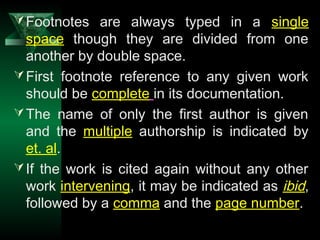
Footnotes are always typed in a single
space though they are divided from one
another by double space.
First footnote reference to any given work
should be complete in its documentation.
The name of only the first author is given
and the multiple authorship is indicated by
et. al.
If the work is cited again without any other
work intervening, it may be indicated as ibid,
followed by a comma and the page number.
11
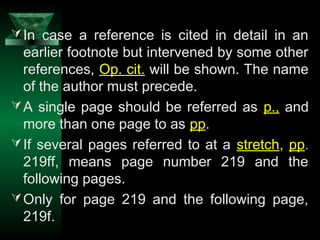
In case a reference is cited in detail in an
earlier footnote but intervened by some other
references, Op. cit. will be shown. The name
of the author must precede.
A single page should be referred as p., and
more than one page to as pp.
If several pages referred to at a stretch, pp.
219ff, means page number 219 and the
following pages.
Only for page 219 and the following page,
219f.
12
 Quotations should be placed in quotation marks
and double spaced.
 If a quotation carries more than four/ five type
written lines, it should be single spaced and
reduced to at least 0.5’’ to the right of the normal
text margin.
 Second-hand quotations reference:
Original author and title;
“ quoted or cited in,”;
Second author and work.
T.R. Dash. (2005). Cooperatives and Economic
Development, p. 62, quoted in Business
Environment, by Sok Rotha. (2007). p. 192.
Treatment of Quotations
13
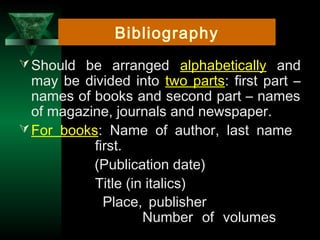
Should be arranged alphabetically and
may be divided into two parts: first part –
names of books and second part – names
of magazine, journals and newspaper.
For books: Name of author, last name
first.
(Publication date)
Title (in italics)
Place, publisher
Number of volumes
Bibliography
14
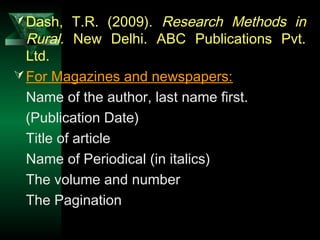
Dash, T.R. (2009). Research Methods in
Rural. New Delhi. ABC Publications Pvt.
Ltd.
For Magazines and newspapers:
Name of the author, last name first.
(Publication Date)
Title of article
Name of Periodical (in italics)
The volume and number
The Pagination
15
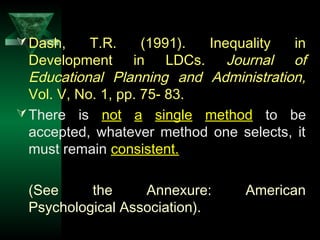
Dash, T.R. (1991). Inequality in
Development in LDCs. Journal of
Educational Planning and Administration,
Vol. V, No. 1, pp. 75- 83.
There is not a single method to be
accepted, whatever method one selects, it
must remain consistent.
(See the Annexure: American
Psychological Association).
16
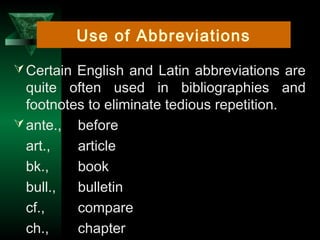
Certain English and Latin abbreviations are
quite often used in bibliographies and
footnotes to eliminate tedious repetition.
ante., before
art., article
bk., book
bull., bulletin
cf., compare
ch., chapter
Use of Abbreviations
17
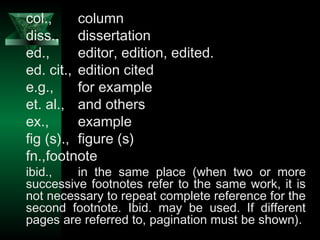
col., column
diss., dissertation
ed., editor, edition, edited.
ed. cit., edition cited
e.g., for example
et. al., and others
ex., example
fig (s)., figure (s)
fn.,footnote
ibid., in the same place (when two or more
successive footnotes refer to the same work, it is
not necessary to repeat complete reference for the
second footnote. Ibid. may be used. If different
pages are referred to, pagination must be shown).
18
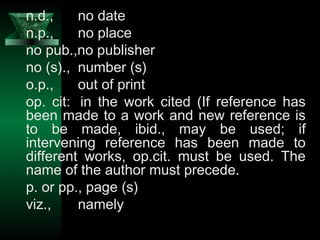
n.d., no date
n.p., no place
no pub.,no publisher
no (s)., number (s)
o.p., out of print
op. cit: in the work cited (If reference has
been made to a work and new reference is
to be made, ibid., may be used; if
intervening reference has been made to
different works, op.cit. must be used. The
name of the author must precede.
p. or pp., page (s)
viz., namely
19
Clearly identify a focused well-defined
question in the introduction part of the
report.
Provide answer to that question in the
report.
Instead of simply reporting the data, analyze
and interpret the data as per the objectives.
Discuss the significance and limitations of
the study.
Specifically and concretely state the findings
in the report.
Guidelines to Avoid Common
Mistakes in Report Writing
20
Two types: Informational and Descriptive.
Informational Abstracts:
Normally short, depending upon the length
of the report (10 per cent or less of the
report).
Communicate contents of the report.
Include purpose, methods, scope, results,
conclusions and recommendations.
Highlight essential points of the report.
Enable readers to decide whether they want
to read the report or not.
Writing of Abstract
21
Descriptive Abstracts:
Normally very short – usually under 100
words.
Speak what the report contains.
Include purpose, methods, scope,
conclusions and recommendations but NOT
results.
Introduce subject to readers for further study
of the report.
22
Qualities of an Effective Abstract
Should have an introduction-body-
conclusion structure: Purpose, Findings,
Conclusions, Recommendations. Should
follow strictly the chronology of the report.
Must provide logical connections between
material included.
Should summarize the report without adding
any new information.
23
Ministry of Education, Youth and Sport
Build Bright University
Institute of Post Graduate Studies
Tith Rotha
Rural Sector Development in Cambodia – A
Case Study
THESIS SUBMITTED FOR THE DEGREE OF
Master of Rural Development and Project
management (MRD & PM)
Phnom Penh, 2011
24
Ministry of Education, Youth and Sport
Build Bright University
Institute of Post Graduate Studies
Tith Rotha
Rural Sector Development in Cambodia – A
Case Study
THESIS SUBMITTED FOR THE DEGREE OF
Master of Rural Development and Project
management (MRD & PM)
Under the Guidance of
PROF.(DR.) TAPAS RANJAN DASH
Phnom Penh, 2011
25
DECLARATION
I do hereby declare that except otherwise
stated the thesis ‘Rural Sector
Development in Cambodia – A Case Study’
is based on my original work and the same
has not been submitted either in part or in
full for the award of any other degree of any
other University.
My indebtedness to other writer has been
acknowledged at relevant places.
Tith Rotha
26
CERTIFICATE
(To be given by your Guide)
27
ACKNOWLEDGEMENTS
i
28
CONTENTS
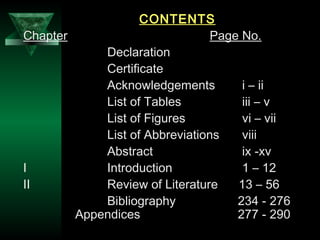
Chapter Page No.
Declaration
Certificate
Acknowledgements i – ii
List of Tables iii – v
List of Figures vi – vii
List of Abbreviations viii
Abstract ix -xv
I Introduction 1 – 12
II Review of Literature 13 – 56
Bibliography 234 - 276
Appendices 277 - 290
29
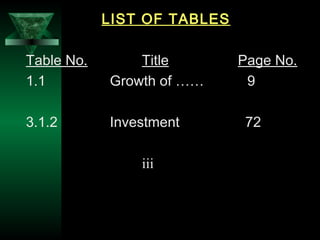
LIST OF TABLES
Table No. Title Page No.
1.1 Growth of …… 9
3.1.2 Investment 72
iii
30
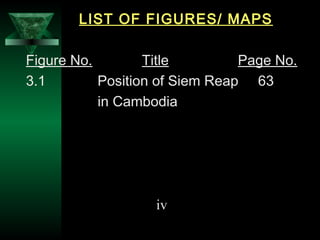
LIST OF FIGURES/ MAPS
Figure No. Title Page No.
3.1 Position of Siem Reap 63
in Cambodia
iv
31
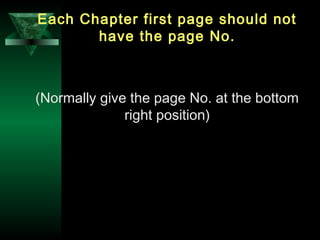
Each Chapter first page should not
have the page No.
(Normally give the page No. at the bottom
right position)
32
Discussion on thesis writing
See the Thesis Writing Guidelines

Chapter 9 (report writing)

  • 1.
  • 2.
    2 Contents  Step inwriting research report  Layout of research report  Procedure of writing research report  Size and physical design  Footnotes, Treatment of quotations  Bibliography  Use of abbreviations  Guidelines to avoid common mistakes in report writing  Guidelines of writing abstract
  • 3.
    3 Is an integralpart of research process. Is the last step in a research study. Requires a set of skills somewhat different from those called for in respect of the earlier stages of research. Report of the Research
  • 4.
    4 Steps in WritingReportSteps in Writing Report Preparation of the chapter outline Logical Analysis of the subject- matter Preparation of the rough draft Rewriting and Polishing Writing the final draft Preparation of the final bibliographies
  • 5.
    5 Layout ReportLayout Report 1.Preliminary Pages 2. Main Text 3. End matter Title and date, Declaration, Certificate, Acknowledgements/ Preface, Contents, List of tables, Figures and maps, Acronyms, Executive summary Introduction, Lit. Rev, Methodology, Data Analysis, Findings, Recommendations, Bibliography Appendices Questionnaires, Technical data, Detailed sample Information, etc.
  • 6.
    6 Size and physicaldesign Footnotes Treatment of quotations Bibliography Abbreviations Mechanics of Writing Research Report
  • 7.
    7 Manuscript should bewritten on A4 size paper (8.5’’ x 11’’) in size. A margin of 1.5’’ should be allowed at the left hand and 1.0’’ at the right hand. A margin of 1.0’’ should be given at top and bottom. All typing should be double-spaced on one side of the page except footnotes. Text material should be of 12 font (Tahoma) and heading and sub-headings should be 14 font and bold. Size and Physical Design
  • 8.
    8 Serve two purposes: 1.Identification of materials used in quotations in the report. 2. Notice of materials not immediately necessary to the body of the research text but still of supplemental value. Footnotes
  • 9.
    9 Footnotes are placedat the bottom of the page on which the reference or quotation appears. Are separated from the textual material by a space of half an inch and a line about one and a half inches long. Should be numbered consecutively, beginning with 1 in each chapter. The number should be put slightly above the line, say at the end of a quotation. In case of statistical tables, symbols such as the asterisk (*) or the like may be used.
  • 10.
    10 Footnotes are alwaystyped in a single space though they are divided from one another by double space. First footnote reference to any given work should be complete in its documentation. The name of only the first author is given and the multiple authorship is indicated by et. al. If the work is cited again without any other work intervening, it may be indicated as ibid, followed by a comma and the page number.
  • 11.
    11 In case areference is cited in detail in an earlier footnote but intervened by some other references, Op. cit. will be shown. The name of the author must precede. A single page should be referred as p., and more than one page to as pp. If several pages referred to at a stretch, pp. 219ff, means page number 219 and the following pages. Only for page 219 and the following page, 219f.
  • 12.
    12  Quotations shouldbe placed in quotation marks and double spaced.  If a quotation carries more than four/ five type written lines, it should be single spaced and reduced to at least 0.5’’ to the right of the normal text margin.  Second-hand quotations reference: Original author and title; “ quoted or cited in,”; Second author and work. T.R. Dash. (2005). Cooperatives and Economic Development, p. 62, quoted in Business Environment, by Sok Rotha. (2007). p. 192. Treatment of Quotations
  • 13.
    13 Should be arrangedalphabetically and may be divided into two parts: first part – names of books and second part – names of magazine, journals and newspaper. For books: Name of author, last name first. (Publication date) Title (in italics) Place, publisher Number of volumes Bibliography
  • 14.
    14 Dash, T.R. (2009).Research Methods in Rural. New Delhi. ABC Publications Pvt. Ltd. For Magazines and newspapers: Name of the author, last name first. (Publication Date) Title of article Name of Periodical (in italics) The volume and number The Pagination
  • 15.
    15 Dash, T.R. (1991).Inequality in Development in LDCs. Journal of Educational Planning and Administration, Vol. V, No. 1, pp. 75- 83. There is not a single method to be accepted, whatever method one selects, it must remain consistent. (See the Annexure: American Psychological Association).
  • 16.
    16 Certain English andLatin abbreviations are quite often used in bibliographies and footnotes to eliminate tedious repetition. ante., before art., article bk., book bull., bulletin cf., compare ch., chapter Use of Abbreviations
  • 17.
    17 col., column diss., dissertation ed.,editor, edition, edited. ed. cit., edition cited e.g., for example et. al., and others ex., example fig (s)., figure (s) fn.,footnote ibid., in the same place (when two or more successive footnotes refer to the same work, it is not necessary to repeat complete reference for the second footnote. Ibid. may be used. If different pages are referred to, pagination must be shown).
  • 18.
    18 n.d., no date n.p.,no place no pub.,no publisher no (s)., number (s) o.p., out of print op. cit: in the work cited (If reference has been made to a work and new reference is to be made, ibid., may be used; if intervening reference has been made to different works, op.cit. must be used. The name of the author must precede. p. or pp., page (s) viz., namely
  • 19.
    19 Clearly identify afocused well-defined question in the introduction part of the report. Provide answer to that question in the report. Instead of simply reporting the data, analyze and interpret the data as per the objectives. Discuss the significance and limitations of the study. Specifically and concretely state the findings in the report. Guidelines to Avoid Common Mistakes in Report Writing
  • 20.
    20 Two types: Informationaland Descriptive. Informational Abstracts: Normally short, depending upon the length of the report (10 per cent or less of the report). Communicate contents of the report. Include purpose, methods, scope, results, conclusions and recommendations. Highlight essential points of the report. Enable readers to decide whether they want to read the report or not. Writing of Abstract
  • 21.
    21 Descriptive Abstracts: Normally veryshort – usually under 100 words. Speak what the report contains. Include purpose, methods, scope, conclusions and recommendations but NOT results. Introduce subject to readers for further study of the report.
  • 22.
    22 Qualities of anEffective Abstract Should have an introduction-body- conclusion structure: Purpose, Findings, Conclusions, Recommendations. Should follow strictly the chronology of the report. Must provide logical connections between material included. Should summarize the report without adding any new information.
  • 23.
    23 Ministry of Education,Youth and Sport Build Bright University Institute of Post Graduate Studies Tith Rotha Rural Sector Development in Cambodia – A Case Study THESIS SUBMITTED FOR THE DEGREE OF Master of Rural Development and Project management (MRD & PM) Phnom Penh, 2011
  • 24.
    24 Ministry of Education,Youth and Sport Build Bright University Institute of Post Graduate Studies Tith Rotha Rural Sector Development in Cambodia – A Case Study THESIS SUBMITTED FOR THE DEGREE OF Master of Rural Development and Project management (MRD & PM) Under the Guidance of PROF.(DR.) TAPAS RANJAN DASH Phnom Penh, 2011
  • 25.
    25 DECLARATION I do herebydeclare that except otherwise stated the thesis ‘Rural Sector Development in Cambodia – A Case Study’ is based on my original work and the same has not been submitted either in part or in full for the award of any other degree of any other University. My indebtedness to other writer has been acknowledged at relevant places. Tith Rotha
  • 26.
  • 27.
  • 28.
    28 CONTENTS Chapter Page No. Declaration Certificate Acknowledgementsi – ii List of Tables iii – v List of Figures vi – vii List of Abbreviations viii Abstract ix -xv I Introduction 1 – 12 II Review of Literature 13 – 56 Bibliography 234 - 276 Appendices 277 - 290
  • 29.
    29 LIST OF TABLES TableNo. Title Page No. 1.1 Growth of …… 9 3.1.2 Investment 72 iii
  • 30.
    30 LIST OF FIGURES/MAPS Figure No. Title Page No. 3.1 Position of Siem Reap 63 in Cambodia iv
  • 31.
    31 Each Chapter firstpage should not have the page No. (Normally give the page No. at the bottom right position)
  • 32.
    32 Discussion on thesiswriting See the Thesis Writing Guidelines