1
Improve your thesis writing
style
A C K N O W L E D G E M E N T O F C O U N T R Y
The University of Notre DameAustralia is proud to acknowledge the traditional owners and
custodians of the land upon which our University sits. The University acknowledges that the Sydney
Campus is located on Cadigal Country, the Fremantle Campus on Wadjuk Country and the Broome
Campus on Yawuru Country.
What has helped you most with your
writing so far?
Contents
The three ‘C’s of writing
Clarity
Coherence
Conciseness
Selected resources
WHAT KIND OF WRITER ARE YOU?
How closely does this match your
experience?
"Writing a first draft is like groping one's
way into a dark room .....one writes mainly
to rewrite, for rewriting and revising are
how one's mind comes to inhabit the
material fully." Ted Solotaroff
What has helped you most with your thesis
writing so far?
Discuss in your pairs / groups The 3 ‘C’s of writing
2
CLARITY: Explaining your points, so that the
reader can easily understand exactly what
they mean
COHERENCE: Building on what have written
previously, so that the reader can easily
follow the thread of your argument
CONCISENESS: Including only those words
and ideas that contribute significantly to the
reader’s understanding of your essential
meaning
WRITING TIPS FOR CLARITY
CLARITY 1: Avoid vague information
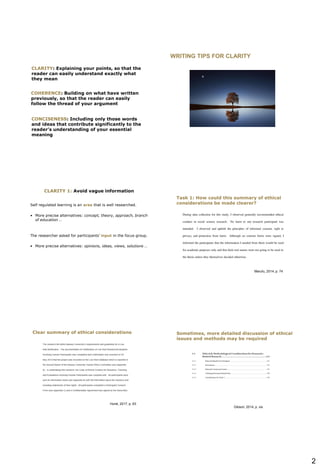
Self regulated learning is an area that is well researched.
• More precise alternatives: concept, theory, approach, branch
of education …
The researcher asked for participants’ input in the focus group.
• More precise alternatives: opinions, ideas, views, solutions …
Marufu, 2014, p. 74
Task 1: How could this summary of ethical
considerations be made clearer?
Hurst, 2017, p. 63
Clear summary of ethical considerations
Gibson, 2014, p. xix
Sometimes, more detailed discussion of ethical
issues and methods may be required
3
Marufu, 2014, p. 40
CLARITY 2: Avoid vague references to theory
Clear overview of theoretical perspective
Hurst, 2017, p. 18
In the 1960s, when little study was devoted to
facial expression (reference), like most social
scientists of her day, Mead (reference) believed
expression was culturally determined, we simply
use our face according to a set of learned social
conventions, which grew from the emphasis on
motivation and cognition in academic psychology
that flourished at the time (reference).
CLARITY 3: Avoid vague, rambling sentences
STOP & REFRESH
In the 1960s, empirical research into facial expression
was limited (reference).
Like most social scientists of her day, Mead believed
expression was culturally determined (reference).
In other words, she believed we simply use our face
according to a set of learned social conventions.
This belief grew from the emphasis on motivation and
cognition in academic psychology that flourished at the
time (reference).
Clarity is enhanced by writing short sentences,
each covering a single point
Task 2: What is the focus of the paragraph and
of each sentence in it?
Gibson, 2014, p. 56
4
CLARITY 4: Include ‘hedging’ to avoid
over-generalisation
Hurst, 2017, p. 45
Marufu, 2014, p. 5
CLARITY 5: Avoid vague figures & tables
Hwee Ming Teo, 2016, p. 154
Clear illustration of a process WRITING TIPS FOR COHERENCE
Gibson, 2014, pp. 56-57
COHERENCE 1: Begin a paragraph with a topic sentence
Marufu, 2014, p. 24
Task 3: To what extent does the rest of the paragraph
develop the point made in the topic sentence?
5
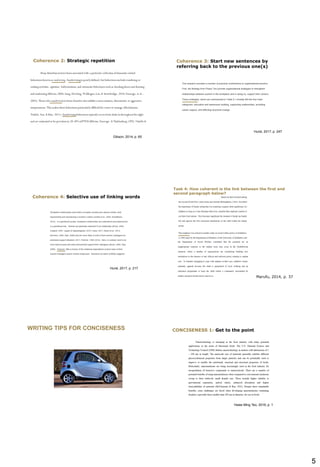
Coherence 2: Strategic repetition
Gibson, 2014, p. 65
Hurst, 2017, p. 247
Coherence 3: Start new sentences by
referring back to the previous one(s)
Hurst, 2017, p. 217
Coherence 4: Selective use of linking words
Marufu, 2014, p. 37
Task 4: How coherent is the link between the first and
second paragraph below?
WRITING TIPS FOR CONCISENESS CONCISENESS 1: Get to the point
Hwee Ming Teo, 2016, p. 1
6
Marufu, 2014, p. 12
CONCISENESS 1: Get to the point
Task 5: Based on this paragraph from the introduction,
what would you guess is the topic of this thesis?
Cognitive theories of motivation, on the other hand, seek to
explain motivation to learn language in relation to learners’
beliefs about their abilities (Dornyei, 1994, p. 276). Perhaps the
most influential of these, attribution theory, suggests that our
beliefs about past experiences influence expectations of future
success. According to this view, the common experience of low
achievement in foreign languages at school does not necessarily
lead to low motivation in adults, since those who ascribe their
past failures to factors beyond their control, might still be highly-
motivated despite past failures. Research by Wu and Ushioda
supports this view, finding that highly motivated learners did in
fact tend to associate their successes with personal factors and
failures to external factors (in Dornyei, 2005, p. 80). A practical
application of such research might be a stronger emphasis on
learner training with the goal of helping learners overcome
unfounded perceptions of lack of language learning ability based
on past failures…. (my writing)
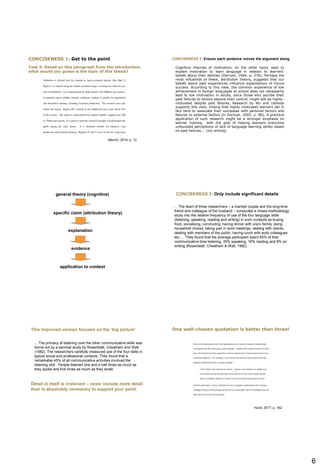
CONCISENESS 2: Ensure each sentence moves the argument along
general theory (cognitive)
specific claim (attribution theory)
explanation
application to context
evidence
CONCISENESS 3: Only include significant details
... The team of three researchers – a married couple and the long-time
friend and colleague of the husband – conducted a mixed-methodology
study into the relative frequency of use of the four language skills
(listening, speaking, reading and writing) in such contexts as buying
food, socialising, commuting, having dinner with one’s family, doing
household chores, taking part in work meetings, dealing with clients,
dealing with members of the public, having lunch with work colleagues
etc.... They found that the average participant spent 45% of their
communicative time listening, 30% speaking, 16% reading and 9% on
writing (Rosenblatt, Cheatham & Watt, 1982).
This improved version focuses on the ‘big picture’.
... The primacy of listening over the other communicative skills was
borne out by a seminal study by Rosenblatt, Cheatham and Watt
(1982). The researchers carefully measured use of the four skills in
typical social and professional contexts. They found that a
remarkable 45% of all communicative activities involved the
listening skill. People listened one and a half times as much as
they spoke and five times as much as they wrote.
Detail in itself is irrelevant – never include more detail
than is absolutely necessary to support your point.
Hurst, 2017, p. 162
One well-chosen quotation is better than three!
7
CONCISENESS 4: Reduce phrases to single words
Another way this research methodology is limited, looking at it from an
ethnographic angle ...
Another limitation, in ethnographic terms ...
APPLYING THE 3 ‘C’s
A common method of finding out about any problems children
might be having with eating and drinking is to ask their parents if
they could fill out questionnaires about them. They don’t take
long and there is no need for professional researchers necessarily
to be involved in meeting the parents and asking them questions
(Seivering et al., 2010). One of these is the Brief Autism
Mealtime Behaviour Inventory (BAMBI). Mealtime behaviours are
the main topic of BAMBI (Seivering et al., 2010). In the food
preference inventory (FPI), parents select how often their child
eats a food. They have to say whether their son or daughter
often, sometimes, or never eats a particular kind of food, like ice-
cream, carrots, chips, fish, yoghurt, chocolate etc (Sharp,
Jaquess, & Lukens, 2013). They can also be directly observed.
The therapist, researcher or parent feeds the child food from
different food groups or textures and he or she makes notes
(Seivering et al., 2010). The ways they behave while eating, the
kinds of food they like or do not like and the way they interact
with the other person while they are eating are noted and
analysed.
How could this text be made clearer, more coherent and more
concise?
Information about a child’s feeding difficulties can be collected
through parent questionnaires or observation (which requires more
time and expertise) (Seivering et al., 2010). Parent questionnaires
include the Brief Autism Mealtime Behaviour Inventory (BAMBI)
(Seivering et al., 2010) and the Food Preference Inventory (FPI),
where parents record how often their child eats a food (Sharp,
Jaquess, & Lukens, 2013). Direct observation involves the therapist,
researcher or parent feeding the child food from different food
groups or textures (Seivering et al., 2010), recording the child’s
behaviour, preferences and interactions.
Improved version
• Paragraph has a more inclusive topic sentence
• Repetition has been reduced
• Some details (e.g. sometimes, often, never) have
been omitted
Resources
For more advice on academic writing, see our ‘Success
Now! e-course
https://tinyurl.com/successnowecourse
8
Selected thesis writing resources
Patter (blog on thesis writing etc) patthomson.net
The thesis whisperer thesiswhisperer.com
Doctoral writing SIG doctoralwriting.wordpress.com
John Swales & Christine Feak English in today’s research
world / Academic writing for graduate students etc. See
tinyurl.com/swalesfeak
Paul Oliver Writing your thesis
Joyner, Rowse, & Glatthorn Writing the winning thesis
Rowena Murray How to write a thesis
Evans, Gruba, & Zobel How to write a better thesis
Rosemary Gibson (2014): Understanding and Managing
Dementia-Related Sleep Problems: Community-Based Research with
Older New Zealanders. http://hdl.handle.net/10179/6688
Jane Hurst (2017): It's all about relationships: Women managing
women and the impact on their careers.
http://hdl.handle.net/10179/11814
Grace Marufu (Mugabe) (2014): The changing structure and
functions of the family. http://tinyurl.com/gracemugabethesis
Hwee Ming Teo (2016): Development of novel nanoemulsions as
delivery systems. http://hdl.handle.net/10179/9903
Theses referred to in this presentation

Improving your thesis writing style.pdf

  • 1.
    1 Improve your thesiswriting style A C K N O W L E D G E M E N T O F C O U N T R Y The University of Notre DameAustralia is proud to acknowledge the traditional owners and custodians of the land upon which our University sits. The University acknowledges that the Sydney Campus is located on Cadigal Country, the Fremantle Campus on Wadjuk Country and the Broome Campus on Yawuru Country. What has helped you most with your writing so far? Contents The three ‘C’s of writing Clarity Coherence Conciseness Selected resources WHAT KIND OF WRITER ARE YOU? How closely does this match your experience? "Writing a first draft is like groping one's way into a dark room .....one writes mainly to rewrite, for rewriting and revising are how one's mind comes to inhabit the material fully." Ted Solotaroff What has helped you most with your thesis writing so far? Discuss in your pairs / groups The 3 ‘C’s of writing
  • 2.
    2 CLARITY: Explaining yourpoints, so that the reader can easily understand exactly what they mean COHERENCE: Building on what have written previously, so that the reader can easily follow the thread of your argument CONCISENESS: Including only those words and ideas that contribute significantly to the reader’s understanding of your essential meaning WRITING TIPS FOR CLARITY CLARITY 1: Avoid vague information Self regulated learning is an area that is well researched. • More precise alternatives: concept, theory, approach, branch of education … The researcher asked for participants’ input in the focus group. • More precise alternatives: opinions, ideas, views, solutions … Marufu, 2014, p. 74 Task 1: How could this summary of ethical considerations be made clearer? Hurst, 2017, p. 63 Clear summary of ethical considerations Gibson, 2014, p. xix Sometimes, more detailed discussion of ethical issues and methods may be required
  • 3.
    3 Marufu, 2014, p.40 CLARITY 2: Avoid vague references to theory Clear overview of theoretical perspective Hurst, 2017, p. 18 In the 1960s, when little study was devoted to facial expression (reference), like most social scientists of her day, Mead (reference) believed expression was culturally determined, we simply use our face according to a set of learned social conventions, which grew from the emphasis on motivation and cognition in academic psychology that flourished at the time (reference). CLARITY 3: Avoid vague, rambling sentences STOP & REFRESH In the 1960s, empirical research into facial expression was limited (reference). Like most social scientists of her day, Mead believed expression was culturally determined (reference). In other words, she believed we simply use our face according to a set of learned social conventions. This belief grew from the emphasis on motivation and cognition in academic psychology that flourished at the time (reference). Clarity is enhanced by writing short sentences, each covering a single point Task 2: What is the focus of the paragraph and of each sentence in it? Gibson, 2014, p. 56
  • 4.
    4 CLARITY 4: Include‘hedging’ to avoid over-generalisation Hurst, 2017, p. 45 Marufu, 2014, p. 5 CLARITY 5: Avoid vague figures & tables Hwee Ming Teo, 2016, p. 154 Clear illustration of a process WRITING TIPS FOR COHERENCE Gibson, 2014, pp. 56-57 COHERENCE 1: Begin a paragraph with a topic sentence Marufu, 2014, p. 24 Task 3: To what extent does the rest of the paragraph develop the point made in the topic sentence?
  • 5.
    5 Coherence 2: Strategicrepetition Gibson, 2014, p. 65 Hurst, 2017, p. 247 Coherence 3: Start new sentences by referring back to the previous one(s) Hurst, 2017, p. 217 Coherence 4: Selective use of linking words Marufu, 2014, p. 37 Task 4: How coherent is the link between the first and second paragraph below? WRITING TIPS FOR CONCISENESS CONCISENESS 1: Get to the point Hwee Ming Teo, 2016, p. 1
  • 6.
    6 Marufu, 2014, p.12 CONCISENESS 1: Get to the point Task 5: Based on this paragraph from the introduction, what would you guess is the topic of this thesis? Cognitive theories of motivation, on the other hand, seek to explain motivation to learn language in relation to learners’ beliefs about their abilities (Dornyei, 1994, p. 276). Perhaps the most influential of these, attribution theory, suggests that our beliefs about past experiences influence expectations of future success. According to this view, the common experience of low achievement in foreign languages at school does not necessarily lead to low motivation in adults, since those who ascribe their past failures to factors beyond their control, might still be highly- motivated despite past failures. Research by Wu and Ushioda supports this view, finding that highly motivated learners did in fact tend to associate their successes with personal factors and failures to external factors (in Dornyei, 2005, p. 80). A practical application of such research might be a stronger emphasis on learner training with the goal of helping learners overcome unfounded perceptions of lack of language learning ability based on past failures…. (my writing) CONCISENESS 2: Ensure each sentence moves the argument along general theory (cognitive) specific claim (attribution theory) explanation application to context evidence CONCISENESS 3: Only include significant details ... The team of three researchers – a married couple and the long-time friend and colleague of the husband – conducted a mixed-methodology study into the relative frequency of use of the four language skills (listening, speaking, reading and writing) in such contexts as buying food, socialising, commuting, having dinner with one’s family, doing household chores, taking part in work meetings, dealing with clients, dealing with members of the public, having lunch with work colleagues etc.... They found that the average participant spent 45% of their communicative time listening, 30% speaking, 16% reading and 9% on writing (Rosenblatt, Cheatham & Watt, 1982). This improved version focuses on the ‘big picture’. ... The primacy of listening over the other communicative skills was borne out by a seminal study by Rosenblatt, Cheatham and Watt (1982). The researchers carefully measured use of the four skills in typical social and professional contexts. They found that a remarkable 45% of all communicative activities involved the listening skill. People listened one and a half times as much as they spoke and five times as much as they wrote. Detail in itself is irrelevant – never include more detail than is absolutely necessary to support your point. Hurst, 2017, p. 162 One well-chosen quotation is better than three!
  • 7.
    7 CONCISENESS 4: Reducephrases to single words Another way this research methodology is limited, looking at it from an ethnographic angle ... Another limitation, in ethnographic terms ... APPLYING THE 3 ‘C’s A common method of finding out about any problems children might be having with eating and drinking is to ask their parents if they could fill out questionnaires about them. They don’t take long and there is no need for professional researchers necessarily to be involved in meeting the parents and asking them questions (Seivering et al., 2010). One of these is the Brief Autism Mealtime Behaviour Inventory (BAMBI). Mealtime behaviours are the main topic of BAMBI (Seivering et al., 2010). In the food preference inventory (FPI), parents select how often their child eats a food. They have to say whether their son or daughter often, sometimes, or never eats a particular kind of food, like ice- cream, carrots, chips, fish, yoghurt, chocolate etc (Sharp, Jaquess, & Lukens, 2013). They can also be directly observed. The therapist, researcher or parent feeds the child food from different food groups or textures and he or she makes notes (Seivering et al., 2010). The ways they behave while eating, the kinds of food they like or do not like and the way they interact with the other person while they are eating are noted and analysed. How could this text be made clearer, more coherent and more concise? Information about a child’s feeding difficulties can be collected through parent questionnaires or observation (which requires more time and expertise) (Seivering et al., 2010). Parent questionnaires include the Brief Autism Mealtime Behaviour Inventory (BAMBI) (Seivering et al., 2010) and the Food Preference Inventory (FPI), where parents record how often their child eats a food (Sharp, Jaquess, & Lukens, 2013). Direct observation involves the therapist, researcher or parent feeding the child food from different food groups or textures (Seivering et al., 2010), recording the child’s behaviour, preferences and interactions. Improved version • Paragraph has a more inclusive topic sentence • Repetition has been reduced • Some details (e.g. sometimes, often, never) have been omitted Resources For more advice on academic writing, see our ‘Success Now! e-course https://tinyurl.com/successnowecourse
  • 8.
    8 Selected thesis writingresources Patter (blog on thesis writing etc) patthomson.net The thesis whisperer thesiswhisperer.com Doctoral writing SIG doctoralwriting.wordpress.com John Swales & Christine Feak English in today’s research world / Academic writing for graduate students etc. See tinyurl.com/swalesfeak Paul Oliver Writing your thesis Joyner, Rowse, & Glatthorn Writing the winning thesis Rowena Murray How to write a thesis Evans, Gruba, & Zobel How to write a better thesis Rosemary Gibson (2014): Understanding and Managing Dementia-Related Sleep Problems: Community-Based Research with Older New Zealanders. http://hdl.handle.net/10179/6688 Jane Hurst (2017): It's all about relationships: Women managing women and the impact on their careers. http://hdl.handle.net/10179/11814 Grace Marufu (Mugabe) (2014): The changing structure and functions of the family. http://tinyurl.com/gracemugabethesis Hwee Ming Teo (2016): Development of novel nanoemulsions as delivery systems. http://hdl.handle.net/10179/9903 Theses referred to in this presentation