CHILD PSYCHOLOGY
Fall 2019Project Options
Project Due Date: April 17, 2020
Purpose: The purpose of this assignment is to give you
experience with scientific observation along with gaining an in-
depth knowledge of various aspects of childhood development.
In addition, you will have the opportunity to hone your writing
skills. Please approach these projects as a scientist - be
objective, precise, and systematic in your observations and
interpretations.
Instructions: To complete the entire assignment, you will be
required to choose one project from each of the four sections
outlined below. In other words, everyone will complete four
small projects – one from each section. Please watch the
Tegrity recording regarding the project. There is a forum in the
Discussion Board for you to ask any questions you might still
have.
Format: Each project should be at least two double-
spacedpages in length with 1” margins. Two pages is a simply a
minimum – it is fine to go over this guideline. I would rather
you be thorough than stay within the two page guideline. You
will need to provide background information from your text for
each of the topics but be sure to use your own words!!For the
“Special Topics” portion, you will need to use the textbook and
another scholarly source as background information. Please use
proper citations and quotations when appropriate. There is a
handout under “Project” regarding APA format that will help
you with this. In addition, you will need to reference both your
text and the outside article in a reference list.
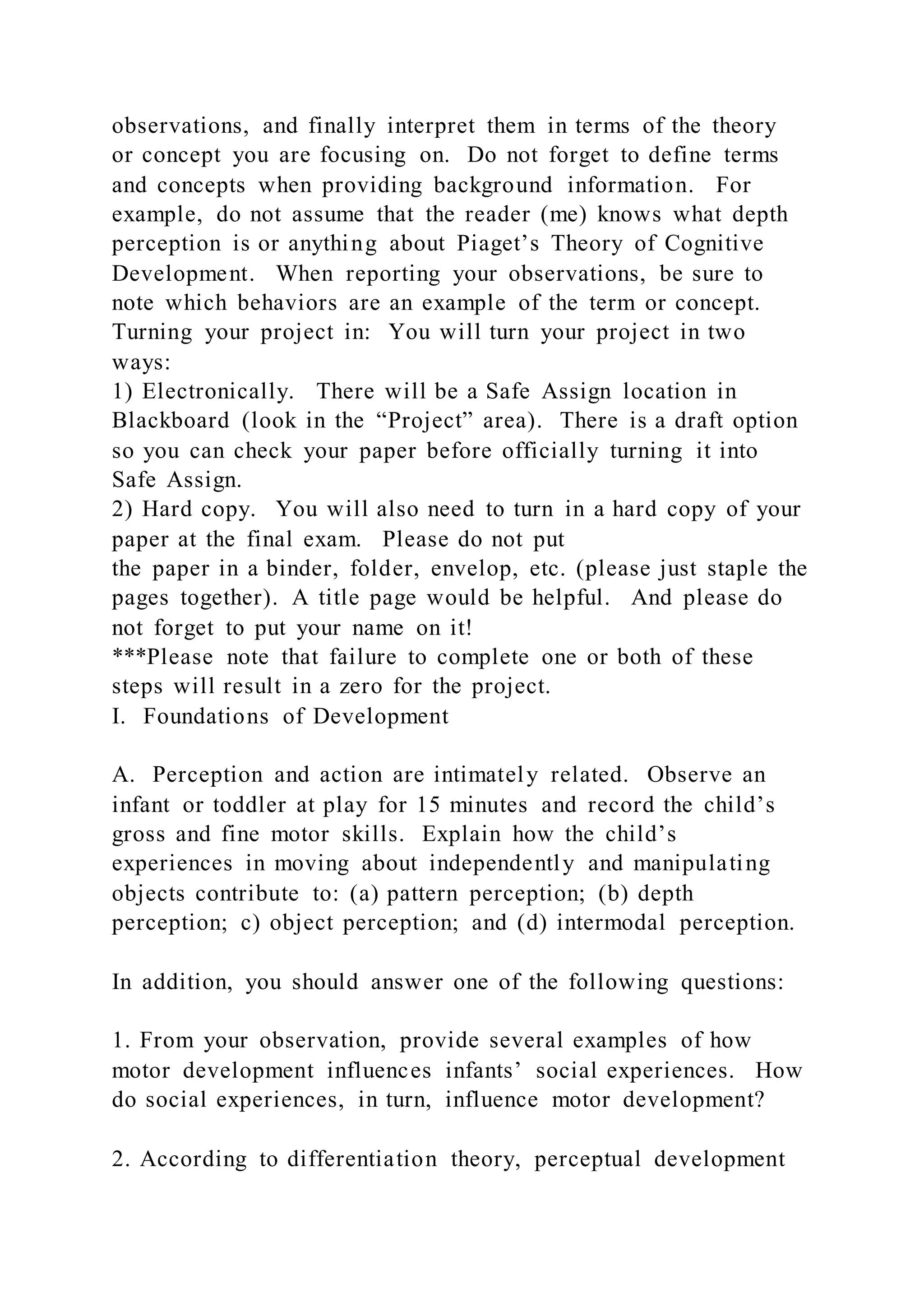
There are many ways to present your findings. One way that
you might consider (and seems to work well) is to first provide
background information regarding the particular type of
development you are investigating, then describe your
observations, and finally interpret them in terms of the theory
or concept you are focusing on. Do not forget to define terms
and concepts when providing background information. For
example, do not assume that the reader (me) knows what depth
perception is or anything about Piaget’s Theory of Cognitive
Development. When reporting your observations, be sure to
note which behaviors are an example of the term or concept.
Turning your project in: You will turn your project in two
ways:
1) Electronically. There will be a Safe Assign location in
Blackboard (look in the “Project” area). There is a draft option
so you can check your paper before officially turning it into
Safe Assign.
2) Hard copy. You will also need to turn in a hard copy of your
paper at the final exam. Please do not put
the paper in a binder, folder, envelop, etc. (please just staple the
pages together). A title page would be helpful. And please do
not forget to put your name on it!
***Please note that failure to complete one or both of these
steps will result in a zero for the project.
I. Foundations of Development
A. Perception and action are intimately related. Observe an
infant or toddler at play for 15 minutes and record the child’s
gross and fine motor skills. Explain how the child’s
experiences in moving about independently and manipulating
objects contribute to: (a) pattern perception; (b) depth
perception; c) object perception; and (d) intermodal perception.
In addition, you should answer one of the following questions:
1. From your observation, provide several examples of how
motor development influences infants’ social experiences. How
do social experiences, in turn, influence motor development?
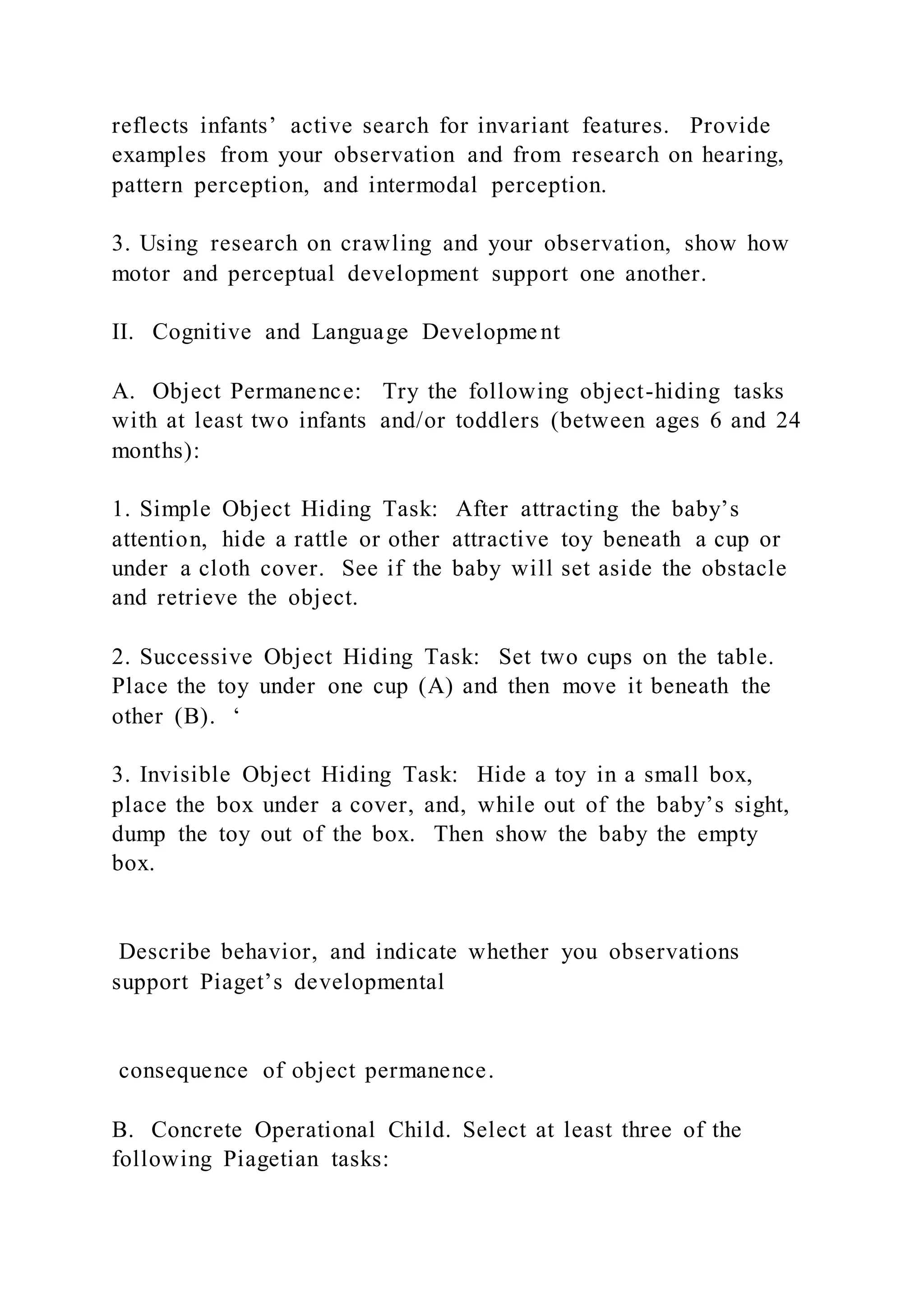
2. According to differentiation theory, perceptual development
reflects infants’ active search for invariant features. Provide
examples from your observation and from research on hearing,
pattern perception, and intermodal perception.
3. Using research on crawling and your observation, show how
motor and perceptual development support one another.
II. Cognitive and Language Developme nt
A. Object Permanence: Try the following object-hiding tasks
with at least two infants and/or toddlers (between ages 6 and 24
months):
1. Simple Object Hiding Task: After attracting the baby’s
attention, hide a rattle or other attractive toy beneath a cup or
under a cloth cover. See if the baby will set aside the obstacle
and retrieve the object.
2. Successive Object Hiding Task: Set two cups on the table.
Place the toy under one cup (A) and then move it beneath the
other (B). ‘
3. Invisible Object Hiding Task: Hide a toy in a small box,
place the box under a cover, and, while out of the baby’s sight,
dump the toy out of the box. Then show the baby the empty
box.
Describe behavior, and indicate whether you observations
support Piaget’s developmental
consequence of object permanence.
B. Concrete Operational Child. Select at least three of the
following Piagetian tasks:
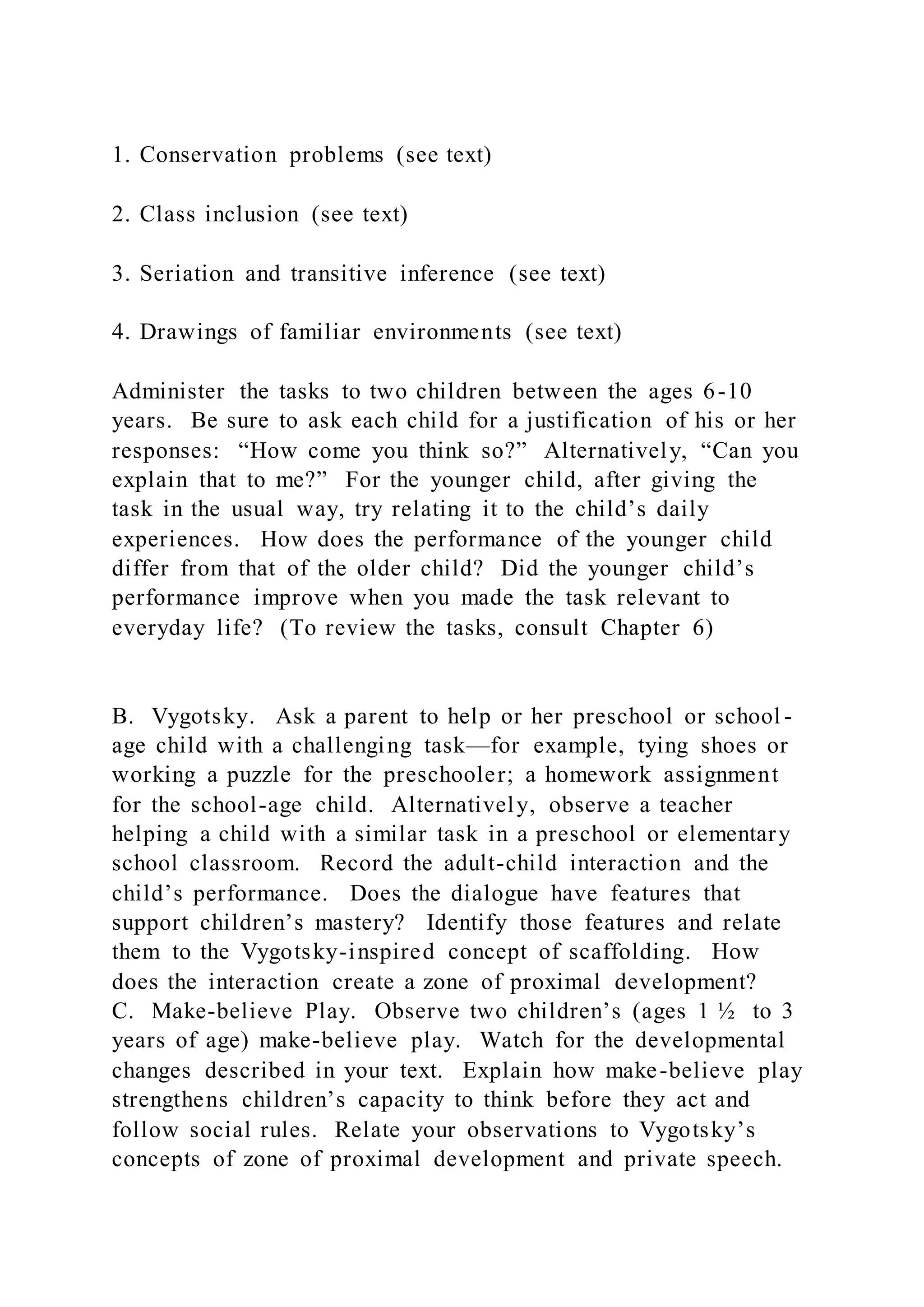
1. Conservation problems (see text)
2. Class inclusion (see text)
3. Seriation and transitive inference (see text)
4. Drawings of familiar environments (see text)
Administer the tasks to two children between the ages 6-10
years. Be sure to ask each child for a justification of his or her
responses: “How come you think so?” Alternatively, “Can you
explain that to me?” For the younger child, after giving the
task in the usual way, try relating it to the child’s daily
experiences. How does the performance of the younger child
differ from that of the older child? Did the younger child’s
performance improve when you made the task relevant to
everyday life? (To review the tasks, consult Chapter 6)
B. Vygotsky. Ask a parent to help or her preschool or school -
age child with a challenging task—for example, tying shoes or
working a puzzle for the preschooler; a homework assignment
for the school-age child. Alternatively, observe a teacher
helping a child with a similar task in a preschool or elementary
school classroom. Record the adult-child interaction and the
child’s performance. Does the dialogue have features that
support children’s mastery? Identify those features and relate
them to the Vygotsky-inspired concept of scaffolding. How
does the interaction create a zone of proximal development?
C. Make-believe Play. Observe two children’s (ages 1 ½ to 3
years of age) make-believe play. Watch for the developmental
changes described in your text. Explain how make-believe play
strengthens children’s capacity to think before they act and
follow social rules. Relate your observations to Vygotsky’s
concepts of zone of proximal development and private speech.
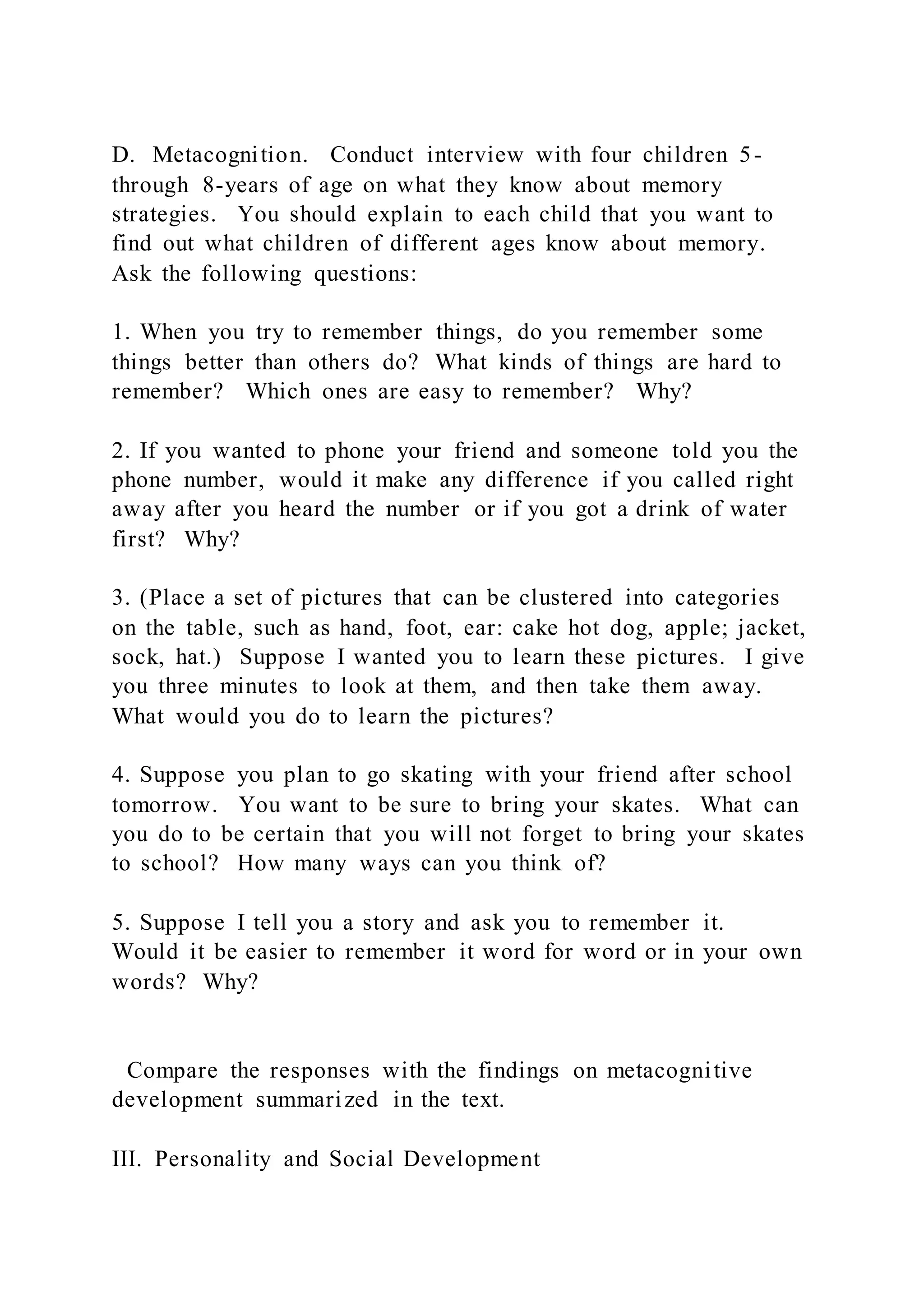
D. Metacognition. Conduct interview with four children 5-
through 8-years of age on what they know about memory
strategies. You should explain to each child that you want to
find out what children of different ages know about memory.
Ask the following questions:
1. When you try to remember things, do you remember some
things better than others do? What kinds of things are hard to
remember? Which ones are easy to remember? Why?
2. If you wanted to phone your friend and someone told you the
phone number, would it make any difference if you called right
away after you heard the number or if you got a drink of water
first? Why?
3. (Place a set of pictures that can be clustered into categories
on the table, such as hand, foot, ear: cake hot dog, apple; jacket,
sock, hat.) Suppose I wanted you to learn these pictures. I give
you three minutes to look at them, and then take them away.
What would you do to learn the pictures?
4. Suppose you plan to go skating with your friend after school
tomorrow. You want to be sure to bring your skates. What can
you do to be certain that you will not forget to bring your skates
to school? How many ways can you think of?
5. Suppose I tell you a story and ask you to remember it.
Would it be easier to remember it word for word or in your own
words? Why?
Compare the responses with the findings on metacognitive
development summarized in the text.
III. Personality and Social Development
A. Quality Daycare. Arrange to visit a day care center during
early morning hours, when parents bring their infants, toddlers,
and young preschoolers for the day. What steps do the staff
take to ease the stress of separation from the parent? How do
children greet their caregivers? Describe several examples, and
indicate whether children seem, for the most part, securely
attached to professional caregivers? Based on information
provided in Chapter 10 the text, rate the overall quality of the
day care center as excellent, average, or poor. Is overall quality
related to sensitive, responsive care? Explain. Describe steps
staff takes to ease separation anxiety and quality of attachment
to professional caregivers, and the relationship of center quality
to sensitive, responsive care.
B. Levels of Friendship. Interview two children—a
preschooler and a school-age child - about friendship using such
questions, as “What does it mean to be a good friend?” “Why is
it nice to have a friend?” “How can you tell that someone i s a
best friend?” Again, take notes on the children’s responses. At
what stage of friendship understanding is each child?
Preschool child:
School-age child:
Comparison:
C. Prosocial Understanding. Explore young children’s
prosocial understanding by presenting the
following dilemmas to two children between 4 and 8 years of
age.
One day a girl named Mary was going to a friend’s birthday
party. On her way she saw
a girl who had fallen down and hurt her leg. The girl asked
Mary to go to her house
and get her parents so the parents could come and take her to
the doctor. But if Mary
did run and get the child’s parents, she would be late for the
birthday party and miss
the ice cream, cake, and all the games. What should Mary do?
Why?
Record the children’s responses, and classify them according to
the sequence in the text.
Do your findings match the text discussion of prosocial
reasoning?
Younger child:
Older child:
D. Socializing Gender. Many adults hold gender-stereotyped
beliefs about what is appropriate for baby boys and baby girls.
Interview the parents of a young infant. Find out whether they
purchased certain colors of clothing or toys based on the
infant’s sex. Ask the parents to describe their baby. If the baby
is a boy, do the parents use more “masculine” descriptors, such
as “active” and “loud?” If a girl, do they more often mention
“feminine” characteristics, such as “gentle” and “sweet?” What
expectations do the parents have for their child’s behavior at
older ages? Are they aware of gender stereotypes? Are they
consciously trying to avoid them? Use information in Chapter
13 as background and to discuss consequences of a traditional
gender identity. Are there are alternatives to a traditional
gender identity?
IV. Special Topics (Include at least one scholarly source other
than the text in the background information)
A. Cognitive development and the understanding of death.
Interview at least two children between the ages of 3 and 10 to
explore their understanding of death. Relate your findings to
information on cognitive development.
B. Child-rearing styles. Interview at least two parents of
different families regarding their child rearing style.
C. Violence and Prosocial Behavior. Watch one hour each:
Saturday morning cartoons, late-afternoon children’s shows, and
prime-time adult-oriented television programs. For each tally
the number of violent and prosocial acts depicted on the screen.
Violent acts include both expressions of physical force as well
as threats of harm and verbal abuse. Prosocial behavior
encompasses all acts of generosity, helping, cooperation, and
self-control in which the actor shows a willingness to work for
long-term goals and resist temptation. Compare the prosocial
acts to aggressive acts and reflect on the socialization messages
children receive from television.
D. Other (Please have any other topic approved by me.) There
are many possibilities for other topics. If you are interested in
family dynamics, media, bullying, etc., look in the relevant
chapters in your text for ideas on what to specifically
investigate.
2

CHILD PSYCHOLOGYFall 2019Project OptionsProject Due Date Apr

  • 1.
    CHILD PSYCHOLOGY Fall 2019ProjectOptions Project Due Date: April 17, 2020 Purpose: The purpose of this assignment is to give you experience with scientific observation along with gaining an in- depth knowledge of various aspects of childhood development. In addition, you will have the opportunity to hone your writing skills. Please approach these projects as a scientist - be objective, precise, and systematic in your observations and interpretations. Instructions: To complete the entire assignment, you will be required to choose one project from each of the four sections outlined below. In other words, everyone will complete four small projects – one from each section. Please watch the Tegrity recording regarding the project. There is a forum in the Discussion Board for you to ask any questions you might still have. Format: Each project should be at least two double- spacedpages in length with 1” margins. Two pages is a simply a minimum – it is fine to go over this guideline. I would rather you be thorough than stay within the two page guideline. You will need to provide background information from your text for each of the topics but be sure to use your own words!!For the “Special Topics” portion, you will need to use the textbook and another scholarly source as background information. Please use proper citations and quotations when appropriate. There is a handout under “Project” regarding APA format that will help you with this. In addition, you will need to reference both your text and the outside article in a reference list. There are many ways to present your findings. One way that you might consider (and seems to work well) is to first provide background information regarding the particular type of development you are investigating, then describe your
  • 2.
    observations, and finallyinterpret them in terms of the theory or concept you are focusing on. Do not forget to define terms and concepts when providing background information. For example, do not assume that the reader (me) knows what depth perception is or anything about Piaget’s Theory of Cognitive Development. When reporting your observations, be sure to note which behaviors are an example of the term or concept. Turning your project in: You will turn your project in two ways: 1) Electronically. There will be a Safe Assign location in Blackboard (look in the “Project” area). There is a draft option so you can check your paper before officially turning it into Safe Assign. 2) Hard copy. You will also need to turn in a hard copy of your paper at the final exam. Please do not put the paper in a binder, folder, envelop, etc. (please just staple the pages together). A title page would be helpful. And please do not forget to put your name on it! ***Please note that failure to complete one or both of these steps will result in a zero for the project. I. Foundations of Development A. Perception and action are intimately related. Observe an infant or toddler at play for 15 minutes and record the child’s gross and fine motor skills. Explain how the child’s experiences in moving about independently and manipulating objects contribute to: (a) pattern perception; (b) depth perception; c) object perception; and (d) intermodal perception. In addition, you should answer one of the following questions: 1. From your observation, provide several examples of how motor development influences infants’ social experiences. How do social experiences, in turn, influence motor development? 2. According to differentiation theory, perceptual development
  • 3.
    reflects infants’ activesearch for invariant features. Provide examples from your observation and from research on hearing, pattern perception, and intermodal perception. 3. Using research on crawling and your observation, show how motor and perceptual development support one another. II. Cognitive and Language Developme nt A. Object Permanence: Try the following object-hiding tasks with at least two infants and/or toddlers (between ages 6 and 24 months): 1. Simple Object Hiding Task: After attracting the baby’s attention, hide a rattle or other attractive toy beneath a cup or under a cloth cover. See if the baby will set aside the obstacle and retrieve the object. 2. Successive Object Hiding Task: Set two cups on the table. Place the toy under one cup (A) and then move it beneath the other (B). ‘ 3. Invisible Object Hiding Task: Hide a toy in a small box, place the box under a cover, and, while out of the baby’s sight, dump the toy out of the box. Then show the baby the empty box. Describe behavior, and indicate whether you observations support Piaget’s developmental consequence of object permanence. B. Concrete Operational Child. Select at least three of the following Piagetian tasks:
  • 4.
    1. Conservation problems(see text) 2. Class inclusion (see text) 3. Seriation and transitive inference (see text) 4. Drawings of familiar environments (see text) Administer the tasks to two children between the ages 6-10 years. Be sure to ask each child for a justification of his or her responses: “How come you think so?” Alternatively, “Can you explain that to me?” For the younger child, after giving the task in the usual way, try relating it to the child’s daily experiences. How does the performance of the younger child differ from that of the older child? Did the younger child’s performance improve when you made the task relevant to everyday life? (To review the tasks, consult Chapter 6) B. Vygotsky. Ask a parent to help or her preschool or school - age child with a challenging task—for example, tying shoes or working a puzzle for the preschooler; a homework assignment for the school-age child. Alternatively, observe a teacher helping a child with a similar task in a preschool or elementary school classroom. Record the adult-child interaction and the child’s performance. Does the dialogue have features that support children’s mastery? Identify those features and relate them to the Vygotsky-inspired concept of scaffolding. How does the interaction create a zone of proximal development? C. Make-believe Play. Observe two children’s (ages 1 ½ to 3 years of age) make-believe play. Watch for the developmental changes described in your text. Explain how make-believe play strengthens children’s capacity to think before they act and follow social rules. Relate your observations to Vygotsky’s concepts of zone of proximal development and private speech.
  • 5.
    D. Metacognition. Conductinterview with four children 5- through 8-years of age on what they know about memory strategies. You should explain to each child that you want to find out what children of different ages know about memory. Ask the following questions: 1. When you try to remember things, do you remember some things better than others do? What kinds of things are hard to remember? Which ones are easy to remember? Why? 2. If you wanted to phone your friend and someone told you the phone number, would it make any difference if you called right away after you heard the number or if you got a drink of water first? Why? 3. (Place a set of pictures that can be clustered into categories on the table, such as hand, foot, ear: cake hot dog, apple; jacket, sock, hat.) Suppose I wanted you to learn these pictures. I give you three minutes to look at them, and then take them away. What would you do to learn the pictures? 4. Suppose you plan to go skating with your friend after school tomorrow. You want to be sure to bring your skates. What can you do to be certain that you will not forget to bring your skates to school? How many ways can you think of? 5. Suppose I tell you a story and ask you to remember it. Would it be easier to remember it word for word or in your own words? Why? Compare the responses with the findings on metacognitive development summarized in the text. III. Personality and Social Development
  • 6.
    A. Quality Daycare.Arrange to visit a day care center during early morning hours, when parents bring their infants, toddlers, and young preschoolers for the day. What steps do the staff take to ease the stress of separation from the parent? How do children greet their caregivers? Describe several examples, and indicate whether children seem, for the most part, securely attached to professional caregivers? Based on information provided in Chapter 10 the text, rate the overall quality of the day care center as excellent, average, or poor. Is overall quality related to sensitive, responsive care? Explain. Describe steps staff takes to ease separation anxiety and quality of attachment to professional caregivers, and the relationship of center quality to sensitive, responsive care. B. Levels of Friendship. Interview two children—a preschooler and a school-age child - about friendship using such questions, as “What does it mean to be a good friend?” “Why is it nice to have a friend?” “How can you tell that someone i s a best friend?” Again, take notes on the children’s responses. At what stage of friendship understanding is each child? Preschool child: School-age child: Comparison: C. Prosocial Understanding. Explore young children’s prosocial understanding by presenting the following dilemmas to two children between 4 and 8 years of age.
  • 7.
    One day agirl named Mary was going to a friend’s birthday party. On her way she saw a girl who had fallen down and hurt her leg. The girl asked Mary to go to her house and get her parents so the parents could come and take her to the doctor. But if Mary did run and get the child’s parents, she would be late for the birthday party and miss the ice cream, cake, and all the games. What should Mary do? Why? Record the children’s responses, and classify them according to the sequence in the text. Do your findings match the text discussion of prosocial reasoning? Younger child:
  • 8.
    Older child: D. SocializingGender. Many adults hold gender-stereotyped beliefs about what is appropriate for baby boys and baby girls. Interview the parents of a young infant. Find out whether they purchased certain colors of clothing or toys based on the infant’s sex. Ask the parents to describe their baby. If the baby is a boy, do the parents use more “masculine” descriptors, such as “active” and “loud?” If a girl, do they more often mention “feminine” characteristics, such as “gentle” and “sweet?” What expectations do the parents have for their child’s behavior at older ages? Are they aware of gender stereotypes? Are they consciously trying to avoid them? Use information in Chapter 13 as background and to discuss consequences of a traditional gender identity. Are there are alternatives to a traditional gender identity? IV. Special Topics (Include at least one scholarly source other than the text in the background information) A. Cognitive development and the understanding of death. Interview at least two children between the ages of 3 and 10 to explore their understanding of death. Relate your findings to information on cognitive development. B. Child-rearing styles. Interview at least two parents of different families regarding their child rearing style. C. Violence and Prosocial Behavior. Watch one hour each: Saturday morning cartoons, late-afternoon children’s shows, and prime-time adult-oriented television programs. For each tally the number of violent and prosocial acts depicted on the screen. Violent acts include both expressions of physical force as well as threats of harm and verbal abuse. Prosocial behavior encompasses all acts of generosity, helping, cooperation, and self-control in which the actor shows a willingness to work for long-term goals and resist temptation. Compare the prosocial acts to aggressive acts and reflect on the socialization messages
  • 9.
    children receive fromtelevision. D. Other (Please have any other topic approved by me.) There are many possibilities for other topics. If you are interested in family dynamics, media, bullying, etc., look in the relevant chapters in your text for ideas on what to specifically investigate. 2