
CONTENTS OF A RESEARCH REPORT Dr. Neeru Sharma Department of Home Science
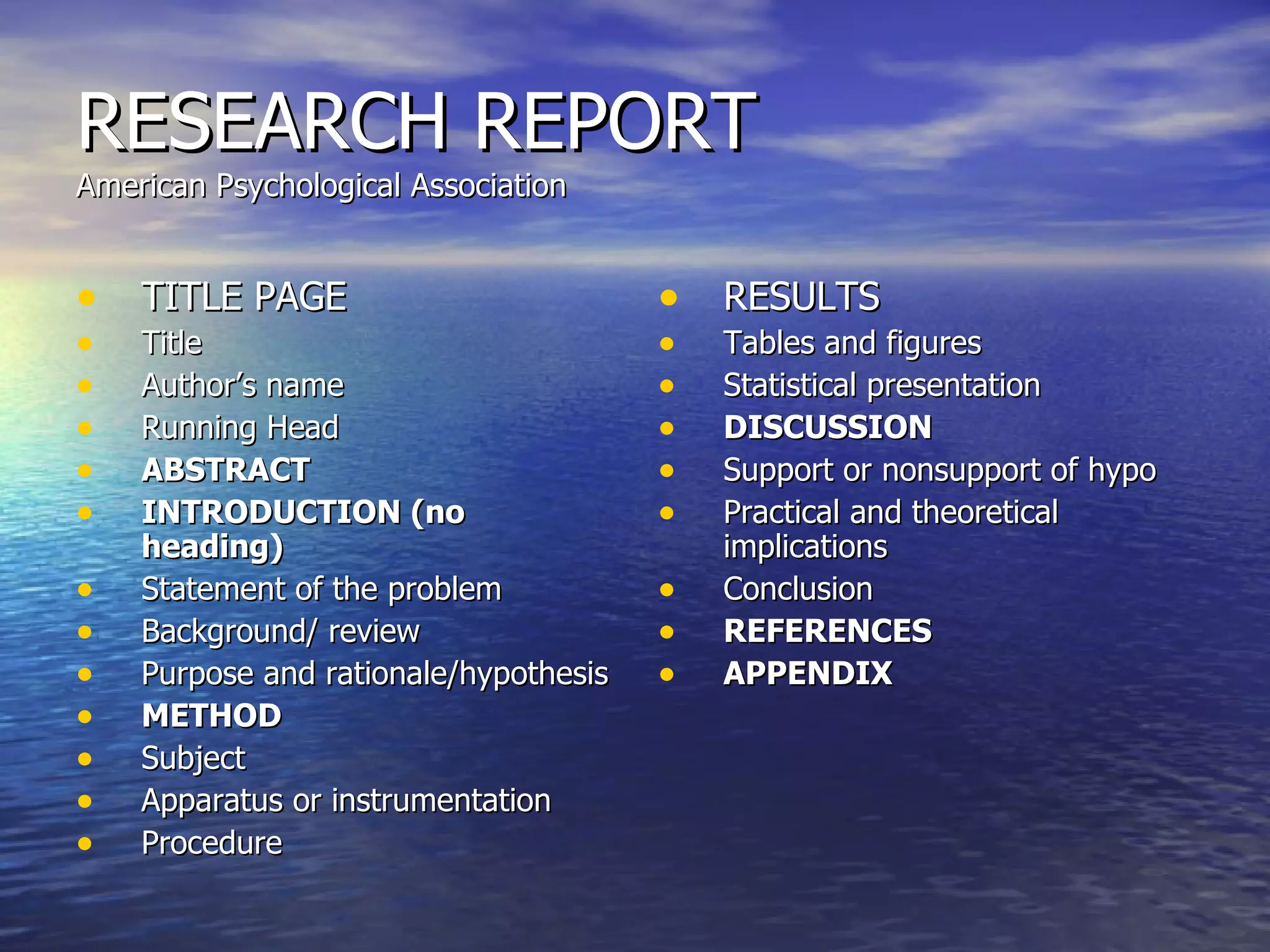
RESEARCH REPORT American Psychological Association TITLE PAGE Title Author’s name Running Head ABSTRACT INTRODUCTION (no heading) Statement of the problem Background/ review Purpose and rationale/hypothesis METHOD Subject Apparatus or instrumentation Procedure RESULTS Tables and figures Statistical presentation DISCUSSION Support or nonsupport of hypo Practical and theoretical implications Conclusion REFERENCES APPENDIX
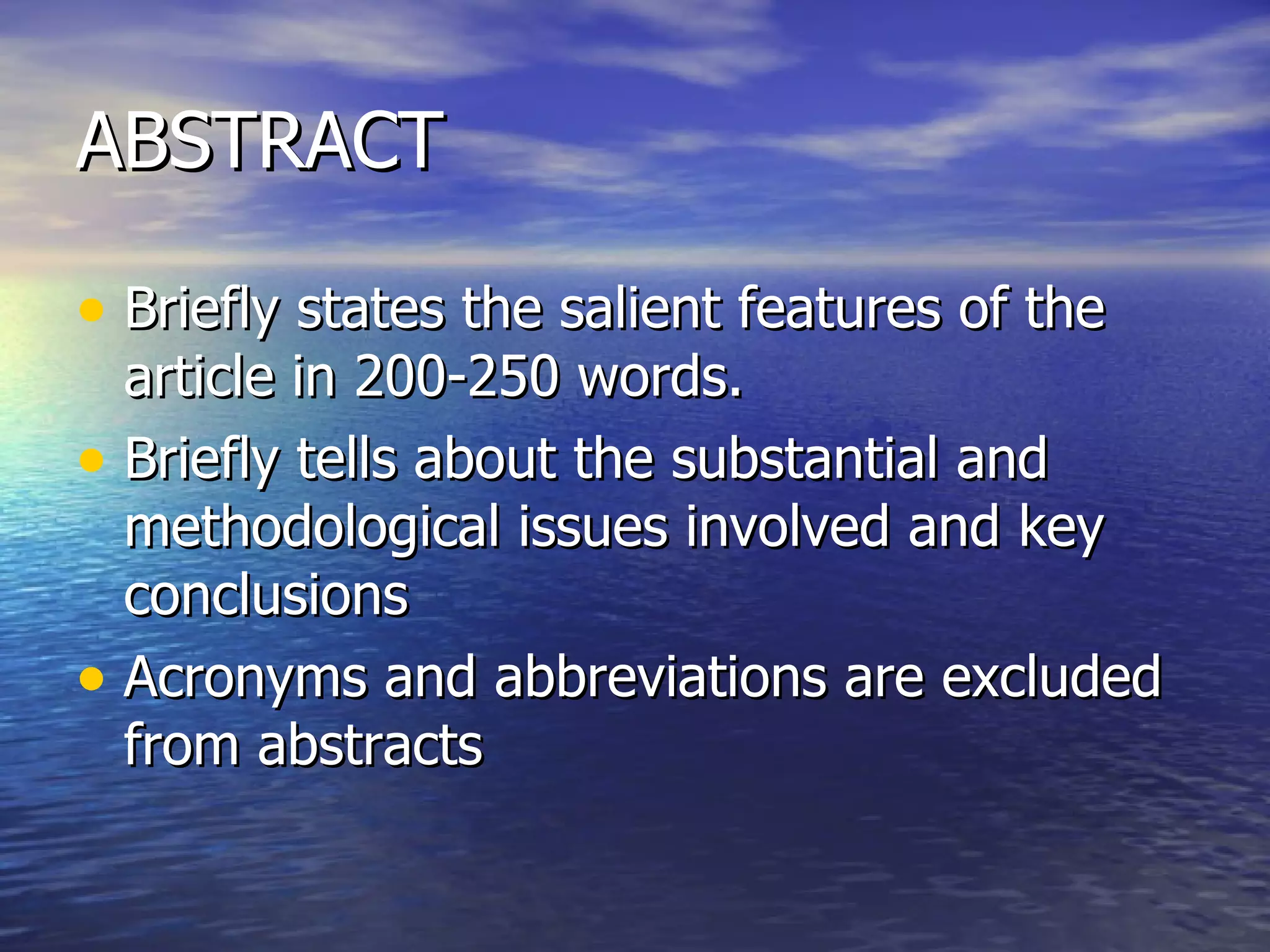
ABSTRACT Briefly states the salient features of the article in 200-250 words. Briefly tells about the substantial and methodological issues involved and key conclusions Acronyms and abbreviations are excluded from abstracts
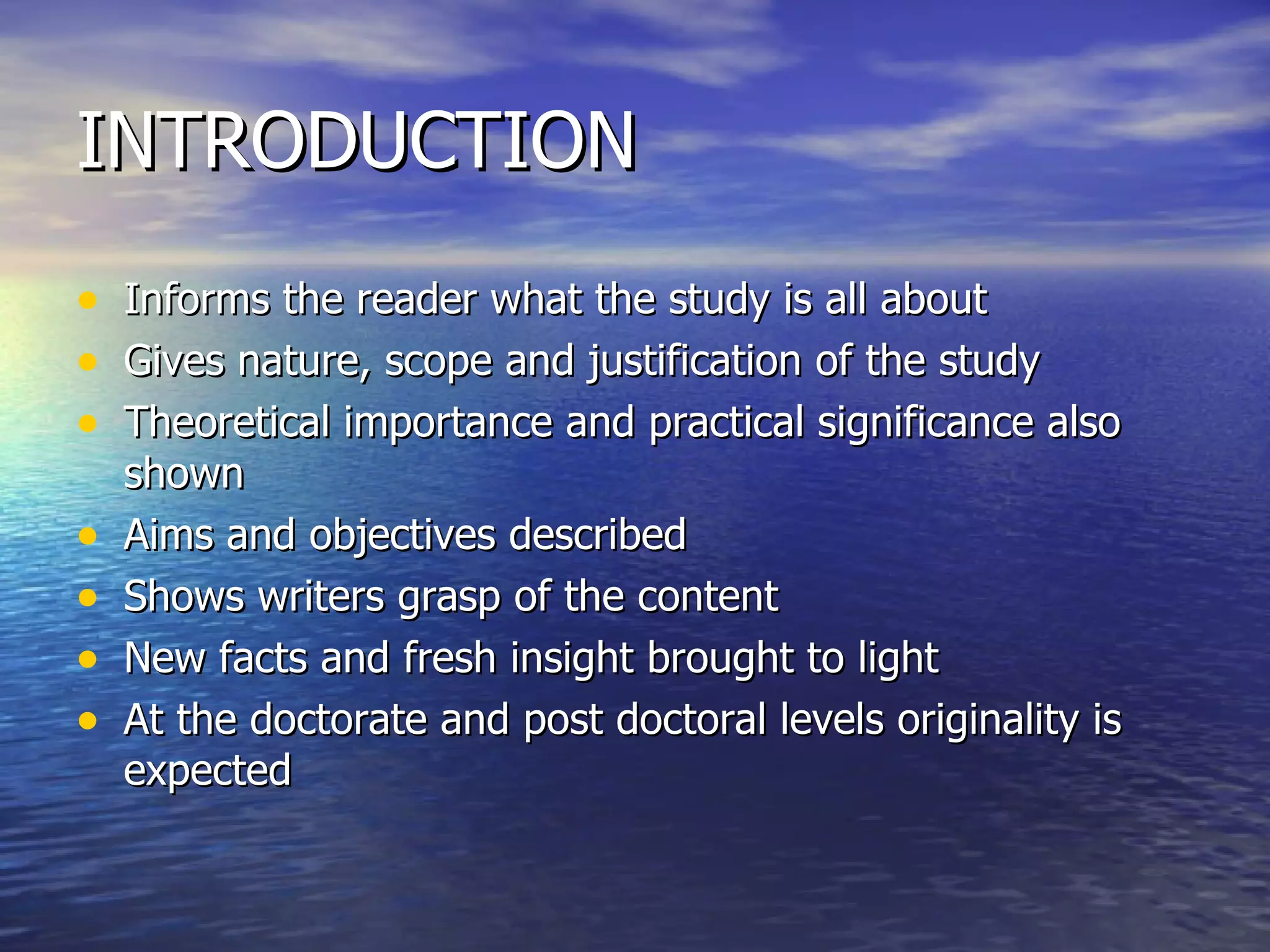
INTRODUCTION Informs the reader what the study is all about Gives nature, scope and justification of the study Theoretical importance and practical significance also shown Aims and objectives described Shows writers grasp of the content New facts and fresh insight brought to light At the doctorate and post doctoral levels originality is expected
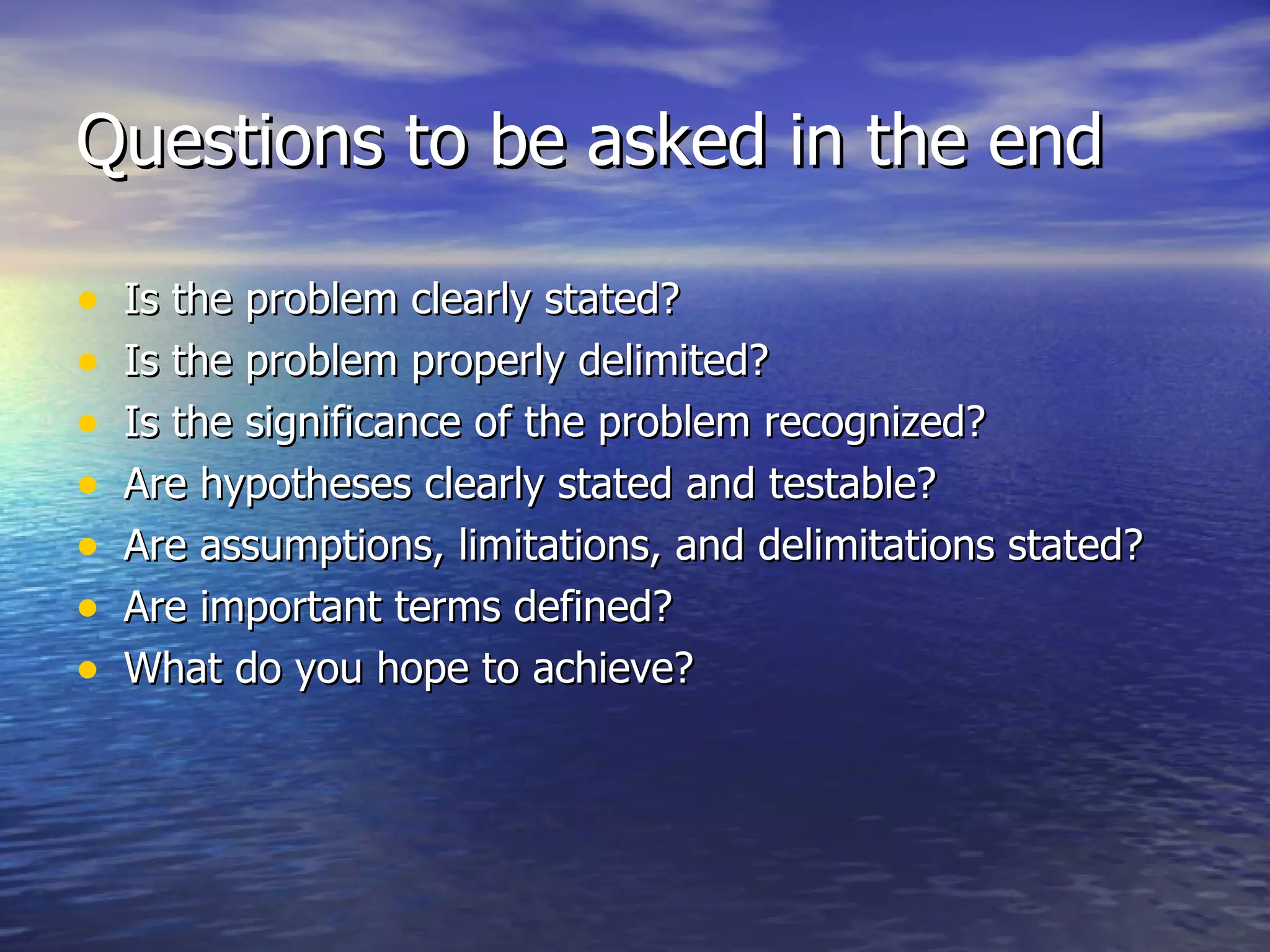
Questions to be asked in the end Is the problem clearly stated? Is the problem properly delimited? Is the significance of the problem recognized? Are hypotheses clearly stated and testable? Are assumptions, limitations, and delimitations stated? Are important terms defined? What do you hope to achieve?
REVIEW OF LITERATURE Involves thorough search from sources- Libraries, documentation centers, private collections, internet, catalogues, newspapers, periodicals, magazines, bibliographies, abstracts , archives etc Discus with others working in the same field and exchange notes Make best use of whatever is available Catalogues are available authorwize, subject-wise and language or regionwize Going through matter make notes Passages copied verbatim are placed within quotes Note the exact page from which copied It is not permissible to change the original wording of material within inverted commas Paraphrasing may be done when direct quotation is not required.
If you begin sorting and organizing your annotations by themes, issues of concern, common shortcomings  a pattern  would start emerging Develop a structure.  Make a potential modifiable  outline for your literature early, Footnotes and references should be complete in all respects References may be arranged topic wise- alphabetically or numerically Use reference cards. Be sure to pass a draft to your supervisor early on Be prepared to redraft two or three times.
Questions to be asked Is it adequately covered? Are important findings noted? Is it well organized? Is an effective summary provided? Is the literature directly relevant to the problem and hypotheses?
METHOD OF RESEARCH Techniques used for carrying out the work Sample- size, location, techniques used selection, controls Major demographic characteristics such as age, sex, SES may be included Tools used for study- observation interview, experiment ,etc  Data collection- Procedure, problems encountered, pre testing etc Analysis- Method of analysis- content or statistical
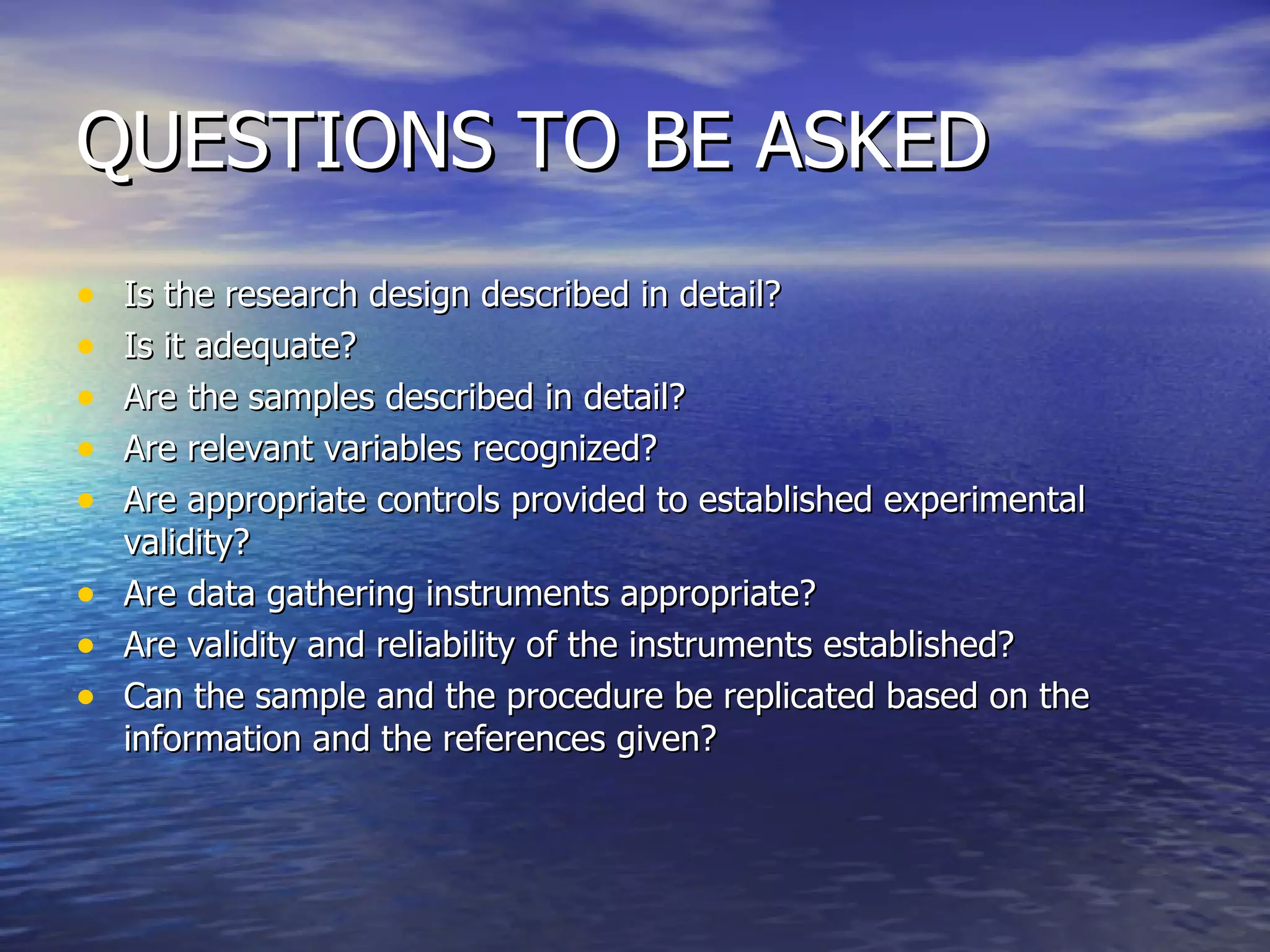
QUESTIONS TO BE ASKED Is the research design described in detail? Is it adequate? Are the samples described in detail? Are relevant variables recognized? Are appropriate controls provided to established experimental validity? Are data gathering instruments appropriate? Are validity and reliability of the instruments established? Can the sample and the procedure be replicated based on the information and the references given?
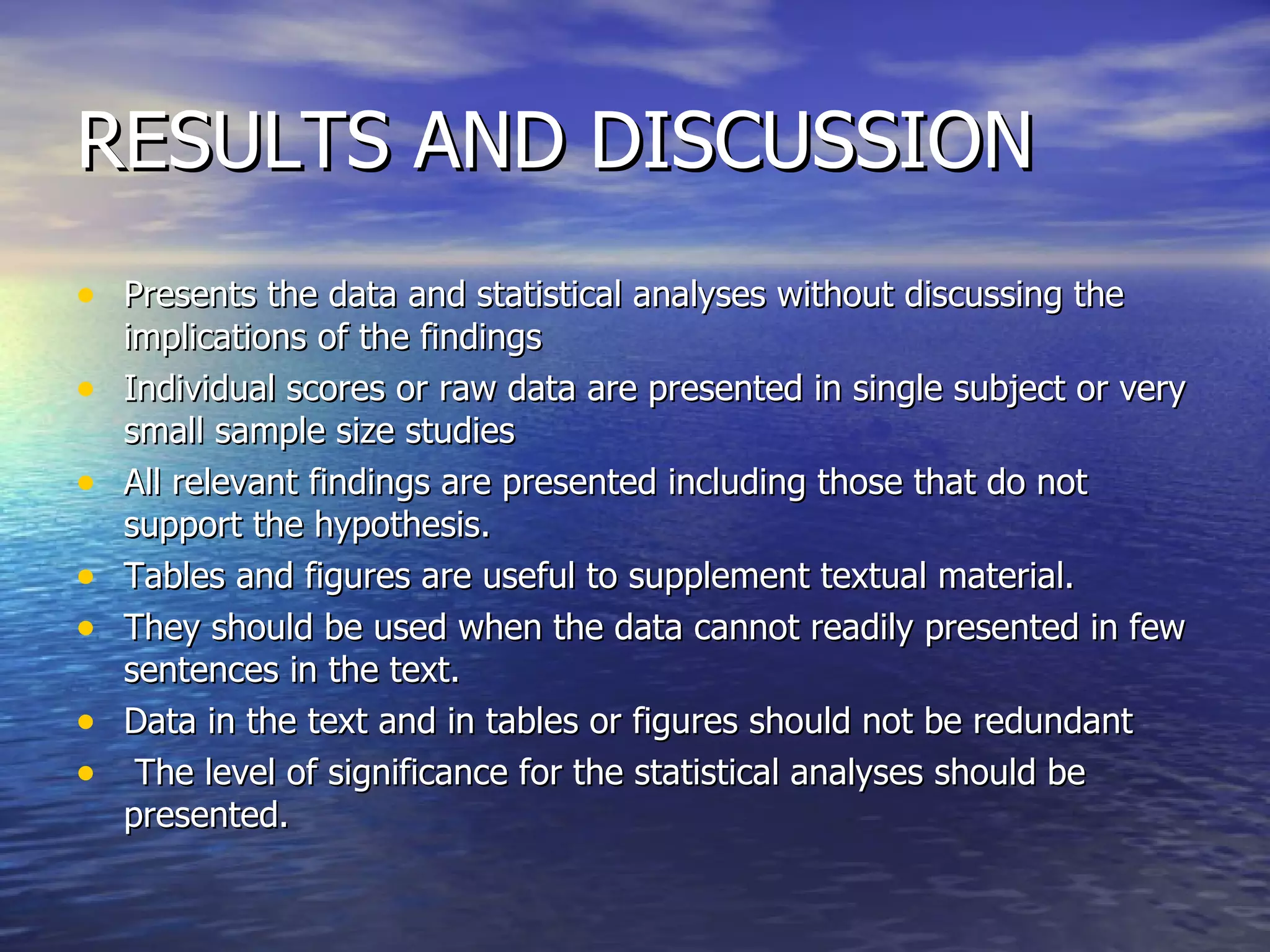
RESULTS AND DISCUSSION Presents the data and statistical analyses without discussing the implications of the findings Individual scores or raw data are presented in single subject or very small sample size studies All relevant findings are presented including those that do not support the hypothesis. Tables and figures are useful to supplement textual material. They should be used when the data cannot readily presented in few sentences in the text. Data in the text and in tables or figures should not be redundant The level of significance for the statistical analyses should be presented.
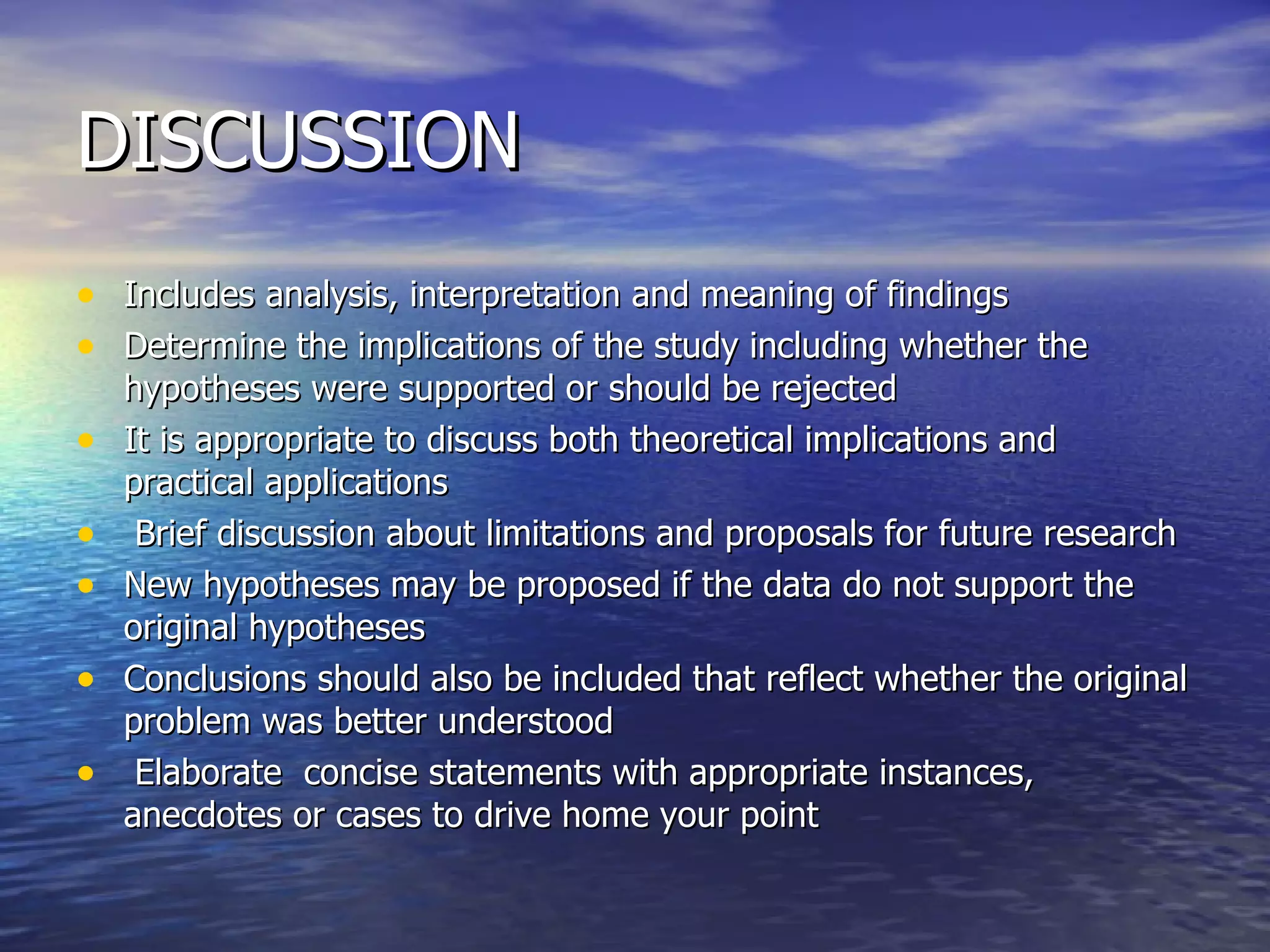
DISCUSSION Includes analysis, interpretation and meaning of findings Determine the implications of the study including whether the hypotheses were supported or should be rejected It is appropriate to discuss both theoretical implications and practical applications Brief discussion about limitations and proposals for future research  New hypotheses may be proposed if the data do not support the original hypotheses Conclusions should also be included that reflect whether the original problem was better understood  Elaborate  concise statements with appropriate instances, anecdotes or cases to drive home your point
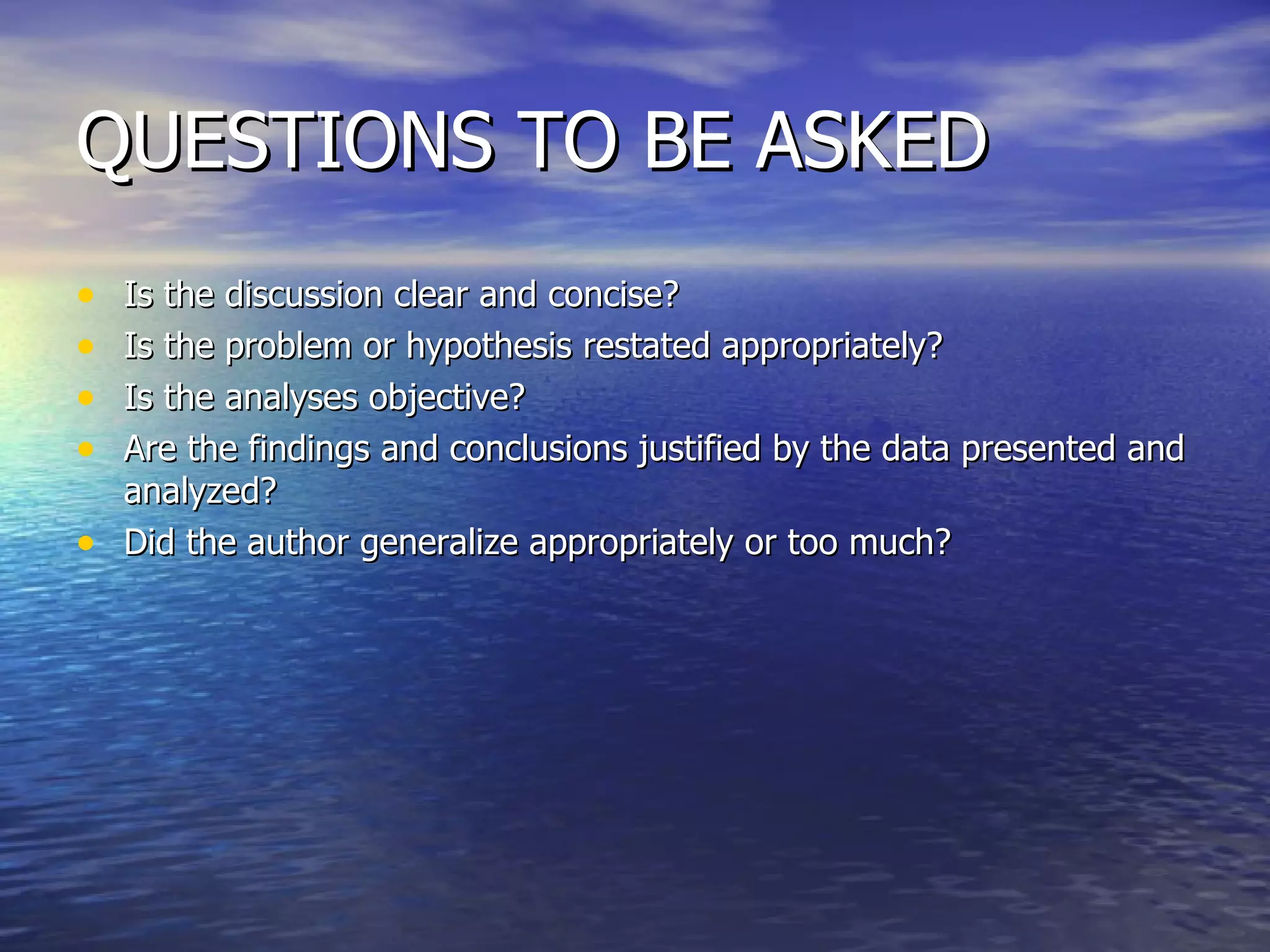
QUESTIONS TO BE ASKED Is the discussion clear and concise? Is the problem or hypothesis restated appropriately? Is the analyses objective? Are the findings and conclusions justified by the data presented and analyzed? Did the author generalize appropriately or too much?
SUMMARY Wrap up the things Clinch the issue under discussion The main points from the main body starting from brief introduction including hypotheses and objectives; methodology, and important findings may be stated Their implications for policy making are drawn Suggestions for future research are made New data are not brought in Summary is not an abstract Unlike the latter it may even refer to tables and figures in the main body of the report.
QUESTIONS TO BE ASKED Is the statistical  treatment appropriate? Is the appropriate use made of tables and figures? Is the analysis of data relationships logical, perspective and objective?
ACKNOWLEDGEMENTS Thank all the people who helped in carrying out the study Thanks are due to the respondents, community leaders etc Thank the  supervisor, friends and colleagues, family members Avoid name dropping
APPENDIX Superfluous tables are given in the end Tools used for the study Your publications related to the study Any other relevant information you want to share with the audience

Contents Of A Research Repor Tppt

  • 1.
    CONTENTS OF ARESEARCH REPORT Dr. Neeru Sharma Department of Home Science
  • 2.
    RESEARCH REPORT AmericanPsychological Association TITLE PAGE Title Author’s name Running Head ABSTRACT INTRODUCTION (no heading) Statement of the problem Background/ review Purpose and rationale/hypothesis METHOD Subject Apparatus or instrumentation Procedure RESULTS Tables and figures Statistical presentation DISCUSSION Support or nonsupport of hypo Practical and theoretical implications Conclusion REFERENCES APPENDIX
  • 3.
    ABSTRACT Briefly statesthe salient features of the article in 200-250 words. Briefly tells about the substantial and methodological issues involved and key conclusions Acronyms and abbreviations are excluded from abstracts
  • 4.
    INTRODUCTION Informs thereader what the study is all about Gives nature, scope and justification of the study Theoretical importance and practical significance also shown Aims and objectives described Shows writers grasp of the content New facts and fresh insight brought to light At the doctorate and post doctoral levels originality is expected
  • 5.
    Questions to beasked in the end Is the problem clearly stated? Is the problem properly delimited? Is the significance of the problem recognized? Are hypotheses clearly stated and testable? Are assumptions, limitations, and delimitations stated? Are important terms defined? What do you hope to achieve?
  • 6.
    REVIEW OF LITERATUREInvolves thorough search from sources- Libraries, documentation centers, private collections, internet, catalogues, newspapers, periodicals, magazines, bibliographies, abstracts , archives etc Discus with others working in the same field and exchange notes Make best use of whatever is available Catalogues are available authorwize, subject-wise and language or regionwize Going through matter make notes Passages copied verbatim are placed within quotes Note the exact page from which copied It is not permissible to change the original wording of material within inverted commas Paraphrasing may be done when direct quotation is not required.
  • 7.
    If you beginsorting and organizing your annotations by themes, issues of concern, common shortcomings a pattern would start emerging Develop a structure. Make a potential modifiable outline for your literature early, Footnotes and references should be complete in all respects References may be arranged topic wise- alphabetically or numerically Use reference cards. Be sure to pass a draft to your supervisor early on Be prepared to redraft two or three times.
  • 8.
    Questions to beasked Is it adequately covered? Are important findings noted? Is it well organized? Is an effective summary provided? Is the literature directly relevant to the problem and hypotheses?
  • 9.
    METHOD OF RESEARCHTechniques used for carrying out the work Sample- size, location, techniques used selection, controls Major demographic characteristics such as age, sex, SES may be included Tools used for study- observation interview, experiment ,etc Data collection- Procedure, problems encountered, pre testing etc Analysis- Method of analysis- content or statistical
  • 10.
    QUESTIONS TO BEASKED Is the research design described in detail? Is it adequate? Are the samples described in detail? Are relevant variables recognized? Are appropriate controls provided to established experimental validity? Are data gathering instruments appropriate? Are validity and reliability of the instruments established? Can the sample and the procedure be replicated based on the information and the references given?
  • 11.
    RESULTS AND DISCUSSIONPresents the data and statistical analyses without discussing the implications of the findings Individual scores or raw data are presented in single subject or very small sample size studies All relevant findings are presented including those that do not support the hypothesis. Tables and figures are useful to supplement textual material. They should be used when the data cannot readily presented in few sentences in the text. Data in the text and in tables or figures should not be redundant The level of significance for the statistical analyses should be presented.
  • 12.
    DISCUSSION Includes analysis,interpretation and meaning of findings Determine the implications of the study including whether the hypotheses were supported or should be rejected It is appropriate to discuss both theoretical implications and practical applications Brief discussion about limitations and proposals for future research New hypotheses may be proposed if the data do not support the original hypotheses Conclusions should also be included that reflect whether the original problem was better understood Elaborate concise statements with appropriate instances, anecdotes or cases to drive home your point
  • 13.
    QUESTIONS TO BEASKED Is the discussion clear and concise? Is the problem or hypothesis restated appropriately? Is the analyses objective? Are the findings and conclusions justified by the data presented and analyzed? Did the author generalize appropriately or too much?
  • 14.
    SUMMARY Wrap upthe things Clinch the issue under discussion The main points from the main body starting from brief introduction including hypotheses and objectives; methodology, and important findings may be stated Their implications for policy making are drawn Suggestions for future research are made New data are not brought in Summary is not an abstract Unlike the latter it may even refer to tables and figures in the main body of the report.
  • 15.
    QUESTIONS TO BEASKED Is the statistical treatment appropriate? Is the appropriate use made of tables and figures? Is the analysis of data relationships logical, perspective and objective?
  • 16.
    ACKNOWLEDGEMENTS Thank allthe people who helped in carrying out the study Thanks are due to the respondents, community leaders etc Thank the supervisor, friends and colleagues, family members Avoid name dropping
  • 17.
    APPENDIX Superfluous tablesare given in the end Tools used for the study Your publications related to the study Any other relevant information you want to share with the audience