09/10/22
1
HLTH 1150: Oral
presentations
A C K N O W L E D G E M E N T O F C O U N T R Y
The University of Notre Dame Australia is proud to acknowledge the traditional owners and custodians of this
land upon which our University sits. The University acknowledges that the Fremantle Campus is located on
Wadjuk Country, the Broome Campus on Yawuru Country and the Sydney Campus on Cadigal Country.
CONTENTS
1.Overview of assessment 4
2.Example presentation
3.Do’s and Don’ts of oral presentations
4.Opening your presentation
5.Delivering the key points
6.Closing your presentation 1. Overview of assessment 4
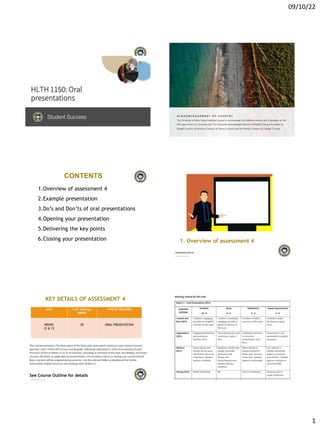
KEY DETAILS OF ASSESSMENT 4
DATE % OF OVERALL
GRADE
TYPE OF DELIVERY
WEEKS
12 & 13
20 ORAL PRESENTATION
See Course Outline for details
09/10/22
2
TASK 1: Tell your partner(s) about the last
presentation that you gave.
2. Example presentation
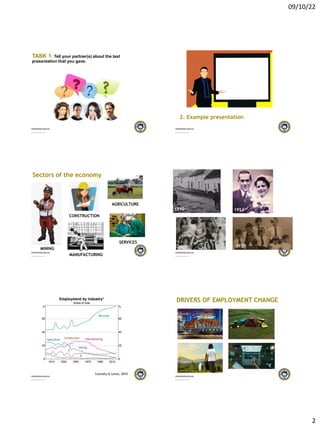
Sectors of the economy
MINING
CONSTRUCTION
MANUFACTURING
AGRICULTURE
SERVICES
1910 1953
1970
2005
Connolly & Lewis, 2010
1970 1970
DRIVERS OF EMPLOYMENT CHANGE
09/10/22
3
1970
References
Connolly, E. & Lewis, C. (2010, September). Structural change in
the Australian economy. Bulletin.
https://www.rba.gov.au/publications/bulletin/2010/sep/1.html
TASK 2: Tell your partner(s) any tips you picked up
from this example presentation.
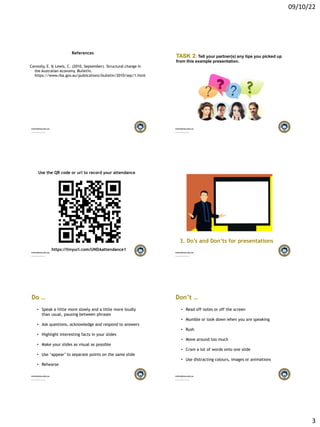
Use the QR code or url to record your attendance
https://tinyurl.com/UNDAattendance1
3. Do’s and Don’ts for presentations
Do …
• Speak a little more slowly and a little more loudly
than usual, pausing between phrases
• Ask questions, acknowledge and respond to answers
• Highlight interesting facts in your slides
• Make your slides as visual as possible
• Use ‘appear’ to separate points on the same slide
• Rehearse
Don’t …
• Read off notes or off the screen
• Mumble or look down when you are speaking
• Rush
• Move around too much
• Cram a lot of words onto one slide
• Use distracting colours, images or animations
09/10/22
4
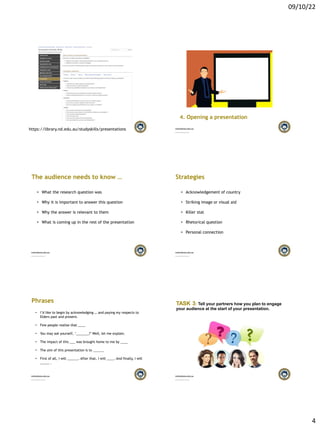
Presentations - Successful University
https://library.nd.edu.au/studyskills/presentations
Dame Australia (nd.edu.au)
4. Opening a presentation
The audience needs to know …
• What the research question was
• Why it is important to answer this question
• Why the answer is relevant to them
• What is coming up in the rest of the presentation
Strategies
• Acknowledgement of country
• Striking image or visual aid
• Killer stat
• Rhetorical question
• Personal connection
Phrases
• I’d like to begin by acknowledging … and paying my respects to
Elders past and present.
• Few people realise that ____
• You may ask yourself, ‘_______?’ Well, let me explain.
• The impact of this ___ was brought home to me by ____
• The aim of this presentation is to ______
• First of all, I will ______. After that, I will ____. And finally, I will
_____ .
TASK 3: Tell your partners how you plan to engage
your audience at the start of your presentation.
09/10/22
5
5. The body of your presentation
The audience needs to know …
• What kind of research has been done
• What has been found out
• What has not been found out
• What research needs to be done in future
Strategies
• Use a table to summarise research studies
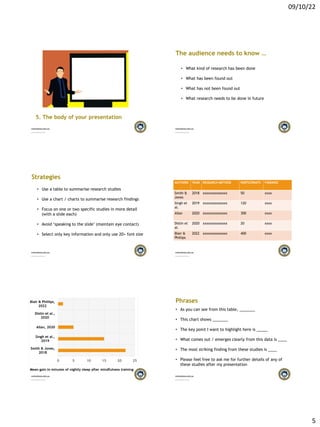
• Use a chart / charts to summarise research findings
• Focus on one or two specific studies in more detail
(with a slide each)
• Avoid ‘speaking to the slide’ (maintain eye contact)
• Select only key information and only use 20+ font size
AUTHORS YEAR RESEARCH METHOD PARTICIPANTS FINDINGS
Smith &
Jones
2018 xxxxxxxxxxxxxx 50 xxxx
Singh et
al.
2019 xxxxxxxxxxxxxx 120 xxxx
Allan 2020 xxxxxxxxxxxxxx 300 xxxx
Distin et
al.
2020 xxxxxxxxxxxxxx 20 xxxx
Blair &
Phillips
2022 xxxxxxxxxxxxxx 400 xxxx
0 5 10 15 20 25
Smith & Jones,
2018
Singh et al.,
2019
Allan, 2020
Distin et al.,
2020
Blair & Phillips,
2022
Mean gain in minutes of nightly sleep after mindfulness training
Phrases
• As you can see from this table, _______
• This chart shows _______
• The key point I want to highlight here is _____
• What comes out / emerges clearly from this data is ____
• The most striking finding from these studies is ____
• Please feel free to ask me for further details of any of
these studies after my presentation
09/10/22
6
6. Closing a presentation
The audience needs to know …
• What research has found out
• How this research (or your review) was limited
• Where more research is needed
• What, if anything, they should do / not do
Strategies
• Focus on the ‘take-away message from your
presentation
• Keep it short
• Don’t repeat details
• Return to example / personal connection from the
opening
• Include your reference list
Phrases
• So, if we return to the original research question, what have we
found out?
• ____ significant limitations of this review need to be
acknowledged.
• Future research studies need to focus on _____
• So, where does this leave you in relation to ______?
• I have time to answer one or two of your questions?
• Well, that’s all the time I have today, but feel free to contact me
by email at _______ and to receive the slides from today’s
presentation.
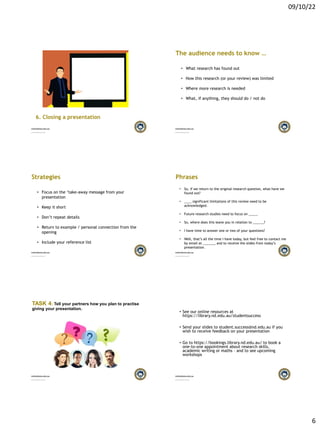
TASK 4: Tell your partners how you plan to practise
giving your presentation.
• See our online resources at
https://library.nd.edu.au/studentsuccess
• Send your slides to student.success@nd.edu.au if you
wish to receive feedback on your presentation
• Go to https://bookings.library.nd.edu.au/ to book a
one-to-one appointment about research skills,
academic writing or maths – and to see upcoming
workshops

HLTH 1150 Oral presentations.pdf

  • 1.
    09/10/22 1 HLTH 1150: Oral presentations AC K N O W L E D G E M E N T O F C O U N T R Y The University of Notre Dame Australia is proud to acknowledge the traditional owners and custodians of this land upon which our University sits. The University acknowledges that the Fremantle Campus is located on Wadjuk Country, the Broome Campus on Yawuru Country and the Sydney Campus on Cadigal Country. CONTENTS 1.Overview of assessment 4 2.Example presentation 3.Do’s and Don’ts of oral presentations 4.Opening your presentation 5.Delivering the key points 6.Closing your presentation 1. Overview of assessment 4 KEY DETAILS OF ASSESSMENT 4 DATE % OF OVERALL GRADE TYPE OF DELIVERY WEEKS 12 & 13 20 ORAL PRESENTATION See Course Outline for details
  • 2.
    09/10/22 2 TASK 1: Tellyour partner(s) about the last presentation that you gave. 2. Example presentation Sectors of the economy MINING CONSTRUCTION MANUFACTURING AGRICULTURE SERVICES 1910 1953 1970 2005 Connolly & Lewis, 2010 1970 1970 DRIVERS OF EMPLOYMENT CHANGE
  • 3.
    09/10/22 3 1970 References Connolly, E. &Lewis, C. (2010, September). Structural change in the Australian economy. Bulletin. https://www.rba.gov.au/publications/bulletin/2010/sep/1.html TASK 2: Tell your partner(s) any tips you picked up from this example presentation. Use the QR code or url to record your attendance https://tinyurl.com/UNDAattendance1 3. Do’s and Don’ts for presentations Do … • Speak a little more slowly and a little more loudly than usual, pausing between phrases • Ask questions, acknowledge and respond to answers • Highlight interesting facts in your slides • Make your slides as visual as possible • Use ‘appear’ to separate points on the same slide • Rehearse Don’t … • Read off notes or off the screen • Mumble or look down when you are speaking • Rush • Move around too much • Cram a lot of words onto one slide • Use distracting colours, images or animations
  • 4.
    09/10/22 4 Presentations - SuccessfulUniversity https://library.nd.edu.au/studyskills/presentations Dame Australia (nd.edu.au) 4. Opening a presentation The audience needs to know … • What the research question was • Why it is important to answer this question • Why the answer is relevant to them • What is coming up in the rest of the presentation Strategies • Acknowledgement of country • Striking image or visual aid • Killer stat • Rhetorical question • Personal connection Phrases • I’d like to begin by acknowledging … and paying my respects to Elders past and present. • Few people realise that ____ • You may ask yourself, ‘_______?’ Well, let me explain. • The impact of this ___ was brought home to me by ____ • The aim of this presentation is to ______ • First of all, I will ______. After that, I will ____. And finally, I will _____ . TASK 3: Tell your partners how you plan to engage your audience at the start of your presentation.
  • 5.
    09/10/22 5 5. The bodyof your presentation The audience needs to know … • What kind of research has been done • What has been found out • What has not been found out • What research needs to be done in future Strategies • Use a table to summarise research studies • Use a chart / charts to summarise research findings • Focus on one or two specific studies in more detail (with a slide each) • Avoid ‘speaking to the slide’ (maintain eye contact) • Select only key information and only use 20+ font size AUTHORS YEAR RESEARCH METHOD PARTICIPANTS FINDINGS Smith & Jones 2018 xxxxxxxxxxxxxx 50 xxxx Singh et al. 2019 xxxxxxxxxxxxxx 120 xxxx Allan 2020 xxxxxxxxxxxxxx 300 xxxx Distin et al. 2020 xxxxxxxxxxxxxx 20 xxxx Blair & Phillips 2022 xxxxxxxxxxxxxx 400 xxxx 0 5 10 15 20 25 Smith & Jones, 2018 Singh et al., 2019 Allan, 2020 Distin et al., 2020 Blair & Phillips, 2022 Mean gain in minutes of nightly sleep after mindfulness training Phrases • As you can see from this table, _______ • This chart shows _______ • The key point I want to highlight here is _____ • What comes out / emerges clearly from this data is ____ • The most striking finding from these studies is ____ • Please feel free to ask me for further details of any of these studies after my presentation
  • 6.
    09/10/22 6 6. Closing apresentation The audience needs to know … • What research has found out • How this research (or your review) was limited • Where more research is needed • What, if anything, they should do / not do Strategies • Focus on the ‘take-away message from your presentation • Keep it short • Don’t repeat details • Return to example / personal connection from the opening • Include your reference list Phrases • So, if we return to the original research question, what have we found out? • ____ significant limitations of this review need to be acknowledged. • Future research studies need to focus on _____ • So, where does this leave you in relation to ______? • I have time to answer one or two of your questions? • Well, that’s all the time I have today, but feel free to contact me by email at _______ and to receive the slides from today’s presentation. TASK 4: Tell your partners how you plan to practise giving your presentation. • See our online resources at https://library.nd.edu.au/studentsuccess • Send your slides to student.success@nd.edu.au if you wish to receive feedback on your presentation • Go to https://bookings.library.nd.edu.au/ to book a one-to-one appointment about research skills, academic writing or maths – and to see upcoming workshops