An informative report is a factual text, which
means it provides information about something.
An information report is used as a way to gain a
better understanding about a living or non-living
subject. An informative report:
• uses facts to explain something
• gives details about a topic
• does not contain personal views
• Is usually written, but can also be presented
orally (spoken).
Topics, or subjects, found in informative reports
can be about one specific thing or a group of
things. Some examples of topics might include:
• cars
• ocean animals
• rainforests
• pollution
• computers
 Formal written informative reports usually
follow a very specific structure. The first part of
an informative report is the title, or heading, of
the report. This will tell the reader what topic is
covered in the report.
 The first introductory paragraph, known as the
classification, explains the aspects of the topic
that will be covered in the report.
 The following information is contained in the
body paragraphs. This is where the topic of the
report is covered in more detail. These
paragraphs use factual information to give the
reader a better understanding of the topic.
Often, these paragraphs are broken up by sub-
headings to help organize the information.
 The conclusion of an information report gives
any final details or facts about the topic. It may
also be used to review what the report was
about.
 Visual elements are important because they
help the reader to understand the topic better.
Visual elements can include drawings,
photographs, graphs, maps or diagrams.
 A glossary is often put at the end of an
information report. A glossary is a list of
technical words used in the report and their
definitions.
 The bibliography is a list of resources like
books, magazines and websites, which were
used to help write the information report.
 The first step in preparing an information report is to
choose the topic of the report. Then you will need to
research the topic. Textbooks, websites, an encyclopedia
and other information reports are good places to gather
information. You might also want to look for pictures
and diagrams to use in your report.
 Once you have the information, you will need to
organize it into the structure of an information report. It
is also important to make a list of any important words
to use in the glossary. Information reports are generally
written in the present tense.
 When you have finished writing the report, read it again
to make sure that it uses facts, gives details, and does
not contain personal views. Always check your text for
correct spelling, grammar and punctuation.
 Research report writing is the oral or written
presentation of the evidence and the findings in such
detail and form as to be readily understood and
accessed by the reader and as to enable him to verify
the validity of the conclusions..
 According to American Marketing Society, Its purpose
is to Convey to interested persons the whole result of
study in sufficient detail and to enable each reader to
comprehend the data and to determine himself the
validity of the conclusions. It is covers,
Disseminations, Presents the conclusions for the
information and knowledge to others, to check the
validity of the generalizations, to encourage others to
carry on research on the same or allied problem.
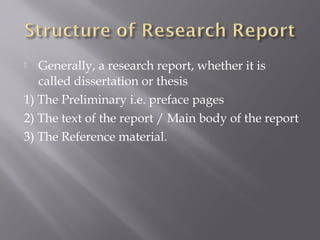
 Generally, a research report, whether it is
called dissertation or thesis
1) The Preliminary i.e. preface pages
2) The text of the report / Main body of the report
3) The Reference material.
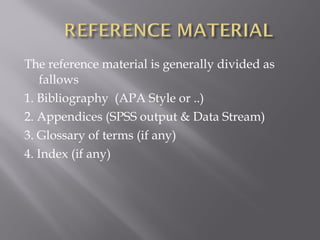
The reference material is generally divided as
fallows
1. Bibliography (APA Style or ..)
2. Appendices (SPSS output & Data Stream)
3. Glossary of terms (if any)
4. Index (if any)
 Technical Report:
 Popular Report
 The Report for the Administrator
 Oral Report
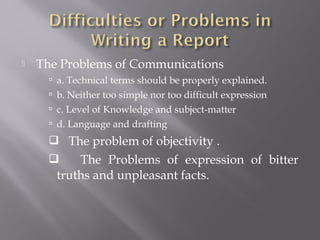
 The Problems of Communications
 a. Technical terms should be properly explained.
 b. Neither too simple nor too difficult expression
 c. Level of Knowledge and subject-matter
 d. Language and drafting
 The problem of objectivity .
 The Problems of expression of bitter
truths and unpleasant facts.
For preparations or drafting of reports three steps
are involved.
1) First Draft:
 Comprehensiveness or fullness of facts.
Precision or Accuracy of Facts
Coherence or logic of facts, and
Movement or transition of facts and ideas.
 2nd
. The researcher should give the first draft, at this stage, a
shape so that it can be readable, clear and lucid. Considerable
trimming or editing will have to be done to make the writing
precise, Concise and brief. Finally, at the second draft stage,
critical evaluation will have to be made of all that has been
written-facts, findings, conclusions and recommendations.
 3rd
. And final The final stage in drafting is the preparations of
final report. It concentrates mainly on the finish and final touches,
i.e., on documentation and polish to make the report weighty,
authoritative, convincing and attractive. Documentation indicated
the references to the sources, other previous and current work and
view, additional data and discussion and suggested further
reading on the specific problem as handled by the researcher. In
other words, it indicated the thoroughness of the investigation
and on the other a guide to further work.
1) Attractive
2) Clear Topic
3) Balanced Language
4) No repetition of facts
5) Statement of scientific facts
6) Practicability
7)Description of the difficulties and the
shortcomings
 Review of literature
 Treatment of quotations
 Size and Physical Design
 Footnotes
 Use of Abbreviations
 Use of Statistics, Charts and Graphs
 Bibliography, Index & Appendices
 Conclusions: In spite of all that has been stated above, one
should always keep in view the fact report-writing is an art which
is learnt by practice and experience.
035 research report writing amir

035 research report writing amir

  • 3.
    An informative reportis a factual text, which means it provides information about something. An information report is used as a way to gain a better understanding about a living or non-living subject. An informative report: • uses facts to explain something • gives details about a topic • does not contain personal views • Is usually written, but can also be presented orally (spoken).
  • 4.
    Topics, or subjects,found in informative reports can be about one specific thing or a group of things. Some examples of topics might include: • cars • ocean animals • rainforests • pollution • computers
  • 5.
     Formal writteninformative reports usually follow a very specific structure. The first part of an informative report is the title, or heading, of the report. This will tell the reader what topic is covered in the report.  The first introductory paragraph, known as the classification, explains the aspects of the topic that will be covered in the report.
  • 6.
     The followinginformation is contained in the body paragraphs. This is where the topic of the report is covered in more detail. These paragraphs use factual information to give the reader a better understanding of the topic. Often, these paragraphs are broken up by sub- headings to help organize the information.  The conclusion of an information report gives any final details or facts about the topic. It may also be used to review what the report was about.
  • 7.
     Visual elementsare important because they help the reader to understand the topic better. Visual elements can include drawings, photographs, graphs, maps or diagrams.  A glossary is often put at the end of an information report. A glossary is a list of technical words used in the report and their definitions.  The bibliography is a list of resources like books, magazines and websites, which were used to help write the information report.
  • 8.
     The firststep in preparing an information report is to choose the topic of the report. Then you will need to research the topic. Textbooks, websites, an encyclopedia and other information reports are good places to gather information. You might also want to look for pictures and diagrams to use in your report.  Once you have the information, you will need to organize it into the structure of an information report. It is also important to make a list of any important words to use in the glossary. Information reports are generally written in the present tense.  When you have finished writing the report, read it again to make sure that it uses facts, gives details, and does not contain personal views. Always check your text for correct spelling, grammar and punctuation.
  • 11.
     Research reportwriting is the oral or written presentation of the evidence and the findings in such detail and form as to be readily understood and accessed by the reader and as to enable him to verify the validity of the conclusions..  According to American Marketing Society, Its purpose is to Convey to interested persons the whole result of study in sufficient detail and to enable each reader to comprehend the data and to determine himself the validity of the conclusions. It is covers, Disseminations, Presents the conclusions for the information and knowledge to others, to check the validity of the generalizations, to encourage others to carry on research on the same or allied problem.
  • 12.
     Generally, aresearch report, whether it is called dissertation or thesis 1) The Preliminary i.e. preface pages 2) The text of the report / Main body of the report 3) The Reference material.
  • 13.
    The reference materialis generally divided as fallows 1. Bibliography (APA Style or ..) 2. Appendices (SPSS output & Data Stream) 3. Glossary of terms (if any) 4. Index (if any)
  • 14.
     Technical Report: Popular Report  The Report for the Administrator  Oral Report
  • 15.
     The Problemsof Communications  a. Technical terms should be properly explained.  b. Neither too simple nor too difficult expression  c. Level of Knowledge and subject-matter  d. Language and drafting  The problem of objectivity .  The Problems of expression of bitter truths and unpleasant facts.
  • 16.
    For preparations ordrafting of reports three steps are involved. 1) First Draft:  Comprehensiveness or fullness of facts. Precision or Accuracy of Facts Coherence or logic of facts, and Movement or transition of facts and ideas.
  • 17.
     2nd . Theresearcher should give the first draft, at this stage, a shape so that it can be readable, clear and lucid. Considerable trimming or editing will have to be done to make the writing precise, Concise and brief. Finally, at the second draft stage, critical evaluation will have to be made of all that has been written-facts, findings, conclusions and recommendations.  3rd . And final The final stage in drafting is the preparations of final report. It concentrates mainly on the finish and final touches, i.e., on documentation and polish to make the report weighty, authoritative, convincing and attractive. Documentation indicated the references to the sources, other previous and current work and view, additional data and discussion and suggested further reading on the specific problem as handled by the researcher. In other words, it indicated the thoroughness of the investigation and on the other a guide to further work.
  • 18.
    1) Attractive 2) ClearTopic 3) Balanced Language 4) No repetition of facts 5) Statement of scientific facts 6) Practicability 7)Description of the difficulties and the shortcomings
  • 19.
     Review ofliterature  Treatment of quotations  Size and Physical Design  Footnotes  Use of Abbreviations  Use of Statistics, Charts and Graphs  Bibliography, Index & Appendices  Conclusions: In spite of all that has been stated above, one should always keep in view the fact report-writing is an art which is learnt by practice and experience.