Drills and drilling process
Tribhuvan University
Institute of Engineering (IOE)
Himalaya College of Engineering
Prepared By: Er. Amrit Tiwari
Lecturer
Himalaya College of Engineering
• Drilling is the operation of producing circular hole in the work piece by
using a rotating cutter called DRILL BIT.
Drill bits materials are generally High speed steel
• The machine used in drilling is called drilling machine
Types of drilling machine
a) Based on construction:
Portable, Sensitive, Radial, up-right, Multi-spindle
b)Based on Feed:
Hand and Power driven
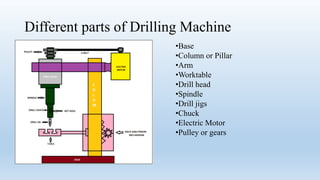
Different parts of Drilling Machine
•Base
•Column or Pillar
•Arm
•Worktable
•Drill head
•Spindle
•Drill jigs
•Chuck
•Electric Motor
•Pulley or gears
Sensitive upright Drilling machine
• Light duty type
• Drill holes upto 15mm
• Can only be hand fed
• Operator senses the cutting action
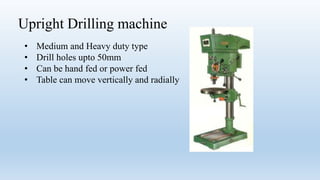
Upright Drilling machine
• Medium and Heavy duty type
• Drill holes upto 50mm
• Can be hand fed or power fed
• Table can move vertically and radially
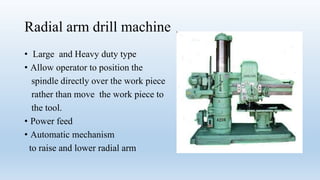
Radial arm drill machine
• Large and Heavy duty type
• Allow operator to position the
spindle directly over the work piece
rather than move the work piece to
the tool.
• Power feed
• Automatic mechanism
to raise and lower radial arm
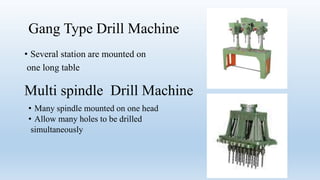
Multi spindle Drill Machine
• Several station are mounted on
one long table
Gang Type Drill Machine
• Many spindle mounted on one head
• Allow many holes to be drilled
simultaneously
The two most common types are
1. HSS (High Speed Steel) drill
2. Carbide- tipped drills
- high production and in CNC machines
Other types are
Solid Carbide drill, Tin coated drills
Tool Materials
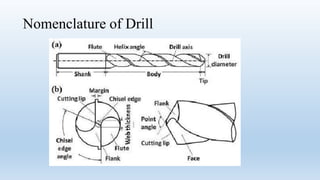
Nomenclature of Drill
Drill holding devices
Drill can be directly fitted spindle and also by different
attachment
The different methods used for holding drill in a
drill spindle are
• Geared Drill Chucks: three adjustable jaws
• Drill Sockets
• Drill Sleeves
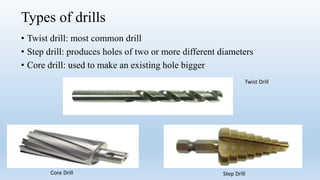
Types of drills
• Twist drill: most common drill
• Step drill: produces holes of two or more different diameters
• Core drill: used to make an existing hole bigger
Twist Drill
Core Drill Step Drill
Drilling Operation
• Drilling
• Reaming
• Boring
• Counter boring
• Countersinking
• Tapping
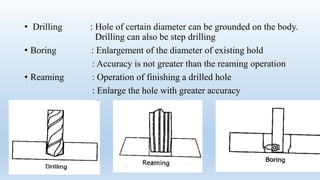
• Drilling : Hole of certain diameter can be grounded on the body.
Drilling can also be step drilling
• Boring : Enlargement of the diameter of existing hold
: Accuracy is not greater than the reaming operation
• Reaming : Operation of finishing a drilled hole
: Enlarge the hole with greater accuracy
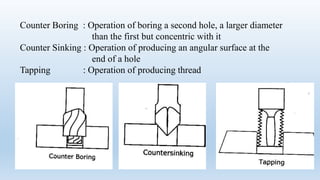
Counter Boring : Operation of boring a second hole, a larger diameter
than the first but concentric with it
Counter Sinking : Operation of producing an angular surface at the
end of a hole
Tapping : Operation of producing thread
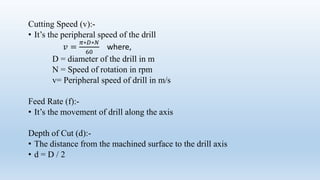
Cutting Speed (v):-
• It’s the peripheral speed of the drill
𝑣 =
𝜋∗𝐷∗𝑁
60
where,
D = diameter of the drill in m
N = Speed of rotation in rpm
v= Peripheral speed of drill in m/s
Feed Rate (f):-
• It’s the movement of drill along the axis
Depth of Cut (d):-
• The distance from the machined surface to the drill axis
• d = D / 2
Material Removal Rate:-
• It’s the volume of material removed by the drill per unit time
𝑀𝑅𝑅 =
𝜋𝐷2
4
∗ 𝑓 ∗ 𝑁 𝑚3/𝑚𝑖𝑛
Machining Time (T) :-
• It depends upon the length (L) of the hole to be drilled ,to the Speed (N)
and feed (f) of the drill
• t = L / f N min
Safety Precautions
• Do not support the work piece by hand – use work holding device.
• Use brush to clean the chip
• No adjustments while the machine is operating
• Ensure for the cutting tools running straight before starting the
operation.
• Never place tools on the drilling table
Safety Precautions
• Avoid loose clothing and protect the eyes.
• Ease the feed if drill breaks inside the work piece.
• Lubrication is important to remove heat and friction.
• Machines should be cleaned after use
• Chips should be removed using brush.
Assignment
Prepare summary report including the following contents (No more
than 2 pages for drilling machine
1. Operating Principle
2. Different operations (can be performed by machines)
3. Discussion and conclusions (Actually what did you learn?)
Deadline Next class

WORKSHOP TECHNOLOGY-Drills and drilling process

  • 1.
    Drills and drillingprocess Tribhuvan University Institute of Engineering (IOE) Himalaya College of Engineering Prepared By: Er. Amrit Tiwari Lecturer Himalaya College of Engineering
  • 2.
    • Drilling isthe operation of producing circular hole in the work piece by using a rotating cutter called DRILL BIT. Drill bits materials are generally High speed steel • The machine used in drilling is called drilling machine Types of drilling machine a) Based on construction: Portable, Sensitive, Radial, up-right, Multi-spindle b)Based on Feed: Hand and Power driven
  • 3.
    Different parts ofDrilling Machine •Base •Column or Pillar •Arm •Worktable •Drill head •Spindle •Drill jigs •Chuck •Electric Motor •Pulley or gears
  • 4.
    Sensitive upright Drillingmachine • Light duty type • Drill holes upto 15mm • Can only be hand fed • Operator senses the cutting action
  • 5.
    Upright Drilling machine •Medium and Heavy duty type • Drill holes upto 50mm • Can be hand fed or power fed • Table can move vertically and radially
  • 6.
    Radial arm drillmachine • Large and Heavy duty type • Allow operator to position the spindle directly over the work piece rather than move the work piece to the tool. • Power feed • Automatic mechanism to raise and lower radial arm
  • 7.
    Multi spindle DrillMachine • Several station are mounted on one long table Gang Type Drill Machine • Many spindle mounted on one head • Allow many holes to be drilled simultaneously
  • 8.
    The two mostcommon types are 1. HSS (High Speed Steel) drill 2. Carbide- tipped drills - high production and in CNC machines Other types are Solid Carbide drill, Tin coated drills Tool Materials
  • 9.
  • 10.
    Drill holding devices Drillcan be directly fitted spindle and also by different attachment The different methods used for holding drill in a drill spindle are • Geared Drill Chucks: three adjustable jaws • Drill Sockets • Drill Sleeves
  • 11.
    Types of drills •Twist drill: most common drill • Step drill: produces holes of two or more different diameters • Core drill: used to make an existing hole bigger Twist Drill Core Drill Step Drill
  • 12.
    Drilling Operation • Drilling •Reaming • Boring • Counter boring • Countersinking • Tapping
  • 13.
    • Drilling :Hole of certain diameter can be grounded on the body. Drilling can also be step drilling • Boring : Enlargement of the diameter of existing hold : Accuracy is not greater than the reaming operation • Reaming : Operation of finishing a drilled hole : Enlarge the hole with greater accuracy
  • 14.
    Counter Boring :Operation of boring a second hole, a larger diameter than the first but concentric with it Counter Sinking : Operation of producing an angular surface at the end of a hole Tapping : Operation of producing thread
  • 15.
    Cutting Speed (v):- •It’s the peripheral speed of the drill 𝑣 = 𝜋∗𝐷∗𝑁 60 where, D = diameter of the drill in m N = Speed of rotation in rpm v= Peripheral speed of drill in m/s Feed Rate (f):- • It’s the movement of drill along the axis Depth of Cut (d):- • The distance from the machined surface to the drill axis • d = D / 2
  • 16.
    Material Removal Rate:- •It’s the volume of material removed by the drill per unit time 𝑀𝑅𝑅 = 𝜋𝐷2 4 ∗ 𝑓 ∗ 𝑁 𝑚3/𝑚𝑖𝑛 Machining Time (T) :- • It depends upon the length (L) of the hole to be drilled ,to the Speed (N) and feed (f) of the drill • t = L / f N min
  • 17.
    Safety Precautions • Donot support the work piece by hand – use work holding device. • Use brush to clean the chip • No adjustments while the machine is operating • Ensure for the cutting tools running straight before starting the operation. • Never place tools on the drilling table
  • 18.
    Safety Precautions • Avoidloose clothing and protect the eyes. • Ease the feed if drill breaks inside the work piece. • Lubrication is important to remove heat and friction. • Machines should be cleaned after use • Chips should be removed using brush.
  • 19.
    Assignment Prepare summary reportincluding the following contents (No more than 2 pages for drilling machine 1. Operating Principle 2. Different operations (can be performed by machines) 3. Discussion and conclusions (Actually what did you learn?) Deadline Next class