TYPES OF
DRILLS
Mansoura University
Faculty of Engineering
Dept. of Production Engineering and
Mechanical Design
PRESENTED BY:
Hassan Nabil
Mohammed Megahed
Sameh Mohammed
Mostafa Sadek
Hossam Sobh
SUPERVISED BY:
Dr. Rania Mostafa
Machining Techniques and Equipment (1) - Types of Drills 2
OUTLINE:
• What is a drill?
• Why need different types of drills?
• What changes from one type of drills to another?
• Introducing different types of drills.
• Conclusion
Machining Techniques and Equipment (1) - Types of Drills 3
INTRODUCTION
What is a drill?
• A drill is, mostly, a double-edged cutting tool,
used for producing circular holes in the work-
piece.
• There is a variety of purposes for which
circular holes are needed, such as fitting joints
or shafts or even passing gases, fluids, etc.Machining Techniques and Equipment (1) - Types of Drills 4
WHY NEED DIFFERENT TYPES OF
DRILLS?
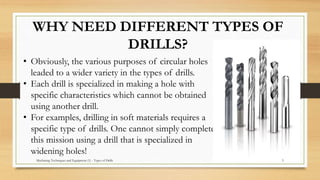
• Obviously, the various purposes of circular holes
leaded to a wider variety in the types of drills.
• Each drill is specialized in making a hole with
specific characteristics which cannot be obtained
using another drill.
• For examples, drilling in soft materials requires a
specific type of drills. One cannot simply completes
this mission using a drill that is specialized in
widening holes!
Machining Techniques and Equipment (1) - Types of Drills 5
WHAT CHANGES FROM ONE TYPE
OF DRILLS TO ANOTHER?
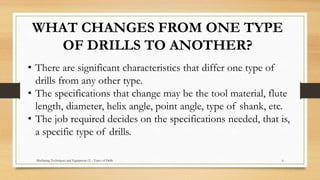
• There are significant characteristics that differ one type of
drills from any other type.
• The specifications that change may be the tool material, flute
length, diameter, helix angle, point angle, type of shank, etc.
• The job required decides on the specifications needed, that is,
a specific type of drills.
Machining Techniques and Equipment (1) - Types of Drills 6
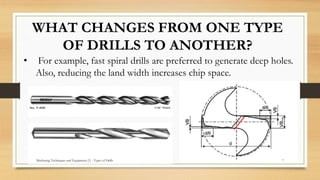
• For example, fast spiral drills are preferred to generate deep holes.
Also, reducing the land width increases chip space.
WHAT CHANGES FROM ONE TYPE
OF DRILLS TO ANOTHER?
Machining Techniques and Equipment (1) - Types of Drills 7
DIFFERENT TYPES OF DRILLS
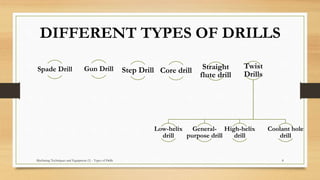
Spade Drill Gun Drill Step Drill Core drill
Twist
Drills
General-
purpose drill
Low-helix
drill
High-helix
drill
Coolant hole
drill
Straight
flute drill
Machining Techniques and Equipment (1) - Types of Drills 8
Machining Techniques and Equipment (1) - Types of Drills 9
DIFFERENT TYPES OF DRILLS
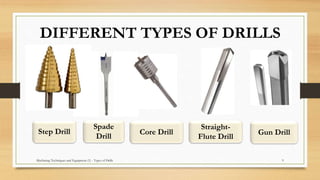
Step Drill
Spade
Drill
Core Drill
Straight-
Flute Drill
Gun Drill
Machining Techniques and Equipment (1) - Types of Drills 10
DIFFERENT TYPES OF DRILLS
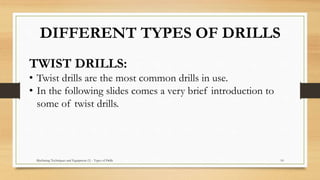
TWIST DRILLS:
• Twist drills are the most common drills in use.
• In the following slides comes a very brief introduction to
some of twist drills.
Machining Techniques and Equipment (1) - Types of Drills 11
TWIST DRILLS:
DIFFERENT TYPES OF DRILLS
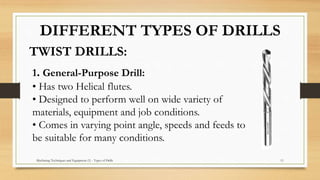
1. General-Purpose Drill:
• Has two Helical flutes.
• Designed to perform well on wide variety of
materials, equipment and job conditions.
• Comes in varying point angle, speeds and feeds to
be suitable for many conditions.
Machining Techniques and Equipment (1) - Types of Drills 12
TWIST DRILLS:
DIFFERENT TYPES OF DRILLS
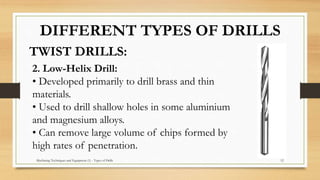
2. Low-Helix Drill:
• Developed primarily to drill brass and thin
materials.
• Used to drill shallow holes in some aluminium
and magnesium alloys.
• Can remove large volume of chips formed by
high rates of penetration.
Machining Techniques and Equipment (1) - Types of Drills 13
TWIST DRILLS:
DIFFERENT TYPES OF DRILLS
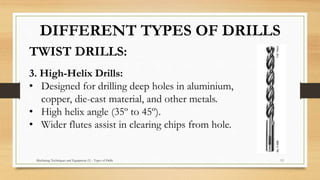
3. High-Helix Drills:
• Designed for drilling deep holes in aluminium,
copper, die-cast material, and other metals.
• High helix angle (35º to 45º).
• Wider flutes assist in clearing chips from hole.
Machining Techniques and Equipment (1) - Types of Drills 14
TWIST DRILLS:
DIFFERENT TYPES OF DRILLS
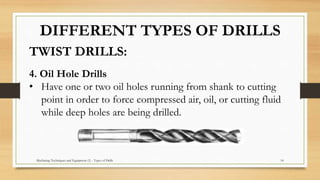
4. Oil Hole Drills
• Have one or two oil holes running from shank to cutting
point in order to force compressed air, oil, or cutting fluid
while deep holes are being drilled.
Machining Techniques and Equipment (1) - Types of Drills 15
CONCLUSION…
Machining Techniques and Equipment (1) - Types of Drills 16
THANK YOU!

Type of drills

  • 1.
    TYPES OF DRILLS Mansoura University Facultyof Engineering Dept. of Production Engineering and Mechanical Design
  • 2.
    PRESENTED BY: Hassan Nabil MohammedMegahed Sameh Mohammed Mostafa Sadek Hossam Sobh SUPERVISED BY: Dr. Rania Mostafa Machining Techniques and Equipment (1) - Types of Drills 2
  • 3.
    OUTLINE: • What isa drill? • Why need different types of drills? • What changes from one type of drills to another? • Introducing different types of drills. • Conclusion Machining Techniques and Equipment (1) - Types of Drills 3
  • 4.
    INTRODUCTION What is adrill? • A drill is, mostly, a double-edged cutting tool, used for producing circular holes in the work- piece. • There is a variety of purposes for which circular holes are needed, such as fitting joints or shafts or even passing gases, fluids, etc.Machining Techniques and Equipment (1) - Types of Drills 4
  • 5.
    WHY NEED DIFFERENTTYPES OF DRILLS? • Obviously, the various purposes of circular holes leaded to a wider variety in the types of drills. • Each drill is specialized in making a hole with specific characteristics which cannot be obtained using another drill. • For examples, drilling in soft materials requires a specific type of drills. One cannot simply completes this mission using a drill that is specialized in widening holes! Machining Techniques and Equipment (1) - Types of Drills 5
  • 6.
    WHAT CHANGES FROMONE TYPE OF DRILLS TO ANOTHER? • There are significant characteristics that differ one type of drills from any other type. • The specifications that change may be the tool material, flute length, diameter, helix angle, point angle, type of shank, etc. • The job required decides on the specifications needed, that is, a specific type of drills. Machining Techniques and Equipment (1) - Types of Drills 6
  • 7.
    • For example,fast spiral drills are preferred to generate deep holes. Also, reducing the land width increases chip space. WHAT CHANGES FROM ONE TYPE OF DRILLS TO ANOTHER? Machining Techniques and Equipment (1) - Types of Drills 7
  • 8.
    DIFFERENT TYPES OFDRILLS Spade Drill Gun Drill Step Drill Core drill Twist Drills General- purpose drill Low-helix drill High-helix drill Coolant hole drill Straight flute drill Machining Techniques and Equipment (1) - Types of Drills 8
  • 9.
    Machining Techniques andEquipment (1) - Types of Drills 9 DIFFERENT TYPES OF DRILLS Step Drill Spade Drill Core Drill Straight- Flute Drill Gun Drill
  • 10.
    Machining Techniques andEquipment (1) - Types of Drills 10 DIFFERENT TYPES OF DRILLS TWIST DRILLS: • Twist drills are the most common drills in use. • In the following slides comes a very brief introduction to some of twist drills.
  • 11.
    Machining Techniques andEquipment (1) - Types of Drills 11 TWIST DRILLS: DIFFERENT TYPES OF DRILLS 1. General-Purpose Drill: • Has two Helical flutes. • Designed to perform well on wide variety of materials, equipment and job conditions. • Comes in varying point angle, speeds and feeds to be suitable for many conditions.
  • 12.
    Machining Techniques andEquipment (1) - Types of Drills 12 TWIST DRILLS: DIFFERENT TYPES OF DRILLS 2. Low-Helix Drill: • Developed primarily to drill brass and thin materials. • Used to drill shallow holes in some aluminium and magnesium alloys. • Can remove large volume of chips formed by high rates of penetration.
  • 13.
    Machining Techniques andEquipment (1) - Types of Drills 13 TWIST DRILLS: DIFFERENT TYPES OF DRILLS 3. High-Helix Drills: • Designed for drilling deep holes in aluminium, copper, die-cast material, and other metals. • High helix angle (35º to 45º). • Wider flutes assist in clearing chips from hole.
  • 14.
    Machining Techniques andEquipment (1) - Types of Drills 14 TWIST DRILLS: DIFFERENT TYPES OF DRILLS 4. Oil Hole Drills • Have one or two oil holes running from shank to cutting point in order to force compressed air, oil, or cutting fluid while deep holes are being drilled.
  • 15.
    Machining Techniques andEquipment (1) - Types of Drills 15 CONCLUSION…
  • 16.
    Machining Techniques andEquipment (1) - Types of Drills 16 THANK YOU!