LIQUIDITY DECISIONS/ WORKING CAPITAL MANAGEMENT
Meaning “ The excess of current assets over currents liabilities”  also known as  circulating,   revolving  or  fluctuating  capital Components  of wc current liabilities current assets Taxes & dividends payable Inventory of raw materials, Stores & spares, FG Advances received Receivables Short term borrowings Short term advances Outstanding expenses Temporary investments Creditors Cash & bank balances
TYPES  Gross working capital & net working capital Permanent working & temporary working capital Positive working & negative working capital Balance sheet working cap & cash working cap Methods of estimating working capital . Conventional method - cash inflows & cash outflows are matched together. Emphasis is on liquidity  & its ratios.  Operating cycle method It considers the production and other business operations.  It emphasis on  profitability & liquidity of  the firm
Factors determining WC requirements  Nature of business  11. Growth of business Manufacturing cycle  12. Market conditions  Production process   13. Supply situations Business cycle  14. Environment factors Seasonal variations Scale of operations Inventory policy Credit policy Accessibility of credit Business standing
Working capital management Working capital management  refers to the management of working capital with twin objectives of Liquidity & profitability. Working capital management establishes the best possible  trade-off between the profitability of net current assets employed and the ability to pay current liabilities as they fall due.  Objectives:  Optimize investments in current assets. To see that the company meets its current liabilities obligations Manage current assets  to see that the return on current assets is more than cost of capital Proper balance between current assets & current liabilities
Components of WCM INVENTORY MANAGEMENT CASH MANAGEMENT RECEIVABLES MANAGEGMENT
INVENTORY MANAGEMENT Meaning- Objectives- For continuous supply for uninterrupted production To reduce wastage & losses To introduce scientific inventory management techniques To reduce cost of purchase & storage To reduce excessive or  shortage of inventory To have uninterrupted production for effective utilization of store space To provide right material at right time, from right source & at right prices.
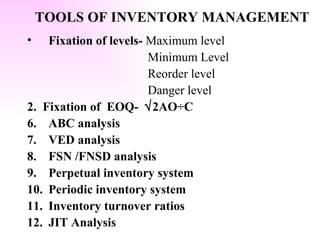
TOOLS OF INVENTORY MANAGEMENT Fixation of levels-  Maximum level Minimum Level Reorder level Danger level 2.  Fixation of  EOQ-   2AO ÷C ABC analysis VED analysis FSN /FNSD analysis Perpetual inventory system Periodic inventory system Inventory turnover ratios JIT Analysis
CASH MANAGEMENT Objectives-  To make   prompt cash payments To maintain minimum cash reserve Motives of holding cash-  Transaction motive Precautionary motive Speculative motive compensatory motive Cash management strategies -  Cash planning Managing the cash flows Optimum cash balance Investing idle cash.
Cash planning   –  It is a technique to plan for & use of cash. It involves cash forecasting and budgeting. Cash budgets & forecasting  –  Short term cash forecasting  Long term cash forecasting  Methods of cash forecasting  – 1. Receipt & Disbursement method 2.  Adjusted net income method
2. Managing cash flows Accelerating  cash collection Prompt payment by customers Lock box system Concentrating banking Electronic fund transfer Decentralize collection Controlling Disbursement Playing the Float-collection float payment float  Payment on last day & by drafts Centralisation of payments
3. Determining optimum cash balance 4. Investment in marketable securities. Selection of securities Safety Maturity Marketability
RECEIVABLES MANAGEMENT Meaning – Determinants of accounts receivable/credit sales- Credit sales volume Credit policies Business terms- time period, discounts Competition Location New products Cost of  receivables/trade credits- Carrying cost Defaulting cost Administration cost
Management of receivables Forming of credit policy Executing credit policy Formulating & executing collection policy Credit rating-5 C’s  (character, capacity, capital,  collateral & condition) Ageing schedules- it is a statement prepared to determine quality of individual debtors. No of days, period ending, % age of debt etc. Factoring- Services- finance, maintenance of accounts, collection of data or protection against credit risks.

Working Capital Management

  • 1.
    LIQUIDITY DECISIONS/ WORKINGCAPITAL MANAGEMENT
  • 2.
    Meaning “ Theexcess of current assets over currents liabilities” also known as circulating, revolving or fluctuating capital Components of wc current liabilities current assets Taxes & dividends payable Inventory of raw materials, Stores & spares, FG Advances received Receivables Short term borrowings Short term advances Outstanding expenses Temporary investments Creditors Cash & bank balances
  • 3.
    TYPES Grossworking capital & net working capital Permanent working & temporary working capital Positive working & negative working capital Balance sheet working cap & cash working cap Methods of estimating working capital . Conventional method - cash inflows & cash outflows are matched together. Emphasis is on liquidity & its ratios. Operating cycle method It considers the production and other business operations. It emphasis on profitability & liquidity of the firm
  • 4.
    Factors determining WCrequirements Nature of business 11. Growth of business Manufacturing cycle 12. Market conditions Production process 13. Supply situations Business cycle 14. Environment factors Seasonal variations Scale of operations Inventory policy Credit policy Accessibility of credit Business standing
  • 5.
    Working capital managementWorking capital management refers to the management of working capital with twin objectives of Liquidity & profitability. Working capital management establishes the best possible trade-off between the profitability of net current assets employed and the ability to pay current liabilities as they fall due. Objectives: Optimize investments in current assets. To see that the company meets its current liabilities obligations Manage current assets to see that the return on current assets is more than cost of capital Proper balance between current assets & current liabilities
  • 6.
    Components of WCMINVENTORY MANAGEMENT CASH MANAGEMENT RECEIVABLES MANAGEGMENT
  • 7.
    INVENTORY MANAGEMENT Meaning-Objectives- For continuous supply for uninterrupted production To reduce wastage & losses To introduce scientific inventory management techniques To reduce cost of purchase & storage To reduce excessive or shortage of inventory To have uninterrupted production for effective utilization of store space To provide right material at right time, from right source & at right prices.
  • 8.
    TOOLS OF INVENTORYMANAGEMENT Fixation of levels- Maximum level Minimum Level Reorder level Danger level 2. Fixation of EOQ-  2AO ÷C ABC analysis VED analysis FSN /FNSD analysis Perpetual inventory system Periodic inventory system Inventory turnover ratios JIT Analysis
  • 9.
    CASH MANAGEMENT Objectives- To make prompt cash payments To maintain minimum cash reserve Motives of holding cash- Transaction motive Precautionary motive Speculative motive compensatory motive Cash management strategies - Cash planning Managing the cash flows Optimum cash balance Investing idle cash.
  • 10.
    Cash planning – It is a technique to plan for & use of cash. It involves cash forecasting and budgeting. Cash budgets & forecasting – Short term cash forecasting Long term cash forecasting Methods of cash forecasting – 1. Receipt & Disbursement method 2. Adjusted net income method
  • 11.
    2. Managing cashflows Accelerating cash collection Prompt payment by customers Lock box system Concentrating banking Electronic fund transfer Decentralize collection Controlling Disbursement Playing the Float-collection float payment float Payment on last day & by drafts Centralisation of payments
  • 12.
    3. Determining optimumcash balance 4. Investment in marketable securities. Selection of securities Safety Maturity Marketability
  • 13.
    RECEIVABLES MANAGEMENT Meaning– Determinants of accounts receivable/credit sales- Credit sales volume Credit policies Business terms- time period, discounts Competition Location New products Cost of receivables/trade credits- Carrying cost Defaulting cost Administration cost
  • 14.
    Management of receivablesForming of credit policy Executing credit policy Formulating & executing collection policy Credit rating-5 C’s (character, capacity, capital, collateral & condition) Ageing schedules- it is a statement prepared to determine quality of individual debtors. No of days, period ending, % age of debt etc. Factoring- Services- finance, maintenance of accounts, collection of data or protection against credit risks.