Managing your cash-flow
can you afford to ignore it?
Jeff Davies
Why working capital management is
important
•It will help ensures the timely provision of cash
resources necessary to support the company’s
operations
Aims of this session
• To clearly understand that profit and cash can be two
different things
• To practice developing a cash-flow forecast
• What is meant by Working Capital Management
• To measure the vulnerability of your business
• To understand that cash management cannot be
achieved in isolation from other functions in your
business
Some questions
• What is the main cause of insolvency?
• Are companies who become insolvent profitable?
• Majority of SME’s do not have a cash-flow forecast, why?
• To develop a cash-flow forecast you need a business plan (budget)
• How many of you have a detailed budget at the start of the year?
• This budget should be summarised into a forecast:
• 1. Balance Sheet
• 2. Profit and Loss Account
• 3. Cash-flow forecast
Some more questions
• Which is the most important statement?
• Which is the easiest of the 3 to construct for a non finance
specialist?
• What statement is of major concern to banks; government
bodies etc in evaluating loan/grant applications
• You cannot delegate this
• It is not a one off exercise to obtain a loan/grant
• To construct a cash-flow forecast you need a plan. This may be
a change of culture for your business but it is essential
The need to plan
• “a failure to plan is like planning to fail”
Budgetary Planning and Control
•By budgetary planning and control, we mean the
preparation of forecasts of operations, capital
expenditure, and cashflows, and the subsequent
comparison of actual results with those forecasts,
which in turn will lead to management activity to
either :
•1. Pursue policies to bring actual into equality with
forecast or
•2. Adapt to the new circumstances by changing the
forecast to reflect the “new reality”
Process of budget preparation
• Communicate details of budget policy and guidelines to those
who are responsible for the preparation of budgets.
• Determine the factors that restrict performance.
• Preparation of sales budget.
• Initial preparation of the various support budgets.
• Negotiation of budgets between budget holders.
• Coordination and review of budgets
• Final acceptance of budgets
• Ongoing review of budgets.
The Master Budget
• This represents the forecast Balance Sheet, Profit and Loss
Account, and the Cash-flow Statement.
• All of these must be in balance with each other to achieve the
company objectives
• The cash flow statement determines if the company will
survive the year. Everything must be subservient to achieving
this objective. (construction of cash flow statements)
• You will sacrifice profit to ensure survival.
• You cannot approve the budget and move into the operations
phase without the cash position being covered.
Possible miss-understanding
• Cash-flow Statement
• Cash-flow Forecast
Why profit is not cash
• The accruals system of accounting
• Lets look at the accounts of Brambles Ltd 2015 and 2016
• Stock adjustments
• Purchase of fixed assets/depreciation
• Repayment of loans
• Credit sales
• Credit purchases
• VAT
• Corp Tax
• Provisions
• Research and Development
Working Capital
• Working capital is Current Assets- Current Liabilities
• This is how you run your business (a cash merry-go-round)
• Working Capital while essential to run a business is :
• Dead money (earns no interest) and
• Is high risk. Debtors may not pay or stock becomes obsolete.
• An organisation must therefore try to operate with as little
working capital as possible.
• Consequently you must do everything you can to speed up the
merry-go-round (Working Capital Cycle/Plumbing diagram)
Cash-flow forecast
• You are only interested in those transactions that involve
the physical flow of cash.
• Depreciation ,provisions, adjustments etc have no part
to play in the cash-flow forecast.
• Concentrate first on Receipts (Cash in)
• Now concentrate on Payments (Cash out)
• Put them together in the Cash flow Forecast.
• Lets construct a cash-flow forecast (Dave and Jill’s art
exhibition)
Using the cash-flow forecast
• The cash-flow forecast is essential to monitoring your working capital management
plus other factors that influence cash availability.
• Start with a 12 week rolling forecast
• If the forecast shows you will exceed overdraft limit and all cash currently available
you must revisit the plan and make changes. Alternatively if you think you have a
good plan and do not want to change it now is the time to speak to the bank
manager
• You cannot progress with your plans and hope “it will be all right on the night”
• Get into the habit of holding a monthly meeting to discuss actual performance
against budget and make, if necessary, adjustments
• This meeting gives time for reflection (step back from fighting the fires). Involve as
many of your staff as you can.
• Timely monthly accounts are essential
• Check Current and Quick Ratios at least every month
Making a start Jenkins Ltd
• Information required:
• 1. Opening bank balance
• 2. Current overdraft limit
• 3. Current Order Book
• 4. Closing Debtors and Creditors
• 5. Forecast activity (sales) for 3 months
• 6. List of all expenses to be paid and the timing of payment
• Jenkins Example
The cash (Working Capital)cycle
• This measures the time it takes for cash to flow into the
company
• In a manufacturing company you can see the cycle as being:
• Purchase raw materials(which can be held in stock)
• Manufacture period
• Held in finished goods stock
How do we measure the length of the
cash cycle?
• 1. Debtors collection period. 365/ (Credit sales/debtors)
• 2. Stock held. 365/(Cost of Sales/Stock)
• 3. Creditor payment period. 365/(Purchases/creditors)
• These calculations can be refined
Length of cash cycle is 1+2-3
• You should monitor the length of this cycle month by month
Brambles Ltd 2015
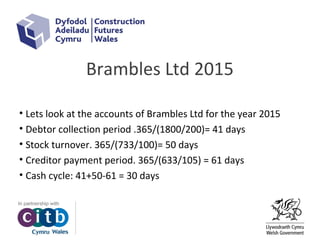
• Lets look at the accounts of Brambles Ltd for the year 2015
• Debtor collection period .365/(1800/200)= 41 days
• Stock turnover. 365/(733/100)= 50 days
• Creditor payment period. 365/(633/105) = 61 days
• Cash cycle: 41+50-61 = 30 days
Brambles Ltd 2016
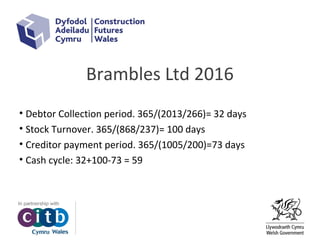
• Debtor Collection period. 365/(2013/266)= 32 days
• Stock Turnover. 365/(868/237)= 100 days
• Creditor payment period. 365/(1005/200)=73 days
• Cash cycle: 32+100-73 = 59
There is no magic solution
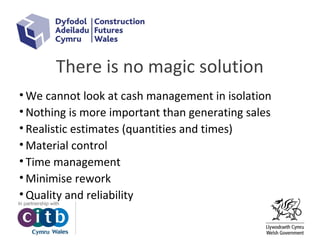
• We cannot look at cash management in isolation
• Nothing is more important than generating sales
• Realistic estimates (quantities and times)
• Material control
• Time management
• Minimise rework
• Quality and reliability
Debtor Control
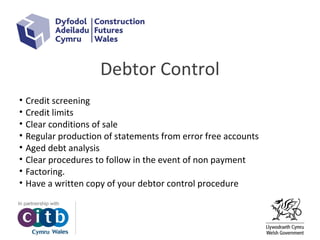
• Credit screening
• Credit limits
• Clear conditions of sale
• Regular production of statements from error free accounts
• Aged debt analysis
• Clear procedures to follow in the event of non payment
• Factoring.
• Have a written copy of your debtor control procedure
Creditor Control
• Strict control over creation of supplier accounts
• Control of who has authority to purchase supplies
• Control over deliveries
• Check statements carefully
• Take advantage of discounts.
• Strict control of cheque issuing procedures
• Separation of duties
Stock Control
• 80/20 rule
• Economic Order Quantity (EOQ)
• Buffer Stock
• Reorder point
• Lead time
• Just in time (JIT)
Overtrading
•Symptoms of overtrading are :
•1. Rapid growth in turnover
•2. Delay in payment to creditors
•3. Increase in short term bank borrowing
•4. Increase in gearing
•5. decline in current and quick ratios
Increasing working capital
• An issue of shares to existing shareholders
• An issue of shares to new shareholders
• Long term loans
• Lease or hire purchase
• Factoring debts
• Non payment of dividends
• Ideally by budgetary planning and control these problems
would have been anticipated and planned for.
Vulnerability
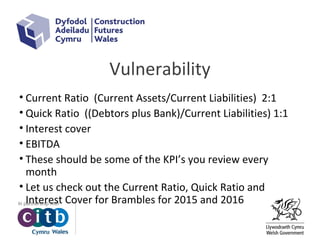
• Current Ratio (Current Assets/Current Liabilities) 2:1
• Quick Ratio ((Debtors plus Bank)/Current Liabilities) 1:1
• Interest cover
• EBITDA
• These should be some of the KPI’s you review every
month
• Let us check out the Current Ratio, Quick Ratio and
Interest Cover for Brambles for 2015 and 2016
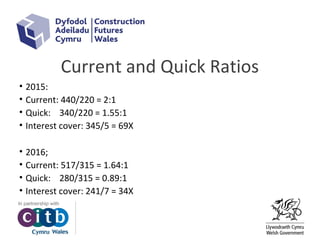
Current and Quick Ratios
• 2015:
• Current: 440/220 = 2:1
• Quick: 340/220 = 1.55:1
• Interest cover: 345/5 = 69X
• 2016;
• Current: 517/315 = 1.64:1
• Quick: 280/315 = 0.89:1
• Interest cover: 241/7 = 34X
Vulnerability
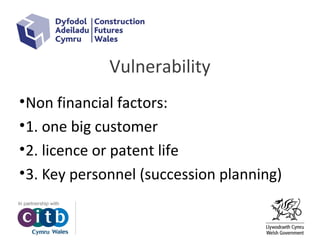
•Non financial factors:
•1. one big customer
•2. licence or patent life
•3. Key personnel (succession planning)
Any Questions?

CFW Managing your Cash-flow

  • 1.
    Managing your cash-flow canyou afford to ignore it? Jeff Davies
  • 2.
    Why working capitalmanagement is important •It will help ensures the timely provision of cash resources necessary to support the company’s operations
  • 3.
    Aims of thissession • To clearly understand that profit and cash can be two different things • To practice developing a cash-flow forecast • What is meant by Working Capital Management • To measure the vulnerability of your business • To understand that cash management cannot be achieved in isolation from other functions in your business
  • 4.
    Some questions • Whatis the main cause of insolvency? • Are companies who become insolvent profitable? • Majority of SME’s do not have a cash-flow forecast, why? • To develop a cash-flow forecast you need a business plan (budget) • How many of you have a detailed budget at the start of the year? • This budget should be summarised into a forecast: • 1. Balance Sheet • 2. Profit and Loss Account • 3. Cash-flow forecast
  • 5.
    Some more questions •Which is the most important statement? • Which is the easiest of the 3 to construct for a non finance specialist? • What statement is of major concern to banks; government bodies etc in evaluating loan/grant applications • You cannot delegate this • It is not a one off exercise to obtain a loan/grant • To construct a cash-flow forecast you need a plan. This may be a change of culture for your business but it is essential
  • 6.
    The need toplan • “a failure to plan is like planning to fail”
  • 7.
    Budgetary Planning andControl •By budgetary planning and control, we mean the preparation of forecasts of operations, capital expenditure, and cashflows, and the subsequent comparison of actual results with those forecasts, which in turn will lead to management activity to either : •1. Pursue policies to bring actual into equality with forecast or •2. Adapt to the new circumstances by changing the forecast to reflect the “new reality”
  • 8.
    Process of budgetpreparation • Communicate details of budget policy and guidelines to those who are responsible for the preparation of budgets. • Determine the factors that restrict performance. • Preparation of sales budget. • Initial preparation of the various support budgets. • Negotiation of budgets between budget holders. • Coordination and review of budgets • Final acceptance of budgets • Ongoing review of budgets.
  • 9.
    The Master Budget •This represents the forecast Balance Sheet, Profit and Loss Account, and the Cash-flow Statement. • All of these must be in balance with each other to achieve the company objectives • The cash flow statement determines if the company will survive the year. Everything must be subservient to achieving this objective. (construction of cash flow statements) • You will sacrifice profit to ensure survival. • You cannot approve the budget and move into the operations phase without the cash position being covered.
  • 10.
    Possible miss-understanding • Cash-flowStatement • Cash-flow Forecast
  • 11.
    Why profit isnot cash • The accruals system of accounting • Lets look at the accounts of Brambles Ltd 2015 and 2016 • Stock adjustments • Purchase of fixed assets/depreciation • Repayment of loans • Credit sales • Credit purchases • VAT • Corp Tax • Provisions • Research and Development
  • 12.
    Working Capital • Workingcapital is Current Assets- Current Liabilities • This is how you run your business (a cash merry-go-round) • Working Capital while essential to run a business is : • Dead money (earns no interest) and • Is high risk. Debtors may not pay or stock becomes obsolete. • An organisation must therefore try to operate with as little working capital as possible. • Consequently you must do everything you can to speed up the merry-go-round (Working Capital Cycle/Plumbing diagram)
  • 13.
    Cash-flow forecast • Youare only interested in those transactions that involve the physical flow of cash. • Depreciation ,provisions, adjustments etc have no part to play in the cash-flow forecast. • Concentrate first on Receipts (Cash in) • Now concentrate on Payments (Cash out) • Put them together in the Cash flow Forecast. • Lets construct a cash-flow forecast (Dave and Jill’s art exhibition)
  • 14.
    Using the cash-flowforecast • The cash-flow forecast is essential to monitoring your working capital management plus other factors that influence cash availability. • Start with a 12 week rolling forecast • If the forecast shows you will exceed overdraft limit and all cash currently available you must revisit the plan and make changes. Alternatively if you think you have a good plan and do not want to change it now is the time to speak to the bank manager • You cannot progress with your plans and hope “it will be all right on the night” • Get into the habit of holding a monthly meeting to discuss actual performance against budget and make, if necessary, adjustments • This meeting gives time for reflection (step back from fighting the fires). Involve as many of your staff as you can. • Timely monthly accounts are essential • Check Current and Quick Ratios at least every month
  • 15.
    Making a startJenkins Ltd • Information required: • 1. Opening bank balance • 2. Current overdraft limit • 3. Current Order Book • 4. Closing Debtors and Creditors • 5. Forecast activity (sales) for 3 months • 6. List of all expenses to be paid and the timing of payment • Jenkins Example
  • 16.
    The cash (WorkingCapital)cycle • This measures the time it takes for cash to flow into the company • In a manufacturing company you can see the cycle as being: • Purchase raw materials(which can be held in stock) • Manufacture period • Held in finished goods stock
  • 17.
    How do wemeasure the length of the cash cycle? • 1. Debtors collection period. 365/ (Credit sales/debtors) • 2. Stock held. 365/(Cost of Sales/Stock) • 3. Creditor payment period. 365/(Purchases/creditors) • These calculations can be refined Length of cash cycle is 1+2-3 • You should monitor the length of this cycle month by month
  • 18.
    Brambles Ltd 2015 •Lets look at the accounts of Brambles Ltd for the year 2015 • Debtor collection period .365/(1800/200)= 41 days • Stock turnover. 365/(733/100)= 50 days • Creditor payment period. 365/(633/105) = 61 days • Cash cycle: 41+50-61 = 30 days
  • 19.
    Brambles Ltd 2016 •Debtor Collection period. 365/(2013/266)= 32 days • Stock Turnover. 365/(868/237)= 100 days • Creditor payment period. 365/(1005/200)=73 days • Cash cycle: 32+100-73 = 59
  • 20.
    There is nomagic solution • We cannot look at cash management in isolation • Nothing is more important than generating sales • Realistic estimates (quantities and times) • Material control • Time management • Minimise rework • Quality and reliability
  • 21.
    Debtor Control • Creditscreening • Credit limits • Clear conditions of sale • Regular production of statements from error free accounts • Aged debt analysis • Clear procedures to follow in the event of non payment • Factoring. • Have a written copy of your debtor control procedure
  • 22.
    Creditor Control • Strictcontrol over creation of supplier accounts • Control of who has authority to purchase supplies • Control over deliveries • Check statements carefully • Take advantage of discounts. • Strict control of cheque issuing procedures • Separation of duties
  • 23.
    Stock Control • 80/20rule • Economic Order Quantity (EOQ) • Buffer Stock • Reorder point • Lead time • Just in time (JIT)
  • 24.
    Overtrading •Symptoms of overtradingare : •1. Rapid growth in turnover •2. Delay in payment to creditors •3. Increase in short term bank borrowing •4. Increase in gearing •5. decline in current and quick ratios
  • 25.
    Increasing working capital •An issue of shares to existing shareholders • An issue of shares to new shareholders • Long term loans • Lease or hire purchase • Factoring debts • Non payment of dividends • Ideally by budgetary planning and control these problems would have been anticipated and planned for.
  • 26.
    Vulnerability • Current Ratio(Current Assets/Current Liabilities) 2:1 • Quick Ratio ((Debtors plus Bank)/Current Liabilities) 1:1 • Interest cover • EBITDA • These should be some of the KPI’s you review every month • Let us check out the Current Ratio, Quick Ratio and Interest Cover for Brambles for 2015 and 2016
  • 27.
    Current and QuickRatios • 2015: • Current: 440/220 = 2:1 • Quick: 340/220 = 1.55:1 • Interest cover: 345/5 = 69X • 2016; • Current: 517/315 = 1.64:1 • Quick: 280/315 = 0.89:1 • Interest cover: 241/7 = 34X
  • 28.
    Vulnerability •Non financial factors: •1.one big customer •2. licence or patent life •3. Key personnel (succession planning)
  • 29.