1
2
In the financial sense, the capital market is
the market for the instruments representing
long-term funds requirement of the
corporation.
It consists of a sprawling complex of
institutions and mechanism whereby
intermediate-term funds and long-term funds
are pooled and made available to business,
government, and individuals. 3
4
Characteristics of
Capital Market
5
◘ Debt and equities instruments traded in
the capital markets are intermediate or
longer-term in maturity.
◘ The scope of the market is very wide.
◘ The supply of the new funds comes from the
same sectors although it is funneled within the
markets through financial institutions.
6
◘ The demand for the capital market
instruments comes from five categories like
individuals and households, business and
financial corporation, central government,
local government, and foreign government.
◘ Transactions in open markets influence the
prices and yields of longer-term instruments
immediately
7
Function of Capital
Market
• Mobilization of Savings : Capital market is an
important source for mobilizing idle savings from the
economy. It mobilizes funds from people for
further investments in the productive channels of an
economy. In that sense it activate the ideal monetary
resources and puts them in proper investments.
• Capital Formation : Capital market helps in capital
formation. Capital formation is net addition to the existing
stock of capital in the economy. Through mobilization of
ideal resources it generates savings; the mobilized savings
are made available to various segments such as
agriculture, industry, etc. This helps in increasing capital
formation.
8
• Speed up Economic Growth and Development :
Capital market enhances production and productivity in
the national economy. As it makes funds available for long
period of time, the financial requirements of business
houses are met by the capital market. It helps in research
and development. This helps in, increasing production and
productivity in economy by generation of employment and
development of infrastructure.
• Proper Regulation of Funds : Capital markets not
only helps in fund mobilization, but it also helps in proper
allocation of these resources. It can have regulation over
the resources so that it can direct funds in a qualitative
manner.
9
• Service Provision : As an important financial set up capital market
provides various types of services. It includes long term and
medium term loans to industry, underwriting services, consultancy
services, export finance, etc. These services help the manufacturing
sector in a large spectrum.
• Continuous Availability of Funds : Capital market is place where
the investment avenue is continuously available for long term
investment. This is a liquid market as it makes fund available on
continues basis. Both buyers and seller can easily buy and sell
securities as they are continuously available. Basically capital
market transactions are related to the stock exchanges. Thus
marketability in the capital market becomes easy.
• Provision of Investment Avenue : Capital market raises resources
for longer periods of time. Thus it provides an investment avenue
for people who wish to invest resources for a long period of time. It
provides suitable interest rate returns also to investors. Instruments
such as bonds, equities, units of mutual funds, insurance policies,
etc. definitely provides diverse investment avenue for the public.
10
11
12
13
14
15
16
17
• Easy liquidity- with the help of secondary market investors can sell
off their holdings and convert them into liquidity cash. Commercial
banks also allow investors to withdraw their deposits, as and when
they are in need f funds.
• Foreign capital-it makes possible to generate foreign capital. Indian
firms are able to generate capital funds from overseas market by
way of bonds and other securities. Government has liberalized
“Foreign Direct Investment” (FDI) in the country. This is not
brings in foreign capital but also foreign technology which is
important for economic development of the country.
18
Important Factors Affecting the Choice
of Capital Structure
Under the capital structure, decision the
proportion of long-term sources of capital is
determined. Most favorable proportion
determines the optimum capital structure. That
happens to be the need of the company
because EPS happens to be the maximum on it.
Some of the chief factors affecting the choice of
the capital structure are the following:
19
(1) Cash Flow Position:
While making a choice of the capital structure the future
cash flow position should be kept in mind. Debt capital
should be used only if the cash flow position is really good
because a lot of cash is needed in order to make payment
of interest and refund of capital.
(2) Interest Coverage Ratio-ICR:
With the help of this ratio an effort is made to find out how
many times the EBIT is available to the payment of interest.
The capacity of the company to use debt capital will be in direct
proportion to this ratio.
It is possible that in spite of better ICR the cash flow position of
the company may be weak. Therefore, this ratio is not a proper
or appropriate measure of the capacity of the company to pay
interest. It is equally important to take into consideration the
cash flow position.
20
(3) Debt Service Coverage Ratio-DSCR:
This ratio removes the weakness of ICR. This shows
the cash flow position of the company. This ratio tells
us about the cash payments to be made (e.g., preference
dividend, interest and debt capital repayment) and the
amount of cash available. Better ratio means the better
capacity of the company for debt payment.
Consequently, more debt can be utilized in the capital
structure.
(4) Return on Investment-ROI:
The greater return on investment of a company
increases its capacity to utilize more debt capital.
21
(5) Cost of Debt:
The capacity of a company to take debt depends
on the cost of debt. In case the rate of interest on
the debt capital is less, more debt capital can be
utilized and vice versa.
(6) Tax Rate:
The rate of tax affects the cost of debt. If the rate
of tax is high, the cost of debt decreases. The
reason is the deduction of interest on the debt
capital from the profits considering it a part of
expenses and a saving in taxes.
22
(7) Cost of Equity Capital:
Cost of equity capital (it means the expectations of the equity
shareholders from the company) is affected by the use of debt
capital. If the debt capital is utilized more, it will increase the cost of
the equity capital. The simple reason for this is that the greater use
of debt capital increases the risk of the equity shareholders.
Therefore, the use of the debt capital can be made only to a limited
level. If even after this level the debt capital is used further, the cost
of equity capital starts increasing rapidly. It adversely affects the
market value of the shares. This is not a good situation. Efforts
should be made to avoid it.
(8) Floatation Costs:
Floatation costs are those expenses which are incurred while issuing
securities (e.g., equity shares, preference shares, debentures, etc.).
These include commission of underwriters, brokerage, stationery
expenses, etc. Generally, the cost of issuing debt capital is less than
the share capital. This attracts the company towards debt capital.
23
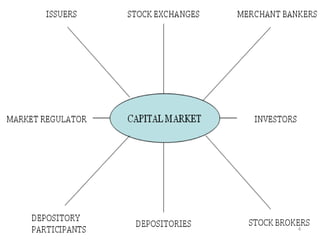
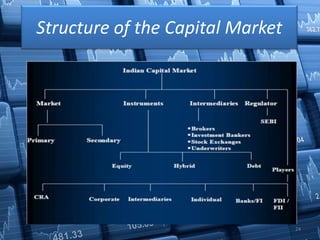
Structure of the Capital Market
24
REFORMS AND
DEVELOPMENT
SINCE
1991
25
1> Securities and exchange board of
India-
The Securities and Exchange Board of India (SEBI) was established
in 1988. It got a legal status in 1992. SEBI was primarily set up to
regulate the activities of the merchant banks, to control the
operations of mutual funds, to work as a promoter of the stock
exchange activities and to act as a regulatory authority of new issue
activities of companies.
2> Establishment of Creditors Rating
Agencies - Three creditors rating agencies viz. The Credit
Rating Information Services of India Limited the Investment
Information and Credit Rating Agency of India Limited and Credit
Analysis and Research Limited were set up in order to assess the
financial health of different financial institutions and agencies
related to the stock market activities
26
3> Increasing of Merchant Banking
Activities- Many Indian and foreign commercial banks have
set up their merchant banking divisions in the last few years. These
divisions provide financial services such as underwriting facilities,
issue organizing consultancy services, etc.
4> Candid Performance of Indian
Economy- In the last few years, Indian economy is growing at
a good speed. It has attracted a huge inflow of Foreign Institutional
Investments (FII).
5> Rising Electronic Transactions- Due to
technological development in the last few years. The physical
transaction with more paper work is reduced.
27
6> Growing Mutual Fund Industry- The
growing of mutual funds in India has certainly helped the capital
market to grow. Public sector banks, foreign banks, financial
institutions and joint mutual funds between the Indian and foreign
firms have launched many new funds.
7> Growing Stock Exchanges - The numbers
of various stock in India are increasing. Initially the BSE was the
main exchange, but now after the setting up of the NSE and
the OTCEI, stock exchanges have spread across the country.
8> Investor's Protection- Under the purview of the
SEBI the Central Government of India has set up the Investors
Education and Protection Fund (IEPF) in 2001.
28
9> Growth of Derivative Transactions- Since
June 2000, the NSE has introduced the derivatives trading in the
equities. In November 2001 it also introduced the future and options
transactions.
10> Insurance Sector Reforms- Indian insurance
sector has also witnessed massive reforms in last few years. The
Insurance Regulatory and Development Authority (IRDA) was set
up in 2000.
11> Commodity Trading- Along with the trading of
ordinary securities, the trading in commodities is also recently
encouraged. The Multi Commodity Exchange (MCX) is set up. The
volume of such transactions is growing at a splendid rate.
29
30
• UTKARSH BISHT – (BBA/4560/16)
• PRATEEK PANDEY – (BBA/4561/16)
• SAKET MANGALAM – (BBA/4563/16)
• SHUBHAM KUMAR – (BBA/4566/16)
• AYUSHI GUPTA – (BBA/4567/16)
31
32

Capital Market

  • 1.
  • 2.
  • 3.
    In the financialsense, the capital market is the market for the instruments representing long-term funds requirement of the corporation. It consists of a sprawling complex of institutions and mechanism whereby intermediate-term funds and long-term funds are pooled and made available to business, government, and individuals. 3
  • 4.
  • 5.
  • 6.
    ◘ Debt andequities instruments traded in the capital markets are intermediate or longer-term in maturity. ◘ The scope of the market is very wide. ◘ The supply of the new funds comes from the same sectors although it is funneled within the markets through financial institutions. 6
  • 7.
    ◘ The demandfor the capital market instruments comes from five categories like individuals and households, business and financial corporation, central government, local government, and foreign government. ◘ Transactions in open markets influence the prices and yields of longer-term instruments immediately 7
  • 8.
    Function of Capital Market •Mobilization of Savings : Capital market is an important source for mobilizing idle savings from the economy. It mobilizes funds from people for further investments in the productive channels of an economy. In that sense it activate the ideal monetary resources and puts them in proper investments. • Capital Formation : Capital market helps in capital formation. Capital formation is net addition to the existing stock of capital in the economy. Through mobilization of ideal resources it generates savings; the mobilized savings are made available to various segments such as agriculture, industry, etc. This helps in increasing capital formation. 8
  • 9.
    • Speed upEconomic Growth and Development : Capital market enhances production and productivity in the national economy. As it makes funds available for long period of time, the financial requirements of business houses are met by the capital market. It helps in research and development. This helps in, increasing production and productivity in economy by generation of employment and development of infrastructure. • Proper Regulation of Funds : Capital markets not only helps in fund mobilization, but it also helps in proper allocation of these resources. It can have regulation over the resources so that it can direct funds in a qualitative manner. 9
  • 10.
    • Service Provision: As an important financial set up capital market provides various types of services. It includes long term and medium term loans to industry, underwriting services, consultancy services, export finance, etc. These services help the manufacturing sector in a large spectrum. • Continuous Availability of Funds : Capital market is place where the investment avenue is continuously available for long term investment. This is a liquid market as it makes fund available on continues basis. Both buyers and seller can easily buy and sell securities as they are continuously available. Basically capital market transactions are related to the stock exchanges. Thus marketability in the capital market becomes easy. • Provision of Investment Avenue : Capital market raises resources for longer periods of time. Thus it provides an investment avenue for people who wish to invest resources for a long period of time. It provides suitable interest rate returns also to investors. Instruments such as bonds, equities, units of mutual funds, insurance policies, etc. definitely provides diverse investment avenue for the public. 10
  • 11.
  • 12.
  • 13.
  • 14.
  • 15.
  • 16.
  • 17.
  • 18.
    • Easy liquidity-with the help of secondary market investors can sell off their holdings and convert them into liquidity cash. Commercial banks also allow investors to withdraw their deposits, as and when they are in need f funds. • Foreign capital-it makes possible to generate foreign capital. Indian firms are able to generate capital funds from overseas market by way of bonds and other securities. Government has liberalized “Foreign Direct Investment” (FDI) in the country. This is not brings in foreign capital but also foreign technology which is important for economic development of the country. 18
  • 19.
    Important Factors Affectingthe Choice of Capital Structure Under the capital structure, decision the proportion of long-term sources of capital is determined. Most favorable proportion determines the optimum capital structure. That happens to be the need of the company because EPS happens to be the maximum on it. Some of the chief factors affecting the choice of the capital structure are the following: 19
  • 20.
    (1) Cash FlowPosition: While making a choice of the capital structure the future cash flow position should be kept in mind. Debt capital should be used only if the cash flow position is really good because a lot of cash is needed in order to make payment of interest and refund of capital. (2) Interest Coverage Ratio-ICR: With the help of this ratio an effort is made to find out how many times the EBIT is available to the payment of interest. The capacity of the company to use debt capital will be in direct proportion to this ratio. It is possible that in spite of better ICR the cash flow position of the company may be weak. Therefore, this ratio is not a proper or appropriate measure of the capacity of the company to pay interest. It is equally important to take into consideration the cash flow position. 20
  • 21.
    (3) Debt ServiceCoverage Ratio-DSCR: This ratio removes the weakness of ICR. This shows the cash flow position of the company. This ratio tells us about the cash payments to be made (e.g., preference dividend, interest and debt capital repayment) and the amount of cash available. Better ratio means the better capacity of the company for debt payment. Consequently, more debt can be utilized in the capital structure. (4) Return on Investment-ROI: The greater return on investment of a company increases its capacity to utilize more debt capital. 21
  • 22.
    (5) Cost ofDebt: The capacity of a company to take debt depends on the cost of debt. In case the rate of interest on the debt capital is less, more debt capital can be utilized and vice versa. (6) Tax Rate: The rate of tax affects the cost of debt. If the rate of tax is high, the cost of debt decreases. The reason is the deduction of interest on the debt capital from the profits considering it a part of expenses and a saving in taxes. 22
  • 23.
    (7) Cost ofEquity Capital: Cost of equity capital (it means the expectations of the equity shareholders from the company) is affected by the use of debt capital. If the debt capital is utilized more, it will increase the cost of the equity capital. The simple reason for this is that the greater use of debt capital increases the risk of the equity shareholders. Therefore, the use of the debt capital can be made only to a limited level. If even after this level the debt capital is used further, the cost of equity capital starts increasing rapidly. It adversely affects the market value of the shares. This is not a good situation. Efforts should be made to avoid it. (8) Floatation Costs: Floatation costs are those expenses which are incurred while issuing securities (e.g., equity shares, preference shares, debentures, etc.). These include commission of underwriters, brokerage, stationery expenses, etc. Generally, the cost of issuing debt capital is less than the share capital. This attracts the company towards debt capital. 23
  • 24.
    Structure of theCapital Market 24
  • 25.
  • 26.
    1> Securities andexchange board of India- The Securities and Exchange Board of India (SEBI) was established in 1988. It got a legal status in 1992. SEBI was primarily set up to regulate the activities of the merchant banks, to control the operations of mutual funds, to work as a promoter of the stock exchange activities and to act as a regulatory authority of new issue activities of companies. 2> Establishment of Creditors Rating Agencies - Three creditors rating agencies viz. The Credit Rating Information Services of India Limited the Investment Information and Credit Rating Agency of India Limited and Credit Analysis and Research Limited were set up in order to assess the financial health of different financial institutions and agencies related to the stock market activities 26
  • 27.
    3> Increasing ofMerchant Banking Activities- Many Indian and foreign commercial banks have set up their merchant banking divisions in the last few years. These divisions provide financial services such as underwriting facilities, issue organizing consultancy services, etc. 4> Candid Performance of Indian Economy- In the last few years, Indian economy is growing at a good speed. It has attracted a huge inflow of Foreign Institutional Investments (FII). 5> Rising Electronic Transactions- Due to technological development in the last few years. The physical transaction with more paper work is reduced. 27
  • 28.
    6> Growing MutualFund Industry- The growing of mutual funds in India has certainly helped the capital market to grow. Public sector banks, foreign banks, financial institutions and joint mutual funds between the Indian and foreign firms have launched many new funds. 7> Growing Stock Exchanges - The numbers of various stock in India are increasing. Initially the BSE was the main exchange, but now after the setting up of the NSE and the OTCEI, stock exchanges have spread across the country. 8> Investor's Protection- Under the purview of the SEBI the Central Government of India has set up the Investors Education and Protection Fund (IEPF) in 2001. 28
  • 29.
    9> Growth ofDerivative Transactions- Since June 2000, the NSE has introduced the derivatives trading in the equities. In November 2001 it also introduced the future and options transactions. 10> Insurance Sector Reforms- Indian insurance sector has also witnessed massive reforms in last few years. The Insurance Regulatory and Development Authority (IRDA) was set up in 2000. 11> Commodity Trading- Along with the trading of ordinary securities, the trading in commodities is also recently encouraged. The Multi Commodity Exchange (MCX) is set up. The volume of such transactions is growing at a splendid rate. 29
  • 30.
  • 31.
    • UTKARSH BISHT– (BBA/4560/16) • PRATEEK PANDEY – (BBA/4561/16) • SAKET MANGALAM – (BBA/4563/16) • SHUBHAM KUMAR – (BBA/4566/16) • AYUSHI GUPTA – (BBA/4567/16) 31
  • 32.