WORKING
CAPITAL
MANAGEMEN
T
WORKING CAPITAL MANAGEMENT
Working Capital: The firm’s investment made in current assets. It is a
measure of firm’s liquidity position.
a) Gross Working Capital: Total investment in the current assets.
b) Net Working Capital: difference between current assets and
current liabilities.
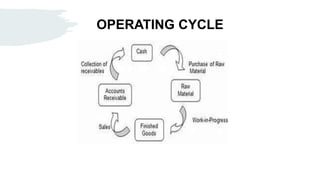
OPERATING CYCLE OR CIRCULAR FLOW
CONCEPT
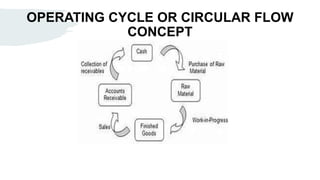
• Working Capital is required for financing short-term assets.
• Funds thus invested in C.A. keep revolving fast and are being
constantly converted into cash and this cash flows out again in
exchange for other current assets.
• Thus, also know as revolving or circulated capital.
OPERATING CYCLE OR CIRCULAR FLOW
CONCEPT
WORKING CAPITAL FINANCING POLICIES
1. Matching Approach
2. Conservative Approach
3. Aggressive Approach
WORKING CAPITAL FINANCING POLICIES
1. Matching Approach:
• A process of matching maturities of debt with the maturities of
financial needs.
• The maturity of sources of funds should match the nature of assets
to be financed.
• The permanent W.C. requirements should be financed with funds
from long-term sources while the temporary or seasonal W.C.
requirements should be financed with the short-term funds.
WORKING CAPITAL FINANCING POLICIES
2. Conservative Approach:
The entire estimated investments in current assets should be financed
from long-term sources and the short-term sources should be used
only for emergency requirements.
WORKING CAPITAL FINANCING POLICIES
3. Aggressive Approach:
The entire estimated requirements of current assets should be
financed from short-term sources and even a part of fixed assets
investments be financed from short-term sources. This approach
makes the finance-mix riskier, less costly and more profitable.
ESTIMATION OF WORKING CAPITAL
REQUIREMENTS
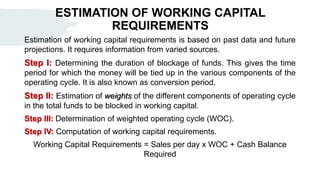
Estimation of working capital requirements is based on past data and future
projections. It requires information from varied sources.
Step I: Determining the duration of blockage of funds. This gives the time
period for which the money will be tied up in the various components of the
operating cycle. It is also known as conversion period.
Step II: Estimation of weights of the different components of operating cycle
in the total funds to be blocked in working capital.
Step III: Determination of weighted operating cycle (WOC).
Step IV: Computation of working capital requirements.
Working Capital Requirements = Sales per day x WOC + Cash Balance
Required
OPERATING CYCLE
WORKING CAPITAL MANAGEMENT
1. Inventory Management
2. Receivable Management
3. Cash Management
1. INVENTORY MANAGEMENT
Inventory Management is about determining and maintaining an
optimal level of inventory, i.e. neither inadequate nor excessive.
For typical manufacturing firms, inventory comprises of raw material,
work-in-progress and finished goods.
For trading firms, it refers to the finished goods stock held for sale.
1. INVENTORY MANAGEMENT
Motives for Holding Inventory
A. Transitionary Motive: is to carry out production or selling transactions in
an uninterrupted manner.
B. Precautionary Motive: there might be uncertainty associated with the
supply of basic inputs or with the demand for outputs.
C. Speculative Motive: Firms might be holding inventory in anticipation of
gain from expected rises in future prices of raw material.
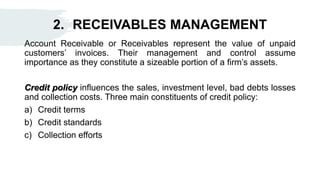
2. RECEIVABLES MANAGEMENT
Account Receivable or Receivables represent the value of unpaid
customers’ invoices. Their management and control assume
importance as they constitute a sizeable portion of a firm’s assets.
Credit policy influences the sales, investment level, bad debts losses
and collection costs. Three main constituents of credit policy:
a) Credit terms
b) Credit standards
c) Collection efforts
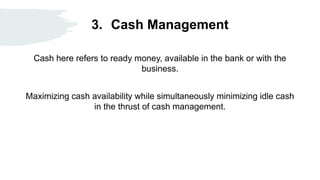
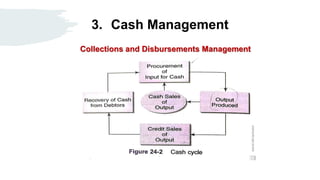
3. Cash Management
Cash here refers to ready money, available in the bank or with the
business.
Maximizing cash availability while simultaneously minimizing idle cash
in the thrust of cash management.
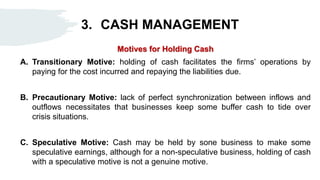
3. CASH MANAGEMENT
Motives for Holding Cash
A. Transitionary Motive: holding of cash facilitates the firms’ operations by
paying for the cost incurred and repaying the liabilities due.
B. Precautionary Motive: lack of perfect synchronization between inflows and
outflows necessitates that businesses keep some buffer cash to tide over
crisis situations.
C. Speculative Motive: Cash may be held by sone business to make some
speculative earnings, although for a non-speculative business, holding of cash
with a speculative motive is not a genuine motive.
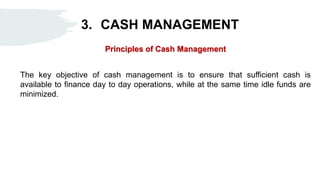
3. CASH MANAGEMENT
Principles of Cash Management
The key objective of cash management is to ensure that sufficient cash is
available to finance day to day operations, while at the same time idle funds are
minimized.
3. Cash Management
Collections and Disbursements Management
3. CASH MANAGEMENT
Collections and Disbursements Management
Cash management focuses prominently on maximizing the availability of cash
through quick collections and slow disbursement.
THANK YOU

8. working capital management

  • 1.
  • 2.
    WORKING CAPITAL MANAGEMENT WorkingCapital: The firm’s investment made in current assets. It is a measure of firm’s liquidity position. a) Gross Working Capital: Total investment in the current assets. b) Net Working Capital: difference between current assets and current liabilities.
  • 3.
    OPERATING CYCLE ORCIRCULAR FLOW CONCEPT • Working Capital is required for financing short-term assets. • Funds thus invested in C.A. keep revolving fast and are being constantly converted into cash and this cash flows out again in exchange for other current assets. • Thus, also know as revolving or circulated capital.
  • 4.
    OPERATING CYCLE ORCIRCULAR FLOW CONCEPT
  • 5.
    WORKING CAPITAL FINANCINGPOLICIES 1. Matching Approach 2. Conservative Approach 3. Aggressive Approach
  • 6.
    WORKING CAPITAL FINANCINGPOLICIES 1. Matching Approach: • A process of matching maturities of debt with the maturities of financial needs. • The maturity of sources of funds should match the nature of assets to be financed. • The permanent W.C. requirements should be financed with funds from long-term sources while the temporary or seasonal W.C. requirements should be financed with the short-term funds.
  • 7.
    WORKING CAPITAL FINANCINGPOLICIES 2. Conservative Approach: The entire estimated investments in current assets should be financed from long-term sources and the short-term sources should be used only for emergency requirements.
  • 8.
    WORKING CAPITAL FINANCINGPOLICIES 3. Aggressive Approach: The entire estimated requirements of current assets should be financed from short-term sources and even a part of fixed assets investments be financed from short-term sources. This approach makes the finance-mix riskier, less costly and more profitable.
  • 9.
    ESTIMATION OF WORKINGCAPITAL REQUIREMENTS Estimation of working capital requirements is based on past data and future projections. It requires information from varied sources. Step I: Determining the duration of blockage of funds. This gives the time period for which the money will be tied up in the various components of the operating cycle. It is also known as conversion period. Step II: Estimation of weights of the different components of operating cycle in the total funds to be blocked in working capital. Step III: Determination of weighted operating cycle (WOC). Step IV: Computation of working capital requirements. Working Capital Requirements = Sales per day x WOC + Cash Balance Required
  • 10.
  • 11.
    WORKING CAPITAL MANAGEMENT 1.Inventory Management 2. Receivable Management 3. Cash Management
  • 12.
    1. INVENTORY MANAGEMENT InventoryManagement is about determining and maintaining an optimal level of inventory, i.e. neither inadequate nor excessive. For typical manufacturing firms, inventory comprises of raw material, work-in-progress and finished goods. For trading firms, it refers to the finished goods stock held for sale.
  • 13.
    1. INVENTORY MANAGEMENT Motivesfor Holding Inventory A. Transitionary Motive: is to carry out production or selling transactions in an uninterrupted manner. B. Precautionary Motive: there might be uncertainty associated with the supply of basic inputs or with the demand for outputs. C. Speculative Motive: Firms might be holding inventory in anticipation of gain from expected rises in future prices of raw material.
  • 14.
    2. RECEIVABLES MANAGEMENT AccountReceivable or Receivables represent the value of unpaid customers’ invoices. Their management and control assume importance as they constitute a sizeable portion of a firm’s assets. Credit policy influences the sales, investment level, bad debts losses and collection costs. Three main constituents of credit policy: a) Credit terms b) Credit standards c) Collection efforts
  • 15.
    3. Cash Management Cashhere refers to ready money, available in the bank or with the business. Maximizing cash availability while simultaneously minimizing idle cash in the thrust of cash management.
  • 16.
    3. CASH MANAGEMENT Motivesfor Holding Cash A. Transitionary Motive: holding of cash facilitates the firms’ operations by paying for the cost incurred and repaying the liabilities due. B. Precautionary Motive: lack of perfect synchronization between inflows and outflows necessitates that businesses keep some buffer cash to tide over crisis situations. C. Speculative Motive: Cash may be held by sone business to make some speculative earnings, although for a non-speculative business, holding of cash with a speculative motive is not a genuine motive.
  • 17.
    3. CASH MANAGEMENT Principlesof Cash Management The key objective of cash management is to ensure that sufficient cash is available to finance day to day operations, while at the same time idle funds are minimized.
  • 18.
    3. Cash Management Collectionsand Disbursements Management
  • 19.
    3. CASH MANAGEMENT Collectionsand Disbursements Management Cash management focuses prominently on maximizing the availability of cash through quick collections and slow disbursement.
  • 20.