



PRESENTATION
ON
FACTORING
PRESENTED BY: Pawan Singh Raikhola
MBA INTEGREATED
5TH SEMESTER
FACTORING
 Factoring is a wider term. It means the financial
transaction whereby a business sells its account
receivable to the third party called (a factor) at a
discounting rate.
 Factoring means financial services under which the
‘factor’ renders various services.
PARTIES
There are three parties:
 FACTOR
A Person ,an agent or a firm which renders the services of factoring.
 CLIENT/SELLER
The company or the firm to whom the factor renders his services of
factoring.
 BUYER/CUSTOMER
A person or a firm who is in debt to the client.
FEATURES
 Easy access.
 Factoring period is 90-150 days.
 Costly source of finance.
 Credit rating is not mandatory.
 Cost of factoring = finance cost+ operating cost.
TYPES OF FACTORING
 FULL FACTORING:
Full factoring is a comprehensive form of factoring. The
factor performs almost all the services of factoring, that
includes collection , credit protection, sales ledger
administration and short term finance. It is also known as old-
line factoring.
 RECOURSE AND NON RECOURSE FACTORING:
In this , the factor has the right to demand payment from the
suppliers in the event of default by the customers. This means
that the factor does not assume credit risk associated with the
receivables. On the other hand, non- recourse factoring means
the risk or loss on account of non- payment by the customers
of the client is to be borne by the factor and he cannot claim
this amount from the selling firm.
 DISCLOSED AND UNDISCLOSED FACTORING:
When the name of the factor is disclosed in the invoice by the
supplier, it is called disclosed factoring. The suppliers may
continue to bear the risk of non –payment by the buyer without
passing it on the factor. On the other hand , Undisclosed
factoring is when the factor is not disclosed in the invoice .The
customers are not informed or notified about the arrangement
between the client and the factor.
 DOMESTIC AND INTERNATIONAL FACTORING:
In domestic factoring, it includes three parties that is buyer,
seller and factor are domiciled in the same country. On the
other hand international factoring has two factors. It is
customary to use two factor system namely export factor and
import factor. An export factor is employed by the exporter in
the exporters country and import factor will be employed in the
importers country.
 MATURITY OR ADVANCE FACTORING:
Certain percentage of receivables is paid in advance to the
client , the balance being paid on the guaranteed payment
date. On the other hand, when the factor does not make a pre-
payment to the client , is known as maturity factoring. It is also
known as collection factoring. The payment is made either on
the guaranteed payment date or the date of collection.
STEPS INVOLVED IN
FACTORING
 STEP1 :
The customer places an order with the seller(the client).
 STEP 2:
The factor and the seller enter into a factoring agreement
about the various terms factoring.
 STEP3:
Sale contract is enter into with buyer and the good are
delivered .The invoice with a notice to pay the factor is sent
along with.
 STEP 4:
The copy of invoice covering the above sale is sent to the
factors , who maintain the sales ledger.
 STEP 5:
The factor prepays 80% of the invoice value.
 STEP 6:
Monthly statements are sent by the factor to the buyer.
 STEP 7:
If there are any unpaid invoices follow up action is initiated.
 STEP 8:
The buyer settles the invoices on expiry of credit period
allowed.
 STEP 9:
The balance 20% less the cost of factoring is paid by the factor
to the client.
FACTORING PROFILE (INDIA)
 Number of factoring companies – 08.
 From domestic factoring turnover-1450(million euros).
 From international factoring turnover – 175(million euros).
 From the total factoring turnover -1625 (million euros).
 India still has limited number of players engaged in
providing factoring services . Most of the players engaged
in providing factoring services currently are :
 Specialized factor institution
• SBI Global factors
• IFCI Factors( industrial finance corporation of india)
 Commercial banks:
• ICICI Bank
• AXIS Bank
 Specialized
financial
institutions
 ECGC (Export
Credit Guarantee
Corporation of
India).
factoring is of recent origin in Indian
context
• Kalyan Sundaram Committee recommended introduction
of factoring in 1989.
• Banking Regulation Act, 1949 was amended in 1991 for
banks setting up factoring services.
• SBI/Canara bank have set up their factoring subsidiaries :
 SBI factors ltd (April,1991).
 RBI has permitted banks to undertake factoring services
through subsidiaries.
FORFAITING
 The term forfaiting is similar to export factoring. It is the
form of financing of export receivables. The word
forfaiting has come from the French word ‘forfait’ which
means surrender or relinquish the right.
 Forfaiting in essence means the forfeiting of the right to
future payments through discounting future cash flows.
PARTIES TO FORFAITING
OPERATIONS
 The exporters.
 The importers.
 The importer’s bank (the guarantor).
 The discounting bank ( the forfaitor).
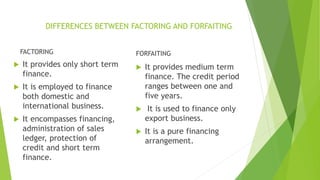
DIFFERENCES BETWEEN FACTORING AND FORFAITING
FACTORING
 It provides only short term
finance.
 It is employed to finance
both domestic and
international business.
 It encompasses financing,
administration of sales
ledger, protection of
credit and short term
finance.
FORFAITING
 It provides medium term
finance. The credit period
ranges between one and
five years.
 It is used to finance only
export business.
 It is a pure financing
arrangement.
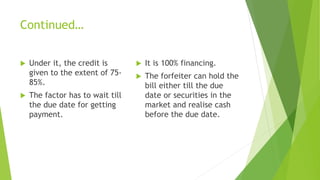
Continued…
 Under it, the credit is
given to the extent of 75-
85%.
 The factor has to wait till
the due date for getting
payment.
 It is 100% financing.
 The forfeiter can hold the
bill either till the due
date or securities in the
market and realise cash
before the due date.
THANK YOU

Factoring

  • 1.
    PRESENTATION ON FACTORING PRESENTED BY: PawanSingh Raikhola MBA INTEGREATED 5TH SEMESTER
  • 2.
    FACTORING  Factoring isa wider term. It means the financial transaction whereby a business sells its account receivable to the third party called (a factor) at a discounting rate.  Factoring means financial services under which the ‘factor’ renders various services.
  • 3.
    PARTIES There are threeparties:  FACTOR A Person ,an agent or a firm which renders the services of factoring.  CLIENT/SELLER The company or the firm to whom the factor renders his services of factoring.  BUYER/CUSTOMER A person or a firm who is in debt to the client.
  • 4.
    FEATURES  Easy access. Factoring period is 90-150 days.  Costly source of finance.  Credit rating is not mandatory.  Cost of factoring = finance cost+ operating cost.
  • 5.
    TYPES OF FACTORING FULL FACTORING: Full factoring is a comprehensive form of factoring. The factor performs almost all the services of factoring, that includes collection , credit protection, sales ledger administration and short term finance. It is also known as old- line factoring.  RECOURSE AND NON RECOURSE FACTORING: In this , the factor has the right to demand payment from the suppliers in the event of default by the customers. This means that the factor does not assume credit risk associated with the receivables. On the other hand, non- recourse factoring means the risk or loss on account of non- payment by the customers of the client is to be borne by the factor and he cannot claim this amount from the selling firm.
  • 6.
     DISCLOSED ANDUNDISCLOSED FACTORING: When the name of the factor is disclosed in the invoice by the supplier, it is called disclosed factoring. The suppliers may continue to bear the risk of non –payment by the buyer without passing it on the factor. On the other hand , Undisclosed factoring is when the factor is not disclosed in the invoice .The customers are not informed or notified about the arrangement between the client and the factor.  DOMESTIC AND INTERNATIONAL FACTORING: In domestic factoring, it includes three parties that is buyer, seller and factor are domiciled in the same country. On the other hand international factoring has two factors. It is customary to use two factor system namely export factor and import factor. An export factor is employed by the exporter in the exporters country and import factor will be employed in the importers country.
  • 7.
     MATURITY ORADVANCE FACTORING: Certain percentage of receivables is paid in advance to the client , the balance being paid on the guaranteed payment date. On the other hand, when the factor does not make a pre- payment to the client , is known as maturity factoring. It is also known as collection factoring. The payment is made either on the guaranteed payment date or the date of collection.
  • 8.
    STEPS INVOLVED IN FACTORING STEP1 : The customer places an order with the seller(the client).  STEP 2: The factor and the seller enter into a factoring agreement about the various terms factoring.  STEP3: Sale contract is enter into with buyer and the good are delivered .The invoice with a notice to pay the factor is sent along with.  STEP 4: The copy of invoice covering the above sale is sent to the factors , who maintain the sales ledger.  STEP 5: The factor prepays 80% of the invoice value.
  • 9.
     STEP 6: Monthlystatements are sent by the factor to the buyer.  STEP 7: If there are any unpaid invoices follow up action is initiated.  STEP 8: The buyer settles the invoices on expiry of credit period allowed.  STEP 9: The balance 20% less the cost of factoring is paid by the factor to the client.
  • 10.
    FACTORING PROFILE (INDIA) Number of factoring companies – 08.  From domestic factoring turnover-1450(million euros).  From international factoring turnover – 175(million euros).  From the total factoring turnover -1625 (million euros).  India still has limited number of players engaged in providing factoring services . Most of the players engaged in providing factoring services currently are :  Specialized factor institution • SBI Global factors • IFCI Factors( industrial finance corporation of india)  Commercial banks: • ICICI Bank • AXIS Bank
  • 11.
     Specialized financial institutions  ECGC(Export Credit Guarantee Corporation of India).
  • 12.
    factoring is ofrecent origin in Indian context • Kalyan Sundaram Committee recommended introduction of factoring in 1989. • Banking Regulation Act, 1949 was amended in 1991 for banks setting up factoring services. • SBI/Canara bank have set up their factoring subsidiaries :  SBI factors ltd (April,1991).  RBI has permitted banks to undertake factoring services through subsidiaries.
  • 13.
    FORFAITING  The termforfaiting is similar to export factoring. It is the form of financing of export receivables. The word forfaiting has come from the French word ‘forfait’ which means surrender or relinquish the right.  Forfaiting in essence means the forfeiting of the right to future payments through discounting future cash flows.
  • 14.
    PARTIES TO FORFAITING OPERATIONS The exporters.  The importers.  The importer’s bank (the guarantor).  The discounting bank ( the forfaitor).
  • 15.
    DIFFERENCES BETWEEN FACTORINGAND FORFAITING FACTORING  It provides only short term finance.  It is employed to finance both domestic and international business.  It encompasses financing, administration of sales ledger, protection of credit and short term finance. FORFAITING  It provides medium term finance. The credit period ranges between one and five years.  It is used to finance only export business.  It is a pure financing arrangement.
  • 16.
    Continued…  Under it,the credit is given to the extent of 75- 85%.  The factor has to wait till the due date for getting payment.  It is 100% financing.  The forfeiter can hold the bill either till the due date or securities in the market and realise cash before the due date.
  • 17.