PORTFOLIO MANAGEMENT
Portfolio Revision
M.Vadivel
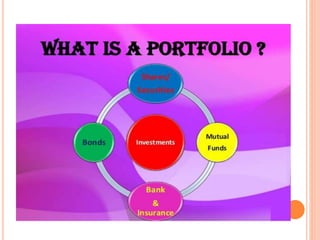
What is a Portfolio ?
A combination of various investment products
like bonds, shares, securities, mutual funds is called a
portfolio.
What is Portfolio Revision
What is Portfolio Revision ?
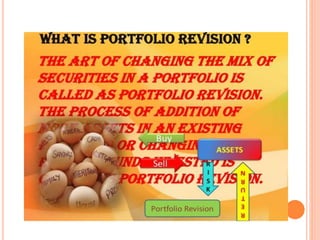
The art of changing the mix of securities in a portfolio is
called as portfolio revision.
The process of addition of more assets in an existing
portfolio or changing the ratio of funds invested is called as
portfolio revision.
The sale and purchase of assets in an existing portfolio
over a certain period of time to maximize returns and minimize
risk is called as Portfolio revision.
Need for Portfolio Revision
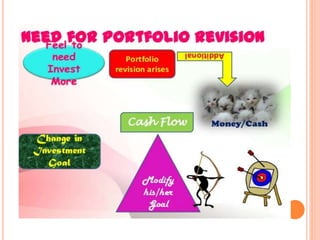
 An individual at certain point of time might feel the
need to invest more. The need for portfolio revision
arises when an individual has some additional money to
invest.
 Change in investment goal also gives rise to revision in
portfolio. Depending on the cash flow, an individual can
modify his financial goal, eventually giving rise to
changes in the portfolio i.e. portfolio revision.
 Financial market is subject to risks and uncertainty. An
individual might sell off some of his assets owing to
fluctuations in the financial market.
Portfolio Revision Strategies
There are two types of Portfolio Revision Strategies
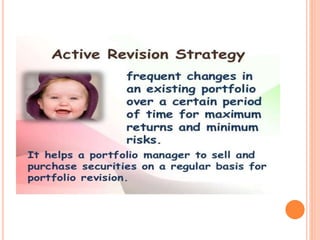
1. Active Revision Strategy
Active Revision Strategy involves frequent
changes in an existing portfolio over a certain period of
time for maximum returns and minimum risks.
Active Revision Strategy helps a portfolio manager
to sell and purchase securities on a regular basis for
portfolio revision.
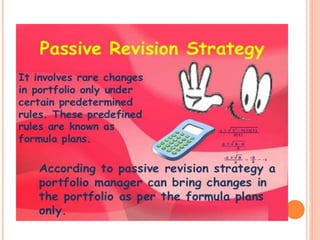
2.Passive Revision Strategy
Passive Revision Strategy involves rare changes in
portfolio only under certain predetermined rules. These
predefined rules are known as formula plans.
According to passive revision strategy a portfolio
manager can bring changes in the portfolio as per the
formula plans only.
Roles and Responsibilities of a Portfolio
Manager
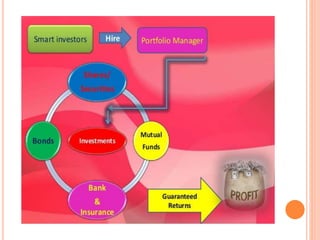
1. A portfolio manager plays a pivotal role in deciding
the best investment plan for an individual as per his
income, age as well as ability to undertake risks.
Investment is essential for every earning individual. One
must keep aside some amount of his/her income for
tough times. Unavoidable circumstances might arise
anytime and one needs to have sufficient funds to
overcome the same.
2. A portfolio manager is responsible for making an
individual aware of the various investment tools
available in the market and benefits associated with each
plan. Make an individual realize why he actually needs
to invest and which plan would be the best for him.
3. A portfolio manager is responsible for designing
customized investment solutions for the clients. No
two individuals can have the same financial needs. It is
essential for the portfolio manager to first analyze the
background of his client. Know an individual’s earnings
and his capacity to invest. Sit with your client and
understand his financial needs and requirement.
4. A portfolio manager must keep himself abreast with
the latest changes in the financial market. Suggest the
best plan for your client with minimum risks involved
and maximum returns. Make him understand the
investment plans and the risks involved with each plan in
a jargon free language. A portfolio manager must be
transparent with individuals. Read out the terms and
conditions and never hide anything from any of your
clients. Be honest to your client for a long term
relationship.
5. A portfolio manager ought to be unbiased and a
thorough professional. Don’t always look for your
commissions or money. It is your responsibility to guide
your client and help him choose the best investment plan.
A portfolio manager must design tailor made investment
solutions for individuals which guarantee maximum
returns and benefits within a stipulated time frame. It is
the portfolio manager’s duty to suggest the individual
where to invest and where not to invest? Keep a check
on the market fluctuations and guide the individual
accordingly.
6. A portfolio manager needs to be a good decision
maker. He should be prompt enough to finalize the best
financial plan for an individual and invest on his behalf.
 Communicate with your client on a regular basis. A
portfolio manager plays a major role in setting financial
goal of an individual. Be accessible to your clients.
Never ignore them. Remember you have the
responsibility of putting their hard earned money into
something which would benefit them in the long run.
 Be patient with your clients. You might need to meet
them twice or even thrice to explain them all the
investment plans, benefits, maturity period, terms and
conditions, risks involved and so on. Don’t ever get
hyper with them.
7. Never sign any important document on your client’s
behalf. Never pressurize your client for any plan. It is his
money and he has all the rights to select the best plan for
himself.
Thanking You…….

Portfolio Revision

  • 1.
  • 2.
    What is aPortfolio ? A combination of various investment products like bonds, shares, securities, mutual funds is called a portfolio.
  • 5.
  • 7.
    What is PortfolioRevision ? The art of changing the mix of securities in a portfolio is called as portfolio revision. The process of addition of more assets in an existing portfolio or changing the ratio of funds invested is called as portfolio revision. The sale and purchase of assets in an existing portfolio over a certain period of time to maximize returns and minimize risk is called as Portfolio revision.
  • 9.
    Need for PortfolioRevision  An individual at certain point of time might feel the need to invest more. The need for portfolio revision arises when an individual has some additional money to invest.  Change in investment goal also gives rise to revision in portfolio. Depending on the cash flow, an individual can modify his financial goal, eventually giving rise to changes in the portfolio i.e. portfolio revision.  Financial market is subject to risks and uncertainty. An individual might sell off some of his assets owing to fluctuations in the financial market.
  • 14.
    Portfolio Revision Strategies Thereare two types of Portfolio Revision Strategies 1. Active Revision Strategy Active Revision Strategy involves frequent changes in an existing portfolio over a certain period of time for maximum returns and minimum risks. Active Revision Strategy helps a portfolio manager to sell and purchase securities on a regular basis for portfolio revision.
  • 15.
    2.Passive Revision Strategy PassiveRevision Strategy involves rare changes in portfolio only under certain predetermined rules. These predefined rules are known as formula plans. According to passive revision strategy a portfolio manager can bring changes in the portfolio as per the formula plans only.
  • 16.
    Roles and Responsibilitiesof a Portfolio Manager 1. A portfolio manager plays a pivotal role in deciding the best investment plan for an individual as per his income, age as well as ability to undertake risks. Investment is essential for every earning individual. One must keep aside some amount of his/her income for tough times. Unavoidable circumstances might arise anytime and one needs to have sufficient funds to overcome the same.
  • 17.
    2. A portfoliomanager is responsible for making an individual aware of the various investment tools available in the market and benefits associated with each plan. Make an individual realize why he actually needs to invest and which plan would be the best for him.
  • 18.
    3. A portfoliomanager is responsible for designing customized investment solutions for the clients. No two individuals can have the same financial needs. It is essential for the portfolio manager to first analyze the background of his client. Know an individual’s earnings and his capacity to invest. Sit with your client and understand his financial needs and requirement.
  • 19.
    4. A portfoliomanager must keep himself abreast with the latest changes in the financial market. Suggest the best plan for your client with minimum risks involved and maximum returns. Make him understand the investment plans and the risks involved with each plan in a jargon free language. A portfolio manager must be transparent with individuals. Read out the terms and conditions and never hide anything from any of your clients. Be honest to your client for a long term relationship.
  • 20.
    5. A portfoliomanager ought to be unbiased and a thorough professional. Don’t always look for your commissions or money. It is your responsibility to guide your client and help him choose the best investment plan. A portfolio manager must design tailor made investment solutions for individuals which guarantee maximum returns and benefits within a stipulated time frame. It is the portfolio manager’s duty to suggest the individual where to invest and where not to invest? Keep a check on the market fluctuations and guide the individual accordingly.
  • 21.
    6. A portfoliomanager needs to be a good decision maker. He should be prompt enough to finalize the best financial plan for an individual and invest on his behalf.  Communicate with your client on a regular basis. A portfolio manager plays a major role in setting financial goal of an individual. Be accessible to your clients. Never ignore them. Remember you have the responsibility of putting their hard earned money into something which would benefit them in the long run.  Be patient with your clients. You might need to meet them twice or even thrice to explain them all the investment plans, benefits, maturity period, terms and conditions, risks involved and so on. Don’t ever get hyper with them.
  • 22.
    7. Never signany important document on your client’s behalf. Never pressurize your client for any plan. It is his money and he has all the rights to select the best plan for himself.
  • 23.