Working Capital Management
A perspective
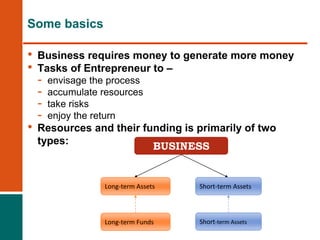
Some basics
• Business requires money to generate more money
• Tasks of Entrepreneur to –
- envisage the process
- accumulate resources
- take risks
- enjoy the return
• Resources and their funding is primarily of two
types:
BUSINESS
Short-term Assets
Long-term Assets
Long-term Funds Short-term Assets
Working Capital
• Centuries old concept
• Necessity of every business
• Needed for various purposes
• Requirement varies according to industry, size,
technology, creditability, etc.
• Available from numerous sources
• Working capital typically means the firm’s holding
of current or short-term assets such as cash,
receivables, inventory and marketable securities.
• These items are also referred to as circulating
capital
• Corporate executives devote a considerable amount
of attention to the management of working capital.
Working Capital
• Working Capital refers to that part of the firm’s capital,
which is required for financing short-term or current
assets such a cash marketable securities, debtors and
inventories. Funds thus, invested in current assets
keep revolving fast and are constantly converted into
cash and this cash flow out again in exchange for other
current assets. Working Capital is also known as
revolving or circulating capital or short-term capital.
• Part of long term finance is locked in and used for
supporting current activities
Definition of Working Capital
• Two possible interpretations :
- Balance sheet concept
- Operating cycle concept
• Balance sheet concept
- There are two interpretations of working capital under
the balance sheet concept.
o Excess of current assets over current liabilities (Net
working capital)
o Gross or total current assets.
- The definition is meaningful only as an indication of the
firm’s current solvency in repaying its creditors.
- When firms speak of shortage of working capital they in
fact possibly imply scarcity of cash resources.
Concept of working capital …1
Concept of working capital …2
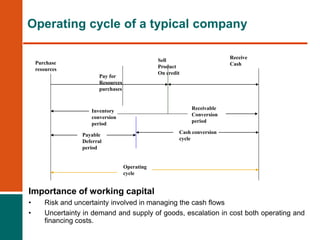
• Operating cycle concept
- A company’s operating cycle typically consists of three
primary activities:
o Purchasing resources,
- The firm has to maintain cash balance to pay the bills as they come due
o Producing the product and
- In addition, the company must invest in inventories to fill customer orders
promptly
o Distributing (selling) the product.
- And finally, the company invests in accounts receivable to extend
credit to customers
- Operating cycle is equal to the length of inventory and
receivable conversion periods.
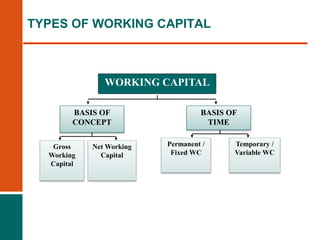
WORKING CAPITAL
BASIS OF
CONCEPT
BASIS OF
TIME
Gross
Working
Capital
Net Working
Capital
Permanent /
Fixed WC
Temporary /
Variable WC
TYPES OF WORKING CAPITAL
Payable
Deferral
period
Inventory
conversion
period
Cash conversion
cycle
Operating
cycle
Pay for
Resources
purchases
Receive
Cash
Purchase
resources
Sell
Product
On credit
Receivable
Conversion
period
Importance of working capital
• Risk and uncertainty involved in managing the cash flows
• Uncertainty in demand and supply of goods, escalation in cost both operating and
financing costs.
Operating cycle of a typical company
THE WORKING CAPITAL
CYCLE
(OPERATING CYCLE)
Accounts Payable
Cash
Raw
Materials
W I P
Finished
Goods
Accounts
Receivable
SALES
Fixed Assets
Permanent Current Assets
Total Assets
Fluctuating Current Assets
Time
Rs
Short-term
Debt
Long-term
Debt +
Equity
Capital
Matching approach to asset financing
• How to manage the current assets, the current liabilities
and the inter-relationship that exists between them.
• Working Capital Management Policies of a firm have a
great effect on its profitability, liquidity and structural
health of the organization.
MANAGEMENT OF WORKING CAPITAL
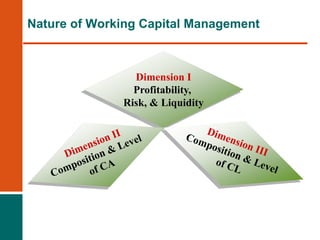
Dimension I
Profitability,
Risk, & Liquidity
Nature of Working Capital Management
• Factors to be considered
- Total costs incurred on materials, wages and overheads
- The length of time for which raw materials remain in stores before they
are issued to production.
- The length of the production cycle or WIP, i.e., the time taken for
conversion of RM into FG.
- The length of the Sales Cycle during which FG are to be kept waiting for
sales.
- The average period of credit allowed to customers.
- The amount of cash required to pay day-to-day expenses of the
business.
- The amount of cash required for advance payments if any.
- The average period of credit to be allowed by suppliers.
- Time – lag in the payment of wages and other overheads
Estimation of working capital requirements
1. Importance of Cash
When planning the short or long-term funding
requirements of a business, it is more important to
forecast the likely cash requirements than to project
profitability etc.
More businesses fail for lack of cash than for want of
profit.
Management of cash
• Cash flow planning entails forecasting and
tabulating all significant cash inflows relating to
sales, new loans, interest received etc., and
then analyzing in detail the timing of expected
payments relating to suppliers, wages, other
expenses, capital expenditure, loan
repayments, dividends, tax, interest payments
etc.
Calculating Cash Flows
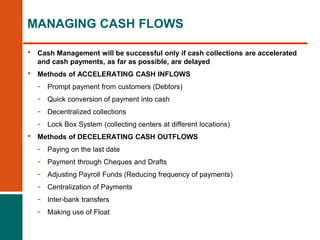
• Cash Management will be successful only if cash collections are accelerated
and cash payments, as far as possible, are delayed
• Methods of ACCELERATING CASH INFLOWS
- Prompt payment from customers (Debtors)
- Quick conversion of payment into cash
- Decentralized collections
- Lock Box System (collecting centers at different locations)
• Methods of DECELERATING CASH OUTFLOWS
- Paying on the last date
- Payment through Cheques and Drafts
- Adjusting Payroll Funds (Reducing frequency of payments)
- Centralization of Payments
- Inter-bank transfers
- Making use of Float
MANAGING CASH FLOWS
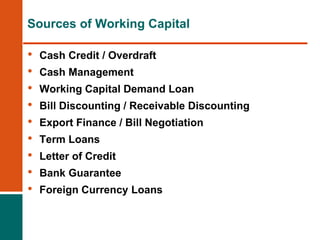
Sources of Working Capital
• Cash Credit / Overdraft
• Cash Management
• Working Capital Demand Loan
• Bill Discounting / Receivable Discounting
• Export Finance / Bill Negotiation
• Term Loans
• Letter of Credit
• Bank Guarantee
• Foreign Currency Loans
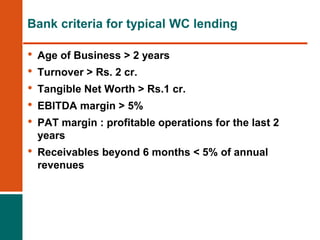
Bank criteria for typical WC lending
• Age of Business > 2 years
• Turnover > Rs. 2 cr.
• Tangible Net Worth > Rs.1 cr.
• EBITDA margin > 5%
• PAT margin : profitable operations for the last 2
years
• Receivables beyond 6 months < 5% of annual
revenues
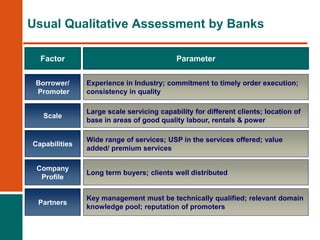
Usual Qualitative Assessment by Banks
Borrower/
Promoter
Experience in Industry; commitment to timely order execution;
consistency in quality
Factor Parameter
Scale
Large scale servicing capability for different clients; location of
base in areas of good quality labour, rentals & power
Capabilities
Wide range of services; USP in the services offered; value
added/ premium services
Partners
Key management must be technically qualified; relevant domain
knowledge pool; reputation of promoters
Company
Profile
Long term buyers; clients well distributed
THANK YOU

workingcapitalmgt-090513064636-phpapp01.ppt

  • 1.
  • 2.
    Some basics • Businessrequires money to generate more money • Tasks of Entrepreneur to – - envisage the process - accumulate resources - take risks - enjoy the return • Resources and their funding is primarily of two types: BUSINESS Short-term Assets Long-term Assets Long-term Funds Short-term Assets
  • 3.
    Working Capital • Centuriesold concept • Necessity of every business • Needed for various purposes • Requirement varies according to industry, size, technology, creditability, etc. • Available from numerous sources
  • 4.
    • Working capitaltypically means the firm’s holding of current or short-term assets such as cash, receivables, inventory and marketable securities. • These items are also referred to as circulating capital • Corporate executives devote a considerable amount of attention to the management of working capital. Working Capital
  • 5.
    • Working Capitalrefers to that part of the firm’s capital, which is required for financing short-term or current assets such a cash marketable securities, debtors and inventories. Funds thus, invested in current assets keep revolving fast and are constantly converted into cash and this cash flow out again in exchange for other current assets. Working Capital is also known as revolving or circulating capital or short-term capital. • Part of long term finance is locked in and used for supporting current activities Definition of Working Capital
  • 6.
    • Two possibleinterpretations : - Balance sheet concept - Operating cycle concept • Balance sheet concept - There are two interpretations of working capital under the balance sheet concept. o Excess of current assets over current liabilities (Net working capital) o Gross or total current assets. - The definition is meaningful only as an indication of the firm’s current solvency in repaying its creditors. - When firms speak of shortage of working capital they in fact possibly imply scarcity of cash resources. Concept of working capital …1
  • 7.
    Concept of workingcapital …2 • Operating cycle concept - A company’s operating cycle typically consists of three primary activities: o Purchasing resources, - The firm has to maintain cash balance to pay the bills as they come due o Producing the product and - In addition, the company must invest in inventories to fill customer orders promptly o Distributing (selling) the product. - And finally, the company invests in accounts receivable to extend credit to customers - Operating cycle is equal to the length of inventory and receivable conversion periods.
  • 8.
    WORKING CAPITAL BASIS OF CONCEPT BASISOF TIME Gross Working Capital Net Working Capital Permanent / Fixed WC Temporary / Variable WC TYPES OF WORKING CAPITAL
  • 9.
    Payable Deferral period Inventory conversion period Cash conversion cycle Operating cycle Pay for Resources purchases Receive Cash Purchase resources Sell Product Oncredit Receivable Conversion period Importance of working capital • Risk and uncertainty involved in managing the cash flows • Uncertainty in demand and supply of goods, escalation in cost both operating and financing costs. Operating cycle of a typical company
  • 10.
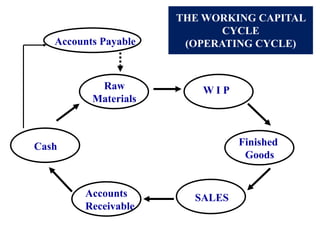
    THE WORKING CAPITAL CYCLE (OPERATINGCYCLE) Accounts Payable Cash Raw Materials W I P Finished Goods Accounts Receivable SALES
  • 11.
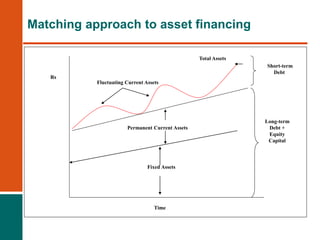
    Fixed Assets Permanent CurrentAssets Total Assets Fluctuating Current Assets Time Rs Short-term Debt Long-term Debt + Equity Capital Matching approach to asset financing
  • 12.
    • How tomanage the current assets, the current liabilities and the inter-relationship that exists between them. • Working Capital Management Policies of a firm have a great effect on its profitability, liquidity and structural health of the organization. MANAGEMENT OF WORKING CAPITAL
  • 13.
    Dimension I Profitability, Risk, &Liquidity Nature of Working Capital Management
  • 14.
    • Factors tobe considered - Total costs incurred on materials, wages and overheads - The length of time for which raw materials remain in stores before they are issued to production. - The length of the production cycle or WIP, i.e., the time taken for conversion of RM into FG. - The length of the Sales Cycle during which FG are to be kept waiting for sales. - The average period of credit allowed to customers. - The amount of cash required to pay day-to-day expenses of the business. - The amount of cash required for advance payments if any. - The average period of credit to be allowed by suppliers. - Time – lag in the payment of wages and other overheads Estimation of working capital requirements
  • 15.
    1. Importance ofCash When planning the short or long-term funding requirements of a business, it is more important to forecast the likely cash requirements than to project profitability etc. More businesses fail for lack of cash than for want of profit. Management of cash
  • 16.
    • Cash flowplanning entails forecasting and tabulating all significant cash inflows relating to sales, new loans, interest received etc., and then analyzing in detail the timing of expected payments relating to suppliers, wages, other expenses, capital expenditure, loan repayments, dividends, tax, interest payments etc. Calculating Cash Flows
  • 17.
    • Cash Managementwill be successful only if cash collections are accelerated and cash payments, as far as possible, are delayed • Methods of ACCELERATING CASH INFLOWS - Prompt payment from customers (Debtors) - Quick conversion of payment into cash - Decentralized collections - Lock Box System (collecting centers at different locations) • Methods of DECELERATING CASH OUTFLOWS - Paying on the last date - Payment through Cheques and Drafts - Adjusting Payroll Funds (Reducing frequency of payments) - Centralization of Payments - Inter-bank transfers - Making use of Float MANAGING CASH FLOWS
  • 18.
    Sources of WorkingCapital • Cash Credit / Overdraft • Cash Management • Working Capital Demand Loan • Bill Discounting / Receivable Discounting • Export Finance / Bill Negotiation • Term Loans • Letter of Credit • Bank Guarantee • Foreign Currency Loans
  • 19.
    Bank criteria fortypical WC lending • Age of Business > 2 years • Turnover > Rs. 2 cr. • Tangible Net Worth > Rs.1 cr. • EBITDA margin > 5% • PAT margin : profitable operations for the last 2 years • Receivables beyond 6 months < 5% of annual revenues
  • 20.
    Usual Qualitative Assessmentby Banks Borrower/ Promoter Experience in Industry; commitment to timely order execution; consistency in quality Factor Parameter Scale Large scale servicing capability for different clients; location of base in areas of good quality labour, rentals & power Capabilities Wide range of services; USP in the services offered; value added/ premium services Partners Key management must be technically qualified; relevant domain knowledge pool; reputation of promoters Company Profile Long term buyers; clients well distributed
  • 21.