
Working Capital
Finance
 Trade Credit
 Accrued Expenses and Deferred Income
 Bank Borrowings
 Factoring of receivables
 Commercial Paper
2
 Refers to the credit that the customer gets
from supplier of goods in normal course
of business.
 An informal arrangement, granted on an
open account basis, not formally
acknowledge as a debt.
 Trade credit may also take the form of bills
payable.
 Credit Terms refers to the conditions of
due date and cash discount.
3
 Benefits
1. Easy Availability.
2. Flexibility.
3. Informality.
 Costs
1. Implicit Cost.
2. Stretching A/P can prove to be very costly.
4
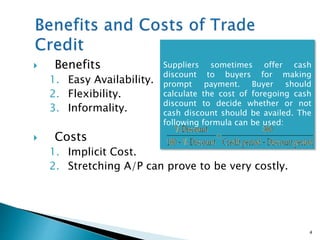
Suppliers sometimes offer cash
discount to buyers for making
prompt payment. Buyer should
calculate the cost of foregoing cash
discount to decide whether or not
cash discount should be availed. The
following formula can be used:
5
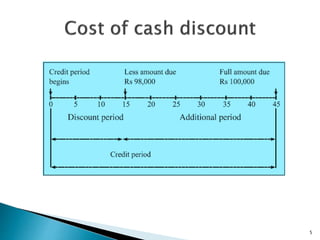
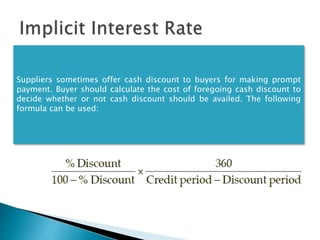
Suppliers sometimes offer cash discount to buyers for making prompt
payment. Buyer should calculate the cost of foregoing cash discount to
decide whether or not cash discount should be availed. The following
formula can be used:
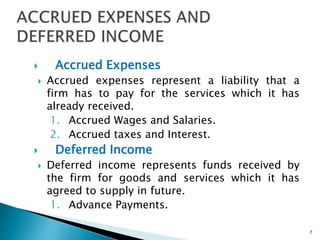
 Accrued Expenses
 Accrued expenses represent a liability that a
firm has to pay for the services which it has
already received.
1. Accrued Wages and Salaries.
2. Accrued taxes and Interest.
 Deferred Income
 Deferred income represents funds received by
the firm for goods and services which it has
agreed to supply in future.
1. Advance Payments.
7
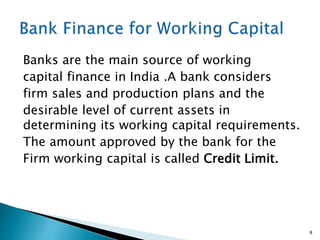
Banks are the main source of working
capital finance in India .A bank considers
firm sales and production plans and the
desirable level of current assets in
determining its working capital requirements.
The amount approved by the bank for the
Firm working capital is called Credit Limit.
8
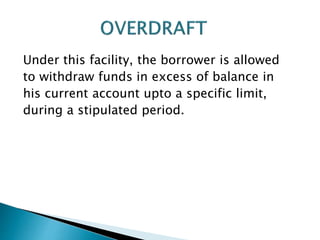
Under this facility, the borrower is allowed
to withdraw funds in excess of balance in
his current account upto a specific limit,
during a stipulated period.
Under this facility, borrower is allowed to
withdraw funds from banks upto the
sanctioned credit limit .
The borrower is not required to borrow the
entire sanctioned credit at once, rather he can
draw periodically to the extents of his
requirements and repay it by depositing
surplus funds in his cash credit amount.
Under purchase or discounting of bills, A
borrower can obtain credit from a bank
against its bills.
The amount provided under this agreement
Is covered within the overall cash credit or
overdraft limit.
Suppliers, Particularly the foreign suppliers,
Insist that the buyer should ensure that his
bank will make the payment if he/She fails to
honour its obligation. This is ensured through
a letter of credit (L/C) arrangement .
 Hypothecation
 Pledge
 Mortgage
 Lien
13
Working capital finance

Working capital finance

  • 1.
  • 2.
     Trade Credit Accrued Expenses and Deferred Income  Bank Borrowings  Factoring of receivables  Commercial Paper 2
  • 3.
     Refers tothe credit that the customer gets from supplier of goods in normal course of business.  An informal arrangement, granted on an open account basis, not formally acknowledge as a debt.  Trade credit may also take the form of bills payable.  Credit Terms refers to the conditions of due date and cash discount. 3
  • 4.
     Benefits 1. EasyAvailability. 2. Flexibility. 3. Informality.  Costs 1. Implicit Cost. 2. Stretching A/P can prove to be very costly. 4 Suppliers sometimes offer cash discount to buyers for making prompt payment. Buyer should calculate the cost of foregoing cash discount to decide whether or not cash discount should be availed. The following formula can be used:
  • 5.
  • 6.
    Suppliers sometimes offercash discount to buyers for making prompt payment. Buyer should calculate the cost of foregoing cash discount to decide whether or not cash discount should be availed. The following formula can be used:
  • 7.
     Accrued Expenses Accrued expenses represent a liability that a firm has to pay for the services which it has already received. 1. Accrued Wages and Salaries. 2. Accrued taxes and Interest.  Deferred Income  Deferred income represents funds received by the firm for goods and services which it has agreed to supply in future. 1. Advance Payments. 7
  • 8.
    Banks are themain source of working capital finance in India .A bank considers firm sales and production plans and the desirable level of current assets in determining its working capital requirements. The amount approved by the bank for the Firm working capital is called Credit Limit. 8
  • 9.
    Under this facility,the borrower is allowed to withdraw funds in excess of balance in his current account upto a specific limit, during a stipulated period.
  • 10.
    Under this facility,borrower is allowed to withdraw funds from banks upto the sanctioned credit limit . The borrower is not required to borrow the entire sanctioned credit at once, rather he can draw periodically to the extents of his requirements and repay it by depositing surplus funds in his cash credit amount.
  • 11.
    Under purchase ordiscounting of bills, A borrower can obtain credit from a bank against its bills. The amount provided under this agreement Is covered within the overall cash credit or overdraft limit.
  • 12.
    Suppliers, Particularly theforeign suppliers, Insist that the buyer should ensure that his bank will make the payment if he/She fails to honour its obligation. This is ensured through a letter of credit (L/C) arrangement .
  • 13.