PRUDENTIAL NORMS FOR CLASSIFICATION,
VALUATION AND OPERATION OF INVESTMENT
         PORTFOLIO BY BANKS


                          -Abhishesh Suman 11020241069
                          -Kuldeep Joshi 11020241114
                          -Mehul Mandge 11020241088
Investment Policy
• Frame Investment Policy and obtain Board’s Approval
• Must include Primary Dealer activities also
• Banks may sell a government security already contracted for
  purchase
• Scheduled Commercial Banks and Primary Dealers have been
  permitted to short sell Government securities
• The settlement of all outright secondary market transactions
  in Government Securities will be done on a standardized T+1
  basis


11/10/2012           Prudential Norms for Investments by Banks   2
Investment Policy contd..

• Investment in equity shares/debentures should observe
  following guidelines
1. Expertise in equity research
2. Transparent policy and procedure for investment in shares
3. The Investment Committee should be held accountable for
    the investments made by the bank.


11/10/2012          Prudential Norms for Investments by Banks   3
Ready Forward Contracts in
               Government Securities.
• Forward contract in Dated securities and Tbills of Govt. of
  India and Dated securities by State governments.
• All ready forward contracts shall be reported on the
  Negotiated Dealing System
• All ready forward contracts shall be settled through the SGL
  Account / CSGL Account maintained with the RBI, Mumbai
  with CCIL


11/10/2012           Prudential Norms for Investments by Banks   4
Transactions through SGL account
• The transfer of securities takes place simultaneously, with the
  transfer of funds, So it is mandatory to maintain current A/C
  with RBI.
• Bounce for want of sufficient funds in SGL a/c should never
  happen
• SGL transfer forms should be signed by two authorized
  officials of the bank
• If the bouncing of the SGL form occurs thrice, the bank will be
  debarred from trading with the use of the SGL facility for a
  period of 6


11/10/2012           Prudential Norms for Investments by Banks      5
Use of Bank Receipt (BR)
• NO BR should be issued when SGL a/c facility is available.
• No BR should be issued on the basis of a BR of other bank and
  no transaction should take place by exchange of BR.
• No BR should remain outstanding for more than 15 days.
• All transactions of issue and receipt of BR should be
  maintained separately


11/10/2012           Prudential Norms for Investments by Banks   6
Internal Control System
• There should be a clear functional separation of (i) trading, (ii)
  settlement, monitoring and control and (iii) accounting.
• Portfolio Management Scheme
• Deal slip for every transaction containing name of
  counterparty , nature of deal, amount ,date, time must be
  mentioned
• Balances as per bank's books should be reconciled at
  quarterly intervals


11/10/2012            Prudential Norms for Investments by Banks    7
Internal Control System contd..
• Bouncing of SGL transfer forms issued by selling banks should
  be brought to notice of the Regional Office of Department of
  Banking Supervision of RBI
• Report to the top management, on a weekly basis
• Audit the transactions in securities on an on going basis


11/10/2012           Prudential Norms for Investments by Banks    8
Engagement of brokers
• Transactions between one bank and another bank should not
  be put through the brokers' accounts
• If broker is used, role of broker is that of bringing two parties
  to deal together.
• A panel of brokers must be prepared with the approval of top
  management


11/10/2012            Prudential Norms for Investments by Banks       9
Audit, review and reporting of
               investment transactions
• Half-yearly review (as of 30 September and 31 March) of their
  investment portfolio
• Copy of the review report put up to the Bank's Board, should
  be forwarded to the RBI


11/10/2012           Prudential Norms for Investments by Banks   10
What are non-SLR securities?
• As part of prudential guidelines, central banks require lenders
  to maintain a portion of their deposits in liquid assets
• These liquid assets can be cash, gold or government
  securities. The ratio of prescribed liquid investments to
  deposits is termed as statutory liquidity ratio
• In India, banks invest in bonds issued by the government and
  notified by the Reserve Bank of India as qualifying for SLR to
  meet the prescribed ratio.
• Currently, the prescribed statutory liquidity ratio for banks is
  23% of their deposits


11/10/2012            Prudential Norms for Investments by Banks   11
Non-SLR Securities
• Various Capital market instruments such as stocks and bonds
  issued by public and private sector companies and
  commercial papers
• Various Mutual Fund Schemes
• But no compulsion on Banks to invest in these securities


11/10/2012          Prudential Norms for Investments by Banks   12
Non- SLR investments
• Appraisal -deficiencies in the appraisal of privately placed
  issues when investments are done in privately placed unrated
  bonds
• Disclosure requirements in offer documents Minimum
  disclosure standards
• Internal assessment a) prudential limits on investments in
  bonds and debentures including cap and on private
  placement basis, sub limits for PSU bonds, corporate bonds,
  guaranteed bonds, issuer ceiling, etc.
  b) Investment proposal should of same risk like loans
  c) proper risk management systems and remedial measures
  in time

11/10/2012          Prudential Norms for Investments by Banks   13
Non- SLR investments contd..
• Regulatory requirements-
•    Not invest in Non-SLR securities of original maturity of less
  than one-year, other than Commercial Paper and Certificates
  of Deposits, which are covered under RBI guidelines.
•     Due diligence in respect of investments in non-SLR
  securities.


11/10/2012            Prudential Norms for Investments by Banks   14
Listing and rating requirements
• Must not invest in unrated non-SLR securities.
• Banks may invest in unrated bonds of companies engaged in
  infrastructure activities, within the ceiling of 10 per cent.
• Investment are made only in listed debt securities of
  companies which comply with the requirements of the SEBI.


11/10/2012           Prudential Norms for Investments by Banks    15
Prudential Limits
• Investment in unlisted non-SLR securities should not exceed
  10 per cent of its total investment in non-SLR securities
• Only investment in units of such mutual fund schemes, which
  have an exposure to unlisted securities of less than 10 per
  cent of the corpus of the fund, will be treated on par with
  listed securities.


11/10/2012          Prudential Norms for Investments by Banks   16
Limits on Banks' Exposure to Capital
                 Markets
• Exposure of a bank should not exceed 40 per cent of its net
  worth
• The aggregate direct exposure by way of the consolidated
  bank’s investment in shares, convertible bonds / debentures,
  units of equity-oriented mutual funds and all exposures to
  Venture Capital Funds (VCFs) should not exceed 20 per cent of
  its consolidated net worth.


11/10/2012           Prudential Norms for Investments by Banks   17
Role of Boards (Non-SLR Securities)
• All investment policies duly approved by Board of Directors
• These securities to be given risk weights
• Thus Proper risk management systems for capturing and
  analysing the risk in respect of non-SLR investment and taking
  remedial measures in time
• Should review following aspects at least quarterly
   – Total business (investment and divestment) during the
      reporting period.
   – Extent of non-performing investments in the non-SLR
      category


11/10/2012           Prudential Norms for Investments by Banks   18
Portfolio Management on behalf of
                 clients
• The general powers vested in banks to operate PMS and
  similar schemes have been withdrawn
• No bank should, therefore, restart or introduce any new PMS
  or similar scheme in future without obtaining specific prior
  approval of the RBI
• However, bank-sponsored NBFCs are allowed to offer
  discretionary PMS to their clients, on a case-to-case basis


11/10/2012           Prudential Norms for Investments by Banks   19
Portfolio Management on behalf of
                 clients
• But those Banks that do take permission for PMS need to
  follow these guidelines strictly:
   – PMS should be entirely at the customer's risk, without
      guaranteeing, either directly or indirectly, a pre-
      determined return
   – Funds should not be accepted for portfolio management
      for a period less than one year.
   – There should be a clear functional separation of trading
      and back office functions relating to banks’ own
      investment accounts and PMS clients' accounts


11/10/2012           Prudential Norms for Investments by Banks   20
Portfolio Management on behalf of
                 clients
• Violation will include
   – deterrent action against the banks
   – It includes raising of reserve requirements
   – withdrawal of facility of refinance from the RBI
   – denial of access to money markets
   – prohibition from undertaking PMS activity


11/10/2012           Prudential Norms for Investments by Banks   21
Classification
• The entire investment portfolio of the banks (including SLR
  securities and non-SLR securities) should be classified under
  three categories
   – Held to Maturity
   – Available for Sale
   – Held for Trading

• Banks should decide the category of the investment at the
  time of acquisition and the decision should be recorded on
  the investment proposals


11/10/2012           Prudential Norms for Investments by Banks    22
Classification (contd.)
• Held to Maturity (HTM)
   – The intention is to hold the securities till maturity
   – Max 25 % of total investments
• Held for Trading (HFT)
   – Intention to profit from short term price/interest rate
     movements
   – Need to be sold within 90 days
• Available for Sale (AFS)
   – The securities which do not fall within the above two
     categories will be classified under ‘Available for Sale’

11/10/2012            Prudential Norms for Investments by Banks   23
Classification (contd.)
• Max 25% for HTM
• Rest 75% - Freedom to Bank to decide on the extent of
  holdings under HFS and AFS
• Profit or loss on sale of investments in both the categories will
  be taken to the Profit & Loss Account
• Banks may shift investments to/from HTM with the approval
  of the Board of Directors once a year
• Normally at the beginning of the year.
• No further to/from shifting HTM will be allowed during
  remaining part of accounting year


11/10/2012            Prudential Norms for Investments by Banks   24
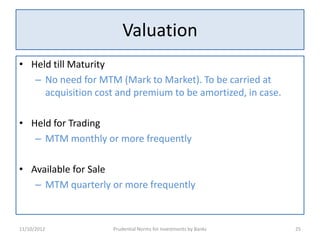
Valuation
• Held till Maturity
   – No need for MTM (Mark to Market). To be carried at
     acquisition cost and premium to be amortized, in case.

• Held for Trading
   – MTM monthly or more frequently

• Available for Sale
   – MTM quarterly or more frequently


11/10/2012           Prudential Norms for Investments by Banks   25
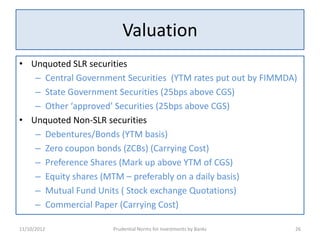
Valuation
• Unquoted SLR securities
   – Central Government Securities (YTM rates put out by FIMMDA)
   – State Government Securities (25bps above CGS)
   – Other ‘approved’ Securities (25bps above CGS)
• Unquoted Non-SLR securities
   – Debentures/Bonds (YTM basis)
   – Zero coupon bonds (ZCBs) (Carrying Cost)
   – Preference Shares (Mark up above YTM of CGS)
   – Equity shares (MTM – preferably on a daily basis)
   – Mutual Fund Units ( Stock exchange Quotations)
   – Commercial Paper (Carrying Cost)

11/10/2012           Prudential Norms for Investments by Banks   26
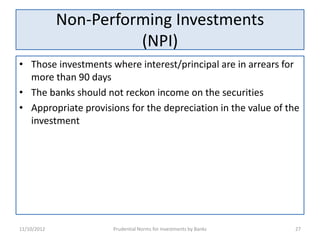
Non-Performing Investments
                       (NPI)
• Those investments where interest/principal are in arrears for
  more than 90 days
• The banks should not reckon income on the securities
• Appropriate provisions for the depreciation in the value of the
  investment


11/10/2012           Prudential Norms for Investments by Banks   27
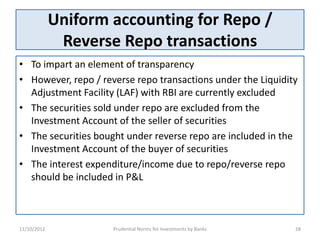
Uniform accounting for Repo /
              Reverse Repo transactions
• To impart an element of transparency
• However, repo / reverse repo transactions under the Liquidity
  Adjustment Facility (LAF) with RBI are currently excluded
• The securities sold under repo are excluded from the
  Investment Account of the seller of securities
• The securities bought under reverse repo are included in the
  Investment Account of the buyer of securities
• The interest expenditure/income due to repo/reverse repo
  should be included in P&L


11/10/2012           Prudential Norms for Investments by Banks   28
Thank You…


             Any Questions?


11/10/2012     Prudential Norms for Investments by Banks   29

Banking prudential norms

  • 1.
    PRUDENTIAL NORMS FORCLASSIFICATION, VALUATION AND OPERATION OF INVESTMENT PORTFOLIO BY BANKS -Abhishesh Suman 11020241069 -Kuldeep Joshi 11020241114 -Mehul Mandge 11020241088
  • 2.
    Investment Policy • FrameInvestment Policy and obtain Board’s Approval • Must include Primary Dealer activities also • Banks may sell a government security already contracted for purchase • Scheduled Commercial Banks and Primary Dealers have been permitted to short sell Government securities • The settlement of all outright secondary market transactions in Government Securities will be done on a standardized T+1 basis 11/10/2012 Prudential Norms for Investments by Banks 2
  • 3.
    Investment Policy contd.. •Investment in equity shares/debentures should observe following guidelines 1. Expertise in equity research 2. Transparent policy and procedure for investment in shares 3. The Investment Committee should be held accountable for the investments made by the bank. 11/10/2012 Prudential Norms for Investments by Banks 3
  • 4.
    Ready Forward Contractsin Government Securities. • Forward contract in Dated securities and Tbills of Govt. of India and Dated securities by State governments. • All ready forward contracts shall be reported on the Negotiated Dealing System • All ready forward contracts shall be settled through the SGL Account / CSGL Account maintained with the RBI, Mumbai with CCIL 11/10/2012 Prudential Norms for Investments by Banks 4
  • 5.
    Transactions through SGLaccount • The transfer of securities takes place simultaneously, with the transfer of funds, So it is mandatory to maintain current A/C with RBI. • Bounce for want of sufficient funds in SGL a/c should never happen • SGL transfer forms should be signed by two authorized officials of the bank • If the bouncing of the SGL form occurs thrice, the bank will be debarred from trading with the use of the SGL facility for a period of 6 11/10/2012 Prudential Norms for Investments by Banks 5
  • 6.
    Use of BankReceipt (BR) • NO BR should be issued when SGL a/c facility is available. • No BR should be issued on the basis of a BR of other bank and no transaction should take place by exchange of BR. • No BR should remain outstanding for more than 15 days. • All transactions of issue and receipt of BR should be maintained separately 11/10/2012 Prudential Norms for Investments by Banks 6
  • 7.
    Internal Control System •There should be a clear functional separation of (i) trading, (ii) settlement, monitoring and control and (iii) accounting. • Portfolio Management Scheme • Deal slip for every transaction containing name of counterparty , nature of deal, amount ,date, time must be mentioned • Balances as per bank's books should be reconciled at quarterly intervals 11/10/2012 Prudential Norms for Investments by Banks 7
  • 8.
    Internal Control Systemcontd.. • Bouncing of SGL transfer forms issued by selling banks should be brought to notice of the Regional Office of Department of Banking Supervision of RBI • Report to the top management, on a weekly basis • Audit the transactions in securities on an on going basis 11/10/2012 Prudential Norms for Investments by Banks 8
  • 9.
    Engagement of brokers •Transactions between one bank and another bank should not be put through the brokers' accounts • If broker is used, role of broker is that of bringing two parties to deal together. • A panel of brokers must be prepared with the approval of top management 11/10/2012 Prudential Norms for Investments by Banks 9
  • 10.
    Audit, review andreporting of investment transactions • Half-yearly review (as of 30 September and 31 March) of their investment portfolio • Copy of the review report put up to the Bank's Board, should be forwarded to the RBI 11/10/2012 Prudential Norms for Investments by Banks 10
  • 11.
    What are non-SLRsecurities? • As part of prudential guidelines, central banks require lenders to maintain a portion of their deposits in liquid assets • These liquid assets can be cash, gold or government securities. The ratio of prescribed liquid investments to deposits is termed as statutory liquidity ratio • In India, banks invest in bonds issued by the government and notified by the Reserve Bank of India as qualifying for SLR to meet the prescribed ratio. • Currently, the prescribed statutory liquidity ratio for banks is 23% of their deposits 11/10/2012 Prudential Norms for Investments by Banks 11
  • 12.
    Non-SLR Securities • VariousCapital market instruments such as stocks and bonds issued by public and private sector companies and commercial papers • Various Mutual Fund Schemes • But no compulsion on Banks to invest in these securities 11/10/2012 Prudential Norms for Investments by Banks 12
  • 13.
    Non- SLR investments •Appraisal -deficiencies in the appraisal of privately placed issues when investments are done in privately placed unrated bonds • Disclosure requirements in offer documents Minimum disclosure standards • Internal assessment a) prudential limits on investments in bonds and debentures including cap and on private placement basis, sub limits for PSU bonds, corporate bonds, guaranteed bonds, issuer ceiling, etc. b) Investment proposal should of same risk like loans c) proper risk management systems and remedial measures in time 11/10/2012 Prudential Norms for Investments by Banks 13
  • 14.
    Non- SLR investmentscontd.. • Regulatory requirements- • Not invest in Non-SLR securities of original maturity of less than one-year, other than Commercial Paper and Certificates of Deposits, which are covered under RBI guidelines. • Due diligence in respect of investments in non-SLR securities. 11/10/2012 Prudential Norms for Investments by Banks 14
  • 15.
    Listing and ratingrequirements • Must not invest in unrated non-SLR securities. • Banks may invest in unrated bonds of companies engaged in infrastructure activities, within the ceiling of 10 per cent. • Investment are made only in listed debt securities of companies which comply with the requirements of the SEBI. 11/10/2012 Prudential Norms for Investments by Banks 15
  • 16.
    Prudential Limits • Investmentin unlisted non-SLR securities should not exceed 10 per cent of its total investment in non-SLR securities • Only investment in units of such mutual fund schemes, which have an exposure to unlisted securities of less than 10 per cent of the corpus of the fund, will be treated on par with listed securities. 11/10/2012 Prudential Norms for Investments by Banks 16
  • 17.
    Limits on Banks'Exposure to Capital Markets • Exposure of a bank should not exceed 40 per cent of its net worth • The aggregate direct exposure by way of the consolidated bank’s investment in shares, convertible bonds / debentures, units of equity-oriented mutual funds and all exposures to Venture Capital Funds (VCFs) should not exceed 20 per cent of its consolidated net worth. 11/10/2012 Prudential Norms for Investments by Banks 17
  • 18.
    Role of Boards(Non-SLR Securities) • All investment policies duly approved by Board of Directors • These securities to be given risk weights • Thus Proper risk management systems for capturing and analysing the risk in respect of non-SLR investment and taking remedial measures in time • Should review following aspects at least quarterly – Total business (investment and divestment) during the reporting period. – Extent of non-performing investments in the non-SLR category 11/10/2012 Prudential Norms for Investments by Banks 18
  • 19.
    Portfolio Management onbehalf of clients • The general powers vested in banks to operate PMS and similar schemes have been withdrawn • No bank should, therefore, restart or introduce any new PMS or similar scheme in future without obtaining specific prior approval of the RBI • However, bank-sponsored NBFCs are allowed to offer discretionary PMS to their clients, on a case-to-case basis 11/10/2012 Prudential Norms for Investments by Banks 19
  • 20.
    Portfolio Management onbehalf of clients • But those Banks that do take permission for PMS need to follow these guidelines strictly: – PMS should be entirely at the customer's risk, without guaranteeing, either directly or indirectly, a pre- determined return – Funds should not be accepted for portfolio management for a period less than one year. – There should be a clear functional separation of trading and back office functions relating to banks’ own investment accounts and PMS clients' accounts 11/10/2012 Prudential Norms for Investments by Banks 20
  • 21.
    Portfolio Management onbehalf of clients • Violation will include – deterrent action against the banks – It includes raising of reserve requirements – withdrawal of facility of refinance from the RBI – denial of access to money markets – prohibition from undertaking PMS activity 11/10/2012 Prudential Norms for Investments by Banks 21
  • 22.
    Classification • The entireinvestment portfolio of the banks (including SLR securities and non-SLR securities) should be classified under three categories – Held to Maturity – Available for Sale – Held for Trading • Banks should decide the category of the investment at the time of acquisition and the decision should be recorded on the investment proposals 11/10/2012 Prudential Norms for Investments by Banks 22
  • 23.
    Classification (contd.) • Heldto Maturity (HTM) – The intention is to hold the securities till maturity – Max 25 % of total investments • Held for Trading (HFT) – Intention to profit from short term price/interest rate movements – Need to be sold within 90 days • Available for Sale (AFS) – The securities which do not fall within the above two categories will be classified under ‘Available for Sale’ 11/10/2012 Prudential Norms for Investments by Banks 23
  • 24.
    Classification (contd.) • Max25% for HTM • Rest 75% - Freedom to Bank to decide on the extent of holdings under HFS and AFS • Profit or loss on sale of investments in both the categories will be taken to the Profit & Loss Account • Banks may shift investments to/from HTM with the approval of the Board of Directors once a year • Normally at the beginning of the year. • No further to/from shifting HTM will be allowed during remaining part of accounting year 11/10/2012 Prudential Norms for Investments by Banks 24
  • 25.
    Valuation • Held tillMaturity – No need for MTM (Mark to Market). To be carried at acquisition cost and premium to be amortized, in case. • Held for Trading – MTM monthly or more frequently • Available for Sale – MTM quarterly or more frequently 11/10/2012 Prudential Norms for Investments by Banks 25
  • 26.
    Valuation • Unquoted SLRsecurities – Central Government Securities (YTM rates put out by FIMMDA) – State Government Securities (25bps above CGS) – Other ‘approved’ Securities (25bps above CGS) • Unquoted Non-SLR securities – Debentures/Bonds (YTM basis) – Zero coupon bonds (ZCBs) (Carrying Cost) – Preference Shares (Mark up above YTM of CGS) – Equity shares (MTM – preferably on a daily basis) – Mutual Fund Units ( Stock exchange Quotations) – Commercial Paper (Carrying Cost) 11/10/2012 Prudential Norms for Investments by Banks 26
  • 27.
    Non-Performing Investments (NPI) • Those investments where interest/principal are in arrears for more than 90 days • The banks should not reckon income on the securities • Appropriate provisions for the depreciation in the value of the investment 11/10/2012 Prudential Norms for Investments by Banks 27
  • 28.
    Uniform accounting forRepo / Reverse Repo transactions • To impart an element of transparency • However, repo / reverse repo transactions under the Liquidity Adjustment Facility (LAF) with RBI are currently excluded • The securities sold under repo are excluded from the Investment Account of the seller of securities • The securities bought under reverse repo are included in the Investment Account of the buyer of securities • The interest expenditure/income due to repo/reverse repo should be included in P&L 11/10/2012 Prudential Norms for Investments by Banks 28
  • 29.
    Thank You… Any Questions? 11/10/2012 Prudential Norms for Investments by Banks 29