Financing of Current
Asset
By Sheetal Verma
INTRODUCTION
– A current asset is either cash or an asset (e.g. stock) that can be
converted into cash within a year and is often used to pay off current
liabilities.
– Current assets typically include categories such as cash, marketable
securities, short-term investments, accounts receivable , prepaid
expenses, and inventory.
– Current assets of enterprises may be financed either by short-term
sources or long-term sources or by combination of both.
– The long term source of finance provides support for a small part of
current assets requirements which is called the working capital
margin.
– Short-term financing of current assets includes sources of short-
term credit, which a firm is mostly required to arrange in advance.
Short-term bank loans, commercial paper etc. are a few of its
components.
Approaches to Financing
Current Assets
• 1. Matching Approach
• Under this approach a match is established between the
expected lives of current asset to be financed with the source
of fund raised to finance the current assets. Thus, a ten-year
loan may be raised for financing machinery bearing expected
life of ten years. Similarly, one-month stock can be financed by
means of one-month bank loan. This is also termed as hedging
approach.
• 2. Conservative Approach
• Conservative approach takes an edge over and above matching
approach, as it is practically not possible to plan an exact
match in all cases. A firm is said to be following conservative
approach when it depends more on long-term financial
sources for meeting its financial needs.
• 3. Aggressive Approach
• As against conservative approach, a firm is said to be following
aggressive financing policy when depends relatively more on
short-term sources than warranted by the matching plan.
Under this approach the firm finance not only its temporary
current assets but also a part of permanent current assets with
short-term sources of finance.
1. Spontaneous liabilities
2. Trade credit
3. Short term bank finance
4. Public deposits
5. Inter-corporate deposits
6. Short term financial assistance from
financial institutions
7. Commercial paper
Instruments in raising finance
Spontaneous
Liabilities
• Spontaneous liabilities are types of
funding that arise from the normal
operations of the firm.
• Types of Spontaneous Liabilities
Accounts Payable
Accruals – Wages Payable
-- Taxes Payable
Bank Finance:
The major source for financing current
assets is bank finance. The various
ways in which the banks finance
current assets are:
(1)Loan arrangement
(2) Overdraft arrangement
(3) Cash credit arrangement
(4) Bills purchased and bills
discounted
(5) Letter of credit
PUBLIC DEPOSIT
• Public deposits refer to the unsecured deposits
invited by companies from the public mainly to
finance working capital needs. A company
wishing to invite public deposits makes an
advertisement in the newspapers.
• Any member of the public can fill up the
prescribed form and deposit the money with the
company. The company in return issues a
deposit receipt.
• The rate of interest on public deposits depends
on the period of deposit and reputation of the
company.
• A company can invite public deposits for a
period of six months to three years. Therefore,
public deposits are primarily a source of short-
term finance.
• Public deposits of a company cannot exceed 25
per cent of its share capital and free reserves.
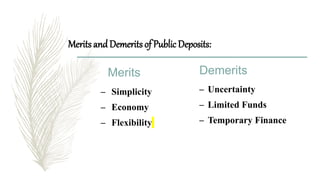
Merits andDemerits of Public Deposits:
Merits
– Simplicity
– Economy
– Flexibility
Demerits
– Uncertainty
– Limited Funds
– Temporary Finance
Trade credit
• Trade credit is an important external
source of working capital financing.
• It is a short-term credit extended by
suppliers of goods and services in the
normal course of business, to a buyer in
order to enhance sales.
• Trade credit arises when a supplier of
goods or services allows customers to
pay for goods and services at a later
date.
• Cash is not immediately paid and
deferral of payment represents a source
of finance.
Advantages and disadvantages of trade credit
• It is easy and automatic source of short-term finance.
• It reduces the capital requirement.
• It helps the business focus on core activities.
• It does not require any negotiation or formal agreement.
• Trade credit is available only to those companies that have a good
track record of repayment in the past.
• For a new business, it is very difficult to finance working capital
through trade credit.
• It is very expensive, if payment is not made on the due date.
Disadvantages
Advantages
Commercial
Paper
• WHAT: A Commercial paper is an unsecured short term debt
instrument issued by corporation typically for meeting short
term liabilities.
• WHY: It provides the organization a borrowing option other
than a bank.
• WHEN: CP’s are issued or sold when an organization needs to
borrow money for its short term needs.
• Who can invest Invest in CP’s:
o Individuals
o Banks
o Corporates
o Non Resident Indians
o Foreign Institutional Investors
• Who can issue CP’s:
o Corporates
o Non Banking Financial Company
o Financial Institutions
o Prior Approval of RBI is required
o Entity has to go through with Credit rating process
– Benefits:
o Low Interest Expenses
o No collaterals required
o It does not need to be registered with the SEBI
– Example:
o Say Future Group, the owner of large retail store like Big Bazaar wishes
to raise funds from the market to raise funds from the market to
purchase its merchandise
o If it were to go to a bank for a loan, then it would probably have to pay
around 15% interest on the loan, but from the open market it could
perhaps get the loan at only 10%.
o Hence by resorting to an instrument like CP, the organization gain 5%.
Benefits & Example
Inter Corporate
Deposits
• Inter Corporate Deposits indicates
unsecured short term funding raised by
one company from another company.
They are dependent on personal contacts.
• 1) They are for a very short period of
time i.e 3 months or 6 months.
• 2) They are unsecured source for raising
funds.
• 3) They are not regulated by any law.
• 4) It is a relationship based borrowing
made by the company.
• 5) They involve high risk and high returns
• 6) Useful in solving temporary capital
crisis.
Such deposits are of three types:
1. Call Deposit:
Such a type of deposit is withdrawn by the
lender by giving a notice of one day. However, in
practice, a lender has to wait for at least 3 days.
2. Three-month Deposit:
As the name suggests, such type of a deposit
provides funds for three months to meet up
short-term cash inadequacy.
3. Six-month Deposit:
The lending company provides funds to another
company for a period of six months.
Fund based Assistance of Commercial Banks:
Fund based assistance is in the form of credit and loans directly extended by the
commercial banks to the exporters at different stages of export procedure. The fund
based assistance of commercial banks includes:
(a) Pre-shipment Finance: Pre-shipment finance refers to the credit extended to
exporters prior to the shipment of goods for the execution of export orders. It
is also known as 'Packing Credit’.
(b) Post-Shipment Finance: Post-shipment finance (short-term) refers to
the credit extended to exporters after the shipment of goods for meeting
working capital requirement.
(c) Finance against deferred Payment Export: Export of goods or services against
to be received partly or fully beyond the period statutorily prescribed for
of export proceeds are treated as deferred payment’ exports. Finance against
payments is referred to as Deferred Credit. Commercial rate of interest
with the EXIM Bank.
Thankyou

Financing of Current Asset

  • 1.
  • 2.
    INTRODUCTION – A currentasset is either cash or an asset (e.g. stock) that can be converted into cash within a year and is often used to pay off current liabilities. – Current assets typically include categories such as cash, marketable securities, short-term investments, accounts receivable , prepaid expenses, and inventory. – Current assets of enterprises may be financed either by short-term sources or long-term sources or by combination of both. – The long term source of finance provides support for a small part of current assets requirements which is called the working capital margin. – Short-term financing of current assets includes sources of short- term credit, which a firm is mostly required to arrange in advance. Short-term bank loans, commercial paper etc. are a few of its components.
  • 3.
    Approaches to Financing CurrentAssets • 1. Matching Approach • Under this approach a match is established between the expected lives of current asset to be financed with the source of fund raised to finance the current assets. Thus, a ten-year loan may be raised for financing machinery bearing expected life of ten years. Similarly, one-month stock can be financed by means of one-month bank loan. This is also termed as hedging approach. • 2. Conservative Approach • Conservative approach takes an edge over and above matching approach, as it is practically not possible to plan an exact match in all cases. A firm is said to be following conservative approach when it depends more on long-term financial sources for meeting its financial needs. • 3. Aggressive Approach • As against conservative approach, a firm is said to be following aggressive financing policy when depends relatively more on short-term sources than warranted by the matching plan. Under this approach the firm finance not only its temporary current assets but also a part of permanent current assets with short-term sources of finance.
  • 4.
    1. Spontaneous liabilities 2.Trade credit 3. Short term bank finance 4. Public deposits 5. Inter-corporate deposits 6. Short term financial assistance from financial institutions 7. Commercial paper Instruments in raising finance
  • 5.
    Spontaneous Liabilities • Spontaneous liabilitiesare types of funding that arise from the normal operations of the firm. • Types of Spontaneous Liabilities Accounts Payable Accruals – Wages Payable -- Taxes Payable
  • 6.
    Bank Finance: The majorsource for financing current assets is bank finance. The various ways in which the banks finance current assets are: (1)Loan arrangement (2) Overdraft arrangement (3) Cash credit arrangement (4) Bills purchased and bills discounted (5) Letter of credit
  • 7.
    PUBLIC DEPOSIT • Publicdeposits refer to the unsecured deposits invited by companies from the public mainly to finance working capital needs. A company wishing to invite public deposits makes an advertisement in the newspapers. • Any member of the public can fill up the prescribed form and deposit the money with the company. The company in return issues a deposit receipt. • The rate of interest on public deposits depends on the period of deposit and reputation of the company. • A company can invite public deposits for a period of six months to three years. Therefore, public deposits are primarily a source of short- term finance. • Public deposits of a company cannot exceed 25 per cent of its share capital and free reserves.
  • 8.
    Merits andDemerits ofPublic Deposits: Merits – Simplicity – Economy – Flexibility Demerits – Uncertainty – Limited Funds – Temporary Finance
  • 9.
    Trade credit • Tradecredit is an important external source of working capital financing. • It is a short-term credit extended by suppliers of goods and services in the normal course of business, to a buyer in order to enhance sales. • Trade credit arises when a supplier of goods or services allows customers to pay for goods and services at a later date. • Cash is not immediately paid and deferral of payment represents a source of finance.
  • 10.
    Advantages and disadvantagesof trade credit • It is easy and automatic source of short-term finance. • It reduces the capital requirement. • It helps the business focus on core activities. • It does not require any negotiation or formal agreement. • Trade credit is available only to those companies that have a good track record of repayment in the past. • For a new business, it is very difficult to finance working capital through trade credit. • It is very expensive, if payment is not made on the due date. Disadvantages Advantages
  • 11.
    Commercial Paper • WHAT: ACommercial paper is an unsecured short term debt instrument issued by corporation typically for meeting short term liabilities. • WHY: It provides the organization a borrowing option other than a bank. • WHEN: CP’s are issued or sold when an organization needs to borrow money for its short term needs. • Who can invest Invest in CP’s: o Individuals o Banks o Corporates o Non Resident Indians o Foreign Institutional Investors • Who can issue CP’s: o Corporates o Non Banking Financial Company o Financial Institutions o Prior Approval of RBI is required o Entity has to go through with Credit rating process
  • 12.
    – Benefits: o LowInterest Expenses o No collaterals required o It does not need to be registered with the SEBI – Example: o Say Future Group, the owner of large retail store like Big Bazaar wishes to raise funds from the market to raise funds from the market to purchase its merchandise o If it were to go to a bank for a loan, then it would probably have to pay around 15% interest on the loan, but from the open market it could perhaps get the loan at only 10%. o Hence by resorting to an instrument like CP, the organization gain 5%. Benefits & Example
  • 13.
    Inter Corporate Deposits • InterCorporate Deposits indicates unsecured short term funding raised by one company from another company. They are dependent on personal contacts. • 1) They are for a very short period of time i.e 3 months or 6 months. • 2) They are unsecured source for raising funds. • 3) They are not regulated by any law. • 4) It is a relationship based borrowing made by the company. • 5) They involve high risk and high returns • 6) Useful in solving temporary capital crisis.
  • 14.
    Such deposits areof three types: 1. Call Deposit: Such a type of deposit is withdrawn by the lender by giving a notice of one day. However, in practice, a lender has to wait for at least 3 days. 2. Three-month Deposit: As the name suggests, such type of a deposit provides funds for three months to meet up short-term cash inadequacy. 3. Six-month Deposit: The lending company provides funds to another company for a period of six months.
  • 15.
    Fund based Assistanceof Commercial Banks: Fund based assistance is in the form of credit and loans directly extended by the commercial banks to the exporters at different stages of export procedure. The fund based assistance of commercial banks includes: (a) Pre-shipment Finance: Pre-shipment finance refers to the credit extended to exporters prior to the shipment of goods for the execution of export orders. It is also known as 'Packing Credit’. (b) Post-Shipment Finance: Post-shipment finance (short-term) refers to the credit extended to exporters after the shipment of goods for meeting working capital requirement. (c) Finance against deferred Payment Export: Export of goods or services against to be received partly or fully beyond the period statutorily prescribed for of export proceeds are treated as deferred payment’ exports. Finance against payments is referred to as Deferred Credit. Commercial rate of interest with the EXIM Bank.
  • 16.

Editor's Notes

  • #8 Consider talking about: Financial economics Financial mathematics Experimental finance Behavioral finance
  • #17 Quotes by Finance: "The campaign finance scandal in America is the global warming of American political life - with cash substituting for deadly solar radiation." "One of the main reasons that the landscape of financial stuff in America is different is that gambling is illegal there. So there's a kind of sport-like aspect to the American coverage of finance." "I could not finance a movie on my own. Frankly, I could not even afford to take a year off. I, like most people in America, need to keep making money." "I now work for a finance company in Luxembourg with projects in South America and the Caribbean." "We have this film that we hope to finance, it's called 'Southern Rights.' It's a documentary about segregated proms that are still happening in the South of America. So there's a black prom and a white prom, so we hope to finance a film soon about that." "America's sanctions policy is largely consistent and, in a certain sense, admirable. By applying economic restraints, we label the most oppressive and dangerous governments in the world pariahs. We wash our hands of evil, declining to help despots finance their depredations, even at a cost to ourselves of some economic growth." "What, for me, was exciting about America was just this extraordinary, complex, difficult, fascinating country, and Britain can feel very small. London, in particular, feels small because everything happens there, so you have publishing, politics, you have finance; everything in Britain happens in London." "World's major powers, including China and Russia, don't want to 'finance' American military adventures anymore." "The Republican Party is not in the hands of the Jewish lobby in America as the Democratic Party must look quite often to Jewish money to finance candidates." "Any constitutional amendment that simply gives Congress the option of regulating campaign finance fails to immediately achieve what the American people want, and that is a complete reversal of Citizens United and other Supreme Court decisions that have allowed corporations and the wealthy few to drown out the voices of everyday voters."