ACHIEVING WORK-LIFE BALANCE   AIM- IRS Conference  August 2009 Grand Rapids, Michigan Presented by: HMT Industry Director, Charlie Brantley HMT Director of Field Operations – West , Dave Horton
Achieving Work Life Balance Workshop   Purpose:   To focus on how to successfully combine work, family relationships and leisure time into a satisfying life. Approach:   To create a skill set that enhances the ability to evaluate priorities, focus on the big picture and use  long range planning  Use prioritizing and organizational skills to make sense out of conflicting demands
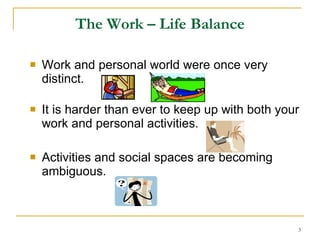
The Work – Life Balance Work and personal world were once very distinct. It is harder than ever to keep up with both your work and personal activities. Activities and social spaces are becoming ambiguous.
Some things people deal with on a daily basis  Getting ahead at work Spending quality time with your significant other Caring for elderly parents Doing chores at home Taking care of children Commuting to/from work
The Never-Ending Work Day … There  was  a time when people in the IRS reported to work Monday through Friday and worked an 8 hour day. The day started at 8:00AM and ended at 4:45 PM   however , The world has changed. Some of the changes in the work world caused a change and blurring of the work and personal worlds.
Changes in the Work World   Global economy International business Advanced communication technology Flex-time schedules  Alternative or flexi-place work location Changes in family structure (dual-career)
Some Facts to Consider About the Workforce  57% of people who say they had to go into work late or leave early did so because of caring for elderly relatives  4% say they’ve turned down a promotion 10% say they went from full-time to  part-time work Article in Forbes Magazine- March 17, 2009
Survey Results From More Than 50,000 Employees from a Variety of Manufacturing and Service Organizations Found   (Source: Quintessential Careers article) 2 out of every 5 employees are dissatisfied with the balance between their work and personal lives The lack of balance is due to: Long work hours Changing demographics More time in the car Deterioration of boundaries between work and home
So … How Do You Restore Balance  to your Life? First, remember that  the work/life balance can mean different things to different people. It can also change and mean different things to you at various points in your career. You also have to be realistic . If you set a priority (EX: advance in your career),  you have to be realistic about what that will require.
10 Tips for Getting your Work/Life in Balance   ( By Randall S. Hansen, Ph.D.)   Negotiate a Change with Your Current Employer Changes can include: flextime, job-sharing, telecommuting or  part-time employment. Your 1 st  step is to research your employer’s policies and methods of handling previous requests Find a New Career Some careers are simply more stressful and time-consuming than others. E xplore careers that are less stressful and more flexible
10 Tips for Getting your Work/Life in Balance  (continued)   Find a New Job  Rather than a career change, perhaps you simply need to take a less stressful job within your chosen career. This may involve working with your current employer to identify a new position  Slow Down   Life is simply too short Take steps to stop and enjoy the things and people around you. Find some ways to distance yourself from the things that are causing you the most stress
10 Tips for Getting your Work/Life in Balance  (continued) Learn to Better Manage Your Time.  Avoid Procrastination.  For many people, most of the stress they feel comes from simply being disorganized – and procrastinating.   Learn to set more realistic goals and deadlines – and then stick to them   Share the Load   Even though we may sometimes feel we’re the only ones capable of doing something, it's usually  not  the case.  Get your partner or other family members to help you with all your personal/family responsibilities
10 Tips for Getting your Work/Life in Balance  (continued) Let Things Go. (Don’t Sweat the Small Stuff)  Learn to let things go every once in a while  Learn to recognize the things that don’t really have much impact in your life and allow yourself to let them go  …  then don’t beat yourself up for doing so  Explore Your Options. Get Help .   In many cases you do have options; you just need to take the time to explore them EX: a sitter for your children, options for care of your aging parents, counseling for yourself Don’t feel overwhelmed with your family responsibilities
10 Tips for Getting your Work/Life in Balance  (continued) Take Charge. Set Priorities.   Sometimes it’s easier for us to allow ourselves to feel overwhelmed rather than taking charge and developing a prioritized list of things that need to get done Buck the trend. Simplify  It’s human nature to take on too many tasks and responsibilities, to try to do too much and to own too much. Find a way to simplify your life Change your lifestyle Get rid of the clutter and baggage in your house – and your life.
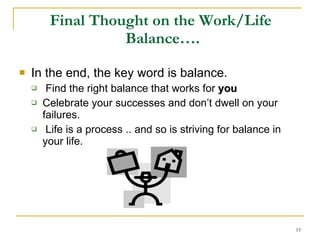
Final Thought on the Work/Life  Balance…. In the end, the key word is balance. Find the right balance that works for  you Celebrate your successes and don’t dwell on your failures. Life is a process .. and so is striving for balance in your life.
7 Tips For Work-Life Balance By: Jeff Wuorio    Don’t overbook Prioritize ruthlessly Learn how to say no Organize Use technology …but don’t overdo it Know it won’t always be perfect
Don’t Overbook: Don’t plan too many things  Assume that only 50% of things you plan for the day will actually get done Lisa McGonagle (Public Relations business owner – Boston)
Prioritize Ruthlessly: The secret to booking your time effectively boils down to knowing what is important and what can wait Use the sharpest knife to trim the essential from the secondary  Krista Kurth, Co-author  “Running on Plenty at Work”
Learn to Say No One of the biggest land mines to effective time management is recognizing you don’t have to agree with everything and with everyone.  “ Saying no to one thing opens the door to saying yes to something else”    Krista Kurth
Organize  Bringing time into line isn’t just a matter of scheduling. “ Eliminating clutter and the chaos it causes will give you a gift of 240 to 288 hours every year” Peggy Duncan (an Atlanta-based personal productivity authority) Organizational ideas include :
Use Technology: Go beyond personal habits and practices for time management. Use technology as another weapon to make the most effective use of your workday “ Sticky notes are one of the worst things in the world. ..” “ ..You should live by your database. That way nothing is ever forgotten.” Lisa McGonagle
(Use technology) … But Don’t Overdue It   Part of effective time management is knowing when to shut things down Turning off a cell phone or other wireless means of communication establishes boundaries Helps you balance your personal and professional time
Know It Won’t Always Be  Perfect   “ Be grateful for what goes right  and learn from your mistakes.” Do what you can and enjoy whatever time you spend more pleasantly and productively . Time management is not an exact science.  Don’t stress out and waste time in the process obsessing over every second of time.   Krista Kurth

Work lifebalance

  • 1.
    ACHIEVING WORK-LIFE BALANCE AIM- IRS Conference August 2009 Grand Rapids, Michigan Presented by: HMT Industry Director, Charlie Brantley HMT Director of Field Operations – West , Dave Horton
  • 2.
    Achieving Work LifeBalance Workshop Purpose: To focus on how to successfully combine work, family relationships and leisure time into a satisfying life. Approach: To create a skill set that enhances the ability to evaluate priorities, focus on the big picture and use long range planning Use prioritizing and organizational skills to make sense out of conflicting demands
  • 3.
    The Work –Life Balance Work and personal world were once very distinct. It is harder than ever to keep up with both your work and personal activities. Activities and social spaces are becoming ambiguous.
  • 4.
    Some things peopledeal with on a daily basis Getting ahead at work Spending quality time with your significant other Caring for elderly parents Doing chores at home Taking care of children Commuting to/from work
  • 5.
    The Never-Ending WorkDay … There was a time when people in the IRS reported to work Monday through Friday and worked an 8 hour day. The day started at 8:00AM and ended at 4:45 PM however , The world has changed. Some of the changes in the work world caused a change and blurring of the work and personal worlds.
  • 6.
    Changes in theWork World Global economy International business Advanced communication technology Flex-time schedules Alternative or flexi-place work location Changes in family structure (dual-career)
  • 7.
    Some Facts toConsider About the Workforce 57% of people who say they had to go into work late or leave early did so because of caring for elderly relatives 4% say they’ve turned down a promotion 10% say they went from full-time to part-time work Article in Forbes Magazine- March 17, 2009
  • 8.
    Survey Results FromMore Than 50,000 Employees from a Variety of Manufacturing and Service Organizations Found (Source: Quintessential Careers article) 2 out of every 5 employees are dissatisfied with the balance between their work and personal lives The lack of balance is due to: Long work hours Changing demographics More time in the car Deterioration of boundaries between work and home
  • 9.
    So … HowDo You Restore Balance to your Life? First, remember that the work/life balance can mean different things to different people. It can also change and mean different things to you at various points in your career. You also have to be realistic . If you set a priority (EX: advance in your career), you have to be realistic about what that will require.
  • 10.
    10 Tips forGetting your Work/Life in Balance ( By Randall S. Hansen, Ph.D.) Negotiate a Change with Your Current Employer Changes can include: flextime, job-sharing, telecommuting or part-time employment. Your 1 st step is to research your employer’s policies and methods of handling previous requests Find a New Career Some careers are simply more stressful and time-consuming than others. E xplore careers that are less stressful and more flexible
  • 11.
    10 Tips forGetting your Work/Life in Balance (continued) Find a New Job Rather than a career change, perhaps you simply need to take a less stressful job within your chosen career. This may involve working with your current employer to identify a new position Slow Down Life is simply too short Take steps to stop and enjoy the things and people around you. Find some ways to distance yourself from the things that are causing you the most stress
  • 12.
    10 Tips forGetting your Work/Life in Balance (continued) Learn to Better Manage Your Time. Avoid Procrastination. For many people, most of the stress they feel comes from simply being disorganized – and procrastinating. Learn to set more realistic goals and deadlines – and then stick to them Share the Load Even though we may sometimes feel we’re the only ones capable of doing something, it's usually not the case. Get your partner or other family members to help you with all your personal/family responsibilities
  • 13.
    10 Tips forGetting your Work/Life in Balance (continued) Let Things Go. (Don’t Sweat the Small Stuff) Learn to let things go every once in a while Learn to recognize the things that don’t really have much impact in your life and allow yourself to let them go … then don’t beat yourself up for doing so Explore Your Options. Get Help . In many cases you do have options; you just need to take the time to explore them EX: a sitter for your children, options for care of your aging parents, counseling for yourself Don’t feel overwhelmed with your family responsibilities
  • 14.
    10 Tips forGetting your Work/Life in Balance (continued) Take Charge. Set Priorities. Sometimes it’s easier for us to allow ourselves to feel overwhelmed rather than taking charge and developing a prioritized list of things that need to get done Buck the trend. Simplify It’s human nature to take on too many tasks and responsibilities, to try to do too much and to own too much. Find a way to simplify your life Change your lifestyle Get rid of the clutter and baggage in your house – and your life.
  • 15.
    Final Thought onthe Work/Life Balance…. In the end, the key word is balance. Find the right balance that works for you Celebrate your successes and don’t dwell on your failures. Life is a process .. and so is striving for balance in your life.
  • 16.
    7 Tips ForWork-Life Balance By: Jeff Wuorio Don’t overbook Prioritize ruthlessly Learn how to say no Organize Use technology …but don’t overdo it Know it won’t always be perfect
  • 17.
    Don’t Overbook: Don’tplan too many things Assume that only 50% of things you plan for the day will actually get done Lisa McGonagle (Public Relations business owner – Boston)
  • 18.
    Prioritize Ruthlessly: Thesecret to booking your time effectively boils down to knowing what is important and what can wait Use the sharpest knife to trim the essential from the secondary Krista Kurth, Co-author “Running on Plenty at Work”
  • 19.
    Learn to SayNo One of the biggest land mines to effective time management is recognizing you don’t have to agree with everything and with everyone. “ Saying no to one thing opens the door to saying yes to something else” Krista Kurth
  • 20.
    Organize Bringingtime into line isn’t just a matter of scheduling. “ Eliminating clutter and the chaos it causes will give you a gift of 240 to 288 hours every year” Peggy Duncan (an Atlanta-based personal productivity authority) Organizational ideas include :
  • 21.
    Use Technology: Gobeyond personal habits and practices for time management. Use technology as another weapon to make the most effective use of your workday “ Sticky notes are one of the worst things in the world. ..” “ ..You should live by your database. That way nothing is ever forgotten.” Lisa McGonagle
  • 22.
    (Use technology) …But Don’t Overdue It Part of effective time management is knowing when to shut things down Turning off a cell phone or other wireless means of communication establishes boundaries Helps you balance your personal and professional time
  • 23.
    Know It Won’tAlways Be Perfect “ Be grateful for what goes right and learn from your mistakes.” Do what you can and enjoy whatever time you spend more pleasantly and productively . Time management is not an exact science. Don’t stress out and waste time in the process obsessing over every second of time. Krista Kurth