ACHIEVING WORK-LIFE BALANCE
AIM- IRS Conference
August 2009
Grand Rapids, Michigan
Presented by:
HMT Industry Director, Charlie Brantley
HMT Director of Field Operations – West , Dave Horton
2
Achieving Work Life Balance Workshop
 Purpose:
 To focus on how to successfully combine work, family
relationships and leisure time into a satisfying life.
 Approach:
 To create a skill set that enhances the ability to evaluate
priorities, focus on the big picture and use long range
planning
 Use prioritizing and organizational skills to make sense
out of conflicting demands
3
The Work – Life Balance
 Work and personal world were once very
distinct.
 It is harder than ever to keep up with both your
work and personal activities.
 Activities and social spaces are becoming
ambiguous.
4
Some things people deal with on a daily
basis
 Getting ahead at work
 Spending quality time with your significant other
 Caring for elderly parents
 Doing chores at home
 Taking care of children
 Commuting to/from work
5
The Never-Ending Work Day …
 There was a time when people in the IRS
reported to work Monday through Friday and
worked an 8 hour day.
 The day started at 8:00AM and ended at 4:45 PM
however,
 The world has changed. Some of the changes
in the work world caused a change and blurring
of the work and personal worlds.
6
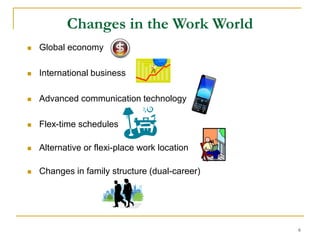
Changes in the Work World
 Global economy
 International business
 Advanced communication technology
 Flex-time schedules
 Alternative or flexi-place work location
 Changes in family structure (dual-career)
7
Some Facts to Consider About the Workforce
 57% of people who say they had to go into
work late or leave early did so because of
caring for elderly relatives
 4% say they’ve turned down a promotion
 10% say they went from full-time to
part-time work
Article in Forbes Magazine- March 17, 2009
8
Survey Results From More Than 50,000
Employees from a Variety of Manufacturing
and Service Organizations Found
(Source: Quintessential Careers article)
 2 out of every 5
employees are
dissatisfied with the
balance between their
work and personal lives
 The lack of balance is
due to:
 Long work hours
 Changing demographics
 More time in the car
 Deterioration of boundaries
between work and home
9
So … How Do You Restore Balance to
your Life?
 First, remember that the work/life balance can
mean different things to different people.
 It can also change and mean different things to you at
various points in your career.
 You also have to be realistic.
 If you set a priority (EX: advance in your career),
you have to be realistic about what that will require.
10
10 Tips for Getting your Work/Life in
Balance ( By Randall S. Hansen, Ph.D.)
1. Negotiate a Change with Your Current Employer
 Changes can include: flextime, job-sharing, telecommuting or
part-time employment.
 Your 1st step is to research your employer’s policies and
methods of handling previous requests
2. Find a New Career
 Some careers are simply more stressful and time-consuming
than others.
 Explore careers that are less stressful and more flexible
11
10 Tips for Getting your Work/Life in
Balance (continued)
3. Find a New Job
 Rather than a career change, perhaps you simply need to
take a less stressful job within your chosen career.
 This may involve working with your current employer to
identify a new position
4. Slow Down
 Life is simply too short
 Take steps to stop and enjoy the things and people
around you.
 Find some ways to distance yourself from the things that
are causing you the most stress
12
10 Tips for Getting your Work/Life in
Balance (continued)
5. Learn to Better Manage Your Time. Avoid
Procrastination.
 For many people, most of the stress they feel comes from
simply being disorganized – and procrastinating.
 Learn to set more realistic goals and deadlines – and then
stick to them
6. Share the Load
 Even though we may sometimes feel we’re the only ones
capable of doing something, it's usually not the case.
 Get your partner or other family members to help you with
all your personal/family responsibilities
13
10 Tips for Getting your Work/Life in
Balance (continued)
7. Let Things Go. (Don’t Sweat the Small Stuff)
 Learn to let things go every once in a while
 Learn to recognize the things that don’t really have much
impact in your life and allow yourself to let them go
 … then don’t beat yourself up for doing so
8. Explore Your Options. Get Help.
 In many cases you do have options; you just need to take the
time to explore them
 EX: a sitter for your children, options for care of your aging
parents, counseling for yourself
 Don’t feel overwhelmed with your family responsibilities
14
10 Tips for Getting your Work/Life in
Balance (continued)
9. Take Charge. Set Priorities.
 Sometimes it’s easier for us to allow ourselves to feel
overwhelmed rather than taking charge and developing a
prioritized list of things that need to get done
 Buck the trend.
10. Simplify
 It’s human nature to take on too many tasks and
responsibilities, to try to do too much and to own too
much.
 Find a way to simplify your life
 Change your lifestyle
 Get rid of the clutter and baggage in your house –
and your life.
15
Final Thought on the Work/Life
Balance….
 In the end, the key word is balance.
 Find the right balance that works for you
 Celebrate your successes and don’t dwell on your
failures.
 Life is a process .. and so is striving for balance in
your life.

Work Life Balance

  • 1.
    ACHIEVING WORK-LIFE BALANCE AIM-IRS Conference August 2009 Grand Rapids, Michigan Presented by: HMT Industry Director, Charlie Brantley HMT Director of Field Operations – West , Dave Horton
  • 2.
    2 Achieving Work LifeBalance Workshop  Purpose:  To focus on how to successfully combine work, family relationships and leisure time into a satisfying life.  Approach:  To create a skill set that enhances the ability to evaluate priorities, focus on the big picture and use long range planning  Use prioritizing and organizational skills to make sense out of conflicting demands
  • 3.
    3 The Work –Life Balance  Work and personal world were once very distinct.  It is harder than ever to keep up with both your work and personal activities.  Activities and social spaces are becoming ambiguous.
  • 4.
    4 Some things peopledeal with on a daily basis  Getting ahead at work  Spending quality time with your significant other  Caring for elderly parents  Doing chores at home  Taking care of children  Commuting to/from work
  • 5.
    5 The Never-Ending WorkDay …  There was a time when people in the IRS reported to work Monday through Friday and worked an 8 hour day.  The day started at 8:00AM and ended at 4:45 PM however,  The world has changed. Some of the changes in the work world caused a change and blurring of the work and personal worlds.
  • 6.
    6 Changes in theWork World  Global economy  International business  Advanced communication technology  Flex-time schedules  Alternative or flexi-place work location  Changes in family structure (dual-career)
  • 7.
    7 Some Facts toConsider About the Workforce  57% of people who say they had to go into work late or leave early did so because of caring for elderly relatives  4% say they’ve turned down a promotion  10% say they went from full-time to part-time work Article in Forbes Magazine- March 17, 2009
  • 8.
    8 Survey Results FromMore Than 50,000 Employees from a Variety of Manufacturing and Service Organizations Found (Source: Quintessential Careers article)  2 out of every 5 employees are dissatisfied with the balance between their work and personal lives  The lack of balance is due to:  Long work hours  Changing demographics  More time in the car  Deterioration of boundaries between work and home
  • 9.
    9 So … HowDo You Restore Balance to your Life?  First, remember that the work/life balance can mean different things to different people.  It can also change and mean different things to you at various points in your career.  You also have to be realistic.  If you set a priority (EX: advance in your career), you have to be realistic about what that will require.
  • 10.
    10 10 Tips forGetting your Work/Life in Balance ( By Randall S. Hansen, Ph.D.) 1. Negotiate a Change with Your Current Employer  Changes can include: flextime, job-sharing, telecommuting or part-time employment.  Your 1st step is to research your employer’s policies and methods of handling previous requests 2. Find a New Career  Some careers are simply more stressful and time-consuming than others.  Explore careers that are less stressful and more flexible
  • 11.
    11 10 Tips forGetting your Work/Life in Balance (continued) 3. Find a New Job  Rather than a career change, perhaps you simply need to take a less stressful job within your chosen career.  This may involve working with your current employer to identify a new position 4. Slow Down  Life is simply too short  Take steps to stop and enjoy the things and people around you.  Find some ways to distance yourself from the things that are causing you the most stress
  • 12.
    12 10 Tips forGetting your Work/Life in Balance (continued) 5. Learn to Better Manage Your Time. Avoid Procrastination.  For many people, most of the stress they feel comes from simply being disorganized – and procrastinating.  Learn to set more realistic goals and deadlines – and then stick to them 6. Share the Load  Even though we may sometimes feel we’re the only ones capable of doing something, it's usually not the case.  Get your partner or other family members to help you with all your personal/family responsibilities
  • 13.
    13 10 Tips forGetting your Work/Life in Balance (continued) 7. Let Things Go. (Don’t Sweat the Small Stuff)  Learn to let things go every once in a while  Learn to recognize the things that don’t really have much impact in your life and allow yourself to let them go  … then don’t beat yourself up for doing so 8. Explore Your Options. Get Help.  In many cases you do have options; you just need to take the time to explore them  EX: a sitter for your children, options for care of your aging parents, counseling for yourself  Don’t feel overwhelmed with your family responsibilities
  • 14.
    14 10 Tips forGetting your Work/Life in Balance (continued) 9. Take Charge. Set Priorities.  Sometimes it’s easier for us to allow ourselves to feel overwhelmed rather than taking charge and developing a prioritized list of things that need to get done  Buck the trend. 10. Simplify  It’s human nature to take on too many tasks and responsibilities, to try to do too much and to own too much.  Find a way to simplify your life  Change your lifestyle  Get rid of the clutter and baggage in your house – and your life.
  • 15.
    15 Final Thought onthe Work/Life Balance….  In the end, the key word is balance.  Find the right balance that works for you  Celebrate your successes and don’t dwell on your failures.  Life is a process .. and so is striving for balance in your life.