The document discusses key topics in human resource management including gaining competitive advantage through people, the impact of globalization and technology, managing change, developing human capital, responding to market pressures, containing costs, and addressing demographic and employee concerns. It outlines objectives for understanding how these factors influence HR strategies and the roles and competencies of today's HR managers.
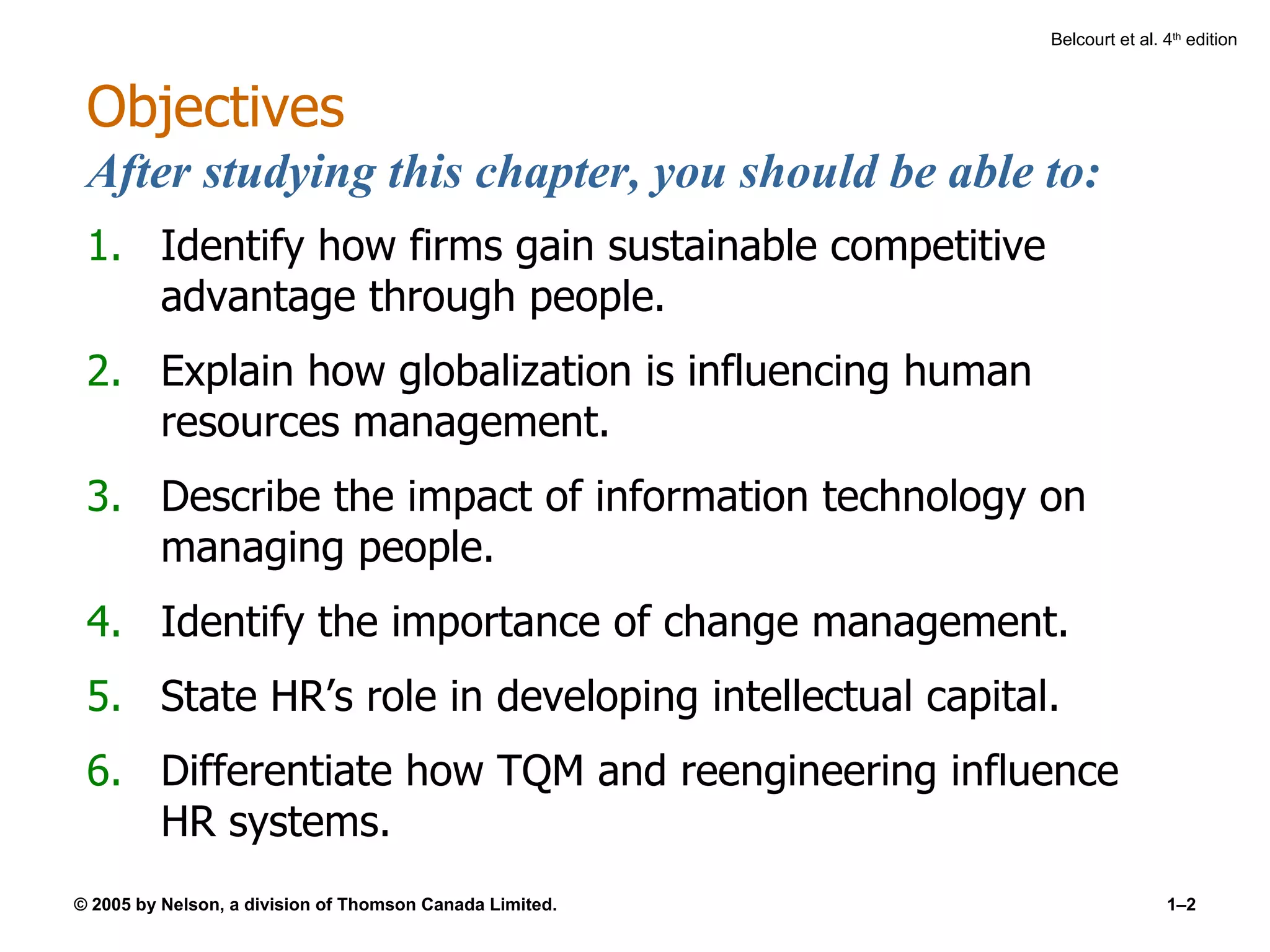
Objectives After studyingthis chapter, you should be able to: Identify how firms gain sustainable competitive advantage through people. Explain how globalization is influencing human resources management. Describe the impact of information technology on managing people. Identify the importance of change management. State HR’s role in developing intellectual capital. Differentiate how TQM and reengineering influence HR systems.
3.
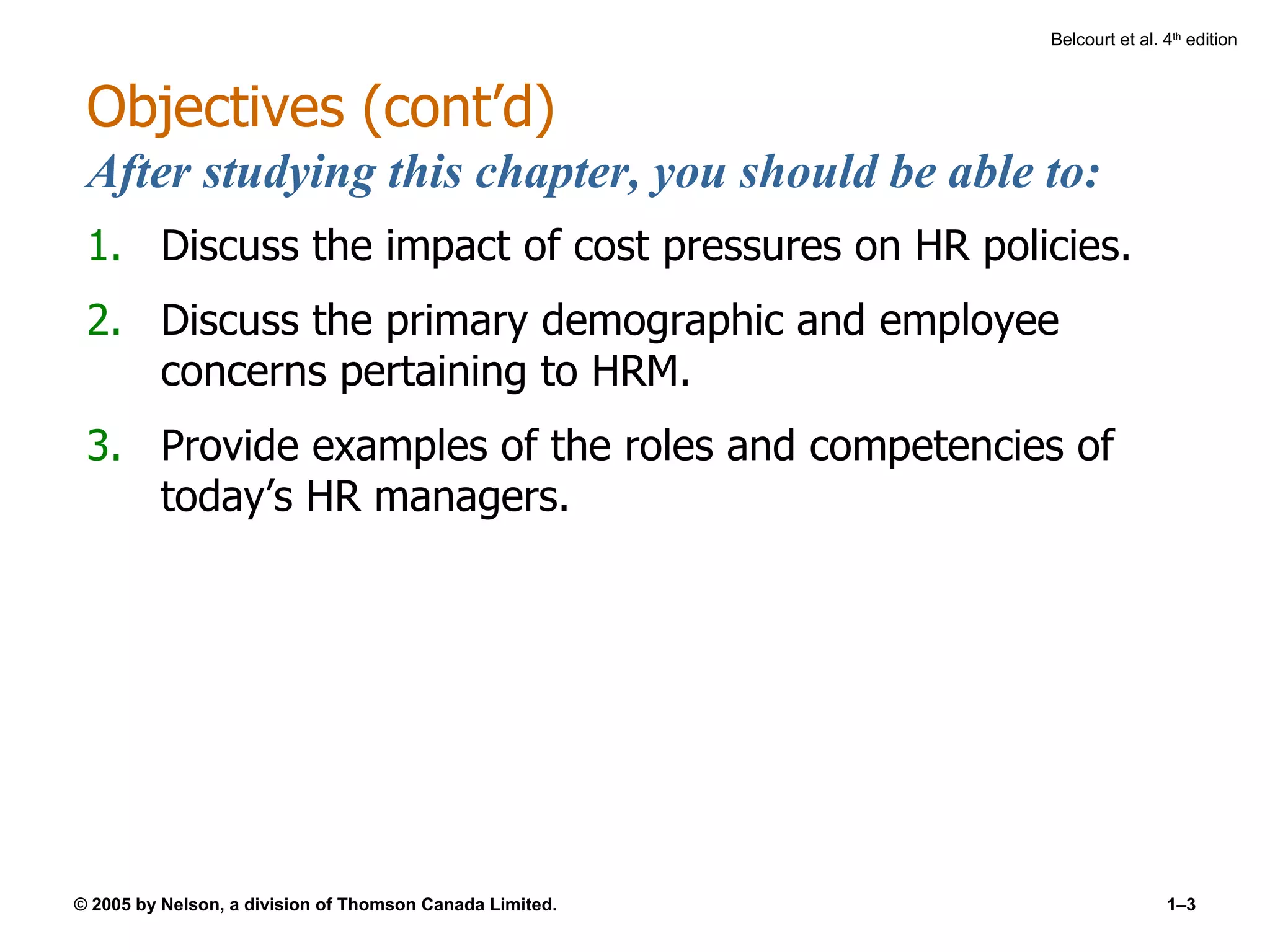
Objectives (cont’d) Afterstudying this chapter, you should be able to: Discuss the impact of cost pressures on HR policies. Discuss the primary demographic and employee concerns pertaining to HRM. Provide examples of the roles and competencies of today’s HR managers.
4.
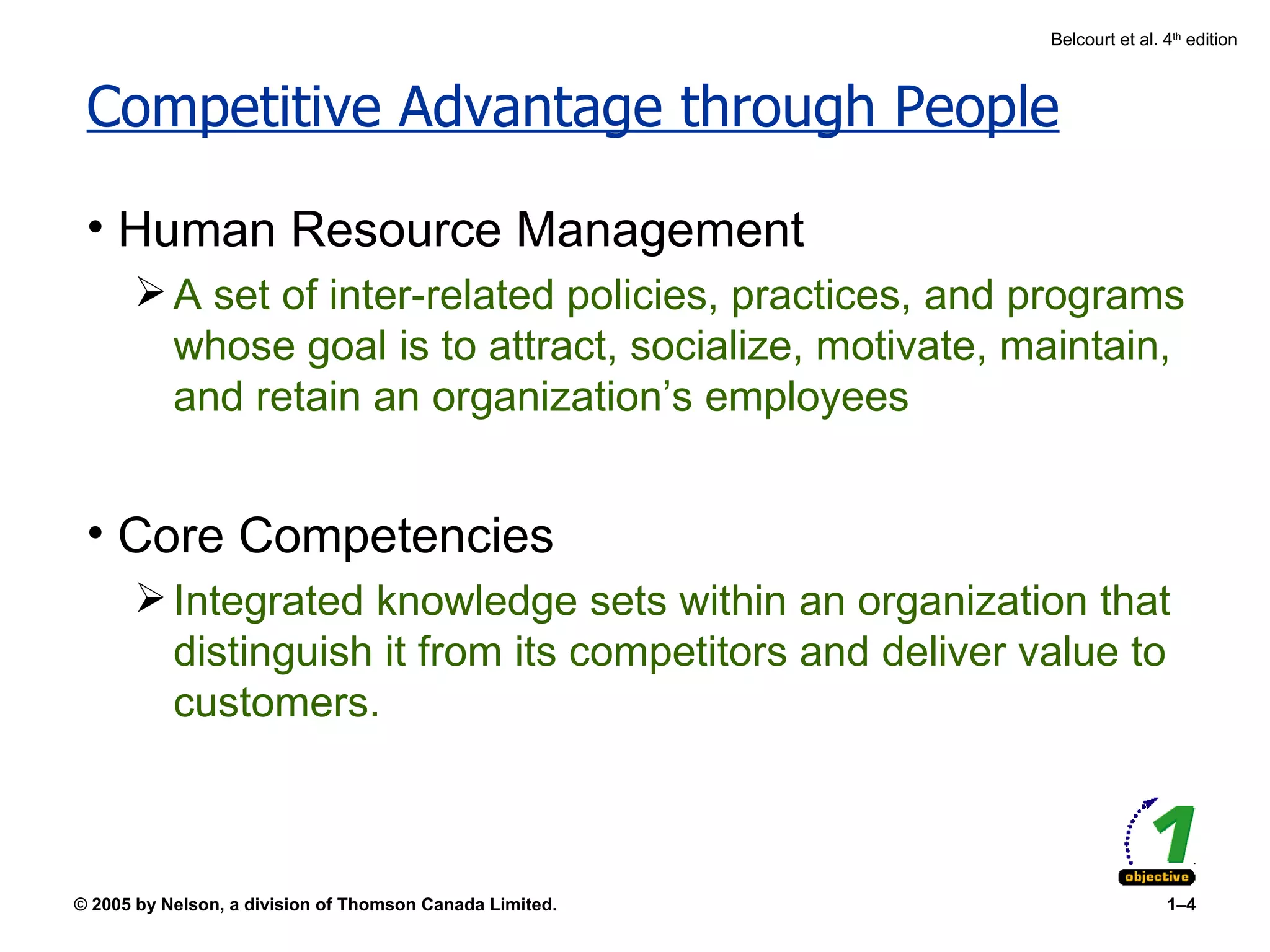
Competitive Advantage throughPeople Human Resource Management A set of inter-related policies, practices, and programs whose goal is to attract, socialize, motivate, maintain, and retain an organization’s employees Core Competencies Integrated knowledge sets within an organization that distinguish it from its competitors and deliver value to customers.
5.
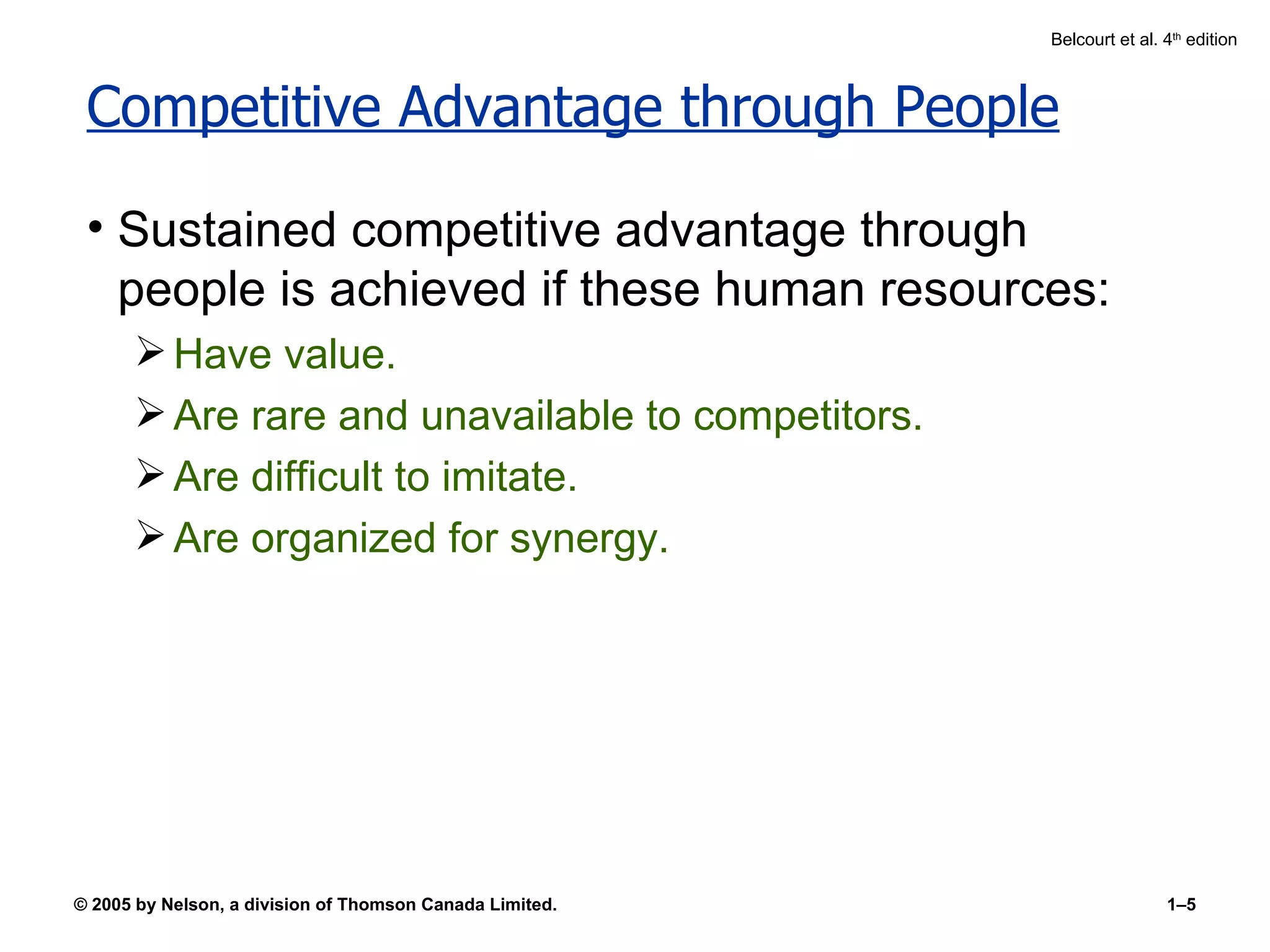
Competitive Advantage throughPeople Sustained competitive advantage through people is achieved if these human resources: Have value. Are rare and unavailable to competitors. Are difficult to imitate. Are organized for synergy.
6.
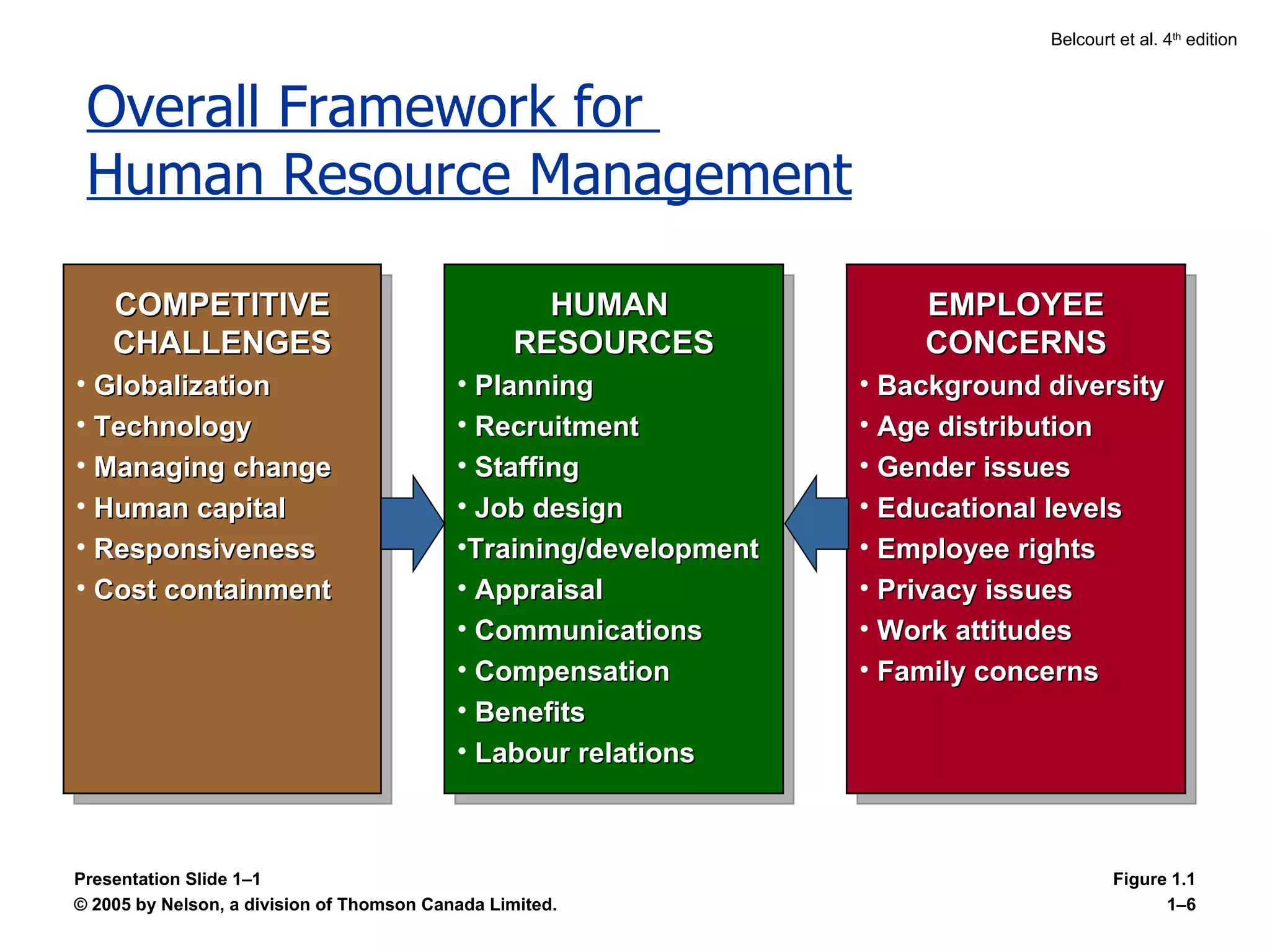
Overall Framework for Human Resource Management Presentation Slide 1 – 1 COMPETITIVE CHALLENGES Globalization Technology Managing change Human capital Responsiveness Cost containment HUMAN RESOURCES Planning Recruitment Staffing Job design Training/development Appraisal Communications Compensation Benefits Labour relations EMPLOYEE CONCERNS Background diversity Age distribution Gender issues Educational levels Employee rights Privacy issues Work attitudes Family concerns Figure 1.1
7.
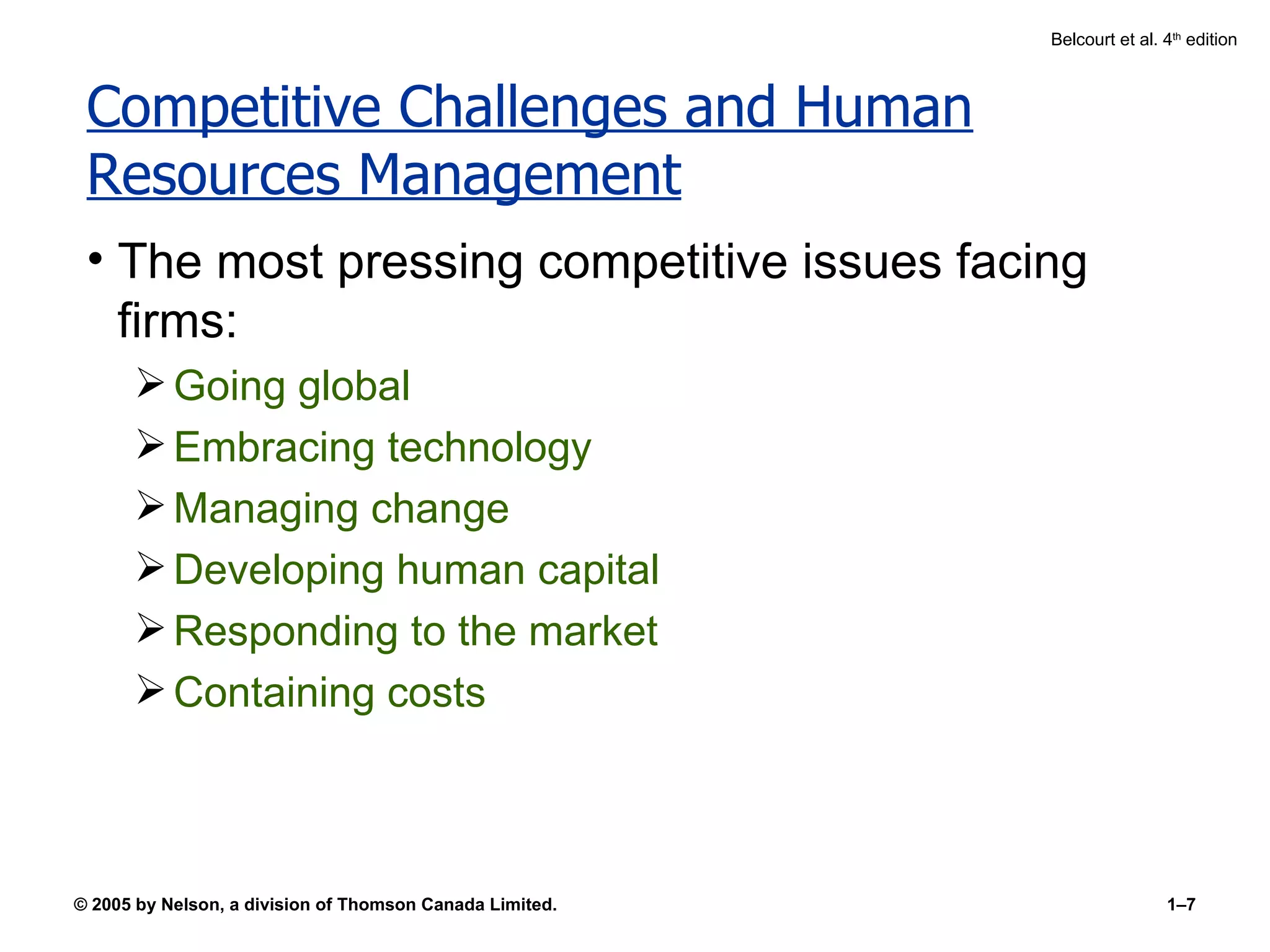
Competitive Challenges andHuman Resources Management The most pressing competitive issues facing firms: Going global Embracing technology Managing change Developing human capital Responding to the market Containing costs
8.
Going Global GlobalizationThe trend toward opening up foreign markets to international trade and investment. Impact of Globalization Partnerships with foreign firms “Anything, anywhere, anytime” markets Lower trade and tariff barriers NAFTA, EU, APEC trade agreements WTO and GATT
9.
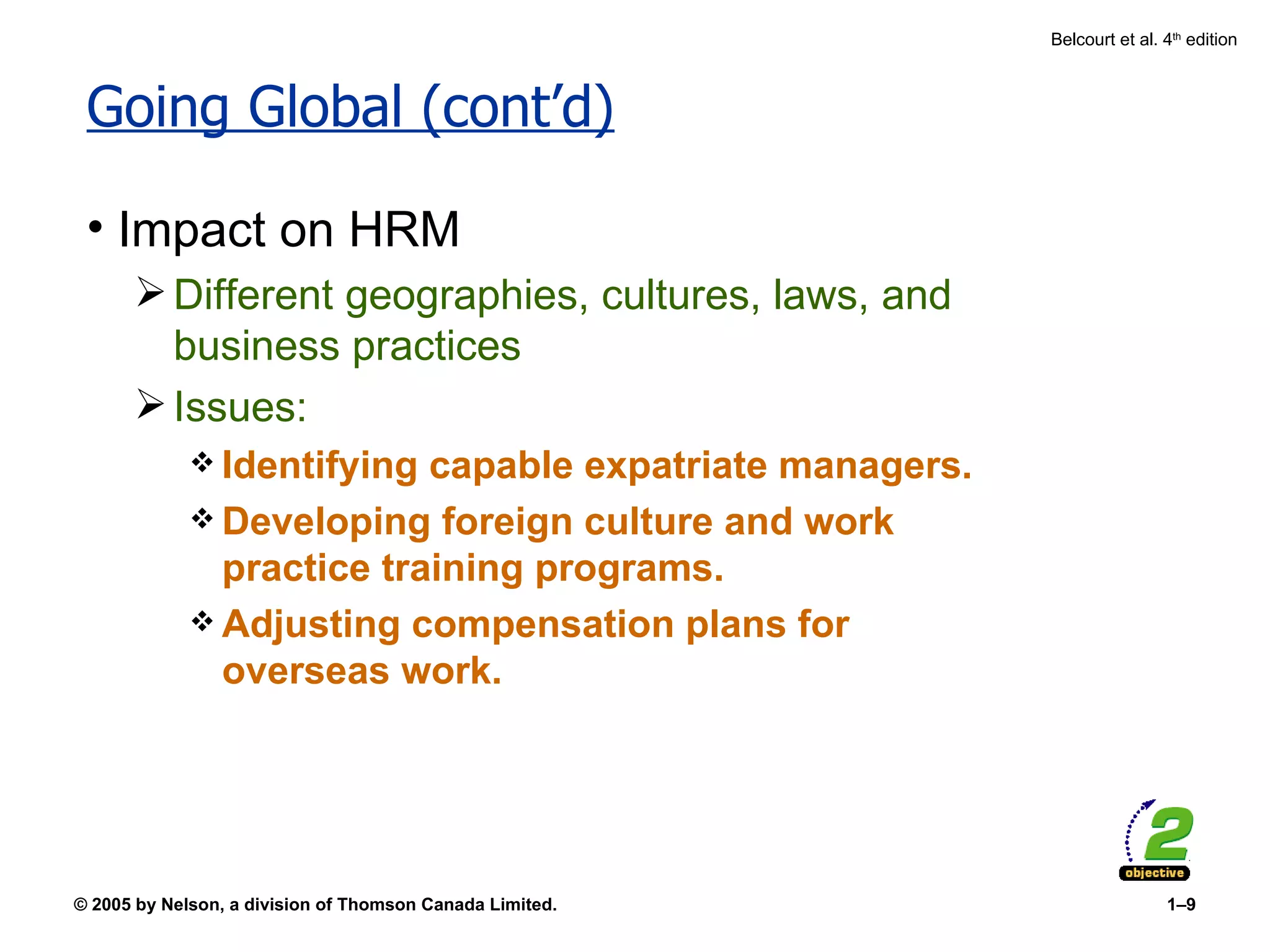
Going Global (cont’d)Impact on HRM Different geographies, cultures, laws, and business practices Issues: Identifying capable expatriate managers. Developing foreign culture and work practice training programs. Adjusting compensation plans for overseas work.
10.
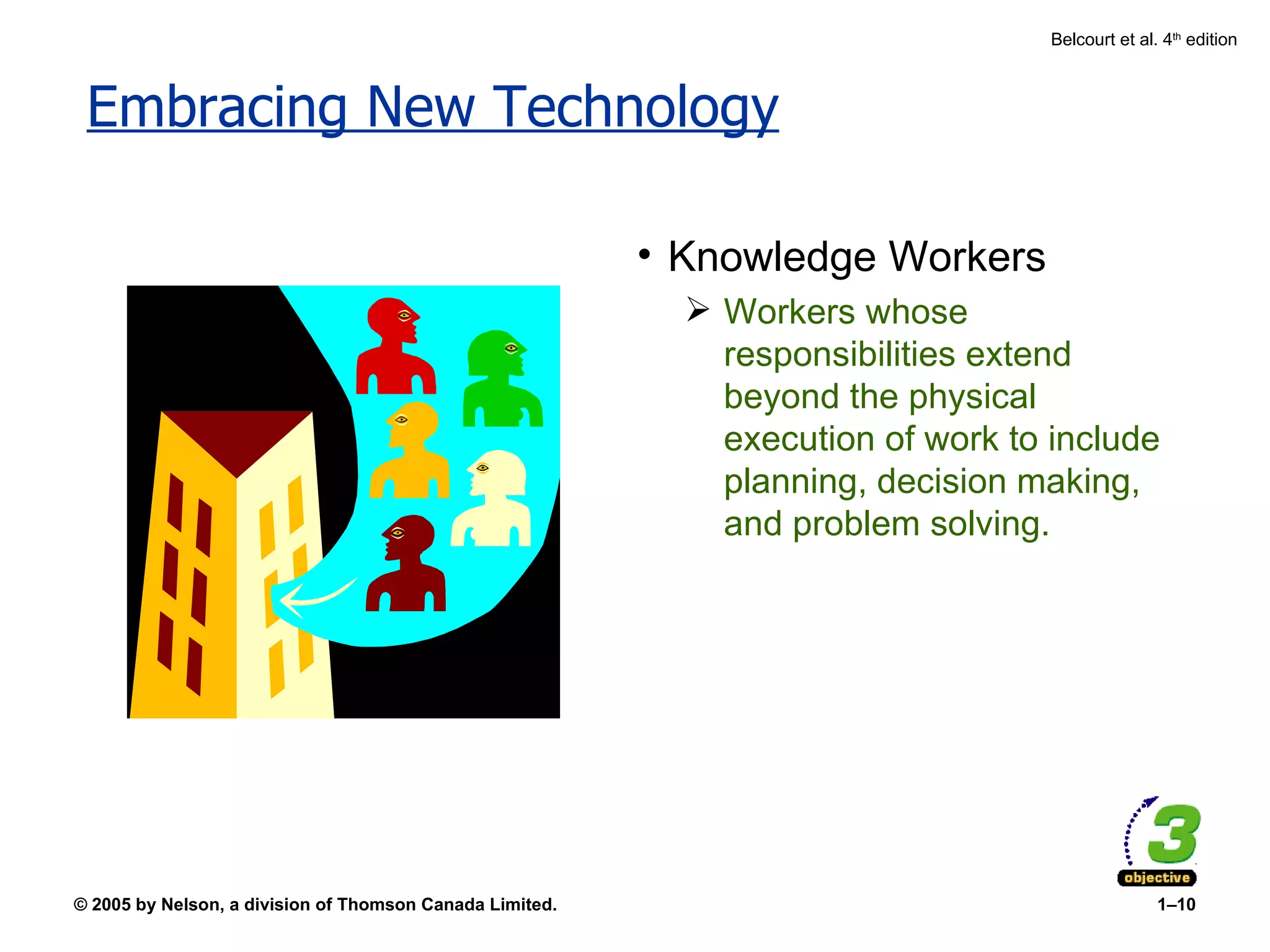
Embracing New TechnologyKnowledge Workers Workers whose responsibilities extend beyond the physical execution of work to include planning, decision making, and problem solving.
11.
Influence of Technologyin HRM Human Resources Information System (HRIS) Computerized system that provides current and accurate data for purposes of control and decision making. Benefits: Store and retrieve of large quantities of data. Combine and reconfigure data to create new information. Institutionalization of organizational knowledge. Easier communications. Lower administrative costs, increase productivity, and response times.
12.
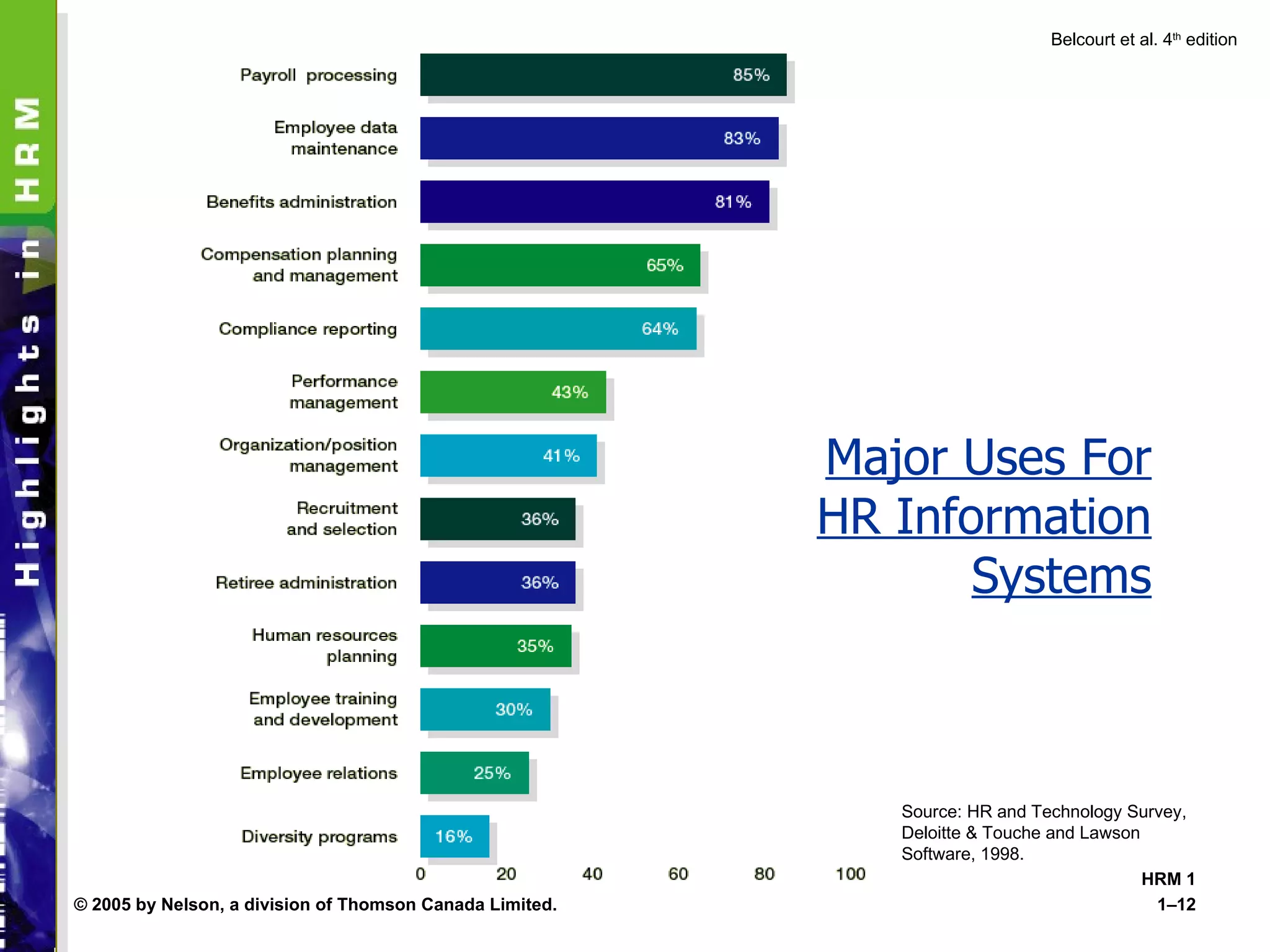
Major Uses ForHR Information Systems Source: HR and Technology Survey, Deloitte & Touche and Lawson Software, 1998. HRM 1
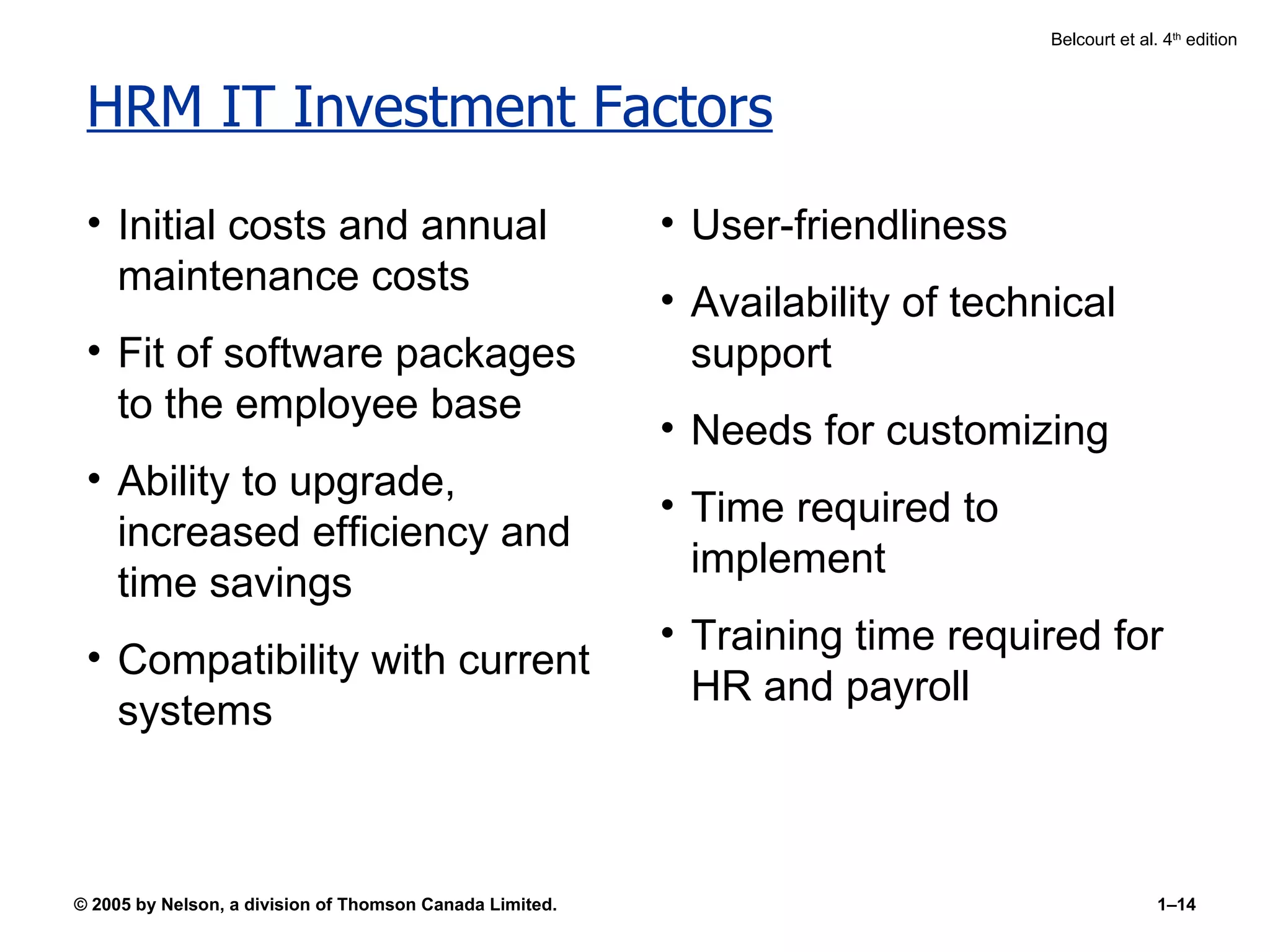
HRM IT InvestmentFactors Initial costs and annual maintenance costs Fit of software packages to the employee base Ability to upgrade, increased efficiency and time savings Compatibility with current systems User-friendliness Availability of technical support Needs for customizing Time required to implement Training time required for HR and payroll
15.
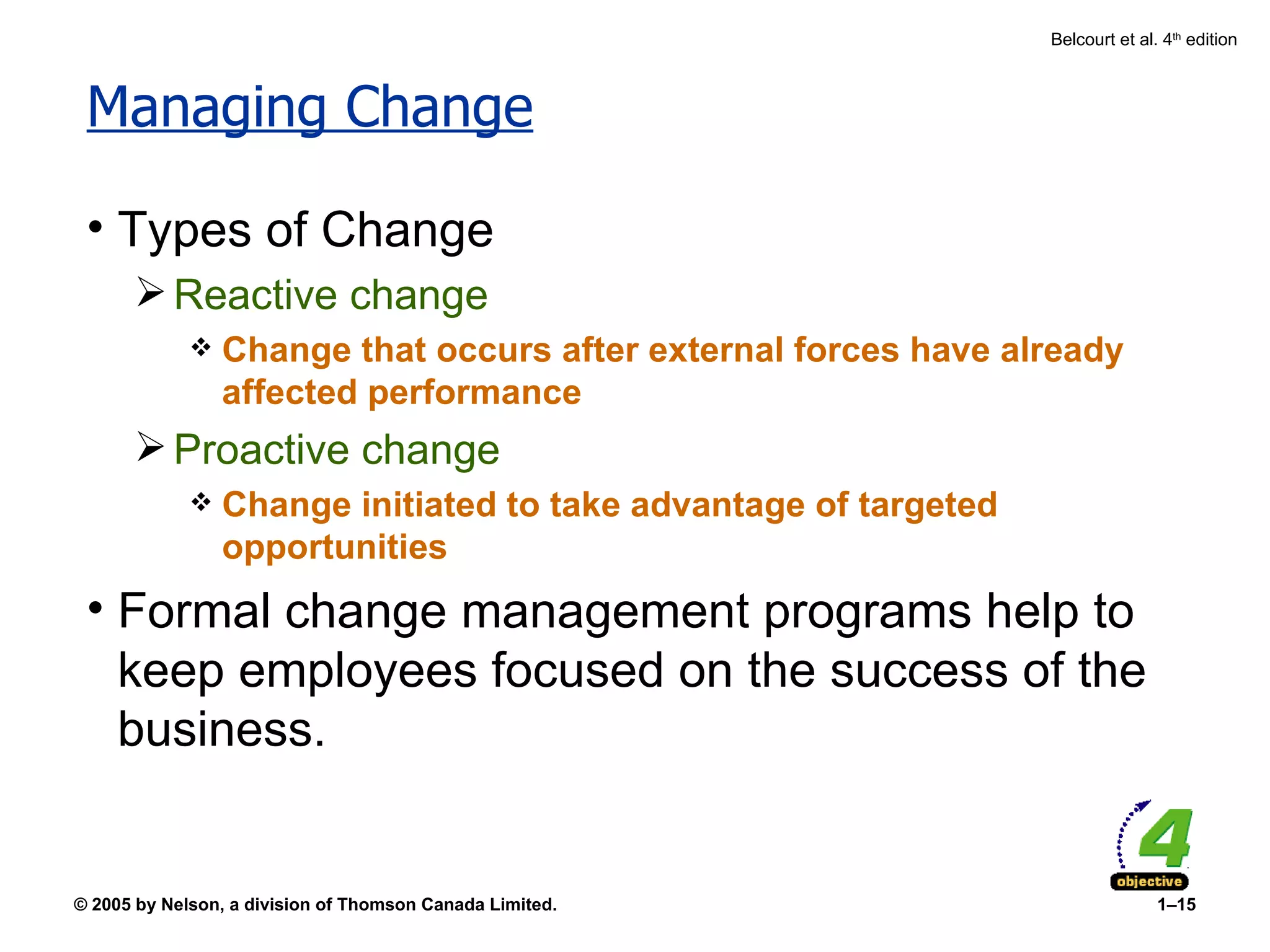
Managing Change Typesof Change Reactive change Change that occurs after external forces have already affected performance Proactive change Change initiated to take advantage of targeted opportunities Formal change management programs help to keep employees focused on the success of the business.
16.
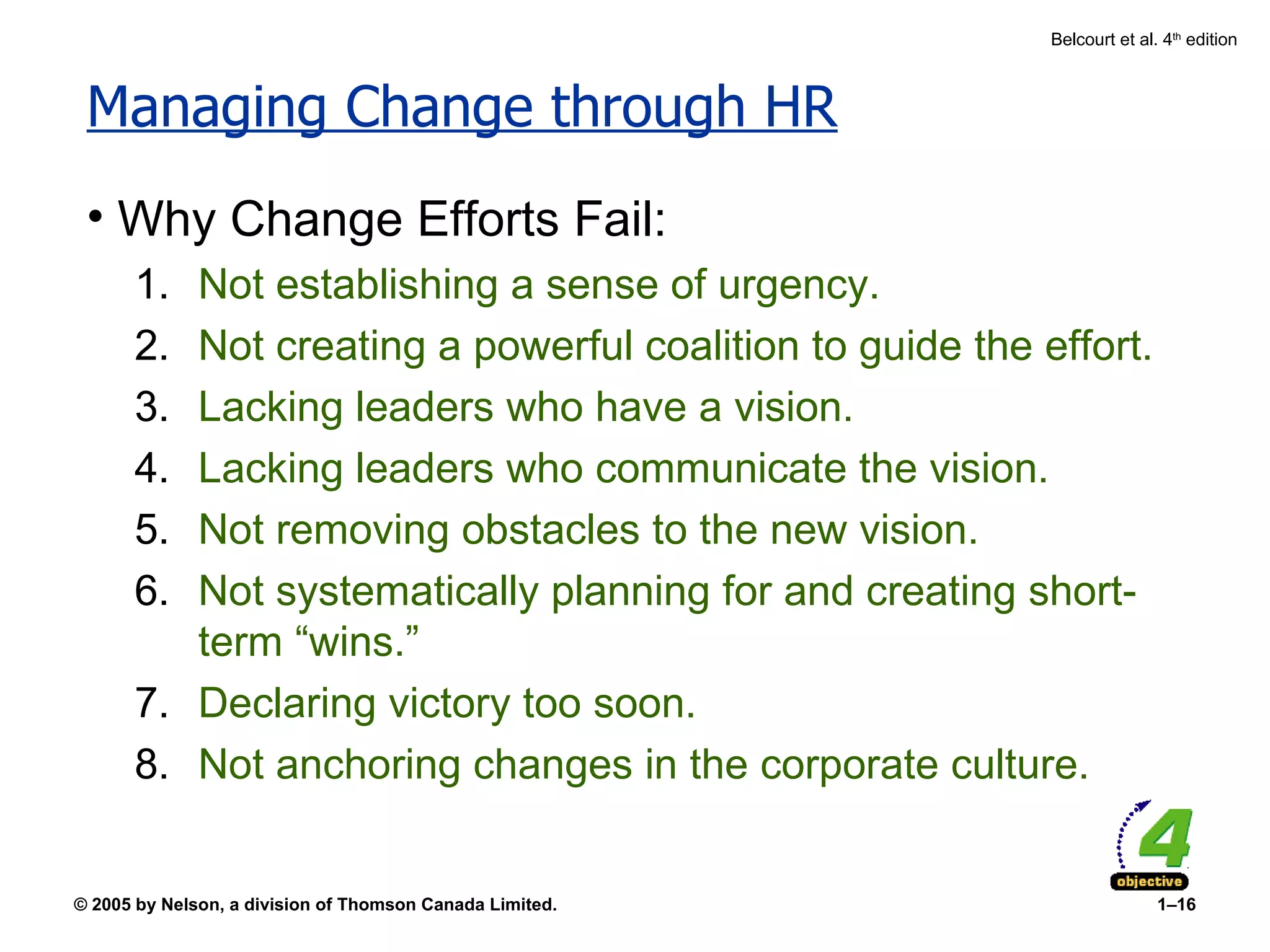
Managing Change throughHR Why Change Efforts Fail: Not establishing a sense of urgency. Not creating a powerful coalition to guide the effort. Lacking leaders who have a vision. Lacking leaders who communicate the vision. Not removing obstacles to the new vision. Not systematically planning for and creating short-term “wins.” Declaring victory too soon. Not anchoring changes in the corporate culture.
17.
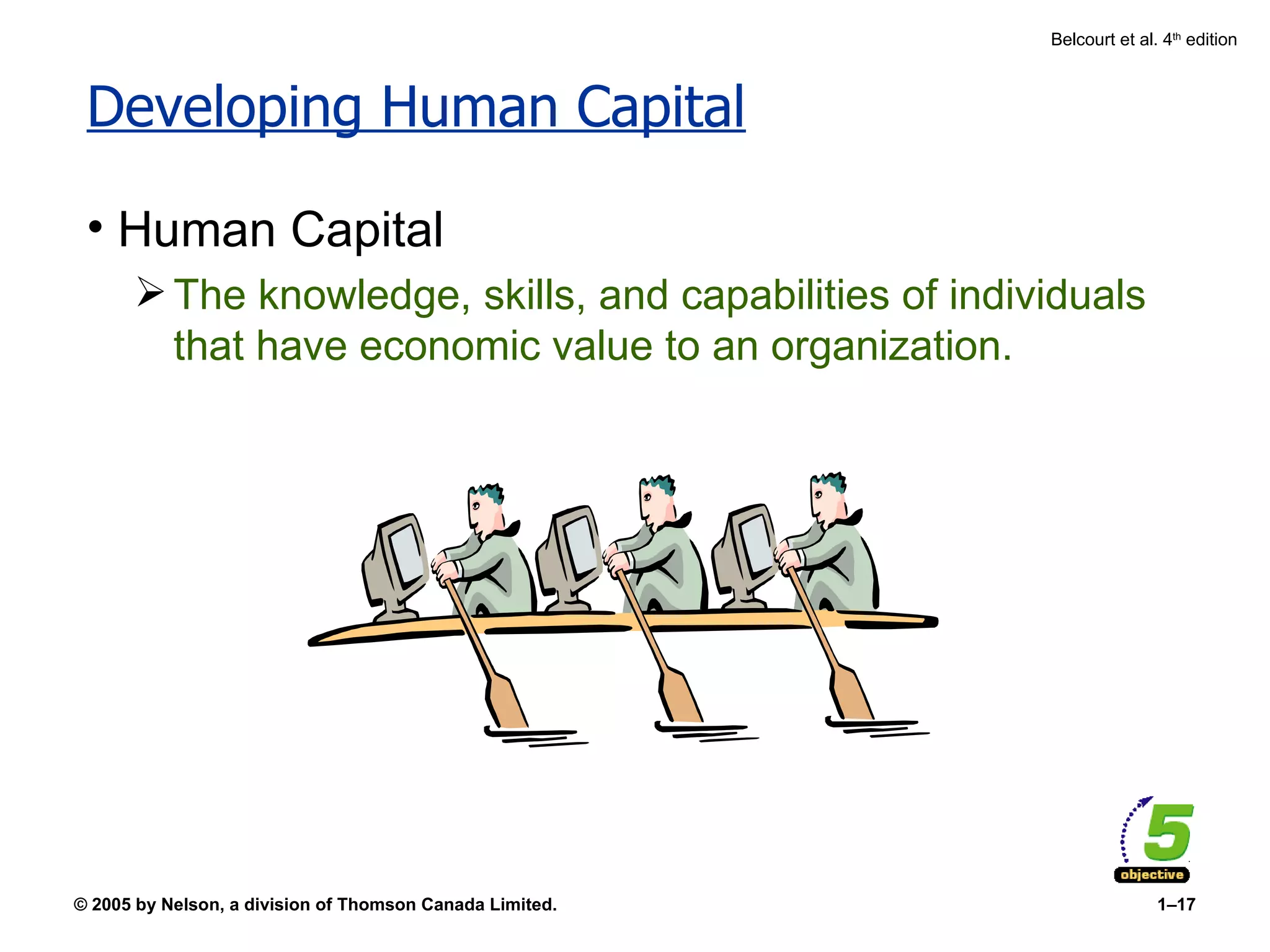
Developing Human CapitalHuman Capital The knowledge, skills, and capabilities of individuals that have economic value to an organization.
18.
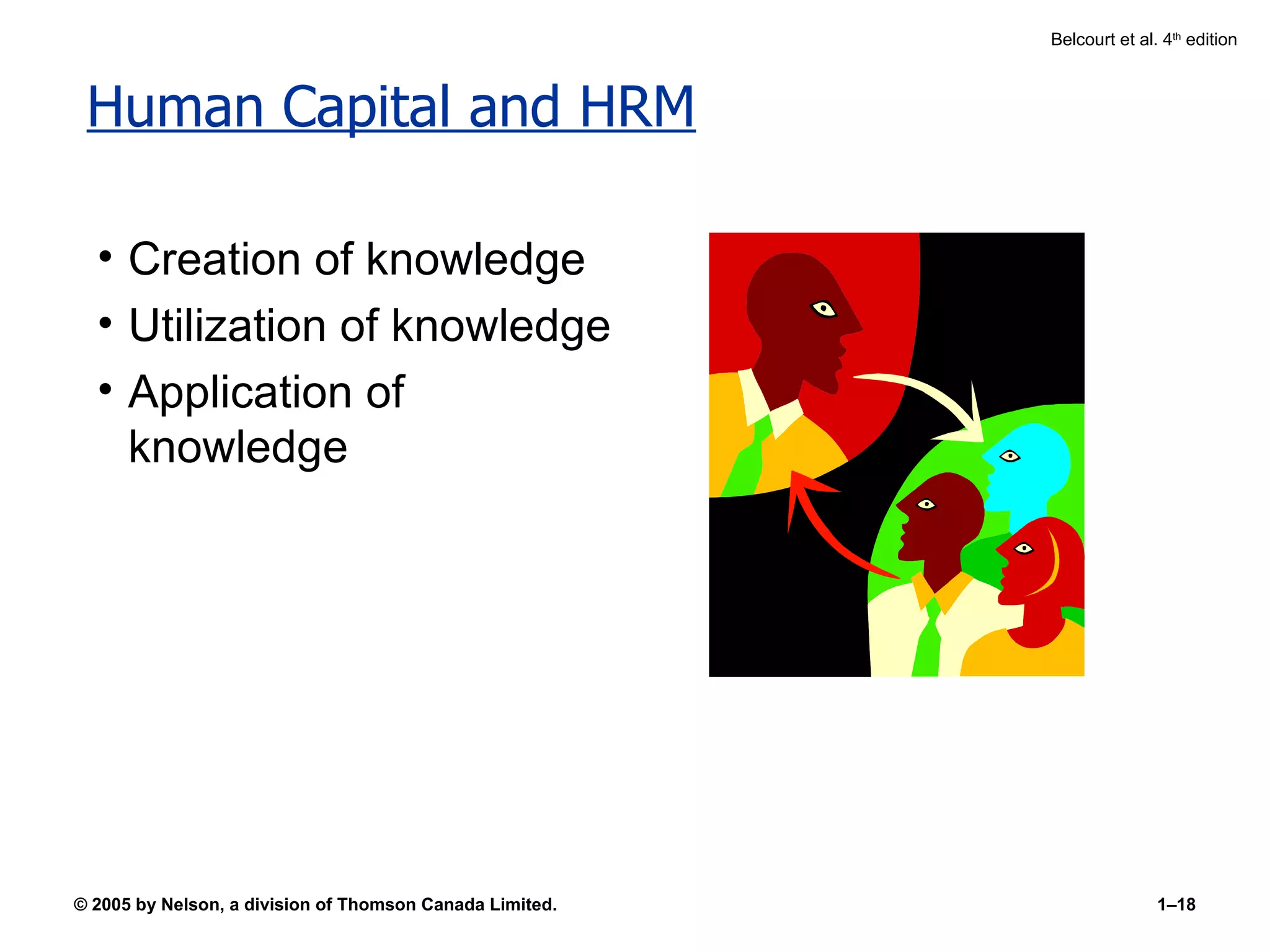
Human Capital andHRM Creation of knowledge Utilization of knowledge Application of knowledge
19.
Responding to theMarket Total Quality Management (TQM) A set of principles and practices whose core ideas include understanding customer needs, doing things right the first time, and striving for continuous improvement. Six Sigma A process used to translate customer needs into a set of optimal tasks that are performed in concert with one another.
20.
Responding to theMarket Reengineering Fundamental rethinking and radical redesign of business processes to achieve dramatic improvements in cost, quality, service, and speed. Requires that managers create an environment for change. Depends on effective leadership and communication processes. Requires that administrative systems be reviewed and modified.
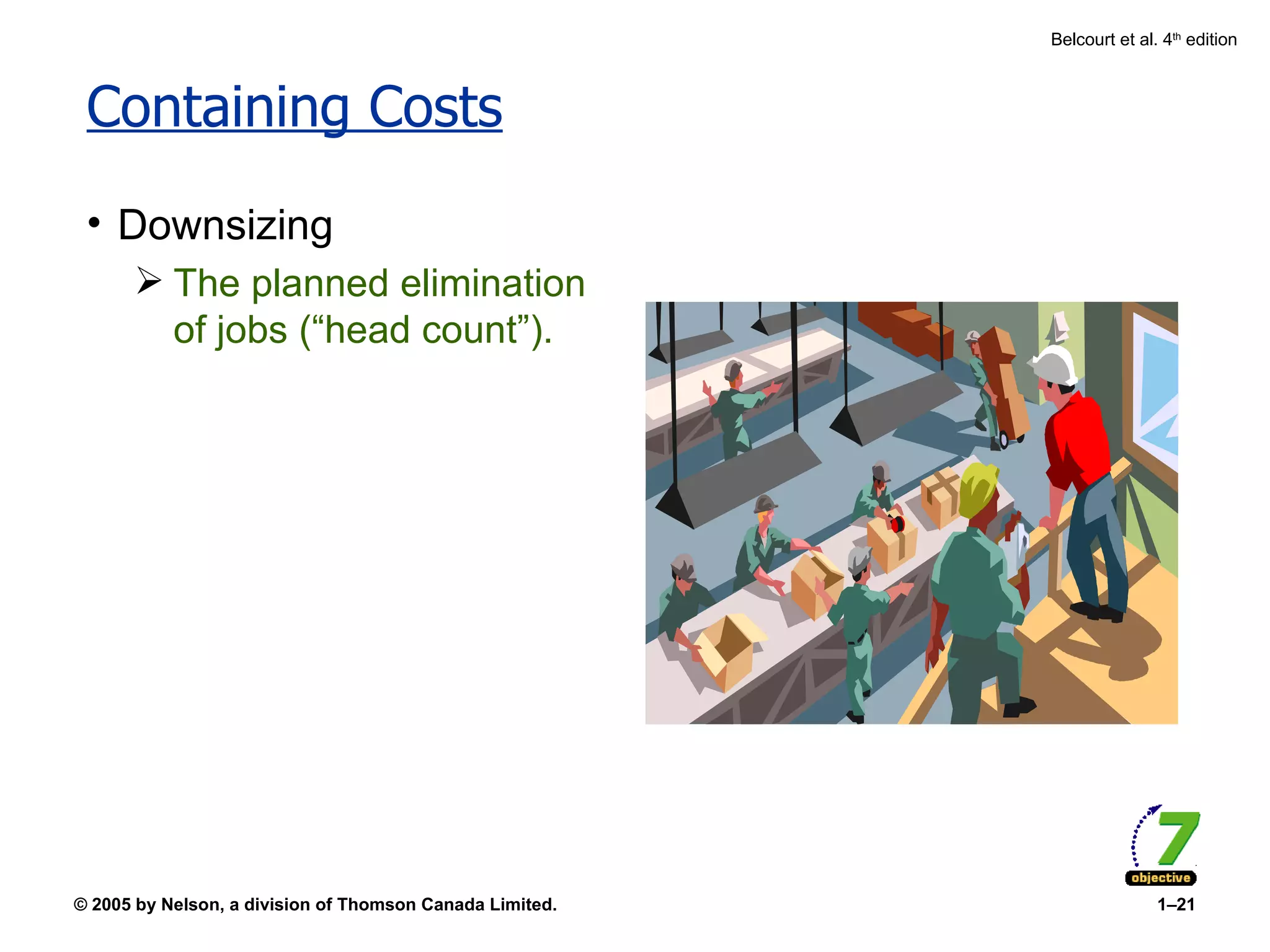
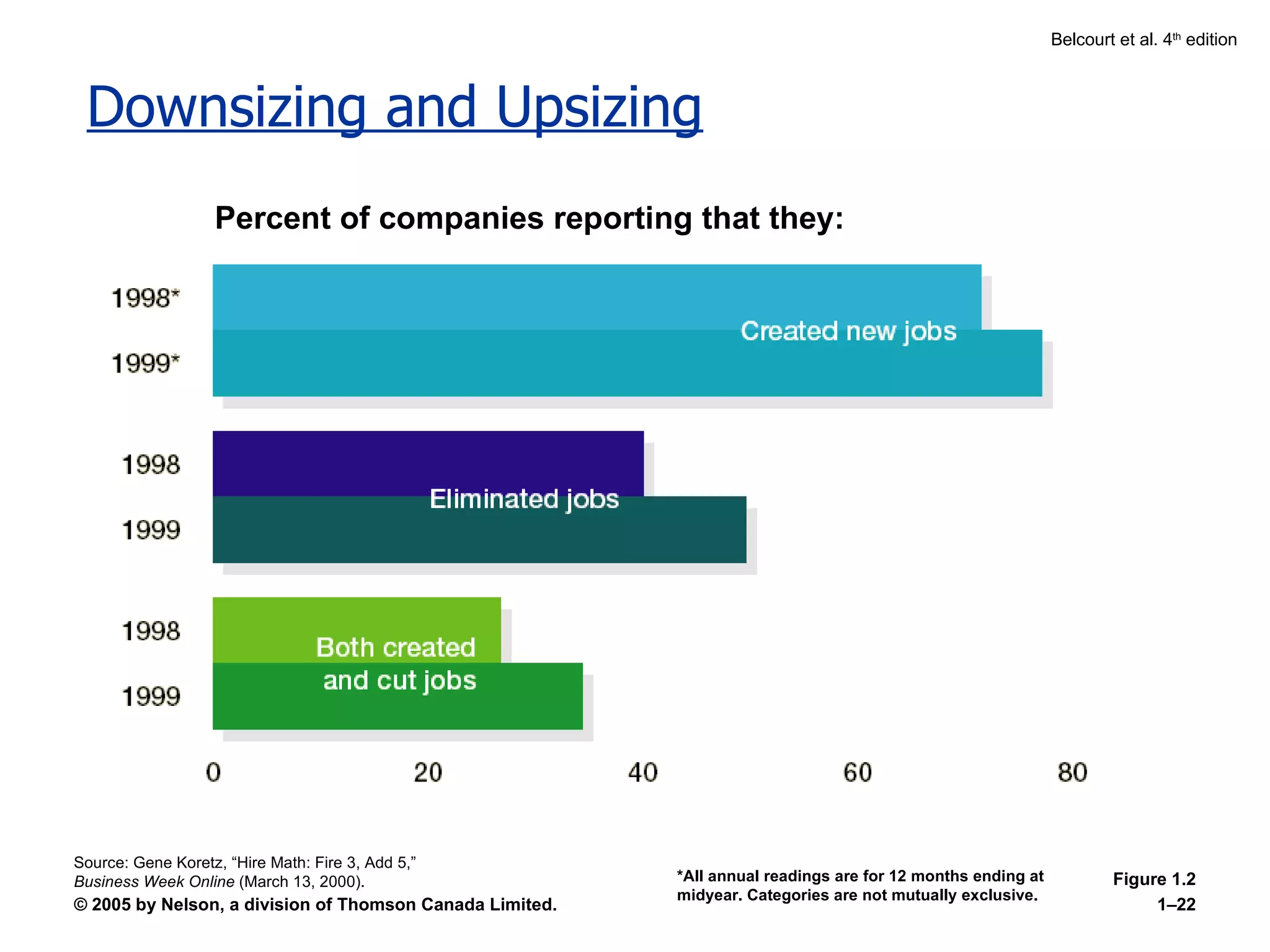
Downsizing and UpsizingPercent of companies reporting that they: *All annual readings are for 12 months ending at midyear. Categories are not mutually exclusive. Source: Gene Koretz, “Hire Math: Fire 3, Add 5,” Business Week Online (March 13, 2000). Figure 1. 2
23.
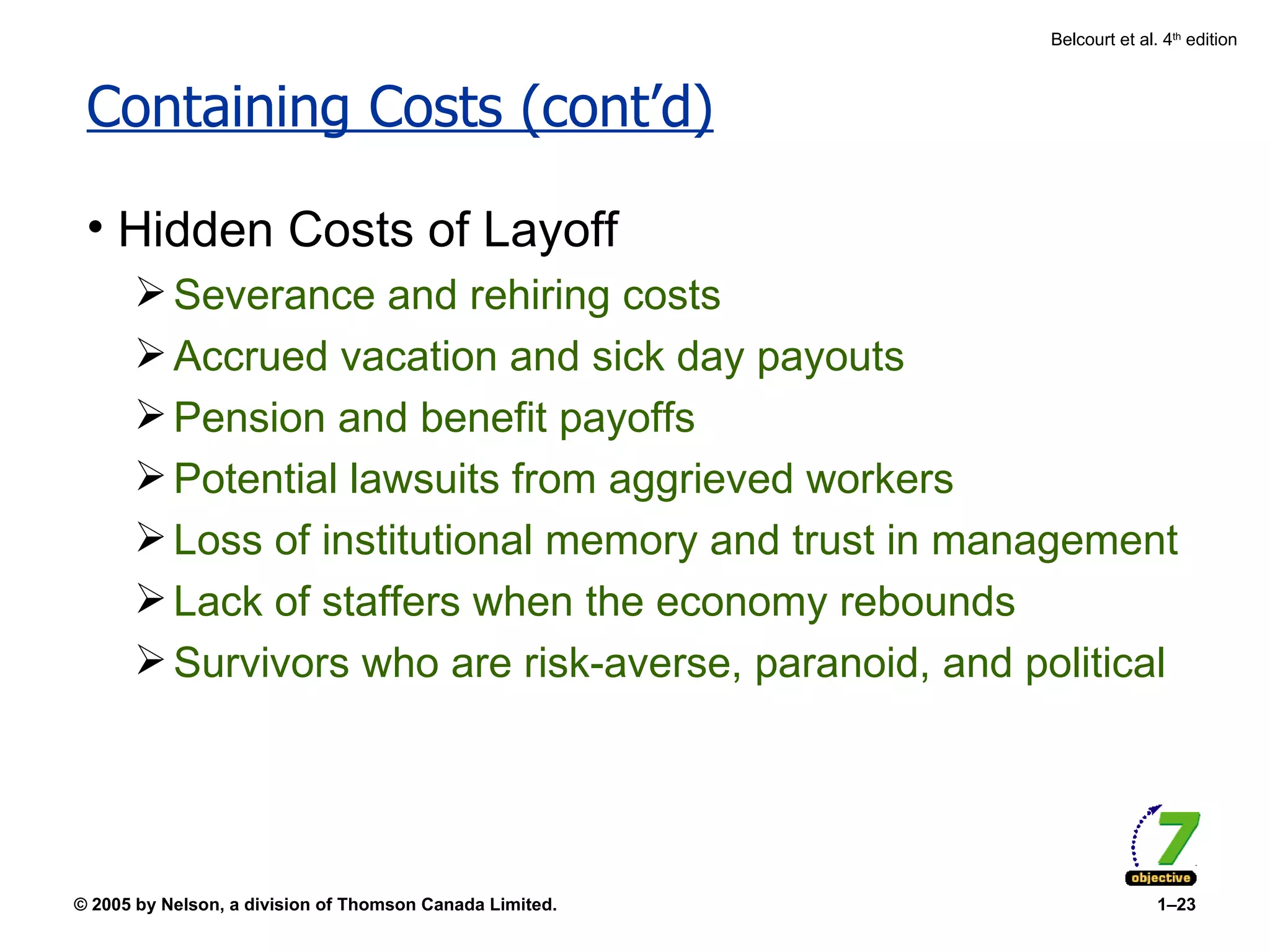
Containing Costs (cont’d)Hidden Costs of Layoff Severance and rehiring costs Accrued vacation and sick day payouts Pension and benefit payoffs Potential lawsuits from aggrieved workers Loss of institutional memory and trust in management Lack of staffers when the economy rebounds Survivors who are risk-averse, paranoid, and political
24.
Containing Costs (cont’d)Benefits of a No-Layoff Policy A fiercely loyal,more productive workforce Higher customer satisfaction Readiness to snap back with the economy A recruiting edge Workers who aren’t afraid to innovate, knowing their jobs are safe.
25.
Containing Costs OutsourcingContracting outside the organization to have work done that formerly was done by internal employees. Employee Leasing The process of dismissing employees who are then hired by a leasing company (which handles all HR-related activities) and contracting with that company to lease back the employees.
26.
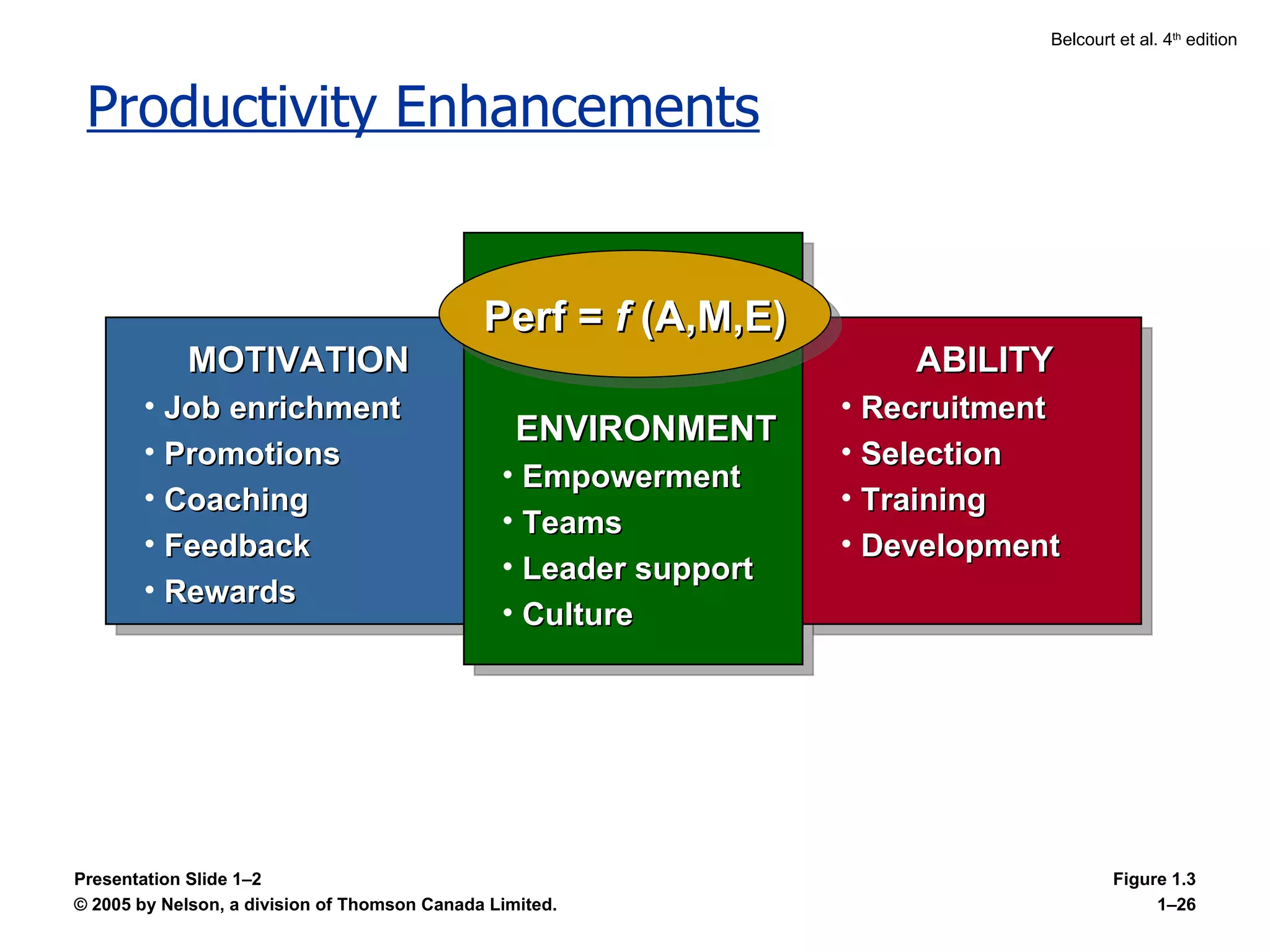
Productivity Enhancements Figure1.3 Presentation Slide 1 –2 MOTIVATION Job enrichment Promotions Coaching Feedback Rewards ENVIRONMENT Empowerment Teams Leader support Culture ABILITY Recruitment Selection Training Development Perf = f (A,M,E)
Top Issues forManagers in Balancing Work and Home Executive recruiters say 75 percent of senior management candidates and 88 percent of middle managers raised concerns about balancing work and home. Top issues: Source: Association of Executive Search Consultants (member survey). Used with permission of the Association of Executive Search Consultants, http://www.aesc.org. Figure 1.8
34.
Partnerships: Line Managersand Human Resources Managers Responsibilities of HR Advice and counsel Service Policy formulation and implementation Employee advocacy
35.
Strategic Human ResourcesManagement Strategy The formulation of an organization’s missions, goals, and objective as well as the action plans to execute the strategy. Corporate Strategy Business Strategy
36.
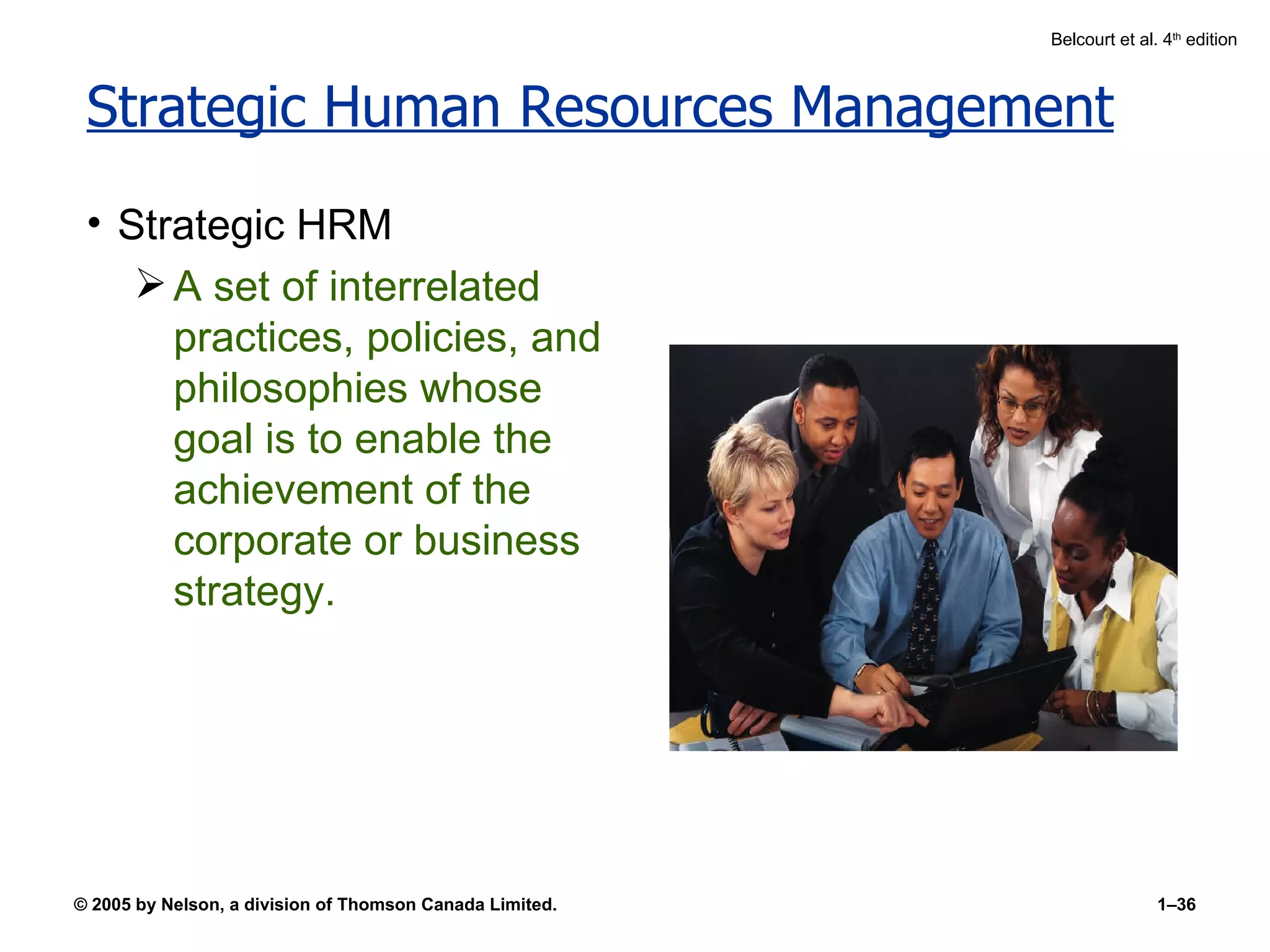
Strategic Human ResourcesManagement Strategic HRM A set of interrelated practices, policies, and philosophies whose goal is to enable the achievement of the corporate or business strategy.
37.
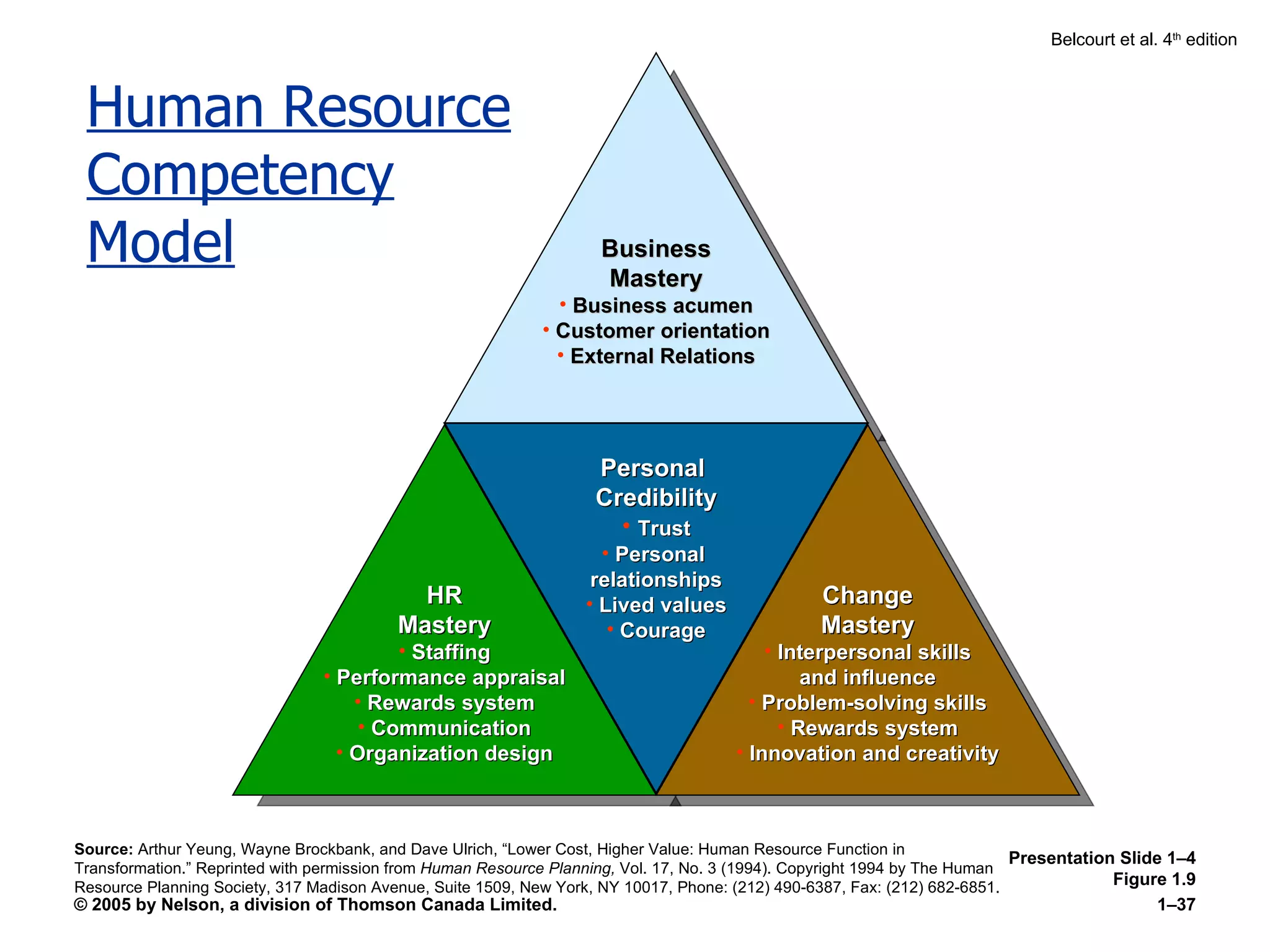
Human Resource CompetencyModel Source: Arthur Yeung, Wayne Brockbank, and Dave Ulrich, “Lower Cost, Higher Value: Human Resource Function in Transformation.” Reprinted with permission from Human Resource Planning, Vol. 17, No. 3 (1994). Copyright 1994 by The Human Resource Planning Society, 317 Madison Avenue, Suite 1509, New York, NY 10017, Phone: (212) 490-6387, Fax: (212) 682-6851. Figure 1.9 Presentation Slide 1 –4 Business Mastery Business acumen Customer orientation External Relations Personal Credibility Trust Personal relationships Lived values Courage HR Mastery Staffing Performance appraisal Rewards system Communication Organization design Change Mastery Interpersonal skills and influence Problem-solving skills Rewards system Innovation and creativity