Presentation Skills
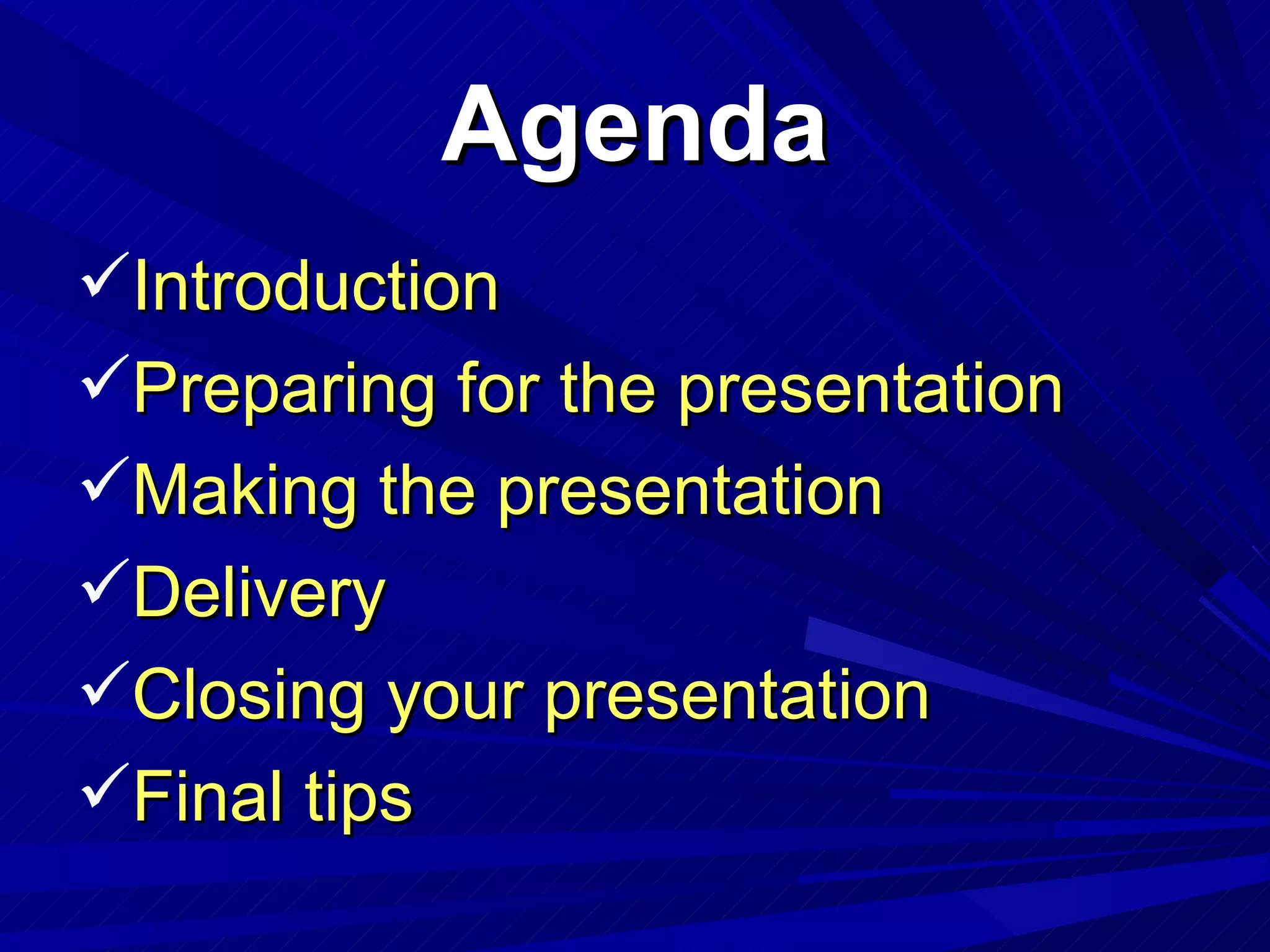
Agenda Introduction Preparing for the presentation Making the presentation Delivery Closing your presentation Final tips
Introduction What is the objective of this course?
Introduction What is a presentation?
Agenda Introduction Preparing for the presentation Making the presentation Delivery Closing your presentation Final tips
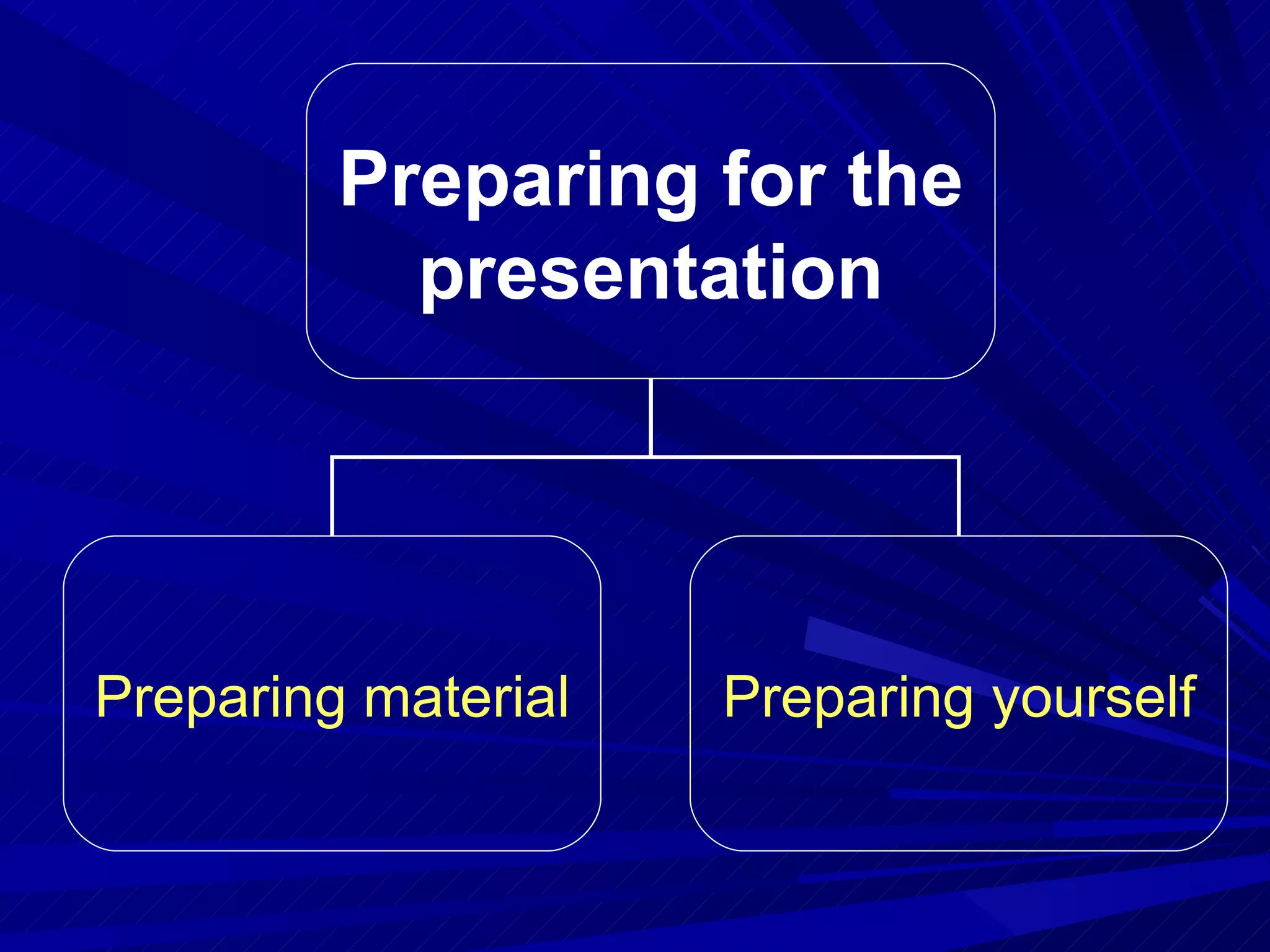
Preparing for the presentation Preparing material Preparing yourself
Preparing the material Define your objective
Preparing the material Define your objective Prepare the structure of the talk carefully and logically.
How to choose data? Include something just because it is interesting. Use stories and examples under the condition or relevancy. Quoting someone well known can give you credibility.
Preparing the material Define your objective Prepare the structure of the talk carefully and logically. Concentrate on the objective of the talk and the main points you want to make. HOW?
You have to ask yourself four questions ! What do I want to do? What do I want my audience to know? What do I want my audience to do? What do I want my audience to feel?
Preparing the material  Define your objective Prepare the structure of the talk carefully and logically. Concentrate on the objective of the talk and the main points you want to make. Write out your presentation in rough. (first draft).
Drafting (what’s a first draft) Give yourself 15 min to focus on your topic. List as many things as you can think of that you want to include in your presentation (brain storming). Start grouping the items in categories. Leave it for three days. Read it again and edit it if needed.
Preparing the material Define your objective. Prepare the structure of the talk carefully and logically. Concentrate on the objective of the talk and the main points you want to make. Write out your presentation in rough. (first draft). Rehearse to your self and in front of some colleagues. (Why?)
Preparing your self Know your audience. (Size, Knowledge, Interests, Relationships, environment) Rehearse several times. “ Only the prepared presenter deserves to be confident” Dale Carnegie Dress in clothes that make you feel good, free, and comfortable.
Preparing your self Make no negative confessions. “ I’m so nervous” Take several breathes to relax your body to get rid of your  FEAR . FEAR FEAR FEAR FEAR FEAR FEAR
FEAR The Great Truth Everyone suffers from nervousness
A Survey in the UK FEAR
Sources of FEAR Looking foolish All the eyes on you You are the center of attention Making mistake Your first moments Negative past experience And the list is endless…
Methods to combat fear Think positively Behave naturally  Visualize success Rehearsal: be on top of your material Practice, practice, practice,… for your life
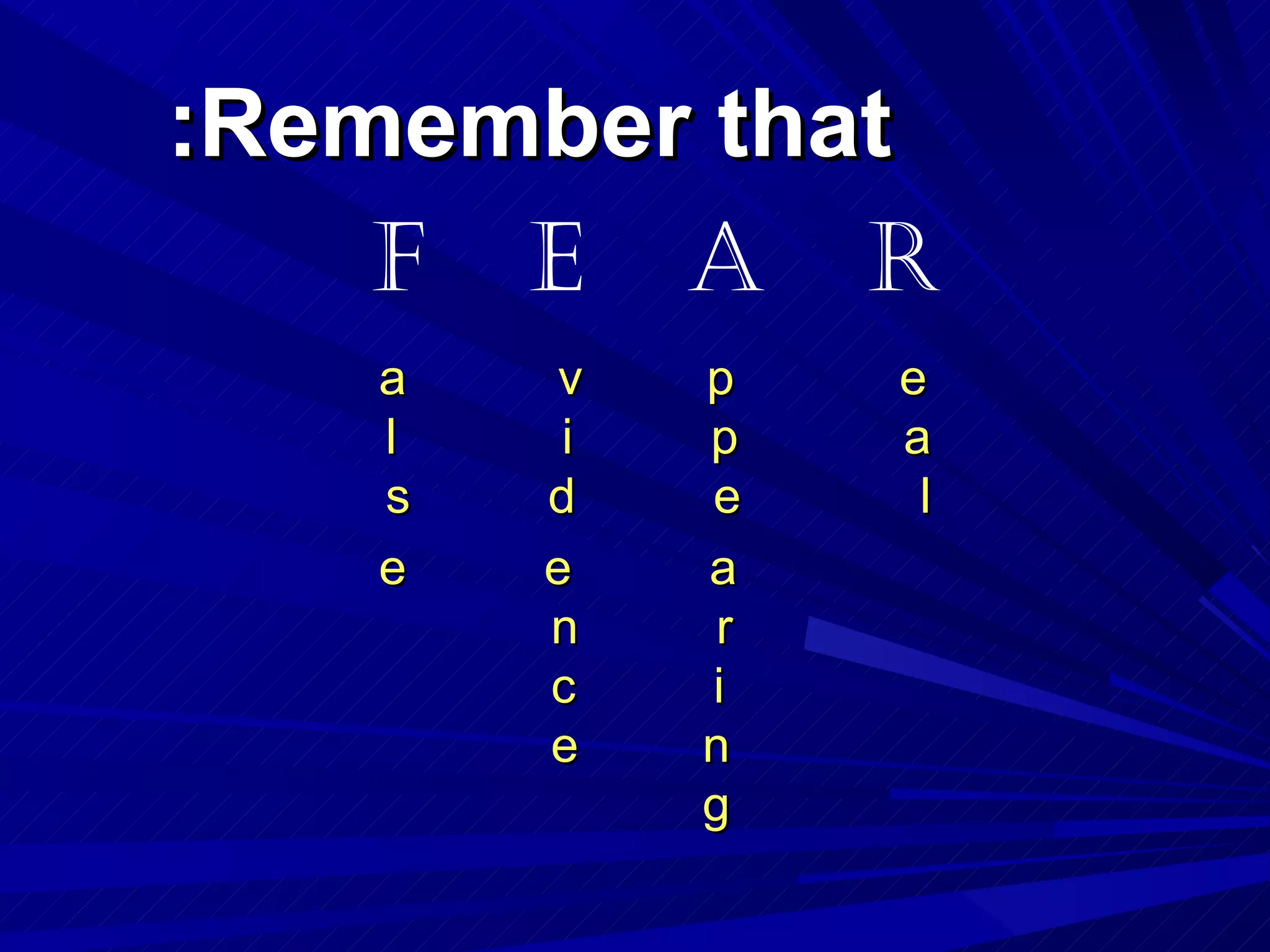
Remember that: a  v  p  e   l  i  p  a   s  d  e  l e  e  a   n  r   c  i   e  n   g F  E  A  R
Word of wisdom “ All the great speakers were bad speakers at first” Ralph Waldo Emerson
Agenda Introduction Preparing for the presentation Making the presentation Delivery Closing your presentation Final tips
Making the presentation Greet the audience. Introduce yourself. Tell them what you are going to tell them ,  tell them , then tell them what you told them. Leave time for discussion. At the end ask if there are any questions.
Agenda Introduction Preparing for the presentation Making the presentation Delivery Closing your presentation Final tips
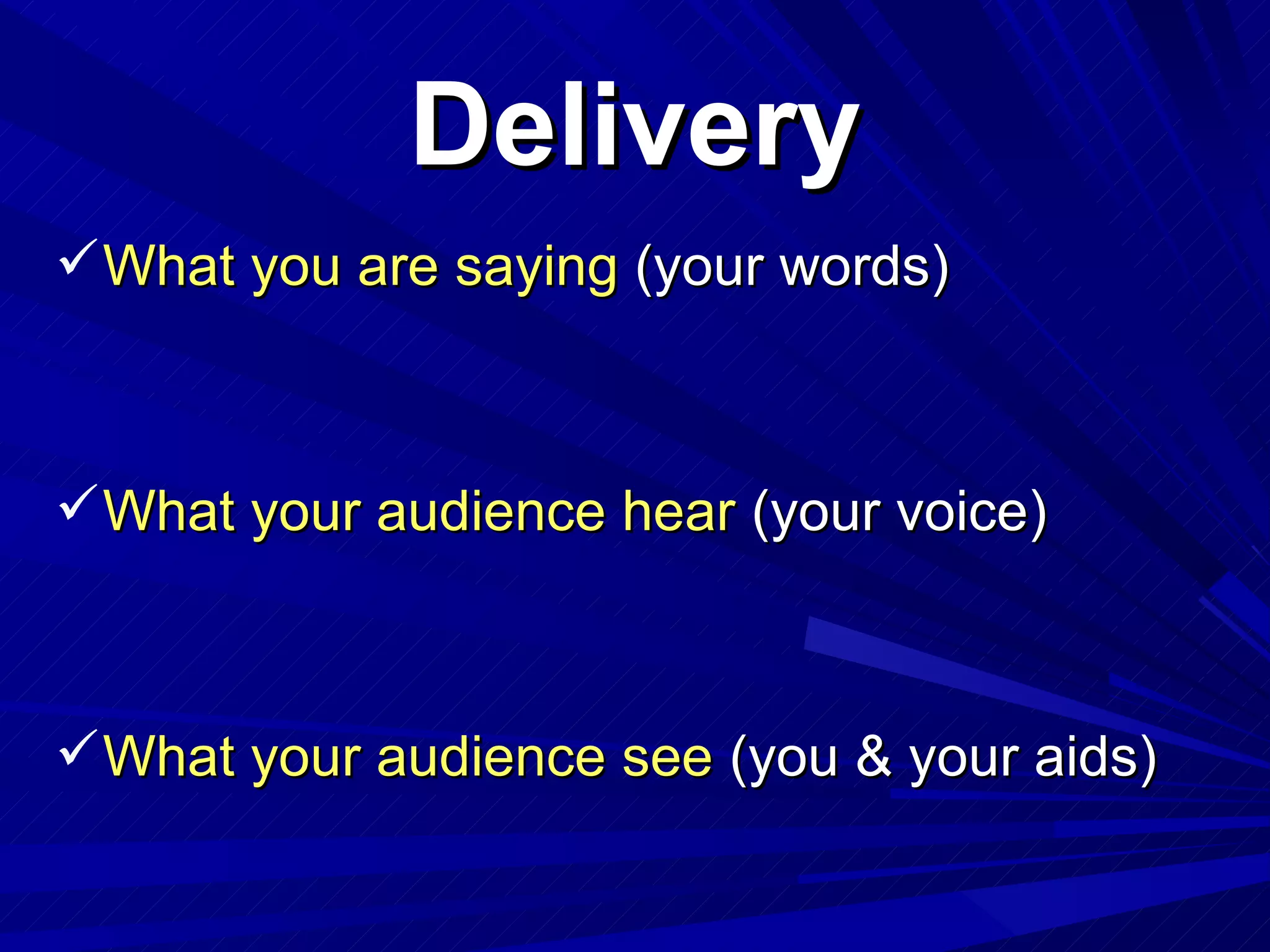
Delivery What you are saying  (your words) What your audience hear  (your voice) What your audience see  (you & your aids)
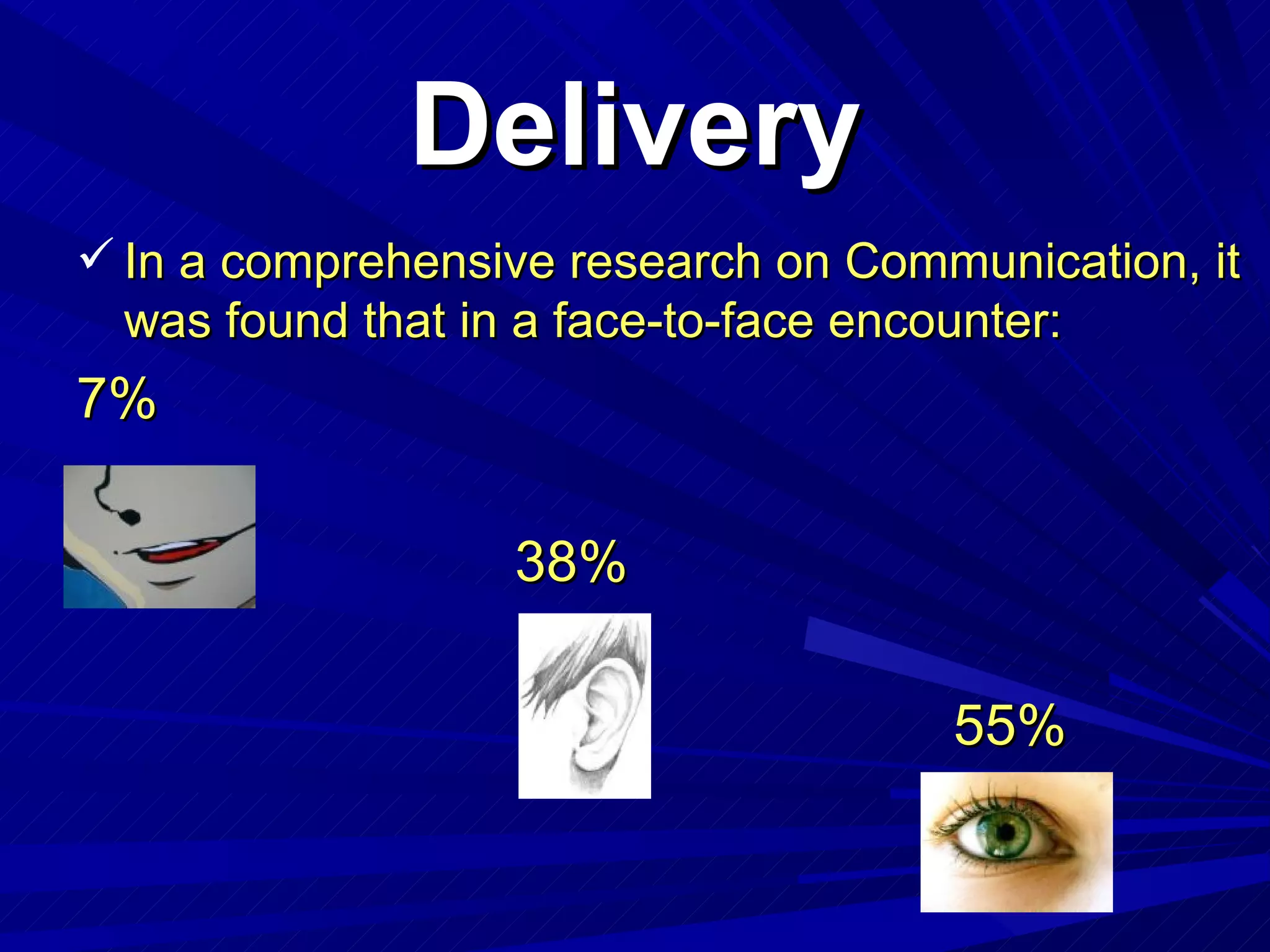
Delivery In a comprehensive research on Communication, it was found that in a face-to-face encounter: 7% 38% 55%
Delivery What you are saying  (your words) What your audience hear  (your voice) What your audience see  (you & your aids)
Your words The  more important than WHAT you are going to say is HOW you are going to say it! Avoid jokes unless you are natural expert.
Delivery What you are saying  (your words) What your audience hear  (your voice) What your audience see  (you & your aids)
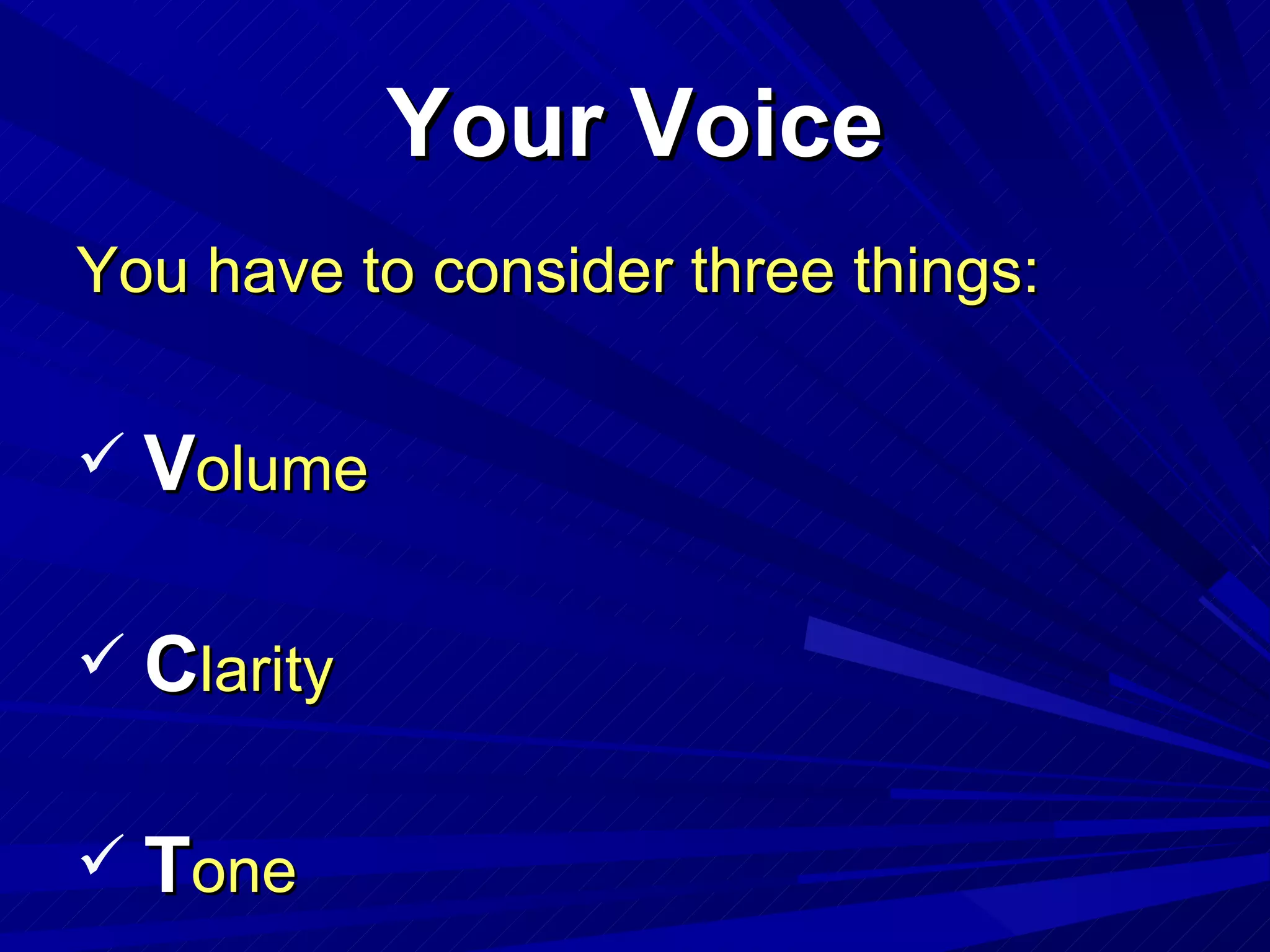
Your Voice You have to consider three things: V olume C larity T one
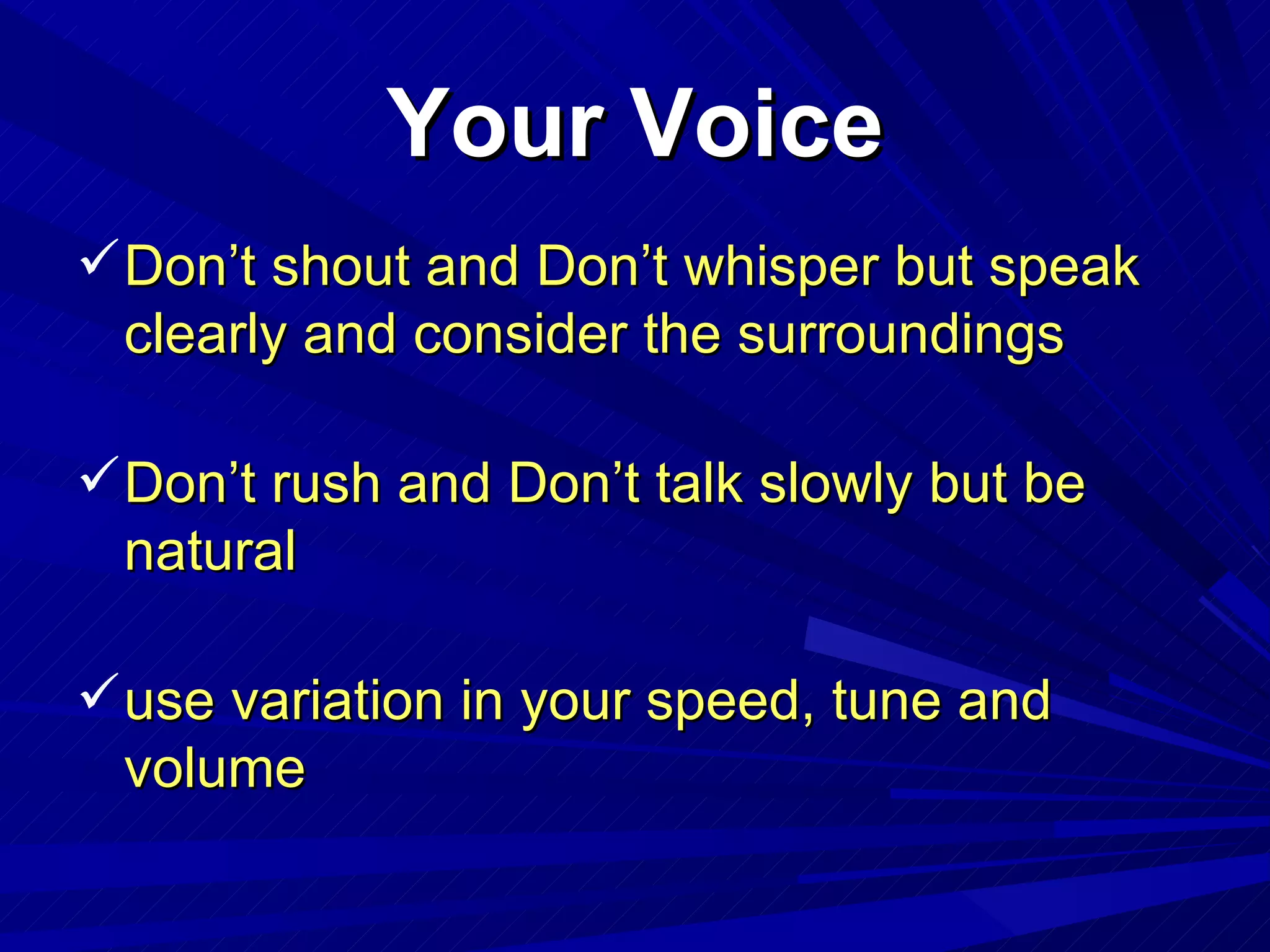
Your Voice Don’t shout and Don’t whisper but speak clearly and consider the surroundings Don’t rush and Don’t talk slowly but be natural use variation in your speed, tune and volume
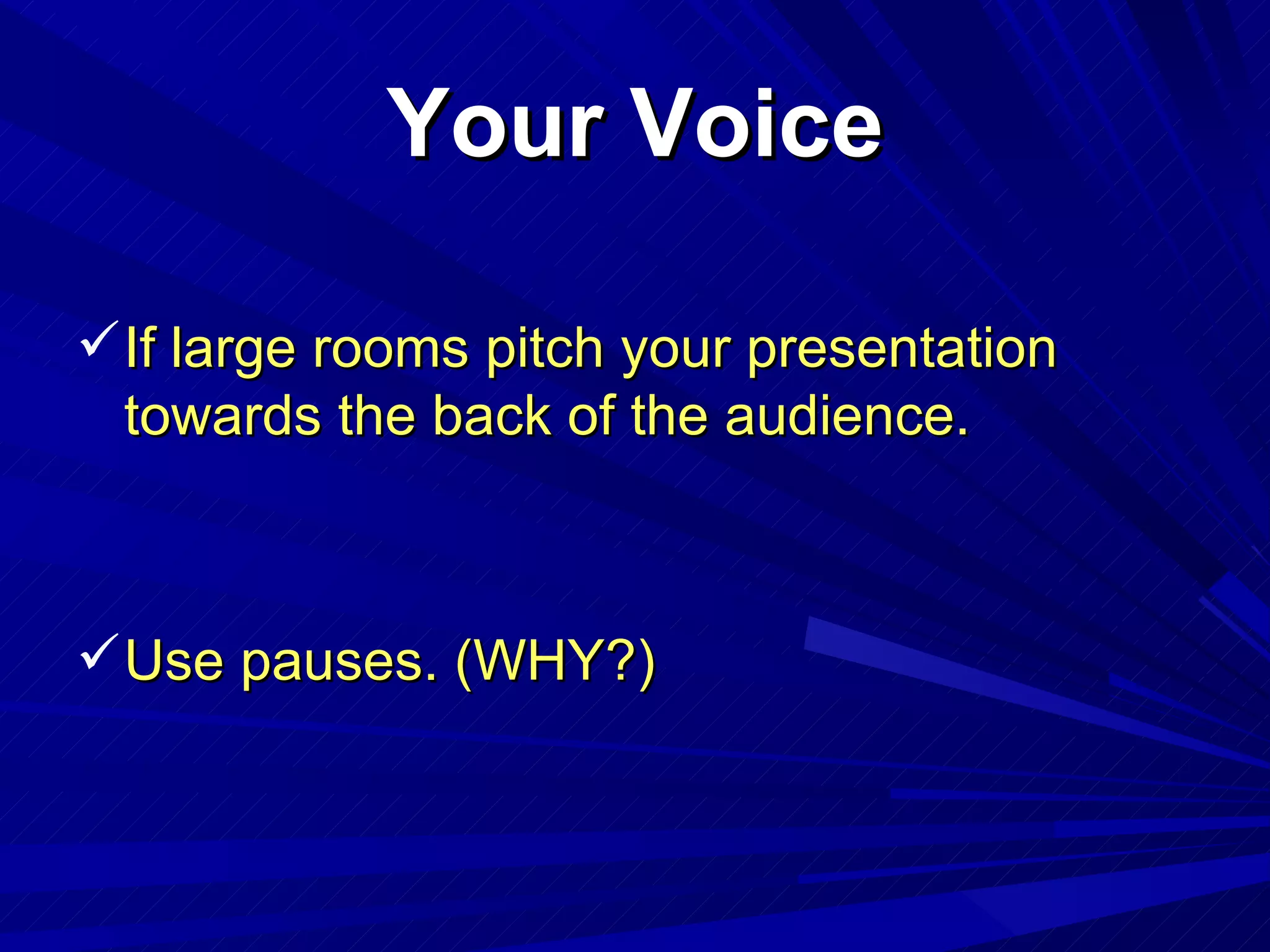
Your Voice If large rooms pitch your presentation towards the back of the audience. Use pauses. (WHY?)
Delivery What you are saying  (your words) What your audience hear  (your voice) What your audience see  (you & your aids)
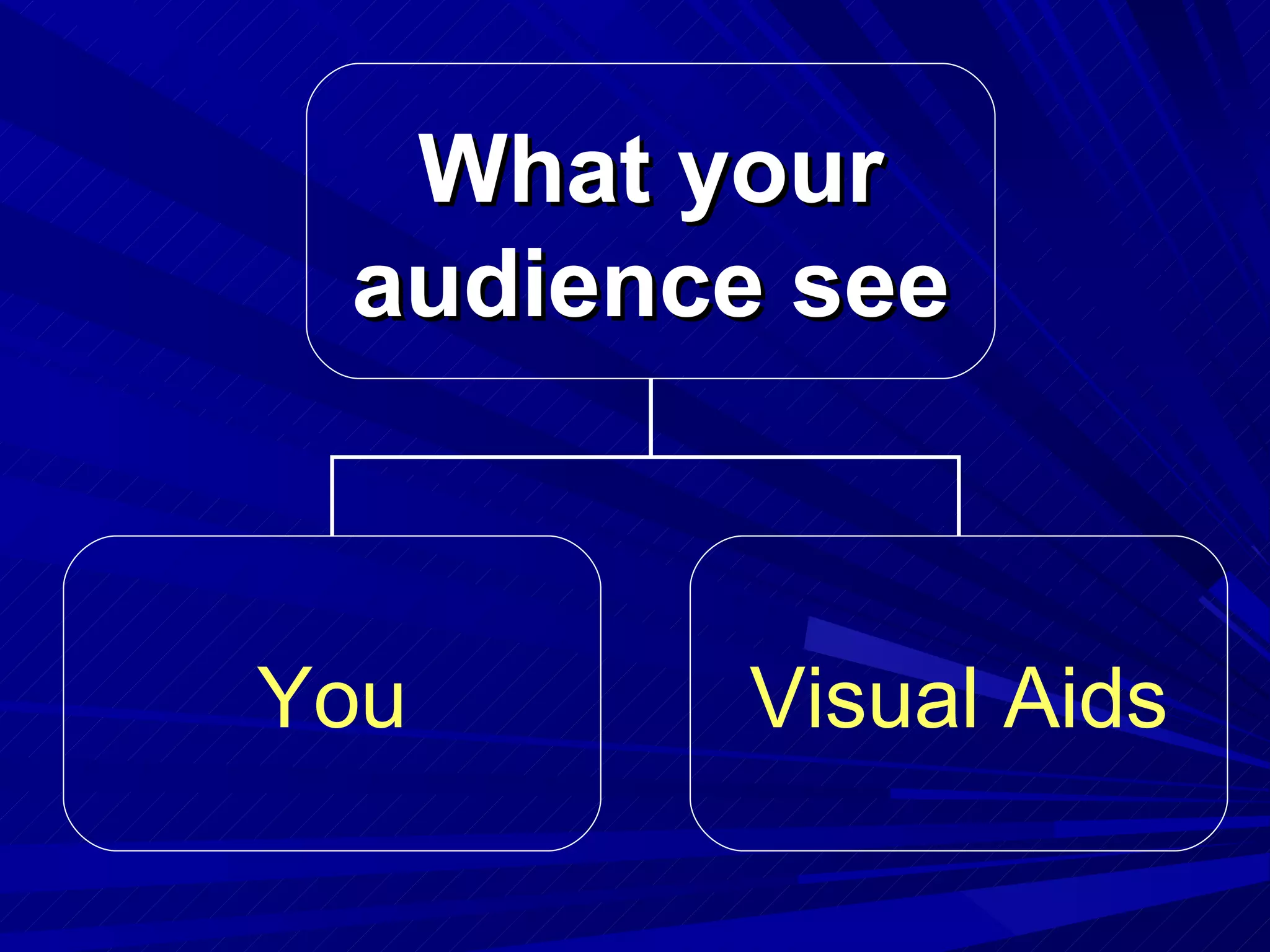
What your audience see You Visual Aids
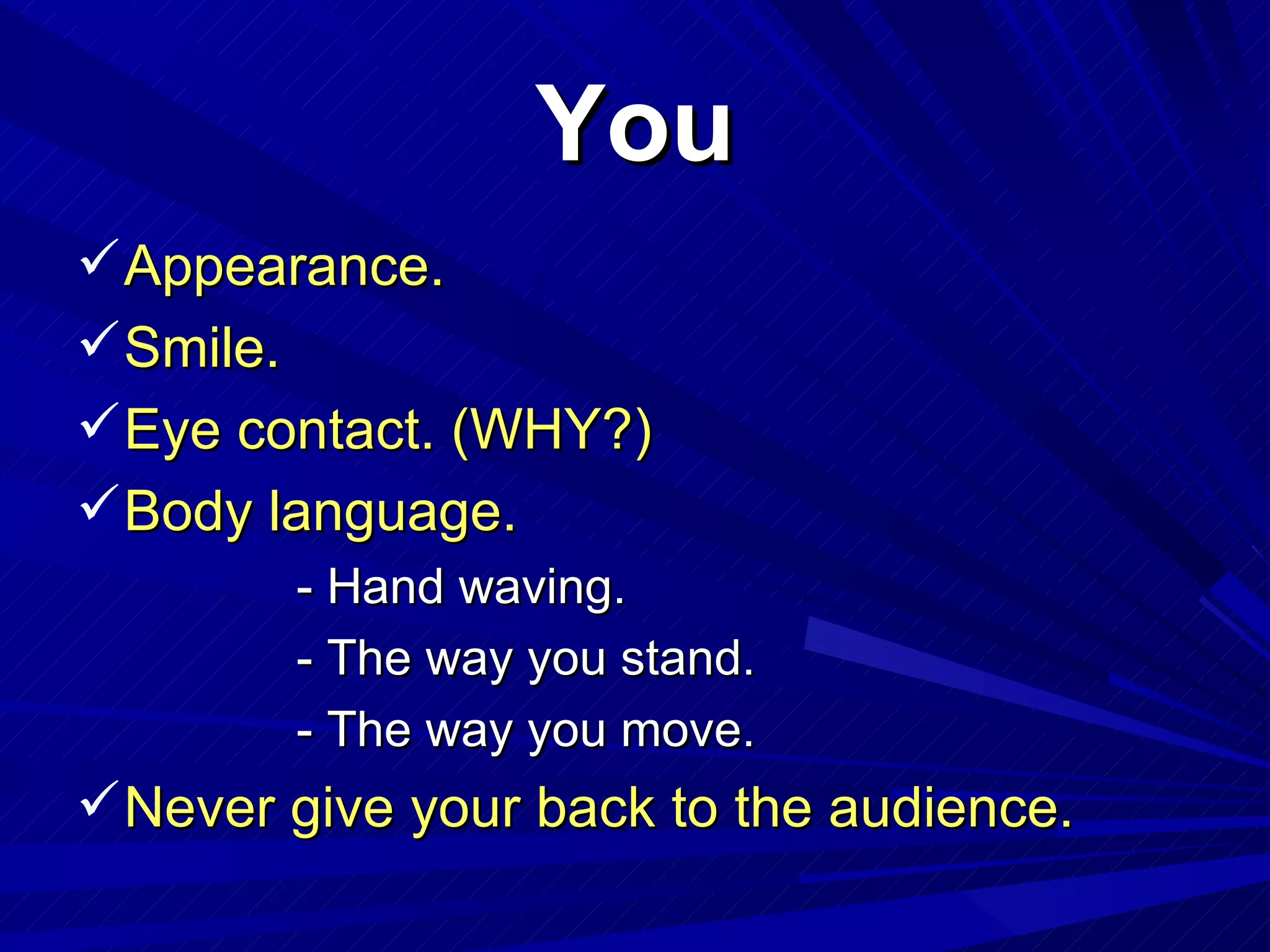
You Appearance. Smile. Eye contact. (WHY?) Body language. - Hand waving. - The way you stand. - The way you move. Never give your back to the audience.
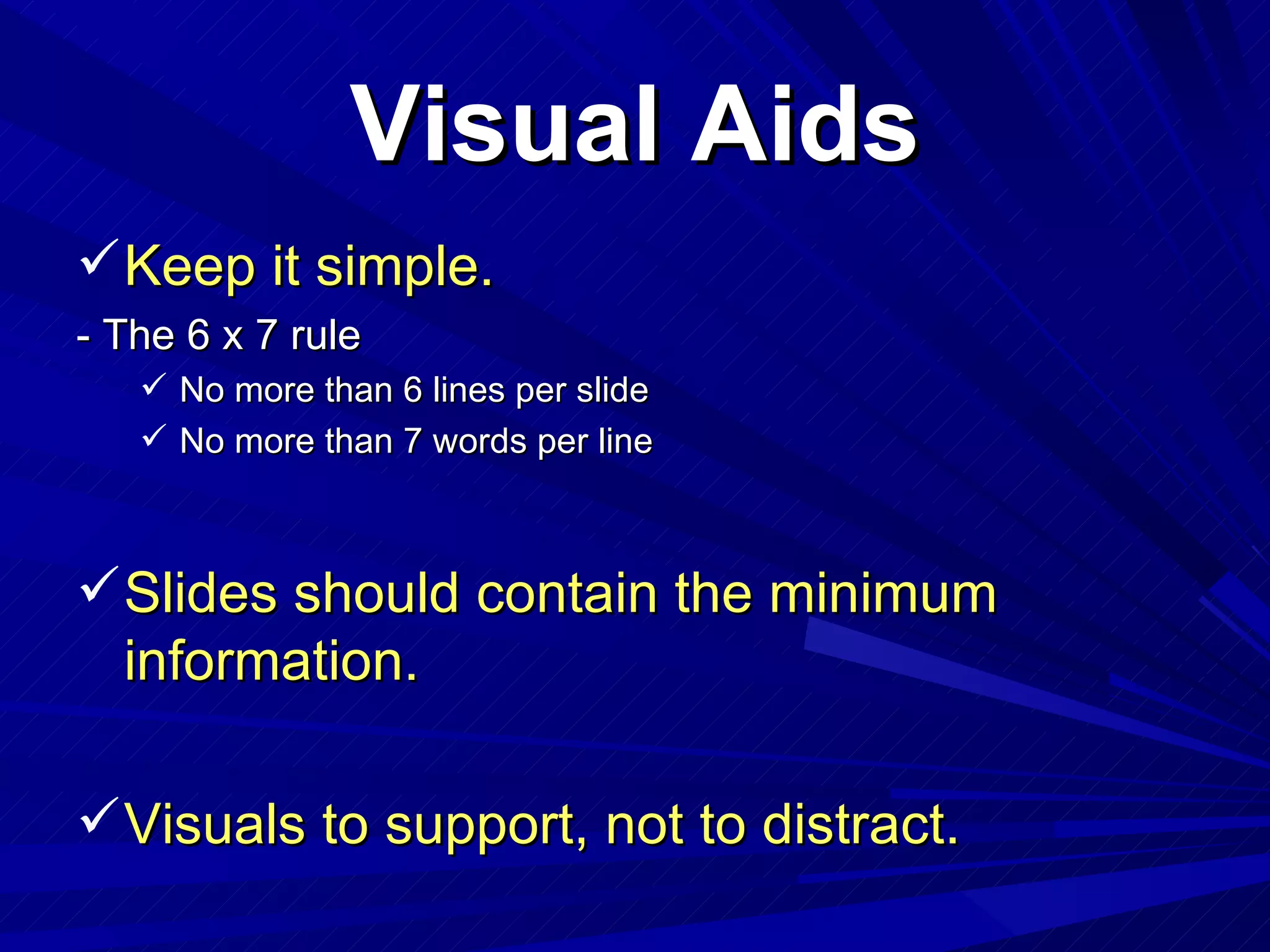
Visual Aids Keep it simple. - The 6 x 7 rule No more than 6 lines per slide No more than 7 words per line Slides should contain the minimum information. Visuals to support, not to distract.
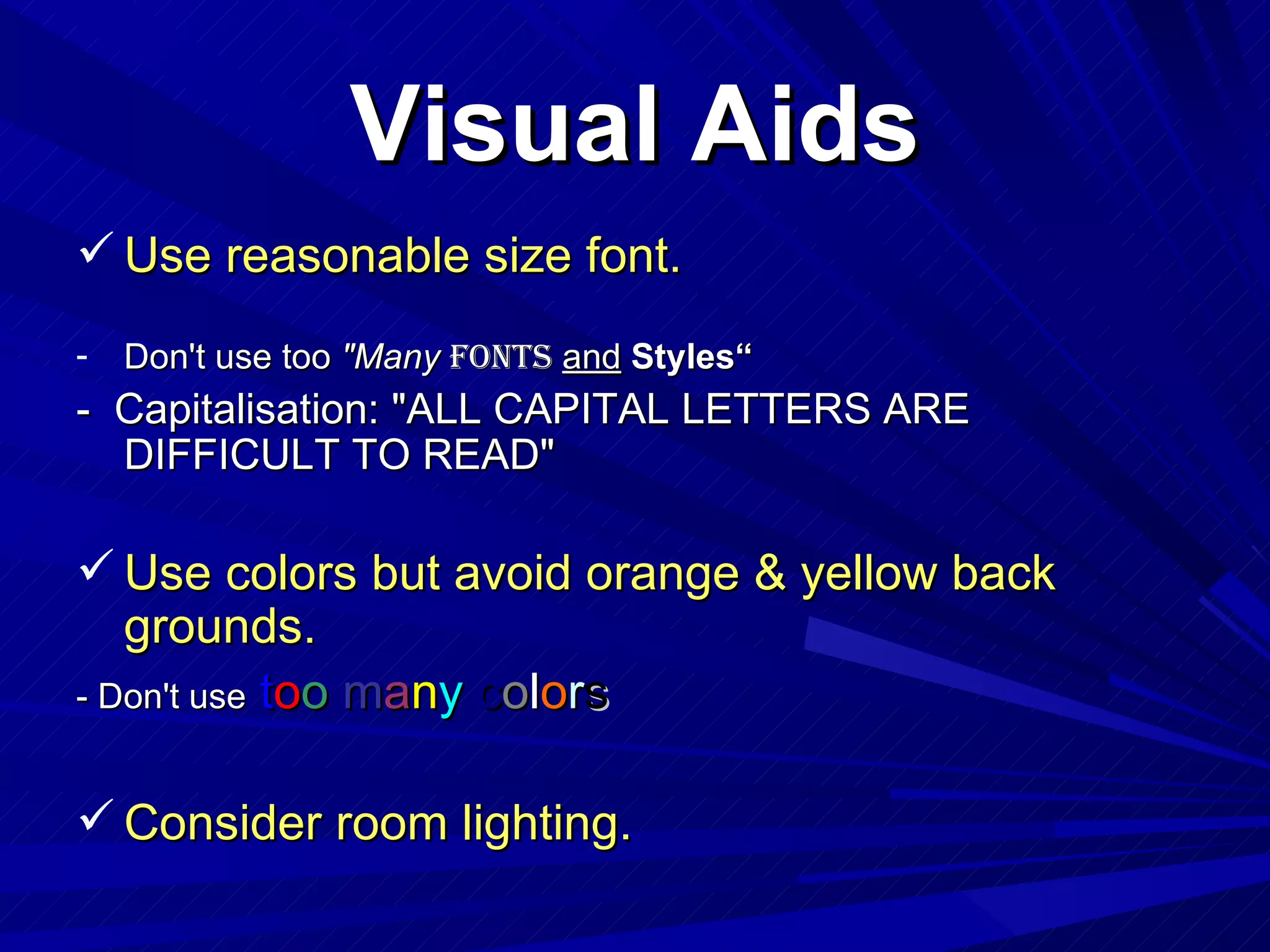
Visual Aids Use reasonable size font. Don't use too  "Many   Fonts   and   Styles“ -  Capitalisation:  "ALL CAPITAL LETTERS ARE DIFFICULT TO READ" Use colors but avoid orange & yellow back grounds. - Don't use   t o o   m a n y   c o l o r s Consider room lighting.
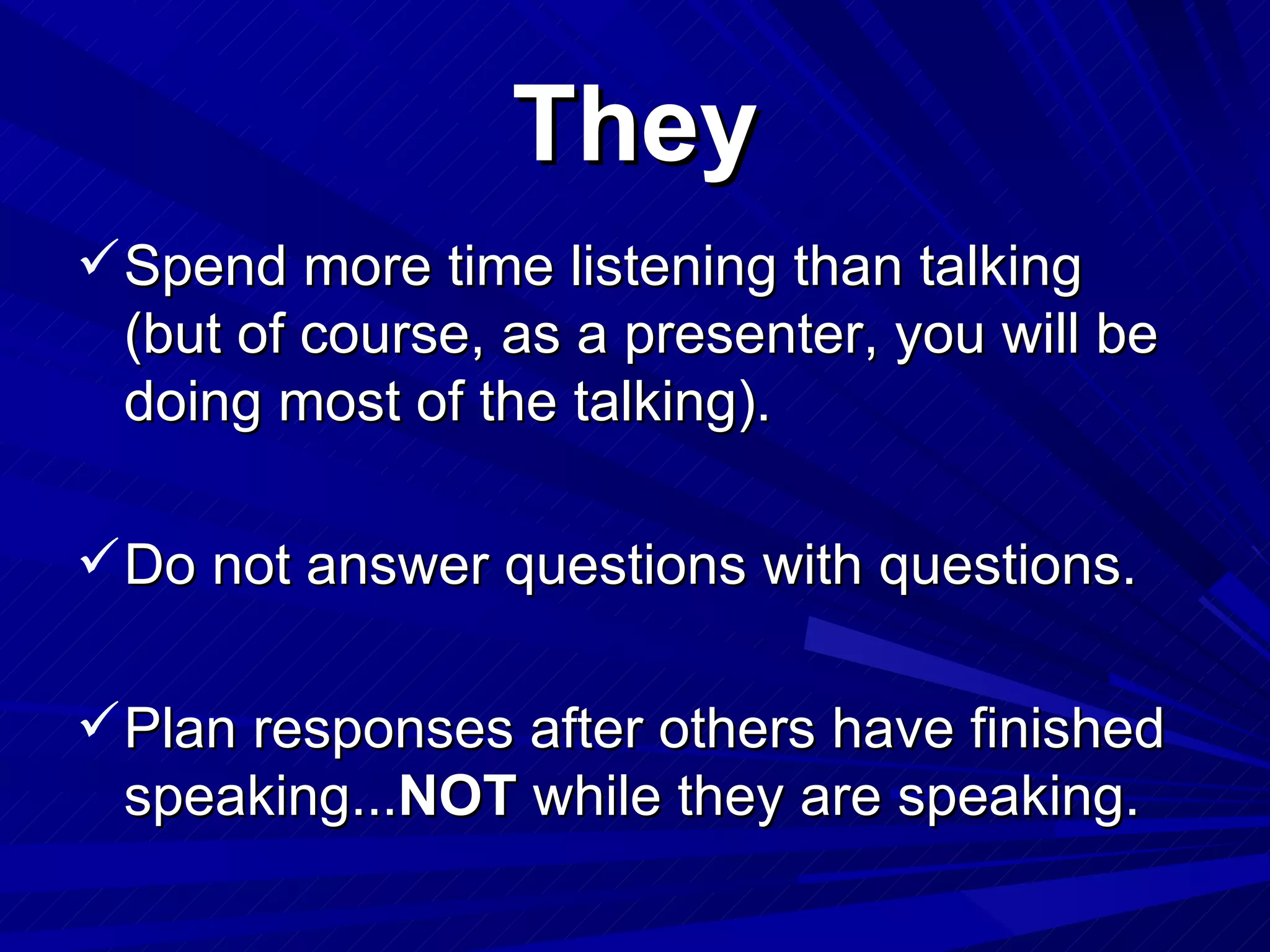
They Spend more time listening than talking (but of course, as a presenter, you will be doing most of the talking).  Do not answer questions with questions. Plan responses after others have finished speaking... NOT  while they are speaking.
They Keep   cool  if a questioner disagrees with you. You are a professional! No matter how hard you try, not everyone in the world will agree with you! When a question is asked, repeat the question to ensure that everyone heard it (and that you heard it correctly).
Agenda Introduction Preparing for the presentation Making the presentation Delivery Closing your presentation Final tips
Closing your presentation Leave a memorable close. Be precise, brief and to the point.
Agenda Introduction Preparing for the presentation Making the presentation Delivery Closing your presentation Final tips
Final Tip If there are things you can’t easily express, possibly because of understanding problem, it is better to leave it unsaid.
Summary
Finally Enjoy yourself, the audience will be on your side and want to hear what you are going to say.
THANK YOU!
Questions?

Presentation skills final

  • 1.
  • 2.
    Agenda Introduction Preparingfor the presentation Making the presentation Delivery Closing your presentation Final tips
  • 3.
    Introduction What isthe objective of this course?
  • 4.
    Introduction What isa presentation?
  • 5.
    Agenda Introduction Preparingfor the presentation Making the presentation Delivery Closing your presentation Final tips
  • 6.
    Preparing for thepresentation Preparing material Preparing yourself
  • 7.
    Preparing the materialDefine your objective
  • 8.
    Preparing the materialDefine your objective Prepare the structure of the talk carefully and logically.
  • 9.
    How to choosedata? Include something just because it is interesting. Use stories and examples under the condition or relevancy. Quoting someone well known can give you credibility.
  • 10.
    Preparing the materialDefine your objective Prepare the structure of the talk carefully and logically. Concentrate on the objective of the talk and the main points you want to make. HOW?
  • 11.
    You have toask yourself four questions ! What do I want to do? What do I want my audience to know? What do I want my audience to do? What do I want my audience to feel?
  • 12.
    Preparing the material Define your objective Prepare the structure of the talk carefully and logically. Concentrate on the objective of the talk and the main points you want to make. Write out your presentation in rough. (first draft).
  • 13.
    Drafting (what’s afirst draft) Give yourself 15 min to focus on your topic. List as many things as you can think of that you want to include in your presentation (brain storming). Start grouping the items in categories. Leave it for three days. Read it again and edit it if needed.
  • 14.
    Preparing the materialDefine your objective. Prepare the structure of the talk carefully and logically. Concentrate on the objective of the talk and the main points you want to make. Write out your presentation in rough. (first draft). Rehearse to your self and in front of some colleagues. (Why?)
  • 15.
    Preparing your selfKnow your audience. (Size, Knowledge, Interests, Relationships, environment) Rehearse several times. “ Only the prepared presenter deserves to be confident” Dale Carnegie Dress in clothes that make you feel good, free, and comfortable.
  • 16.
    Preparing your selfMake no negative confessions. “ I’m so nervous” Take several breathes to relax your body to get rid of your FEAR . FEAR FEAR FEAR FEAR FEAR FEAR
  • 17.
    FEAR The GreatTruth Everyone suffers from nervousness
  • 18.
    A Survey inthe UK FEAR
  • 19.
    Sources of FEARLooking foolish All the eyes on you You are the center of attention Making mistake Your first moments Negative past experience And the list is endless…
  • 20.
    Methods to combatfear Think positively Behave naturally Visualize success Rehearsal: be on top of your material Practice, practice, practice,… for your life
  • 21.
    Remember that: a v p e l i p a s d e l e e a n r c i e n g F E A R
  • 22.
    Word of wisdom“ All the great speakers were bad speakers at first” Ralph Waldo Emerson
  • 23.
    Agenda Introduction Preparingfor the presentation Making the presentation Delivery Closing your presentation Final tips
  • 24.
    Making the presentationGreet the audience. Introduce yourself. Tell them what you are going to tell them , tell them , then tell them what you told them. Leave time for discussion. At the end ask if there are any questions.
  • 25.
    Agenda Introduction Preparingfor the presentation Making the presentation Delivery Closing your presentation Final tips
  • 26.
    Delivery What youare saying (your words) What your audience hear (your voice) What your audience see (you & your aids)
  • 27.
    Delivery In acomprehensive research on Communication, it was found that in a face-to-face encounter: 7% 38% 55%
  • 28.
    Delivery What youare saying (your words) What your audience hear (your voice) What your audience see (you & your aids)
  • 29.
    Your words The more important than WHAT you are going to say is HOW you are going to say it! Avoid jokes unless you are natural expert.
  • 30.
    Delivery What youare saying (your words) What your audience hear (your voice) What your audience see (you & your aids)
  • 31.
    Your Voice Youhave to consider three things: V olume C larity T one
  • 32.
    Your Voice Don’tshout and Don’t whisper but speak clearly and consider the surroundings Don’t rush and Don’t talk slowly but be natural use variation in your speed, tune and volume
  • 33.
    Your Voice Iflarge rooms pitch your presentation towards the back of the audience. Use pauses. (WHY?)
  • 34.
    Delivery What youare saying (your words) What your audience hear (your voice) What your audience see (you & your aids)
  • 35.
    What your audiencesee You Visual Aids
  • 36.
    You Appearance. Smile.Eye contact. (WHY?) Body language. - Hand waving. - The way you stand. - The way you move. Never give your back to the audience.
  • 37.
    Visual Aids Keepit simple. - The 6 x 7 rule No more than 6 lines per slide No more than 7 words per line Slides should contain the minimum information. Visuals to support, not to distract.
  • 38.
    Visual Aids Usereasonable size font. Don't use too "Many Fonts and Styles“ - Capitalisation: "ALL CAPITAL LETTERS ARE DIFFICULT TO READ" Use colors but avoid orange & yellow back grounds. - Don't use t o o m a n y c o l o r s Consider room lighting.
  • 39.
    They Spend moretime listening than talking (but of course, as a presenter, you will be doing most of the talking). Do not answer questions with questions. Plan responses after others have finished speaking... NOT while they are speaking.
  • 40.
    They Keep cool if a questioner disagrees with you. You are a professional! No matter how hard you try, not everyone in the world will agree with you! When a question is asked, repeat the question to ensure that everyone heard it (and that you heard it correctly).
  • 41.
    Agenda Introduction Preparingfor the presentation Making the presentation Delivery Closing your presentation Final tips
  • 42.
    Closing your presentationLeave a memorable close. Be precise, brief and to the point.
  • 43.
    Agenda Introduction Preparingfor the presentation Making the presentation Delivery Closing your presentation Final tips
  • 44.
    Final Tip Ifthere are things you can’t easily express, possibly because of understanding problem, it is better to leave it unsaid.
  • 45.
  • 46.
    Finally Enjoy yourself,the audience will be on your side and want to hear what you are going to say.
  • 47.
  • 48.